Standards in Thailand
Vilaivan Chiratpigalpong
B.A. (Chulalongkorn University)
M.B.A. (National Institute of Development and Administration)
A dissertation submitted in partial fulfilment of the requirements for
the Degree of Doctor of Education, School of Education,
Faculty of Arts, Education and Human Development,
Victoria University, Melbourne, Australia
Declaration
I, Vilaivan Chiratpigalpong, declare that this Doctor of Education dissertation entitled Staff Training Programs to Meet ISO Food Factory
Standards in Thailandis not more than 60 000 words in length, exclusive of
tables, figures, appendices, references and footnotes. This dissertation contains no material that has been submitted previously, in whole or in part, for the award of any other academic degree or diploma. Except where otherwise indicated, this dissertation is my own work.
Sunday, 19 October 2008
Declaration ... i
List of Contents ... ii
List of Tables ... vi
List of Figures ... ix
Acknowledgements... x
Abstract ... xii
List of Abbreviations... xiv
Chapter 1 Introduction to the Study... 1
Introduction ... 1
Purpose of the Study ... 1
Background of the Study... 2
Objectives ... 3
Research Questions ... 4
Contribution to Knowledge... 5
Research Significance ... 5
Methodology ... 6
Limitations ... 7
Summary of the Chapters... 7
Chapter 2 Literature Review ...10
Introduction ... 10
Proactive Evaluation ... 11
Approaches to Proactive Evaluation... 14
Policymaking ... 15
Learning Organisations ... 17
Systems Thinking: the cornerstone of the learning organisation ... 19
Personal Mastery... 19
Mental Models ... 20
Building Shared Vision ... 20
Team Learning ... 20
Organisational Learning... 21
Management and Staff Training Programs... 22
Industrial Training... 24
Types of training ... 24
Knowledge of Related Fields ... 30
Marketing ... 31
Finance... 33
Summary ... 34
Chapter 3 Methodology...35
Introduction ... 35
General Overview ... 35
Methodology ... 36
Phase 1: Needs Assessment... 37
Phase 2: Expert Review... 44
Phase 3: Second Focus Group interview and Draft Policy Development... 46
Phase 4: Brainstorming and Semi-structured Interviews... 47
Chapter 4 Phase 1: Needs Assessment ...50
Introduction ... 50
Focus Group Questions ... 51
Application for ISO Accreditation Registration: Question 1... 52
Planning ... 53
Organising concept... 54
Level of Preparation to Meet ISO Standard Regulations: Question 2 ... 54
Early Preparation... 55
Organising concept... 55
Problems during the period of adjustment to meet ISO Standard: Question 3 ... 56
Leading... 56
Managing ... 57
Organising concept... 58
Preparation for the new standards: Question 4 ... 58
Leading... 59
Managing ... 59
Planning ... 59
Organising concept... 60
Discrepancies between the desired ISO standards and current Top Management standards: Question 5 ... ... 60
Leading... 60
Planning ... 62
Organising concept... 62
The reasons for these discrepancies: Question 6 ... 62
Leading... 63
Planning ... 64
Organising concept... 64
Additional staff training needed in order for Top Management to reach ISO standards requirements: Question 7... ... 64
Leading... 65
Recording ... 66
Organising concepts ... 66
Kinds of support that were required from management at that time: Question 8 ... 66
Leading... 67
Planning ... 67
Organising concept... 68
Summary ... 68
Chapter 5 Phase 2: Expert Review...70
Introduction ... 70
Step 1: Semi-structured Interviews ... 71
Background to the interviews... 72
Findings from the Interviews ... 72
Developing staff training programs prior to ISO registration... 73
The key steps in the developing staff training programs ... 76
Leading... 76
Changes made in staff training programs due to ISO registration ... 80
Problems currently encountered in staff training programs... 83
Overcoming the problems ... 86
Staff training programs following initial ISO certification... 88
Step 2: SWOT analysis ... 89
Summary ... 96
Chapter 6 Phase 3: Best Practice (Benchmarking)...97
Introduction ... 97
Step 1: General Issues related to Best Practice Benchmarking ... 98
Efficiency ... 98
Think global, act local... 99
Opinions on Best Practice Benchmarking ... 100
Benchmarking for Consultants and Auditors ... 104
Achieving local needs ... 104
Confidence ... 105
Efficiency ... 105
Benchmarking for Groups – the QMR and the Quality Working Group... 106
Leadership... 107
HRD manager... 108
Production manager... 108
Maintenance manager... 112
Purchasing manager ... 114
Quality Control manager ... 117
Marketing manager ... 119
Logistics manager ... 122
ISO Standards Training Programs... 125
Continuous on-site learning... 125
Constant revision and up-dating of training programs ... 125
Improvement, using the experience of others... 126
Think global, act local... 127
Benchmarking and ISO Training Programs ... 127
Expert practice of leaders in the industry ... 127
Constant revision and updating of quality manuals... 128
Industry supports expert practice guidelines ... 129
Quality control ... 129
Teamwork ... 130
Benchmarking and Applications in Staff Training Programs... 130
Expert practice guidelines ... 130
Brainstorming as a problem-solving process... 132
Changing behaviour ... 132
Continuous on-site learning... 133
Diffusion of the innovation ... 133
Improving quality standards ... 133
ISO training benefits ... 134
Organisation requirements ... 134
Product knowledge and improvement ... 135
Additional Program Support ... 135
Continuous training and improvement ... 137
Constant revision and updating of training programs... 138
Meeting international standards ... 139
ISO as a base-level standard... 140
Niche marketing ... 141
Summary ... 141
Chapter 7 Phase 4.1-2: Formulation and Preliminary Testing of Draft Policy..142
Introduction ... 142
Identifying Policy Elements ... 144
Identification of key ideas ... 144
Types of behaviour... 145
Organising concept... 146
Establishing a matrix for the development of a draft training policy... 147
Identifying the cell components within the policy matrix ... 148
Applying Dror’s Optimal Model... 164
The Phase 8: Sub-allocation of resources... 166
Phase 11: Preparing alternative policies ... 167
Phase 14: Evaluating the benefits and costs of the policies... 168
Phase 18: Communication and feedback channels connecting all phases ... 168
Chapter 8 Phase 4.3: Final Testing of the Draft Training Policy ...171
Introduction ... 171
Question 1: What comments do you have about the overall structure of this draft?... 172
Meeting key objectives of the ISO ... 172
Overcoming East-West barriers in order to maintain and develop world markets. ... 175
Question 2: What are your general perceptions of the policy? ... 177
Leading: Strategic thinking for senior management... 177
Policy 3 - Leading: Operational Thinking for senior management... 197
Policy 5 - Leading: Training thinking for senior management ... 198
Policy 7 - Managing: Strategic Thinking for senior management ... 199
Policy 8 - Managing: Operational thinking for senior management... 206
Policy 12 - Monitoring: Operational Thinking for senior management... 208
Policy 14 - Planning: Strategic thinking for senior management ... 210
Policy 18 - Recording: Operational Thinking for senior management ... 213
Policy 19 - Recording: Operational Thinking for senior management and Staff... 217
Question 3: Is there anything specific you would like to comment on regarding each of the five policy areas – Leading, Managing, Monitoring, Planning, and Recording?... 218
Marketing, finance and financial management... 218
Question 4: Is there anything else you would like to add? ... 222
Dharma Leadership ... 223
Kaizen leadership ... 224
Specific emphasis on marketing expertise... 224
People are the life-blood of an organisation ... 224
Summary ... 225
Chapter 9 Reflection and Conclusion ...226
Introduction ... 226
A New Approach within the Proactive Evaluation Form ... 228
Needs Assessment in the Proactive Evaluation Process ... 229
Analytic Data Reduction using Grounded Theory ... 230
Effectiveness of Proactive Evaluation in developing policies ... 231
Key ideas for Staff Training Programs to meet ISO Food Factory Standards in Thailand... 231
Meeting key objectives of the ISO ... 231
Leaders’ Knowledge ... 245
Additional Organising Principles ... 246
Learning organisations ... 246
Continual improvement (or Kaizen)... 246
A Strategic Map for using Proactive Evaluation to bring about Organisational Change... 247
Implications of Proactive Evaluation for Personal Practice... 252
Recommendations for Further Action and Research... 254
Conclusion ... 256
References ...257
Attachments ...263
Attachment 3.1: Description of research study ... 263
Attachment 3.2: Participant Consent Form... 264
Attachment 3.3 Letter to Food Factory – Focus Group Interview ... 265
Attachment 3.4: Letter to Managing Director... 266
Attachment 3.5: Managing Director’s consent form... 267
Attachment 4: Phase 1 Questions ... 268
Attachment 6: Phase 3, Step 3 14Nov06... 269
Attachment 7.1: Phase 3, Step 3 ... 280
Attachment 7.2: Development of Draft Staff Training Policy ... 292
Attachment 7.3: Draft Staff Training Policy Questions ... 304
Attachment 7.4: Draft Staff Training Policy... 305
Attachment 8: CEO Semi-structured Interview: Inductive Analysis ... 344
Table 2.1 Summary of Proactive Evaluation...13
Table 4.1 Top Management preparation plans...53
Table 4.2 Level of Preparation ...55
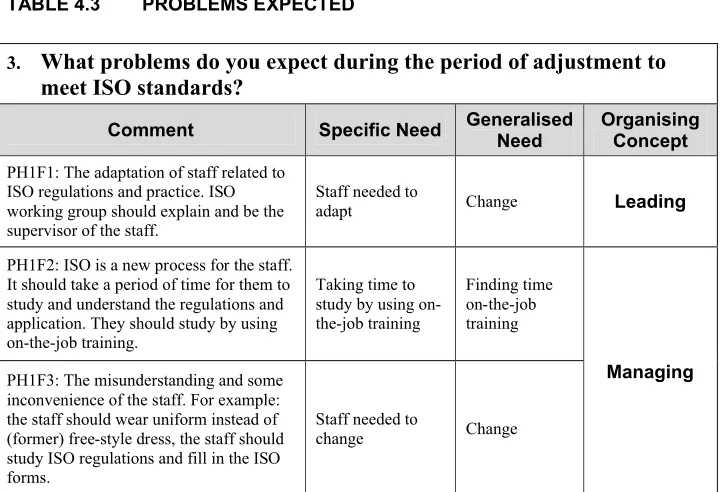
Table 4.3 Problems expected ...56
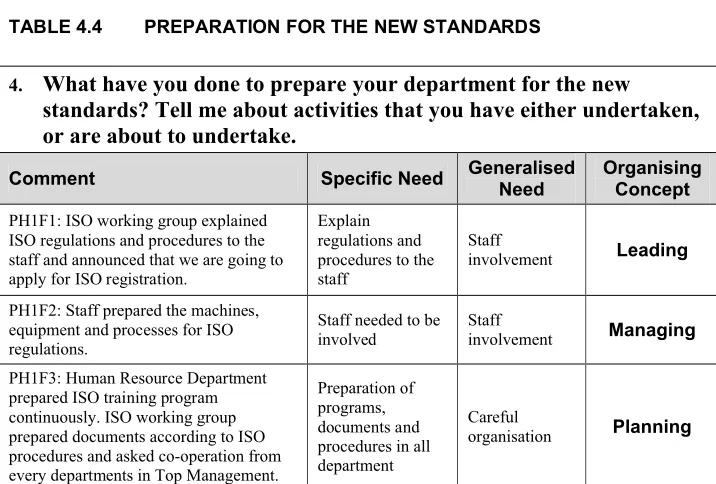
Table 4.4 Preparation for the new standards ...58
Table 4.5 Discrepancies noted ...61
Table 4.6 Reasons for discrepancies...63
Table 4.7 Additional training needs ...65
Table 4.8 Kinds of supports needed ...67
Table 5.1 Developing staff training programs...73
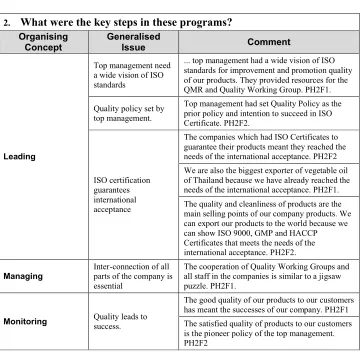
Table 5.2 Key steps in developing staff training ...76
Table 5.3 Changes in staff training programs...80
Table 5.4 Problems currently encountered ...83
Table 5.5 Overcoming training problems...86
Table 5.6 Impact on subsequent staff training program Plans...88
Table 5.7 SWOT analysis...89
Table 6.1 General expert practice Issues ...98
Table 6.2 Benchmarking for Staff Training Programs ...100
Table 6.3 Benchmarking for Senior Management...102
Table 6.4 Benchmarking for Consultants and auditors ...104
Table 6.5 Benchmarking: Quality Management Representative and the Quality Working Group ...106
Table 6.6 Benchmarking for the Human Resources Development Manager ...108
Table 6.7 Benchmarking for the Production Manager ...109
Table 6.7 Benchmarking for the Maintenance Manager ...113
Table 6.8 Benchmarking for the Purchasing Manager ...115
Table 6.9 Benchmarking for quality control manager ...118
Table 6.10 Benchmarking for marketing manager...120
Table 6.11 Benchmarking for logistics manager...123
Table 6.12 Benchmarking for ISO standards training programs ...126
Table 6.13 Practical aspects of benchmarking of ISO training programs...128
Table 6.14 Using benchmarking to solve problems in staff training programs ....131
Table 6.15 Additional program support ...135
Table 7.2 Senior management and Staff training Policy matrix...148
Table 7.3 Leading: Strategic thinking for Senior Management ...149
Table 7.4 Leading: Strategic thinking for Staff ...150
Table 7.5 Leading: Operational thinking for Senior Management ...152
Table 7.6 Leading: Operational thinking for Staff ...152
Table 7.7 Leading: Training thinking for Senior Management ...152
Table 7.8 Leading: Training thinking for Staff...153
Table 7.9 Managing: Strategic thinking for Senior Management...153
Table 7.10 Managing: Operational thinking for Senior Management...154
Table 7.11 Managing: Operational thinking for Staff...155
Table 7.12 Managing: Training thinking for Senior Management ...156
Table 7.13 Managing: Training thinking for Staff ...157
Table 7.14 Monitoring: Operational thinking for Senior Management ...158
Table 7.15 Monitoring: Training thinking for Senior management ...159
Table 7.16 Planning: Strategic thinking for Senior Management ...160
Table 7.17 Planning: Training thinking for Senior Management ...161
Table 7.18 Planning: Training thinking for Staff ...161
Table 7.19 Recording: Operational thinking for Senior Management ...162
Table 7.20 Recording: Operational thinking for Staff ...163
Table 7.21 Phases in the development of policies for draft training policies ...166
Table 8.1 Meeting key objectives of the ISO ...172
Table 8.2 Overcoming east-west barriers ...175
Table 8.3 Knowledge and expertise: Both global and local...178
Table 8.4 Highly developed communication skills ...180
Table 8.5 Strategic leadership and ISO accreditation ...181
Table 8.6 Accommodating the changing world of technology ...182
Table 8.7 Winning the hearts of staff and stakeholders ...185
Table 8.8 Leadership and training materials ...187
Table 8.9 Leadership and People...189
Table 8.10 Balancing training and coaching over time ...191
Table 8.11 Leadership and Assessment ...193
Table 8.12 Good information flow and continuous improvement...195
Table 8.13 Finance: the life-blood of a company ...197
Table 8.14 Natural leadership ...198
Table 8.15 Training that is needs based...198
Table 8.16 Favourable attitudes are outcomes based ...199
Table 8.17 Technology as the work unifier...200
Table 8.18 Positioning ...201
Table 8.19 Knowledge of procedures and processes ...202
Table 8.24 Future orientation, expertise, team leadership, and outcomes
orientation...208
Table 8.25 Planning skills required...211
Table 8.26 Production ...211
Table 8.27 Marketing expertise ...212
Table 8.28 Futures orientation ...212
Table 8.29 Systems approach to data management ...213
Table 8.30 Systems approach to recording...215
Table 8.31 Staff ...216
Table 8.32 Systematic development and generational planning...217
Table 8.33 Marketing and finance...219
Table 8.34 Knowledge requirements of leaders ...220
Table 8.35 Related knowledge ...222
List of Figures
Figure 2.1 A ‘4P’ model of the Toyota Way...27
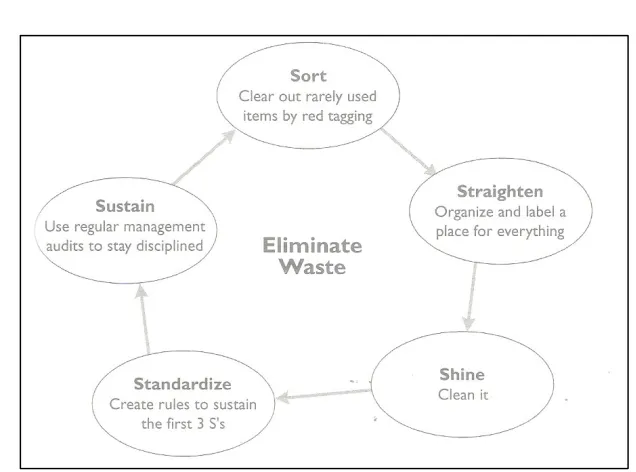
Figure 2.2 The 5Ss ...29
Figure 3.1 Determining Needs Model ...39
Figure 3.2 The Phases of the Methodology ...48
Figure 7.1 Model for determining policy needs to meet ISO standards ...143
Figure 7.2 Dror’s Alternative-Search Feedback Loops ...165
I want to thank those people who have been helpful and supportive in the completion of my doctoral degree. Many people have touched my life during this time of learning and growing and I want to thank them all.
My special thanks go to my great supervisor Dr. Ian M. Ling. He has been very patient and supporting of me while I stayed in Melbourne. He provided me with guidance and insight into writing this dissertation. I also want to express my thanks to my co-supervisor Dr. Vichit Suratreungchai for giving his expert guidance and time throughout the study.
scholarship and support from the President (Mr. Him Chiratpigalpong) and two Vice-Presidents (Miss Prapai Chiratpigalpong and Miss Pranom Chiratpigalpong) of Kitroongrueng Tapioca Factory Ltd., Part. This scholarship and support provided me with a wonderful opportunity for which I am truly grateful.
This long journey of achieving a doctoral degree has taken up time, I want to give my deepest thanks to my parents, my family, my brothers, my sisters, my friends and my team for their love, support, encourage, and understanding.
This study focuses on the development of effective Staff Training Programs to meet ISO Food Factory standards. It is set in the context of significant changes required to meet these standards in order to improve international business opportunities in the food industry in Thailand.
The study is based on a needs assessment within the proactive form of evaluation as categorised by Owen, with Rogers (1999) and Owen (2006). The research was conducted in four phases: a needs assessment, an expert review, a determination of best practice, and the formulation of a staff training policy. The purely qualitative methodology involved focus group and semi-structured interviews, a SWOT analysis, inductive data reduction, and policy development using Dror’s (1973) Optimal Method of policymaking. The findings of this study were validated by means of triangulation involving the outcomes of the needs assessment, the semi-structured interviews with the QMRs of two registered ISO certificated food factories, and the testing of the draft policy against the perceptions of the Chief Executive Officers of two registered ISO certificated food factories.
The fifth involved the importance of acquiring appropriate knowledge prior to engaging in planning. The sixth outcome involved a focus on recording and retrieving data and information, and the importance of tracking personnel development.
CEO Chief Executive Officer GMP Good Manufacturing Practice
HACCP Hazard Analysis and Critical Control Point HRD Human Resource Development
ICT Information, Communication & Technology IT Information Technology
ISO The International Organization for Standardization KPI Key Performance Indicator
QMR Quality Management Representative SET The Stock Exchange of Thailand SM Senior Management
CHAPTER 1
Introduction to the Study
Introduction
This chapter outlines the background of the study, contribution to knowledge, research significance and literature review. Background information includes the importance of ISO (International Organisation for Standardisation), the benefits of ISO to Food Industry. The research questions are listed, the research design, the methodology is briefly outlined, and a summary of the chapters of the thesis is provided.
Purpose of the Study
The purpose of my study is to investigate developing policy for staff training programs to meet ISO Food Factory Standards in Thailand.The International Organisation for Standardisation (ISO) (based in Geneva, Switzerland) was established in 1947 to promote standards in international trade, communications, and manufacturing. ISO is a nongovernmental organisation (Goetsch & Davis, 2002, 3).
broader needs of society. (www.iso.org, from www.google.comaccessed 02-03-2008).
To find the most suitable approach in developing policy for staff training programs to meet ISO Standards for Thailand’s Food Factories requires an exploration of existing policies and programs in terms of problems likely to be met, and the new requirements expected from the staff. A proactive evaluation is chosen for this study since it concerns findings that will assist decision-making in the development of appropriate staff training programs.
Background of the Study
ISO (International Organisation for Standardisation) is a worldwide federation of national standards bodies (ISO member bodies). The work of preparing International Standards is normally carried out through ISO technical committees. International organisations, governmental and non-governmental, in liaison with ISO, also take part in the work (ISO 2000, 2000). ISO is a standard of quality management that is a set of generally accepted accounting principles for documenting quality procedures. ISO 9000 (which is for manufacturers) was first released in March 1987 (Masternak & Kleiner, 1995).
The adoption of a quality management system should be a strategic decision for an organisation. The design and implementation of an organisation’s quality management system is influenced by varying needs, particular objectives, the products provided, the processes employed and the size and structure of the organisation (ISO 2000, 2002).
Chapter 1 Introduction to the Study
with Thai machines. KRR uses stainlesspipelines, clean equipment and tools in order to meet the clean food standard. KRR has two affiliates which produce tapioca flour: in Kalasin and Nakorn Ratchasima. Both affiliates also operate according to ISO regulations.
The markets for tapioca flour are both domestic and export. The customers of the domestic market are noodle factories, snack factories, pharmaceutical factories, sweetmeat factories, bakeries, etc. The customers of export markets are mainly in USA, EU, Japan, Australia, Hong Kong and Singapore. At the present time, the importers in many countries, for example, USA, EU, and Japan, prefer to buy the goods from the manufacturers that are good quality products and which have an ISO Certificate to guarantee accepted quality.
KRR is one of the exporters that needs to have the quality of its product guaranteed by ISO. Although KRR’s tapioca flour has been accepted as a good quality product, KRR has no ISO Certificate. If KRR wants to get the ISO certificate for international standard acceptance, KRR should improve all policies in order to meet the ISO regulations.
Objectives
The research process will include the following: a needs assessment, a research review, defining benchmarks that describe best practice, and developing a staff training program based on ISO standards. According to Owen, with Rogers (1999), a proactive evaluation provides the basis for evaluating the program’s development. Proactive evaluation is concerned with the extent of need of a program among a defined population in a given area of provision, synthesising what is known in the existing research and related literature about an identified issue or problem and critically reviewing ways in which an identified issue or problem has been solved through programs mounted in other locations. Interviews, document reviews, and focus groups are selected as data collection methods to gain an insight into participants’ viewpoints about the developmental process.
Research Questions
The general research question that I wish to examine is as follows:
What are the essential elements for a quality training policy to meet ISO standards for Thailand’s Food Factories?
There are five specific research questions that I will address in order to answer this question:
What are the consequences of applying ISO standards to a training program?
What is the context of Thailand’s Food Factories and how might ISO affect this context?
What are the actual conditions prevailing in selected food factories in Thailand and how do these match the desired conditions as spelt out in ISO standards?
Chapter 1 Introduction to the Study
What policies are required to ensure these factors are included in training programs to meet ISO standards?
Contribution to Knowledge
My research aims to examine the effectiveness of staff training programs to meet ISO standards for Thailand’s Food Factories. This will result in finding the most suitable strategy to be used in staff training programs and in identifying the most common problems likely to be found. The outcomes of the evaluation will help improve the application of staff training programs in the future. In addition, the strategy will be able to apply to staff in other industry areas. As for the evaluation, the most important part of the study, the results will provide guidelines for managers, staff and even the organisation itself. This proactive evaluation will enable more relevant policies to be developed.
Research Significance
The significance of the research is at four levels. First of all, the staff will be exposed to training programs that are designed to be of the greatest benefit to them. Entrepreneurs, together with managers, will have alternatives when training staff in a changing context. Researchers, together with customers, will be engaged to assist the developers of the training program to achieve a range of objectives, having a clear understanding of the overall program. The most important thing is that a systematic training program will be developed to enable management to adapt to changing requirements and conditions.
Hager (2002), education and training are the main instruments available to governments, community and organisations to prepare individuals for rapidly-changing, increasingly-demanding world of work, and to improve their employability. It requires ‘learning to learn’ for new job opportunities in an advanced knowledge, communication and technological society. The greatest significance of this research will be establishing a set of findings that will be useful for staff training programs to meet ISO standards in all of Thailand’s Food Factories.
Methodology
The design for the study follows a proactive evaluation (Owen, with Rogers, 1999,170-189). A proactive evaluation is concerned with the following issues:
Is there a need for the program?
What do we know about this problem that the problem will address?
What is recognised as best practice in this area?
Have there been other attempts to find solutions to this problem?
What does the relevant research or conventional wisdom tell us about this problem?
What could we find out from external sources to rejuvenate an existing policy or program?
Chapter 1 Introduction to the Study
practice (establishment of benchmarks) will be the key research tools in this study.
Limitations
This research is limited to findings from only five food factories: three food factories that were in an advanced planning stage for ISO registration, to determine details of Needs Assessment (Phase 1), and two registered ISO Certificated Thai food factories to carry out an Expert Review (Phase 2). The outcome of Phase 3, the identification of Best Practice, involved only three people – one each from each of the three Phase 1 factories. Finally, in the draft policy preparation (Phase 4) two people, only, who were the CEOs of two food companies registered on the Stock Exchange of Thailand, were involved in discussion and refinement. To overcome these limitations, triangulation of the outcomes from all four phases was undertaken to ensure reliability of findings.
Summary of the Chapters
Chapter 1
This chapter covers the purpose, significance and background of the thesis, research questions, contribution to knowledge, and research significance. The importance and benefits of ISO as the world’s largest developer and publisher of International Standards and developing policy for staff training programs to meet ISO Food Factories Standards in Thailand are described and the methodology used in the research is briefly discussed.
Chapter 2
Chapter 3
This chapter discusses the research methodology and research design for the study. In each phase, details of the participants, data collection and data analysis are provided.
Chapter 4
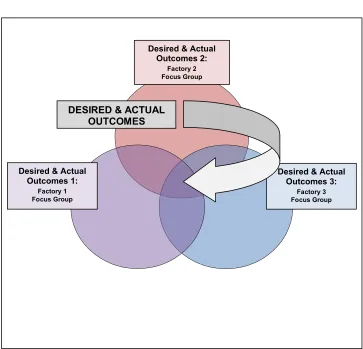
This chapter reports on a needs assessment, Phase 1 of the research, carried out to determine actual and desired needs in Staff Training Programs to meet ISO Food Factories Standards in Thailand, as identified by focus group interviews with three food factory groups with Quality Management Representatives, managers and staff. Standard data reduction techniques were applied to the responses of the participants in each of three focus groups in order to determine needs.
Chapter 5
This chapter reports on an expert review, Phase 2 of the research. This involved plant visits, and semi-structured interviews with two QMRs of two registered ISO certificated food factories. Standard qualitative data reduction procedures were used to produce a set of key actual and desired outcomes for Staff Training Programs to meet ISO Food Factories Standards in Thailand.
Chapter 6
This chapter reports on the identification of best practice, Phase 3 of the research. This involved identifying a set of training programs benchmarks, arising from Phases 1 & 2, by means of a focus group interview with three QMRs from Phase 1. These outcomes are used to formulate a draft Staff Training Policy according to Dror’s Optimal Model.
Chapter 7
Chapter 1 Introduction to the Study
ISO certificated food factories, brainstorming with three QMRs, and focus group discussion on best practice. The intersection of four separate inputs is linked through Dror’s (1973) phases of his ‘Optimal Model’ of policymaking process to develop a draft policy on Staff Training Programs to meet ISO Food Factory Standards in Thailand. Draft policy guidelines for the needs areas are developed by considering the resource allocation that will best meet these needs.
Chapter 8
This chapter reports on a testing of the draft policy as a result of two semi-structured interviews with two Chief Executive Officers of two registered Public Company Limited companies listed on the Stock Exchange of Thailand. As a consequence, a final Policy for Staff Training Programs to meet ISO Food Factory Standards in Thailand is formulated.
Chapter 9
Literature Review
Introduction
In this chapter the theories and concepts that are related to the construction of this research are reviewed. The literature related to Proactive Evaluation, policymaking, and learning organisations assisted in the study of the skills and competencies required by management and staff in food industry in order to develop training programs for workplace learning and improvement of work quality. The literature on professional development guided the design of professional development strategies required to promote these skills and competencies. The literature relating to management and staff training programs was concerned with a needs assessment of the company in order to identify and justify the implications for a professional development program that aimed to improve the job performance of management and staff in the food industry and to help them better understand the needs of a learning organisation.
Chapter 2 Literature Review
Proactive Evaluation
Guba & Lincoln (2001) consider evaluation to be one of three basic elements in disciplined inquiry – the others being research and policy analysis. In this thesis, evaluation will be considered as that form of inquiry whose focus is an evaluand (program and an organisation (Owen, 2006), using a particular approach (Jody et al., 2004), that results in judgements of ‘merit’ and ‘worth’ (Guba & Lincoln, 1989, 39).
To find the most suitable approach in developing policy for staff training programs to meet ISO standards for Thailand’s primary food production factories requires an exploration of existing policies and programs in terms of the problems likely to be met, and the new requirements expected from the staff. A proactive evaluation is chosen for this study since it concerns findings that will assist decision-making in the development of appropriate staff training programs. In this particular evaluation context, there is the need for a change or a review of the approach due to two pressures, namely, the imposition of ISO (quality) standards and the need to develop a new approach to staff training programs.
Proactive Evaluation is concerned with the following:
the extent of the need among a defined population for a program in a given area of provision;
synthesising what is known in the existing research and related literature about an identified issue or problem;
critically reviewing ways in which an identified issue or problem has been solved through programs mounted in other locations.
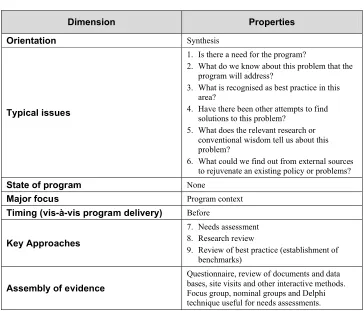
The essential features of Proactive Evaluation are summarised in Table 2.1 which shows the orientation, or purpose of evaluation, of a Proactive
evaluation is to provide findings to aid the synthesis of programs. Given that the state of these programs is that either no program exists or that radical
changes are needed to an existing one, the timing of the evaluation can be conceived of as occurring ‘before development’. The focus from which
evidence is drawn is the context or milieu within which the program will or may be developed, or like contexts in other locations.
Employing special approaches associated with this form assumes that policy and program development should be informed by the best and most appropriate evidence about the problem to be addressed. For example, an analysis of needs, combined with information on available resources, is fundamental to making decisions about the provision of services. Such knowledge enables planners at the policy, program and program levels to:
determine priorities in geographic areas, among clients groups and across areas of support;
train and allocate staff appropriately;
locate services and facilities to achieve maximum effect;
Chapter 2 Literature Review
TABLE 2.1 SUMMARY OF PROACTIVE EVALUATION
Dimension Properties
Orientation Synthesis
Typical issues
1. Is there a need for the program?
2. What do we know about this problem that the program will address?
3. What is recognised as best practice in this area?
4. Have there been other attempts to find solutions to this problem?
5. What does the relevant research or conventional wisdom tell us about this problem?
6. What could we find out from external sources to rejuvenate an existing policy or problems?
State of program None
Major focus Program context
Timing (vis-à-vis program delivery) Before
Key Approaches
7. Needs assessment 8. Research review
9. Review of best practice (establishment of benchmarks)
Assembly of evidence
Questionnaire, review of documents and data bases, site visits and other interactive methods. Focus group, nominal groups and Delphi technique useful for needs assessments.
Source: Owen, 2006
Approaches to Proactive Evaluation
Owen (2006) outlines three major approaches to Proactive evaluation: 1. Needs assessment;
2. Research review (evidence-based practice); and
3. Review of exemplary practice (and the establishment of benchmarks).
Needs Assessment
Owen (2006, 171) points out that needs assessment is a well-established Approach. An extensive conceptual literature has emerged, and the American Evaluation has a strong Topical Interest Group on needs assessment, an indication that this approach is acknowledged as an important subset of evaluation practice. A needs assessment is defined by Witkin & Altschuld (1995) as:
… a systematic set of procedures undertaken for the purpose of setting priorities and making decisions about program or organisational improvements and allocation of resources. The priorities are based on identified needs.
Chapter 2 Literature Review
Elements of needs assessment
Owen (2006), spelling out the essential features of Proactive Evaluation, is concerned with the following five elements of needs assessment:
the desired or ideal condition or state of affairs, or what ought to be;
the present or actual condition or state of affairs;
discrepancies between desired and actual affairs;
reasons for the discrepancies; and
deciding which needs should be given priority for action through a treatment or program.
According to Roth (1990), needs can be generally defined as follows:
N = D-A
where N is the need or discrepancy, D is the desired state and A is the actual state.
Policymaking
A policy is broad guidelinefor decision making that links the formulation of
strategy with its implementation. Companies use policies to make sure that employees throughout the firm make decisions and take actions that support the corporation’s mission, objectives, and strategies (Wheelen & Hunger, 2000, 14).
A most comprehensive framework for policy analysis and policymaking is provided by Dror (1973, 1989). In his book, Public Policymaking:
Reexamined, he outlines an Optimal Model of policymaking. The major
characteristics of this model (Dror, 1973, 1989, p154-162) are as follows:
takes a qualitative, rather than a quantitative approach;
contains both rational and extra-rational components;
basic rationale of the model is to be economically rational;
details a meta-policymaking phase (‘policy about making policy’);
includes extensive feedback phases.
The model consists of 18 phases, divided into three stages: the Metapolicymaking Stage (seven phases), the Policymaking Stage (seven phases) and the Post-Policymaking Stage (three phases); Dror regards, as the eighteenth phase, a detailed communication and feedback network that connects all phases. The phases within each Stage consist of the following:
I. Metapolicymaking Stage
1. Processing values: identifying values held by the stakeholders.
2. Processing reality: identifying the contexts in which the policy will operate.
3. Processing problems: identifying problems encountered by agencies involved in the program.
4. Surveying, processing, and developing resources.
5. Designing, evaluating, and redesigning the policymaking system.
6. Allocating problems, values, and resources: placing these elements in a priority order.
Chapter 2 Literature Review
II. Policymaking Stage
8. Sub allocating resources.
9. Establishing operational goals, with some order of priority for them.
10. Establishing significant values, with some order of priority for them.
11. Preparing a set of major alternative policies, including some ‘good’ ones.
12. Preparing reliable predictions of the significant benefits and costs of the various alternatives.
13. Comparing the predicted benefits and costs of the various alternatives and identifying the ‘best’ ones.
14. Evaluating the benefits and costs of the ‘best’ alternatives and deciding whether they are ‘good’ or not?
III.Post-policymaking Stage
15. Motivating and executing of the policy.
16. Executing the policy.
17. Evaluating policymaking after executing the policy.
18. All these 17 phases are interconnected by a complex communication and feedback network, which can be considered a separate phase:
Communication and feedback channels interconnecting all phases.
Learning Organisations
people continually expand their capacity to create the results they truly desire, where new and expansive patterns of thinking are nurtured, where collective aspiration is set free, and where people are continually learning how to learn together.
The basic rationale for such organisations is that in situations of rapid change on those that are flexible, adaptive and productive will excel. For this to happen, it is argued, organisations need to ‘discover how to tap people’s commitment and capacity to learn at all levels in an organisation’ (Senge, 1990, 4).
Peter Senge (Senge, 1990, 13) notes that:
When you ask people about what it is like being part of a great team, what is most striking is the meaningfulness of the experience. People talk about being part of something larger than themselves, or being connected, of being generative. It becomes quite clear that, for many, their experiences as part of truly great teams stand out as singular periods of life lived to the fullest. Some spend the rest of their lives looking for ways to recapture that spirit.
For Senge, real learning gets to the heart of what it is to be human. We become able to re-create ourselves. This applies to both individuals and organisations. Thus, for a ‘learning organisation it is not enough to survive.’ ‘Survival learning’ or what is more often termed ‘adaptive learning’ is important – indeed it is necessary. But for a learning organisation, ‘adaptive learning’ must be joined by ‘generative learning’, learning that enhances our capacity to create (Senge, 1990, 14).
The dimension that distinguishes learning from more traditional organisations is the mastery of certain basic disciplines or ‘component technologies’. The five disciplines, according to Senge (1990, 373) can be approached at one of three levels:
Practice: what you do;
Chapter 2 Literature Review
Essences: the state of being those with high levels of mastery in
the discipline (Senge, 1990, 373).
Each discipline provides a vital dimension. Each is necessary to the others if organisations are to ‘learn’.
The five disciplines that Senge identifies are said to be ‘converging to create innovative learning organisations’. The disciplines are as follows:
Systems Thinking: the cornerstone of the learning organisation
A great virtue of Peter Senge’s work is the way in which he puts systems theory to work (Smith, 2001, 3). The Fifth Discipline provides a good
introduction to the basics and uses of such theory – and the way in which it can be brought together with other theoretical devices in order to make sense of organisational questions and issues. Systems thinking is the conceptual cornerstone (‘The Fifth Discipline’) of his approach. It is the discipline that integrates the others, fusing them into a coherent body of theory and practice (Senge, 1990, 12). Systems theory’s ability to comprehend and address the whole and to examine the interrelationship between the parts provides, for Senge, both the incentive and the means to integrate the disciplines.
Alongside systems thinking, there stand four other ‘component technologies’ or disciplines (Smith, 2001, 4). A ‘discipline’ is viewed by Senge as a series of principles and practices that we study, master and integrate into our lives.
Personal Mastery
beyond spiritual opening, although it involves spiritual growth (Senge, 1990, 141). Mastery is seen as a special kind of proficiency. It is not about dominance, but rather about calling. Vision is vocation rather than simply just a good idea.
Mental Models
These are ‘deeply ingrained assumptions, generalisations, or even pictures and images that influence how we understand the world and how we take action’ (Senge, 1990, 8). They constitute what Donald A. Schön (Schön, 1983, 1) referred to as a professional’s ‘repertoire’. We are often not that aware of the impact of such assumptions on our behaviour – and, thus, ‘a fundamental part of our task’ (as Schön puts it) is to develop the ability to reflect-in and reflect-on action.
Building Shared Vision
Senge (1990, 9) starts from the position that if any one idea about leadership has inspired organisations of thousands of years ‘it’s the capacity to hold a shared picture of the future we seek to create’. Such a vision has the power to be uplifting – and to encourage experimentation and innovation. Crucially, it is argued, it can also foster a sense of the long-term, something that is fundamental to the ‘fifth discipline’, namely, systems thinking (Smith, 2001, 5).
Team Learning
Chapter 2 Literature Review
organisation; members will grow more rapidly than could have occurred otherwise.
Organisational Learning
Organisational learning has been defined by Marsick (1994, in Armstrong, 2006, 540) as follows:
a process or coordinated systems change, with mechanisms built in for individuals and groups to access, build and use organisational memory, structure and culture to develop long-term organisational capacity
More recently, organisational learning has been defined by Easterby-Smith & Araujo (1999, in Armstrong, 2006, 540) as:
an efficient procedure to process, interpret and respond to both internal and external information of a predominantly explicit nature.
Thus, organisational learning is concerned with the development of new knowledge or insights that have the potential to influence behaviour (Mabey & Salaman, 1995). It takes place within the wide institutional context of inter-organisational relationships (Geppert, 1996). As Argyris & Schön (1996, in Armstrong, 2006, 540) point out, organisational learning:
refers broadly to an organisation’s acquisition of understanding, know-how, techniques and practices of any kind and by any means.
Management and Staff Training Programs
Organisations get things done when people do their jobs effectively. To make this happen, they need to be well trained. A number of people are likely to be involved in the training. They will be engaged in identifying the needs of the organisation and of the individual, selecting or designing appropriate training to meet those needs, delivering it and assessing how effective it was (Peterson, 1994).
In the study of Noe (2003), training refers to a planned effort by an organisation to facilitate employees’ learning of job-related competencies. These competencies include knowledge, skills or behaviours that are critical for successful job performance. The goal of training is for employees to master the knowledge, skill, and behaviours emphasised in training programs and to apply them to their day-to-day activities. Recently it has been acknowledged that to gain a competitive advantage, training has to involve more than basic skill development. That is, to use training to gain a competitive advantage, training should be viewed broadly as a way to create intellectual capital that includes basic skills (skills needed to perform one’s job), advanced skills (such as how to use technology to share information with other employees), an understanding of the customer or manufacturing system, and self-motivated creativity.
Chapter 2 Literature Review
training (Collyer, 1996). The key to successful training system is to keep it ‘simple, practical and user-friendly’.
The training design process refers to a systematic approach for developing programs. The process consists of the following: conducting a needs assessment, ensuring employees’ readiness for training, creating a learning environment, developing an evaluation transfer of training, select training method, and monitoring and evaluating the program (Noe, 2003). Training worthy of the name achieves real and tangible results that will be reflected in the improved performance of the staff involved (Peterson, 1994). Organisations will get full value for their investments in training when the training they pay for is fully transferred to the job.
Transfer of training is the effective and continuing application, by trainees to their jobs, of the knowledge and skills gained in training – both on and off the job. The effective transfer of training also needs the effective partnerships of managers (including executives, supervisors, and team leaders), trainers, and trainees who have a strong interest in particular training programs and who have agreed to work together to support the full application of training that is specific to the job being undertaken (Broad & Newstrom, 1992).
After discussing current training program design needs, an analysis of appropriate policies will be undertaken. Policy analysis is the activity of creating knowledge of and in the policy-making process. In creating knowledge of policy-making processes, policy analysts investigate the causes, consequences, and performance of public policies and programs (Dunn, 1994). According to Dror’s (1973) Optimal Model of Public
Policymaking, the policymaking stage includes seven phases: sub allocating
evaluating the benefits and costs of the ‘best’ alternatives and deciding whether they are ‘good’ or not. The approaches of Dunn and Dror will be applied in the development of policy options that will be discussed in the final phase of this research.
Industrial Training
Training is the use of systematic and planned instruction activities to promote learning (Armstrong, 2006, 575). As Reynolds (2004, in Armstrong, 2006, p575-576) points out, training has a complementary role to play in accelerating learning:
It should be reserved for situations that justify a more directed, expert-led approach rather than viewing it as a comprehensive and all-pervasive people development solution.
Armstrong (2006, 576) also comments that the conventional training model has a tendency to ‘emphasise subject-specific knowledge, rather than trying to build core learning abilities’. Because I am developing a training policy, I will attempt to concentrate developing ‘core learning abilities’ and determining the necessary resources to ensure their delivery.
Types of training
According to Armstrong (2006, 578), training programs may be concerned with any of the following:
…manual skills, IT skills, team leader or supervisory training, management training, interpersonal skills (e.g. leadership, teambuilding, group dynamics, neuro-linguistic programming), personal skills (e.g. assertiveness, coaching, communicating, time management), and training in organisational procedures and practice.
sub-Chapter 2 Literature Review
Industrial training
Industrial training has been based on technology, innovation, market mechanisms and a system of occupational labour markets. In some countries (e.g., Japan), training has been primarily organised internally within the firm and training has been in more firm-specific skills and attitudes. As a result of the development of strong internal labour markets in Japan, more emphasis has been placed on training for lifetime careers.
In Japan, in the early stages of its industrialisation, the managerial, technical, and manual skills required for the new industries were in short supply. In order to acquire such skills, the emerging large Japanese firm had of necessity to look to the universities and to concentrate on developing its own managers and key employees if it wished to make progress. Having this investment, there was then a strong incentive to hold on to its employees. In this way, there emerged an organisational capacity to develop human resources that, in turn, encouraged further training. Over time, in the large firm sector, these practices have been extended throughout the firm. There is no simple one-to-one relationship between training and innovation or between training and performance (Gospel, 1991).
One of the most successful industrial training approaches within Japanese manufacturing is identified with the Toyota Organisation. Toyota’s global competitive advantage is based on a corporate philosophy known as the Toyota Production System. The system depends in part on a human resources management policy that stimulates employee creativity and loyalty but also on a highly efficient network of supplies and components manufacturers.
Toyota Production System and the Toyota Way
The Toyota Way explains the management principle and business
philosophy behind Toyota’s success (Business Summaries, 2008). The Toyota Way can be briefly summarised through the two pillars that support it: ‘Continuous Improvement’ and ‘Respect for People.’ Continuous improvement, often called KAIZEN, defines Toyota’s basic approach to
doing business: ‘Challenge everything!’
More important than the actual improvements that individuals contribute, the true value of continuous improvement is the creation of an atmosphere of continuous learning and an environment that not only accepts, but actually
embraces change. Such an environment can only be created where there is
respect for people – hence the second pillar of the Toyota Way. Toyota demonstrates this respect by providing employment security and seeking to engage team members through active participation in improving their jobs. Managers must take responsibility for development and nurturing mutual trust and understanding in all team members, in the belief that management has no more critical role than to motivate and engage large numbers of people to work together toward a common goal. Defining and explaining what the goal is, sharing a path to achieving it, motivating people to embark on the journey, and assisting them by removing obstacles should be management’s reason for being. As Gary Convis, Managing Officer of Toyota and President, Toyota Motor Manufacturing, Kentucky USA is reported (Liker, 2004, xi-xii):
We must encourage the minds of people to support and contribute their ideas to the organisation. In my experience, the Toyota Way is the best method for fulfilling this role.
Chapter 2 Literature Review
The 14 Principles of the Toyota Way
The 14 Principles of the Toyota Way is a system designed to provide the tools for people to continually improve their work. The 14 principles fall into four groups:
1. Long-term philosophy,
2. The right process will produce the right results,
3. Add value to the organisation by developing your people;
4. Continuously solving root problems drives organisational learning.
The principles (Liker, 2004, 37-41) are set out in Figure 2.1, and are briefly described below.
FIGURE 2.1 A ‘4P’ MODEL OF THE TOYOTA WAY
Section I – Long-term Philosophy
Principle 1: Base your management decisions on a long-term philosophy,
even at the expense of short-term financial goals. Have a philosophy sense of
purpose that supersedes any short-term decision making. Work, grow, and align the whole organisation toward a common purpose that is bigger than making money. Understand your place in the history of the company and work to bring the company to the next level. Your philosophy mission is the foundation for all the other principles.
Section II – The Right Process Will Produce the Right Results
Principle 2: Create a continuous process flow to bring problems to the
surface. Redesign work processes to achieve high value-added, continuous
flow. Strive to cut back or zero the amount of time that any work project is sitting idle or waiting for someone to work on it.
Principle 3: Use ‘pull’ systems to avoid overproduction. Provide your down
line customers in the production process with what they want, when they want it, and in the moment they want. Material replenishment initiated by consumption is the basic principle of just-in-time.
Principle 4: Level out the workload. (Work like the tortoise, not the hare).
Eliminating waste is just one-third of the equation for making lean successful. Eliminating overburden to people and equipment and eliminating unevenness in the production schedule are just as important – yet generally not understood at companies attempting to implement lean principles. (Lean
principles or lean manufacturing is the production of goods using less of
everything. They are overproduction, waiting or time on hand, unnecessary transportation, over processing or incorrect processing, excess inventory, unnecessary movement, defects, and unused employee creativity.)
Principle 5: Build a culture of stopping to fix problems, to get quality right
the first time.Quality for the customer drives your value proposition. Use all
Chapter 2 Literature Review
Principle 6: Standardised tasks are the foundation for continuous
improvement and employee empowerment. Use stable, repeatable methods
everywhere to maintain the predictability, regular timing, and regular output of your process. It is the foundation for flow and pull.
Principle 7: Use visual control so no problems are hidden.Use simple visual
indicators to help people determine immediately whether they are in standard condition or deviating from it. Included in this principle is the 5Ss Program
-steps that are used to make all work spaces efficient and productive, help people share work stations, reduce time looking for needed tools and improve the work environment. These are detailed in Figure 2.2. They are Sort: Sort
out unneeded items, Straighten: Have a place for everything, Shine: Keep the
area clean, Standardise: Create rules and standard operation procedures, and
Sustain: Maintain the system and continue to improve it.
Principle 8: Use only reliable, thoroughly tasted technology that serves your
people and processes. Use technology to support people, not to replace
people. Often it is best to work out a process manually before adding technology to support the process.
FIGURE 2.2 THE 5Ss
Section III– Add Value to the Organisation by Developing Your People Principle 9: Grow leaders who thoroughly understand the work, live the philosophy, and teach it to others. Grow leaders from within, rather than buying from outside the organisation.
Principle 10: Develop exceptional people and team who follow your
company’s philosophy. Create a strong, stable culture in which company
values and beliefs are widely shared and lived out over a period of many years.
Principle 11: Respect your extended network of partners and suppliers by
challenging them and helping them improve. Have respect for your partners
and suppliers and treat them as an extension of your business.
Section IV– Continuously Solving Root Problems Drives Organisational Learning
Principle 12: Go and see for yourself to thoroughly understand the situation.
Solve problems and improve process by going to the source and personally observing and verifying data rather than theorising on the basis of what other people or the company screen tell you.
Principle 13: Make decisions slowly by consensus, thoroughly considering
all options; implement decisions rapidly.Do not pick a single direction or go
down that one path until you have thoroughly considered alternatives. When you have picked, move quickly but cautiously down the path.
Principle 14: Become a learning organisation through relentless reflection
and continuous improvement (Kaizen). Once you have established a stable
process, use continuous improvement tools to determine the root cause of inefficiencies and apply effective countermeasures.
Knowledge of Related Fields
Chapter 2 Literature Review
organisation. This will likely require major additional knowledge in the related fields of Marketing and Finance. Each of these is discussed, below.
Marketing
The American Marketing Association offers the following formal definition: Marketing is an organisational function and a set of processes for creating, communicating, and delivering value to customers and for managing customer relationships in ways that benefit the organisation and its stake holders. According to Kotler (2006, 6), coping with exchange processes calls for a considerable amount of work and skill. He (Kotler, 2006, 6) provides a social definition that serves my purpose:
Marketing is a societal process by which individuals and groups obtain what they need and want through creating, offering, and freely exchanging products and services of value with others.
Peter Drucker, a leading management theorist, in Kotler (2006, 6) highlights that effective marketing makes selling redundant:
There will always, one can assume, be a need for some selling. But the aim of marketing is to make selling superfluous. The aim of marketing is to know and understand the customer so well that the product or service fits him and sells itself. Ideally, marketing should result in a customer who is ready to buy. All that should be needed then is to make the product or service available.
Of special importance to Kotler is the concept of the ‘marketing mix’.
Marketing Mix
Marketing mixis the set of marketing tools that the firm uses to pursue its
marketing objectives in the target market. They are Product, Price, Place, and Promotion.
The components of Productare: product variety, quality, design, features, brand name, packaging, sizes, services, warranties, and returns.
The components of Price are: list price, discounts, allowances, payment period, and credit terms.
The components of Place are: channels, coverage, assortments, locations, inventory, and transport.
The components of Promotionare: sales promotion, advertising, sales force, public relations, and direct marketing.
According to Kotler (2000, 15-18), the product concept is one of the oldest concepts in business. He argues that:
The product concept holds that consumers will prefer products that are
widely available and inexpensive.
Many businesses, he suggests, are guided by the product concept:
The product conceptholds that consumers will favour those products that offer the most quality, performance, or innovative features.
The selling concept is another common business orientation.
The selling conceptholds that consumers and businesses, if left alone, will
ordinarily not buy enough the organisation’s products. The organisation must, therefore, undertake an aggressive selling and promotion effort.
Chapter 2 Literature Review
Finance
The objective of a company must be to create value for its shareholders. Value is represented by the market price of the company’s common stock, which, in turn, is a function of the firm’s investment, financing, and dividend decisions. Van Horne (2002, 3) argues that:
The financial goalis to maximise shareholder wealth. The idea is to acquire
assets and invest in new products and services where expected return exceeds their cost, to finance with those instruments where there is particular advantage, tax or otherwise, and to undertake a meaningful dividend policy for stockholders.
An understanding of the function of finance, therefore, will need to be considered in any training policy.
Functions of finance
According to Van Horne (2002, 6), the functions of finance involve three major decisions a company must make: the investment decision, the financing decision, and the dividend/share repurchase decision. Each must be considered in relation to the prime company objective of providing value; an optimal combination of the three will create value.
Investment decision
Van Horne, (2002, 6) considers the investment decision to be the most
important of the three decisions when it comes to the creation of value:
Capital investment is the allocation of capital to investment proposals whose benefits are to be realised in the future. Because the future benefits are not known with certainty, investment proposals necessarily involve risk.
Investments in capital projects should provide expected returns in excess of
Financing decision
Van Horne (2002, 7) suggests that in the second major decision of the firm, the financing decision, the financial manager is concerned with determining the best financial mix or capital structure.
If a company can change its total valuation by varying its capital structure, an optimal financing mix would exist, in which market price per share could be maximised.
Capital structure involves determining the best mix of debt, and hybrid
securities to be employed.
Dividend/Share repurchase decision
Finally, Van Horne (2002, 7) points out that the third important decision of a company is the amount of cash to distribute to stockholders. There are two methods of distribution: cash dividends and share repurchase;
Dividend policy includes the percentage of earnings paid to stockholders in cash dividends, the stability of absolute dividends about a trend, stock dividends, and stock splits. Share repurchase allows the distribution of a large amount of cash without tax consequence to those who choose to continue to hold their shares.
Excess cashcan be distributed to stockholders directly through dividends
or indirectly via share repurchase.
Summary
CHAPTER 3
Methodology
Introduction
My study is based on the Proactive Form of evaluation as categorised by Owen, with Rogers (1999) and Owen (2006) using three distinct approaches: a needs assessment; a research and expert review; and establishing best practice benchmarks. These three approaches constitute the first three phases of the research; the fourth phase, the formulation and testing of policy concludes the research. The objectives of this study were to: 1) develop the most effective policy for an approach to Staff Training Programs to meet ISO Food Factory Standards in Thailand; 2) outline professional development strategies required by ISO Standards, through its regulations, to seek ways of developing policy and improving the quality to reach their customer satisfactions. This chapter includes the procedures that were used in preparing the study and conducting the research.