A PERSPECTIVE EVALUATION OF GROUP WORK IN ENGLISH
LANGUAGE CLASSROOM
Omar
Mohammad Alali
1Radzuwan Ab Rashid2+
Omar Ali Al-Smadi3
1,2Faculty of Languages and Communication, Universiti Sultan Zainal Abidin, Terengganu, Malaysia.
3English Language Department, Al-Ghad International Colleges for Applied
Medical Sciences, AlMadinah AlMunawarah, Saudi Arabia. (+ Corresponding author)
ABSTRACT
Article History Received: 19 November 2019 Revised: 23 December 2019 Accepted: 29 January 2020 Published: 9 March 2020
Keyword
s
Group workEnglish language learning University students Jordan
Collaborative learning Student centred approach 21st century pedagogy Peer collaboration Student-teacher interaction.
This paper provides insights into how Jordanian university students perceive their experiences in learning English through group work activities. A total of 55 students of Mutah University who learn English as a preparation for their TOEFL examination took part in this quantitative study which was carried out in the first semester of the 2019 academic year. The respondents are from different majors, such as Business Administration and International Relations. Data were collected through three sets of questionnaires with a 5 point Likert scale which focused on the learner perspectives regarding the use of group work for English language learning, the student-peer collaboration, and the student-teacher collaboration involved in the group work activities. Descriptive statistics involving frequency counts and percentage were used to analyze the data. The findings revealed that the majority of the students had positive views regarding the use of group work for language learning. They were also satisfied with the collaboration with their peers and the teacher throughout the group work activities. However, in comparison, the student-peer collaboration is perceived as less positive than the student-teacher collaboration. This study concludes that group work is favoured by the students but for the group work to be successful, their collaborative skills need to be improved.
Contribution/ Originality:
This study contributes to the current understanding of the student-centered approach to language learning which is currently at its infancy in the Jordanian education system. It also provides insights into the relevancy of group work activities in the context of English as a Foreign language (EFL) classroom.1. INTRODUCTION
In the English language classroom, group activity is common. This is because group activity is argued to have several benefits, such as improving learner autonomy (Liu, Huang, & Xu, 2018; Rashid, Mohamed, Rahman, &
Shamsuddin, 2017), motivation to learn (Costley & Lange, 2018) and oral proficiency and interactional competence
(Assalihee, Boonsuk, Bakoh, & Sano, 2019; Namaziandost, Esfahani, Nasri, & Mirshekaran, 2018; Wang, An, &
Wright, 2018) as the learners communicate with one another in the group. However, all these positive aspects of
group activity are achievable only if the group work process is well developed. There are several studies which report the failure of group activity in achieving its intended effects (e.g. (Blatchford & Russell, 2019; Wilson,
International Journal of English Language and Literature Studies
ISSN(e):
2306-0646 ISSN(p):
2306-9910
DOI: 10.18488/journal.23.2020.91.56.62 Vol. 9, No. 1, 56-62.
Brickman, & Brame, 2018)). This is not surprising as there are many important elements of group work which need to be carefully considered to ensure its effectiveness. This includes the group size, placing the „right members‟ that function well when grouped together, and also the credibility of the group leader (Blatchford & Russell, 2019).
The group leader, either appointed by the teacher or the other group members, plays an important role to optimize the group‟s performance. However, being a group leader is not an easy task as it involves not only ensuring the completion of given tasks within stipulated timeframes, but also encouraging the group members to start working on the task and maintain their equal contributions. Most of the time, not all group members give equal contribution. As pointed by Viberg, Mavroudi, Fernaeus, Bogdan, and Laaksolahti (2019) the phenomenon of “free riding” is commonly observed in group activity in addition to the cases of group bullying where only one or two group members are asked to complete the task whilst the other group members engaged in off-task interaction. The problems highlighted above can be worsened by the group leader who does not know how to play his/her roles well. They need to have a good interactional competence so that they can develop positive discursive behaviour in the group to minimize and avoid off-task interactions. The positive discursive behaviour afforded by good interactional competence will enable the group leader and the group members to focus on on-task interaction thus ensuring the success of the group work.
Unfortunately, there is very limited research in Jordanian context which looks into learners‟ behaviour and interactional competence when they are engaged in group work. To the best of our knowledge, none of the classroom research in Jordanian context has focused on learners‟ behaviour and interactional competence of individuals involved in group work. Thus, this study is hoped to fill in this gap in the literature. By focusing on how Jordanian students evaluate the group work activities, their peers and the teacher who are involved in the group work, this study is hoped to reveal the strengths and weaknesses in their practices hence providing useful insights to teachers in taking appropriate actions to improve group activity for effective language learning.
1.1. Group Work Activity and Language Learning
Mathews-Aydinli (2007) gave a good explanation on the use of group work in English language classrooms. It
requires students to use the target language rather than being drilled with predetermined language structures. This is because group work activity demands students to negotiate meaning by interacting with one another such as their peers, the facilitators and the texts they are working with. This interaction allows the students to express their opinion and look at things critically. At the same time, they can observe their peers‟ learning strategies and model how the language is used by others.
Boon (2004) affirmed that teachers must act as a coach when conducting group work activity in the sense that
they must know when to step in and guide the students to build and test strategies. Teachers also should know how to guide students in receiving, sharing, and making sense of what they read, write, speak, and hear as well as gathering information and managing autonomous learning habits. Baden and Major (2004) emphasized that the teachers must support and value students so that they do not fear being ridiculed when contributing something to the team, suggest alternatives when the team is unable to decide, monitor the team progress, reflect back to seek understanding and clarification of what is occurring, and give clear, positive and specific feedback to help students improve their learning.
While teachers act as a coach, students act as a problem solver who play active roles in group work activity
(Boon, 2004). Tan (2004) stressed that in order to succeed in group work activity, students must be able to work
together, seek information from various sources and share their knowledge with others. There are seven team roles that need to be played by the team members in order to ensure that their team functions effectively (Baden & Major,
2004). The first one is the role of facilitator who moderates discussions, keeps the team on task and makes sure
timekeeper who makes sure that the tasks are well planned and could be finished on time. Fifth, the recorder who takes notes of the team‟s discussion and prepares a written conclusion. Sixth, the checker who checks team member‟s understanding and the last role is the wildcard who assumes the role of any missing member. These roles must be rotated so that students have equal experiences besides encouraging interdependence amongst team members.
1.2. Research Objectives and Questions
This study aims to explore students‟ perspectives regarding the incorporation of group work activity in English language classrooms at university level and their perceptions of peer collaboration and student-teacher collaboration involved in the learning process. The research questions are:
1) How do Jordanian university students view the use of group work activity in English language classrooms?
2) How do the students view the student-peer collaboration in group work activity? 3) How do the students view the student-teacher collaboration in group work activity?
2. METHODOLOGY
This study involved 55 graduate students from different majors at Mutah University, Jordan who learned English as part of their preparation for TOEFL examination. They were taught by Teacher Ali, a 35-year old man who obtained his master degree in English Language Teaching from a university in United Kingdom. Teacher Ali has five years of teaching experience at the university level and he describes himself as an advocate of group work activity. All the participants were chosen based on purposive sampling as suggested by Too and Saimima (2019)
that one needs to select a sample from which one can learn the most.
Three sets of questionnaires were used in this study which is End of Session Evaluation, Student-Peer Collaboration Evaluation, and Student-Teacher Collaboration Evaluation. The three questionnaires were adapted from Sulaiman, Atan, Idrus, and Dzakiria (2004). Data were analyzed using descriptive statistics which involved frequency count and percentage.
3. FINDINGS
3.1. Learner Views of Using Group Work Activity for Language Learning
The findings presented in Table 1 show that the use of group work activity in English language classrooms is perceived positively by the students. All respondents chose Strongly Agree (SA) and Agree (A) for the statements listed except for statements no. 5, 9 and 10 where 3% (n=2) of the respondents chose No Opinion (NO). Statement no. 8 which is “I have gained new knowledge” has the highest percentage of SA (89 %, n=49), followed by statement no. 2 that is “the learning was enjoyable” with the percentage of 77 % (n=42). Majority of the respondents agreed with statement no.1 that the learning was effective in developing their language skills. Besides that, 60% (n=33) strongly agreed with statement no. 11 that they felt more confident to speak and write in English through group work activity.
3.2. Learner Views on Student-Peer Collaboration
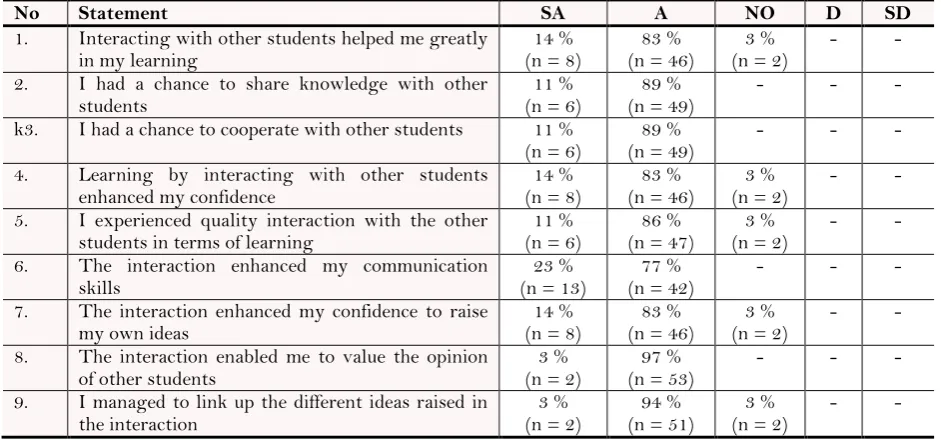
other students” has the highest percentage of A (97 %, n = 53), followed by statement no. 9, “I managed to link up the different ideas” with 94 % (n = 52).
Table-1. Frequency of students‟ responses on the use of group work activity in ESL classroom.
No Statement SA A NO D SD
1. The learning was effective in developing my
language skills (n = 18) 34 % (n = 36) 66 % - - -
2. The learning was enjoyable 77 %
(n = 42) (n=13) 23 % - - -
3. I was satisfied with the learning 51 %
(n = 28) (n = 27) 49 % - - -
4. I learnt with ease 60 %
(n = 33) (n = 22) 40 % - - -
5. This type of learning is suitable for me 51 %
(n = 28) (n = 25) 46 % (n = 2) 3 % - - 6. I could understand the learning materials 31 %
(n = 17) ( n = 38) 69 % - - -
7. I could grasp the presented facts 26%
(n = 14) ( n = 41) 74 % - - -
8. I have gained new knowledge 89 %
(n =49) (n = 6) 11 % - - -
9. I could identify the critical issues 54 %
( n = 30) (n = 23) 43 % (n = 2) 3 % - - 10. My ability to connect factual concepts has
increased ( n = 28) 51 % (n = 25) 46 % (n = 2) 3 % - -
11. I am more confident to speak and write
In English through group work activity (n = 33) 60 % (n = 22) 40 % - - - Note:SA (Strongly agree) A (Agree) NO (No opinion) D (Disagree) SD (Strongly disagree).
Table-2. Frequency of students‟ responses on student-peer collaboration.
No Statement SA A NO D SD
1. Interacting with other students helped me greatly
in my learning (n = 8) 14 % (n = 46) 83 % (n = 2) 3 % - -
2. I had a chance to share knowledge with other
students (n = 6) 11 % (n = 49) 89 % - - -
k3. I had a chance to cooperate with other students 11 %
(n = 6) (n = 49) 89 % - - -
4. Learning by interacting with other students
enhanced my confidence (n = 8) 14 % (n = 46) 83 % (n = 2) 3 % - -
5. I experienced quality interaction with the other
students in terms of learning (n = 6) 11 % (n = 47) 86 % (n = 2) 3 % - - 6. The interaction enhanced my communication
skills (n = 13) 23 % (n = 42) 77 % - - -
7. The interaction enhanced my confidence to raise
my own ideas (n = 8) 14 % (n = 46) 83 % (n = 2) 3 % - -
8. The interaction enabled me to value the opinion
of other students (n = 2) 3 % (n = 53) 97 % - - -
9. I managed to link up the different ideas raised in
the interaction (n = 2) 3 % (n = 51) 94 % (n = 2) 3 % - -
Note:SA (Strongly agree) A (Agree) NO (No opinion) D (Disagree) SD (Strongly disagree).
3.3. Learner Views on Student-Teacher Collaboration
Table-3. Frequency of students‟ responses on student-facilitator collaboration in PBL.
No Statement SA A NO D SD
1. Interaction with the teacher established effective
learning (n = 46) 83 % (n = 9) 17 % - - -
2. It was easier to learn with the help of the teacher 89 %
(n = 49) (n = 6) 11 % - - -
3. The teacher helped in my learning 71 %
(n = 39) (n = 16) 29 % - - -
4. The teacher encouraged my participation 77 %
(n = 42) (n = 13) 23 % - - -
5. It was easy to contact the teacher 66 %
(n = 36) (n = 19) 34 % - - -
6. The teacher responded promptly on my query 77 %
(n = 42) (n = 13) 23 % - - -
7. The teacher provided guidance to the
construction of new knowledge (n = 49) 89 % (n = 6) 11 % - - -
8. I experienced quality interaction with the teacher
in terms of learning (n = 42) 77 % ( n = 13) 23 % - - -
Note:SA (Strongly agree) A (Agree) NO (No opinion) D (Disagree) SD (Strongly disagree).
4. DISCUSSIONS
The use of group work in the English language classroom has given positive impacts to the students and the learning of English. This is discernible where a significant percentage of students (100 %) claim that they have gained new knowledge through group work activities carried out. It proves what Tan (2004) has affirmed that one of the key characteristics of group work is that it allows students to explore things deeply in the search of the possible solution to the problem given. The success of the students to gain the new knowledge is an important indication that group work is useful for English language learning at university level in Jordanian context.
More importantly, the students also report that the learning of English through group work activity is enjoyable thus enables them to develop their language skills as well as their level of confidence to speak and write. This is a very vital finding as it shows that group work offers a pleasant environment for English language learning. This finding supports (Baden & Major, 2004) who state that group work provides a student-centered learning environment where students are given autonomy to handle, set pace for their own learning, and pursue and directing their own inquiry. It is through the freedom given that the students feel less stressful and benefit from their learning.
Another significant finding is that all of the students reported that they could understand the materials involved in the learning process. This is also an important finding which shows that the students benefit from the incorporation of group work. This is because group work gives autonomy for the students to use appropriate sources and choose materials which meet their proficiency level. As Krashen (1981) has proven in his Comprehensible Input Theory, learners must first be able to comprehend the input in order for learning to take place. This shows that group work, if planned carefully, could be employed to help less proficient students develop their proficiency as they are free to choose materials that suit their current language proficiency before they move on to more challenging materials. This learner-driven approach to language learning is also meaningful to the students (Idris & Abdul Raof, 2019; Nor & Ab Rashid, 2018).
However, a critical look at the findings related to student-peer collaboration reveals that it is viewed less positively compared to the evaluation of group work activity as a whole and the student-teacher collaboration. This is discernible where for all the statements listed, students prefer to choose Agree (A) compared to Strongly Agree (SA) like in the other two questionnaires. This is perhaps due to the duration of this study which lasts for only six weeks, so the students are unable to really get to know their group members thus make them feel less comfortable working in the group. Additionally, the students do not have much experience working in groups prior to this study as their other teachers prefer to carry out whole class and pair work activities.
In terms of student-teacher collaboration, the students perceive the collaboration as something that produces positive educational output where they experience effective learning and quality interaction with the teacher who has facilitated the learning by giving professional guidance and intervention where necessary. The finding that the majority of the students (89%, n = 49) strongly agree that it is easier to learn with the help of the teacher and the guidance given in construction of new knowledge shows that students acknowledge the importance of the role of the teacher in broadening and facilitating their learning. This reflects that the teacher in this study had played his roles well and managed to handle the conflicts faced by many traditional teachers when conducting group work activity. The implication is, teachers, if trained properly will be able to adopt the required roles in group work activity.
5. CONCLUSION
Group interaction is a complex practice. It is evident that poor management of group interaction affects learning processes in several ways such as failure to engage in active collaborative learning. Therefore, if not carried out tactfully, it can contribute to problematic classroom interactions. Group work in this study is perceived as beneficial to students‟ learning, their improvement as well as their motivation to learn. Student-teacher interaction and student-student interaction have been reported to increase learning opportunities, students‟ talk time and language varieties. In fact, classroom interaction during group work creates and maximizes authentic meaningful interactions among students through clarifying ideas, asking questions and responding to comments. Thus, teachers are required to attend to successful group work settings in order to achieve learning and minimize chances of disruptive behaviour that may lead to failure of group work.
This study has shown that the students are ready to engage in group work for their learning and gain benefits from it. Group work affords the instructors a platform to construct natural, real life interactions. The interaction between teacher and students afforded by group work activity generates meaning which is valuable for further investigation in order to understand how educational discourses are established and developed in group work.
It is recommended for future research to explore the role of learners‟ and teachers‟ discursive identities in influencing the success of group work as studies (e.g. Ab Rashid, Yunus, Azmi, Rahman, and Yusoff (2016)) have shown that the identities affect the collaborative learning process.
Funding: This study received no specific financial support.
Competing Interests: The authors declare that they have no competing interests.
Acknowledgement: All authors contributed equally to the conception and design of the study.
REFERENCES
Ab Rashid, R., Yunus, K., Azmi, N. J., Rahman, S. B. A., & Yusoff, S. (2016). The discursive construction of teachers‟ desirable identity on a social networking site. International Journal of Applied Linguistics and English Literature, 5(5), 139-144. Available at: https://doi.org/10.7575/aiac.ijalel.v.5n.5p.139.
Baden, M. S., & Major, C. H. (2004). Foundations of problem-based learning. New York: Open University Press.
Blatchford, P., & Russell, A. (2019). Class size, grouping practices and classroom management. International Journal of Educational Research, 96, 154-163. Available at: https://doi.org/10.1016/j.ijer.2018.09.004.
Boon, T. H. (2004). Teachers as coaches of cognitive processes in problem-based learning. In Oon, S.T (Ed.), Enhancing Thinking through Problem-Based Learning Approaches (pp. 101-116). Shenton Way, Singapore: Thompson.
Costley, J., & Lange, C. (2018). The moderating effects of group work on the relationship between motivation and cognitive load.
The International Review of Research in Open and Distributed Learning, 19(1), 177-201. Available at: https://doi.org/10.19173/irrodl.v19i1.3325.
Idris, M., & Abdul Raof, A. H. (2019). Learner-driven oral assessment criteria for English presentation. Journal of Nusantara Studies, 4(1), 365-383. Available at: https://doi.org/10.24200/jonus.vol4iss1pp365-383.
Krashen, S. (1981). Second language acquisition. Second Language Learning, 3(7), 19-39.
Liu, M.-C., Huang, Y.-M., & Xu, Y.-H. (2018). Effects of individual versus group work on learner autonomy and emotion in digital storytelling. Educational Technology Research and Development, 66(4), 1009-1028. Available at: https://doi.org/10.1007/s11423-018-9601-2.
Mathews-Aydinli, J. M. (2007). Problem-based learning and adult English language learners. Retrieved from CAELA: /briefs/Problem-based.pdf. [Accessed April 4, 2010].
Namaziandost, E., Esfahani, F. R., Nasri, M., & Mirshekaran, R. (2018). The effect of gallery walk technique on pre-intermediate EFL learners‟ speaking skill. Language Teaching Research Quarterly, 8, 1-15.
Nor, N. M., & Ab Rashid, R. (2018). A review of theoretical perspectives on language learning and acquisition. Kasetsart Journal of Social Sciences, 39(1), 161-167. Available at: https://doi.org/10.1016/j.kjss.2017.12.012.
Rashid, R. A., Mohamed, S. B., Rahman, M. F. A., & Shamsuddin, S. N. W. (2017). Developing speaking skills using virtual speaking buddy. International Journal of Emerging Technologies in Learning (iJET), 12(05), 195-201. Available at: https://doi.org/10.3991/ijet.v12i05.6955.
Sulaiman, F., Atan, H., Idrus, R. M., & Dzakiria, H. (2004). Problem-based learning: A study of the web-based synchronous collaboration. Malaysian Online Journal of Instructional Technology, 1(2), 58-66.
Tan, O. S. (2004). Enhancing thinking through problem based learning approaches (pp. 10-11). Shenton Way, Singapore: Thompson.
Too, W. K., & Saimima, E. J. (2019). Teacher belief and practice in a school-based English language classroom in Eastern Indonesia. Journal of Nusantara Studies, 4(1), 211-231. Available at: https://doi.org/10.24200/jonus.vol4iss1pp211-231. Viberg, O., Mavroudi, A., Fernaeus, Y., Bogdan, C., & Laaksolahti, J. (2019). Reducing free riding: CLASS–a system for collaborative learning assessment. Paper presented at the International Conference in Methodologies and intelligent Systems for Techhnology Enhanced Learning. Springer, Cham.
Wang, J., An, N., & Wright, C. (2018). Enhancing beginner learners‟ oral proficiency in a flipped Chinese foreign language classroom. Computer Assisted Language Learning, 31(5-6), 490-521.
Wilson, K. J., Brickman, P., & Brame, C. J. (2018). Group work. CBE—Life Sciences Education, 17(1), 1-15.