Publisher: Asian Economic and Social Society ISSN: 2225-4226
Volume 3 No. 2 February 2013.
Effectiveness the Laid-off Empowerment Program
Case Study
Ahmad, N. Al-Rfou (Business Management, Tafilah Technical University, Tafila, Jordan)
Effectiveness the Laid-off Empowerment ...
33 Author(s)
Ahmad, N. Al-Rfou Business Management, Tafilah Technical University, Tafila, Jordan
Effectiveness the Laid-off Empowerment Program
Case Study
Abstract
The purpose of the study is to investigate the relationship between laid off personal characteristics and success Small and Medium-sized Businesses, (SMBs), which established by empowering laid off program in Jordan Cement Factories Company (JOCM), the study also trying to identify the main factors that contribute in success and failure SMBs for laid off. 73 questionnaires were analyzed to achieve the research objective. The results indicated that there was no significant difference in success SMBs for staff laid off based on age, education and experiences. 66% reported that their projects failed, 24% of respondents stated that their projects are unrealistic, and they aimed to get amount of money from the company, where they shut down the project after receiving the project grant.
Keywords: Small and medium-sized businesses, (SMBs), empowering laid off, downsizing, Jordanian companies.
Introduction
Some Jordanian companies adopted the downsizing strategy to minimize the operating cost and achieving competitive advantage by offering severance package to their employees, one of these companies is JOCM which offered generous severance package (Al-Rfou, 2003).
JOCM was established in 1951. JOCMs' main activities include quarrying, producing and trading in cement in locally and abroad. It is member of the Lafarge group; it has two cement factories in Jordan, one in Fuheis and the other in Rashadiyah (Al-Sawalqa & Al-Rfou 2012).
JOCM simultaneously, with its downsizing strategy, launched in 2007 a program was a first of its kind in Jordan designed to support employees leaving the company to establish SMBs that will ensure sustainable income for the future and to create new jobs in the local communities. Employees leaving the company would receive in addition to their severance packages a grant 10,000 Jordan Dinner (JDs) to establish their projects. This grant is paid over 2 years and 80 % of it is paid based on the number of jobs created. The beneficiaries from program 510 laid off, they established SMBs in various sectors of commercial, industrial, service and agriculture
these businesses created 1530 jobs in all governances of the kingdom. The cost of program is 3.5 JDs million (Soso, 2011).
After few years from carrying out the empowerment program, important questions were questioned about the achieving program goals. In particular, it has been noted that some SMBs established by lay off failed. This study comes to determine factors effect on success and failure SMBs were established by the empowerment program.
In particular, this study trying to answer the following questions
1- What is the relationship between successes of SMBs for employees laid off based on age, education and. experiences?
2- To what extent the goals of program empower staff laid off were achieved? 3- What are the main factors that contribute in
failure SMBs for staff laid off?
Literatures review
34 (1995) 99% of all European companies are SMBs it provided 66% of the employment in Europe.
In Jordanian economy which witness high unemployment rate 12.5% of the labor forces, SMBs have a vital role in the economic development, which represent 98% of all employers and 52% of the private work force and provide virtually all the net new jobs and provide 51% of private sector output and 96% of all export of goods however, so, Jordan depends almost entirely on SMBs to drive its economy (JEDCO 2011; Jordanian Department of Statistics 2011).
About 98% of all businesses in Jordan have less than 50 employees are classified as SMBs (depending on the number of workers per establishment for the definition of SMBs) two third of which have less than 19 employees (Ministry of Industry, 2012).
Previous studies explored the factors that affect SMBs success. Thibault et al. (2002) suggested personal factors such as demographic variable, business factors such as amount of financing, use of technology, age of business, operating location, business structure and number of full-time employees.
Lerner et al. (1997) identified the factors affecting women entrepreneur performance by motivation, goals, social learning, affiliation, human and environmental factors.
Reynolds et al. (2000) found that individuals aged 25-44 years were the most entrepreneurially active. Finding from another study in India by (Sinha, 1996) disclosed that successful entrepreneur were relatively younger in age. In their study on Internet cafe entrepreneurs in Indonesia, Kristiansen et al. (2003) found a significant correlation between age of the entrepreneur and business success. The older (>25 years old) entrepreneurs were more successful than the younger ones. A research by Sinha (1996) founded appositive relationship between the qualification and successful SMBs. 72% of the successful SMBs owner who had a minimum of technical qualification, whereas most (67%) of the unsuccessful owners did not have any technical background.
Charney and Libecap (2000) found that entrepreneurship education produces self-sufficient enterprising individuals. Furthermore, they found that entrepreneurship education increases the formation of new ventures, the likelihood of self-employment, the likelihood of developing new products, and the likelihood of self-employed graduates owning a high-technology business. Also, the study revealed that entrepreneurship education of employee increases the sales growth rates of emerging firms and graduates’ assets. Kolvereid (1996) found that individuals with prior entrepreneurial experience had significantly higher entrepreneurial intentions than those without such experience. On the other hand, Mazzarol et al. (1999) found that respondents with previous government employment experience were less likely to be successful founders of small-businesses. But, they did not investigate the relationship between previous employment experience in private companies and entrepreneurial intentions
Current study investigates the relationship between the laid off characteristics (i.e. age, education and experiences) and the SMBs success. It can be hypothesized that:
H01: There is no significant difference in success
of SMBS for employees laid off based on age, education and. experiences.
Methodology
Sample selection and data collection
Effectiveness the Laid-off Empowerment ...
35 Data analysis
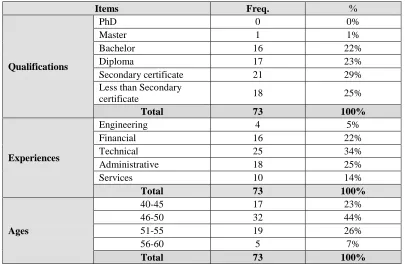
Descriptive analysis in table (1) shows that there are zero respondents from PhD holders, 1 (1%) was from master’s degree, 16 (22%) were from bachelor’s degree, 17 (23%) were from certificate/diploma, 21(29%) were from secondary school and 18 (25%) less than secondary certificate. Regarding the scope of experience, 4 (5%) respondents having experiences in engineering field, 16 (22%) in financial, 25(34%) technical experiences and 18 (25%) in the administrative field. Table (1) shows also the ages of respondents, majority of respondents a total of 32 (44%) were aged between 46-50 years old, (26% ) were aged between 51 - 55 and 23% were aged between 40 to 45 years old, 7%.were above 55 years old.
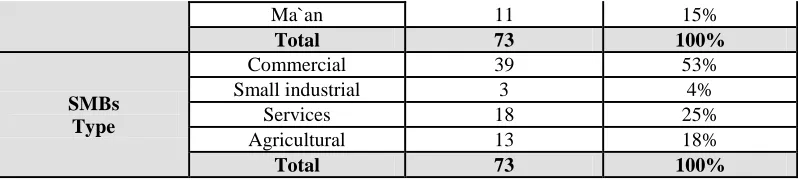
Table 2 shows that SMBs have been distributed to most provinces, (41%) in the Tafila province (15%) for each provinces Amman, Balqa and Ma`an. In respect to the project type, the study findings show that (53%) commercial, (25%) services, (18%) agriculture and (2%) small industrial.
Also, study findings show that 66% of respondents have reported that their SMBs failed for several reasons. 70% agreed that choosing of unprofitable considered the main reason for the failure of SMBs. In addition, they mentioned that insufficient capital, failure to clearly define and understand market, customers, and customers' buying habits and personal use of business funds played role in failure the projects.
24% of respondents stated that their SMBs are unrealistic, and they aim to get amount of money from the company, where they shut down the SMBs after receiving the amount of project support.
In considering the reasons for selection SMBs, the respondents have pointed out that market needs, opinion of colleagues and family, feasibility study and the years of experiences are the main reasons for selection the SMBs.
Hypothesis test
In this part, the researcher tested the hypothesis of the study.
H01: There is no significant difference in success
of SMBs for employees laid off based on age, education and experiences.
Table (3) shows the mean, standard deviations and inter-correlation matrix of the independent variables. The correlation matrix shows that there is positive correlation between the variables (age, education and experiences) and success of SMBs for employees laid off which is represented with the cumulative grade point average of the respondents. A look at the table reveals that though there is a positive relationship between age (0.904), education (0.240), experiences (0.105) and success SMBs, the relationship was not statistically significant.
To test whether the variables of (age, education and experiences) predict the success of SMBs of the respondents, multiple regression tools was employed. Table 4 shows that the combination of the three independent variables (age, education and experiences) in predicting the success of SMBs yielded a multiple regression (R) of 0.095 and R2 (adj) of 0.008. This implies that all the independent variables in this study accounts for only about 1% of the variance in the success of SMBs of the respondents. The F-ratio of the model is 0.519 and it is not significant. This shows that the variables did not significantly predict success of SMBs among the respondents who participated in this study.
To test for the predictive power of each of the independent variables, (age, education and experiences), their regression co-efficient was computed using t-ratio. The t-values are as follows experiences -.360, education 0.270 and age 1.179. All the variables were tested at 0.05 level of significance. Table 5 shows that none of the variables has significant influence on the success of SMBs.
Discussion and conclusion
36 communities. The current study aims to investigate the relationship between successes of SMBs for employees laid off based on age, education and. experiences and identify the main factors that contribute in success and failure SMBs for laid off. One hypothesis was developed to test the relationship between the independent variables (age, education and experiences) and the dependent variable (success of SMBs for staff laid off). To achieve the research objective, two types of analysis were performed. In general, the results indicated that there is a positive relationship between age education, experiences and success SMBs, the relationship was not statistically significant, in other word, age, education and experiences are not significant predictors of success of SMBs for laid off, . Also the study found that 66% of respondents revealed that their SMBs failed and 24% from SMBs are unrealistic, and shut down after receiving the financial support.
70% of respondents agreed that choosing a business that isn't very profitable the main reason for the failure of the SMBs, they mentioned that insufficient capital, failure to clearly define and understand market, customers, and customers' buying habits and personal use of business funds played role in failure the SMBs. Despite that this study has some limitations related to the low study sample. It can be argued that this study is open many avenues for the future research agenda. There is a fruitful opportunities for future research to investigate the effect. Since this study is considered one of the first studies in this field it must be taken as a starting point for researchers to build on and for companies to overcome the limitations.
The current study recommends continuing occupying the laid off empowerment programs and suggests projects relevant to their qualifications, experiences and skills. In addition, it’s necessary to generalize the idea of laid off empowering as this well help in minimizing the psychological, social, and economical negative consequences of downsizing. Furthermore, follow up and support lay off projects to ensure its continuity.
References
Al-Rfou, A. N. (2003). Evaluating the effect of downsizing strategies on corporate
performance in industrial Jordanian companies. PhD thesis, Amman Arab University for graduate studies, Jordan, Amman.
Al-Sawalqa, F. & Al-Rfou, A. N. (2012). Fairness of Financial Severance Package: Employees' Perspective in Jordan. European Journal of Economics, Finance and Administrative Sciences 45: 140-147. Charney, A. & Libecap, G. D. (2000). Impact of
Entrepreneurship Education: Kauffman Center for Entrepreneurial Leadership. JEDCO (2011). Jordan Enterprise Develop-ment
Corporation.
http://www.jedco.gov.jo/joomla/index.php? option=com_wrapper&view=wrapper&Ite mid=252&lang=en. Retrieved 10/11/2011. Jordanian Department of Statistics (2011).
Hashemite Kingdom of Jordan, http://www.dos.gov.jo/dos_home_e/main/in dex.htm. Retrieved 10/11/2011.
Kolvereid, L. (1996). Prediction of Employment Status Choice Inten-tions. Entrepreneurship Theory and Practice Fall , 47-57.
Kristiansen, S., Furuholt, B. & Wahid, F. (2003). Internet Cafe Entrepreneurs: Pioneers in Information Dissemination in Indonesia. The International Journal of Entrepreneurship and Innovation, 4(4): 251-263.
Lerner, M., Brush, C., & Hisrich, R. (1997). Israel Women Entrepreneur: An Examination of Factors Affecting Performance. Journal of Business Venturing, 12(4): 315-339. Mazzarol, T., T. Volery, N. Doss & V. Thein.
(1999). Factors Influencing Small Business Start-ups: A Comparison with Previous Research. International Journal of Entrepreneurial Behaviour and Research, 5(2): 48-61.
Ministry of Industry (2012). Hashemite Kingdom of Jordan
http://www.mit.gov.jo/tabid/476/Realities% 20of%20Industrial%20Sector%20in%20Jor dan.aspx. Retrieved 6/2/2012.
Mulhern, A. (1995). The SME Sector in Europe: A Broad Perspective. Journal of Small Business Management, 33(3): 83 -87. Reynolds, P. D., Hay, M., Bygrave, W. D., Camp,
Effectiveness the Laid-off Empowerment ...
37 Kauffman Center for Entrepreneurial Leadership, and London Business School. Sinha, T. N. (1996). Human Factors in
Entrepreneurship Effectiveness. The Journal of Entrepreneurship, 5: 23-39.
Soso, S. (2011).
http://alarabalyawm.batelco.jo/print.php?n ews_id=309189. Retrieved 6/2/2012.
Thibault, M. Wilcock, A. & Kanetkar, V. (2002). An Exploratory Study of Factors Influencing Sales Performance of Small and Medium–Sized Enterprises. Proceedings of the Administrative Sciences association of Canada.Winnipeg, Manitoba.
Tables
Table 1: Respondents Characteristics
Table 2: SMBs Characteristics
Items Freq. %
Qualifications
PhD 0 0%
Master 1 1%
Bachelor 16 22%
Diploma 17 23%
Secondary certificate 21 29%
Less than Secondary
certificate 18 25%
Total 73 100%
Experiences
Engineering 4 5%
Financial 16 22%
Technical 25 34%
Administrative 18 25%
Services 10 14%
Total 73 100%
Ages
40-45 17 23%
46-50 32 44%
51-55 19 26%
56-60 5 7%
Total 73 100%
Items Freq. %
SMBs Location
Amman 11 15%
Zarqa 2 3%
Balqa 11 15%
Irbid 2 3%
Madaba 2 3%
Karak 4 5%
38
Table 3: Inter-correlation matrix, means and standard deviation of the independent variables
(age, education and experiences) and the dependent variable (success of SMBs for laid off)
S. No. Variable Age Education Experiences C.G.P.A
1 Age 1
2 Education .201 1
3 Experiences .189 .624 1
4 Cumulative grade
point Average 904 .240 .105
5 Mean .67 2.34 20.94 2.35
6 Standard Deviation .47 .60 5.70 .70
N= 73 P> 0.05 level of significance
Table 4: ANOVA on Multiple Regression Analysis on Success of SMBs for laid off
Model D.F Sum of
squares
Mean
square F R
R2 (cal)
Standard
error Sign
Regression 3 0.771 0.257 0.519 0.95 0.008 0.7036 0.669
Residual 70 84.652 0.495
Total 73 85.423
Table 5: Testing the Significance of Regression Weights
Variable B Standard
error Beta t-ratio Sign
Experiences -3.338 E-03 .009 -.028 -.360 .719
Education 3.090 E-02 .115 .021 .270 .788
Age .105 .089 .090 1.179 .240
Constant 2.120 .352 6.017 .000
Ma`an 11 15%
Total 73 100%
SMBs Type
Commercial 39 53%
Small industrial 3 4%
Services 18 25%
Agricultural 13 18%