99
Volume 65 11 Number 1, 2017
https://doi.org/10.11118/actaun201765010099
IMPACT OF ADDED COLORED WHEAT
BRAN ON BREAD QUALITY
Lenka Machálková
1, Marie Janečková
1, Luděk Hřivna
1, Yvona Dostálová
1,
Joany Hernandez
1, Eva Mrkvicová
2, Tomáš Vyhnánek
3, Václav Trojan
31 Department of Food Technology, Faculty of AgriSciences, Mendel University in Brno, Zemědělská 1, 613 00 Brno,
Czech Republic
2 Department of Animal Nutrition and Forage Production, Faculty of AgriSciences, Mendel University in Brno,
Zemědělská 1, 613 00 Brno, Czech Republic
3 Department of Plant Biology, Faculty of AgriSciences, Mendel University in Brno, Zemědělská 1, 613 00 Brno,
Czech Republic
Abstract
MACHÁLKOVÁ LENKA, JANEČKOVÁ MARIE, HŘIVNA LUDĚK, DOSTÁLOVÁ YVONA, HERNANDEZ JOANY, MRKVICOVÁ EVA, VYHNÁNEK TOMÁŠ, TROJAN VÁCLAV. 2017. Impact of Added Colored Wheat Bran on Bread Quality. Acta Universitatis Agriculturae et Silviculturae Mendelianae Brunensis, 65(1): 0099–0104.
The impact of colored wheat bran addition on bread quality was tested on wheat varieties with purple pericarp (Konini, Rosso and Karkulka) and on a variety containing blue aleurone (Skorpion). The effect of 10 %, 15 % and 20 % bran addition on sensory evaluation, bread color and texture was compared to the characteristics of bread prepared from wheat variety Mulan. The addition of 10 % bran significantly increased the sensory evaluation scores of bread. Crumb characteristics were improved mainly by the addition of 10 % bran. Moreover, top-quality bread contained bran separated from wheat variety Konini.
Keywords: color wheat bran, sensory analysis, color, hardness
INTRODUCTION
Effort to increase the nutritional value of commercial bakery products is considered a worldwide trend. Important role is played by the antioxidant content which is able to eliminate free radicals (Vaculová et al., 2010, Pasqualone et al., 2015). Unusually-colored wheat kernels may be a possible source of these beneficial substances. These substances are provided by the varieties with the purple pericarp and blue aleurone (Bagheri, Seyedein, 2011; Vaculová et al., 2010).
The purple grain pericarp contains mainly 3-glucoside of cyanidin and peonidin-3-glucoside anthocyanins (Knievel et al., 2009). Aleurone layer of kernel with blue grain contents 3-the glucoside of delphinidin; that covers about the 41 % of the total amount of anthocyanins, and the 3-rutinoside of delphinidin (Abdel-Aal, Hucl 2003, Hosseinian et al., 2008; Knievel et al., 2009). Generally, the blue wheat grains tend to have higher anthocyanin contents,
compared with the wheat with purple pericarp (Martinek et al., 2012).
Due to the antioxidant activity of the anthocyanins and carotenoids on the caryopsis of the wheat; the wheat could be useful for use in food production (Trojan et al., 2010). The high content of anthocyanin reduce the risk of oxidative damage, increases the ability to bind heavy metals; and moreover, may prevent cardiovascular diseases, cancer, rheumatoid arthritis, neurodegenerative diseases and diabetes mellitus type 2 (Lutsey et al. 2007; Fang et al. 2002). It is also anticipated in synergistic effect with the vitamin C and some flavonoids (Hosseinian et al., 2008).
100 L. Machálková, M. Janečková, L. Hřivna, Y. Dostálová, J. Hernandez, E. Mrkvicová, T. Vyhnánek, V. Trojan
not in the flour (Kalač, 2003). The wheat with purple pericarp or blue aleurone is mainly used in wholemeal flours or by adding the bran during the processing (Kalač, 2003; Vyhnánek et al., 2015).
The use of wholemeal flour changes the taste when using traditional recipes (Vyhnánek et al., 2015). Flour obtained from purple wheat grains has been compared to standard white flour, and at a glance is impossible to observe a noticeable discoloration is impossible to noticed by naked eye due to the color agents remaining in the grinding of the bran. In the case of the wholemeal flours, this is an evident phenomena, as well as along the blend of dark purple flours on the crumb of the bread. On the other hand, the situation is different in blue wheat, where anthocyanins are found in the aleurone layer and only partially in the endosperm, resulting in white flour with blue-gray color (Hrušková et al., 2012). The application of purple pericarp and blue aleurone wheat in the production of bakery products has been tested in several experiments carried out by this department.
MATERIAL AND METHODS
The study was performed on colored wheat varieties Konini, Rosso and Karkulka with purple pericarp; and Skorpion with blue aleurone. The variety Mulan was used as control sample.
Bread preparation
Flour, semolina and bran were separate during milling process performed on laboratory mill Chopin CD1. Flour was blended with 10 %, 15 % and 20 % of bran obtained from the same variety. The formulas are presented in Tab. I. To prepare 500 g of the dough 7.5 g of salt, 5 g of sugar, 5 g of oil, 25 g of fresh yeast and 300 ml of water was used.
The dough was prepared by mixing all raw materials at once. The dough was kneaded in a dough kneader Zelmer Profi for about one minute. It was proofed at 32 ± 1 °C and humidity of 80 ± 5 % for 20 minutes. After the removal from the proofer, the dough was rested for 10 minutes and afterwards weighted. Then it was shaped into desired pieces weighing 80 g and allowed to rise again at 32 ± 1 °C and humidity of 80 ± 5 %, for 25 minutes. The pieces were sprinkled with water before being loaded into the oven and baked at 230 °C to 240 °C in a laboratory oven with a proofer (Poland). At
the beginning of the baking, the oven was steamed with 50 ml of water. The baking time was 20 minutes.
Sensory analysis of the bread
Unstructured verbal scales with 100 mm of length where the distance between points equals one centimeter were used. The sensory evaluation was carried out in a specialized laboratory under standard conditions (ČSN ISO 8586-1, ČSN ISO 8589). Simultaneously, determination of the color and texture of the samples was carried out.
Determination of the color
To determine the color of each sample the Konica Minolta Spectrophotometer CM-3500d (KONICA, Japan) was used. The following preferences were chosen: reflectance, geometry d/8 (the instrument measures the reflected light at an angle of 8°), SCE (specular component excluded – with the elimination of gloss), D 65 (illumination mode – 6,500 Kelvin), and aperture 30 mm. Lighness L*, ranging from 0 (black) to 100 (white), and color coordinates +a* to -a* (the axis running from red to green) and +b* to -b* when (axis from yellow to blue) were used to characterize the sample (Třešňák, 1999).
Texture analysis
Penetration test was performed on universal instruments – Tira Test (Type 27025). The chosen criteria for test were: flat end (extension type), 3 mm (diameter probe), 200 N (sensor force), v1 = 50 mm·min-1 (speed test), 10 mm (distance). The force required to push the probe to the desired depth of crumb was recorded. The texture measurement took place one hour after the samples were done baking.
Statistical analysis
The evaluation of the results was performed using MS Excel and the statistical evaluation was performed using the statistical program STATISTICA Version 12 – ANOVA (Analysis of variance with interactions, tested at the significant level of P < 0.05).
I: The formula used in bread making
Var. Variety 10 % 15 % 20 %
Flour (g) Bran (g) Flour (g) Bran (g) Flour (g) Bran (g)
1 Mulan 450 50 425 75 400 100
2 Skorpion 450 50 425 75 400 100
3 Konini 450 50 425 75 400 100
4 Rosso 450 50 425 75 400 100
RESULTS AND DISCUSSION
Sensory analysis
Most properties of the bakery and food products can only be assessed with the use of sensory techniques. Nowadays, the use of instrumental methods still is limited. The crispness, consistency during chewing and acceptability are just some of the complexly-assessable characteristics. These characteristics are essential for proper development of a new recipe (Kamel, Stauffer, 1993). Sensory quality of the food is included, together with the price, among the main parameters the consumer is taking into account when buying a product (Pokorný, 1993).
The usage of colored wheat for the production of functional foods, such as bakery products, has their own specific properties. The pigments are located in the caryopsis, requiring them to be added into the dough, but this may lead to a negative impact on some properties of the baking products (Liu, 2007). The addition of the bran into the dough impacts its behavior, because it retains more water. Likewise, the bread crumb is then less elastic and flexible (Bagdi et al., 2015). Thanks to the water absorption ability of the bran, the bakery products are able to keep more water. The sugars present in the fiber play an important role in bakery products (Kučerová
et al., 2014). The different additions of bran in the dough were significantly reflected in the sensory evaluation of the products (Tab. II).
Bread quality was generally improved by 10 % addition of bran. Likewise, the best result was achieved with the sample 3, in which the Konini variety was used. Furthermore, sensory quality of breads prepared from colored wheat was higher
than bread from the control sample. The use of a higher proportion of bran in the dough (15 – 20 %) deteriorated the sensory acceptability of the products. With the exception of varieties Konini then drop the sensory quality was at the color of wheat higher than in the control variant. Crumb elasticity, color, easy bite and mouth feel after a brief chewing, were evaluated as the best in bread prepared from flour with added bran separated from Konini variety. All breads prepared from color wheat and its bran have been acceptable for the panelists and, moreover, were rated by higher scores than bread prepared from the Mulan variety. The use of colored wheat in the bakery industry therefore has a considerable potential, not only on terms of health, but also through the sensory analysis. Similar results were obtained by Kučerová et al. (2014), comparing bakery products with 5 %, 10 %, 15 % and 20 % of added Skorpion and Rosso bran. Results of their sensory analysis showed that better rated products were achieved with Skorpion variety. Moreover, the data indicated that Skorpion variety with blue aleurone reached the highest score when 10 and 15 % of bran were added. Thus Skorpion seems to be more suitable for usage in bakery products than the variety Rosso with a purple pericarp. These conclusions, however, cannot be confirmed, as both varieties achieved almost the same score in our study.
Janečková et al. (2015) studied the impact of 10 % addition of bran separated from color wheat of varieties Konini, Rosso, Skorpion, UC66049. The panelists preferred the products with no added bran, moreover they preferred the addition of blue wheat.
II: The results of the sensory evaluation of bread with added color bran*
Variant
Shape
Crust-color Aroma
Crumb-elasticity
Crumb-color
Easy of bite
Mouth feel
Crumb-moisture Taste impressionOverall
% bran 1
10
7.76bcd 4.90ab 6.03abc 7.10ab 8.14bcd 7.87bc 6.98ab 5.93a 6.63ab 7.02abc
2 8.39bcd 5.00ab 6.72abc 6.36ab 8.36bcd 7.72bc 7.07ab 4.28a 7.21ab 7.40abc
3 7.33bcd 5.36ab 7.13bc 7.61b 8.78bcd 8.20bc 7.46b 4.92a 7.75b 8.21bc
4 7.96bcd 5.28ab 7.21bc 6.36ab 8.26bcd 7.63bc 6.93ab 4.64a 7.52ab 7.60bc
5 6.57abcd 6.58b 7.58bc 5.82ab 7.72bcd 7.58bc 6.92ab 5.27a 7.17ab 6.97abc
1
15
6.84bcd 4.48ab 5.16abc 4.76ab 5.79abc 6.08abc 5.80ab 6.57a 6.26ab 6.03abc
2 5.54ab 5.12ab 4.30a 4.46a 4.80a 5.58abc 4.92ab 5.14a 5.18a 5.12ab
3 5.70ab 5.14ab 4.63ab 5.87ab 5.98abc 6.08abc 5.84ab 5.15a 5.89ab 5.89abc
4 6.27abcd 5.50ab 5.16abc 4.34a 5.16ab 4.67a 5.20ab 4.75a 5.60ab 5.54ab
5 6.09abc 5.68ab 4.55ab 4.58a 5.87abc 4.99ab 4.54a 5.46a 5.18a 4.83a
1
20
6.55abcd 3.93a 5.92abc 4.10a 7.07abcd 6.50abc 5.73ab 6.23a 6.55ab 6.23abc
2 5.63abc 5.13ab 5.05abc 4.15a 6.68abcd 6.35abc 6.20ab 5.43a 6.53ab 6.00abc
3 4.12a 4.88ab 6.07abc 6.37ab 7.70abcd 7.77abc 7.00ab 6.53a 6.47ab 6.37abc
4 5.70abc 5.90ab 6.13abc 4.72ab 6.63abcd 6.57abc 5.90ab 5.75a 6.27ab 5.90abc
5 6.48abcd 5.85ab 4.97abc 3.90a 6.78abcd 5.73abc 5.85ab 6.08a 6.48ab 6.13abc
102 L. Machálková, M. Janečková, L. Hřivna, Y. Dostálová, J. Hernandez, E. Mrkvicová, T. Vyhnánek, V. Trojan
Color measurement
Spectrophotometric measurement of color is a suitable addition to sensory analysis. Darker color of bread prepared from colored wheat kernel was expected. But this hypothesis was not confirmed. Decisive is that where are the color pigments. How many passes into flour.
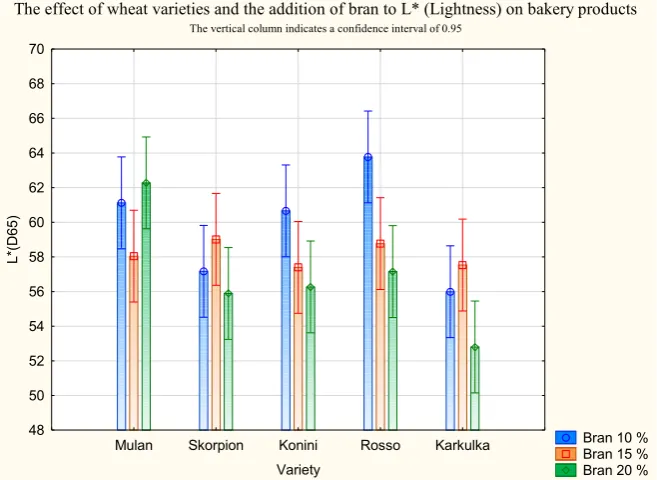
The palest products were obtained from the variety Rosso with the 10 % of bran (L* = 63.77) (Fig. 1). Similar values (L* = 60.7−61.1) were achieved by Mulan and Konini varieties. The varieties Skorpion and Karkulka were the darkest. The characteristic of the Skorpion variety through its pigments located primarily in the aleurone layer that stepped into the flour and apparently in Karkulka showed the technological quality of its raw materials. So, because of the color pigments, located in the casing layers of the grains, it was interesting that in the Konini and Rosso wheat varieties, more addition of bran decreased their brightness value (L*). For Skorpion and Karkulka varieties, were observed a temporary increase of L* in those samples that use a 15 % of bran. Finally, it was also observed that those samples that had used 20 % of bran, the bread was significantly darker than the bread made of the variety Mulan.
The darkest bread was produced after the addition of 20 % of Karkulka bran (L* = 52.8). This conclusion is consistent with what was found by Janečková
et al. (2015). In her experiments by the addition of colored wheat bran, clearly decreased the brightness of the samples. The average values after the addition of 10 % of bran reached L*(D65) = 55.86.
Kurek and Wyrwisz (2015) showed that the used of bran, as a dietary fiber, may also affect the concentration of melanoidins produced along the Maillard reaction, that cause the darkening of the final products.
Texture analysis
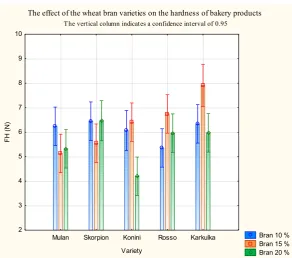
Texture properties are an indicator of the food quality (Nedomová, 2012). Hardness is a textural mechanical property measured as a force required to deform the product (Szczesniak, 2002). The highest value of hardness was achieved by the variety Karkulka with a 15 % of bran (7.92 N) (Fig. 2). The lowest resistance to penetration was achieved with the variety Konini with 20 % of bran (4.2 N), indicating low resistance of this product to the penetration. The purple wheat with a 15 % of bran was hard, while Mulan and Skorpion varieties were soft. The results obtained by Janečková et al., (2014) showed increasing addition of bran decreases crumb hardness. In this study, the results were not so clear; it was only valid in samples containing purple wheat with 15 % and 20 % of added bran. The similar results were previously published by Sivam et al. (2010) and Romano et al. (2011).
The effect of wheat varieties and the addition of bran to L* (Lightness) on bakery products The vertical column indicates a confidence interval of 0.95
Bran 10 % Bran 15 % Bran 20 % Mulan Skorpion Konini Rosso Karkulka
Variety 48
50 52 54 56 58 60 62 64 66 68 70
L*
(D
65
)
Fig. 1 The effect of wheat varieties by the addition of bran on L* (Lightness) on bakery
products
The effect of the wheat bran varieties on the hardness of bakery products
The vertical column indicates a confidence interval of 0.95
Bran 10 % Bran 15 % Bran 20 %
Mulan Skorpion Konini Rosso Karkulka
Variety 2
3 4 5 6 7 8 9 10
FH
(N)
Fig. 2 The effect of the wheat bran varieties on the hardness of bakery products
Impact of Added Colored Wheat Bran on Bread Quality 103
CONCLUSION
The results showed that the panelists prefer the sample which contains 10 % of bran; as well as all the varieties of colored wheat bran with the same content, and a slightly better assessment than the control variant. Also, the samples with 15 % and 20 % of bran did not get significantly worse results. In terms of sensory quality, it could be suggest that, the bakery products made of colored wheat, and its bran, are aimed towards a good direction to expand the bread offer in the market and besides to provide a positive effects on the human health.
Acknowledgement
This work was financially supported by the project IGA AF MENDELU no. TP 4/2015.
Bran 10 % Bran 15 % Bran 20 % Mulan Skorpion Konini Rosso Karkulka
Variety 48
50 52 54 56 58 60 62 64 66 68
L*
(D
65
)
Fig. 1 The effect of wheat varieties by the addition of bran on L* (Lightness) on bakery products
The effect of the wheat bran varieties on the hardness of bakery products The vertical column indicates a confidence interval of 0.95
Bran 10 % Bran 15 % Bran 20 % Mulan Skorpion Konini Rosso Karkulka
Variety 2
3 4 5 6 7 8 9 10
FH
(N)
Fig. 2 The effect of the wheat bran varieties on the hardness of bakery products
2: The effect of the wheat bran varieties on the hardness of bakery products
REFERENCES
ABDEL-AAL EL. S. M. and HUCL P. 2003. Composition and Stability of Anthocyanins in Blue-Grained Wheat. Journal of agricultural and Food Chemistry, 51(8): 2174–2180.
BAGDI A., TÓTH B, LÖRINC R., SZENDI S., GERE A., KÓKAI Z., SIPOS L. and TÖMÖSKÖZI S. 2015. Effect of Aleurone-Rich Flour On Composition, Baking, Textural, And Sensory Properties of Bread. LWT – Food Science and Technology, 65(1): 762–769
BAGHERI R. and SEYEDEIN S. M. 2011. The Effect of Adding Rice Bran Fibre on Wheat Dough Performance and Bread Quality. World Applied Sciences Journal(Special Issue of Food and Environment), 14: 121–125.
ČESKO. 1997. Zákon č. 110 ze dne 12. prosince 1997 o potravinách a tabákových výrobcích a doplnění některých souvisejících zákonů, pro mlýnské obilné výrobky, těstoviny, pekařské výrobky a cukrářské výrobky a těsta (Vyhláška č. 333/1997 Sb.) In: Sbírka zákonů České republiky. Částka: 111/1997.
FANG Y-Z., YANG S. and WU G. 2002. Free radicals, antioxidants, and nutrition. Nutrition,18(10): 872–879. HOSSEINIAN F. S., LI W. and BETA T. 2008. Measurement of anthocyanins and other phytochemicals in
purple wheat. Food Chemistry, 109 (4): 916–924.
HRUŠKOVÁ M., ŠVEC I., JURINOVÁ I. and TOMÁŠEK I. 2012. Hodnocení nových odrůd potravinářské pšenice se žlutým endospermem. Mlynářské noviny XXIII., 1(141): 4–6.
JANEČKOVÁ M., HŘIVNA L., JŮZL M., NEDOMOVÁ Š., VYHNÁNEK T., TROJAN V. and MRKVICOVÁ E. 2014. Possibilities of using purple wheat in producing bakery products. In: MendelNet 2014: Proceedings of International PhD Students Conference. Mendel University in Brno, 19-20 November. Brno: Department of Food Technology, Mendel University in Brno, 412–416.
104 L. Machálková, M. Janečková, L. Hřivna, Y. Dostálová, J. Hernandez, E. Mrkvicová, T. Vyhnánek, V. Trojan
industry. In: MendelNet 2015: Proceedings of International PhD Students Conference, Mendel University in Brno, 11-12 November. Brno: Department of Food Technology, Mendel University in Brno, 350–355.
KALAČ P. 2003. Funkční potraviny: kroky ke zdraví. 1st edition. České Budějovice: DONA. KAMEL B. S. and STAUFFER C. E. 1993, Advances in Baking Technology, 1st ed, Springer US.
KNIEVEL D. C., ABDEL-AAL E. S. M., RABALSKI I., NAKAMURA T. and HUCL P. 2009. Grain color development and the inheritance of high anthocyanin blue aleurone and purple pericarp in spring wheat (Triticum aestivum L.). Journal of cereal science, 50(1): 113–120.
KUČEROVÁ J., HŘIVNA L., ŠOTTNÍKOVÁ V., JANEČKOVÁ M. and DOSTÁLOVÁ Y. 2014. Pekařské pokusy z pšeničné mouky s přídavkem otrub barevných pšenic. Úroda, 12: 481–484.
KUREK M. and WYRWISZ J. 2015. The Application of Dietary Fiber in Bread Products. Journal Food Processing&Technology, 447(6): 74–80.
LIU R. H. 2007. Whole grain phytochemicals and health. Journal of Cereal Science, 46(3): 207–219.
LUTSEY P. L., JACOBS D. R., KORI J. S., MAYER-DAVIS E., SHEA S. and STEFEN L. M. 2007. Whole grain intake and its cross- sectional association with obesity, insulin resistance, inflammation, diabetes and subclinical CVD: The MESA study. British Journalof Nutrition, 98(2): 397–405.
MARTINEK P., ŠKOPÍK M., CHRPOVÁ J. and FUČÍK P. 2012. Skorpion – odrůda ozimé pšenice s modrým zrnem. Obilnářské listy, 20(3): 78–79.
NEDOMOVÁ Š. 2012. Texturní vlastnosti potravin. CHEMPOINT. [Online]. Available at: www.chempoint. cz/texturni-vlastnosti-potravin [Accessed: 2014, January 28]
PASQUALONE A., BIANCO A. M., PARADISO V. M., SUMMO C., GAMBACORTA G., CAPONIO F. and BLANCO A. 2015. Production and characterization of functional biscuits obtained from purple wheat,
Food Chemistry, 180: 64–70.
POKORNÝ J. 1993. Metody senzorické analýzy potravin a stanovení senzorické jakosti. 2nd edition, Praha: ÚZPI ROMANO A., TORRIERI E., MASI P. and CAVELLA S. B. 2011. Effects of dietary fiber on structure formation
in bread during baking process. Journal of Cereal Science, 49(2): 190–201.
SIVAM S. A., SUN-WATERHOUSE D., QUEK S. Y. and PERERA C. O. 2010. Properties of Bread Dough with Added Fiber Polysacharides and Phenolic Antioxidants: A Review. Journal of Food Science. 75(8): 163–174. SZCZESNIAK A. S. 2002. Texture is a sensory property. Food Quality and Preference, 13 (4): 215–225.
TROJAN V., MUSILOVÁ M., VYHNÁNEK T. and HAVEL L. 2010. The genetic variability of coloured grain wheat collection. MendelNet 2010: Proceedings of International PhD Students Conference, Mendel University in Brno, 24 November. Brno: Department of Food Technology Mendel university in Brno, s. 845-851
TŘEŠŇÁK, K. 1999. Barvy a barevné modely. Svět tisku, 6: 58-60.
ÚNMZ. 2011. Senzorická analýza. Obecná směrnice pro výběr, výcvik a sledování činnosti vybraných posuzovatelů a odborných senzorických posuzovatelů. ČSN ISO 8586. Praha: Úřad pro technickou normalizaci, metrologii a státní zkušebnictví.
ÚNMZ. 2011. Senzorická analýza. Obecná směrnice pro uspořádání senzorického pracoviště. ČSN ISO 8589. Praha: Úřad pro technickou normalizaci, metrologii a státní zkušebnictví.
VACULOVÁ K., JIRSA O., MARTINEK P. and BALOUNOVÁ M. 2010. Hodnocení kvality zrna vybraných vzorků netradiční pšenice a bezpluchého ječmene. Obilnářské listy: Odborný časopis pro zemědělskou veřejnost, 18(3): 71–77.
VYHNÁNEK T., TROJAN V., ŠTIASTNA K., PRESINSZKÁ M., JAKUBCOVÁ Z., ŠŤASTNÍK O., KARÁSEK F., JANEČKOVÁ M., DOSTÁLOVÁ Y., MRKVICOVÁ E., HŘIVNA L., MARTINEK P. and HAVEL L. 2015. Barevné pšenice – genetika a možnosti zpracování, Fulltextový sborník XLI. Konference o jakosti potravin a potravinových surovin. Mendelova univerzita v Brně, 22–28.