VOLUME 1
PERI-TRAUMATIC VERBAL PROCESSING
AND THE DEVELOPMENT
OF INTRUSIONS
RICHARD G. HENNESSY
JUNE, 2002
Submitted in partial fulfilment for the requirements for the degree
of Doctor in Clinical Psychology (DClinPsy),
ProQuest Number: U642566
All rights reserved
INFORMATION TO ALL USERS
The quality of this reproduction is dependent upon the quality of the copy submitted. In the unlikely event that the author did not send a complete manuscript and there are missing pages, these will be noted. Also, if material had to be removed,
a note will indicate the deletion.
uest.
ProQuest U642566
Published by ProQuest LLC(2015). Copyright of the Dissertation is held by the Author.
All rights reserved.
This work is protected against unauthorized copying under Title 17, United States Code. Microform Edition © ProQuest LLC.
ProQuest LLC
789 East Eisenhower Parkway P.O. Box 1346
ACKNOWLEDGEMENTS
I wish to sincerely thank:
Dr Emily Holmes for her invaluable guidance, enthusiasm and attentiveness.
Professor Chris Brewin for his inspiration and suggestions.
Pasco Fearon for his help and advice.
My parents Vivien and Patrick and my sister Alison for their consistent support.
My “non-psychology” friends for their confidence and sense o f perspective (especially Jim, Rachel, Mike, Rich and Rob).
My fellow trainees for humour in the face o f thesis, especially Ailsa and Louise.
TABLE OF CONTENTS
ABSTRACT... 1
INTRODUCTION... 2
Aims of the current study... 2
Post-traumatic stress disorder (PTSD)... 4
Features of PTSD... 4
Intrusions in PTSD... 5
Individual reactions to trauma... 5
Theoretical models of PTSD... 7
Single level models... 7
Horowitz’s Formulation of Stress Response Syndromes... 7
JanofF-Bulman’s Cognitive Appraisal Theory... 8
Foa’s Fear Network... 9
Dissociation... 10
Dual Representation Theory... 12
Ehlers and Clark’s cognitive model of PTSD... 17
Conceptual processing and Dual Representation Theory... 19
Experimental investigation of the development of intrusions... 20
The distressing film as a trauma analogue... 20
The concurrent visuospatial tapping task... 21
Further experimentation using a distressing film... 23
Early research on the role of verbal processing... 24
Other experimentation using concurrent tasks... 25
Summary of key empirical findings... 28
Prior findings and the current study... 28
Predictions from Dual Representation Theory... 30
Inhibited peri-traumatic verbal processing... 30
Enhanced peri-traumatic verbal processing... 31
Summary of main predictions... 33
Experimental investigation of the thesis hypotheses... 34
Peri-traumatic verbal processing... 34
Peri-traumatic tasks... 35
Verbal distraction... 35
Verbal enhancement... 35
Summary of hypotheses... 37
Intrusion quantity... 37
Intrusion quality... 37
Conceptual processing... 38
Attention and memory... 38
Peri-traumatic verbal processing... 39
METHOD... 40
Participants... 41
Experimenter... 41
Apparatus... 41
Equipment... 41
Computer software... 42
Task compliance monitoring... 42
Procedure... 43
Summary of measures... 43
Intrusion quantity and quality... 43
Diary compliance rating... 43
Intrusion description questionnaire... 43
Verbal task performance... 45
Expectations regarding effects of the verbal tasks... 47
Attention... 47
Memory... 47
Emotion and distress... 48
Peri-traumatic state dissociation... 48
Trait dissociation... 49
Exposure to trauma history... 49
Personal relevance of car crashes... 49
Talking, thinking and avoiding thinking about the film... 50
Fear of blood and injury... 50
Initial contact... 50
Main experiment... 50
Randomisation of condition... 50
Introduction and information exchange... 51
Experimental task instructions... 51
Pre-film measures... 52
Viewing of the film... 53
After the film... 55
Intrusion diary... 55
RESULTS... 57
Missing data and outliers... 58
Missing data... 58
Treatment of outliers... 58
Comparability of groups... 59
Participant details... 59
Initial measures and experimental groups... 60
Correlations between initial measures and dependant variables... 62
Results of main experiment and follow-up... 65
Experimental effects... 65
Intrusions... 65
Intrusion meaning... 70
Peri-traumatic task performance... 71
Attention and memory... 76
Emotion, distress and dissociation... 78
Correlation between state dissociation and dependent variables... 80
DISCUSSION... 82
Comment on each hypothesis... 83
Intrusion quantity... 83
Intrusion quality... 87
Conceptual processing... 89
Attention and memory... 91
Peri-traumatic verbal processing... 93
Emotion, distress and dissociation... 94
Other findings of note... 95
Summary of main findings... 96
Theoretical implications... 97
Effects of verbal versus visuospatial concurrent tasks... 97
Conceptual processing and intrusion-inhibiting VAMs... 99
Peri-traumatic verbal processing and traumatic “hot-spots”... 102
Attention and explicit memory... 102
Emotion and distress... 103
State dissociation... 103
Clinical implications... 105
Verbal distraction and verbal enhancement... 105
1 ) Elaboration and integration of VAMs... 107
2) Problematic appraisals and pre-existing beliefs... 109
3) Dysfunctional cognitive and behavioural coping strategies... 110
Traumatic hot-spots... I ll Assessment and understanding... 112
Limitations of the study... 114
External validity of trauma analogues... 114
Verbal enhancement task instructions... 115
Assessment of conceptual processing... 116
Coding of verbal task performance... 117
Measurement of verbal ability... 117
Future research... 118
New peri-traumatic verbal enhancement tasks... 118
REFERENCES... 120
APPENDICES... 128
Appendix 1: Video tape commentary... 128
Appendix 2: The Dissociation State Subscale (DSS)... 129
Appendix 3: The Trait Dissociation Questionnaire (TDQ)... 133
Appendix 4: Traumatic experiences questionnaire... 136
Appendix 5: Mood ratings... 138
Appendix 6a: Intrusion diary - front page... 139
Appendix 6b: Intrusion diary - daily form (7 provided)... 140
Appendix 7a: The Recall Memory Questionnaire... 141
Appendix 7b: The Recognition Memory Questionnaire... 142
Appendix 8: The Intrusion Description Questionnaire... 144
Appendix 9a: Information form... 146
Appendix 9b: Consent form... 147
Appendix 10: Missing data and outliers... 148
ABSTRACT
INTRODUCTION
Post-traumatic stress disorder (PTSD) has become the focus o f considerable research interest in recent years leading to the elaboration o f theoretical frameworks o f how individuals react to traumatic experiences and how best to intervene with those who present to services. Clinicians and researchers have argued that there is a need for the further development o f models that can explain how the various factors understood as relevant to the development and maintenance o f PTSD interact with each other and how the varied reactions to traumatic events come to be manifested. Naturally, cognitive models that attempt to account for some or all o f the phenomena associated with reactions to trauma are valuable in understanding PTSD and in the development, evolution and evaluation o f cognitive behavioural interventions. One such model is Dual Representation Theory (Brewin, Dalgleish & Joseph, 1996) and it is the aim o f this thesis to test some predictions o f this framework and to explore its implications for theory and treatment.
Aims of the current study
Recent research into PTSD has focused on the relationship between peri-traumatic psychological processing (i.e. processing during a traumatic event) and the subsequent development o f intrusions \ As peri-traumatic processing can only be investigated retrospectively in the case o f naturally occurring trauma, researchers have used the distressing film as an experimental analogue for real-life traumatic experiences to allow experimenters to study the theoretical implications o f how what happens during distressing events effects the development o f intrusions
afterwards. Intrusions, especially intrusive imagery, have been focused on due to their status as the hallmark symptom, and treatment focus, o f PTSD since its official recognition as a psychiatric disorder (see DSM-111; A?A, 1980).
Dual Representation Theory (Brewin et al, 1996) suggests that the intrusions that occur in PTSD arise because trauma memories have been encoded into a primarily non-verbal form at the time o f the traumatic event. Such memories lack a coherent narrative, are rich in sensory detail and are cued into consciousness by situational cues rather than voluntary processes. Therefore, Dual Representation Theory predicts that the efficiency of verbal processing during a traumatic event (i.e. “peri- traumatic verbal processing”) will be related to the development and frequency o f intrusions afterwards. The current study tests this prediction by manipulating the efficiency o f peri-traumatic verbal processing across groups to allow a comparison o f the quantity and quality o f intrusions recorded in a diary within a one-week period after viewing a distressing film featuring the aftermath o f road-traffic accidents. Participants are assigned to one o f three different conditions including verbal distraction, verbal enhancement and a no-task control condition.
Post-traumatic stress disorder (PTSD)
Features of PTSD
A diagnosis o f PTSD using I CD-10 (International Classification o f Diseases and Health Related Problems, Tenth revision, 1992, p. 168) requires that an individual have been exposed to a “stressful event or situation (either short- or long-lasting) o f exceptionally threatening or catastrophic nature, which would be likely to cause pervasive distress in almost anyone”. Therefore, although predisposing factors such as personality traits or history o f mental illness may lower the threshold for developing the disorder, such factors are neither necessary nor sufiQcient to explain the occurrence o f PTSD which hinges on memories o f normatively traumatising events such as assault, rape and road-trafiSc accidents.
Intrusions in PTSD
Prior to official recognition of PTSD, accounts o f traumatic stress reactions have often included vivid accounts o f intrusive thoughts and images (e.g. Kardiner, 1941). Salkovskis (1990, p. 91) defines intrusions as “mental events which are perceived as interrupting a person’s stream of consciousness by capturing the focus o f attention” and notes, “These cognitive events can take the form o f verbal thoughts, images or impulses or some combination o f the three”. Similarly, Rachman (1989) states that intrusions intrude into consciousness, interrupt ongoing activities, are difficult to control but are attributed to an internal origin.
Intrusions tend to feature physiological reactivity, psychological distress, more prominent perceptual features than normal autobiographical memories and contextual distortions that involve acting or feeling as if the event were happening again (Tromp, Koss, Figueredo & Tharan, 1995).
Individual reactions to trauma
Theoretical models of PTSD
Single level models o f PTSD assume that trauma memories are represented in a unitary form with all aspects o f the trauma represented together in some form of “fear memory” that is poorly integrated with higher-level meaning structures. Although unitary models account for some o f the phenomena associated with PTSD, it will be shown that Dual Representation Theory, as a multi-level model o f trauma representations, is capable o f providing a more comprehensive account of the full range o f PTSD phenomena.
Single Level models
Some o f the more influential single level models o f PTSD will be summarised to provide relevant background to theorising in this area and to allow comparison with the multi-level Dual Representation Theory.
Horowitz’s Formulation of Stress Response Syndromes
“active memory” where it gives rise to re-experiencing symptoms at points when psychological defences break down, leading to oscillation between intrusions and denial-numbing defences as the completion tendency attempts to integrate the trauma with prior knowledge.
Horowitz model holds considerable explanatory power but fails to account for why some individuals develop PTSD while others who experienced similar events do not, what peri-traumatic factors might account for such individual differences or how “active memory” relates to normal autobiographical representations.
Janoff-Bulman’s Cognitive Appraisal Theory
Similarly to Horowitz, Janofif-Bulman (1985, 1992; Janofif-Bulman & Frieze, 1983) relates PTSD to incongruence between the meaning an individual attaches to a traumatic event and their pre-existing beliefs. However, cognitive-appraisal theory goes further to suggest PTSD arises from the “shattering” of basic assumptions about the self and the world such as the assumption o f personal invulnerability, the perception o f the world as meaningful and the view o f the self in a positive light. Although this model is applicable to cases where individuals held such beliefs prior to trauma, it holds little explanatory power in the cases where trauma serves to confirm pre-existing negative beliefs and fails to specify cognitive architecture through which “shattering” occurs.
Foa’s Fear Network
between the feared stimuli, physiological and behavioural responses, and verbally accessible appraisals, thereby accounting for why any stimulus associated with the trauma can activate the entire constellation of responses. When activated by cues the information enters consciousness in the form o f intrusions leading to attempts to avoid reminders and suppress thoughts that maintain and exacerbate re- experiencing symptoms.
Dissociation
The experience o f peri-traumatic dissociation is often referred to in clinical literature as a factor that increases individual’s vulnerability to developing PTSD (Foa & Hearst-Ikeda, 1996; Foa & Riggs 1993; van der Volk & van der Hart, 1989). Dissociation has often been characterised as a “defence mechanism” that helps an individual cope during the trauma through stress-reduction due to a sense o f detachment and unreality but, for the same reasons, interferes with processing o f the experience and exacerbates post-trauma pathology (van der Kolk and van der Hart, 1989; Foa and Hearst-Ikeda, 1996).
Dual Representation Theory
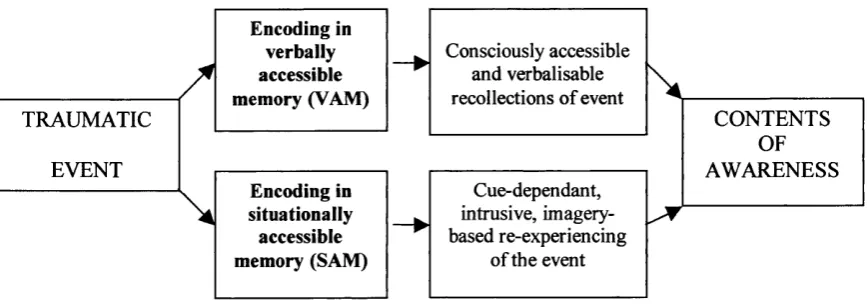
The notion that two fundamentally distinct types o f memory for traumatic events was first suggested by Janet (1904) who distinguished between traumatic memories and ordinary narrative memories. Similarly, Pillemer, Desrochers and Ebanks (1997) have distinguished between narrative-based ordinary memories and image- based memories that have the quality o f “re-living”. Unlike single level models. Dual Representation Theory (DRT) (Brewin, Dalgleish & Joseph, 1996) suggests that traumatic memories can be stored in two distinct representational formats:
verbally accessible memory (VAM) and situationally accessible memory (SAM).
In contrast, SAM only contains information from processing at the time o f the trauma, cannot be deliberately accessed, is difficult to control being dependent on internal or external cues, is difficult to communicate to others and contains extensive sensory information from lower-level perceptual processing (i.e. imagery which has received little conscious processing and autonomic and motor responses occurring at the time o f the trauma). Crucially, SAM supports imagery-based re- experiencing symptoms and may promote distortions in personal context, such as feeling or acting as if the trauma is re-occurring in the present. The contextual distortions that arise during SAM-based re-experiencing symptoms results from its lack o f integration within long-term, autobiographical memory structures which normally contextualise memories o f personal experience. Furthermore, traumatic memories (i.e. SAM-based intrusions) may not change to any significant extent despite multiple retrievals (van der Kolk & van der Hart, 1991).
Figure 1. An illustration o f Dual Representation Theory applied to PTSD phenomenology (based on Brewin et al.. 1996).
TRAUMATIC
EVENT
Encoding in
verbally Consciously accessible
accessible and verbalisable
memory (VAM) recollections of event
\
Encoding in Cue-dependant,
situationally __^ intrusive,
imagery-accessible based re-experiencing
memory (SAM) of the event
CONTENTS OF AW ARENESS
reducing the degree o f sensory information attached to the memory and, therefore, the degree o f subjective, imagery-based “re-living” attached to the experience.
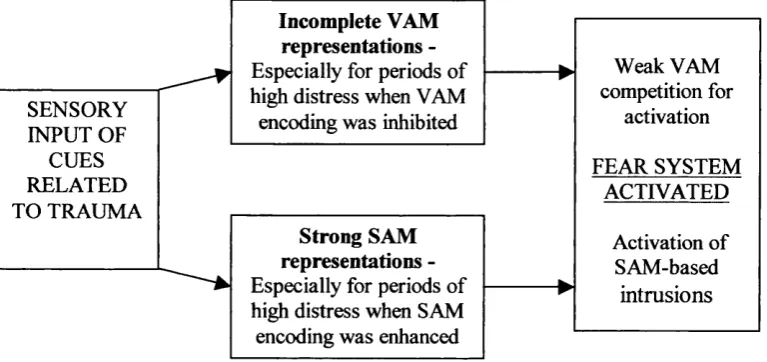
Figure 2. The completeness o f verbally accessible memory (VAM) in comparison to situationally accessible memory (SAMI and the activation o f the fear system (based on Brewin. 2000).
(a) Incomplete VAM representation - fear system activated:
SENSORY INPUT OF CUES RELATED TO TRAUMA Strong SAM representations
-Especially for periods of high distress when SAM encoding was enhanced
Incomplete VAM representations
-Especially for periods of h i ^ distress when VAM encoding was inhibited
FEAR SYSTEM Weak VAM competition for activation ACTIVATED Activation of SAM-based intrusions
(b) Complete VAM representation - fear system inhibited:
SENSORY INPUT OF CUES RELATED TO TRAUMA Complete VAM representations
-For all periods from the traumatic experience
Strong SAM representations
-Especially for periods of
FEAR SYSTEM Strong VAM competition for
activation
INHIBITED Little or no activation of
Therefore, Brewin (2000, p. 17-18) suggests that the frequency o f SAM-based intrusive memories experienced by an individual is likely to depend on the extent o f the discrepancy between the amount o f information coded into verbally and situationally accessible forms o f memory. As this depends on the efiBciency o f verbally accessible memory during critical periods o f the trauma, any peri-traumatic manipulation that affects the efficiency o f VAM can be predicted to affect the number o f intrusive memories that are experienced.
It is also suggested that with repeated re-activation o f the VAM system a more stable, permanent representation of the trauma will be consolidated that can exert the appropriate inhibitory influence on the fear system quickly and efficiently without the need for the VAM representation to be reconstructed each time the person encounters a trauma reminder (Brewin, 2001).
Ehlers and Clark*s cognitive model of PTSD
From a DRT perspective, the first point (excessively negative appraisals) relates to the content o f VAM representations o f the trauma regarding its meaning to the individual. Brewin (2001) suggests that problems arise when individuals fail to “repeatedly process and compare pre-trauma and post-trauma information within the VAM system” and that this failure to integrate trauma appraisals with pre existing beliefs can lead to “catastrophic interference with previous beliefs and assumptions”. The second point (disturbance o f autobiographical memory characterised by poor elaboration and contextualisation, strong associative memory and strong perceptual priming) may be understood in DRT terms as relating to poorly elaborated and integrated VAMs combined with strong, easily triggered SAM representations.
Conceptual processing and Dual Representation Theory
Brewin et al.’s (1996) model gives rise to the question o f precisely what kind of cognitive processing is likely to give rise to strong VAM representations. As described above, according to DRT this simply requires the association o f retrieval cues with VAMs that were previously only associated with SAMs. Ehlers and Clark (2000) go fiirther and use Roediger’s (1990) distinction between conceptual and data-driven processing to suggest that the inhibition o f intrusions requires greater in-depth processing o f the meaning and context o f the trauma.
Experimental investigation of the development of intrusions
The distressing film as a trauma analogue
Murray (1997) experimentally examined the relationship between what happens during the encoding o f a distressing event and the development o f intrusions afterwards. As this can only be examined retrospectively with naturally occurring PTSD, he used a distressing film (containing footage o f the aftermath o f road-trafific accidents) as an experimental analogue to real-life trauma and attempted to manipulate participants’ levels o f peri-traumatic dissociation. Murray predicted that the dissociation group would report lower levels o f initial distress but a higher level o f spontaneous intrusions over a two-week follow-up period than those in a no-task control condition.
His dissociation condition involved describing dissociation to the participants and asking them to attempt to dissociate voluntarily by self-inducing a state of emotional numbness. Contrary to predictions, he found no differences between conditions and attributed this to the inabihty o f participants to dissociate voluntarily under laboratory conditions. However, in another experiment Murray did find that Trait Dissociation, measured using his Trait Dissociation Questionnaire, predicted the development o f intrusive memories.
The concurrent visuo-spatial tapping task
demonstrate the effect o f an experimental analogue o f dissociation on participants’ memory intrusions for a distressing film. The dual task involved tapping repetitive sequences on a hidden key-pad (Moar, 1978). They predicted that a concurrent visuo-spatial tapping task would approximate the decrement in conscious processing that exemplifies dissociation and, therefore, lead to more intrusions in their dissociation group compared to a no-task control. Brewin and Saunders made this prediction on the basis that the visuo-spatial task would mimic real-life dissociation by “reducing the amount o f attention and conceptual processing given to the traumatic scene and hence leading to less well-organised memory records and greater numbers o f memory intrusions over the following days” (2001, p. 468).
Contrary to predictions, the concurrent task actually exerted a highly significant protective effect as the dissociation group recorded less intrusions than the control group, indicating that their divided attention paradigm was a poor analogue o f the kind o f dissociation encountered during traumatic events. Regarding the unexpected protective effect o f the visuospatial tapping task, Brewin and Saunders reject the possibility that this finding might be the result o f less information about the film being encoded in the dual-task group on the basis that scores on an explicit memory questionnaire for the film did not differ between groups and also state that the finding was unlikely to be the result o f arousal as level o f distress did not differ either.
performance o f the primary task are used to determine the extent to which the two task utilise the same cognitive resources (Brook, 1968). The concurrent use o f the Moar box tapping task (which requires visuo-spatial resources related to maintaining a mental representation o f the pattern to be tapped) has been found to disrupt imagery (Baddeley, 1990) and to reduce the vividness and emotiveness of traumatic imagery (Andrade, Kavanagh & Baddeley, 1997) indicating that the tapping task competes for resources with the visuo spatial sketchpad component of working memory and, thus, inhibits the creation and maintenance o f imagery. Therefore, Brewin and Saunders suggest that their finding supports the hypothesis that at least some PTSD intrusions are mediated by an imagery-based memory system and that the protective effect o f the tapping task was due to it’s capacity to compete for visuo spatial processing resources leading to the encoding o f the trauma in a less vivid and less emotive form. Clearly, this account is supportive o f dual representation theory as summarised in Brewin and Saunder’s suggestion that “the tapping task may selectively interfere with encoding into situationally accessible memory, resulting in a reduction in intrusions, while leaving intact encoding into verbally accessible memory, so that explicit recall o f the film is unimpaired” (2001, p. 471).
Further experimentation using a distressing film
Holmes (2000) also used the stressful film and one-week intrusion diary approach to explore peri-traumatic processes in intrusion development. The first experimental condition used a modified visuo-spatial Moar box, tapping task while the second experimental condition employed a dot-staring staring task intended to induce dissociation. All participants heard a description o f dissociation and were screened for their ability to dissociate in response to the dot-staring task before being randomly assigned to the experimental conditions or a no-task control group. Additionally, Holmes elaborated the distressing film approach by drawing on findings fi"om recent research that has employed psycho-physiological measures in the study o f PTSD. Heart rate drops were used as an objective indication o f state dissociation on the basis o f research showing a relationship between drops in heart rate and high peri-traumatic dissociation among rape-victims (Griffin, Resick & Mechanic, 1997).
(1997) finding that trait dissociation predicts intrusion rates by demonstrating that subjectively measured state dissociation independently predicts intrusion development. The finding that peri-traumatic moments o f dissociation were associated with subsequent intrusive thoughts emphasises the importance o f peri- traumatic “hot-spots” within trauma representations (Holmes, 2000).
It is possible that the relationship between peri-traumatic dissociation and the development o f intrusions is mediated by impairment in the efiSciency o f verbal processing. Dual Representation Theory predicts that impairment in the efiSciency o f verbal processing during trauma for any reason (including dissociation) will increase the likelihood o f subsequent PTSD symptomology.
Early research on the role of verbal processing
Interestingly, intellectualisation led to less distress during the film, as indicated by skin conductance and heart rate, and involved participants reminding themselves it was just a film, attributing blame, thinking about technical aspects and finding humour in the events (Koriat, Melkman, Averill and Lazarus, 1972).
From a contemporary theoretical perspective, it can be argued that the distress reducing effect o f the intellectuahsation condition was due to enhanced conceptual processing of the film leading to better elaborated VAM representations in contrast to the control condition, where participants would have been fi'ee to avoid processing o f the trauma, and the denial condition, where denial o f the reahty o f the footage may have inhibited conceptual processing and VAM encoding. However, the lack o f any measures o f post-film development o f intrusions in these studies of peri-traumatic verbal encoding means the post-traumatic impact o f enhanced verbal/ conceptual processing during trauma is an area o f speculation in previous hterature and an area o f enquiry for the current thesis.
Other experimentation using concurrent tasks
They also predicted that during flashback periods participants would should greater amounts o f observable autonomic and motor activity.
To test these predictions, Hellawell and Brewin described the clinical phenomenology o f flashbacks to patients with PTSD and asked them to write a detailed narrative of their traumatic experience. Afterwards, they were asked to retrospectively identify periods in the narrative when flashbacks occurred and periods o f normal memory. Participants performed the verbal and visuospatial cognitive tasks prior to the trauma narrative, following a period o f ordinary memory in the trauma narrative, following a period o f flashback in the trauma narrative, and at the end o f the trauma narrative. The visuospatial task used was the trail making test which forms part o f the Halstead Battery (Reitan & Wolfson, 1985) and the verbal task was the commonly used oral subtraction task o f counting backwards in threes from a specified number. Hellawell and Brewin confirmed the prediction that flashbacks selectively competed for visuospatial resources compared to ordinary memory (as indicated by poorer performance on the trail making test) but did not find that the two types o f memory differed in their utilisation o f verbal resources (as indicated by performance on the oral subtraction task). They also confirmed that flashbacks were associated with greater autonomic arousal and motor behavioural associated with re-living experiences.
Summary of key empirical findings
Research using the stressful film paradigm has demonstrated: the intrusion-reducing effect o f a peri-traumatic visuo-spatial tapping task (Brewin & Sanders, 2001; Holmes, 2000); the selective use o f visuo-spatial cognitive resources during re- experiencing (Hellawell & Brewin, 2001); a connection between verbal processing and peri-traumatic stress (Lazarus, Opton, Nomikos and Ramkin, 1965); and the capacity o f both subjective (DSS change) and objective (heart rate change) naturally occurring, peri-traumatic dissociation to independently predict intrusion development (Holmes, 2000).
Prior findings and the current study
The studies conducted so far have tended to emphasise experimental manipulations intended to either promote dissociation (i.e. inhibiting the formation o f VAMs) or compete for visuo-spatial resources (i.e. inhibiting the formation o f SAMs). No study has directly explored the impact o f enhanced or inhibited peri-traumatic verbal processing o f trauma in relation to the subsequent development o f intrusive memories. As stated earlier, the primary aim o f this study is to test the prediction o f Dual Representation Theory (DRT) that the number o f SAM-based intrusions a person experiences post-trauma is related to "the efGciency o f verbally accessible memory during critical periods o f the trauma" (Brewin, 2000, p. 17-18).
competition with the SAM system for visuo-spatial resources (Brewin & Saunders, 2001; Holmes 2000; Hellawell & Brewin, 2001). This is hypothesized to disrupt the formation of SAMs making memories less visuo-spatial, more verbal and less likely to be triggered by reminders (Holmes, 2000).
It is difficult to account for the intrusion-reducing effect o f a concurrent visuo spatial task as the results o f simple competition for the attentional resources o f the central executive (Baddeley, 1986) as participants in Holmes’ (2000) visuo-spatial distraction condition scored equally to other conditions on an explicit memory test o f the film. However, it can be argued that Holmes’ explicit memory test was insensitive to group differences in explicit memory recall for the film and that the intrusion-reducing effect o f the concurrent visuo-spatial task was attributable to simple distraction that could be accounted for using a single level model o f PTSD without recourse to DRT. Part o f the rationale for the current study is to test whether a verbal concurrent task exerts the same intrusion reducing effect as the well replicated protective effect o f the concurrent visuo-spatial tapping task (as one would predict if simple distraction could account for prior findings) or exerts the counter-intuitive opposite effect o f actually increasing intrusion rates (as predicted by DRT). The equally counter-intuitive DRT prediction that enhanced verbal processing o f the traumatic stimulus will lead to less intrusions wiU also be tested.
Predictions from Dual Representation Theory
In the current thesis, Dual Representation Theory (Brewin et al., 1996) is used to generate two main hypotheses regarding the effect o f verbal distraction and verbal enhancement on peri-traumatic processing o f the film and the development of intrusive memories in the one-week period afterwards.
Inhibited peri-traumatic verbal processing
A verbal distraction task performed while watching the film will interfere with conceptual processing o f the traumatic scenes and, therefore, lead to poorly elaborated, poorly integrated VAMs compared to watching the film with no task. This is hypothesised because conceptual processing is understood as a self- referential process that involves integrating traumatic experience into autobiographical context primarily through verbal elaboration, accessible to conscious awareness. Due to the importance o f verbal elaboration in the creation of VAMs, a concurrent verbal task that taps language-based, attentional resources is expected to inhibit their creation.
automacy. Indeed, through suppression o f conceptual processing, and the inhibition o f VAM representations, a peri-traumatic verbal task is predicted to lead to the generation o f intrusive memories o f a more “PTSD-like” nature.
Additionally, it is possible to form hypotheses regarding the effect o f inhibited peri- traumatic verbal processing on attention, memory, emotion/distress and dissociation. Because inhibited verbal processing is predicted to inhibit VAM encoding it is also predicted that it would result in lower subjective ratings of attention paid to a stimulus and worse explicit memory for the stimulus (because conscious verbal processing resources are inhibited). It can also be tentatively predicted that inhibited peri-traumatic verbal processing will also be associated with lower levels of emotion and distress (due to less distraction o f conscious processing resources) and higher state dissociation (because dissociation has been defined as a “structured separation o f mental processes... that are ordinarily integrated” [Spiegel & Cardena, 1990, p.367] and it may be argued that inhibited verbal processing is associated with lesser integration o f mental processes).
Enhanced peri-traumatic verbal processing
p. 15). Furthermore, greater activation o f competition from the VAM system is predicted to reduce the PTSD-Iike nature o f intrusions (i.e. lower vividness, distress, feeling o f happening now and automacy) due to the hypothesised capacity o f VAM recollections to undermine the impact o f re-experiencing symptoms by contextuahsing the individual in their autobiographical context.
Summary of main predictions
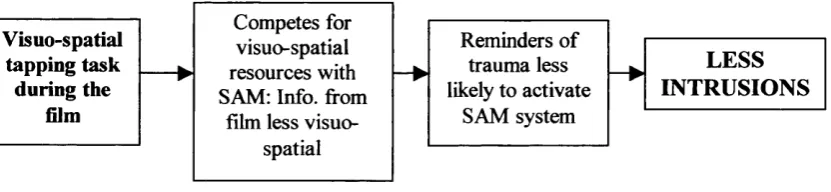
The essential elements o f the model and predictions are represented diagrammatically in Figure 4, below. Additionally, the prior finding o f the intrusion reducing effect o f a peri-traumatic visuo-spatial, tapping task (Holmes, 2000) is shown for comparison in Figure 3. It is important to re-iterate that unlike single level models o f trauma. Dual Representation Theory predicts that a peri-traumatic verbal distraction task will have the opposite effect on intrusion rate to a peri- traumatic visuo-spatial task.
Figure 3. Prediction o f Dual Representation Theorv confirmed bv prior experimentation (Holmes. 2000) regarding the protective effect o f a peri-traumatic visuo-spatial distraction task (based on Holmes, 2000).
LESS INTRUSIONS Visuo-spatial tapping task during the film Reminders of trauma less likely to activate
SAM system Competes for
visuo-spatial resources with SAM: Info, from
film less visuo spatial
Figure 4. Hvpotheses fi'om Dual Representation Theorv to be tested in the current studv regarding the effects o f peri-traumatic manipulation o f verbal encoding variables on intrusion rates.
MORE INTRUSIONS LESS INTRUSIONS Verbal distraction task during the film Verbal enhancement task during the film VAMs compete with SAMs in response to cues
Reminders of trauma more likely to activate
SAM system
Competes with VAM: Film info, less verbal, less integrated, lacks
context
Facilitation of VAM: Film info, more
verbal, more integrated, exists in
Experimental investigation of the thesis hypotheses
Peri-traumatic verbal processing
The proposed design involves a modification o f Holmes’ (2000) distressing film and intrusion diary experiment using new peri-traumatic concurrent tasks intended to manipulate the efficiency verbally accessible memory. A related aim o f the proposed study is to control for the possibility that the protective effect o f a concurrent visuo-spatial task was due to simple distraction effects that would arise fi'om a non-visuo-spatial concurrent task that could be accounted for with a single level model o f PTSD. Conceptual processing o f the film will be measured using questions regarding the meaning o f the film to self, others and the world in order to explore the relationship between peri-traumatic verbal processing and this factor. Additionally, participants verbal task performance (for both the verbal distraction and verbal enhancement tasks) will be recorded and scored to allow a comparison o f task performance during periods o f the video that give rise to intrusions later and those that do not. The Dual Representation prediction that verbal processing will be inhibited during these “intrusion-sequences” will be directly tested using this novel approach.
Peri-traumatic tasks
Verbal distraction
The commonly used oral subtraction verbal task o f counting backwards in threes from a specified number (e.g. Hellawell & Brewin, 2001; Meudell, Butters & Montgomery, 1978) will be used in the verbal distraction condition. A simple articulatory suppression task (i.e. repetitious production o f an irrelevant speech sound) was not used because o f evidence that blocking o f the phonological loop component o f working memory (see Baddeley, 1999) may not satisfactorily inhibit verbal memory encoding under some conditions (Vallar & Baddeley, 1982). In contrast, oral subtraction in threes requires greater verbal attentional resources and was predicted to act as an effective verbal distraction task with most participants.
Verbal enhancement
Summary of hypotheses
Experimental hypotheses developed from the preceding literature review are summarised in greater detail below and operationalised in terms o f the measures to be used. The main predictions o f Experiment 1 are:
Intrusion quantity
• Hypothesis 1: Participants in the verbal distraction condition will experience a significantly greater total number o f intrusions in one week and more days with intrusions in comparison to the control condition as recorded in the intrusion diaries.
• Hypothesis 2: Participants in the verbal enhancement condition will experience a significantly smaller total number o f intrusions in one week and less days with intrusions in comparison to the control condition as recorded in the intrusion diaries.
Intrusion quality
• Hypothesis 4: Participants in the verbal enhancement condition will rate their intrusions lower on mean diary scores for distress vividness, feeling o f happening now and automacy/spontaneity compared to the control condition as recorded in the intrusion diaries. Additionally, the verbal enhancement group “most significant” intrusions will be lower on a score o f intrusion characteristics summed fi'om self-ratings o f intrusion vividness, nowness, distress, unwellcomeness and fi'agmentation.
Conceptual processing
• Hypothesis 5: Verbal distraction participants will experience impaired conceptual processing o f the film as indicated by responding “yes” to significantly less meaning questions than control participants
• Hypothesis 6: Verbal enhancement participants will experience facilitated conceptual processing o f the film as indicated by responding “yes” to significantly more meaning questions than control participants.
Attention and memory
• Hypothesis 8: Participants in the verbal enhancement condition will rate their attention paid to the film as significantly higher than participants in the control group and also show significantly better scores on the recognition and recall memory tests than the verbal distraction group.
Peri-traumatic verbal processing
• Hypothesis 9: Participants in the verbal distraction and verbal enhancement conditions will spend a greater percentage o f time in pauses longer than 2 seconds during film periods associated with subsequent “most significant” intrusions (i.e. most significant intrusion sequences or “MSIS”) than during the film as a whole. Additionally, the VD group will show proportionally more errors in counting during MSIS.
Emotion, distress and dissociation
• Hypothesis 10: Participants in the verbal distraction condition will experience less negative emotion, less distress and more dissociation in response to the video compared to the control group as indicated by self-rating on emotion and distress scales.
METHOD
Participants
The 60 participants were recruited through the placement o f adverts around University College London (UCL), Queen Mary’s University and University o f London sites, and various sites not associated with a University (e.g. notice boards in shops and libraries). Additionally, “face-to-face” recruitment was conducted by the author at the UCL student’s Union. As a non-clinical sample o f healthy volunteers was required, the only exclusion criteria were: age under 18 years; having participated in a similar experiment; and a prior history o f treatment for mental illness. The last exclusion criterion was included to reduce the small possibility o f harm to participants through the viewing o f the distressing video by excluding potentially vulnerable individuals who had suffered from diagnosed mental health problems in the past. Ethical approval for the study was obtained from UCL/UCLH Joint Committees on the Ethics o f Human Research (see Appendix 11, p. 149)
unable to return for follow-up but were able to complete the full follow-up over the telephone.
O f the 60 participants included in the study, 20 were randomly assigned to the verbal distraction condition, 20 to the verbal enhancement condition and 20 to the control condition.
Experimenter
The author tested all 60 participants.Apparatus
Equipment
The equipment used in the experiment consisted of:
• A computer, keyboard, visual display unit (VDU) with linked video and a television.
• Computer administered questionnaires and on screen experimental instructions with software modified from a previous experiment (Holmes, 2000). • An audio tape-recorder (Sony TCM-40DV) with cassettes.
• A sports timer stopwatch (Quantum, Model 694 974).
• Several questionnaires administered on paper.
Computer software
This was composed o f two programmes, originally developed for the methodologically similar study by Holmes (2000). The computer software was developed in collaboration with a computer programmer for Holmes’ study and was modified for use with the current study. Programme one ran the main experiment and programme two extracted the data for a database. Programme one presented a series o f individually displayed questions on the VDU. One copy o f the two programmes was made for each condition to accommodate differing on screen instructions across conditions. Participants responded via a standard keyboard and also completed paper-and-pen questionnaires.
Task compliance monitoring
Procedure
Summary of measures
Intrusion quantity and quality
Participants kept a record o f all intrusions occurring over a seven-day period in an intrusion diary (see Appendix 6a and 6b, p. 139). The diary included a cover sheet with fiill instructions for keeping the diary and one page per day divided into spaces for morning, afternoon, evening and night. For each intrusion participants were instructed to record: the number o f times the intrusion occurred; whether it was primarily an image, thought or both; and a brief description of the content o f the intrusion. Additionally, participants recorded four numeric ratings between 0 (not at all) and 100 (extremely) for each intrusion regarding how distressed they were by the intrusion, how much it felt like the intrusion was “happening now”, how vivid it was and how automatic/spontaneous the intrusion felt.
Diary compliance rating
Participants were asked, “To what extent is the following true o f you: I have often been unable (or forgot) to record my intrusive thought or images in the diary”. They responded with a rating between 1 (not at all true o f me) and 10 (extremely true o f me).
Intrusion Description Questionnaire (incorporating the meaning questions)
experimenter then verbally administered the Intrusion Description Questionnaire (see Appendix 8, p. 145) which included 0 (not at all) to 5 (somewhat) to 10 (extremely) ratings o f how vivid, distressing, unwelcome/unwanted, fragmented and how much it feels like they are “seeing it happen again now”. They also wrote brief descriptions o f the intrusion and the thoughts that occurred the first time they saw the image while watching the film and gave ratings between 0 (not at all) and 10 (extremely) regarding emotions they were feeling while seeing the image. The emotions that were rated at this point included how unhappy, anxious, depressed, angry, fearful, horrified, helpless, disgusted and ashamed/guilt they currently felt.
An extremely important additional aspect to the Intrusion Description Questionnaire was the five “meaning questions”. Participants were asked to respond yes or no to the following questions about their most significant intrusion:
1) Does it mean anything about people in the film? 2) Does it mean anything about you, yourself?
3) Does it mean anything about other people you know? 4) Does it mean anything about other people in general? 5) Does it mean anything about the World in general?
Verbal task performance
The verbal task performance o f both YD and VE participants was recorded on audio tape while they watched the film. The tapes were coded by the experimenter at a later date in order to determine whether participants complied appropriately with task instructions and to allow a comparison o f task performance during the whole film compared to task performance during film sequences associated with subsequent most significant intrusions or “most significant intrusion sequences” (MSIS).
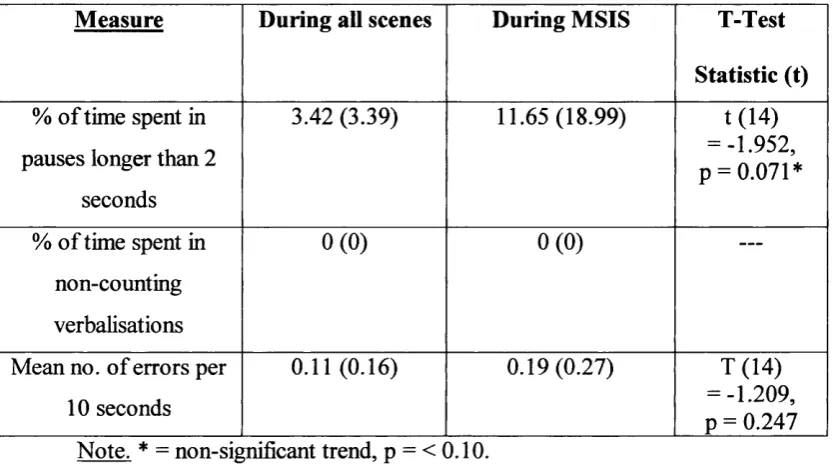
Both YD and VE task performance coding included measurement o f pauses in verbalisation o f 2 seconds or longer. These were measured using a stopwatch and converted into percentages o f time spent in pauses longer than two seconds for the whole film and for the MSIS for each participant.
Specifically to the YD task, the number o f errors in the counting task was coded for the whole film and for participants’ MSIS. The mean number o f errors in counting per 10 seconds was calculated to provide a comparable score between the whole film and MSIS.
people in the film). The scores derived Jfrom the recording o f VE and YD participant task performance are summarised below.
Verbal Distraction participant task performance: 1) Pausing
-a. The percentage the whole film spent in pauses lasting two seconds or longer.
b. The percentage o f the most significant intrusion sequence spent in pauses o f two seconds or longer.
2) Errors
-a. The mean number o f errors in counting per 10 seconds during the whole film.
b. The mean number o f errors in counting per 10 seconds during the most significant intrusion sequence.
Verbal Enhancement participant task performance:
1)
Pauses-a. The percentage the whole film spent in pauses lasting two seconds or longer.
b. The percentage o f the most significant intrusion sequence spent in pauses o f two seconds or longer.
3) Datadriven processing
-a. The percentage the whole film spent in data-driven processing. b. The percentage of the most significant intrusion sequence spent
in data-driven processing. 4) Conceptuallydriven processing
-a. The percentage the whole film spent in conceptually-driven processing.
Expectations regarding the effects of verbal tasks
VD group participants were asked, “How much do you predict that performing the backwards counting task during a distressing film (rather than watching it normally) would increase or decrease intrusive images o f the film o f the type you recorded in your diary?” and responded with a number between -1 0 (extremely decrease), 0 (do nothing) and 10 (extremely increase).
VE group participants were asked, “How much do you predict that performing the verbal enhancement task during a distressing film (rather than watching it normally) would increase or decrease intrusive images o f the film of the type you recorded in your diary?” and responded with a number between -1 0 (extremely decrease), 0 (do nothing) and 10 (extremely increase).
Attention
Attention paid to the film was assessed using a self-rating o f attention paid to the film on a scale o f 0 (paid no attention to film) to 10 (paid total attention to the film) administered via the computer.
Memory
half did not actually occur in the film. The eued recall memory questionnaire was a modification o f Holmes’ (2000) explicit memory questionnaire that included more cueing information within each o f the 15 items in order to reduce the difficultly level so that potential differences could be determined between the conditions.
Emotion and distress
Computer-administered 11-point self-rating scales between 0 (not at all) and 10 (extremely) were used to assess mood and distress caused by the film. Participants rated themselves in this way regarding how unhappy, anxious, depressed, angry, fearful, horrified, helpless, disgusted, ashamed and guilty they felt before and after the film. Additionally, they rated how distressed they felt by the film after viewing.
Peri-traumatic State Dissociation
Trait Dissociation
The 38 item Trait Dissociation Questionnaire (TDQ; Murray, 1997) is designed to measure trait dissociation using 7 factors (see Appendix 3, p. 133). These include detachment from the world and others, sense o f split self, lability o f mood and impulsivity, inattention and memory lapses, emotional numbing, confusion and altered time-sense, and amnesia for important life events. The items used in the TDQ are drawn from pre-existing questionnaires including the Dissociative Experiences Scale (Bernstein & Putnam, 1986). It has an alpha coefiBcient o f 0.93 and a test/re-test reliability of 0.87 in an undergraduate sample and has been shown to predict development o f PTSD (Murray, 1997). The TDQ was also computer- administered.
Exposure to trauma history
The 12 computer-administered items used to determine exposure to prior trauma were extracted from the Posttraumatic Stress Diagnostic Scale (Foa, 1995), featured questions on common traumatising occurrences and indicated the amount, type, recency and severity o f trauma experienced (see Appendix 4, p. 136). If participants indicated they had experienced a traumatic event further details were taken including when it happened, who was injured, if they believed their life to be at risk and whether feelings o f helplessness and terror were present.
Personal relevance of car crashes
Talking, thinking, and avoiding thinking about the film
Participants were asked by the experimenter how much they: (1) Talked about the film; (2) Deliberately thought about the film; and (3) Dehberately avoided thinking about the film during the one-week period before follow-up. For each question they responded with a rating between 0 (not at all) and 10 (extremely).
Fear of blood and iniurv
Participants were asked by the experimenter, “How fearfiil are you o f blood, injury and the like?” and responded with a rating between 0 (not at all) and 10 (extremely).
Initial Contact
Participants were contacted by telephone after leaving their details on an answer phone having heard about the study fi"om adverts or face-to-face recruitment. At this point, two participants were excluded fi'om the study due to past or current treatment for a mental health problem and one was excluded due to being unavailable on days when the study was being administered.
Main experiment
Randomisation of condition
Introduction and information exchange
Upon arrival, participants were given an information form to read (see Appendix 9a, p. 147) and asked to state if they have any questions for the experimenter before starting the experiment. After questions had been answered, participants completed and signed the consent form (see Appendix 9b, p. 148), gave their fiill name, address and ethnicity. After filling in the consent form, the experimenter reminded participants:
“You can leave at any stage without needing to give a reason”.
If a participant expressed concerns about potential harmful effects o f viewing the video they were told:
“No one has yet suffered long term effects from this film in this or previous research using the same film”.
Experimental task instructions
Prior to the main section o f the experiment, all participants were told:
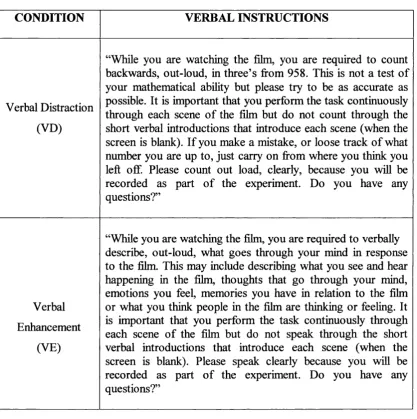
Table 1. Verbal instructions read to participants according to experimental condition.
CONDITION VERBAL INSTRUCTIONS
Verbal Distraction (VD)
“While you are watching the film, you are required to count backwards, out-loud, in three’s fi'om 958. This is not a test of your mathematical ability but please try to be as accurate as possible. It is important that you perform the task continuously through each scene o f the film but do not count through the short verbal introductions that introduce each scene (when the screen is blank). If you make a mistake, or loose track o f what number you are up to, just carry on fi'om where you think you left off Please count out load, clearly, because you will be recorded as part o f the experiment. Do you have any questions?”
Verbal Enhancement
(VE)
“While you are watching the film, you are required to verbally describe, out-loud, what goes through your mind in response to the film. This may include describing what you see and hear happening in the film, thoughts that go through your mind, emotions you feel, memories you have in relation to the film or what you think people in the film are thinking or feeling. It is important that you perform the task continuously through each scene o f the film but do not speak through the short verbal introductions that introduce each scene (when the screen is blank). Please speak clearly because you will be recorded as part o f the experiment. Do you have any questions?”
Pre-film measures
Prior to viewing the video, participants completed the following additional questions and questionnaires in the following sequence:
• Baseline Dissociative State Subscale.
• Age, gender, number o f car crashes involved in.
• Exposure to trauma history.
• 0-10 ratings for how unhappy, anxious, depressed, angry, fearful, horrified, helpless, disgusted, ashamed and guilty they eurrently felt.
Viewing of the film
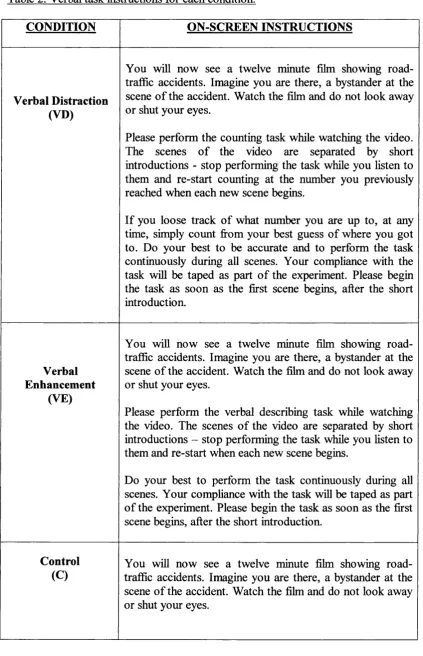
Table 2. Verbal task instructions for each condition.
CONDITION ON-SCREEN INSTRUCTIONS
Verbal Distraction (VD)
You will now see a twelve minute film showing road- trafiBc accidents. Imagine you are there, a bystander at the scene o f the accident. Watch the film and do not look away or shut your eyes.
Please perform the counting task while watching the video. The scenes o f the video are separated by short introductions - stop performing the task while you listen to them and re-start counting at the number you previously reached when each new scene begins.
If you loose track o f what number you are up to, at any time, simply count from your best guess o f where you got to. Do your best to be accurate and to perform the task continuously during all scenes. Your compliance with the task will be taped as part o f the experiment. Please begin the task as soon as the first scene begins, after the short introduction.
Verbal Enhancement
(VE)
You will now see a twelve minute film showing road- traffic accidents. Imagine you are there, a bystander at the scene o f the accident. Watch the film and do not look away or shut your eyes.
Please perform the verbal describing task while watching the video. The scenes o f the video are separated by short introductions - stop performing the task while you listen to them and re-start when each new scene begins.
Do your best to perform the task continuously during all scenes. Your compliance with the task will be taped as part o f the experiment. Please begin the task as soon as the first scene begins, after the short introduction.
Control
(C)
Whilst watching the film, participants conducting concurrent verbal tasks (conditions 1 and 2) were tape recorded to provide a record o f task compliance.
After the film
After viewing the film, participants completed:
• Post-film Dissociative State Subscale.
• 0-10 ratings for how unhappy, anxious, depressed, angry, fearful, horrified, helpless, disgustred, ashamed and guilty they currently felt.
• 0-10 ratings for how much attention they paid to the film and how distressing it was.
Finally, participants were read the instruetions printed on the cover-sheet o f the intrusion diary (see Appendix 6a, p. 139) and a date was arranged to return for follow-up one week later.
Intrusion Diary
Follow-up (1 week later):
The following measures were taken in the following sequence:
• Diary compliance rating.
• Cued recall memory questionnaire.
• Intrusion Description questionnaire. • Recognition memory questionnaire.
• Expectations regarding the effects o f verbal tasks.
RESULTS
The results are presented in three sections: (1) Missing data and outliers; (2) Comparability o f groups; and (3) Results o f main experiment with follow-up. References to experimental hypothesis are made at appropriate points to clarify the relationship between experimental findings and the aims o f the study.
Section 1: Missing data and outliers
Missing data
Only one participant who completed part one o f the experiment failed to return for the follow-up. However, they posted their completed diary form and this was included in the complete data set, with other follow-up measures coded as missing data. Additionally, four participants were unable to return for follow-up but were able to complete the full follow-up over the telephone.
The follow-up questions on how much participants talked, thought and avoided thinking about the film were only introduced into the design from participant five onwards and the question on blood fear was introduced from participant nine onwards. Additionally, there are 5 missing data points in the database due to apparatus failure (see Appendix 10, p. 148 for details).
Treatment of outliers
Section 2: Comparability of groups
Participant details
There were no significant dififerences in age between the verbal enhancement and control groups, Z (2) = -1.779, 0.075, or between the verbal distraction and verbal enhancement groups, Z (2) = -0.353, 0.724. However, there was a significant difference between the age o f participants in the verbal distraction condition compared to those in the control condition as shown by Mann-Whitney tests, Z (2) = -1.980, p.=0.048. Therefore, it is necessary to check whether age is correlated with dependent variables to determine whether difference in groups may be attributed to age rather than experimental manipulations (see Table 5, p. 64).
A Chi Squared test found no significant difference between group for number of men and women, Chi squared (1) = 0.600, 0.44. Therefore, there is no indication that any significant differences found between conditions on dependent variables are confounded by this factor.
Table 3. Sex and mean age in the three experimental conditions
Condition 1:
No task
Condition 2:
Verbal distraction
Condition 3:
Verbal enhancement
Age 30.25 (10.7) 24.70 (7.8) 24.45 (5.9)
Male N = 9 N = 8 N = 10
Initial measures and experimental groups
Table 4 shows that no significant diSerences were found between experimental conditions for any o f the initial measures, using one-way ANOVAs or Kruskal- Wallis tests.
Table 4. Comparability o f initial measures between the three conditions
Measures Condition 1: No task Condition 2: VD Condition 3: VE ANOVA Statistic (F) Trait Dissociation Questionnaire
39.00 (28.71) 26.75 (17.50) 36.20 (20.72)
F(2,57) = 1.585, p = 0.214 Dissociative
Experiences Scale
10.44 (6.39) 9.75 (6.92) 10.44 (8.34)
F(2,57) = 0.061, p = 0.941 Dissociative
State Subscale at baseline
3.65 (5.12) 3.35 (3.08) 2.60 (3.00)
F(2,57)
= 0.392, p = 0.677 Number o f car
crashes experienced
0.20 (0.41) 0.35 (0.59) 0.30 (0.57)
F(2,57) 0.417, p = 0.661 Number of
traumas experienced
3.20(1.94) 3.00(1.97) 3.30(1.90)
F(2,57)
= 0.125, p = 0.883 Visual
intrusions experienced
3.56 (2.82) 3.75 (2.17) 3.85 (2.11)
F(2,57) = 0.082, p = 0.922 Personal
relevance of car crashes
3.35 (2.70) 2.80 (2.35) 3.35 (2.25)
F(2,57)
= 0.338, p = 0.715 Initial
happiness rating
5.40 (2.04) 5.85 (1.73) 5.35 (1.63)
F(2,57) = 0.465, p = 0.630 Initial anxiety
rating 2.75 (2.10) 3.10(2.27) 3.05 (2.26)
F(2,57) = 0.148, p = 0.863 Initial
depression rating
1.65 (2.13) 1.70 (2.23) 2.10(2.34)
F(2,57)
= 0.244, p = 0.785 Initial anger
rating 0.20 (0.41) 0.85 (1.63) 1.25 (2.22)
F(2,57)
= 2.171, p = 0.123 Initial fear
rating 1.05 (1.67) 0.85 (1.27) 0.90 (0.968)
F (2,57)
= 0.122, p = 0.885 Initial horror
rating 0.30 (0.92) 0.20 (0.52) 0.10(0.45)