STRATEGY RESEARCH FOR THE SUPPLY CHAIN
MANAGEMENT BASED ON VALUE CHAIN ANALYSIS IN
CONSTRUCTION ENTERPRISES
1BAI XIAO-PING, 2XU CHUN-MEI
1
Assoc. Prof, School of Management, Xi’an University of architecture technology, Xi’an, 710055, China
2
Master candidate, School of Management, Xi’an University of architecture technology, Xi’an, 710055, China
E-mail: [email protected], 2786204879
@qq.com
ABSTRACT
With the development of economic globalization and the information network system, in order to deal with more and more fierce market competition situation, supply chain management (SCM) which is looked as a kind of main operation modes, has been adopted by manufacturing enterprises, Construction industry has already become pillar sector in the national economy. The particularity of its product and the complexity of its production process have challenged the operation mode of building construction enterprises in which the high cost and low benefit phenomenon often exist. This paper presents the detailed method and procedure applying supply chain management to the construction enterprises from value chain analysis side, also analyzes some strategies that should be selected when the supply chain management based on value chain analysis is applied in building construction enterprises, and gives detailed case study. The presented detailed methods and points can offer the meaningful reference for solving some problems existed in building construction enterprises, such as the discontinuance of business, low level productivity, the big losses, insufficient resource utilization rate.
Keywords: Supply chain management; Value engineering; Construction industry ; Value chain; Strategy;
Purchasing
1. INTRODUCTION
With the fast development of the economy of our country, the construction has already become the pillar industry of the national economy. It has made a contribution to the stabilization and prosperity of a national economy and plays more and more important position in the economic constitution. According to the national bureau of statistics, in 2011, the output value of the construction sector was 11.7734 billion Yuan, up 22.6 percent year-on-year; the building industry housing construction area was 84.62 billion square meters, and up 22.6 percent year-on-year. At the end of 2011, the added value of the construction sector of China was trillion 3.2 Yuan. Compared in comparable prices, it has increased 10.0%, a proportion of 6.8 percent of the total GDP. But compared to the manufacturing and the IT industry, this added value is relatively backward in its speed development, technological progress and the management mode. As socioeconomic enters the digital, networked, information age, the advanced management methods and ideas of the manufacturing industry
being applied in the construction industry are not only possible, but also necessary.
2. DETAILED ANALYZING SOME RELATED REFERENCES
Until now, there have been many references studying the supply chain management. The reference [1] examines the drivers of sustainability and related key features based on extant literature and a case study [1]. The reference [2] investigates the extent of implementation of sustainable supply chain management practices [2]. The reference [3] designates green supply chain management (GSCM) strategies to effectively direct business functions and activities in the electronics industry [3]. The reference [4] investigates methods for managing the irregular and uncertain demands involved in supply chain planning [4]. The reference [5] applies the seminal Bass model to analyze green supply chain management practices diffusion [5]. The reference [6] reviews the extant literature on empirical research in supply chain management (SCM) [6]. The reference [7] develops a corresponding framework for value-based performance and risk optimization in supply chains [7]. The reference [8] studies logistics financial management of supply chain system from the value creation perspective [8], and etc [9-12].
By detailed analyzing these references, we find that the special studies aiming to strategy research of the supply chain management based on value chain analysis in China construction enterprises are scarce. The construction industry has already become pillar sector in the Chinese economy. The particularity of its product and the complexity of its production process have challenged the operation mode of building construction enterprises in which the high cost and low benefit phenomenon often exist. This paper considers this particularity and presents the detailed method and procedure applying supply chain management to the construction enterprises from value chain analysis side, also analyzes some strategies that should be selected when the supply chain management based on value chain analysis is applied in building construction enterprises
3.
ANALYZING THE SUPPLY CHAIN
MANAGEMENT MODE OF
CONSTRUCTION INDUSTRY
Supply chain management embodies advanced system management thoughts, it emphasizes integrating all participants involved in the production process from the view of the whole supply chain, so as to achieve win-win effect and improve the core competitive power of enterprises
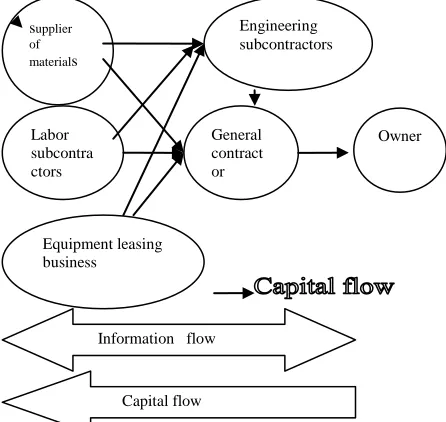
[image:2.612.328.551.332.543.2]on the supply chain. The building supply chain has internal and external supply chain: internal supply chain is limited in a single building enterprise interior, emphasizes the coordination among internal market, finance, planning, engineering and purchasing departments in building enterprise; While the external supply chain is beyond a single building enterprise's range, it consisted of he owner, design institute, supervision company consulting institution, the contractor and the subcontractor, materials, equipment and components supplier, Banks, government departments, insurance companies, and other enterprises and organizations. That is, treats the general contractor as the core enterprise, by controlling information, goods, funds, connects the material suppliers, engineering subcontractors, owner into a whole function network structure model from raw material purchasing to construction, transferring to the client to use, shown as Figure 1.
Figure 1 The Model Of Construction Supply Chain
Like manufacturing, the construction industry also belongs to the order form production, but the construction supply chain have its different characteristics, such as disposable and specificity of the supply chain, the uncertain links, the complex structure of supply chain, which makes us fully considering the industry characteristics and production characteristics to carry on the management of the construction supply chain . In this paper, construction supply chain management is thought as a collaborative integrated management mode by treating engineering project as the carrier, based on project information sharing, to achieve the
supplier of materials
Labor subcontra ctors
Equipment leasing business
Engineering subcontractors
General contract or
Owner
optimal project completing and win-win effect of participants, shown as Figure 2
Information
Information sharing
sharing
Party A
Party A Party B
Party B Party C
Party C Party D
[image:3.612.102.303.588.681.2]Party D Supply chain management system
Figure 2 The Model Of Construction Supply Chain Management
This management mode emphasizes integrated management of core supply chain enterprise (general contractor), but also stresses on the integrated management of each party in external enterprise, applying information sharing and strategic partner relationship to improve efficiency of enterprise and fast response changes in the market, is a kind of new thoughts in building management. The overseas experience shows that taking the supply chain management in construction enterprises would make the total cost of the process can be reduced by 10% ~ 15% average, processing opinion period shortens, owner satisfaction is also greatly improved.
4. THE VALUE CHAIN ANALYSIS OF BUILDING AN ENTERPRISE SUPPLY CHAIN
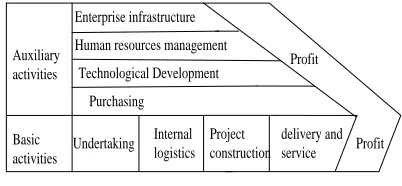
Construction enterprises are different from general manufacturing enterprise; its main business process can be summarized as: according to the requirements of the clients to form contract market, the construction enterprise contracting project, project construction and project delivery and service - from contracting market for contracting, repeats the process, shown as Figure 3.
Auxiliary activities
Enterprise infrastructure
Human resources management
Technological Development
Purchasing
Basic
activities Undertaking Internal logistics
Project construction
delivery and service
Profit
Profit
Figure 3 The General Form Of The Building Enterprise Value Chain
The basic value chain activities of construction enterprises include project contracting, internal
logistics, project construction and project delivery and service for. Among them, the project contracting includes all the activities in the project. Internal logistics mainly refer to the storage and transport for raw material, characters of the production process in building enterprise leads its poor stability of reserve materials. In order to complete the internal logistics, material storage and transportation is achieved with the "purchasing" in auxiliary activities at the same time. Project construction is the one-time activity process to perform construction contract, integrate construction resources (labor, construction machinery, turnover materials and the subcontractor, etc.) To form construction ability, and use it in building materials, finally complete the task of contract. Project delivery and service refers to the project contract delivery and providing the needed services after being handed over the contract. The auxiliary activities of building enterprise value chain include purchasing, technology development, human resources management and enterprise infrastructure.
5. STRATEGY RESEARCH FOR IMPLEMENTING SUPPLY CHAIN MANAGEMENT
5.1 Analyzing the value supply chain in construction enterprise
The value analysis of the supply chain of construction enterprise is applying the value analysis method to supply chain management of the construction enterprises, through the supply chain management makes the enterprise reduce costs, shorten the construction period, improve the work efficiency and management level, improve enterprise's popularity, enhance enterprise core competitiveness in the market on the original basis of management. The creation value of supply chain is mainly reflected in the enterprise's financial value, customer value and social value. The core principles of creating value of supply chain is reducing the cost of enterprise internal existed on supply chain by the cooperation between the enterprises and functional departments, as increasing the financial value of the enterprise, while at the same time improving customer service level, realizing customer value, so that making the overall value to be promoted.
5.2 Strategy Research For Implementing Supply Chain Management
including long business activities time, place fixing, big risk, more uncertainty factors, product being too single etc, so the production of each building products need to reconsider time, cost, efficiency, personnel and the service object, but the supply chain being used to support each building products are different. By detailed analyzing, the strategies of supply chain management based on value chain analysis in construction enterprise include:
(1) Cultivating core competence and carrying out business outsourcing
The core competitiveness is an integrate knowledge and skills in organization internally, it is an ability formed in the business process of the enterprise and it is not easy to aped by rivals, can bring an excess profit. The node enterprises which belongs to the building supply chain must have a unique core competitiveness in a supply chain management environment, therefore they should make use of own characteristics to engage in a business or a certain field. The non-core business must be outsourced to other professional subcontractor, so internal resources in enterprises can be focused on core business. If building contractors have won numerous professional strong construction equipment and construction team involved in pile foundation, glass curtain wall, steel structure, etc., Which generally cause idle and lead to great waste; On the other hand, if subcontracting business to professional subcontractors will achieve better effect at a relatively low cost. But the contractor can put more energy on the total package management and achieve better economic benefits.
(2) Achieving effective human resources management
The practice has proved that people may resist change, when the new concept is introduced and the new plan is implemented. So supply chain management must carry on the effective human resources management, which mainly includes transformation leadership idea, training workers (especially management staff).
Many large construction enterprises in china are merged from blind pursuing "large and all-inclusive" or "small and all-all-inclusive" business model in the planning economy system. This kind of that all things don't ask for help of the old management thoughts make construction enterprises become a closed system, it will put a lot of resources into an auxiliary business which they are not good at, as a result it weaken the core competitiveness of enterprises, and differs very far from the open modern enterprise mode.
Construction enterprises need to train worker especially in management skills and knowledge aspect, including reading and writing skills, computer and network technology, accounting and finance, contract management, cooperation ability and professional knowledge and skills. At the same time it needs to change the concept of staff, to make the staff establish cooperation and win-win consciousness, and cooperation partners should trust each other, strengthen exchanges can make job improve constantly.
(3) Making use of customer relationship management to strengthen cooperation partnership
The CRM system is a new business model based on the business philosophy of “taking the customer as the center", in which "customer relationship one-on-one theory" is the foundation for the market, customer information resources are integrated to realize resources sharing, it can make quick response to the individualized demand market and enhance the competitive ability in the market.
(4) Establishing an electronic business platform The application of information technology is the key to promote information sharing in the supply chain such as EDI (electronic data interchange), E-mail (electronic E-mail), IE (network technology), CAD (computer aided design), DATE Exchange (data Exchange), and other information exchange technology has been widely used in many industries and produces the huge influence. But the information level of building enterprise is relatively low. Accordingly, the application of information technology should be paid special attention to implement supply chain management in the construction enterprise.
(5) Establishing the supply chain system
In the actual operation of supply chain management, safety, laws and regulations, consultation, initiative time limit, competition mechanism and other real problems are existed. In order to standardize the supply chain management we must aim at these problems to adopt strict standards of the supply chain agreement. In addition, we also should establish a reasonable supply chain management performance measurement of evaluation systems and incentive mechanism. This paper detailed analyzes some cost control problems in the supply chain management
about the purchasing value chain combined with the real case.
6. DETAILED CASE STUDY
6.1Putting Forward The Problems
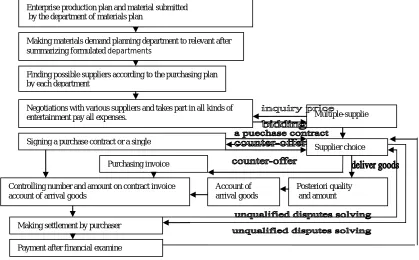
[image:5.612.112.531.234.494.2]Taking a real construction enterprise as an example, the current purchasing business process is shown as Figure 4.
Figure 4 The Current Operation Flow Chart Of A Real Construction Enterprise
Figure 5 The Process Model In Building Enterprise Purchasing Management Based On The Value Chain Thought Production plan of
enterprise
Gather information
Prepa -re purch as-in-g plan
che ck Sin gin g Tal -ks Choo-sing suppl-ier
Supplier s
Logistics distribution
Pla n pay
s u p e r v
i
s
i
e v a l u a
t
i
a d j u s t
Summa-ry material require-ments Purchase requisition for
materials department
Enterprise production plan and material submitted by the department of materials plan
Multiple-supplier
Signing a purchase contract or a single
Supplier choice
Purchasing invoice
Controlling number and amount on contract invoice account of arrival goods
Account of arrival goods
Posteriori quality and amount
Making settlement by purchaser
Payment after financial examine
Making materials demand planning department to relevant after
summarizing formulated departments
Finding possible suppliers according to the purchasing plan by each department
[image:5.612.102.540.527.658.2]6.2 Strategic Analysis For The Supply Chain Purchasing Management Based On The Value Chain
The point of the value chain provides an analysis tool for our controlling purchase cost. Its essence is to look each process associated with purchasing as a value change process, which either is a positive value or negative value. The actual purchase cost C should equal: material cost Cv, pluses the total transportation cost ∑ Ct, pluses buyer and supplier of various dinner party cost between ∑ Cy, pluses the inspection fee ∑ Cj, pluses the total material cost of wear and tear ∑ Ch, pluses the audit cost ∑ Cs, pluses other management fee Cn (mainly is the contract monitoring costs), shown as:
V t y j
s h n
C
C
C
C
C
C
C
C
=
+
+
+
+
+
+
∑
∑
∑
∑
∑
(1) For purchasing activities, purchasing value canbe said to be a kind of competition based on time and quality, the standard of customer satisfaction is to buy lowest cost supply to meet its requirements in time. So, for saving the purchasing cost, we will try to reduce the purchasing cost of each link in the value chain, improve some link, and even omit any unnecessary links to save cost. This paper puts forward the process model in building enterprise material purchasing management based on the value chain thought, shown as Figure 5.
The process model of building enterprise purchasing management can be divided into three layers: the planning layer, the organization implements layer and monitoring layer.
6.3 Planning Layer
In planning layer, each using department submits material requisitions according to the production plan, the materials department checks the actual inventory, summarizes material requirements, makes purchase decisions and prepares purchasing plan, carries on the centralized purchasing according to the collected materials market information. In this way, they can get good quantity discount price by larger purchasing quantity to make full use of the size of the procurement efficiency, reduce purchasing cost and logistics cost, that is, reducing the actual value cost CV and carriage expense ∑ CT in the formula (1) After standardization we can obtain preferential price of standard goods to the supplier, inventory can be also relatively lower. So, the administrative paying will also be reduced by unifying purchasing operation, and reduce the management cost Cn.
6.4 The Organization Implements Layer
Implementing layer mainly includes: selection of supplier according to the purchasing plan, negotiating the supplier, signing the purchase contract, checking incoming materials, and supplier's settlement, etc.
(1) The selection of suppliers
Making use of ABC classification rule of materials to analyze required materials in enterprises, we can see: a few materials occupy a large proportion in total procurement cost, and large quantity materials don’t occupy a large proportion in total procurement cost. So the purchasing materials can be divided into key materials and the non-key material, selecting suppliers will use a different strategy according to these two kinds of materials, so as to reduce the purchasing cost.
(2) The settlement, check payment with suppliers
The department often needs to spend more time in dealing with these agreements, thus causes the great waste of people, finances, time to lead high audit fees ∑Cs. This paper puts forward a new settlement way, under the environment of electronic supply chain management in building enterprise, buyer will input purchasing contract to online databases, after suppliers deliver goods to the factory, the quality inspection station staff checks whether the goods in the database and procurement contract photograph are identical, if being consistent he will make an arrival account entry database, and payment department can achieve payment when he see it. This payment mode based on the goods arriving simplifies the examination links greatly, the contents that settlement department need to verify are decreased greatly, which only need to verify suppliers, supply goods, the quantity and the delivery time, so as to simplify the material management work, realize accurate fast settlement and save most ∑ Cs.
6.5 Monitoring Layer
save the inspection fee ∑ Cj. If the enterprise wants to have credible suppliers, wants to coordinate good relationships with suppliers and choose long-term reliable suppliers, this is the advantage of supply chain management.
7. CONCLUSIONS
Under the background of economic globalization, our country has gradually kept construction industry open; the traditional purchasing and the organization management mode of construction enterprise is no longer suitable for the current construction development needs. Considering the broad domestic and international market, the fierce competition environment and the era of fast transformation, the construction industry is faced with new opportunities for development and new challenges. In order to gain the continuous development and more value return in the competition, the enterprises must establish and enhance their core competitiveness. The building enterprise of our country has own special industry characteristics and historical background, it should be based on their own development status to construct supply chain management according to the existing resources in enterprises, to establish and enhance the core competitiveness.
8. ACKNOWLEDGMENT
This work was supported in part by NSFC (59874019), Shanxi Province Education Department Research Project (12JK0803), Shanxi Province Key Discipline Construction Special Fund Subsidized Project (E08001), Shanxi Province Higher Education Philosophical Social Science key Research Base Construction Special Fund Subsidized Project (DA08046) and Shanxi Province Higher Education Philosophical Social Science Characteristic Discipline Construction Special Fund Subsidized Project (E08003, E08005).
REFRENCES:
[1] Gopalakrishnan, Kavitha; Yusuf, Yahaya Y.; “Sustainable supply chain management: A case study of British Aerospace (BAe) Systems”,
International Journal of Production Economics, v 140, n 1, 2012, pp. 193-203,
[2] Zailani, Suhaiza; Jeyaraman, K.; Vengadasan, G.; Premkumar, R. “Sustainable supply chain management (SSCM) in Malaysia: A survey”,
International Journal of Production Economics, v 140, n 1, 2012, pp. 330-340
[3] Chen, Chiau-Ching; Shih, Hsu-Shih; Shyur, Huan-Jyh; Wu, Kun-Shan, “A business strategy selection of green supply chain management via an analytic network process”,
Computers and Mathematics with Applications, v 64, n 8, 2012, p p.2544-2557 [4] Jung, Hosang ; Jeong, Suk-Jae, “Managing
demand uncertainty through fuzzy inference in supply chain planning”, International Journal of Production Research, v 50, n 19, 2012, pp. 5415-5429
[5] Zhu, Qinghua; Tian, Yihui; Sarkis, Joseph, “Diffusion of selected green supply chain management practices: An assessment of Chinese enterprises”, Production Planning and Control, v 23, n 10-11,2012, pp. 837-850 [6] Soni, Gunjan; Kodali, Rambabu, “A critical
review of empirical research methodology in supply chain management”, Journal of Manufacturing Technology Management, v 23, n 6, 2012, pp. 753-779
[7] Hahn, G.J.; Kuhn, H. “Value-based performance and risk management in supply chains: A robust optimization approach “,
International Journal of Production Economics, v 139, n 1, 2012, pp. 135-144
[8] Wang, Yang ; Hu, Wei, “The topology analysis on value creation of logistics financial management in supply chain system”, BMEI 2011 - Proceedings 2011 International Conference on Business Management and Electronic Information, v 5, 2011, pp. 243-248 [9] Zhou, Wei-Gang ; Feng, Qian-Qian,”Value
disruption information management in a supply chain with myopic customers”, 2011 IEEE 18th International Conference on Industrial Engineering and Engineering Management, IE and EM 2011, n PART 3, pp. 1612-1616. [10] Wang, Xiaojun; Li, Dong; Li, Lulu, “Adding
value of food traceability to the business: A supply chain management approach”,
International Journal of Services Operations and Informatics, v 4, n 3, 2009, pp. 232-257. [11] Tomlin, Brian, “On the value of mitigation and
contingency strategies for managing supply chain disruption risks, Management Science”, v 52, n 5, 2006, pp. 639-657