Use of Time-Frequency Analysis and Neural
Networks for Mode Identification in a Wireless
Software-Defined Radio Approach
Matteo Gandetto
Signal Processing and Telecommunication Group (SP&T), Biophysical and Electronic Engineering Department, University of Genoa, 16145 Genoa, Italy
Email:[email protected]
Marco Guainazzo
Signal Processing and Telecommunication Group (SP&T), Biophysical and Electronic Engineering Department, University of Genoa, 16145 Genoa, Italy
Email:[email protected]
Carlo S. Regazzoni
Signal Processing and Telecommunication Group (SP&T), Biophysical and Electronic Engineering Department, University of Genoa, 16145 Genoa, Italy
Email:[email protected]
Received 4 September 2003; Revised 8 June 2004
The use of time-frequency distributions is proposed as a nonlinear signal processing technique that is combined with a pattern recognition approach to identify superimposed transmission modes in a reconfigurable wireless terminal based on software-defined radio techniques. In particular, a software-software-defined radio receiver is described aiming at the identification of two coexistent communication modes: frequency hopping code division multiple access and direct sequence code division multiple access. As a case study, two standards, based on the previous modes and operating in the same band (industrial, scientific, and medical), are considered: IEEE WLAN 802.11b (direct sequence) and Bluetooth (frequency hopping). Neural classifiers are used to obtain
identification results. A comparison between two different neural classifiers is made in terms of relative error frequency.
Keywords and phrases:mode identification, software-defined radio, frequency hopping code division multiple access, direct se-quence code division multiple access, time-frequency analysis, pattern recognition.
1. INTRODUCTION
The ideal software radio (SR) [1] can accommodate all exist-ing bands and modes in a host terminal or, more generally, in a platform. Toward this end, SR defines all radio frequency (RF) aspects (filtering, access methods, etc.) and transmis-sion/reception layer functions (modulation, coding, etc.) in software terms to support multimode, multiband communi-cations. In general, SR can be applied to base stations (BSs) [2] or to user terminals (UTs). SR-based transceivers are characterized by high levels of adaptability, flexibility, and re-configuration.
The ideal SR leads to a revolution in the design of a trans-mitter/receiver terminal (if used in a BS or UT) with re-spect to the conventional radio devices based on the classical heterodyne schemes [3]. The analogical part of an SR-based
design a wideband receiving antenna to receive all multiband modes or to design D/A and A/D converters with sufficient dynamic range, quantization, and sampling frequency, as re-quired in SR applications [5]. On the other hand, from a soft-ware point of view, the design of flexible procedures able to satisfy the constraints of a real-time communication, at high frequency, and with sufficient computational capabilities, is not yet possible.
Therefore, starting from the SR philosophy and trying to reach its targets with current technology, the actual so-lution for realizing SR-based transceivers is to use an RF conversion stage that brings a received signal to intermedi-ate frequency (IF) to allow the use of commercial D/A and A/D converters [1]. To support multiband communications, antenna arrays [6] or different RF stages can be employed [7]. This solution is known as software-defined radio (SDR) and can be defined as a radio that can receive and transmit a large number of modes in different bands. The SDR ap-proach is a great evolution based on the programmable dig-ital radio (PDR) paradigm, which consists in a radio fully programmable in baseband stage by employing digital signal processors (DSPs). More precisely, according to the technical definition of the SDR forum, “SDR is a collection of hard-ware and softhard-ware technologies that enable reconfigurable system architectures for wireless networks and user termi-nals” (www.sdrforum.org).
In the SR domain, it is worth mentioning the cognitive radio (CR) [8]. This paradigm extends the concept of SR to allow the design of a radio device (based on SR) that un-derstands the user’s communication needs, and provides the user with the most suitable radio services within a particu-lar context. This new evolution offers reasoning radio with conscious capabilities based on the SR paradigm [9].
In this scenario, the present paper describes the receiv-ing part of an SDR-based UT, in particular, its physical layer is highlighted. As explained before, in the design of an SR terminal, many problems arise from both the hardware and software points of view [1]. However, some issues also con-cern the context of the SP domain for SR, in particular, for SDR-based devices. One of the most important open issues in SP is the objective of this work, that is, mode identification (MI) [10]. More precisely, an SDR receiver should be able to monitor the radio channel over a certain frequency range (ideally, the widest possible) and classify all possible com-munication modes by applying digital SP techniques directly to the sampled version of incoming electromagnetic signals provided by A/D. The solution of demodulating in parallel a large set of transmission modes, the so-called “velcro ap-proach,” is unfeasible at the receiver according to SR vision, and introduces a high level of complexity into the hardware receiver structure. A more suitable solution, explored in this paper, is to try to identify, at a lower abstraction level, multi-ple transmission modes directly from the sammulti-pled version of a signal. By this procedure, the device classifies the standards available in the environment before decoding and extracting the modulated information contained in the signal.
Once the available mode is identified, an SR terminal should set up all necessary procedures to support it: if the
software modules (which perform the receiving operations) are present in the terminal, after A/D conversion, baseband SP procedures, like demodulation, decoding, and so forth, follow; otherwise, software libraries have to be downloaded from the network [1]. The MI problem is faced here in the context of SDR because it is the available technology up to now used to realize the SR paradigm. However, this concept is a fundamental and integrating part of SR and CR because it allows one to support multimode and multiband commu-nications according to SR.
In general, MI can be blind or assisted [10], and modes can be superimposed in the same band or not. In the blind approach, no previous information about the modes present in the monitored radio environment are available at the UT which has to recognize the modes directly form the received signals. In the case of assisted identification, the UT has pre-vious information or receives it from the network. This is also known as network-aided identification. In this work, the first kind of MI will be addressed considering superimposed modes.
The state of the art provides the following methods. En-ergy detection [11] is a common procedure with a low pro-cessing load to recognize the presence or absence of a signal. Unfortunately, when signals temporally overlap on the same bandwidth, energy detection can be insufficient to discrim-inate the mode. Moreover, the information provided by en-ergy detection cannot be enough to take further steps, for ex-ample, in the direction of modulation recognition. A recent work [12] presents the use of a radial basis function (RBF) neural network for a power spectral density estimation to identify the communication standard. No superposition of signals is considered and different RF stages are employed. The European project TRUST (European research project transparent ubiquitous terminal) presents an MI system for GSM and UMTS standards [10].
Table1: Physical level characteristics of the Bluetooth and IEEE 802.11b standards.
Characteristic BLUETOOTH WLAN
Air interface FH-CDMAthop=1/1600 DS-CDMA
Modulation GMSK CCK-DQPSK
Channels 82 13
Max coverage max 10 m max 100
Bandwidth 1 MHz 22 MHz
Tx power 1 mW 25 mW
on the market for their wireless connectivity, especially for communications in the coexistent environment [18].
The paper is organized as follows: inSection 2, the prob-lem statement explaining the reason for using an MI mod-ule is presented. In Section 3, the necessity for TF analy-sis is discussed. The proposed method and its subparts are investigated inSection 4. Numerical results are reported in
Section 5and conclusions are drawn inSection 6.
2. PROBLEM STATEMENT
In this paper, the problem addressed is the identification of spread spectrum (SS) modes, namely, DS-CDMA and FH-CDMA. The problem concerns the presence of a user able to move without constraints in an indoor environment and provided with a wireless SDR-based receiver. In particular, in this scenario, two wireless standards using SS modes and superimposed in the same bandwidth at 2.4 GHz are con-sidered: IEEE 802.11b and Bluetooth [16,17]. As explained above, they are employed for transmission the ISM band from 2.4 GHz to 2.4835 GHz. A single IEEE 802.11b channel uses 22 MHz for transmission [16], whereas Bluetooth uses the whole ISM bandwidth employing 79 frequency hops with a bandwidth equal to 1 MHz [17]. Other basic characteristics of the two standards are presented inTable 1.
In this preliminary study, the presence of other SDR UT receivers or conventional WLAN or BT devices is not consid-ered. A downlink scenario where SDR-based receivers try to identify the available modes in the radio environment is ad-dressed. The user’s device is regarded as an SDR device pro-vided with a high level of reconfigurability and sufficient pro-cessing capabilities to recognize and decode all the modes. The classical procedure of receiving the available modes sepa-rately is not applied here as we aim to limit unnecessary com-putational operations, in order to minimize the hardware re-dundancy in the receiver. In particular, if the problem was considered from a scalable and complete SR point of view, the number of standards should have been the largest; there-fore, the necessary time and resources to perform a serial or parallel reception would sharply increase.
The above considerations suggest the use of an MI mod-ule: this tool should aim at the classification of available
stan-dards in the wireless environment without the complete re-ception and decoding of a signal. This involves a shorter recognition time, hence less use of terminal resources for these tasks; moreover, the classification of modes is not im-plemented directly in the receiver. As consequence, a very modular view of the device can be foreseen to meet SR re-quirements (www.sdrforum.org). These points are of major importance in the SR world, in which the device should rec-ognize, in the shortest possible time, the modes available and realize as fast as possible if the classified standards are un-available inside itself and also realize the libraries and soft-ware module downloads needed from the network.
3. WHY TIME-FREQUENCY ANALYSIS FOR MODE IDENTIFICATION?
In this paper, the use of TF analysis for MI by an SDR re-ceiver is proposed and discussed. TF methods are powerful nonlinear SP tools that can be employed for analysis of non-stationary signals and in other different applications [19].
In this case, TF allows one to use a compact and ro-bust signal representation. By using TF, signals can be repre-sented in two dimensions: time and frequency. Therefore, TF methods potentially provide a higher discriminating power for signal representation. In particular, such representation is quite useful for SR, especially in the case of multimode su-perimposed communications. The use of TF for MI allows us to apply an adaptive reception strategy, in particular, to face signal superposition in the same band. In this context, a coexistent radio environment is presented where Bluetooth can interfere with WLAN and vice versa. The use of time and frequency analysis allows one to identify the presence of the two standards at a particular time instant and at a given fre-quency. An adaptive receiver provided with such information could use it to cancel the reciprocal interference of the two modes in an intelligent way, thus making it possible to de-sign an adaptive interference suppression tool for different standards. This should allow better performances in the re-ceiver expressed in terms of error probabilities. Such a result could be attractive in an SR receiver, as minimization of error probabilities on a larger set of transmission modes could be simultaneously obtained.
In the cases of IEEE 802.11b and Bluetooth, methods for decreasing mutual interference are currently under develop-ment, for example, use of adaptive frequency hopping trans-mission [20]. However, these topics will not be addressed in the present paper.
Received
signal Transduce Preprocessing
Features
extraction Classification
Baseband reconfigurable
processing (a)
Received signal
RF stage ADC
TF Analysis
Features
extraction Classification
Baseband reconfigurable
processing
Mode identification
(b)
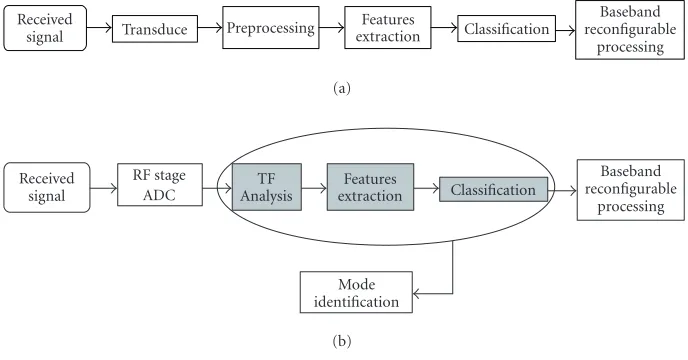
Figure1: A general classification scheme and the proposed method for mode identification.
their occupied bandwidth can considerably vary over time. Therefore, filter design is more complex to realize, and the filter structure should take into account the nonstationary nature of signals.
Moreover, in the case of signals with equal RSS, identifi-cation may become critical. There might be no possibility of discriminating signals in a correct way, and an adaptive re-ception, like that presented above, may not be achieved. For example, in the case under investigation, fromTable 1 it is possible to note different transmission powers for the two standards. However, due to the channel propagation model and the presence of path loss effects during transmission over a real channel, it might be possible to observe received signals with equal RSS. In this case, the RSS feature is not useful for MI.
Another great advantage of TF over other features, like RSS, for MI is the independence of the communication modes. This is quite important from the receiver design point of view. For example, when employing filters for extracting RSS, they should be matched to the signal to be detected, or the signal shape should be known. In the case of TF analysis, the latter constraint must not be fulfilled. TF provides a sig-nal description even when no a priori knowledge of the sigsig-nal shape is available. Therefore, the receiver structure based on TF methods for identification can be more modular and flex-ible in the presence of a multistandard environment, as com-pared with other methods. This can be a good attribute for an SR receiver. Moreover, if the bandwidth to be monitored is variable and a standard is added, the number of filters to be used can be different. This fact introduces into the receiver structure a hardware redundancy that, in the case of an SR device, should be avoided. To sum up, the use of TF tools for MI in a multistandard environment, especially in the case of signals superposition, is better than the use of other features. TF tools allow one:
(i) to design a flexible/modular SR receiver structure;
(ii) to be independent of particular transmission modes; (iii) to obtain a higher discriminating power and a more
effective signal representation; (iv) to use adaptive reception techniques.
A drawback of using TF analysis is computational complex-ity. However, in the field of hardware structures, chips to compute TF are being developed also for real-time applica-tions [21,22,23,24,25,26].
4. PROPOSED METHOD FOR MODE IDENTIFICATION
The proposed approach to performing MI is based on the fol-lowing three main tools: (1) a TF tool, which computes the TF transform; (2) a feature extractor, which derives the main characteristics from a signal; (3) a classifier, which discrimi-nates different standards.
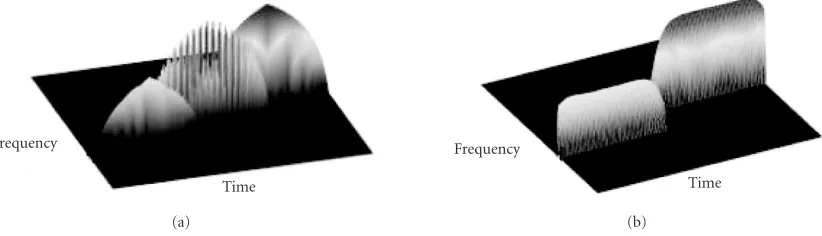
A general classification system (Figure 1a) is composed of various modules. In the proposed method, each module can be mapped into the corresponding general block, as in-dicated inFigure 1b. In particular, after the RF stage and A/D conversion, the received signal is processed by a TF block. This block provides a TF representation (distribution) where the two modes (DS and FH) are well defined in the TF plane (Figure 2). A TF distribution is obtained from the TF block, where each element represents the TF value in the TF plane. Toward this end, the received signal is observed in a window multiple of the time Twhich is the sample time chosen on the basis of the standards’ characteristics [16,17]. This win-dow has been designed to include 10 Bluetooth frequency hops (Bluetooth FH employs 1600 hops/s on 79 frequencies [17]). At the same time, the IEEE 802.11b DS CDMA signal is also present with its frequencies inside the window. The fea-tures obtained by the TF block are given to the classification module to identify the mode available.
Time 1
2 3 4 5 6×10
7
Fre
q
u
en
cy
Bluetooth
(a)
Time 1
2 3 4 5 6×10
7
Fre
q
u
en
cy
IEEE 802.11b
(b)
Figure2: Time-frequency transforms of the two standards: (a) Bluetooth, (b) IEEE 802.11b.
Time Frequency
(a)
Time Frequency
(b)
Figure3: (a) Wigner distribution and (b) Choi-Williams distribution of an FH signal.
4.1. Time-frequency distribution
Two kinds of TF distributions are used: the WV distribution [13] and the CW distribution [27]. Both have advantages and disadvantages as explained below.
The WV distribution is the prototype for all TF trans-forms, and is the most widely used and the most impor-tant. Its optimal performances can be obtained for mono-dimensional signals, whereas multicomponent signals suf-fer from the presence of cross-terms (Figure 3a). According to the distribution profile for any signal of fixed length and moving on the time axis, the WV transform of a signals(t) increases up to the middle of the time window, then it de-creases. Such a behavior produces a typical shape. This trans-form presents a low computational complexity, which is a suitable feature for real-time usage.
The Wigner distribution is given by the following expres-sion [13]:
W(t,f)= 1 2π
s∗
t−1 2τ
s
t+1 2τ
e−jτ2π f tdτ. (1)
The second transform, namely, the CW distribution, thanks
to its exponential kernel, reduces interference effects, thus providing a better and cleaner visualization of signals in the TF plane. Unfortunately, this improvement results in higher computational complexity. Another remarkable difference, as compared with the WV transform, is the profile of the sig-nal distribution: the profile is not sharp but flat and this gives more precise estimates of the distribution borders.
The CW distribution is given by the following expression [27]:
WCW(t,f)=
e−j2π f t 4σ πτ2e
−σ(µ−t)2/4τ2
×s
µ+τ 2
s∗
µ−τ 2
dµ dτ, (2)
whereσis a factor controlling the suppression of cross-terms and the frequency resolution. WCW(t,f) becomes the WV
distribution whenσ → ∞. The integral ranges from−∞to ∞and, in our case,s(t) is the received signal.
The choice of the distribution for the preprocessing task must meet the following requirements:
0 1000 2000 3000 4000 5000 6000 7000
0 1000 2000 3000 4000 5000 6000 7000 Time
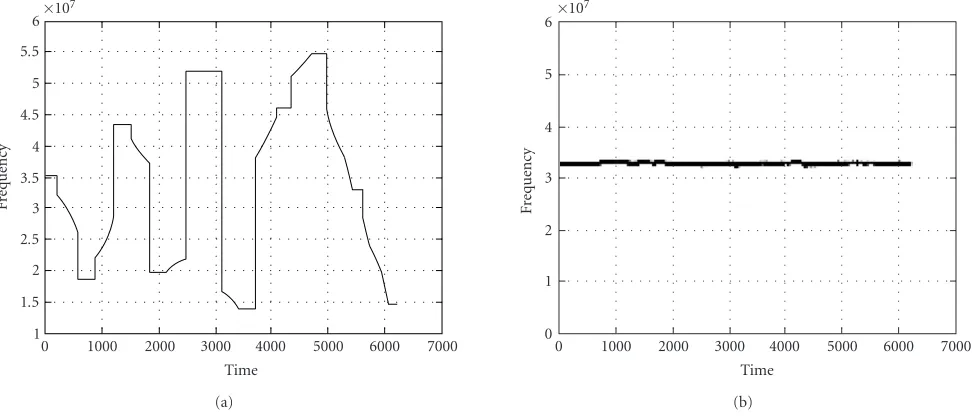
Figure4: Examples of the first-order conditional moments, namely the instantaneous frequency, in the cases of (a) Bluetooth (frequency hopping) and (b) IEEE 802.11b (DS-CDMA).
The first requirement is satisfied more directly by the CW transform thanks to its exponential kernel, as explained above; on the other hand, the WV transform requires a lower computational load thanks to its simpler formula, an impor-tant feature in real-time usage.
In an MI task, the WV transform yields worse results than the ones achieved by the CW transform. Moreover, the problem of obtaining the first-order conditional moment by the WV distribution lies in the fact that it can take on neg-ative values that are not physically correct. In the literature, one can find some TF distributions defined to obtain only positive values [28] of that parameter. In our case, just to simplify the computation, the Janssen method has been ap-plied to the distribution [29], and positive values have been obtained by the WV distribution.
4.2. Features extraction
From the TF matrix, computed by either the WV transform or the CW transform, it is possible to extract the features of a received signal. Two features are studied in this paper:
(i) the standard deviation of the instantaneous frequency; (ii) the maximum duration of a signal.
To obtain the first feature from a given TF distribution
P(t,ω), the first conditional moment of the frequency is computed as [13]
where P(t) is the time distribution and the integral ranges from−∞to∞.ωt is the average frequency at a particular time t and, most important, is considered as the instanta-neous frequency [13]. So, if a signal is regarded as a generic bandpass signal composed of the amplitude component and
the phase component [13],
s(t)=A(t)ejϕ(t), (4)
its instantaneous frequencyωiis
ωi=ϕ(t)=
ωt. (5)
From this parameter the first feature is obtained, namely, the standard deviation of the first-order conditional moment,
stdωi
This parameter is computed on a time window T longer
than the time hopping period of the Bluetooth signal. From
Figure 4, one can see thatThas been chosen such as to obtain a low value of std(ωi) when the first conditional moment is quite constant, as in the case of DS (IEEE 802.11b), whereas std(ωi) takes on large values when the spectrum is strongly variable in time, as in the case of FH (Bluetooth).
(1) From the chosen transform, a binary TF matrix
Pbin(t,f) is obtained by thresholding the real-valued
TF transform. The values of this matrix represent the presence (elements equal to 1) or the absence (ele-ments equal to 0) of signals at a given timetand at a given frequency f .
(2) The threshold has been chosen in an empirical way. Af-ter a trial and test procedure, its value has been chosen as the mean value of the original TF matrix.
(3) OncePbin(t,f) has been obtained, the elements of each
row of this matrix are summed up to derive the time durations of the signal components at a certain fre-quency.
These operations yield different values for each row of the TF matrix according to a run-length measurement scheme. The feature to be presented to the classifier has been chosen as the maximum value in such a set, that is,
TM =max
where the summation is done over the entire length of the window where the distribution is computed.
4.3. Choice of the classifier
A multiple-hypothesis test has been carried out. In particular, four classes have been studied.
(1) Class H0: presence of additive white gaussian noise (AWGN). This class will be denoted by “Noise.” (2) Class H1: presence of WLAN signal with AWGN and
multipath fading. It will be denoted by “WLAN.” (3) Class H2: presence of Bluetooth signal with AWGN
and multipath fading. It will be denoted by “Blue-tooth.”
(4) Class H3: presence of both types of signals with AWGN and multipath fading. It will be denoted by “WLAN + Bluetooth.”
The data extracted are dependent on the user’s distance from the Bluetooth or the IEEE 802.11b BS. As a consequence, the classes, except Noise, move in the features plane according to the user’s movement. InFigure 5, an example of the WLAN + Bluetooth class is given for a moving user. The first effect of this peculiarity is that a different linear classifier would be necessary for each user position. This solution is too complex and unfeasible. Therefore, a pattern recognition approach using neural classifiers has been chosen. With this technique, a theoretical model of experimental distribution is not nec-essary, thus the problem of modeling the probability density function (PDF) of each feature is avoided. Then, the classifier is the same for any location, being completely uncorrelated with the user’s movements, and the analysis has been made for different positions with respect to the signal source, as will be explained in the next section.
4 m from WLAN source 7.5 m from WLAN source 9 m from WLAN source
11 m from WLAN source 12.5 m from WLAN source
0 2 4 6 8 10 12 14 16
Standard deviation of instantaneous frequency 0.1
Figure5: Feature plane at multiple-user positions for the WLAN + Bluetooth class by using CW.
The chosen networks are feed forward back-propagation neural networks (FFBPNN) and support vector machines (SVMs). An FFBPNN is trained by the back propagation su-pervised method [30,31]. In particular, the learning algo-rithm is the “batch gradient descent with momentum,” so the synaptic weights and biases are updated at the end of the entire training set [14]. Moreover, the momentum version permits one to consider not only the local gradient but also the previous values of the cost function: acting as a low-pass filter, the momentum allows the network to ignore some lo-cal minima.
The second classifier, that is, the SVM, has an RBF as ker-nel, due to the characteristics of the features space, which is composed of nonseparable classes [14,15]. The equation for the kernel is given by the following formula:
Kxi,xj
=exp−γ·xi−xj
2
, γ >0. (10)
As in the case of this paper, the classical problem of lin-ear SVMs is modified by inserting positive slack variablesξi,
i =1,. . .,l[32] to introduce a further cost when necessary. So the constraint that has to be satisfied by the training data becomes
Then the problem of finding the hyperplane is
min
wherelis the training set dimension,xiis the training vector,
Table2: Data of the SVM.
Characteristic Choi-Williams Wigner-Ville
Parameters Optimization Grid search Grid search
C 16 13777
γ 46.851 18.379
Training vectors 6000 6000
To obtain the best classifier, the parameters have to be optimized. The grid search approach has been chosen to find the values ofC andγ(RBF exponent, (10)) and the results are shown inTable 2.
Both classifiers present as input a vectorvwhose compo-nents are the features (6) and (8):
v=stdωi
,TM
=v1,v2
. (13)
The output is a two-bit variable with one of the four possible values: presence of WLAN (DS-CDMA), presence of Blue-tooth (FH-CDMA), presence of both, and presence of noise only.
Having two kinds of TF distributions, two different train-ing vectors for each network have been studied. In particular, the vectorvis available for the WV transform and is called
vW, whereas it isvCfor the CW transform.
5. NUMERICAL RESULTS
In this section, results in terms of error classification proba-bility, expressed as relative error frequency, are reported.
For the trials, a power class three [17] for Bluetooth and a 25 mW power level for WLAN are considered [16]. Bit rate equal to 1 Mbps for Bluetooth and 11 Mbps for IEEE 802.11b are used [16,17]. The number of transmitted bits is equal to 104.
The simulation model of the physical levels of the two standards has been set up in the Matlab/Simulink environ-ment, following all the specifications given by [16,17], except the presence of coding, which has not been assumed because it is beyond the scope of this paper.
Moreover, a scenario with a single user has been consid-ered: an IEEE 802.11b access point and two Bluetooth pi-conets are presented. An indoor environment (a 15 m×15 m room) with sources placed in the room corners is considered as described in [33] (seeFigure 6). The simulation assumes that a user, provided with an SDR mobile handset, gets into the room where one or both standards are available and have to be identified. The user’s movement is simulated straight from the WLAN source to the Bluetooth one [14].
The channel model is a downlink indoor channel at 2.4 GHz. More precisely, a Rician fading channel has been considered with a delay spread of 60 ns and a root mean square (rms) delay spread of 30 ns [34] with AWGN noise. A path loss term has also been added. This term is modeled as described in [33,35] and introduces an attenuation term
15 m 15 m
Figure6: Scenario for simulations.
in dB given by
LP=
32.45 + 20 log(f ·d), d≤8,
58.3 + 33 log
d
8
, d >8, (14)
where f is the carrier frequency in GHz anddis the distance in meters from the source. Assuming unitary gains for the transmitter and receiver antennas, the received powerPRis given by
PR=PT−LP, (15)
wherePTis the transmission power in dB andLPis the atten-uation value (expressed in dB) due to the path loss (14). Dur-ing the simulations, the signal to noise ratio (SNR) is con-sidered variable with respect to the distance, as the received signal power changes due to the path loss (14)-(15).
Once the signals are passed through the channel, they are converted to IF, and then the A/D conversion is performed at a sample rate of 120 MSample/s to satisfy the Nyquist limit. The IF has been chosen to be equal to 30 MHz. Then the re-ceived signal is computed by the TF block.
The WV and CW distributions use blocks withN=512 samples obtained by a time windowT long enough to con-tain 10 frequency hops. The time hopping is 625µs [16]. The extraction module stores 10 TF matrices and calculates the features as defined in the previous section. The values are passed to the classifiers, which are implemented in the fol-lowing steps:
(i) training, (ii) testing, (iii) evaluation.
Table3: Data of the FFBPNN.
Input 2
Output 2
Levels 4
Neurons for level 5, 5, 4, 2
Activation function tansig
Epochs 10000
Learning rate 0.1
Goal 0
As reported inSection 4.3, having two possible input vec-tors, vW andvC (from WV and CW, resp.) and two possi-ble classifiers (FFBPNN and SVM), four configurations have been studied and evaluated:
(1) FFBPNN withvW; (2) FFBPNN withvC; (3) SVM withvW; (4) SVM withvC.
For each configuration, the output of the classifiers is a two-bit variable giving one of the four possible classes (see
Section 4.3); the variable represents the mode present in the environment.
The number of levels for the FFBPNN is 4 with 5, 5, 4, and 2 neurons. The activation function is a hyperbolic tan-gent sigmoid and the learning rate is 10%. The network is trained by means of 1000 different feature vectors presented 10000 times. Other data used for the FFBPNN are given in
Table 3.
As in the case of the FFBPNN, the SVM has been trained by using two different training vectors (vW andvC), so two different classifiers have been obtained. InTable 2, some pa-rameters of the SVM are presented.
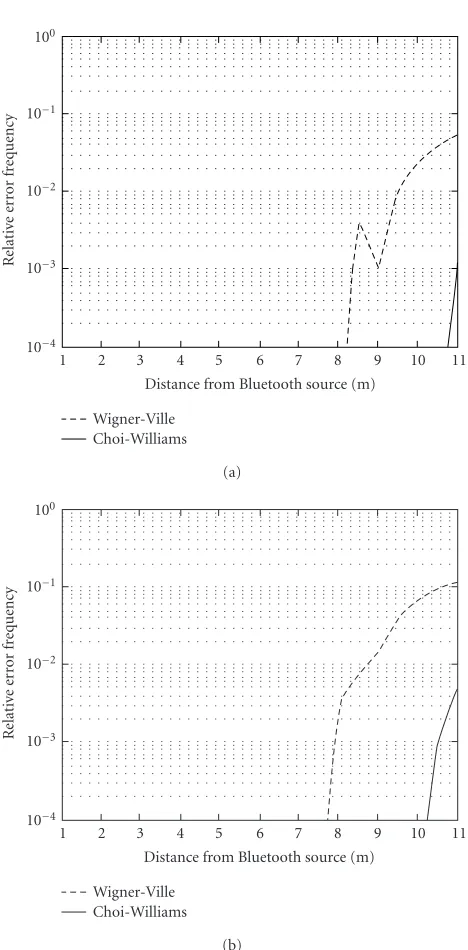
In the following figures, the relative classification error frequency is shown for each class by using the two classifiers and the two TF distributions. The only noise class is always correctly classified. Instead, the case of Bluetooth (BT) clas-sification is depicted in Figures7aand7b. InFigure 7a, the SVM classifier shows good performances by the CW distri-bution, but in the case of WV, some errors occur; the same considerations can be done for the classification by the FF-BPNN The best performances of CW, as compared with the ones of WV results from its behavior with multicomponent signals, like Bluetooth. The CW distribution strongly reduces the so called cross-terms thanks to the exponential kernel, which is not present in the WV distribution.
In Figures8aand8b, classification results for the WLAN class are shown. As in previous case, the performances of CW are better than WV. Making a comparison between the two classes, one can notice that the error frequency is higher in the case of WLAN: this is due to the larger overlapping between WLAN and WLAN + Bluetooth than between BT and WLAN + Bluetooth. The superimposition is caused by the higher transmission power of WLAN, which makes the WLAN + Bluetooth class more similar to WLAN than BT, when the user is closer to the sources.
Wigner-Ville Choi-Williams
1 2 3 4 5 6 7 8 9 10 11
Distance from Bluetooth source (m) 10−4
10−3 10−2 10−1 100
R
elat
iv
e
er
ro
r
fr
equency
(a)
Wigner-Ville Choi-Williams
1 2 3 4 5 6 7 8 9 10 11
Distance from Bluetooth source (m) 10−4
10−3 10−2 10−1 100
R
elat
iv
e
er
ro
r
fr
equency
(b)
Figure 7: Relative error frequency of Bluetooth by using (a) the SVM and (b) the FFBPNN.
The results reported above are also demonstrated by Fig-ures9aand9b. In this case, the performances of the MI mod-ule are good at intermediate distances from both sources. In
Wigner-Ville Choi-Williams
2 4 6 8 10 12 14
Distance from WLAN source (m) 10−4
10−3 10−2 10−1
R
elat
iv
e
er
ro
r
fr
equency
(a)
Wigner-Ville Choi-Williams
2 4 6 8 10 12 14
Distance from WLAN source (m) 10−4
10−3 10−2 10−1 100
R
elat
iv
e
er
ro
r
fr
equency
(b) Figure8: Relative error frequency of WLAN by using (a) the SVM and (b) the FFBPNN.
Wigner-Ville Choi-Williams
1 2 3 4 5 6 7 8 9 10 11
Distance from Bluetooth source (m) 10−4
10−3 10−2 10−1 100
R
elat
iv
e
er
ro
r
fr
equency
(a)
Wigner-Ville Choi-Williams
1 2 3 4 5 6 7 8 9 10 11
Distance from Bluetooth source (m) 10−4
10−3 10−2 10−1 100
R
elat
iv
e
er
ro
r
fr
equency
(b)
Figure9: Relative error frequency of WLAN + Bluetooth by using (a) the SVM and (b) the FFBPNN.
The behaviors of WLAN + Bluetooth and the other classes can also be found inTable 4, which shows the confu-sion matrix for a point at 7.5 m from WLAN, using the WV distribution and FFPBNN.
From a TF transform point of view, one can conclude that CW distribution provides better performances than the WV one in all presented cases. As explained, this result stems
from the CW structure, which presents an exponential kernel that strongly reduces auto-interference [13]. The drawback of this transform is a higher computational complexity than that of WV.
Another analysis can be made, considering results plot-ted for the same distributions but different classifiers. Figures
Table4: Confusion matrix.
Mode WLAN Bluetooth WLAN + Bluetooth Noise
WLAN 9980 0 20 0
Bluetooth 0 10000 0 0
WLAN + Bluetooth 1290 0 8710 0
Noise 0 0 0 10000
Neural network SVM
1 2 3 4 5 6 7 8 9 10 11
Distance from Bluetooth source (m) 10−4
10−3 10−2 10−1 100
R
elat
iv
e
er
ro
r
fr
equency
(a)
Neural network SVM
1 2 3 4 5 6 7 8 9 10 11
Distance from Bluetooth source (m) 10−4
10−3 10−2 10−1 100
R
elat
iv
e
er
ro
r
fr
equency
(b)
Figure10: Relative error frequency of Bluetooth by using (a) Choi-Williams and (b) Wigner-Ville.
and (b) WV. The results are better for the SVM in both cases thanks to its ability with nonlinear kernels to identify over-lapping classes.
6. CONCLUSIONS
In this paper, a method to perform MI for an SDR-based re-ceiver has been proposed and discussed. In particular, atten-tion has been focused on discriminating between two modes (FH-CDMA and DS-CDMA) related to two standards (Blue-tooth and IEEE 802.11b) in an indoor environment. TF anal-ysis (by the WV and CW distributions) and neural classifiers (a feedforward network and an SVM) have been proposed as a possible solution. Results in terms of error classification probability (expressed as relative error frequency) with re-spect to the distances from the sources have been given in the context of a Rician fading download channel in the presence of path loss. The proposed method has yielded good results, which will lead the authors to develop these methodologies by adding new standards and new features. Moreover, the comparisons between the two distributions and the two clas-sifiers point out that the CW distribution and the SVM pro-vide best classification performances. The drawback of this solution is a higher computation load due to the TF distribu-tion.
ACKNOWLEDGMENTS
This work was partially developed within the project Vir-tual Immersive COMmunication (VICOM) funded by the Italian Ministry of University and Scientific Research (FIRB Project). The authors wish to thank the anonymous re-viewers for their constructive comments and analyses and Francesco Pantisano for his valuable help in the collection of the paper results.
REFERENCES
[1] J. Mitola, Software Radio Architecture: Object-Oriented
Ap-proaches to Wireless Systems Engineering, John Wiley & Sons, New York, NY, USA, 2000.
[2] T. Turletti and D. Tennenhouse, “Complexity of a software
GSM base station,” IEEE Communications Magazine, vol. 37,
no. 2, pp. 113–117, 1999.
[3] S. Mirabbasi and K. Martin, “Classical and modern receiver
architectures,” IEEE Communications Magazine, vol. 38, no.
11, pp. 132–139, 2000.
[4] E. Buracchini, “The software radio concept,” IEEE
Commu-nications Magazine, vol. 38, no. 9, pp. 138–143, 2000. [5] R. H. Walden, “Performance trends for analog to digital
con-verters,” IEEE Communications Magazine, vol. 37, no. 2, pp.
[6] R. D. Murch and K. B. Letaief, “Antenna systems for
broad-band wireless access,” IEEE Communications Magazine, vol.
40, no. 4, pp. 76–83, 2002.
[7] M. Laddomada, F. Daneshgaran, M. Mondin, and R. M. Hick-ling, “A PC-based software receiver using a novel front-end
technology,” IEEE Communications Magazine, vol. 39, no. 8,
pp. 136–145, 2001.
[8] J. Mitola, Cognitive radio: an integrated agent architecture for
software defined radio, Ph.D. Dissertation, Department of Teleinformatics Electrum 204, Royal Institute of Technology (KTH), Stockholm, Sweden, May 2000.
[9] J. Mitola and G. Q. Maguire Jr., “Cognitive radio: making
soft-ware radios more personal,” IEEE Personal Communications,
vol. 6, no. 4, pp. 13–18, 1999.
[10] M. Mehta, N. Drew, G. Vardoulias, N. Greco, and C. Nieder-meier, “Reconfigurable terminals: an overview of
architec-tural solutions,”IEEE Communications Magazine, vol. 39, no.
8, pp. 82–89, 2001.
[11] H. Urkowitz, “Energy Detection of unknown deterministic
signals,”Proceedings of IEEE, vol. 55, no. 4, pp. 523–531, 1967.
[12] C. Roland and J. Palicot, “A self-adaptive universal receiver,”
Annales des T´el´ecommunications, vol. 57, no. 5-6, pp. 421–456, 2002.
[13] L. Cohen,Time-Frequency Analysis, Prentice-Hall, Englewood
Cliffs, NJ, USA, 1995.
[14] S. Haykin, Neural Networks: A Comprehensive Foundation,
Prentice-Hall, Upper Saddle River, NJ, USA, 1999.
[15] N. Cristianini and J. Shawe-Taylor, An Introduction to
Sup-port Vector Machines and Other Kernel-Based Learning
Meth-ods, Cambridge University Press, Cambridge, UK, 2000.
[16] IEEE 802.11b, “Wireless LAN MAC and PHY specifications: higher speed physical layer (PHY) extension in the 2.4 GHz band,” 1999, supplement to 802.11.
[17] Bluetooth standard, “Specification of the Bluetooth System,”
volume 1,www.bluetooth.com.
[18] J. M. Peha, “Wireless communications and coexistence for
smart environments,”IEEE Personal Communications, vol. 7,
no. 5, pp. 66–68, 2000.
[19] P. J. Loughlin, Ed., “Special Issue on Time Frequency
Analy-sis,”Proceedings of the IEEE, vol. 84, no. 9, 1996.
[20] N. Golmie, N. Chevrollier, and O. Rebala, “Bluetooth and
WLAN coexistence: challenges and solutions,” IEEE Wireless
Communications, vol. 10, no. 6, pp. 22–29, 2003.
[21] B. Boashash and P. Black, “An efficient real-time
implementa-tion of the Wigner-Ville distribuimplementa-tion,” IEEE Trans. Acoustics,
Speech, and Signal Processing, vol. 35, no. 11, pp. 1611–1618, 1987.
[22] G. S. Cunningham and W. J. Williams, “Fast implementations
of generalized discrete time-frequency distributions,” IEEE
Trans. Signal Processing, vol. 42, no. 6, pp. 1496–1508, 1994. [23] I. Gertner and M. Shamash, “VLSI structures for computing
the Wigner distribution,” inProc. IEEE Int. Conf. Acoustics,
Speech, Signal Processing (ICASSP ’88), vol. 4, pp. 2132–2135, New York, NY, USA, April 1988.
[24] A. K. Ozdemir and O. Arikan, “Fast computation of the ambi-guity function and the Wigner distribution on arbitrary line
segments,” IEEE Trans. Signal Processing, vol. 49, no. 2, pp.
381–393, 2001.
[25] H. M. Ozaktas, O. Arikan, M. A. Kutay, and G. Bozdagt,
“Dig-ital computation of the fractional Fourier transform,” IEEE
Trans. Signal Processing, vol. 44, no. 9, pp. 2141–2150, 1996. [26] S. Stankovic and L. Stankovic, “An architecture for the
real-ization of a system for time-frequency signal analysis,” IEEE
Transactions on Circuits and Systems II: Analog and Digital Sig-nal Processing, vol. 44, no. 7, pp. 600–604, 1997.
[27] H.-I. Choi and W. J. Williams, “Improved time-frequency
representation of multicomponent signals using exponential
kernels,” IEEE Trans. Acoustics, Speech, and Signal Processing,
vol. 37, no. 6, pp. 862–871, 1989.
[28] P. J. Loughlin and K. L. Davidson, “Modified Cohen-Lee time-frequency distributions and instantaneous bandwidth of
mul-ticomponent signals,” IEEE Trans. Signal Processing, vol. 49,
no. 6, pp. 1153–1165, 2001.
[29] A. J. E. M. Janssen, “On the locus and spread of
pseudo-density functions in the time-frequency plane,”Philips Journal
of Research, vol. 37, no. 3, pp. 79–110, 1982.
[30] D. E. Rumelhart, G. E. Hinton, and R. J. Williams, “Learning
representations by back-propagation errors,”Nature, vol. 323,
pp. 533–536, 1986.
[31] B. Hassibi and T. Kailath, “Optimal training algorithms and
their relation to backpropagation,” inAdvances in Neural
In-formation Processing Systems (NIPS ’94), vol. 7, pp. 191–198, Denver, Colo, USA, November–December 1994.
[32] C. Cortes and V. Vapnik, “Support-vector networks,”Machine
Learning, vol. 20, no. 3, pp. 273–297, 1995.
[33] A. Kamerman,Coexistence between Bluetooth and IEEE 802.11
CCK Solutions to Avoid Mutual Interference, Lucent Technolo-gies Bell Laboratories, Murray Hill, NJ, USA, January 1999. [34] T. A. Wysocki and H.-J. Zepernick, “Characterization of the
indoor radio propagation channel at 2.4 GHz,” Journal of
Telecommunications and Information Technology, vol. 1, no. 3-4, pp. 84–90, 2000.
[35] N. Golmie, R. E. Van Dyck, and A. Soltanian, “Interference of bluetooth and IEEE 802.11: simulation modeling and
perfor-mance evaluation,” inProc. 4th International ACM Workshop
on Modeling, Analysis and Simulation of Wireless and Mobile Systems, Rome, Italy, July 2001.
Matteo Gandettowas born in Alessandria, Italy, in 1976. He received the Laurea degree in telecommunication engineering from the University of Genoa in 2001 with a Master’s thesis dealing with multimedia data trans-mission over RTP protocol. He is currently pursuing a Ph.D. in information and com-munication technologies in Biophysical and Electronic Engineering Department, Uni-versity of Genoa. His main research
activi-ties are wireless communication with reconfigurable terminals and time-frequency analysis applied in telecommunication. He is a member of the Signal Processing & Telecommunications Group in University of Genoa and of the National Inter-University Consor-tium for Telecommunications.
Marco Guainazzois currently a Ph.D. stu-dent in science and space engineering at the Department of Biophysical and Elec-tronic Engineering (DIBE), University of Genoa, Italy. He received his M.S. degree in telecommunications engineering in 2001. In 2001, he collaborated with the National Inter-University Consortium for Telecom-munications (CNIT) on the “Agenzia Spaziale Italiana (ASI)” cofunded research
Carlo S. Regazzoni is Associate Professor of telecommunications at the Department of Biophysical and Electronic Engineering (DIBE) of the University of Genoa. He ob-tained the Laurea degree and the Ph.D. in telecommunications and signal processing in 1987 and 1992, respectively. He is mem-ber of the CNIT Research Unit of Genoa and responsible of the Signal Processing and Telecommunications Group at DIBE. He