Remote Elicitation of Inflectional Paradigms to Seed Morphological Analysis in
Low-Resource Languages
John Sylak-Glassman*, Christo Kirov*, David Yarowsky**
*Center for Language and Speech Processing**Department of Computer Science Johns Hopkins University Baltimore, MD 21218, USA
[email protected], [email protected], [email protected]
Abstract
Structured, complete inflectional paradigm data exists for very few of the world’s languages, but is crucial to training morphological analysis tools. We present methods inspired by linguistic fieldwork for gathering inflectional paradigm data in a machine-readable, interoperable format from remotely-located speakers of any language. Informants are tasked with completing language-specific paradigm elicitation templates. Templates are constructed by linguists using grammatical reference materials to ensure completeness. Each cell in a template is associated with contextual prompts designed to help informants with varying levels of linguistic expertise (from professional translators to untrained native speakers) provide the desired inflected form. To facilitate downstream use in interoperable NLP/HLT applications, each cell is also associated with a language-independent machine-readable set of morphological tags from the UniMorph Schema. This data is useful for seeding morphological analysis and generation software, particularly when the data is representative of the range of surface morphological variation in the language. At present, we have obtained 792 lemmas and 25,056 inflected forms from 15 languages.
Keywords:Low-Resource Languages, Morphology, UniMorph Schema, Seed Corpus, Crowdsourcing, Linguistic Fieldwork
1.
Introduction
For most of the world’s languages, no structured, com-plete inflectional paradigms in a machine-readable format are available for human language technology (HLT) ap-plications. These paradigms are necessary as seed data for downstream tasks, especially morphological analysis and generation. Increased global internet access has made it possible to gather inflectional paradigm data directly from remotely-located speakers of many of the world’s lan-guages. We present methods for data collection grounded in the practice of linguistic fieldwork. The methods devel-oped thus far have been used to gather a corpus of inflec-tional paradigm data for 15 languages, with materials ready for eliciting data from speakers of 33 additional languages.1 The methods we have developed entail first constructing detailed elicitation templates in which speakers supply de-sired inflectional forms (§2.). These templates include: 1) A prompt in a high-resource world language (e.g. English) that speakers can translate into the target low-resource lan-guage (e.g. Uzbek), 2) a short description of the desired inflectional form in pedagogical or linguistic terminology (e.g. ‘aorist’), and 3) a detailed specification of the inflec-tional form in terms of the UniMorph Schema, introduced by Sylak-Glassman et al. (2015a, 2015b).2 These
elicita-1These 15 languages are listed in Table 1, and the additional 33
languages include: Acholi, Armenian, Balochi, Burmese, Cambo-dian, Coptic, Dinka, Gujarati, Hausa, Hindi, Kikuyu, Kongo (Fi-oti), Kurdish, Lao, Lingala, Luganda, Maguindanao, Malay, Mon-golian, Nahuatl, Nubian, Nuer, Pashto, Samoan, Somali, Span-ish, Surubu (Fiti), Swahili, Tausug, Thai, Vietnamese, Wolof, and Zande.
2
The name used in those works for this schema, the Universal Morphological Feature Schema, is deprecated in favor of the name UniMorph Schema.
tion templates are distributed to remotely-located speakers, who may be either professional translators or untrained na-tive speakers recruited via crowdsourcing platforms (§3.). Even a very small amount of inflectional paradigm seed data, particularly when it is representative of the surface morphological variation of the language, can serve as effec-tive training data for machine learning, particularly for gen-erating possible inflected forms (§4.). We demonstrate this by assessing the ability of recent morphological paradigm completion software by Durrett and DeNero (2013) to pre-dict inflected word forms using the small amount of training data supplied by elicitation, the full amount of Wiktionary data, and a small random subset of that Wiktionary data.
2.
Elicitation Templates
linguistic fieldwork to reveal grammatical distinctions.3 For each requested form, additional descriptive information is given using either pedagogical terminology commonly used when teaching the elicited language or (as a secondary option) standard technical terminology used by linguists. This information is an additional resource that helps trans-lators pinpoint which inflectional form is desired. Fig. 1 (on the following page) shows a template given to transla-tors and includes both the additional descriptive informa-tion and the English prompt.
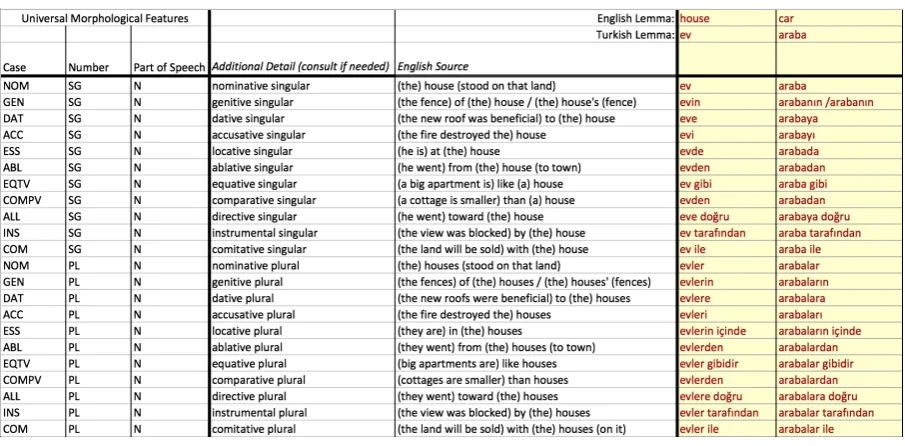
Each inflectional form is associated with a set (i.e. a vector) of features from the UniMorph Schema, as shown on the left in Fig. 2. These features, which are not shown to lan-guage informants, precisely describe the meaning of each form using a language-independent annotation scheme that allows for straightforward comparison with inflectional forms in other languages that have a similar meaning. The UniMorph Schema contains over 277 features from 25 di-mensions of meaning (i.e. morphological categories such as tense, number, case, evidentiality, etc.). These features are motivated by overt, usually affixal morphological contrasts in at least one natural language. Each feature represents a semantic “atom” within a dimension of meaning that is not decomposed further in any natural language.
For example, within the dimension of number, the Aus-tronesian language Sursurunga distinguishes singular (1), dual (2), paucal (>3), greater paucal (>4), and plural (many).4 Larike (also Austronesian; Corbett 2000:21) marks singular, dual (exactly 2), trial (exactly 3), and plural (>4). The UniMorph Schema includes the features neces-sary to distinguish all these categories, which are marked by surface contrasts in each language and are not decom-posed further in any natural language.5 However, were a language to be discovered that distinguished a blended dual-trial (2/3) from singular, paucal, greater paucal, and plural, the UniMorph Schema would combine the minimal dual (exactly 2) and trial (exactly 3) features together addi-tively to annotate the blended category (asDU+TRI). The features of the UniMorph Schema are therefore mo-tivated by findings from the linguistic typology literature that demonstrate the finest-grained, overt morphological distinctions that are made in natural languages. These fea-tures can be combined additively or disjunctively to specify non-minimal morphological categories. For full details on the UniMorph Schema, see Sylak-Glassman et al. (2015a,
3
Although elicitation has significant limitations and is typ-ically combined with textual analysis, it is easily adaptable to crowdsourcing, useful for gathering paradigmatic data (especially when all or most distinctions within the paradigm are already known), and allows for the collection of highly specific forms, particularly those whose use requires an atypical context. For a nuanced discussion of elicitation and its limitations, see Chelliah (2001).
4
Corbett (2000:27-29) writes that the paucal is used for 3-4 people or nuclear families of any size while the greater paucal is used for strictly 4 or more people, including larger-sized groups, with no strict dividing line between the greater paucal and plural.
5
Corbett (2000) devotes considerable discussion to showing that no language uses a quadral (4) category, especially in dis-tinction from the paucal and greater paucal in Sursurunga, even though such a distinction is in principle possible.
2015b).6
Because inflected wordforms in every language in the cor-pus are labeled using a single annotation scheme with con-sistent, meaningful, non-overlapping features, any applica-tion that is designed to take in data from one language can also process data from any other language in the corpus as well as data from any other source annotated using the Uni-Morph Schema. Similarly, because the UniUni-Morph Schema can be used with any language to capture the meaning en-coded by its inflectional morphology, its use in annotating inflected wordform data allows for the design of systems which can be language agnostic or independent without dis-regarding linguistic diversity (Bender, 2009).
3.
Gathering Inflectional Paradigm Data
The templates described above were used to gather inflec-tional paradigm data from professional translators and from untrained native speakers recruited through Amazon’s Me-chanical Turk crowdsourcing platform.One of the primary advantages of gathering paradigm data from professional translators was their greater metalinguis-tic awareness, including their overall knowledge of the lan-guage’s structure and their comfort with pedagogical and linguistic terminology. Professional translators can there-fore use descriptive information to pinpoint which form is desired, and can more reasonably be asked to choose lex-emes/lemmas that illustrate the range of surface morpho-logical variation in the language (e.g. different noun declen-sions or verb conjugations). Professional translators can also supply lemmas that illustrate variation in fixed lexical properties, such as animacy with nouns or transitivity with verbs.
By contrast, untrained native speakers cannot be assumed to have a high degree of metalinguistic awareness. For this reason, only the contextual natural language prompts in a major world language can be used to convey the differences between inflectional forms, and lemmas must be chosen in advance for the speakers. Lemmas can be chosen during the construction of elicitation paradigms based on knowledge of the language gleaned from a descriptive resource, but this entails additional effort for the linguist.
An alternate strategy is to choose lemmas automatically and gather data in sufficient quantities to increase the likeli-hood that examples of most surface variation will be col-lected. To do this, two problems must be solved: 1. Choos-ing lemmas in a way that is likely to maximize variation, and 2. constructing glosses that are intelligible to untrained speakers. Lemmas which maximize lexical variation can be chosen using information on lexical properties available in the entries of lexical resources like PanLex (Kamholz et al., 2014).
Given a set of lemmas whose paradigms we would like to elicit and an initial template designed for professional trans-lators, we can automatically generate new prompts for each new lemma to display to untrained speakers. First, we ex-cise the inflected lemmas from the existing prompts, replac-ing them with a placeholder tag indicatreplac-ing inflection (e.g. ‘I
6Additional detailed documentation on the UniMorph Schema
Figure 1: Excerpt of a blank elicitation template for Sinhalese verbs as presented to a translator.
Figure 2: Excerpt of an elicitation template for Turkish nouns with professional translator’s input in the shaded area and the UniMorph Schema annotation on the left for each form.
am going’ becomes ‘I am VBG’, where VBG is the stan-dard Penn Treebank tag for the-ingverb form in English). This placeholder can be replaced with the inflected form of any lemma we wish to insert to make a new prompt (e.g. ‘I am VBG’ + ‘try’ = ‘I am trying’). Since the prompts are al-ways in a high-resource language like English, it is possible to look up the inflected forms of each replacement lemma. If a replacement lemma is transitive, we add a generic ob-ject pronoun to an intransitive gloss template (e.g. ‘I am VBG it’).
The elicited output of untrained speakers can be scored to determine its accuracy. Scoring consists of compar-ing the elicited output to either verified or predicted
word-forms using string edit distance to determine the extent to which they diverge. Divergence can then be penalized, with thresholds established for acceptance, human inspection, and rejection. Speaker output can be compared to human-produced, gold standard data from reference grammars, professional translators, or a resource such as Wiktionary. It may also be compared to the output predicted by state-of-the-art paradigm completion software that is known to achieve high accuracy, such as Durrett and DeNero (2013), Ahlberg et al. (2014, 2015), and Nicolai et al. (2015).
Language L/F Adj N Pro V
(Indian) F 237 397 389 763
Sinhala L 6 9 – 12 (F) 25056 2449 6740 2120 13747
Table 1: The content of the current elicited inflectional paradigm corpus, with the number of lemmas (L) and in-flected forms (F) for each language indicated, with cross-language totals shown in the bottom row.
Prof. Wikt. Wikt. Trans. Sm. Full Azeri N 55.0% 70.7% 95.7%
Training 15 15 278
Test 30 30 30
Turkish N 23.1% 57.3% 94.7%
Training 13 13 1800
Test 200 200 200
Turkish V 56.0% 66.6% 92.4%
Training 13 13 421
Test 46 46 46
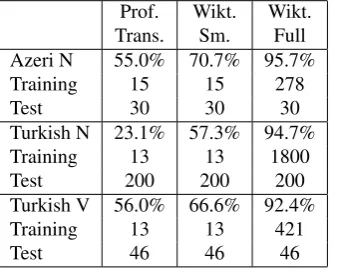
Table 2: Per form accuracy of Durrett and DeNero’s (2013) morphological paradigm learner on datasets of varying sizes for three language–part-of-speech combinations.
4.
Effectiveness of Seed Paradigms in
Morphological Generation
To test the utility of elicited paradigms, data provided by professional translators was compared to the full quantity of data available from Wiktionary and a random subset of that full dataset that contained the same number of
lem-mas as in the data from translators.7 Comparing to a small quantity of randomly chosen data from Wiktionary allows the effect of translators’ manual choice of lemmas to be assessed. It also simulates accurate output from untrained speakers with unconstrained lemma choice since the lem-mas in the randomly chosen subset likely do not capture the full range of surface morphological variation in the lan-guage.
Each dataset served as training input to Durrett and DeN-ero’s (2013) morphological paradigm learner, which learns position-anchored string transformations from the lemma to the inflected form. The transformations that may apply to predicting a given inflectional form from a given lemma are ranked in a classification step using a log-linear model with character 5-grams in both directions as well asn-grams for preserved segments used as features. Table 2 shows the individual form accuracy for each dataset, along with the source and size of the training data. Within each language and part-of-speech, a single test set randomly drawn from the full Wiktionary dataset was used. Each test set repre-sented approximately 10% of the full amount of data avail-able on Wiktionary.
Although accuracy is lowest when the professional transla-tors’ data is used to train the model, the model cannot run on every possible random subset of the Wiktionary data, as Wiktionary paradigms are not guaranteed to be complete or contain the same set of inflections. While the first randomly chosen subset of Wiktionary’s Turkish verb data happened to allow the model to generate predictions, Turkish nouns required one resampling of the random subset, and Azeri nouns required seven such resamplings before the model could generate predictions using the small Wiktionary sub-set.
This indicates that the range of inflectional variation among lemmas provided in the professional translators’ data, which reflects the range of possible surface variation in the language as a whole, supplied sufficiently diverse data to allow the model to learn diverse string transformations and generate a sufficiently wide range of predictions. Hold-one-out validation on the lemmas in the translators’ training data set showed, for example, that certain lemmas contributed strongly to the success of the Durrett and DeNero (2013) learner, as much as 25% of the individual form accuracy in Turkish verbs.
While the informants’ chosen lemmas were highly diverse as a set and informative on an individual basis, the lack of more than one example for any given inflectional class vari-ant appears to have a negative effect on the model’s ability to accurately predict the forms of new lemmas in each class. Because the Wiktionary data as a whole is likely to better represent the type frequency of lemma variants (most lem-mas come from one of a small number of regular inflec-tion classes), even a randomly chosen small subset is more likely to contain multiple examples of some class. This al-lows the model to learn the appropriate string transforma-tion rules for higher frequency inflectransforma-tional classes and
pro-7
vides more data for inflecting lemmas as belonging to one of those classes.
Overall, the results presented here indicate that even a very small amount of representative data is potentially useful for generating possible morphological forms, and that an in-crease in the number of lemmas per variant would likely lead to better classification results and improved accuracy. As data are collected from languages with additional gold standard morphological data (e.g. from Wiktionary), fur-ther testing will allow the disambiguation of the effects of the representation of variation in data, the number of exam-ples of each variant, and the amount of data needed given different degrees of inflectional variation.
5.
Conclusion
To address the need for structured, complete morphological paradigm data for HLT applications, particularly for low-resource languages, we have developed methods to gather inflectional paradigm data from remotely-located language professionals and untrained native speakers. These meth-ods are grounded in traditional linguistic fieldwork prac-tices, can be tailored to experts of varying skill levels, and are designed to be implemented at scale with remotely-located speakers of any language. The application of these methods has resulted in a corpus of inflectional paradigms for verbs, nouns, adjectives, and personal pronouns in 15 languages, with materials for 33 additional languages ready to be deployed and materials for other languages under de-velopment.
Ahlberg, M., Forsberg, M., and Hulden, M. (2014). Semi-supervised learning of morphological paradigms and lex-icons. InProceedings of the 14th Conference of the Eu-ropean Chapter of the Association for Computational Linguistics (EACL), pages 569–578, Gothenburg, Swe-den. Association for Computational Linguistics.
Ahlberg, M., Forsberg, M., and Hulden, M. (2015). Paradigm classification in supervised learning of mor-phology. InHuman Language Technologies: The 2015 Annual Conference of the North American Chapter of the ACL (NAACL-HLT), pages 1024–1029, Denver, CO. As-sociation for Computational Linguistics.
Bender, E. M. (2009). Linguistically na¨ıve != language independent: Why NLP needs linguistic typology. In
Proceedings of the EACL 2009 Workshop on the Inter-action between Linguistics and Computational Linguis-tics (ILCL): Virtuous, Vicious or Vacuous?, pages 26– 32, Stroudsburg, PA. Association for Computational Lin-guistics.
Chelliah, S. L. (2001). The role of text collection and elici-tation in linguistic fieldwork. In Paul Newman et al., ed-itors, Linguistic Fieldwork, pages 152–165. Cambridge University Press, Cambridge.
Corbett, G. G. (2000). Number. Cambridge University Press, Cambridge.
Durrett, G. and DeNero, J. (2013). Supervised learning of complete morphological paradigms. InProceedings of the 2013 Conference of the North American Chap-ter of the Association for Computational Linguistics: Human Language Technologies (NAACL-HLT), pages
1185–1195. Association for Computational Linguistics, Atlanta.
Kamholz, D., Pool, J., and Colowick, S. M. (2014). Pan-Lex: Building a resource for panlingual lexical transla-tion. InProceedings of the Ninth International Confer-ence on Language Resources and Evaluation (LREC), pages 3145–3150, Reykjavik, Iceland, May. European Language Resources Association (ELRA).
Nicolai, G., Cherry, C., and Kondrak, G. (2015). In-flection generation as discriminative string transduction. In Human Language Technologies: The 2015 Annual Conference of the North American Chapter of the ACL (NAACL), pages 922–931, Denver, CO. Association for Computational Linguistics.
Sylak-Glassman, J., Kirov, C., Post, M., Que, R., and Yarowsky, D. (2015a). A universal feature schema for rich morphological annotation and fine-grained cross-lingual part-of-speech tagging. In Cerstin Mahlow et al., editors,Proceedings of the 4th Workshop on Systems and Frameworks for Computational Morphology (SFCM), Communications in Computer and Information Science, pages 72–93. Springer, Berlin, September.