A Comparative Study of Extremely Low-Resource
Transliteration of the World’s Languages
Winston Wu, David Yarowsky
Department of Computer Science, Center for Language and Speech Processing Johns Hopkins University
{wswu,yarowsky}@jhu.edu
Abstract
Transliteration from low-resource languages is difficult, in large part due to the small amounts of data available for training transliteration systems. In this paper, we evaluate the effectiveness of several translation methods in the task of transliterating around 1000 Bible names from 591 languages into English. In this extremely low-resource task, we found that a phrase-based MT system performs much better than other methods, including a g2p system and a neural MT system. However, by combining the data and training a single neural system, we discovered significant gains over single-language systems. We release the output from each system for comparative analysis.
Keywords:Bible, alignment, named entities, translation, transliteration
1.
Introduction
Transliteration is the process of converting text from one script to another. For example, Росси́я is transliterated
as Rossiya but would betranslatedas Russia. Transliter-ation is important in the process of borrowing names be-tween languages. In the case of low-resource languages, there is often little training data with which to train translit-eration models. Thus, one major obstacle for low-resource languages is the problem of out of vocabulary words (in the transliteration setting, these would be unknown characters). Machine translation systems might use a transliteration step to resolve unknown words, especially names; in transliter-ation, one can perform a similar process by attempting to resolve unknown characters. In this paper, we compare and contrast multiple methods of transliterating Bible names in over 500 languages into English and evaluate the effective-ness of a pre- and post-transliteration step in transliteration in resolving unknown characters. Our results indicate that a phrase-based machine translation system is the most effec-tive when training on data in the order of hundreds of words, while by simply concatenating multiple languages’ training data with some preprocessing, a single neural MT system trained to transliterate multiple languages to a single target language significantly outperforms the single-language sys-tems. We release each system’s transliteration output as a dataset for comparative analysis. To our knowledge, this is the first study of such scale that compares such a variety of methods on such small corpora.
2.
Related Work
Machine transliteration has been tackled using a variety of methods. For a comprehensive survey, we refer the reader to Karimi et al. (2011). In this paper, we focus on translit-eration of named entities across multiple language, espe-cially in a low-resource setting, using the paradigm of mono-tonic machine translation (Virga and Khudanpur, 2003). Our work is most similar to Irvine et al. (2010), who built character-based machine translation systems using names mined from Wikipedia. Their setting is higher resource, as they use data acquired from the web, and they experiment on a smaller set of languages. Other recent approaches to
transliteration of low resource languages include Mayhew et al. (2016), who explore using surrogate languages in place of a language not in Wikipedia, Rosca and Breuel (2016) who showed state of the art transliteration perfor-mance using a neural sequence to sequence model, and Ji-ampojamarn et al. (2010), who explore several methods for language-independent transliteration mining. Qian et al. (2010) also developed a toolkit to extract translation pairs from comparable corpora.
We compare several open-source toolkits for translation: Moses (Koehn et al., 2007), a phrase-based statistical ma-chine translation toolkit; Sequitur (Bisani and Ney, 2008), a grapheme to phoneme system; and OpenNMT (Klein et al., 2017), a neural sequence-to-sequence machine transla-tion system. While Sequitur is not commonly used in MT, Sequitur and Moses have been compared for speech recog-nition tasks (Schlippe et al., 2014).
3.
Data
We use the Bible names translation matrix dataset (Wu and Yarowsky, 2018), which contains 1129 person and place names in the Bible aligned across 519 languages. They con-structed this name translation matrix using a combination of distance-based, MT transliteration, and string transduc-tion rules to improve the alignments from a baseline aligner. The scope of this data accentuates the low-resource setting, which is reasonable for many of the world’s languages; the Bible may be one of the only bilingual resources available for certain languages.
4.
Experiments
were lowercased, and characters were space-separated.
In our experiments, the baseline system was Unidecode,2a Python library that provides a language-independent map-ping from a Unicode character to a fixed ASCII string. While this is a naive baseline, for languages that do not have much data to train transliteration systems, this may be one of the few transliteration options available.
Moses was trained using a vanilla setup, with a 4-gram KenLM (Heafield, 2011) language model, tuning with MERT (Och, 2003), and setting the distortion limit to 0 to prevent reordering, which does not occur during translitera-tion. Sequitur was trained iteratively using the--ramp-up flag three times. For OpenNMT, we used the following hy-perparameters: a 2 layer GRU for encoder and decoder, op-timizer is Adadelta, 0.2 dropout rate, hidden size 200, em-bedding size 200, no length normalization. We trained each model for 50 epochs and used the model with the lowest validation perplexity.
In the second experiment, we examine how pre- and post-transliteration using a baseline transliterator (Unidecode) affects a Moses-based transliterator. Pre-transliteration is a preprocessing step that uses Unidecode to convert the in-put data into ASCII letters before it is processed by Moses. In post-transliteration, Unidecode postprocesses the output from Moses to catch foreign (non-ASCII) letters that were not transliterated. We hypothesize that if there is a one-to-one character mapping between the characters of the source language and ASCII letters, then neither pre- nor post-transliteration should help. We expect the preprocess-ing step to reduce the character set of the source language, which has the effect of losing information if multiple char-acters can map to a single ASCII character (e.g. in Greek, σ and ς both correspond to the letter s). For postprocessing, we expect that this step will correct characters that were not transliterated, which can occur if they were not seen in the training set, similar to unseen words in MT.
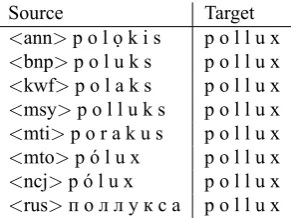
In our final experiment, we exploit the multilinguality of the data for transfer learning. Inspired by the winning system in the SIGMORPHON 2016 shared task (Kann and Schütze, 2016), we train a single neural MT system on the concatena-tion of the entire training set. This allows the system to learn a joint model from multiple source languages to a single tar-get language. In addition, by concatenating training sets of each of the single language-pair systems, the multi-source approach can circumvent the data scarcity problem. Each training example was split into spaces, with a special source language symbol prepended, as shown in Table 1. No tar-get language symbol was used because the tartar-get language was only English. Since the training and test data are dif-ferent (and substantially larger), this system is not directly comparable to the above approaches but rather represents
1
Note that the training and test sets are in the same domain, i.e. named entities. While it may be interesting to test on an unrelated set of words, the results are not likely to be encouraging unless these words are orthographically/phonologically similar to their English counterparts (e.g. cognates or borrowed words).
2https://pypi.python.org/pypi/Unidecode
Table 1: Bitext format for the OpenNMT Multi experiment. The target word is the English name Pollux.
Uni. Seq. Moses M+Pre M+Post ONMT Maj. Wei. Best
0.141
Figure 1: Average transliteration performance for single language pair systems. Light gray indicates system combination (majority, weighted, and best per language).
5.
Results, Discussion, and Error Analysis
Each system was evaluated on 1-best exact-match accuracy. Due to the extremely low-resource nature of the data (on the order of a few hundred training examples), the task proved to be quite difficult. On average, as shown in Fig. 1, Se-quitur performs better than the baseline Unidecode, and the Moses transliterator performs best overall. Moses with pre-and post-processing perform comparably on average. Since there are a number of different systems trying to ac-complish the same task, a natural question is whether com-bining the systems’ outputs would result in improvements. Out of the six systems, simply choosing the most com-mon hypothesis works better than Moses alone. Using a weighted combination, where each hypothesis is weighted by their respective system’s average performance also re-sults in gains over a single system. Finally, if we consider the best performing system on a per-language basis, the av-erage performance sees a small increase.In the following section, we examine each system in re-lation to the vanilla Moses system (without pre- or post-transliteration). Code to reproduce these results are avail-able3. The three letters that represent a language are ISO 639-3 language codes, and asterisks denote incorrect transliterations.
Baseline. As a language-independent baseline, we ex-pected that Unidecode would perform worse in most cases. Indeed, the baseline obtained 0% accuracy for 86 languages. This is due to the presence of morphological affixes.
sider the following:
Apurinã (apu) English Unidecode Moses
épeso ephesos *epeso *ephesus4
xório julius *xorio julius
nikorao nicolas *nikorao *nicolaus
The -o ending in Apurinã, which likely denotes a nomina-tive, is translated to -us by Moses. Unidecode cannot han-dle this phenomenon, since it operates only on single charac-ters; here it merely stripped off accents from each character. In addition, since Unidecode is not a translation system, it will never convert x→j or k→c, since these are already ASCII letters. Many other languages exhibit similar mor-phological patterns that could not be handled by Unidecode. However, the baseline actually performs better than Moses in 42 languages, which is a testament to the difficulty of our task. In these cases, we believe that Moses may have learned an incorrect translation model from the tiny amounts of training data, when simply passing the character through the system unchanged or applying a script conver-sion (e.g. Cyrillic to Roman) would have resulted in the cor-rect answer. The following are some instances where Unide-code transliterates the correct name, while Moses does not.
Lang Unidecode Moses
Siyin (csy) enoch *enoc
Guahibo (guh) jordan *jordam Ukranian (ukr) puteoli *putheoli Murrinh-patha (mwf) moses *mouseus
Sequitur. While Sequitur is more commonly used in the speech community as a grapheme-to-phoneme software, we considered using Sequitur because transliteration is per-formed on sequences of characters rather than entire words. Sequitur’s average performance was only below Moses’ by a few percentage points, and it actually outperformed Moses in 145 languages. Some examples of Sequitur’s successes over Moses follow:
Lang Sequitur Moses
Amele (aey) elam *ilam
abilene *abylene Balinese (ban) cleopas *clopas Bukawa (buk) bartimaeus *batimeas Hawaiian Pidgin castor *casthor
(hwc) phrygia *phirygia
Hote (hot) miletus *miretus philetus *piletus troas *troaz
We observe that the mistakes are natural looking mistakes: mixing up letters that are phonologically similar (landr,
sandz, and some vowels), and occasionally adding or re-moving anh. Our hypothesis is that, in these cases, Moses’ language model is biasing the system away from the cor-rect answer. While the language model is trained on same-domain data (i.e. Bible named entities), it is possible that
4
“Ephesus” is also a valid spelling of this ancient Greek city, but the dataset contains only one correct gold.
the language model would give a low score to unusual let-ter sequences like “aeus” in Bartimaeus or “phry” in Phry-gia. Further investigation is needed to determine the role the language model plays in the transliteration process.
OpenNMT. Neural machine translation is state-of-the-art for many language pairs (Bojar et al., 2016). In this translit-eration task, however, the neural MT system performed the worst overall. For 22 languages, OpenNMT performed bet-ter than Moses, but for most of these languages, the accura-cies were under 10%, representing very small gains. While it is possible that the parameters we used were not optimal for character-based transliteration, it is likely that the size of the data was just too small for a neural model to effectively learn from. This corroborates a finding from Koehn and Knowles (2017) that neural MT models tend to perform better than phrase-based models only past a certain threshold of data size (a corpus size of over 107words). We observed that the neural MT system often prefers shorter words compared to the phrase-based Moses, and perplexity on the development set was generally lowest after around 20–25 epochs training, after which overfitting was evident. Below are some example transliterations from Moses and OpenNMT:
Lang Source Moses OpenNMT Qaqet (byx) aleksandria alexandria *alandria Frafra (gur) metusela *methushelah *metusel alekzander *alechzander alexander Hiri Motu eparona *epharon ephron
(hmo) mikaela *micael michael
5.1.
Resolving Unknown Characters
Analogous to OOVs in machine translation, handling un-known characters is vital in achieving high transliteration accuracy. Since the target language in our experiments is always English, we utilized Unidecode to transliterate char-acters into ASCII letters.
Preprocessing. While the average accuracy of Moses + preprocessing was almost the same as without preprocess-ing, preprocessing helped in 195 languages but hurt in 206 languages, suggesting that preprocessing is largely depen-dent on the language.
Lang Source Moses +Pre Ankave (aak) segɨria *cenria cenchrea Greek (ell) εὔα *eὔa eva Ukranian (ukr) марта *marta martha Armenian (hye) սողոմոնը solomon *solomone Russian (rus) косам cosam *kosam Ossetian (oss) тимейы timaeus *timee
While pretransliterating helps in some cases, in other cases it appears to conflate character mappings, thereby removing information crucial for transliteration. Interestingly, for the name “Martha”, although Moses with preprocessing gives the correct English name, Moses without preprocessing ac-tually produced a closer representation of how the name would be pronounced in Ukranian5. For “Cosam”, prepro-cessing the к→k seems to have prevented the correct letter
5
cfrom appearing in the output instead. From our experi-ments, it is not clear in what cases one should apply pre-transliteration.
Postprocessing. We found that postprocessing the output never hurts performance, but improves performance only for four source languages: Acehnese (ace), German (deu), Korean (kor), and Munduruku (myu). For Acehnese, Ger-man, and Munduruku, the improvements largely consisted of removing a diacritic on a letter (e.g. Joël→Joel). The interesting case however is Korean.
English malchus felix crete Moses *말chus *pel릭s *크re테 +Post malchus *pelrigs6 *keurete
Due to Korean’s system of composing characters based on sound, Korean words may contain characters not seen dur-ing traindur-ing time. In these cases, Moses treats the charac-ter as an unknown word and outputs the same characcharac-ter un-translated. This is a prime example of a situation in which we expect post-processing to help. In the case of Malchus, post-processing correctly transliterates the unknown Ko-rean character, resulting in the correct English name, while for Felix and Crete, the post-transliterated name is not an exact match but is recognizably close.
5.2.
Analyses by Category
We additionally examine transliteration performance not by language, but by features of the words themselves. By ag-gregating all words and stratifying based on word length, we can gain additional insights.
English word length. Roughly two thirds of English names are longer than 5 characters. When separating these names into short (length≤5) and long (length>5), we see that all systems had an easier time transliterating shorter words.
System ≤5 chars >5 chars Moses 3079/10092 (.31) 4536/24314 (.19) Sequitur 2492/10092 (.25) 3756/24314 (.15) Unidecode 2623/10092 (.26) 2437/24314 (.10)
Edit distance between source and target. We see that around two thirds of the names in the entire set have an edit distance of 3 or less to the English. This is not too surpris-ing, especially since most languages use Roman script. We see that the performance of transliteration systems degrades as the difference between source and target increases.
System Dist≤3 Dist>3 Moses 6866/21746 (.32) 749/12660 (.06) Sequitur 5867/21746 (.27) 381/12660 (.03) Unidecode 4995/21746 (.23) 65/12660 (.01)
Roman vs non-roman characters. There are surpris-ingly few languages in the world that do not use a Roman character set; the data set contains 35 such languages. These include the Arabic and Cyrillic scripts, which are used in
6Note that Korean does not have an ‘f’ sound.
several languages, as well as other scripts, including Hangul and the family of Brahmic scripts, that are specific to a sin-gle language. We find that on average, the transliteration of languages in Roman script performs better that that of non-Roman script languages. A surprising result is that Sequitur does not transliterate any non-Roman words cor-rectly, which may be due to encoding issues.
System Roman Non-Roman Moses 7316/32129 (.23) 304/2277 (.13) Sequitur 6248/32129 (.19) 0/2277 (.00) Unidecode 4988/32129 (.16) 72/2277 (.03)
For the non-Roman script languages, we performed the same analysis as above. The following table shows average accuracy on languages written in non-Roman scripts.
Model Accuracy
Baseline 0.031 Moses 0.125
+pre 0.119
+post 0.125
The baseline performs poorly as expected. Pretranslitera-tion improves over Moses in 11 languages but underper-forms in 17. Even on this subset of non-Roman script lan-guages, there seems to be no pattern as to whether prepro-cessing is effective or not, which reiterates our findings for the entire dataset. Even within a language family, for exam-ple, transliterating Kannada and Marathi has slightly higher performance with preprocessing, while Tamil suffers. Pre-processing does slightly better overall for Greek, but when examining the transliterated names, there is evidence both for and against preprocessing:
Greek Moses +Pre
ιαρεδ *jered jared ιεριμωθ jerimoth *jeremoth
Transfer learning. The single neural MT system trained on the concatenation of the training data for all languages performed much better than the other systems in our ex-periments, achieving a 69% one-best accuracy on the con-catenation of the test sets. This massive gain stems from the combination of the 1000x increase in training data and the neural architecture’s ability to effectively leverage the commonality between languages. This result indicates that this transfer learning technique works well when combin-ing low-resource languages, even when each individual lan-guage pair may only have a miniscule amount of data.
6.
Conclusion
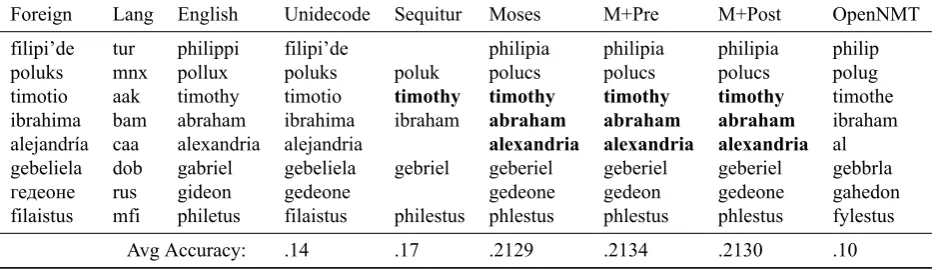
Foreign Lang English Unidecode Sequitur Moses M+Pre M+Post OpenNMT
filipi’de tur philippi filipi’de philipia philipia philipia philip
poluks mnx pollux poluks poluk polucs polucs polucs polug
timotio aak timothy timotio timothy timothy timothy timothy timothe ibrahima bam abraham ibrahima ibraham abraham abraham abraham ibraham alejandría caa alexandria alejandria alexandria alexandria alexandria al gebeliela dob gabriel gebeliela gebriel geberiel geberiel geberiel gebbrla
гедеоне rus gideon gedeone gedeone gedeon gedeone gahedon
filaistus mfi philetus filaistus philestus phlestus phlestus phlestus fylestus
Avg Accuracy: .14 .17 .2129 .2134 .2130 .10
Table 2: Example transliterations from each system. Average accuracy is over all languages, not just the ones listed in the table. Correct transliterations are bolded. Note that Sequitur is not guaranteed to transliterate a word.
or post-processing transliteration step using a language-independent transliterator to deal with unknown characters yielded inconclusive (statistically insignificant) results as to whether preprocessing is effective, though we found ev-idence that post-transliterating can help with unseen char-acters. Standard methods of system combination slightly boosted performance. In addition, we found that exploiting the multilinguality of the data allows for effective transfer learning in a single neural machine translation model that can act as a universal transliterator. A dataset of names transliterated by each system is available for research pur-poses. With recent advances in neural models, we believe that approaches leveraging multiple languages are worth ex-ploring in the future.
7.
Acknowledgments
This work was supported in part by the DARPA LORELEI program. The findings, conclusions, and opinions found in this work are those of the authors and do not necessarily represent the views of the funding agency.
8.
Bibliographical References
Bisani, M. and Ney, H. (2008). Joint-sequence models for grapheme-to-phoneme conversion. Speech communica-tion, 50(5):434–451.
Bojar, O., Chatterjee, R., Federmann, C., Graham, Y., Had-dow, B., Huck, M., Jimeno Yepes, A., Koehn, P., Lo-gacheva, V., Monz, C., Negri, M., Neveol, A., Neves, M., Popel, M., Post, M., Rubino, R., Scarton, C., Specia, L., Turchi, M., Verspoor, K., and Zampieri, M. (2016). Find-ings of the 2016 conference on machine translation. In
Proceedings of the First Conference on Machine Trans-lation, pages 131–198, Berlin, Germany, August. Asso-ciation for Computational Linguistics.
Heafield, K. (2011). Kenlm: Faster and smaller language model queries. InProceedings of the Sixth Workshop on Statistical Machine Translation, pages 187–197. Associ-ation for ComputAssoci-ational Linguistics.
Irvine, A., Callison-Burch, C., and Klementiev, A. (2010). Transliterating from all languages. InProceedings of the Conference of the Association for Machine Translation in the Americas (AMTA).
Jiampojamarn, S., Dwyer, K., Bergsma, S., Bhargava, A., Dou, Q., Kim, M.-Y., and Kondrak, G. (2010).
Translit-eration genTranslit-eration and mining with limited training re-sources. In Proceedings of the 2010 Named Entities Workshop, pages 39–47. Association for Computational Linguistics.
Kann, K. and Schütze, H. (2016). Single-model encoder-decoder with explicit morphological representation for re-inflection. InProceedings of the 54th Annual Meeting of the Association for Computational Linguistics (Volume 2: Short Papers), pages 555–560. Association for Computa-tional Linguistics.
Karimi, S., Scholer, F., and Turpin, A. (2011). Machine transliteration survey. ACM Computing Surveys (CSUR), 43(3):17.
Klein, G., Kim, Y., Deng, Y., Senellart, J., and Rush, A. M. (2017). Opennmt: Open-source toolkit for neural ma-chine translation.arXiv preprint arXiv:1701.02810. Koehn, P. and Knowles, R. (2017). Six challenges for
neural machine translation. InProceedings of the First Workshop on Neural Machine Translation. Association for Computational Linguistics.
Koehn, P., Hoang, H., Birch, A., Callison-Burch, C., Fed-erico, M., Bertoldi, N., Cowan, B., Shen, W., Moran, C., Zens, R., et al. (2007). Moses: Open source toolkit for statistical machine translation. InProceedings of the 45th annual meeting of the ACL on interactive poster and demonstration sessions, pages 177–180. Association for Computational Linguistics.
Mayhew, S., Christodoulopoulos, C., and Roth, D. (2016). Transliteration in any language with surrogate languages.
arXiv preprint.
Och, F. J. (2003). Minimum error rate training in statistical machine translation. InProceedings of the 41st Annual Meeting on Association for Computational Linguistics-Volume 1, pages 160–167. Association for Computational Linguistics.
Qian, T., Hollingshead, K., Yoon, S.-y., Kim, K.-y., and Sproat, R. (2010). A python toolkit for universal translit-eration. InLREC.
Tech-nologies for Under-resourced Languages, St. Petersburg, Russia. SLTU 2014.
Virga, P. and Khudanpur, S. (2003). Transliteration of proper names in cross-lingual information retrieval. In
Proceedings of the ACL 2003 workshop on Multilingual and mixed-language named entity recognition-Volume 15, pages 57–64. Association for Computational Linguis-tics.
Wu, W. and Yarowsky, D. (2018). Creating a translation matrix of the Bible’s names across 591 languages. In