Volume 2007, Article ID 57980,16pages doi:10.1155/2007/57980
Research Article
Polarization Behavior of Discrete Multipath and Diffuse
Scattering in Urban Environments at 4.5 GHz
Markus Landmann,1Kriangsak Sivasondhivat,2Jun-Ichi Takada,2Ichirou Ida,3and Reiner Thom ¨a1
1Electronic Measurment Research Lab, Institute of Information Technology, Ilmenau University of Technology,
P.O. Box 100 565, 98684 Ilmenau, Germany
2Department of International Development Engineering, Takada Laboratory, Graduate School of Engineering,
Tokyo Institute of Technology, Tokyo 152-8552, Japan
3Fujitsu Limited, Tokyo 105-7123, Japan
Received 13 April 2006; Revised 7 November 2006; Accepted 15 November 2006
Recommended by Rodney A. Kennedy
The polarization behavior of the mobile MIMO radio channel is analyzed from polarimetric double-directional channel mea-surements, which were performed in a macrocell rural environment in Tokyo. The recorded data comprise non-line-of-sight, obstructed line-of-sight, and line-of-sight conditions. The gradient-based maximum-likelihood estimation framework RIMAX was used to estimate both specular and dense multipath components. Joint angular-delay results are gained only for the specular components. The dense multipath components, which may be attributed to diffuse scattering, can be characterized only in delay domain. Different characteristics describing the polarization behavior and power-weighted cross- and copolarization ratios for both types of components are introduced. Statistical analysis of long measurement track segments indicates global trends, whereas local analysis emphasizes specific behavior such as polarization dependency on angle of incidence in streets and under shadowing conditions. The results also underline the importance of modeling changing and transient propagation scenarios which are cur-rently not common in available MIMO channel models.
Copyright © 2007 Markus Landmann et al. This is an open access article distributed under the Creative Commons Attribution License, which permits unrestricted use, distribution, and reproduction in any medium, provided the original work is properly cited.
1. INTRODUCTION
Efficient design of MIMO transmission systems requires a thorough understanding of the multidimensional structure of the mobile radio channel. Initially, research was aimed at the spatiotemporal channel structure at base-station side only. The appearance of MIMO systems forced a more detailed description of the mobile radio channel at both transmitter and receiver sides including directions of ar-rival and departure. Recent simulations [1, 2] and mea-surements [3–6] showed that the capacity of MIMO sys-tems can be further enhanced if the polarimetric dimen-sion is exploited. Moreover, dual polarimetric antennas can be colocated (e.g., patch antennas), which is a space- and cost-effective alternative to two spatially separated anten-nas with the same polarization. The draw back of the ex-isting results (as mentioned above) is to consider the an-tennas as a part of the radio channel. There was no at-tempt to separate the channel characteristics from
anten-nas influence in both the measurement and simulation cases.
[10] that estimates both specular and dense multipath com-ponents. However, joint angular-delay results are gained only for the specular components. The dense multipath compo-nents, which may be attributed to diffuse scattering, can be characterized only in delay domain. We present statisti-cal analysis of sets of segments that indicate global trends, whereas local analysis emphasizes specific behavior such as polarization on angle of incidence in streets and under shad-owing conditions. The results underline the importance of modeling of evolving and transient propagation scenarios, which is currently not common in available MIMO channel models. This supports the current discussions in propaga-tion modeling community [15,16], which indicates also a deficiency in modelling of polarization.
The paper is organized as follows:Section 2gives a brief review of the RIMAX parameter estimation framework. In Section 3, we present the sounder and data processing system that were used throughout the measurement campaign. An overview on the propagation environment and a first general classification of the estimated results are given inSection 4. Section 5discusses the different parameters and their defi-nitions describing the polarization behavior of the channel. InSection 6, the statistical analysis along sets of segments of the measurement run and local analysis results are discussed. Finally, local results with specific behavior are pinpointed.
2. CHANNEL CHARACTERIZATION
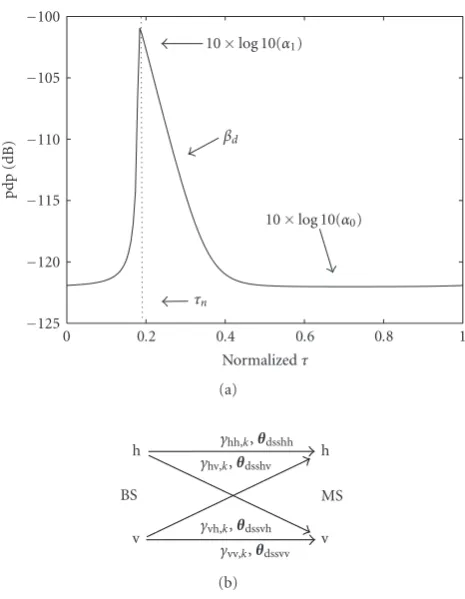
In case of the experimental channel characterization, anten-nas or antenna arrays at the BS and MS are part of the mea-sured links. Since we want to characterize the channel inde-pendent from the used antenna arrays, high-resolution pa-rameter estimation algorithms are applied to the measure-ment data. In our contribution, we use the gradient-based maximum-likelihood parameter estimation algorithm RI-MAX [10,17]. The appropriate data model comprises two components which can be handled separately throughout the estimation procedure. The first part is deterministic and re-sults from specular-like reflection. Each specular component (SC) k is characterized by its parameters direction of de-parture (DoD) ϕTk,ϑTk (azimuth and elevation), time de-lay of arrival (TDoA)τk, Doppler shiftαk, direction of ar-rival (DoA)ϕRk,ϑRk, and the four complex polarimetric path
weightsγhh,k,γhv,k,γvv,k,γvh,k, where the first subscript
indi-cates the polarization at the BS side and the second at the MS side (Figure 1(b)). The vector of the vertical (v) polarization is parallel to the vectoreθand the vector of the horizontal (h) polarization is parallel to the vectoreφof the spherical coor-dinate system. Furthermore, the RIMAX calculates the vari-ancesσϕTk,σϑTk,στk,σαk,σϕRk,σϑRk,σ{γhh,k},σ{γhh,k},σ{γvv,k}, σ{γvv,k},σ{γhv,k},σ{γhv,k},σ{γvh,k}, andσ{γvh,k}of each path based on the Fischer information matrix [10]. Hereby, the estimated variances are used to verify the estimation results of thekth path. The relative variances of the path weights are calculated, where a path with a relative variance better than −3 dB is considered as reliable and paths with a worse rela-tive variance are dropped. This threshold is reasonable since a relative variance of −3 dB stands for equal signal power
0 0.2 0.4 0.6 0.8 1
125 120 115 110 105 100
Normalizedτ
pdp
(dB)
10log 10(α0)
10log 10(α1)
βd
τn
(a)
h h
v v
BS MS
γhh,k,θdsshh
γhv,k,θdsshv
γvh,k,θdssvh
γvv,k,θdssvv (b)
Figure1: Model of the DMC (a), SC polarization and DMC polar-ization schematic (b).
and noise power. In case of the SCs, the complex polarimet-ric pathweights are independent from the used measurement antennas, that is, since we estimate the DoD and DoA, we are able to exclude the effect of the polarimetric antenna beam patterns.
The second part of the data model represents the dense multipath components (DMC) that mainly result from dis-tributed diffuse scattering. The DMCs are considered as the remaining complex impulse responses after removing the contribution of the reliable estimated SCs and measurement noise. As an extension to the estimation process in [17], the distribution of the DMC,
α(τ)=
⎧ ⎪ ⎪ ⎪ ⎪ ⎪ ⎨ ⎪ ⎪ ⎪ ⎪ ⎪ ⎩
α0, τ < τn,
1
2α1, τ =τn,
α0+α1·e−βd·(τ−τn), τ > τn,
(1)
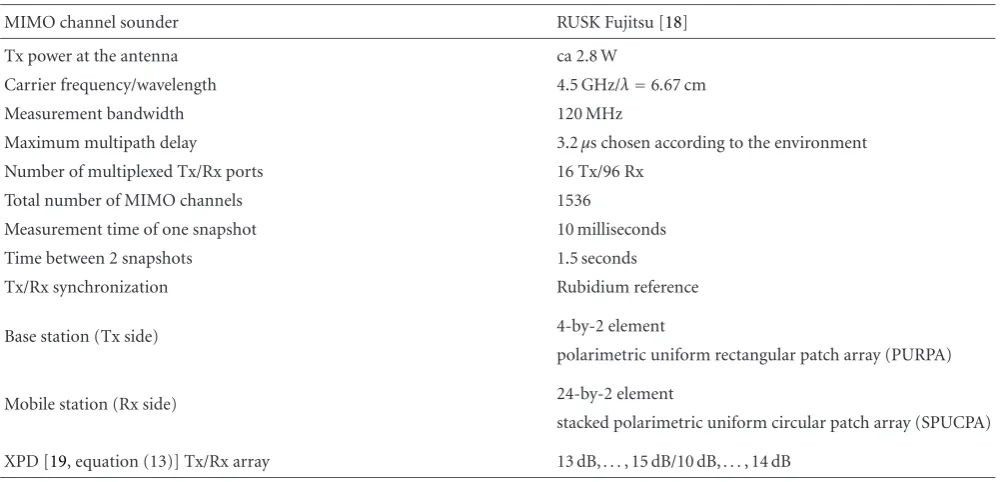
Table1: Measurement system.
MIMO channel sounder RUSK Fujitsu [18]
Tx power at the antenna ca 2.8 W
Carrier frequency/wavelength 4.5 GHz/λ=6.67 cm
Measurement bandwidth 120 MHz
Maximum multipath delay 3.2μs chosen according to the environment
Number of multiplexed Tx/Rx ports 16 Tx/96 Rx
Total number of MIMO channels 1536
Measurement time of one snapshot 10 milliseconds
Time between 2 snapshots 1.5 seconds
Tx/Rx synchronization Rubidium reference
Base station (Tx side) 4-by-2 element
polarimetric uniform rectangular patch array (PURPA)
Mobile station (Rx side) 24-by-2 element
stacked polarimetric uniform circular patch array (SPUCPA)
XPD [19, equation (13)] Tx/Rx array 13 dB,. . ., 15 dB/10 dB,. . ., 14 dB
MS, side andiindicates one channel of all available channels Iwith the polarization combinationxy. Each port of the an-tenna array has been designated either as horizontal or verti-cal. Consequently,xandyare either h or v. To compensate the effect of the antenna beam patterns at least partly (as no directional information is considered) for the DMC,hi,xyis divided by themeangainsgi,xandgi,y(3) of the correspond-ing Tx and Rx port,
hi,xy= hi,xy √gi
,x·gi,y.
(2)
The mean gain
gi,q=1
S·
n2
n=n1 m2
m=m1
bi,q(n·Δϕ,m·Δϑ)2
·sin (m·Δϑ)
(3)
is calculated from the measured beam patternbi,q(ϕ,ϑ) for
polarizationq, whereqis chosen equal to the port
polariza-tionxor y. This means that the cross-polarization term of
the port is neglected. The indicesn1,n2andm1,m2specify
the azimuth and coelevation ranges, andS=N·Mthe to-tal number of samples that are used for the calculation of the mean gain withN = n2−n1+ 1 andM = m2−m1+ 1.
Using this approach, the assumption has been made that the DMCs are uniformly distributed in the chosen azimuth and coelevation ranges. In our analysis, we observed that after re-moving the contribution of the specular propagation paths from the measured complex impulse responses the, power delay-azimuth profile of the remaining complex impulse re-sponses has only a few directional information in the MS az-imuth (similar observations were found in [20]). Therefore,
the ranges at the MS side are chosen between 45◦ to 135◦ in coelevation with respect to the surrounding area and be-tween−180◦to 180◦in azimuth. At the BS side, it was found that it is reasonable to limit the range to the broadside di-rection, where the azimuth range is chosen between−70◦to 70◦and the coelevation range between 80◦to 140◦. The val-uesΔϕ,Δϑare the corresponding step sizes in azimuth and coelevation that are chosen to (1◦).
The four parameter vectors of the DMCsθdsshh,θdsshv,
θdssvh, and θdssvv (Figure 1(b)), composed of the
parame-tersθdssxy=[α0,xy,α1,xy,βd,xy,τn,xy], are estimated from the
mean PDPρxy,
ρxy= 1 I
I
i=1
hi,xy2 (4)
of the corresponding polarization combinationxy.
3. MEASUREMENT TECHNIQUE
AND DATA PROCESSING
Table2: Measurement environment.
Environment macrocell
BS (Tx) height 35 m MS (Rx) height 1.6 m
Building heights around Rx 2-3 floors, mostly residential area Total measurement route 490 m (ca 2000 snapshots) Number of measured segments 45 (seeFigure 2)
For the purpose of the offline measurement data process-ing, by using the RIMAX algorithm, ca 10 PCs are organized in a batch processing system. To process the total amount of measurement data, the system was continuously running for 3 weeks.
4. MEASUREMENT DESCRIPTION AND
ENVIRONMENT CHARACTERIZATION
InSection 4.1, we give a description of how and where the measurements were performed. Additionally, background information is presented on the total power of the estimated SCs and their path length spread at each measurement posi-tion (Section 4.2).
4.1. General description
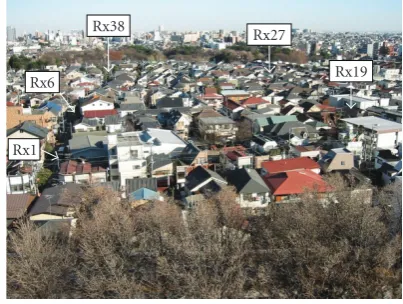
The measurements were performed in a macrocell environ-ment.Table 2summarizes the basic information of the sce-nario. The same system setup and measurement procedure are applied during the entire campaign, where we used only one BS (Tx) position while moving to different MS (Rx) po-sitions. The measurement route is divided in segments of 10 meters. InFigure 2, the significant positions like corners are labeled with crosses. Each segment is measured in the same way: 10 static snapshots at the start position, ca 40 snapshots while moving to the next position (i.e., an approx-imate speed of 25 cm/snapshot), 10 static snapshots at the end. The measurements are carried out in the neighborhood of Minami-Senzoku, Ota-Ku, Tokyo (Figure 3), where the transmit antenna array (BS) is placed over roof top at a 10-floor high building in the nearby campus of the Tokyo Insti-tute of Technology. The receive antenna array (MS) is placed at a cart around 1.6 m above the street, where the buildings in the surrounding residential area are between two and three flours high.
4.2. Environment characterization
The data model used comprises the two components SC and DMC. For an analysis of the results related to these two com-ponents, we will indicate the percentage of total power that is estimated as SC.Figure 4shows the total specular power as a percentage at each point.
(i) In the line-of-sight (LOS) case, moving from position Rx1 to Rx6 (seeFigure 2), the total specular power rep-resents around 95% of the signal power.
200 150 100 50 0 50
50 100 150 200 250
Rxx(m)
Rx
y
(m)
Rx19
Rx27
Rx1 Rx6
Rx38 Tx
Figure2: Map of macrocell measurement site.
Rx19 Rx27
Rx1 Rx6
Rx38
Figure3: Picture taken from Tx in the direction of Rx6 macrocell.
(ii) The measurements between position Rx6 and Rx19 are mostly non-line-of-sight (NLOS) with a total SC power of around 55% to 65%. However, at some po-sitions, the specular power increases to up to 80%, which is mainly caused by strong single bounce scat-tering and obstructed line of sight (OLOS). In the par-allel street between positions Rx27 and Rx38, we ob-serve similar behavior.
(iii) In the street between position Rx19 and Rx27, the portion of SCs is almost constant (around 55%). All measurements here were taken under NLOS condi-tions. Furthermore, strong single bounce reflections and OLOS are rare.
(iv) The measurements between Rx38 and Rx6 are dom-inated by strong single-bounce scattering and OLOS around the corner of Rx6. The total SC power is be-tween 65% to 85%.
50 0 50 80
100 120 140 160 180 200
Rxx(m)
Rx
y
(m)
55 60 65 70 75 80 85 90 95
Figure4: Specular power macrocell color-coded in %.
50 60 70 80 90 100
0 20 40 60 80 100
Specular power (%)
CDF
(%)
NLOS
LOS OLOSLOS
and strong single-bounce reflections
Figure5: CDF of the specular power of the entire route.
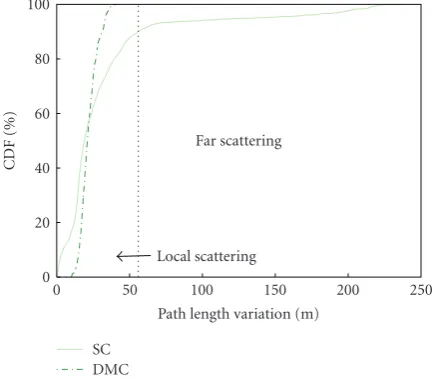
To distinguish between local scattering around Rx and far scattering, the path length spread of the SCs and DMCs is discussed, which is equivalent to the estimated delay spread multiplied by the speed of light. Figure 6 shows the path length spread at each position. It is noted that these values in-crease drastically around corner Rx19. The causes for that be-havior are some far clusters, of which 2 clusters are indicated by arrows inFigure 6. All other regions are dominated by lo-cal scattering.
The far clusters were localized on basis of estimated an-gles of the SCs at the BS and MS sides (seeFigure 7). Each path is plotted with half of the path length from Tx and Rx in the scenario. The colors indicate the total power of a path in dB. In Figure 8, the CDFs of the path length spread of the SCs and DMCs are compared. The path length spread of the DMCs is calculated from the parameterβd, which corre-sponds to the coherency bandwidth and which is inversely proportional to the delay spread. For the DMC, a smaller variation is observed compared to the SCs. We conclude that the DMC process is mainly influenced by local scattering. The authors abstain from a detailed discussion of the
es-100 50 0 50
0 50 100 150 200
Rxx(m)
Rx
y
(m)
50 100 150 200
2 1
Figure6: Path length variation in m, where the arrows indicate the position of far clusters (no. 2 not on the map).
140 135 130 125 120 115 110 105
Tx
Rx
Figure7: DoA, DoD, and TDoA (as length) for all paths at Rx19.
timated angular parameters and far clusters (can be found in [22]). The angular parameters are used inSection 6.3to identify the cause of specific channel characteristics.
5. HOW TO DEFINE THE POLARIZATION BEHAVIOR OF THE CHANNEL
0 50 100 150 200 250
Path length variation (m)
CDF
Figure8: CDF of the path length variation.
would like to point out the difficulties of a comparison of various published results. The XPR is basically defined as the power ratio between the copolarization and the cross-polarization. In [23], the power ratio between Pqq andPqp at the MS side, respectively,Ppqat the BS side,
XPRMSq =10·log10
is used, whereqandpcan be either horizontal or vertical. To calculate the powersPqq,Pqp, orPpq, the powers of allqq,qp orpqchannels are added up, for example,
Pqq=
whereas the column vectorhi,qq is theith complex impulse response with the polarization qq. Using this definition, a reliable estimated XPR is limited to the XPD of the single-antenna elements.
Another approach uses beam forming or high-resolution parameter estimation to detect individual rays/paths. Here, two definitions can be found, the XPR of a single pathk[13]:
XPRMSq,k(s)=10·log10
wheresis the snapshot index, and the narrowband XPR of theLcpaths of a clusterc[24]:
Using these definitions, a reliable estimation of the XPR of a cluster or the SCs is limited to the XPD of the ref-erence horn antenna during the antenna array calibration (see Section 3) in the case of double-directional measure-ments. This is in contrast to, for instance, single-directional measurements. Due to the fact that a single Tx antenna is used, the angle-of departure cannot be resolved, so com-pensation for angle dependent XPD is not possible. As a result, a reliable estimation of the XPR is limited to the XPD of the transmit antenna, which normally varies be-tween 8 dB and 20 dB depending on the direction of depar-ture.
In the following, we define the parameters which are used during the analysis (Section 6) illustrated with exam-ples from the measurement segments Rx19 to Rx27. The ba-sic parameters are defined for both, the BS and MS sides, whereas the distributions are only shown for the MS parame-ters. InSection 5.1, the XPR distribution based on (7) for SCs and DMCs are discussed, whereas inSection 5.2the power-weighted XPR is defined.
5.1. XPR distribution
Definition (7) describes how a single propagation path has to be modeled in terms of the XPR regardless of the importance of the path in terms of its total received power.
Figures 11 and 12 show the PDFs of the XPRMSh and XPRMSv of the SCs for the chosen measurement segment Rx19 to Rx27. The best fit to the normal distribution is plotted in the PDF of the measurement. The expectation and stan-dard deviation of the measurement agree with those of the fitted distribution. This agreement can be observed also for the other segments (not shown).
For a better understanding of the polarization behavior, we analyze the copolarization ratio or the ratio of the total re-ceived or transmitted vertical power to the horizontal power Pv/hMSorPv/hBS (9) (Figure 13) as well:
To describe the polarization behavior of the DMCs, we apply definition (7) like in the case of the SCs. Therefore, we calcu-late a sampled version of the DMC distribution (cf. (1)) for all four polarization combinations. We use the distance
Δτ= 1
B (10)
between two samples, where B is the measurement band-width. To calculate the XPR of the DMC, the sampleskDMC=
range of the largest delay spread of the four DMC processes: andβdof all four polarization combinations. The first sample
in the delayτis defined by the minimum base delayτnmin=
min(θτn). To use (7) for the DMC,
is defined. The calculated XPR of the DMC, using this def-inition, is only valid for values smaller than the XPD of the antenna. Consequently, this definition is similar to (5). For the chosen measurement segments, Figures14and15show the PDFs of the XPRMSh and XPRMSv of the DMCs, where
Figure 16shows the ratio of the total received vertical power to the horizontal of the DMCs.
5.2. Power-weighted XPR distribution
Calculating the expectation of the XPRs (7), each path is assumed to have the same importance. Since every wireless system benefits from the received power, it is necessary to make a difference between paths based on their total received power. Therefore, an effective XPR is defined in which the relation between the received path power and the path XPR is considered. For this purpose, we define an XPR centroid XPRC (first-order moment) (15) and XPR spread XPRS (16). We also define a centroid PC (17) and spread PS (18) of the vertical to horizontal power ratio (9) for a snapshot interval
Δs, wheres1is the first snapshot of the considered interval. In
order to combine several snapshots, the power of each path has to be normalized to exclude the effect of the free-space attenuation for different distances between Tx and Rx. Here, we normalize with the mean total power
Pm(s)= 1
of all paths in one snapshots, whereK(s) is the total number of estimated paths of the snapshots. Furthermore, we relate XPRMSq,k(s) and XPRBSq,k(s) to the normalized powers polarimetric path weightsPk(s) (19),
XPRCMSq
Figures17and18show the distribution of the total normal-ized powersPtMSh andPtMSv with
of all paths and snapshots for the chosen measurements de-pendent on XPRMSh and XPRMSv of the SCs. These
distribu-tions do not follow a normal distribution. This is caused by the dependence of the effective or power-weighted XPR on the measurement position. Comparing the distribution of the copolarization ratio inFigure 13 and the power distri-bution of the copolarization ratio in Figure 19, we observe similar expectation values and standard deviations. However, the power distribution of the co-polarization does not fol-low a normal distribution basically due to the local diff er-ences in the chosen measurement segment. For this reason, inSection 6, the XPRC and XPRS values will be presented both for sets of segments of the route and for much smaller run lengthsΔs.
6. RESULTS
In this section, we will present the results from a stochastical channel model point of view inSection 6.1and from that of a site-specific model (Sections6.2and6.3).
6.1. Statistical analysis
60 65 70 75 80 85 90 0
2 4 6 8 10 12 14 16 18
ϕstreet,TxRx(deg)
XPR
C
(dB)
SC
DMC
XPRCMS v XPRCMS
h
XPRCBS v XPRCBS
h Segment Rx6 to Rx19
Figure9: Change of the XPRCs dependent on the angleϕstreet,TxRx.
30 32 34 36 38
0 5 10 15
ϕstreet,TxRx(deg)
XPR
C
(dB)
SC
DMC
XPRCMS v XPRCMS
h
XPRCBS v XPRCBS
h Segment street Rx19 to Rx27
Figure10: Change of the XPRCs dependent on the angleϕstreet,TxRx, Rx19 to Rx27.
the whole measurement route. The subsets are classified into two groups: corners and streets. The conditions at each cor-ner are quite different. The street subsets Rx1 to Rx6 (LOS), Rx19 to Rx27 (NLOS), and Rx38 to Rx6 (OLOS) are unique, whereas the streets Rx6 to Rx19 and Rx27 to Rx38 are com-parable and consist of a mix of NLOS and OLOS measure-ments.
(i) All subsets under LOS condition have in common that the XPRC of the SCs for horizontal and vertical po-larization are quite high. For the segments Rx1 to Rx6, the XPRCMS
h and XPRCBSv are higher than XPRCMSv and
XPRCBSh , that is, the XPRCs of the channel are not
equal at the BS and MS considering the same polar-ization. In the following, we will call a channel with this polarization behavior not symmetric, the symme-try being related mainly to the difference between the pathweightsγhv andγvh. Exceptions in terms of the
symmetry are the LOS measurements around corner Rx6. In this area, the channel seems to be symmetric with respect to the polarization.
The XPRC parameters of the DMC are in general 5 to 6 dB lower than the parameters of the SCs. At the MS side, the XPRCMSh is around 3 dB lower than the
XPRCMSv , and at the BS the XPRCs are almost equal
for h and v.
(ii) The maximum XPRC values of the SCs in OLOS cases are 1 to 2 dB lower than in the LOS case. The gap be-tween the DMC and the SC parameters is almost equal to the LOS cases. However, there is one significant dif-ference: the SC and DMC parameters of the channel have almost the same properties at the BS and MS, that is, the two-by-two polarization matrix of the SC and DMC is symmetric. The four XPRCs of the SCs are al-most equal, whereas in both cases (MS/BS) the XPRCv
values of the DMCs are around 3 to 5 dB higher than the XPRChs.
(iii) The measurement situations that are dominated by NLOS conditions are not symmetric in terms of the XPRC of the SCs. At the MS side, the vertical XPRCMSv
is higher, whereas, at the BS, the horizontal XPRCBSh is higher, with XPRCMSh , respectively, XPRCBSv being ca 5 dB lower. The cause of this can be found by ana-lyzing the distribution of the four polarimetric path-weights. The cross-polarization valuesγhvhave much
higher values than the values ofγvh and the copolar
valuesγhhandγvvare almost equal.
For the DMCs, the vertical XPRCs are around 5 dB higher than the horizontal at the BS and MS sides. In most cases, the PCMSv/h of the SCs show that the re-ceived power having vertical polarization is higher (around
1,. . ., 2 dB). The LOS cases are the only exceptions (up to
−4 dB). In the NLOS corners (around Rx19, Rx27), a slightly higher vertical power is received (2,. . ., 3 dB). At the BS side, the variation of the PCBSv/his smaller (−2,. . ., 1 dB) dependent on the subset.
Except for the corner Rx19 and the LOS street Rx1 to Rx6, the power ratio PCv/hof the DMCs is around 2 to 3 dB at the
BS and MS.
40 30 20 10 0 10 20 30 40 0
0.1 0.2 0.3 0.4 0.5 0.6 0.7 0.8
XPRMS h (dB)
P
robabilit
y
(%)
EXPRMS
h =5.8 dB;σ
XPRMS h =8.8 dB
Figure11: PDF of the XPRMS
h of the SCs, macrocell Rx19 to Rx27.
40 30 20 10 0 10 20 30 40
0 0.1 0.2 0.3 0.4 0.5 0.6 0.7 0.8
XPRMS v (dB)
P
robabilit
y
(%)
EXPRMS
v =8.6 dB;σ
XPRMS v =8.8 dB
Figure12: PDF of the XPRMSv of the SCs, macrocell Rx19 to Rx27.
30 20 10 0 10 20 30
0 0.1 0.2 0.3 0.4 0.5 0.6 0.7 0.8
PMSv/h(dB)
P
robabilit
y
(%)
E PMSv/h=1.9 dB;σ
PMSv/h=6.5 dB
Figure13: PDF of thePMS
v/hof the SCs, macrocell Rx19 to Rx27.
2 0 2 4 6
0 1 2 3 4
XPRMS hDMC(dB)
P
robabilit
y
(%)
EXPRMS
hDMC=0.05 dB;σ
XPRMS
hDMC=0.7 dB
Figure 14: PDF of the XPRMS
h of the DMCs, macrocell Rx19 to Rx27.
2 0 2 4 6
0 1 2 3 4
XPRMS vDMC(dB)
P
robabilit
y
(%)
E XPRMSvDMC=4.63 dB;σ
XPRMSvDMC=0.86 dB
Figure 15: PDF of the XPRMS
v of the DMCs, macrocell Rx19 to Rx27.
1 0 1 2 3 4 5 6
0 1 2 3 4 5
PMSv/h,DMC(dB)
P
robabilit
y
(%)
E PMSv/h,DMC=2.7 dB;σ
PMSv/h,DMC=0.5 dB
Figure16: PDF of thePMS
40 20 0 20 40 0
0.2 0.4 0.6 0.8
XPRMSh (dB)
P
MS th
(%)
XPRCMSh =4.1 dB; XPRSMSh =9.2 dB
Figure17: Normalized power distribution ofPMS
th dependent on the XPRMS
h of the SCs, macrocell Rx19 to Rx27.
40 20 0 20 40
0 0.2 0.4 0.6 0.8
XPRMS v (dB)
P
MS tv
(%)
XPRCMS
v =10.3 dB; XPRSMSv =8.9 dB
Figure18: Normalized power distribution ofPMS
tv dependent on the XPRMS
v of the SCs, macrocell Rx19 to Rx27.
30 20 10 0 10 20 30
0 0.2 0.4 0.6 0.8
PMSv/h(dB) Pt
(%)
PCMSv/h=1.9 dB; PSMSv/h=6 dB
Figure19: Normalized power distribution ofPMS
t dependent on PMS
v/hof the SCs, macrocell Rx19 to Rx27.
40 50 60 70
155 160 165 170 175
Rxx(m)
Rx
y
(m)
15 20 25 30 35 40
Rx LOS to Tx
Garage door
Figure20: XPRMSh indicated by color, powerPMSh,k by linewidth.
150 100 50 0 50 100 150
30 20 10 0 10 20 30 40
Azimuth Rx (deg)
XPR
MS h
(dB)
70 60 50 40 30 20 10 0
Figure21: Power spectrum ofPMS
th dependent on Rx azimuth and XPRMSh of the SCs.
LOS to Tx
Rx
Garage door
Figure22: Environment around Rx.
MS side, the SCs are dominated by the vertical polariza-tion, whereas at the BS, side the channel is dominated by horizontal polarization in terms of power (PCv/h) and
6.2. Local analysis
One could ask whether it is always sufficient to describe the measured scenario by statistical parameters that are derived from the analysis results of sets of measurement segments. The parameters XPRC of the SCs can strongly vary with the Rx position. Therefore, we calculated all parameters of XPRC and PCv/hof the SCs (Figures23to28) and the DMCs
(Fig-ures 29 to 34) at each position within a snapshot interval
Δs=20, which covers a run length of ca 3 m.
Characteristics of the SCs
With respect to the XPRCs, the following were found.
(i) In the LOS region between Rx1 and Rx6, the XPRC values considering the whole segment are quite high (around 14 dB, see Table 3). From the local analy-sis, it is obvious that the XPRCMSv and XPRCBSh vary more (−3 dB to 20 dB) than the XPRCBSv and XPRCMSh ,
which is mainly caused by the stronger change of the pathweights γvh than the change of the pathweights
γhv. The behavior of the whole segment cannot be
de-scribed by a known distribution.
(ii) Analyzing the position-dependent values of the seg-ment Rx6 to Rx19, we can observe that all four XPRCs increase, while changing the Rx position from y = 50 m to y = 200 m. This behavior is related to the diffraction over rooftop and the strong single-bounce reflections on the opposite (in terms of Tx) side of the street, whereas the polarization vector is rotated de-pendent on the angleϕstreet,TxRxbetween the vector in
the street direction and the vector between Tx and Rx. In the area Rx y=150 m toy=200 m, the incoming wave is almost perpendicular to the street Rx6 to Rx19. Due to this condition, the change of the polarization vector is smaller and the XPRC values are higher. Fur-thermore, the probability of OLOS condition is higher due to the layout of the residential area. In the area Rx y = 50 m toy = 150 m, the XPRC is lower since the street and the incoming wave are not perpendic-ular anymore, the polarization vector is changed. The change of the XPRCBSv and XPRCMSh moving from Rx
y =50 m to y = 200 m is bigger than the change of XPRCMSv and XPRCBSh . The cause is probably the larger change in the horizontal polarization compared to the vertical, the pathweightsγhv change more with angle
ϕstreet,TxRxthan the pathweightsγvh. For a better
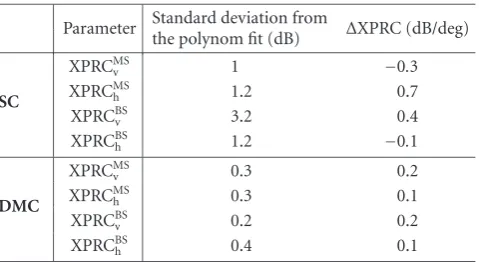
under-standing of this phenomenon, we plotted the line fit of all XPRCs inFigure 9and summarized theΔXPRC and the standard deviation around the line fit inTable 6. The upper four curves in the figure are the values of the XPRCs of the SCs, whereas the lower four describe the DMCs.
(iii) For the segment between Rx27 and Rx38, we expect almost the same behavior like for the segments Rx6 to Rx19. The trend of the XPRCs seems to be the same but due to some positions with a quite irregular char-acteristics, it is impossible to approximate this segment
with a line. One of these positions with an abnormal behavior will be discussed inSection 6.3.
(iv) The measurements in the segments Rx19 to Rx27 are mainly under NLOS condition. But, still, we can ob-serve that the XPRCs dependent on the pathweights γhvvary quite strongly close to the corner Rx19.
Ana-lyzing each path dependent on the DoA and the XPR around the corner, it was observed that the paths com-ing from the far cluster 2 (next corner and some bigger buildings), which we mentioned inSection 4.1, have quite high XPRBSv s and XPRMSh s. Due to the
cancela-tion of these paths while moving away from Rx19 in the direction of Rx27, the XPRCBSv decreases around 10 dB. Besides, we note that the XPRCs dependent onγvh increase continuously while moving in the
di-rection of Rx27. This behavior is shown inFigure 10 using the line fit dependent on the angleϕstreet,TxRx,
where the smaller angle is close to the corner Rx27 and the biggest is located around 10 m after the ner Rx19. In order to identify the SC and DMC cor-rectly the respective curves are grouped (indicated by cycles inFigure 10). The 10 m interval after the cor-ner is not used for the line fit due to the larger varia-tion. After that distance, the XPRCs dependent on the γhvdecrease in average while moving in the direction
of Rx27, which is conform to an increase with angle ϕstreet,TxRx. This behavior is quite similar to that at the
measurement positions of the segments Rx6 to Rx19 in the purely NLOS region. TheΔXPRCs are similar for these values (seeTable 7).
(v) For the segments Rx38 to Rx6, almost all measurement points are under OLOS condition. The beginning and the end of this segment seem to follow a trend. But, on an interval in the middle of this segment, strong single-bounce scattering occurs at a building with a very smooth surface, as becomes apparent by analyz-ing the spatial-temporal parameters of the SCs. As the XPRCs change drastically, a line fit would be meaning-less, at least for the parameters of the SCs.
With the contrast to the analysis of the XPRCs above, few clear relations can be found for the power ratio PCv/h
be-tween horizontal and vertical received (MS) or transmitted (BS). No strong relation to the angleϕstreet,TxRx was found.
The ratios vary mainly with the local conditions around the Rx position.
Characteristics of the DMCs
With respect to the XPRCs, the following were found.
(i) For the XPRC of the DMCs (Figures29to33), we can summarize that the development of these four values is quite similar. The XPRCvs at the BS and at the MS
Table3: XPRC and XPRS of the SCs in dB.
MS side BS side
Segment XPRC
MS
h XPRCMSv PCMSv/h XPRCBSh XPRCBSv PCBSv/h [XPRSMSh ] [XPRSMSv ] [PSMSv/h] [XPRSBSh] [XPRSBSv ] [PSBSv/h]
Corner Rx6 14.9 [9.9] 12.6 [11.1] −1.6 [5.6] 14.2 [10.6] 13 [9.6] −1.1 [5.4] Corner Rx19 3.5 [13.5] 11.2 [8.6] 3.1 [7.4] 9.2 [9.4] 5.7 [15.1] −0.7 [9] Corner Rx27 2.1 [7.8] 9.9 [8.9] 2.2 [5.6] 8.7 [8] 3.4 [10] −1.5 [6.5] Corner Rx38 10.1 [8.4] 12.6 [9.2] 1.2 [6.6] 11.7 [9.1] 11.3 [8.5] 0.7 [5.9] Rx6 to Rx19 11.2 [9.4] 15.4 [8] 1.7 [5.2] 13.9 [8] 13.5 [11.5] 0.5 [6.8] Rx19 to Rx27 4.1 [9.2] 10.4 [8.9] 1.9 [6] 9.1 [7.9] 6.1 [11.8] −0.8 [6.6] Rx27 to Rx38 11.9 [10.6] 14.7 [9.2] 1 [6] 14.3 [9.7] 13.1 [11.3] 0 [7.1] Rx38 to Rx6 11.8 [8] 10.8 [9.5] −0.3 [5.9] 10.1 [9.1] 12.6 [8.7] 0.3 [5.8] Rx1 to Rx6 14.1 [8.5] 7.5 [13] −4.1 [6.5] 10.5 [9.8] 11.3 [9.8] −2 [5]
Table4: XPRC and XPRS of the DMCs in dB.
MS side BS side
Segment XPRC
MS
h XPRCMSv PCMSv/h XPRCBSh XPRCBSv PCBSv/h [XPRSMS
h ] [XPRSMSv ] [PSMSv/h] [XPRSBSh] [XPRSBSv ] [PSBSv/h] Corner Rx6 2.5 [1.7] 6.9 [1.9] 1.6 [0.7] 5.5 [1.5] 4.1 [2.2] 0.2 [1.1] Corner Rx19 −0.2 [1] 6.3 [1] 4.1 [0.6] 0.5 [1.7] 5.6 [0.9] 3.6 [0.8] Corner Rx27 −0.6 [0.6] 4.6 [0.6] 2.8 [0.4] 0.9 [0.6] 3.3 [0.9] 1.8 [0.6] Corner Rx38 0.4 [0.9] 5.5 [0.5] 2.9 [0.4] 1.9 [0.6] 4.2 [0.8] 2 [0.5] Rx6 to Rx19 1.7 [1.7] 6.9 [1.6] 3.3 [1] 2.9 [1.5] 6.2 [2.6] 2.8 [1.4] Rx19 to Rx27 0 [0.7] 4.7 [0.7] 2.6 [0.4] 1 [0.7] 3.8 [0.9] 2 [0.6] Rx27 to Rx38 2.3 [2] 7.5 [2.1] 3 [0.8] 4 [2.5] 6 [1.7] 2.4 [0.9] Rx38 to Rx6 0.9 [1.3] 5.9 [1.7] 2.8 [0.9] 2 [1] 4.9 [1.8] 2.2 [1] Rx1 to Rx6 2.9 [1.2] 6.6 [1.2] 1.8 [0.5] 4.9 [1.3] 4.7 [1.3] 0.8 [0.6]
Table5: Symmetry of the channel in terms of the polarization.
Condition SC DMC
LOS Not symmetric Not symmetric NLOS Not symmetric Symmetric
OLOS Symmetric Symmetric
(ii) Furthermore, the values of the DMC are not varying so much compared to the SCs. The gradient, which ex-presses the dependence on the angleϕstreet,TxRx, of all
four XPRCs of the DMC in the pure NLOS regions is smaller than in the case of the SCs (Figures9,10, Ta-bles6,7).
(iii) If the incoming wave is perpendicular to the street, the XPRC increases drastically (ca 3 dB), which is also re-lated to the higher probability of OLOS due to the lay-out of the residential area (gaps parallel to the broad-side direction of the Tx).
The PCv/his between 2 and 4 dB, that is, the DMC power is
mainly vertical. Furthermore, we can observe the same be-havior at the BS side and the MS side, which again shows that the channel is symmetric for the DMCs in terms of the polarization.
Finally we would like to comment on the accuracy of the calculated values (15), since these results are based on mea-surements with a finite signal-to-noise ratio and limited res-olution of the measurement system. Here, we briefly discuss the error of the XPRCMSh and XPRCMSv as an example. To use
the equations of the error propagation, we need the deriva-tives of (15) with respect to real and imaginary parts of the two corresponding pathweights of all paths in the considered rangeΔs. Using the estimated variances of the corresponding pathweights (SeeSection 2), we have calculated the errors of the discussed parameters. As both derivations and resulting expressions are complex, we do not present them in this con-tribution.
100
Figure24: XPRCMS
v of the SCsΔs=20 (ca 3 m).
these pathweights, resulting in higher variances. Therefore, we used the relative error, which is the ratio between the XPRC and the corresponding error. Around 75% of all po-sitions have an XPRCMSv (61% for XPRCMSh ) with a relative
error better than−10 dB. The difference between h and v can be explained by the lower total power in the h polarization
100
Figure28: PCBS
v/hof the SCsΔs=20 (ca 3 m).
especially in the NLOS cases, which causes higher variances of the estimated pathweigths. The remaining 25% (39% for XPRCMSh ) of the values have an error worse than−10 dB. In
100
6.3. Measurement positions with a specific behavior
In the previous section, we discussed general trends in the analyzed measurement data in terms of the polariza-tion. Nevertheless, in certain measurement intervals no such trends were observed. Yet, we noted an increased total specular power at positions with a specific behavior. In the
100
following, we will discuss one of these positions where we ob-serve a quite different behavior compared to the surrounding area.
Table6:ΔXPRC segments Rx6 to Rx19.
Parameter Standard deviation fromthe polynom fit (dB) ΔXPRC (dB/deg)
SC
XPRCMS
v 1.2 0.2
XPRCMS
h 2.2 0.4
XPRCBSv 1.8 0.5
XPRCBS
h 1.8 0.1
DMC
XPRCMSv 0.6 0.03
XPRCMS
h 0.7 0.07
XPRCBS
v 0.7 0.06
XPRCBSh 0.8 0.03
Table7:ΔXPRC segments Rx19 to Rx27.
Parameter Standard deviation from
the polynom fit (dB) ΔXPRC (dB/deg)
SC
XPRCMS
v 1 −0.3
XPRCMS
h 1.2 0.7
XPRCBSv 3.2 0.4
XPRCBS
h 1.2 −0.1
DMC
XPRCMSv 0.3 0.2
XPRCMS
h 0.3 0.1
XPRCBS
v 0.2 0.2
XPRCBSh 0.4 0.1
is relatively high for the measurement scenario except for LOS positions. To identify the source of these high XPRC values, the estimated DoAs are used. InFigure 20, the esti-mated paths are plotted in the environment around the men-tioned position. The color of the rays indicate the XPRMSh and the line width indicates the strength in terms of PMS
h,k. The characteristics of the values XPRBSh and XPRBSv are similar to XPRMSh . The zero direction in azimuth of the Rx antenna ar-ray is pointing to the north of the map, where we count the azimuth angle counterclockwise.
In the area between−70◦and−90◦azimuth, the XPRMSh is around 40 dB (seeFigure 21). The cause of this behavior is the metallic garage door (Figure 22). The measurements are still taken under NLOS conditions but we receive a very strong single bounce from that door. Furthermore, we can observe a quite high XPRMSh (ca 30 dB) around the corner
of the building at the right side of the street in the direc-tion of 70◦ azimuth. The reason here is the diffraction of LOS around the edge of the building. All other scatterers in the direction of the street or the street corners have a much lower XPRMSh (around 10 dB). These values are comparable
to XPRMSh values of the adjacent measurement positions that do not show this specific behavior. The parameters of the DMC are almost constant in this and the adjacent area.
The described position is not the only position with a un-usual behavior. Along the entire measurement route, several positions could be found. The cause of the specific behavior, for example large smooth building surfaces, metallic objects, and far clusters, could be mostly identified by using the
es-timated directional parameters. Currently, we are analyzing other scenarios where we observe similar effects.
7. CONCLUSIONS
We have introduced different parameters characterizing the polarization behavior of the channel. From macrocell mea-surements, we have shown that the XPRs are lognormal distributed. We have highlighted the importance of power-weighted XPR.
Two different approaches to analyze the measurement data were taken. On one hand, we analyzed statistical param-eters over sets of segments of the measurement. On the other hand, we made a local analysis. We demonstrated that in both cases, the symmetry of the polarization matrix is strongly de-pendent on measurement conditions like LOS, OLOS, and NLOS. Certain trends can be deduced from analyzes of sets of segments. From local analyzes, two effects became apparent. The change of the polarization vector of the specular compo-nents and the diffuse scattering can be related to the angle be-tween the street and the direct connection bebe-tween the trans-mitter and receiver. It was shown that the polarization pa-rameters of the specular components show more variations than those of the diffuse scattering. Some measurement po-sitions with a specific behavior, that is, with strongly varying polarization parameters, are discussed. Plausible causes for these variations could be identified: metallic objects, large smooth building surfaces, and far clusters. In this macro-cell environment, we observed that such objects can signif-icantly change the polarization behavior in an area. Neither with global nor with local analyzes, the power-weighted XPR resembles a known distribution.
ACKNOWLEDGMENTS
This research is partly supported by the National Institute of Information and Communications Technology of Japan. Furthermore, we would like to thank the members of Takada Laboratory for the support during measurements.
REFERENCES
[1] C. Oestges, V. Erceg, and A. J. Paulraj, “Propagation modeling of MIMO multipolarized fixed wireless channels,”IEEE Trans-actions on Vehicular Technology, vol. 53, no. 3, pp. 644–654, 2004.
[2] L. Dong, H. Choo, R. W. Heath Jr., and H. Ling, “Simulation of MIMO channel capacity with antenna polarization diversity,” IEEE Transactions on Wireless Communications, vol. 4, no. 4, pp. 1869–1872, 2005.
[3] J. H¨am¨al¨ainen, R. Wichman, J.-P. Nuutinen, J. Ylitalo, and T. J¨ams¨a, “Analysis and measurements for indoor polarization MIMO in 5.25 GHz band,” inProceedings of 61st IEEE Ve-hicular Technology Conference (VTC ’05), vol. 1, pp. 252–256, Stockholm, Sweden, May-June 2005.
[5] P. Goud Jr., C. Schlegel, W. A. Krzymie ´n, et al., “Indoor MIMO channel measurements using dual polarized patch antennas,” inProceedings of IEEE Pacific RIM Conference on Communica-tions, Computers, and Signal Processing (PACRIM ’03), vol. 2, pp. 752–755, Victoria, BC, Canada, August 2003.
[6] P. Kyritsi, D. C. Cox, R. A. Valenzuela, and P. W. Wolniansky, “Effect of antenna polarization on the capacity of a multiple element system in an indoor environment,”IEEE Journal on Selected Areas in Communications, vol. 20, no. 6, pp. 1227– 1239, 2002.
[7] R. Thom¨a, D. Hampicke, M. Landmann, A. Richter, and G. Sommerkorn, “Measurement-based parametric channel mod-elling (MBPCM),” inProceedings of International Conference on Electromagnetics in Advanced Applications (ICEAA ’03), Torino, Italy, September 2003.
[8] M. Haardt, R. Thom¨a, and A. Richter, “Multidimensional high-resolution parameter estimation with applications to channel sounding,” inHigh-Resolution and Robust Signal Pro-cessing, Y. Hua, A. B. Gershman, and Q. Cheng, Eds., pp. 253– 337, Marcel Dekker, New York, NY, USA, 2003.
[9] B. H. Fleury, M. Tschudin, R. Heddergott, D. Dahlhaus, and K. I. Pedersen, “Channel parameter estimation in mobile ra-dio environments using the SAGE algorithm,”IEEE Journal on Selected Areas in Communications, vol. 17, no. 3, pp. 434–450, 1999.
[10] A. Richter,On the estimation of radio channel parameters: mod-els and algorithms (RIMAX), Ph.D. thesis, Technische Univer-sit¨at Ilmenau, Ilmenau, Germany, 2005.
[11] M. Landmann and R. Thom¨a, “Estimation of phase drift dur-ing calibration measurements for efficient beam pattern mod-elling,” in Proceedings of NEWCOM-ACoRN Workshop, Vi-enna, Austria, September 2006.
[12] J. Medbo, M. Riback, H. Asplund, and J. Berg, “MIMO chan-nel characteristics in a small macrocell measured at 5.25 GHz and 200 MHz bandwidth,” inProceedings of the 62nd IEEE Ve-hicular Technology Conference (VTC ’05), vol. 1, pp. 372–376, Dallas, Tex, USA, September 2005.
[13] X. Yin, B. H. Fleury, P. Jourdan, and A. Stucki, “Polarization estimation of individual propagation paths using the SAGE algorithm,” inProceedings of 14th IEEE International Sympo-sium on Personal, Indoor and Mobile Radio Communications (PIMRC ’03), vol. 2, pp. 1795–1799, Beijing, China, Septem-ber 2003.
[14] G. S. Ching, M. Ghoraishi, N. Lertsirisopon, et al., “Wide-band directional radio propagation channel analysis inside an arched tunnel,” inProceedings of the 17th International Sympo-sium on Personal, Indoor and Mobile Communications (PIMRC ’06), Helsinki, Finland, September 2006.
[15] L. M. Correia,Mobile Broadband Multimedia Networks: Tech-niques, Models and Tools for 4G, Elsevier, London, UK, 2006. [16] IST-4-027756 WINNER II D1.1.1 Interim report, “WINNER
II interim channel models,”https://www.ist-winner.org. [17] R. Thom¨a, M. Landmann, A. Richter, and U. Trautwein,
“Multidimensional high-resolution channel sounding mea-surement,” inSmart Antennas—State of the Art, T. Kaiser, A. Bourdoux, H. Boche, J. R. Fonollosa, J. B. Andersen, and W. Utschick, Eds., vol. 3 ofEURASIP Book Series on Signal Process-ing and Communications, pp. 241–270, Hindawi, New York, NY, USA, 2005.
[18] http://www.channelsounder.de.
[19] K. Kalliola, K. Sulonen, H. Laitinen, O. Kivek¨as, J. Krogerus, and P. Vainikainen, “Angular power distribution and mean ef-fective gain of mobile antenna in different propagation
envi-ronments,”IEEE Transactions on Vehicular Technology, vol. 51, no. 5, pp. 823–838, 2002.
[20] J. B. Andersen, J. Ø. Nielsen, G. Bauch, and M. Herdin, “The large office environment - measurement and modeling of the wideband radio channel,” in Proceedings of the 17th Annual IEEE International Symposium on Personal Indoor and Mo-bile Radio Communications (PIMRC ’06), Helsinki, Finland, September 2006.
[21] http://www.irk-dresden.de.
[22] K. Sivasondhivat, M. Landmann, J.-i. Takada, Y. Nakaya, I. Ida, and Y. Oishi, “Full polarimetric 3-D double directional channel measurement in a NLOS macrocellular environment,” Tech. Rep. AP2005-117, IEICE, Tokyo, Japan, 2005.
[23] A. Kainulainen, L. Vuokko, and P. Vainikainen, “Polarization behaviour in different urban radio environments at 5.3 GHz,” COST 273 Temporary Document TD(05)018, Bologna, Italy, 2005.