Encoding and Presenting Interlinear Text Using XML Technologies
Baden Hughes, Steven Bird and Catherine Bow Department of Computer Science and Software Engineering
University of Melbourne Victoria 3010, Australia
{badenh, sb, cbow}@cs.mu.oz.au
Abstract
Interlinear text is a common presenta-tional format for linguistic information, and its creation and management have been greatly facilitated by the develop-ment of specialised software. In earlier work we developed a four-level model and corresponding formal specification for interlinear text. Here we describe a suitable XML representation for the model and show how it can be rendered into a variety of convenient presenta-tional formats. We conclude by dis-cussing architectural extensions, an ap-plication programming interface for in-terlinear text, and prospects for embed-ding the interlinear model into existing applications.
1 Introduction
Interlinear text is a standard presentational form for displaying a source text aligned with variety of linguistic annotation phonological, morpholog-ical and syntactic analyses, glosses and transla-tions. An example of Yidinj interlinear text is shown in Figure 1.
Interlinear texts can vary in the number of rows, the content and level of analysis for each
njundu wanjdjam
you-SA where-ABL
Where have you come from ?
Figure 1: Yidinj Interlinear Text
row, and certain aspects of layout. However, as we survey a broad range of cases, we can observe consistent patterns in layout. These patterns have lead us to propose an abstract model of interlin-ear text which is sufficiently general that it en-compasses the majority of cases based on a sur-vey of print and electronic representations of in-terlinear text (Bow, Hughes and Bird 2003). As we will show here, the model has a natural repre-sentation in XML, which can be used to generate a variety of useful visualisations. We begin by de-scribing the model in§2, then propose a suitable XML representation (§3). In§4 we discuss com-mon presentation styles, and in§5 we show how they can be implemented using XSL. Finally, we report our work on a prototype (§6) and discuss future research (§7).
2 The EMELD Interlinear Text Model
For the purposes of this discussion we adopt the following nomenclature. By interlinear text we mean a written record of an external linguistic event, consisting of a transcription aligned with linguistic analysis. A line of interlinear text refers to a row of transcription plus all the rows of analy-sis pertaining to it. Within the line, there is a
hor-izontal modality of words and their analysis, plus
there is the vertical modality of row elements to indicate the structure of the interlinear text. Ad-ditionally there is the vertical alignment of one row above the other; typically there is consistency from one block of rows to the next in the vertical alignment of these rows.
proposed a four-level, hierarchical model of inter-linear text consisting of Text, Phrase, Word and Morpheme levels. A phrase is a collection of transcription and its interlinear analysis arrayed across two or more rows, normally represented in interlinear text as beginning on a new line, and wrapping only if necessary. A word is a smaller collection of material (e.g. transcriptions, mor-phemes and glosses) that must be kept together on the same line. A morpheme is the smallest pos-sible level of alignment between linguistic forms and their meanings. In contrast, a text is the high-est level of structure corresponding to the exter-nal linguistic artefact being investigated. Just as it is possible for a word to contain a single mor-pheme, a phrase may contain a single word, and a text may contain a single phrase. Thus there is no prior commitment to the total length of this ex-ternal linguistic artefact. According to this four-level scheme, the user has flexibility in the assign-ment of content to levels, and the decision may be influenced by both linguistic considerations (what is a ‘word’? Is this one text or two?) and layout considerations (what should be kept on the same line in a display?). Additionally, at any particular level, analysis may be optionally omitted.
In this model, two rows are represented within a single node of the hierarchy if they are aligned with each other. For example, morphemes and their glosses, while being displayed on two differ-ent rows, are both represdiffer-ented at the Morpheme level of the hierarchy, given their 1:1 correspon-dence. The hierarchical model allows for the con-catenation of morphemes into words, words into phrases, and phrases into text, as required by the interlinear text. It also allows for complex infor-mation structures to be represented in simple tree diagrams.
3 The XML Representation
We now turn to a discussion of the XML repre-sentation of the EMELD model. In this represen-tation, the textual material has a number of levels, which can be considered nodes in an XML doc-ument. Each level consists of some content, and a sequence of children at subsequent levels. The content is given a user-defined type which docu-ments its intended semantic interpretation.
<interlinear-text>
<item type="user-defined">
Content at the text level, such as metadata, or an unaligned transcription of the entire text, or a pointer to an unaligned audio file
</item> <phrases>
Nested XML content to represent the phrasal constituents of the text
</phrases>
</interlinear-text>
This structure is repeated at each of the four levels, using the Yidinj example again:
<interlinear-text>
<item type="title">A Yidinj Story</item> <phrase>
<item type="number">98</item>
<item type="gls">[When Damari eventually did turn up at the fighting ground, Guyala asked him:] ’Where have you [come] from?’ </item>
<words> <word>
<item type="txt">nundu</item> <morphemes>
<morph>
<item type="gls">you-SA</item> </morph>
</morphemes> </word>
<word>
<item type="txt">wandam</item> <morphemes>
<morph>
<item type="gls">where-ABL</item> </morph>
</morphemes> </word>
</words> </phrase> </phrases>
</interlinear-text>
4 Interlinear Text Styles
4.1 Grouping of Content
Generalising from these examples, it should be possible to view an interlinear text with coarser-grained alignment, e.g. combining phrase-level items to form a single text-level item, or combin-ing morpheme-level items to form a scombin-ingle word-level item. More generally, when a text is en-riched by the addition of finer-grained segmen-tation, it should still be possible to view it with coarser alignment. In terms of the hierarchical model, this amounts to taking material from a lower-level set of nodes, concatenating it together, and storing it in a higher-level node. Just as we can ignore the low-level structures, we must also be able to ignore the high-level structures. For ex-ample, given an interlinear text it should be pos-sible to extract its words or morphemes in order to construct a word-list. Therefore, it is a require-ment on the rendering process that it can ignore aspects of the structure for the purpose of display and alignment.
4.2 Which Rows to Display
Interlinear texts have widely varying levels of de-tail, ranging from two rows to a dozen. When a text is enriched by the addition of another row of information, it should still be possible to view it in its original form without this extra row. There-fore, it is a requirement on the rendering process that it can omit specific rows from the display.
4.3 Row Styles
Font variation in form may reflect the preference of the author or the requirements of the publisher. It should be possible to view the rows of a given text in different styles without having to manually change the style of every item in the text. There-fore, it is a requirement of the rendering process that it can distinguish different types of rows and display them in user-specified fonts, typefaces, point sizes and so forth.
4.4 Ordering of Rows
There are some widespread conventions concern-ing the vertical arrangement of the rows of inter-linear text. For example, morphemes are usually written underneath the corresponding words , and glosses are usually written underneath the corre-sponding morphemes. However, there are
occa-sional exceptions to such patterns. At the text level we can observe considerable variation. In some cases, the notes on the text are placed af-ter the phrases of the text, in other places the or-der is reversed. It should be possible to view a the rows of a given text in different orders with-out having to manually reorganise the laywith-out of every item. Therefore, it is a requirement on the rendering process that it can distinguish different types of rows and display them in a user-defined sequence.
5 Rendering Interlinear Text with XSL
Our implementation of rendering is based on the Extensible Stylesheet Language (XSL) (Bradley, 2000), which can be used to transform XML doc-uments into other formats. By choosing different stylesheets, or selecting different parameters for a given stylesheet, it should be possible to gen-erate a variety of useful formats, whether for hu-man consumption using a particular technology (e.g. conversion to HTML for delivery to a web browser), or for machine consumption (e.g. con-version to or serialisation of another XML format for delivery to another program).
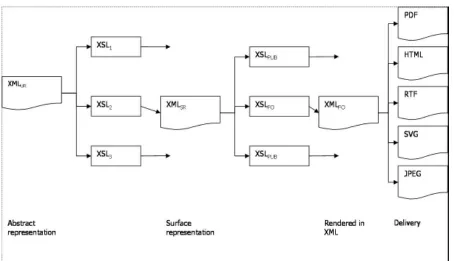
The transformation performed by this model must accomplish two things: (i) convert the ab-stract XML representation into a format which specifies grouping, row ordering and styles, and (ii) convert the XML markup into the formatting instructions of some other language like PDF or HTML. The second of these can be further broken down into two stages: conversion to XSL Format-ting Objects, and conversion to the delivery for-mat. The full model is shown in Figure 2 below.
On the left we see the abstract representation, which is mapped using one of our stylesheets XSL1 to a surface representation that fixes the
end-user.
The key rendering challenge posed by inter-linear text is line-wrapping. A line of inter-linear text contains multiple rows, and these must be wrapped as a group, keeping words and their morphological analysis together on the same line. Thus, these multi-row constituents must be treated as indivisible entities. Format-ting languages such as HTML (Raggett, Le Hors and Jacobs, 1999), DocBook (OASIS, 2003) and DSSSL (ISO/IEC, 1996) model a document as a collection of blocks (paragraphs, quotes, tables, lists) each containing lines of text. Critically, blocks must appear on a line of their own, or equivalently, lines cannot contain multiple blocks. In order to handle the line wrapping requirements of interlinear text, we need a language which per-mits inline blocks, such as TeX or XSL-FO (XSL Formatting Objects (Adler et al, 2003)). To facili-tate flexible integration with web environment we have chosen to use XSL-FO.
Unfortunately, some XSL-FO engines do not handle inline blocks correctly at the present time (e.g. Apache FOP (The Apache Project, 2003) and XEP (RenderX, 2003)). After experimenta-tion, we have found that XSL Formatter (Anten-naHouse, 2003) correctly handles inline blocks, and so we have used it to generate the examples included below. For a discussion of XSL-FO en-gines and their various conformance levels, see Kimber (2002).
XSL processing of the abstract XML format to specify grouping, row-ordering and styles is quite straightforward. We give three examples to illus-trate. The following template matches a phrase, and orders its constituent words before any con-tent at the phrase level (such as a free translation).
<xsl:template match="phrase"> <phrase>
<xsl:apply-templates select="words"/> <xsl:apply-templates select="item"/> </phrase>
</xsl:template>
The following template matches an interlinear-text, ordering any content of type “title” before the constituent phrases, and ordering any other content (e.g. notes) afterwards.
<xsl:template match="interlinear-text"> <interlinear-text>
<xsl:for-each
select="item[@type=’title’]">
<title>
<xsl:value-of select = "." /> </title>
</xsl:for-each> <phrases>
<xsl:apply-templates select="phrases"/> </phrases>
<xsl:for-each
select="item[@type!=’title’]"> <item>
<xsl:value-of select = "." /> </item>
</xsl:for-each> </interlinear-text> </xsl:template>
The following template matches a document and constructs a single interlinear text consisting of just the words (including any morphemes and glosses), and sorts them.
<xsl:template match="document"> <document>
<interlinear-text> <phrases>
<xsl:for-each
select="interlinear-text/phrases/ phrase/words/word">
<xsl:sort select="."/> <phrase>
<words>
<xsl:copy-of select="."/> </words>
</phrase> </xsl:for-each> </phrases>
</interlinear-text> </document>
</xsl:template>
Using such templates we can generate a va-riety of document types for external processing (e.g. use by third-party software) or for delivery to end-users.
Further work on the XSL mapping is needed: to support common layout styles and to include additional rendering parameters; to permit display parameters to be stored within the abstract XML representation itself (or in a special XML format declaration file); and to model affixation in order that hyphens are introduced appropriately at mor-pheme boundaries.
6 Prototype
the processes involved in demonstrating the flex-ibility of this architecture are the conversion of the underlying data to a surface display, and then converting the surface display to a variant display.
6.1 Underlying Data
The underlying data is interlinear text structured according to our model and expressed in XML. This underlying data can be validated against an existing DTD or schema.
6.2 Surface Display
The surface display is a basic display format cor-responding to traditional interlinear text which is enabled by the application of an XSL stylesheet to the underlying data. There are two types of surface display we have identified. The first is a simple type, namely direct application of a sin-gle XSL stylesheet to an underlying XML doc-ument. The second is more complex, including the parameterisation of user selected display in-put which in turn affects the XSL stylesheet and the corresponding display of the underlying XML document. These distinctions form the basis of the categorisation of functions.
6.3 Variant Display
The variant display is a customised display format which demonstrates the flexibility of manipulat-ing the underlymanipulat-ing data for different display pur-poses. For this demonstration we have identified a number of desirable variants based on common linguistic data structures.
6.3.1 Simple Display Types
We have identified two simple display types: (i) free translation as separate block and (ii) frame interface based expansion of free translation. In the first variant, we manipulate the surface dis-play to format the free translation as a separate block of text from the interlinear content. In the second, we manipulate the surface display to provide the free translation in a separate frame from the interlinearization, and allow synchro-nised scrolling and linking between the segments of the free translation and the relevant interlinear segments.
6.3.2 Complex Display Types
We have identified a number of complex dis-play types based on parameterised input. These are tree view or metastructural view; row re-ordering; optional row display; wordlist link-age; and concordance linkage. The tree-view or
metastructural display essentially allows
naviga-tion of the interlinear text using a tree view dis-play format. Individual branches of the tree can be expanded or compressed. This may be use-ful for structural analysis of the text. The row
re-ordering display allows the selection of a
prefer-ence for the order of the lines of interlinear text, eg display source text first, display source text last. This may be useful in evaluation contexts for back-glossing. The optional row display allows a selection of preference for how many interlinear lines are displayed. This may be useful for con-text where features of interest are identified in the interlinear text (eg syntactic vs morphological vs phonological annotation). The word list linkage
display allows the selection of a particular word,
and the corresponding display of interlinear tent for that word. This may be useful for con-texts where particular words are of intermittent interest and detected whilst browsing the source or translation text. The concordance linkage
dis-play allows the selection of a particular, and the
corresponding display a list of of all other occur-rences of the particular word within the text, in-cluding the surrounding words. Any context can be selected, and the complete interlinearization displayed for that context.
6.4 Implementation
We have implemented a prototype which supports the rendering of user-nominated display types. Our implementation is web based, with all user interaction occurring within the browser but re-liant on embedded XML rendering capabilities and plugins to handle external application types such as PDF. Our implementation can be de-scribed as consisting of three modules, namely the user interface, the parameterisation logic, and the rendering engine.
Un-derlying each of these choices are a series of pa-rameters, which are processed by a script to deter-mine the display type and result type. These pa-rameters then are passed to the rendering engine, which in combines the interlinear source and the option parameters to generate the appropriate out-put type which is then sent back to the browser for either direct display or display through a browser plugin.
At a technical level, the user interface itself is written in HTML, while the parameterisation logic is coded in PHP. We have experimented with two server side implementations - one is a wrap-per based approach to a Java application executed in the shell; the other is using a Java servlet sup-ported by Apache and Tomcat. (These alterna-tive implementations reflect the lack of a fully-featured rendering engine which services both browser based rendering and plugin-based render-ing.
There are a number of extensions to the proto-type we hope to implement in the future, includ-ing a remotely instantiable renderinclud-ing engine, the ability for users to contribute their own interlinear texts for rendering, the ability for users to control aspects of the display types, and a wider variety of output formats (eg. JPEG, SVG, or tree dia-grams).
7 Future Research
Although we have developed a specification and prototype implementation for interlinear text, there are a number of areas which warrant fur-ther research. Here we identify and briefly dis-cuss three of these, namely: architectural exten-sions; the development of an API for interlinear text manipulation; and the prospects for embed-ding of the interlinear text model with existing (and ultimately, new) tools. The creation of such tools which are designed for use by the linguist for creating, editing and publishing of interlinear texts represents a significant undertaking, but is based on the foundational work of analysing in-terlinear text structure, and expressing this in an open format.
7.1 Architectural Extensions
Having discussed the presentational flexibility that the XML-based specification provides, we
can now turn to the corresponding architectural flexibility inherent in XML itself. We will con-sider linkages of interlinear text to higher level linguistic ontologies; as the subject for mining and retrieval in large corpora, such as the Web; and compatibility with other schemas for the rep-resentation of materials in an interlinear fashion.
7.1.1 Linguistic Ontologies
Interlinear text typically includes annotations regarding a wide variety of linguistic phenom-ena. Each annotator typically uses a different la-belling inventory for such analysis, and thus au-tomated cross-linguistic enquiry is made signif-icantly more difficult through the disparate la-belling of linguistic features. In order to lever-age the large amount of annotated interlinear text which exists, there is a requirement for annotation to subscribe to a common ontology of linguis-tic concepts. Such a linguislinguis-tic ontology (GOLD) has been defined in Farrar, Lewis and Langen-doen (2002) and further refined in Farrar and Langendoen (2003). Our model provides ease of integration of such ontology-based annotation structures, and may provide a leverage point for theory-neutral cross-linguistic enquiry. Further work is required to fully exploit the power of a formally structured interlinear text with embed-ded ontological annotations.
7.1.2 Text Mining and Retrieval
ex-istence of a model into which existing interlinear forms can be easily translated is a desirable entity. Providing tools exist to manipulate interlinear text compliant with this new model may provide an incentive for linguistic data managers to explore conversion techniques for common proprietary or loosely structured formats. Assuming such con-version is carried out, the standardised body of interlinear text that results can in turn be queried directly for a variety of purposes.
7.1.3 Compatibility with Other Schemata
In our earlier work, we clearly delineated in-terlinear text from other materials which were ex-pressed in an interlinear format. Models such as those proposed by Brugman (2003) use interlin-ear text as a representational medium for non-textual data, in particular for multimodal sources such as audio and video. The annotation of such data sources may require variation in the gran-ularity of an interlinear model in order to cap-ture the extra-linguistic dimension of the expres-sion (eg gesture). Whilst we position our model as an interchange (and possibly archival format), we acknowledge that other annotation types re-quire different structures in which to encode an-notations. Already we have commenced investi-gations into the use of XML namespaces to allow both types of annotation and analysis to coexist within a single XML document. Software which is XML namespace-aware can then interpret rows of analysis according to the appropriate textual or multimodal models. Further work in this area is required to ensure tight integration and the devel-opment of appropriate conversion tools.
7.2 An API for Interlinear Text Manipulation
We have presented a data model but apart from our discussion of rendering we have not attempted to define the legal operations that construct, ac-cess and otherwise manipulate the structures. In future work we plan to define the data types and legal operations formally, independently of their possible XML and XSL representations. This will serve as the basis for object-oriented imple-mentation, for the definition of application pro-gramming interfaces, and for research on suitable query languages. More generally, we need to
con-sider interfaces to other data sources such as texts and lexicons.
7.3 Embedding Interlinear Functionality in Application Instances
The model presented here is a specialisation of the interlinear text model presented by Maeda and Bird (2000), and can be represented using anno-tation graphs. In future work we will implement a tool that is part of the Annotation Graph Toolkit (AGTK, http://agtk.sf.net), building on the exist-ing InterTrans tool (Bird et al, 2002). This will require extending the XML format to support the specification of media file offsets which is likely to be trivial. In addition, translation tools which support conversion between native AGTK and our proposed model format for interchange will facil-itate the import of existing data into this new tool.
8 Conclusion
Interlinear text is a highly pervasive data type in the linguistic domain. Although a number of tools have gained widespread acceptance for creating and editing interlinear text, the lack of an open and extensible model has resulted in annotated textual data in interlinear form being tied to par-ticular implementations either as structural or pre-sentation formats. In this paper we have sought to present open, extensible encoding and presenta-tion mechanisms which allow the re-use of inter-linear text in a variety of output formats. A signif-icant advantage of adopting an XML-based struc-tural encoding is that interlinear text can poten-tially be manipulated and queried systematically by any number of tools which subscribe to open standards, whether they have a linguistic lineage or otherwise.
References
Sharon Adler, Anders Berglund, Jeff Caruso, Stephen Deach, Tony Graham, Paul Grosso, Eduardo Gutentag, Alex Milowski, Scott Parnell, Jeremy Ridner and Steve Zilles. 2001. Extensible Stylesheet Language Ver-sion 1.0 The World Wide Web Consortium. http://www.w3.org/TR/2001/REC-xsl-20011015/ Antenna House Incorporated. 2003.
The Apache Project. 2003. Apache Format-ting Objects Processor The Apache Project. http://xml.apache.org/fop
Steven Bird, Kazuaki Maeda, Xiaoyi Ma, Haejoong Lee, Beth Randall, and Salim Zayat. 2002.
Table-Trans, MultiTable-Trans, InterTrans and TreeTrans: Di-verse Tools Built on the Annotation Graph Toolkit.
Proceedings of the Third International Conference on Language Resources and Evaluation, Paris: Eu-ropean Language Resources Association, pp 364-370.
Catherine Bow, Baden Hughes and Steven Bird. 2003.
Towards a General Model of Interlinear Text.
Pro-ceedings of the EMELD Language Digitization Project Conference 2003: Workshop on Digitizing and Annotating Texts and Field Recordings. LSA Institute, University of Michigan, Lansing MI USA. http://www.emeld.org/workshop/2003/papers03.html Catherine Bow, Baden Hughes and Steven Bird. 2003.
The EMELD Model for Interlinear Text Manuscript
in preparation.
Neil Bradley. 2000. The XSL Companion. Addison-Wesley.
Hennie Brugman. 2003. Annotated Recordings and Texts in the DOBES Project Proceedings of the EMELD Language Digitization Project Conference 2003: Workshop on Digitizing and Annotating Texts and Field Recordings. LSA Institute, University of Michigan, Lansing MI USA. http://www.emeld.org/workshop/2003/papers03.html DSSSL 1996. Document Style Semantics and
Specifi-cation Language ISO/IEC 10179:1996
The EMELD Project 2000. Electronic Metas-tructures for Endangered Language Documentation
http://www.emeld.org
Scott Farrar and Terry Langendoen. An Ontology for Linguistic Annotation. To appear in GLOT
Interna-tional.
Scott Farrar, William Lewis and Terry Langendoen 2002. A Common Ontology for Linguistic Con-cepts. Proceedings of the Knowledge Technologies
Conference, March 10-13 2002, Seattle.
Baden Hughes, Steven Bird and Catherine Bow. 2003. Interlinear Text XML and XSL
Demonstra-tion Handout. Proceedings of the EMELD Language Digitization Project Conference 2003: Workshop on Digitizing and Annotat-ing Texts and Field RecordAnnotat-ings. LSA Insti-tute, University of Michigan, Lansing MI USA. http://www.emeld.org/workshop/2003/papers03.html W. Eliot Kimber 2002. Production Quality XSL-FO.
http://xml.coverpages.org/KimberProductionQuality-XSL-FO.html
William Lewis. 2003. Migrating and Mining Interlinear Text. Proceedings of the EMELD Language Digitization Project Conference 2003: Workshop on Digitizing and Annotat-ing Texts and Field RecordAnnotat-ings. LSA Insti-tute, University of Michigan, Lansing MI USA. http://www.emeld.org/workshop/2003/papers03.html
Kazuaki Maeda and Steven Bird. 2000. A Formal
Framework for Interlinear Text. Proceedings of the Workshop on Web-based Documentation and Description, Philadelphia, USA; December 12-15, 2000.
Organisation for the Advancement of Structured In-formation Standards (OASIS). 2003. DocBook
http://www.oasis-open.org/docbook
Dave Raggett, Arnaud Le Hors and Ian Jacobs 1999. The Hypertext Markup Language Ver-sion 4.1 The World Wide Web Consortium. http://www..w3.org/TR/html4
RenderX. 2003. XEP XSL Rendering Engine Ren-derX Inc. http://xep.xattic.com/
9 Acknowledgements