Using Entity Information from a Knowledge Base to Improve Relation
Extraction
Lan Du1∗, Anish Kumar2, Mark Johnson2and Massimiliano Ciaramita3
1Faculty of Information Technology, Monash University Clayton, VIC 3800, Australia 2Department of Computing, Macquarie University Sydney, NSW 2109, Australia
3Google Research, Zurich, Switzerland
Abstract
Relation extraction is the task of ex-tracting predicate-argument relationships between entities from natural language text. This paper investigates whether back-ground information about entities avail-able in knowledge bases such as FreeBase can be used to improve the accuracy of a state-of-the-art relation extraction sys-tem. We describe a simple and effective way of incorporating FreeBase’s notable typesinto a state-of-the-art relation extrac-tion system (Riedel et al., 2013). Experi-mental results show that our notable type-based system achieves an average 7.5% weighted MAP score improvement. To understand where the notable type infor-mation contributes the most, we perform a series of ablation experiments. Results show that the notable type information im-proves relation extraction more than NER labels alone across a wide range of entity types and relations.
1 Introduction
The goal of relation extraction is to extract rela-tional information about entities from a large text collection. For example, given the text “Michael Bay, the director of Transformers, visited Paris yesterday,” a relation extraction system might ex-tract the relationship film director(Michael Bay, Transformers). These tuples can be then used to extend a knowledge base. With the increase in the amount of textual data available on the web, rela-tion extracrela-tion has gained wide applicarela-tions in in-formation extraction from both general newswire texts and specialised document collections such as biomedical texts (Liu et al., 2007).
∗
This work was partially done while Lan Du was at Mac-quarie University.
A typical relation extraction system functions as a pipeline, first performing named entity recog-nition (NER) and entity disambiguation to link the entity mentions found in sentences to their database entries (e.g., “Michael Bay” and “Trans-formers” would both be linked to their respective database ids). Then the context in which these en-tity mentions co-occur is used to predict the re-lationship between the entities. For example, the path in a syntactic parse between two mentions in a sentence can be used as a feature to predict the relation holding between the two entities. Contin-uing our example, the text pattern feature X-the-director-of-Y (or a corresponding parse subtree fragment) might be used to predict the database relationfilm director(X,Y). In such a pipeline ar-chitecture, information about the entities from the database is available and can be used to help de-termine the most appropriate relationship between the entities. The goal of this paper is to identify whether that information is useful in a relation ex-traction task, and study such information about the entities with a set of ablation experiments.
about entities available in FreeBase (Bollacker et al., 2008).
Here we focus on one particular kind of back-ground information about entities — the informa-tion encoded in FreeBase’s notable types. Free-Base’s notable types are simple atomic labels given to entities that indicate what the entity is notable for, and so serve as a useful informa-tion source that should be relatively easy to ex-ploit. For example, the search results for “Jim Jones” given by FreeBase contains several dif-ferent entities. Although they all have the same name entity (NE) category PERSON, their no-table types are different. The notable types for the top 4 “Jim Jones” results are organiza-tion/organization founder,music/composer, base-ball/baseball playerandgovernment/politician. It is clear that the notable type information provides much finer-grained information about “Jim Jones” than just the NE category. It is reasonable to ex-pect that notable types would be useful for relation extraction; e.g., the politician Jim Jones is likely to stand for election, while the baseball player is likely to be involved in sport activities.
We extend one state-of-the-art relation extrac-tion system of Riedel et al. (2013) to exploit this notable type information. Our notable type ex-tensions significantly improve the mean averaged precision (MAP) by 7.5% and the weighted MAP by 6% over a strong state-of-the-art baseline. With a set of ablation experiments we further evaluate how and where the notable type information con-tributes to relation extraction.The rest of this paper is structured as follows. The next section describes related work on relation extraction. Section 3 de-scribes how a state-of-the-art relation extraction system can be extended to exploit the notable type information available in FreeBase. Section 4 spec-ifies the inference procedures used to identify the values of the model parameters, while section 5 explains how we evaluate our models and presents a systematic experimental comparison of the mod-els by ablating the notable type in different ways based on entities’ NE categories. Section 6 con-cludes the paper and discusses future work.
2 Related work
Most approaches to relation extraction are either supervised or semi-supervised. Supervised ap-proaches require a large set of manually annotated text as training data (Culotta and Sorensen, 2004),
but creating these annotations is both expensive and error-prone. Semi-supervised approaches, by contrast, rely on correlations between relations and other large data sources.
In relation extraction, most semi-supervised ap-proaches use distant supervision, which aligns facts from a large database, e.g., Freebase, to un-labelled text by assuming some systematic rela-tionship between the documents and the database (Bunescu and Mooney, 2007; Mintz et al., 2009; Riedel et al., 2010; Yao et al., 2010). Typically, we assume that (a) an entity linker can reliably identify entity mentions in the text and map them to the corresponding database entries, and (b) for all tuples of entities that appear in a relation in the database, if we observe that entity tuple co-occurring in a suitable linguistic construction (e.g., a sentence) then that construction expresses the database relationship about those entities. Pre-vious work (Weston et al., 2013; Riedel et al., 2013; Bordes et al., 2013; Chang et al., 2014) has shown that models leveraging rich information from database often yield improved performance.
In this work we are particularly interested in ex-ploring entity type information in relation extrac-tion, as semantic relations often have selectional preference over entity types. Yao et al. (2010), Singh et al. (2013), Yao et al. (2013), Koch et al. (2014) and Chang et al. (2014) have shown that the use of type information, e.g., NE categories, sig-nificantly improves relation extraction. Our work here is similar except that we rely on Freebase’s notable types, which provide much finer-grained information about entities. One of the challenges in relation extraction, particularly when attempt-ing to extract a large number of relations, is to gen-eralise appropriately over both entities and rela-tions. Techniques for inducingdistributed vector-space representations can learn embeddings of both entities and relations in a high-dimensional vector space, providing a natural notion of simi-larity (Socher et al., 2013) that can be exploited in the relation extraction task (Weston et al., 2013). Instead of treating notable types as features Ling and Weld (2012), here we learn distributed vector-space representations for notable types as well as entities, entity tuples and relations.
3 Relation extraction as matrix completion
extrac-tion task as a matrix compleextrac-tion problem. In this section we extend this formulation to exploit no-table types in a simple and effective way. Specif-ically, we follow Riedel et al. (2013) in assum-ing that our dataOconsists of pairshr, ti, where
r ∈ R is a relation andt ∈ T is a tuple of en-tities. The tuples are divided into training and test depending on which documents they are ex-tracted from. In this paper, the tuples in T are always pairs of entities, but nothing depends on this. There are two kinds of relations inR: syntac-tic patterns found in the document collection, and those appearing in the database (including target relations for extraction). For our notable type ex-tension we assume we have a functionnthat maps an entityeto its FreeBase notable typen(e).
For example, given text “Michael Bay, the di-rector of Transformers, visited Paris yesterday” we extract the pairhr, tiwheret=hMichael Bay, Transformersiandr =X-the-director-of-Y (actu-ally, the path in a dependency parse between the named entities). From FreeBase we extract the pair hr0, ti where r0 = film/director. FreeBase also tells us that n(Michael Bay) = Person and
n(Transformers) = Film. Our goal is to learn a matrixΘwhose rows are indexed by entity tuples inT and whose columns are indexed by relations in R. The entry θt,r is thelog odds of relation
r ∈ R holding of tuple t ∈ T, or, equivalently, the probability that relation r holds of tuple tis given byσ(θt,r), whereσ is the logistic function:
σ(x) = (1 +e−x)−1.
Riedel et al. (2013) assume thatΘis the sum of three submodels: Θ = ΘN+ΘF+ΘE, where
ΘNis the neighbourhood model,ΘF is the latent feature model and ΘE is the entity model (these will be defined below). Here we extend these sub-models using FreeBase’s notable types.
3.1 A notable type extension to the neighbourhood model
The neighbourhood model ΘN captures depen-dencies between the syntactic relations extracted from the text documents and the database relations extracted from FreeBase. This is given by:
θNr,t = X hr0,ti∈O\{hr,ti}
wr,r0,
whereOis the set of relation/tuple pairs in the data andO \ {hr, ti}isOwith the tuplehr, tiremoved. wis a matrix of parameters, wherewr,r0 is a real-valued weight with which relationr0 “primes”
re-lationr that will be learnt from the training data. The neighbourhood model can be regarded as pre-dicting an entry θr,t by using entries along the
same row. It functions as a logistic regression clas-sifier predicting the log odds of a FreeBase rela-tion r applying to the entity tuple tusing as fea-tures the syntactic relationsr0 that hold oft.
Our notable type extension to the neigh-bourhood model enriches the syntactic pat-terns in the training data O with notable type information. For example, if there is a syntactic pattern for X-director-of-Y in our training data (say, as part of the tuple hX-director-of-Y,hMichael Bay, Transformersii), then we add a new syntactic pattern hPerson(X)-director-of-Film(Y)i, where Per-son and Film are notable types and add the tuple hPerson(X)-director-of-Film(Y), hMichael Bay, Transformersii to our data O. Each new relation corresponds to a new col-umn in our matrix completion formulation. More precisely, the new relations are mem-bers of the set N = {hr, n(t)i : hr, ti ∈ O}, where n(t) is the tuple of notable types cor-responding to the entity tuple t. For example, if t = hMichael Bay, Transformersi then
n(t) = hPerson, Filmi. Then the notable type extension of the neighbourhood model is:
θNr,t0 = X hr0,ti∈O\{hr,ti}
wr,r0 +w0
r,hr0,n(t)i
wherew0 is a matrix of weights relating the rela-tionsN to the target FreeBase relationr.
3.2 A notable type extension to the latent feature model
The latent feature model generalises over relations and entity tuples by associating each of them with a 100-dimensional real-valued vector. Intuitively, these vectors organise the relations and entity tu-ples into clusters where conceptually similar rela-tions and entity tuples are “close,” while those that are dissimilar are far apart. In more detail, each relationr ∈ R is associated with a latent feature vectorar of sizeK = 100. Similarly, each entity
tuplet∈ T is also associated with a latent feature vectorvt of size K as well. Then the latent
fea-ture score for an entity tupletand relationris just the dot product of the corresponding relation and entity tuple vectors, i.e.:θF
r,t=ar·vt.
type sequence observed in the training data, and use this vector to enrich the vector-space repre-sentations of the entity tuples. Specifically, let T0 = {n(t) : t ∈ T } be the set of notable type tuples for all of the tuples inT, wheren(t)is the tuple of notable types corresponding to the tuple of entitiestas before. We associate each tuple of notable typest0 ∈ T0 with a latent feature vector
vt00 of dimensionalityK. Then we define the no-table type extension to the latent feature model as:
θr,tF0 = ar·(vt+vn0(t)).
This can be understood as associating each entity tuplet∈ T with a pair of latent feature vectorsvt
andvn(t). The vectorvn(t)is based on the notable types of the entities, so it can capture generalisa-tions over those notable types. The L2
regularisa-tion employed during inference prefers latent fea-ture vectors in whichvt andv0n(t)are small, thus
encouraging generalisations which can be stated in terms of notable types to be captured byv0n(t).
3.3 A notable type extension of the entity model
The entity model represents an entityewith aK -dimensional (K = 100) feature vectorue.
Sim-ilarly, theith argument position of a relationr is also represented by aK-dimensional feature vec-tor dr,i. The entity model associates a score θr,tE
with a relation r ∈ R and entity tuple t ∈ T as follows: θEr,t = P|t|
i=1dr,i ·uti, where |t| is
the arity of (i.e., number of elements in the entity tuple t), ti is the ith entity in the entity tuple t,
anddr,i anduti areK-dimensional vectors
asso-ciated with theith argument slot of relationr and the entityti respectively. The intuition is that the
latent feature vectors of co-occurring entities and argument slots should be close to each other in the
K-dimensional latent feature space, while entities and argument slots that do not co-occur should be far apart.
Our notable type extension of the entity model is similar to our notable type extension of the la-tent feature model. We associate each notable type
m with aK-dimensional feature vector u0m, and use those vectors to define the entity model score. Specifically, the entity model score is defined as:
θr,tE0 = |t|
X
i=1
dr,i·
uti+u
0
n(ti)
,
wheren(e)is the notable type for entityeand|t|is the length of tuplet. The L2 regularisation again should encourage generalisations that can be
ex-pressed in terms of notable types to be encoded in theu0n(t
i)latent feature vectors.
4 Inference for model parameters
The goal of inference is to identify the values of the model’s parameters, i.e., w,a,v,d andu in the case of the Riedel et al model, and these plus w0,v0 and u0 in the case of the notable type extensions. The inference procedure is in-spired by Bayesian Personalised Ranking (Rendle et al., 2009). Specifically, while the true value of
θr,t is unknown, it’s reasonable to assume that if
hr, t+i ∈ O (i.e., is observed in the training data) then θr,t+ > θr,t− for all hr, t−i 6∈ O (i.e., not observed in the training data). Thus the training objective is to maximise
` = X
hr,t+i∈O
X
hr,t−i6∈O
`hr,t+i,hr,t−i
where: `hr,t+i,hr,t−i = logσ(θr,t+ −θr,t−), and
θr,t =θNr,t+θFr,t+θr,tE orθr,t =θN
0
r,t+θF
0
r,t+θE
0
r,t,
depending on whether the submodels with notable type extensions are used. The objective function
`is then maximised by using stochastic gradient ascent. The stochastic gradient procedure sweeps through the training data, and, for each observed tuplehr, t+i ∈ O, samples a negative evidence tu-plehr, t−i 6∈ Onot in the training data, adjusting weights to prefer the observed tuple.
In our experiments below we ran stochastic gra-dient ascent with a step size of 0.05 and an L2 regulariser constant of 0.1 for the neighbourhood model and 0.01 for the latent feature and entity models (we used the same regulariser constants for models both with and without the notable type ex-tensions). We ran 2,000 sweeps of stochastic gra-dient ascent.
5 Experimental evaluation
no-table types extracted from FreeBase. Our evalua-tion focuses on 19 FreeBase relaevalua-tions, as in Riedel et al. (2013).
5.1 Notable type identification
Our extension requires a FreeBase notable type for every entity mention, which in turn requires a Freebase entity id because a notable type is a property associated with entities in FreeBase. We found the entity id for each named entity as fol-lows. We used the FreeBase API to search for the notable type for each named entity mentioned in the training or test data. In cases where several en-tities were returned, we used the notable type of the first entity returned by the API. For example, the FreeBase API returns two entities for the string “Canada:” a country and a wine (in that order), so we use the notable type “country” for “Canada” in our experiments. This heuristic is similar to the method of choosing the most likely entity id for a string, which provides a competitive baseline for entity linking (Hoffart et al., 2011).
5.2 Evaluation procedure
After the training procedure is complete and we have estimates for the model’s parameters, we can use these to compute estimates for the log oddsθr,t
for the test data. These values quantify how likely it is that the FreeBase relationrholds of an entity tupletfrom the test set, according to the trained model.
In evaluation we follow Riedel et al. (2013) and treat each of the 19 relations r as a query, and evaluate the ranking of the entity tuplestreturned according to θr,t. For each relation r we pool
the highest-ranked 100 tuples produced by each of the models and manually evaluate their accu-racy (e.g., by inspecting the original document if necessary). This gives a set of results that can be used to calculate a precision-recall curve. Aver-aged precision (AP) is a measure of the area under that curve (higher is better), and mean average pre-cision (MAP) is average prepre-cision averaged over all of the relations we evaluate on. Weighted MAP is a version of MAP that weights each relation by the true number of entity tuples for that relation (so more frequent relations count more).
An unusual property of this evaluation is that increasing the number of models being evaluated generally decreases their MAP scores: as we eval-uate more models, the pool of “true” entity tuples for each relation grows in size and diversity (recall
Relation # NF NFT NFE NFET
person/company 131 0.83 0.89 0.83 0.86 location/containedby 88 0.68 0.69 0.68 0.69 person/nationality 51 0.11 0.55 0.15 0.45 author/works written 38 0.51 0.53 0.57 0.53
person/parents 34 0.14 0.31 0.11 0.28
parent/child 31 0.48 0.58 0.49 0.58
person/place of birth 30 0.51 0.48 0.56 0.57 person/place of death 22 0.75 0.77 0.75 0.77 neighbourhood/neighbourhood of 17 0.48 0.55 0.52 0.54 broadcast/area served 8 0.21 0.41 0.26 0.30 company/founders 7 0.46 0.27 0.40 0.28 team owner/teams owned 6 0.21 0.25 0.25 0.25 team/arena stadium 5 0.06 0.07 0.06 0.09 film/directed by 5 0.21 0.25 0.24 0.35
person/religion 5 0.20 0.28 0.21 0.23
composer/compositions 4 0.42 0.44 0.06 0.42 sports team/league 4 0.70 0.62 0.63 0.64 film/produced by 3 0.17 0.30 0.12 0.26 structure/architect 2 1.00 1.00 1.00 1.00
MAP 0.43 0.49 0.42 0.48
[image:5.595.317.515.61.239.2]Weighted MAP 0.55 0.64 0.56 0.62
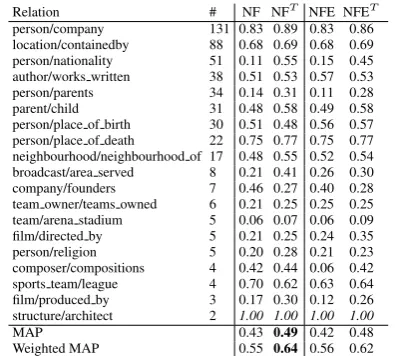
Table 1: Averaged precision and mean aver-age precision results. The rows correspond to FreeBase relations, and the columns indicate the combination of sub-models (N = neighbourhood model, F = latent feature model, E = entity model). The superscript “T” indicates the combined mod-els that incorporate the notable type extensions, and the # column gives the number of true facts.
0.5
Recall
0 0.1 0.2 0.3 0.4 0.6 0.7 0.8 0.9 1
Precision
0 0.1 0.2 0.3 0.4 0.5 0.6 0.7 0.8 0.9 1
NF NFT
NFE NFET
Figure 1: Averaged 11-point precision-recall curve for the four models shown in Table 1.
that this pool is manually constructed by manually annotating the highest-scoring tuples returned by each model). Thus in general the recall scores of the existing models are lowered as the number of models increases.
5.3 Experiments with Notable Types
We found we obtained best performance from the model that incorporates all submodels (which we call NFET) and from the model that only incorpo-rates the Neighbourhood and Latent Feature sub-models (which we call NFT), so we concentrate on them here. Table 1 presents the MAP and weighted MAP scores for these models on the 19 FreeBase relations in the testing set.
[image:5.595.337.499.358.470.2]Relation # NE NFE
T
NE+P NE+L NE+O NE+M person/place of birth 30 0.520.570.54 0.50 0.50 0.54 author/works written 38 0.57 0.530.610.56 0.57 0.49 team/arena stadium 5 0.08 0.090.100.09 0.07 0.09 composer/compositions 4 0.35 0.420.510.37 0.35 0.45 person/company 131 0.810.860.84 0.82 0.830.86 film/directed by 5 0.30 0.350.410.27 0.270.41 neighbourhood/neighbourhood of 17 0.59 0.54 0.59 0.49 0.590.62 film/produced by 3 0.20 0.26 0.29 0.18 0.190.40 person/religion 5 0.22 0.23 0.21 0.22 0.280.53 location/containedby 88 0.66 0.69 0.68 0.64 0.640.70 sports team/league 4 0.53 0.64 0.54 0.520.75 0.75 person/parents 34 0.33 0.28 0.30 0.320.350.34 parent/child 31 0.55 0.58 0.56 0.550.590.56 person/place of death 22 0.71 0.77 0.74 0.740.780.72 company/founders 7 0.22 0.28 0.28 0.210.290.22 team owner/teams owned 6 0.34 0.25 0.27 0.340.360.35 person/nationality 51 0.19 0.45 0.230.500.20 0.21 broadcast/area served 8 0.32 0.30 0.330.380.31 0.29 structure/architect 2 1.00 1.00 1.00 1.00 1.00 1.00
MAP 0.45 0.48 0.48 0.46 0.470.50
[image:6.595.80.285.59.250.2]Weighted MAP 0.570.620.59 0.60 0.58 0.60
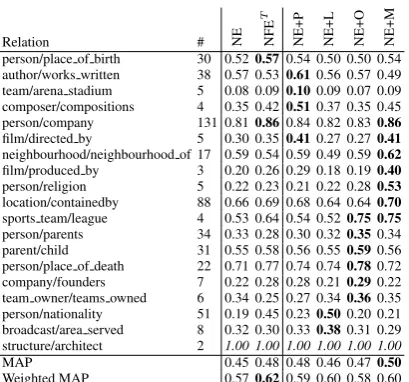
Table 2: Results of ablation experiments on the NFET model. The columns correspond to experi-ments, and the column labels are explained in Ta-ble 3.
A sign test shows that the difference between the models with notable types and those without the notable types is statistically significant (p <0.05). Clearly, the notable type extensions significantly improve the accuracy of the existing relation ex-traction models. Figure 1 shows an averaged 11-point precision-recall curve for these four mod-els. This makes clear that across the range of precision-recall trade-offs, the models with no-table types offer the best performance.
5.4 Ablation Experiments
We performed a set of ablation experiments to de-termine exactly how and where the notable type information improves relation extraction. In these experiments entities are divided into 4 “named en-tity” (NE) classes, and we examine the effect of just providing notable type information for the en-tities of a single NE class. The 4 NE classes we used were PERSON, LOCATION, ORGANISA-TION, and MISC (miscellaneous). We classified all entities into these four categories using their FreeBase types, which provide a more coarse-grained classification than notable types. For ex-ample, if an entity has a FreeBase “people/person” type, then we assigned it to the NE class PER-SON; if an entity has a “location/location” type, then its NE class is LOCATION; and if an en-tity has a “organisation/organisation” type, then its NE class is ORGANISATION. All entities not classified as PERSON, LOCATION, or ORGAN-ISATION were labelled MISC.
We ran a set of ablation experiments as
fol-Ablation setting Description
NE All entities are labelled with their NE class instead of their notable type.
NE+P Only PERSON entities have notable type information; the notable type of other entities is replaced with their NE class.
NE+L Only LOCATION entities have notable type informa-tion; the notable type of other entities is replaced with their NE class.
NE+O Only ORGANISATION entities have notable type in-formation; the notable type of other entities is replaced with their NE class.
NE+M Only MISC entities have notable type information; the notable type of other entities is replaced with their NE class.
Table 3: Descriptions of the ablation experiments in Table 2.
lows. For each NE class c in turn, we replaced the notable type information for entities not clas-sified ascwith their NE class. For example, when
c = PERSON, only entities with the NE label PERSON had notable type information, and the notable types of all other entities was replaced with their NE labels. Table 3 lists the different ab-lation experiments. The abab-lation experiments are designed to study which NE classes the notable types help most on. The results are reported in Ta-ble 2. The results clearly indicate that different re-lations benefit from the different kinds of notable type information about entities.
Column “NE+P” shows that relations such as “author/works written”, “com-poser/compositions” and ”film/directed by” benefit the most from notable type information about PERSONs. We noticed that there are about 43K entities classified as PERSON, which in-cludes 8,888 book authors, 802 music composers, 1212 film directors, etc. These entities have 214 distinct notable types. Our results show that it is helpful to distinguish the PERSON entities with their notable types for relations involving profes-sions. For example, not all people are authors, so knowing that a person is an author increases the accuracy of extracting “author/works written”. Similarly, Column “NE+L” shows that “per-son/nationality” and “broadcast/area served” gain the most from the notable type information about locations. There are about 8.5K entities classified as LOCATION, which includes 4807 city towns, 301 countries, and so on. There are 170 distinct notable types for LOCATION entities.
[image:6.595.307.531.61.184.2]3K business companies and 200 football teams. Notable type information about organisations im-proves extraction of the “parent/child” relation be-cause this relation involves entities such as com-panies. For example, in our corpus the sentence “CNN, a unit of the Turner Broadcasting, says that 7000 schools have signed up for The News-room” expresses the parent/child(Turner Broad-casting, CNN)relation.
The ablation results in Column “NE+M” show that information about MISC entities is most use-ful of all, as this ablation experiment yielded the highest overall MAP score. There are about 13.5K entities labelled MISC. The most frequent no-table types for entities in the MISC NE class are “film/film” and “book/book”. Therefore it is rea-sonable that notable type information for MISC entities would improve AP scores for relations such as “film/directed by” and “person/religion”. For example, “George Bush reached a turning point in his life and became a born-again Chris-tian” is an example of the “person/religion” rela-tion, and it’s clear that it is useful to know that “born-again Christian” belongs to the religion no-table type. The “sports team/league” relation is interesting because it performs best with notable type information for entities in the ORGANISA-TION or MISC NE classes. It turns out that roughly half the sports teams are classified as OR-GANISATIONs and half are classified as MISC. The sports teams that are classified as MISC are missing the “organisation/organisation” type in their FreeBase entries, otherwise they would be classified as ORGANISATIONs.
In summary, the ablation results show that the contribution of notable type information depends on the relation being extracted. The result demon-strates that relations involving organisations bene-fits from the notable type information about these organisations. It also demonstrates that certain re-lations benefit more from notable type information than others. Further research is needed understand some of the ablation experiment results (e.g., why does person/place of death perform best with no-table type information about ORGANISATIONs?)
6 Conclusion and future work
In this paper we investigated the hypothesis that background information about entities present in a large database such as FreeBase can be useful for relation extraction. We modified a state-of-the-art
relation extraction system (Riedel et al., 2013) by extending each of its submodels to exploit the “no-table type” information about entities available in FreeBase. We demonstrated that these extensions improve the MAP score by 6% and the weighted MAP score by 7.5%, which is a significant im-provement over a strong baseline. Our ablation experiments showed that the notable type informa-tion improves relainforma-tion extracinforma-tion more than NER tags across a wide range of entity types and rela-tions.
In future work we would like to develop meth-ods for exploiting other information available in FreeBase to improve a broad range of natural language processing and information extraction tasks. We would like to explore ways of exploit-ing entity information beyond (distant) supervi-sion approaches, for example, in the direction of OpenIE (Wu and Weld, 2010; Fader et al., 2011; Mausam et al., 2012). The temporal information in a large database like FreeBase might be es-pecially useful for named entity linking and re-lation extraction: e.g., someone that has died is less likely to release a hit single. In summary, we believe that there are a large number of ways in which the rich and diverse information present in FreeBase might be leveraged to improve natural language processing and information retrieval, and exploiting notable types is just one of many possi-ble approaches.
Acknowledgments
This research was supported by a Google award through the Natural Language Understanding Focused Program, and under the Australian Research Council’s Discovery Projects fund-ing scheme (project numbers DP110102506 and DP110102593).
References
Kurt Bollacker, Colin Evans, Praveen Paritosh, Tim Sturge, and Jamie Taylor. 2008. Freebase: a col-laboratively created graph database for structuring
human knowledge. InProceedings of the ACM
SIG-MOD international conference on Management of data, pages 1247–1250.
Antoine Bordes, Nicolas Usunier, Alberto Garcia-Duran, Jason Weston, and Oksana Yakhnenko. 2013. Translating embeddings for modeling
multi-relational data. InAdvances in Neural Information
Razvan Bunescu and Raymond Mooney. 2007. Learn-ing to extract relations from the web usLearn-ing
mini-mal supervision. In Proceedings of the 45th
An-nual Meeting of the Association of Computational Linguistics, pages 576–583.
Kai-Wei Chang, Wen-tau Yih, Bishan Yang, and
Christopher Meek. 2014. Typed tensor
decom-position of knowledge bases for relation
extrac-tion. In Proceedings of the 2014 Conference on
Empirical Methods in Natural Language Processing (EMNLP), pages 1568–1579.
Aron Culotta and Jeffrey Sorensen. 2004. Dependency tree kernels for relation extraction. InProceedings of the 42nd Meeting of the Association for Compu-tational Linguistics (ACL’04), pages 423–429.
Anthony Fader, Stephen Soderland, and Oren Etzioni. 2011. Identifying relations for open information
ex-traction. InProceedings of the Conference of
Em-pirical Methods in Natural Language Processing (EMNLP ’11), pages 1535–1545.
Johannes Hoffart, Mohamed Amir Yosef, Ilaria Bor-dino, Hagen F¨urstenau, Manfred Pinkal, Marc Span-iol, Bilyana Taneva, Stefan Thater, and Gerhard Weikum. 2011. Robust disambiguation of named
entities in text. In Proceedings of the 2011
Con-ference on Empirical Methods in Natural Language Processing (EMNLP), pages 782–792.
Mitchell Koch, John Gilmer, Stephen Soderland, and Daniel S. Weld. 2014. Type-aware distantly su-pervised relation extraction with linked arguments. In Proceedings of the 2014 Conference on Em-pirical Methods in Natural Language Processing (EMNLP), pages 1891–1901.
Xiao Ling and Daniel S Weld. 2012. Fine-grained en-tity recognition. InAAAI.
Yudong Liu, Zhongmin Shi, and Anoop Sarkar. 2007. Exploiting rich syntactic information for relation
extraction from biomedical articles. In Human
Language Technologies 2007: The Conference of the North American Chapter of the Association for Computational Linguistics, NAACL-Short’07, pages 97–100.
Mausam, Michael Schmitz, Stephen Soderland, Robert Bart, and Oren Etzioni. 2012. Open language
learn-ing for information extraction. In Proceedings of
the 2012 Joint Conference on Empirical Methods in Natural Language Processing and Computational Natural Language Learning, pages 523–534.
Mike Mintz, Steven Bills, Rion Snow, and Daniel Ju-rafsky. 2009. Distant supervision for relation ex-traction without labeled data. InProceedings of the Joint Conference of the 47th Annual Meeting of the ACL and the 4th International Joint Conference on Natural Language Processing of the AFNLP, pages 1003–1011.
Steffen Rendle, Christoph Freudenthaler, Zeno
Gant-ner, and Lars Schmidt-Thieme. 2009. Bpr:
Bayesian personalized ranking from implicit
feed-back. In Proceedings of the Twenty-Fifth
Confer-ence on Uncertainty in Artificial IntelligConfer-ence, pages 452–461.
Sebastian Riedel, Limin Yao, and Andrew
McCal-lum. 2010. Modeling relations and their
men-tions without labeled text. In Proceedings of the
2010 European Conference on Machine Learning and Knowledge Discovery in Databases: Part III, ECML PKDD’10, pages 148–163.
Sebastian Riedel, Limin Yao, Andrew McCallum, and
Benjamin M. Marlin. 2013. Relation extraction
with matrix factorization and universal schemas. In
Proceedings of the 2013 Conference of the North American Chapter of the Association for Computa-tional Linguistics: Human Language Technologies, pages 74–84.
Evan Sandhaus. 2008. The new york times annotated corpus. Linguistic Data Consortium, Philadelphia.
Sameer Singh, Sebastian Riedel, Brian Martin, Jiap-ing Zheng, and Andrew McCallum. 2013. Joint inference of entities, relations, and coreference. In
Proceedings of the 2013 Workshop on Automated Knowledge Base Construction, pages 1–6.
Richard Socher, Danqi Chen, Christopher D. Manning, and Andrew Ng. 2013. Reasoning with neural
ten-sor networks for knowledge base completion. In
Advances in Neural Information Processing Systems (NIPS 26), pages 926–934.
Michael Spivey-Knowlton and Julie Sedivy. 1995. Re-solving attachment ambiguities with multiple con-straints. Cognition, 55:227–267.
Jason Weston, Antoine Bordes, Oksana Yakhnenko, and Nicolas Usunier. 2013. Connecting language and knowledge bases with embedding models for
re-lation extraction. InProceedings of the 2013
Con-ference on Empirical Methods in Natural Language Processing, pages 1366–1371.
Fei Wu and Daniel S. Weld. 2010. Open information
extraction using wikipedia. In Proceedings of the
48th Annual Meeting of the Association for Compu-tational Linguistics, ACL’10, pages 118–127.
Limin Yao, Sebastian Riedel, and Andrew McCallum. 2010. Collective cross-document relation extraction
without labelled data. InProceedings of the 2010
Conference on Empirical Methods in Natural Lan-guage Processing, pages 1013–1023.