Case Study of Model Adaptation: Transfer Learning and Online Learning
Kenji Imamura
NTT Media Intelligence Laboratories 1-1 Hikari-no-oka, Yokosuka, 239-0847 Japan
Abstract
Many NLP tools are released as programs that include statistical models. Unfortu-nately, the models do not always match the documents that the tool user is inter-ested in, which forces the user to update the models.
In this paper, we investigate model adap-tation under the condition that users can-not access the data used in creating the original model. Transfer learning and on-line learning are investigated as adaptation strategies. We test them on the category classification of Japanese newspaper arti-cles. Experiments show that both trans-fer and online learning can appropriately adapt the original model if the dataset for adaptation contains all data, not just the data that cannot be well handled by the original model. In contrast, we confirmed that the adaptation fails if the dataset con-tains only erroneous data as indicated by the original model.
1 Introduction
Recent natural language processing (NLP) sys-tems are built using machine learning (supervised learning). The developers of these systems basi-cally create annotated corpora from which statis-tical models are generated. However, if the docu-ments that users want to apply the systems to do not belong to the domain of the annotated corpora, the resulting accuracy tends to be unsatisfactory.
For instance, Figure 1 shows the typical drop in accuracy in the category classification task of newspaper articles over time; the statistical model was trained using supervised data from 1995 (de-tails are described later). Even though the test data were obtained from newspaper articles (i.e., the same domain data), the accuracy against 2007
60% 65% 70% 75%
Ac
cu
ra
cy
55% 60% 65% 70% 75%
1995 2000 2005
Ac
cu
ra
cy
Year
Figure 1: Accuracy of Category Classification with training by 1995 Dataset
articles fell by about 10% from the 1996 articles. The reasons for this include the emergence of new words and changes in word distribution. In order to recover this degradation, we have to re-train the models.
To overcome this problem, transfer learning methods have been proposed (Pan and Yang, 2010). Many transfer learning methods assume that the users can obtain both the original data and additional data for adaptation. However, in most practical cases, the users sometimes are unable to access the original data. For example, only the de-velopers are licensed to handle the original data, not the users.
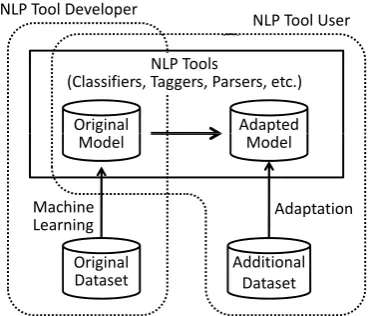
NLP tools, such as taggers, parsers, and clas-sifiers, are commonly released as programs that include the original models. Since many users cannot update the original models, they continue to use them even if the user’s documents do not match the models (Figure 2).
The objective of this paper is to investigate methods that, given an additional dataset, permit adaptation of original models under the constraint that the original dataset is unavailable.
The target task of this paper is category classi-fication of newspaper articles. Because NLP tools such as taggers or parsers are founded on
NLP Tool Developer
Original Model
NLP Tool User
Adapted Model NLP Tools
(Classifiers, Taggers, Parsers, etc.)
Original Dataset Original
Model
Additional Dataset Adapted
Model
Machine Learning
Adaptation
Figure 2: Relationship between Developers and Users of NLP Tools
tured learning, which extends the classification, we select the linear classification task.
In this paper, we investigate the combination of the following learning methods and additional datasets.
• We test two learning methods, batch and online learning. In batch learning, we use a maximum entropy classifier (Berger et al., 1996; Chen and Rosenfeld, 2000) and adapt the model us-ing transfer learnus-ing. In online learnus-ing, we se-lect soft confidence-weighted learning (Wang et al., 2012).
• We test two kinds of additional datasets. One is that all data are used for adaptation. The other is that only the data that failed to predict cor-rect categories by the original model are used. We consider the active learning strategy for the second dataset.
The remainder of this paper is organized as fol-lows. In Section 2, we detail the task, datasets, and learning methods (batch and online learning). Sec-tion 3 describes the experiments conducted and their results, and Section 4 summarizes the find-ings of this study.
2 Settings and Adaptation Methods
2.1 Task and Data
The task of this study is category classification of Japanese newspaper articles. We selected ar-ticles from Mainichi Shinbun newspapers for the
years of 1995, 1996, 2005, and 2006. A part
of the 1995 data is widely used in the Japanese
Set Name Period # of Data
Original Dataset Jan.,1995 - Nov.,1995 102,454 Additional Dataset Jan.,2005 - Nov.,2005 88,202 Development set Dec.,1995 9,043 Test set 1 Jan.,1996 - Dec.,1996 114,116 Test set 2 Jan.,2006 - Dec.,2006 95,761
Table 1: Statistics of Data Used
NLP community because its dependency struc-tures and predicate-argument strucstruc-tures have been annotated1.
One of 16 categories is assigned to each article. The category denotes type of the article, such as ‘Economics’, ‘International’, ‘Sports’, ‘Top page’, and so on. The task of this study is to predict the category of each article from its content (text).
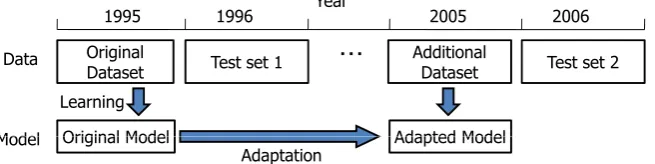
Figure 3 shows the relationships among datasets (for learning and testing) and models. We took ar-ticles from Jan. to Nov. in 1995 as the original dataset, and used them to train the original model. The original dataset was not used thereafter. Arti-cles from Dec. 1995 were used to tune the model’s hyperparameters. The additional dataset for adap-tation was created from articles from Jan. to Nov. 2005. We prepared two test sets. The first con-sisted of 1996 articles (Test set 1), and the second consisted of 2006 articles (Test set 2). Our objec-tive is to improve the accuracy against Test set 2. The statistics of the datasets are shown in Table 1. Features for classification are ‘bag-of-words’ of the title and the first paragraph of the article. Only content words (nouns, verbs, adverbs, adjectives, and interjections) that appear more than once are used as features.
2.2 Transfer Learning from Batch Learning 2.2.1 Regularized Adaptation
The problem setting of this paper is a sort of trans-fer learning (domain adaptation). Because we can-not access the original data, this problem is re-garded as “model-based domain adaptation” ac-cording to the taxonomy of transfer learning by Sha and Kingsbury (2012). Regularized adapta-tion (Evgeniou and Pontil, 2004; Xiao and Bilmes, 2006) is a variant of model-based domain adap-tation. As the regularizer, it uses the differences
1
Year
1995 1996 2005 2006
Original Dataset
Original Model Learning
Test set 1 Additional Dataset
Adapted Model
Test set 2 ・・・
Data
Model Original Model Adapted Model Adaptation
Model
Figure 3: Datasets and Models
in parameters between the adapted model and the original model, not adapted parameters. This is done to minimize the differences between the orig-inal model and the adapted model.
Although Evgeniou and Pontil (2004) proposed regularized adaptation for SVMs, and Xiao and Bilmes (2006) proposed the same for neural net-works, they can also be applied to maximum en-tropy classifiers 2. The loss function, `, is repre-sented as follows.
whereP(y|x;w)denotes the posterior probability of a sample computed with the weight parameters of the modelw;yADi andxADi are the input and
output of theith sample in the additional dataset, respectively, wADk andwORk denote weight
pa-rameters of the adapted and the original model, re-spectively; both have dimensions ofd, andC is a hyperparameter.
The maximum entropy classifier used in this pa-per estimates the weight parameters to minimize the above loss function. The first term in Equa-tion (1) suppresses discriminative errors of the ad-ditional data at minimum, and the second term suppresses differences between the original model and the adapted model.
2.2.2 Regularization with Two Hyperparameters
The output classes of the adapted model are iden-tical to those of the original model in this task. In contrast, features for classification are not identi-cal because new words appear over time.
2Regularized adaptation is used as a re-training function of the Japanese morphological analyzer MeCab (Kudo et al., 2004), which is based on conditional random fields (CRFs). http://mecab.googlecode.com/svn/trunk/mecab/doc/index.html
In Equation (1), all features, which include fea-tures from the original data and the additional data, are treated equally. However, if we significantly change weight parameters of the original model features, the original model can correctly class less data due to errors. In contrast, with regard to the new features from the additional data, we can change the parameters without limitation. There-fore, it is natural to distinguish new features from those of the original model.
Here, assuming that the number of dimensions of the parameters in the original model isdOR, and
that in the adapted model (i.e., the features include the original and additional data) is dAD, the loss
function becomes,
where COR denotes the hyperparameter that was
used while learning the original model, andCAD
denotes the hyperparameter for the additional data. If we set them asCOR ≥CAD, only the new
fea-tures from the additional data can change signifi-cantly; changes to the existing features of the orig-inal model are suppressed.
2.3 Online Learning
The recent proposal Confidence-weighted learning (CW) generates each weight parameter
from a Gaussian distribution whose mean is µ
and standard deviation is σ (Dredze et al., 2008; Crammer et al., 2009a). This method expresses confidence in frequently updated parameters, and accepts only small changes to them. Rarely updated parameters can be greatly changed. Confidence is expressed by a covariance matrix. CW is known to offer faster convergence than the conventional online learning algorithms such as perceptrons and passive-aggressive methods. In other words, CW makes learned samples hard to forget. The CW algorithm offers the possibility of adapting to the additional data without referring to the original data.
It is known that the training performance of the original CW algorithm suffers if the training samples contain significant noise components that are linearly-inseparable. The adaptive regulariza-tion of weight algorithm (AROW; (Crammer et al., 2009b)) and the soft confidence-weighted learning algorithm (SCW; (Wang et al., 2012)) were pro-posed to overcome this weakness. In this paper, we employ the SCW algorithm.
In SCW-I, which uses a linear penalty, parame-ter updating is represented as follows.
(µt+1,Σt+1) =
arg min µ,Σ {
DKL(N(µ,Σ)kN(µt,Σt)) +
C`φ(N(µ,Σ),(xt, yt))}, (3)
where µdenotes a mean vector andΣ denotes a covariance matrix of the parameters,DKL(·k·)
de-notes Kullback-Leibler divergence, N(µ,Σ) de-notes a multivariate normal distribution with mean ofµk and standard deviation ofσk,`φ(·)is a loss
function based on the hinge loss, and C is a hy-perparameter that restricts the maximum change permitted in the update. Following Equation (3), the loss of the correct classytpredicted from input
feature vectorxtbecomes minimum by the second
term, and simultaneously the change in parameters is suppressed by the first term. (Final update for-mulae are provided in (Wang et al., 2012)).
However, there are some problems in imple-menting Equation (3) directly. The following ap-proximations are applied in general.
• Weight parameterswshould be generated from Gaussian distribution N(µ,Σ), but the mean vectorµis directly used as weight parameters.
• The size of the covariance matrix is d × d, whereddenotes the number of dimensions of the parameters, and so memory consumption is high. To avoid this problem, only diagonal elements are considered (the matrix is degen-erated to a vector).
In addition, the hyperparameters that control the maximum change and the confidence value,Cand φ, must be set manually.
To apply the SCW algorithm, we first con-struct the original model from the original data us-ing Equation (3) until classification errors become minimum on the development set. Note that the original model retains not only the mean vector but also the covariance matrix. In adaptation, we re-gard the original model as(µ0,Σ0)and similarly
update it using the additional data, one-by-one.
3 Experiments
3.1 Experimental Settings
Methods We test the methods described in Sec-tions 2.2 and 2.3 (represented as ‘Transfer’ and ‘Online,’ respectively). The following baselines are also tested.
(a) Original Model. This case yields the upper bound of Test set 1.
(b) The model is trained using only the additional dataset. If there is enough data, this yields the upper bound of Test set 2.
(c) The model is trained by the feature augmenta-tion method (Daum´e, 2007) using the original data and the additional data, which is one of the domain adaptation techniques. This case yields the upper bound if we can access the original data.
(d) The case in which the models of (a) and (b) are interpolated at the ratio of 1:1. This provides a baseline for the lack of access to the original data.
Transfer Online
Type Method/Dataset Test1 Test2 Test1 Test2
Baselines
(a) Original Model 70.90% 61.49% 71.41% 62.60% (b) Additional Only 56.73% 75.66% 57.07% 76.36%
(c) Original + Additional Data 70.99% 75.77% 72.00% 76.58%
(d) Interpolation 68.70% 72.28% 68.49% 72.98% Model Adaptation (e) Normal Case 64.26% 75.78% 66.87% 75.78% (f) Active Learning 50.32% 63.29% 57.28% 65.81%
Table 2: Test Set Accuracies of Methods and Datasets
entities, 34,950 and 33,633 for the Transfer and Online cases, respectively.
Tuning The hyperparameters are optimized against the development set when the original models are trained and the same values are used in all experiments.
3.2 Results of the Methods
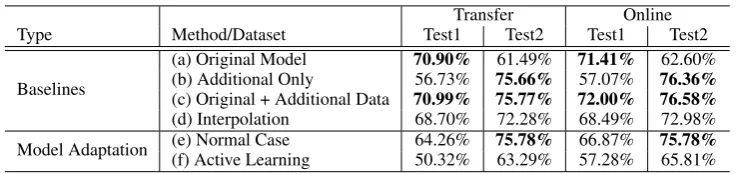
The results are shown in Table 2.
First of all, focusing on baselines (a) and (b), Test set 1 yielded basically the highest accuracies for case (a), while for (b) it was Test set 2. Using datasets that are near to the test sets yields better model training in this task.
Focusing on case (c), in which training uses both the original and the additional datasets, the advantages of cases (a) and (b) are secured. How-ever, although we applied domain adaptation, the improvements from cases (a) and (b) were lit-tle. This result indicates that the size of the ad-ditional dataset was sufficient and that the model matched the upper bound by using just the addi-tional dataset. In addition, we confirmed that the accuracies of interpolation (d) were intermediate between those of (a) and (b).
While accuracy slightly differed with the learn-ing method, the Transfer and Online cases exhib-ited the same tendency.
Next, for normal case (e) in model adaptation, both Transfer and Online achieved basically the highest accuracies against Test set 2. This re-sult shows that model adaptation worked effec-tively. On the other hand, focusing on the accu-racies of Test set 1, Online learning exhibited a smaller degradation from the original model (a) than Transfer. We suppose that this difference is due to the difference between maximum en-tropy and SCW-I, rather than that between the transfer/online learning. The maximum entropy method optimizes parameters based on the max-imum a posteriori (MAP), and it is sensitive to probability distribution. In contrast, SCW-I used
in Online is based on margin criteria, and ignores data outside the margin. Therefore, Online yielded smaller degradation.
In the case of active learning (f), the effects of model adaptation were little compared to the other cases. Namely, improvements against Test set 2 were slight and the accuracies of Test set 1 were degraded from the original model (a). Because transfer learning assumes that the target domain should be similar to the source domain, the dataset difference impacts performance significantly. We can conclude that we should collect (and use) all data for model adaptation regardless of whether or not the original model can correctly classify it.
3.3 Accuracies according to Additional Data Size
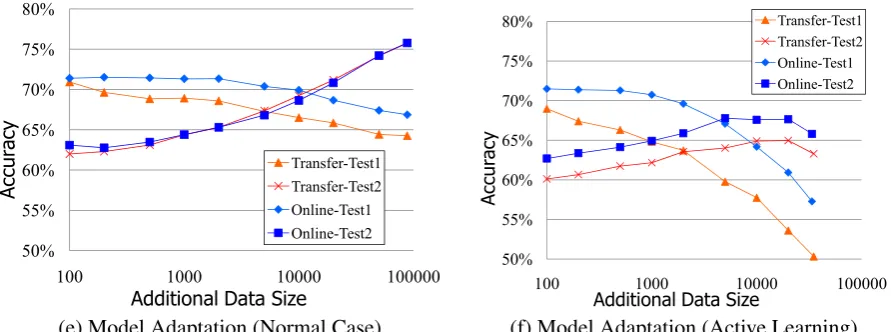
Figure 4 plots accuracy versus the size of the addi-tional datasets. In the normal case (e), the accura-cies of Test set 2 improved with both the Transfer and the Online cases along with dataset size. In contrast, the accuracy of Test set 1 with Trans-fer degraded faster than Online, as described in Section 3.2. The degradation with Online started when over 2,000 data points were added. This result shows that the SCW-I algorithm of Online is relatively robust and remembers the previously learnt data.
Focusing on active learning (f), the accuracies of Test set 2 were degraded with both Transfer and Online when all additional data was used. The ad-dition of huge amounts of erroneous data causes a harmful effect regardless of the learning method used.
3.4 Hyperparameters in Transfer Learning
60%
100 1000 10000 100000
A
(e) Model Adaptation (Normal Case)
60%
100 1000 10000 100000
A
(f) Model Adaptation (Active Learning)
Figure 4: Test Set Accuracy versus Size of Additional Data
Method COR CAD Test 1 Test 2
(e) Normal Case 0.1 0.001 70.33% 67.26% 0.1 0.01 68.09% 72.71% 0.1 0.1 64.26% 75.78% (f) Active Learning 0.1 0.001 67.70% 65.15% 0.1 0.01 61.28% 66.87% 0.1 0.1 50.32% 63.29%
Table 3: Accuracies of Different Hyperparameters
was trained, and onlyCADwas changed.
In the normal case, while the changes to the ex-isting parameters were suppressed (small CAD),
the accuracy of Test set 2 decreased. However, it was higher than that of the original model (61.49%
→67.26%), and the accuracy on Test set 1 was al-most constant (70.90%→70.33%). If we have to adapt the model under the condition that the orig-inal performance is to be maintained, the two hy-perparameter approach is effective.
In the active learning case, although we distin-guished the hyperparameters, the results were not improved from the normal case.
4 Conclusions
We investigated the characteristics of model adap-tation wherein the original training data cannot be accessed. We tested transfer learning (regularized adaptation) on the maximum entropy classifier and online learning (soft confidence-weighted learn-ing). Our results are summarized as follows.
• If the additional dataset contains all data, re-gardless of whether it can be correctly classi-fied by the original model or not, both transfer learning and online learning basically achieved the highest accuracy.
• However, the maximum entropy classifier with regularized adaptation changed more data, which the original model correctly classified, yielding more errors than online learning by SCW-I.
• Restricting the additional data to the data that the original model could not classify correctly had negative effects in our problem setting (i.e., the original dataset cannot be accessed).
• We could slightly adapt the model while retain-ing previous classification performance by dis-tinguishing the hyperparameters for the exist-ing features and those for the new features.
In natural language processing, structured
learning is frequently used for sequential labeling, parsing, and so on. Our future work is to apply model adaptation to structured learning.
References
Adam L. Berger, Stephan A. Della Pietra, and Vin-cent J. Della Pietra. 1996. A maximum entropy
approach to natural language processing.
Compu-tational Linguistics, 22(1):39–71.
Stanley F. Chen and Ronald Rosenfeld. 2000. A sur-vey of smoothing techniques for maximum entropy
models. IEEE Transactions on Speech and Audio
Processing, 8(1):37–50.
Koby Crammer, Mark Dredze, and Alex Kulesza. 2009a. Multi-class confidence weighted algorithms. InProceedings of the 2009 Conference on Empirical Methods in Natural Language Processing (EMNLP 2009), pages 496–504, Singapore.
InAdvances in Neural Information Processing Sys-tems 22 (NLPS), pages 414–422.
Hal Daum´e, III. 2007. Frustratingly easy domain
adaptation. InProceedings of the 45th Annual Meet-ing of the Association of Computational LMeet-inguistics (ACL 2007), pages 256–263, Prague, Czech Repub-lic.
Mark Dredze, Koby Crammer, and Fernando Pereira. 2008. Confidence-weighted linear classification. In
Proceedings of the 25th International Conference on Machine learning (ICML ’08), pages 264–271, New York, NY, USA. ACM.
Theodoros Evgeniou and Massimiliano Pontil. 2004.
Regularized multi-task learning. InProceedings of
the Tenth ACM SIGKDD International Conference on Knowledge Discovery and Data Mining (KDD ’04), pages 109–117.
Ryu Iida, Mamoru Komachi, Kentaro Inui, and Yuji Matsumoto. 2007. Annotating a japanese text cor-pus with predicate-argument and coreference
rela-tions. InProceedings of the Linguistic Annotation
Workshop, pages 132–139, Prague, Czech Republic.
Taku Kudo, Kaoru Yamamoto, and Yuji Matsumoto.
2004. Applying conditional random fields to
japanese morphological analysis. In Dekang Lin
and Dekai Wu, editors, Proceedings of EMNLP
2004, pages 230–237, Barcelona, Spain.
Sinno Jialin Pan and Qiang Yang. 2010. A survey on
transfer learning. IEEE Transactions on Knowledge
and Data Engineering (IEEE TKDE), 22(10):1345– 1359, October.
Fei Sha and Brian Kingsbury. 2012. Domain
adaptaion in machine learning and speech
pro-cessing. Interspeech 2012 Tutotial.
http://www-bcf.usc.edu/˜feisha/pubs/IS2012Tutorial.pdf.
Jialei Wang, Peilin Zhao, and Steven C. Hoi. 2012. Exact soft confidence-weighted learning. In John
Langford and Joelle Pineau, editors, Proceedings
of the 29th International Conference on Machine Learning (ICML-12), pages 121–128, New York, NY, USA. ACM.