From Interoperable Annotations towards Interoperable Resources:
A Multilingual Approach to the Analysis of Discourse
Ekaterina Lapshinova-Koltunski*, Kerstin Anna Kunz**, Anna Nedoluzhko***
Saarland University*, University of Heidelberg**, Charles University in Prague, Faculty of Mathematics and Physics*** [email protected], [email protected], [email protected]
Abstract
In the present paper, we analyse variation of discourse phenomena in two typologically different languages, i.e. in German and Czech. The novelty of our approach lies in the nature of the resources we are using. Advantage is taken of existing resources, which are, however, annotated on the basis of two different frameworks. We use an interoperable scheme unifying discourse phenomena in both frameworks into more abstract categories and considering only those phenomena that have a direct match in German and Czech. The discourse properties we focus on are relations of identity, semantic similarity, ellipsis and discourse relations. Our study shows that the application of interoperable schemes allows an exploitation of discourse-related phenomena analysed in different projects and on the basis of different frameworks. As corpus compilation and annotation is a time-consuming task, positive results of this experiment open up new paths for contrastive linguistics, translation studies and NLP, including machine translation.
Keywords:interoperability, linguistic annotation, multilingual resources, discourse, coreference, German-Czech contrasts
1.
Introduction
This paper aims at a cross-lingual analysis of discourse phe-nomena in the two typologically different languages – Ger-man and Czech. The discourse properties in focus are re-lations of identity and non-identity (semantic similarity) of discourse entities, ellipsis and discourse relations (types of conjunctions). Information on differences between the two languages in terms of discourse structuring devices is bene-ficial to contrastive linguistics, translation studies and mul-tilingual natural language processing.
The novelty of our analysis lies in the nature of the re-sources used. Quantitative contrastive analyses on the level of discourse require annotated corpora involving time-consuming compilation and annotation, especially in a mul-tilingual setting. Therefore, we take advantage of the ex-isting resources reflecting systemic peculiarities and reali-sational options of the languages under analysis. We use Czech and German data annotated on the basis of two different frameworks: Functional Generative Description, see (Sgall et al., 1986), for Czech, and textual cohesion, see (Halliday and Hasan, 1976), for German. In our previous work, see (Lapshinova et al., 2015), we have shown that annotations of the involved resources are comparable if ab-stract categories are used and only the phenomena with a direct match in the frameworks for German and Czech are taken into consideration. We have also shown that although being not general enough to permit a comparison across Germanic and Slavic languages, the existing annotated re-sources capture the same phenomena, and the creation of an interoperable scheme is possible if more abstract cate-gories are taken into consideration. Hence, we make use of this scheme to perform a comparison between German and Czech.
Our analysis is a first step towards unifying separate anal-yses of discourse relations in Germanic and Slavic lan-guages. At the same time, it demonstrates that the applica-tion of ’theoretically’ different resources is possible in one contrastive analysis. This is especially valuable for NLP,
which uses annotated resources to train language models for various tools. Training of language models with more complex linguistic annotation often requires manually an-notated corpora, which is time consuming and costly, es-pecially if more than one language is involved. Therefore, development of interoperable schemes that enable usage of the existing annotated resources is very important.
2.
Related Work
Generally speaking, Slavic languages have a richer, more fusional morphology than Germanic languages. Even though German has conserved more of the inflectional mor-phology of Proto-Indo-European than other Germanic lan-guages such as English, it has a more isolating character than Czech. The morphological reduction in German par-tially results in a less flexible constituent word order as compared to Czech, although more positional options are possible than, e.g., in English. We expect these contrasts to have an effect on the creation of discourse properties (see interpretations below).
2012) for particular coherence relations. In addition, there are various studies related to human and machine transla-tion, see for instance, (Le Nagard and Koehn, 2010; Hard-meier and Federico, 2010; Guillou, 2012), or (Webber et al., 2013) and and (Webber et al., 2015).
Although the analysis of human and machine translation is beyond the scope of this work, we do not exclude the application of our findings for these research areas.
3.
Methodology
3.1.
Data
For our analysis, several texts of written discourse (essays) with comparable topics on economic, political and social issues were selected. For the German data, nine texts were excerpted from the corpus GECCo, comprising 14930 to-kens and 736 sentences in total, see Table 1. The whole corpus represents a continuum of different text types in-cluding written discourse, described in (Hansen-Schirra et al., 2012) and spoken discourse described in (Lapshinova-Koltunski et al., 2012). The corpus is annotated on sev-eral levels, which include morphological, syntactical, struc-tural and textual information. The information on the lat-ter was annotated with the help of semi-automatic proce-dures described by Lapshinova-Koltunski and Kunz (2014). These result from an integration of the systemic peculiari-ties of English and German and at the same time account for textual variation in terms of canonical written and non-canonical spoken language. Textual information is repre-sented in form of cohesive devices, such as coreference, conjunction, substitution, ellipsis and lexical cohesion. The annotated structures contain information about morpho-syntactic features of devices (including antecedents) and allow yielding information on the chain features, i.e. num-ber of elements in chains, distance between chain elements, etc. Annotation of textual coreference contains not only relations of identity between entities but also abstract and situation anaphora. Therefore, we may coreference to nom-inal phrases (NPs) along with coreference to clauses, clause complexes and larger textual chunks, as illustrated in exam-ple (1-a) for German and (1-b) for Czech.
(1) a. GO: Gleichzeitig brauchen wir mindestens eine Verdoppelung des Wohlstands. Wenn wir die Ar-mutsgegenden der Erde anschauen, weiß jeder sofort, dass dies das Mindeste an moralischer Herausforderung ist. [At the same time, we need to double the current level of prosperity. One look at the poor regions throughout the world is enough to make anyone realize that this is the most urgent moral challenge we face].
b. CZ: Cizinci podstatnˇe pˇrispˇeli k nˇemeck´emu hospod´aˇrsk´emu a kulturn´ımu v´yvoji, proˇc jejich poˇcet naopak ve statistik´ach
nezd˚urazˇnovat a t´ım veˇrejnˇe uznat jejich z´asluhy o nˇemeckou hospod´aˇrskou a politickou demokracii? [Foreigners have contributed significantly to the German economic and cultural development, so why not to emphasize their number in statistics, and to acknowledge their merit of the German economic and political democracy by this?
The Czech texts were taken from the Prague Dependency Treebank (PDT 3.0, (Bejˇcek et al., 2013)). They are annotated with morphological, analytical and tectogram-matical information, whereas each sentence is represented as a dependency tree structure. The tectogrammatical layer of PDT 3.0 also contains annotation of information structure attributes and the following inter-sentential rela-tions: pronominal, zero and nominal coreference, abstract anaphora, bridging relations and discourse relations (in-cluding connectives, discourse units linked by them, and semantic relations between these units), see Zik´anov´a et al. (2015) for details.
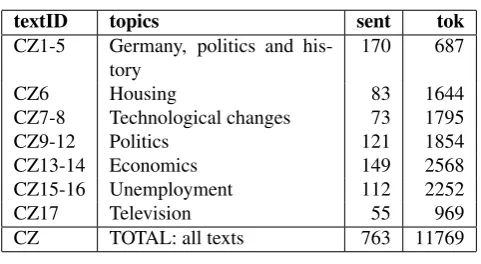
Since texts are shorter in PDT than in GECCo, 17 texts were excerpted to arrive at a similar number of tokens and sentences (11769 and 763 respectively), see Table 2. Both German and Czech texts under analysis include all levels of annotations (i.e. morphological, syntactical, POS, textual phenomena, etc.) along the corresponding frameworks.
textID topics sent tok
GO1 Germany and social market economy
121 2035
GO2 Optimistic remarks on global-isation
47 971
GO3 Politics and globalisation 103 1871 GO4 Globalisation and new
chal-lenges
27 478
GO5 The biggest currency
changeover
85 1460
GO6 Globalisation and market economy
80 1782
GO7 Global market and technical progress
108 1851
GO8 Economic and technological changes
73 1795
GO9 Doctors and medical system 92 2687
GO TOTAL: all texts 736 14930
Table 1: German dataset
textID topics sent tok
CZ1-5 Germany, politics and his-tory
170 687
CZ6 Housing 83 1644
CZ7-8 Technological changes 73 1795
CZ9-12 Politics 121 1854
CZ13-14 Economics 149 2568
CZ15-16 Unemployment 112 2252
CZ17 Television 55 969
CZ TOTAL: all texts 763 11769
Table 2: Czech dataset
Although these two data sets were annotated within two dif-ferent frameworks, the data is comparable, see our discus-sion (Lapshinova et al., 2015).
3.2.
Scheme for Analysis
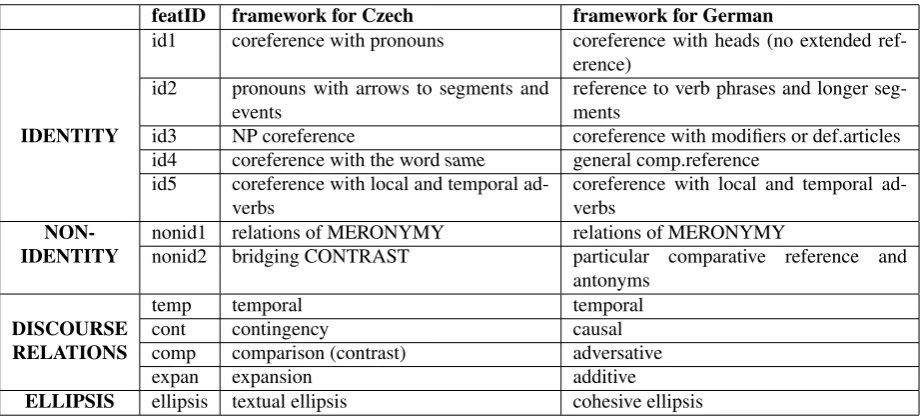
an-featID framework for Czech framework for German
id1 coreference with pronouns coreference with heads (no extended ref-erence)
id2 pronouns with arrows to segments and events
reference to verb phrases and longer seg-ments
IDENTITY id3 NP coreference coreference with modifiers or def.articles
id4 coreference with the wordsame general comp.reference id5 coreference with local and temporal
ad-verbs
coreference with local and temporal ad-verbs
NON- nonid1 relations of MERONYMY relations of MERONYMY
IDENTITY nonid2 bridging CONTRAST particular comparative reference and
antonyms
temp temporal temporal
DISCOURSE cont contingency causal
RELATIONS comp comparison (contrast) adversative
expan expansion additive
ELLIPSIS ellipsis textual ellipsis cohesive ellipsis
Table 3: Categories of the interoperable scheme
notation of discourse properties. The creation of an inter-operable scheme requires a comparison of the underlying annotations. So, we annotated a small corpus of compara-ble English texts according to the two separate frameworks. This dataset served us as basis for identifying overlapping annotation categories and creating an interoperable scheme. In the present study, we use this scheme to test whether this can be applied for contrastive analyses of Czech and Ger-man, which can be extended to more general comparisons of Germanic and Slavic languages in the future. The whole scheme is illustrated in Table 3. The main categories are labelled as IDENTITY, NON-IDENTITY, ELLIPSIS and DISCOURSE RELATIONS.
The category of IDENTITY, or coreferential relations, are further specified into five groups according to the form of anaphoric expressions:
• Pronominal coreference (id1) with pronouns referring to nominal antecedents, e.g. Ludwig Erhard – er [he] in example (2).
(2) a. GO: Als Superstar der sozialen Mark-twirtschaft gilt aus gutem Grund Ludwig Erhard. Er hatte.. in den 50er Jahren... die produktiven Kr¨afte der Unternehmen entfesselt und daraus ein Wirtschaftswunder gezaubert... [Ludwig Erhard is regarded as the superstar of the social market economy, and for good reasons. ...in the nineteen-fifties..., he had unleashed the productive forces of business and in this way conjured up an economic miracle...]
b. CZ: Ta pˇrijala strategii B´ıl´eho domu v domnˇen´ı, ˇze je to nejjistˇejˇs´ı cesta k v´ıtˇezstv´ı. [She endorsed the White House strategy, believing it to be the surest way to victory.
• Abstract coreference (id2) with pronominal anaphors
linking up to complex antecedents such as clauses, sentences and longer stretches of text, see example (1) above.
• Nominal coreference, where anaphors are realised in text by nouns with (in German, see Gewerkschaften – den Gewrkschaftenin example (3-a)) or without a modifier, as in Czech, see Prahu – Prahy in example (3-b) (id3).
(3) a. GO: Staatstragender k¨onnen Gewerkschaften kaum sein. Auch wenn... Ludwig Erhard von den Gewerkschaften nicht viel hielt... [Greater loyalty to the state can hardly be expected of a trade union. Despite the fact that... Ludwig Erhard did not think much of the trade unions...]
b. CZ: Za´ım se posunuje st´ale v´ıce za Prahu... Po d´alnici bychom se mˇeli sv´ezt z Prahy aˇz do Cesk´ychˇ Budˇejovic... [So far, people are moving away from Prague... [Highways should take us from Prague all the way to ˇCesk´e Budˇejovice...
• coreference with anaphors including the word same (id4), see (4), and
(4) And then we do this process again. It’s really exactly the same process every time.
• coreference with local and temporal adverbs as anaphors (id5), e.g.Lissabon – there.
Ger-mansin (5-a),studio apartments – kitchensin (5-b) and so on.
(5) a. GO: ...praktisch wird es dazu nicht kommen – daf¨ur ist in Deutschland die Bereitschaft zur Solidarit¨at, der Glaube an das “f¨ur alle” zu groß. Eine andere Gefahr ist da weit realer: daß die Deutschen... [In practice... it will not come to that – the readiness to practice solidarity, and people’s belief in the “for all” is too pronounced in Germany. An-other danger is much more real, however: that the Germans...]
b. CZ:Jednotliv´a studia v apartm´anech jsou vy-bavena kuchyn´ı, takˇze je moˇzn´a individu´aln´ı pˇr´ıprava stravy. [Studio apartments are equipped with kitchens, so everyone can pre-pare their own food.]
CONTRAST covers (again, generally taken) antonymy be-tween nominal groups (such asHalbierung – Verdoppelung [halving – doubling]in example (6-a)) and relations termed as comparative reference, e.g.cars – a smaller car.
(6) a. GO: Dazu geh¨oren zum Beispiel die Halbierung der Energie- und Rohstoffin-tensit¨at bis 2020 gegen¨uber 1990 (bzw. 1994) und die Verdoppelung des Anteils erneuer-barer Energien am Energieverbrauch bis 2010. [For example, halving the amount of power and raw material consumption by 2020 compared to 1990 (or 1994) levels and doubling the percentage of renewable energy used as part of total energy consumption by 2010.]
b. CZ: Saldo bˇeˇzn´eho ´uˇctu platebn´ı bilance po-dle odhadu dos´ahlo vloni cca 600 USD... I kdyˇz letos a pˇr´ıˇst´ı rok je nutn´e poˇc´ıtat se zpo-malen´ım r˚ustu v´yvozu, progn´ozujeme, ˇze saldo pˇzesto z˚ustane kladn´e. [The balance of the cur-rent account deficit is estimated to reach$600 last year ... Although this and the next yeas we expect the slowdown in export growth, we fore-cast that the deficit will still remain positive.]
Similarly, we include four subclasses of DISCOURSE RE-LATIONS, i.e. logico-semantic relations that are signalled by a discourse marker or a conjunction:
• temporal relations (temp), e.g. als [when]in (7-a) for German orpotom [then]in (7-b) for Czech.
(7) a. GO:Als in Osteuropa der Kommunismus st¨urzte, h¨atten viele, die dabei mittaten, gerne etwas von ihm gerettet. [When communism collapsed in Eastern Europe, many of the people involved would gladly have kept individual aspects of it]. b. CZ:Posluchaˇc mus´ı pˇristoupit na pozici,
ˇze vˇse je dovoleno. Potom se pobav´ı a tak´e pochop´ı, ˇze drama zn´azorˇnuje ztr´atu re´aln´e komunikace. [The listener has to
accept the fact that everything is permit-ted. Then he can enjoy himself and also understand that the drama symbolizes the loss of a real-life communication.]
• relations of contingency or cause (cont), e.g. deshalb [this is why]in (8-a) for German orproto [therefore] in (8-b) for Czech.
(8) a. GO: Aber nur in den wenigsten ist diese Organisation ein dynamisches Ele-ment der Volkswirtschaft. Deshalb irri-tiert ausl¨andische Beobachter auch oft... [This is why foreign observers are often confused...]
b. CZ: Zat´ımco vˇetˇsina fotbalov´ych reprezentac´ı vstupuje do kvalifikace pro ME 1996 nyn´ı v z´aˇr´ı, boj o ´uˇcast v Anglii vypukl jiˇz dˇr´ıve. (...) Pˇred opravdov´ym rozjezdem kvalifikace proto pˇrin´aˇs´ıme pˇrehled, jak ˇcasto spolu celky v jednotliv´ych skupin´ach uˇz v soutˇeˇz´ıch ME a MS v minulosti hr´aly. [While most national football teams enter the qualification for the 1996 European Championship now, in September, the fight for a place at the competition in Eng-land started earlier.Before the real start of the qualification, we therefore provide an overview of how often the teams in each group had played each other at European and World Championships in the past.]
• relations of contrast (comp), e.g.aberin (9-a) for Ger-man, andvˇsak [however]in (9-b) for Czech.
(9) a. GO: Arbeiten wie die Polen, aber leben wie die Japaner... [Work like the Poles, but live like the Japanese...]
b. CZ: Posledn´ı statistick´e sˇc´ıt´an´ı dopravy probˇehlo v roce 1990. Za posledn´ı tˇri roky se vˇsak na ˇcesk´ych silnic´ıch zv´yˇsil provoz. [The latest statistical traffic cen-sus took place in 1990. Over the past three years, however, traffic on Czech roads has increased.
• relations of expansion or addition (expan), such as ebenso in example (10-a) in German or a [and] in (10-b) in Czech.
b. CZ: Vl´adn´ı pl´an je podle Jana ˇSvarce ambici´ozn´ı a poˇc´ıt´a v t´eto oblasti s inves-ticemi 85 miliard korun do roku 2005. [According to Jan ˇSvarc, the government plan is ambitious and it envisages in this area the investment of 85 billion crowns in 2005.]
Note that all kinds of structural types are analysed, such as connectives of main clauses, subordinators and also adver-bials.
NOMINAL ELLIPSIS includes only nominal constructions as this type is available in both frameworks. We demon-strate an example of a nominal elliptical construction in ex-ample (11-a).
(11) a. GO:All das ist eine kleine Revolution. Die gr¨ossere [] ist diese: [But there is also a big-ger [revolution], and it is this:]
b. CZ: Klienti pojiˇstoven, kter´e ukonˇc´ı svou ˇcinnost, se automaticky vr´at´ı k Vˇseobecn´e []. [Clients of insurance companies which shut down will automatically return to the General [one].
4.
Analyses and Results
We now analyse the categories in both languages with re-spect to their overall distribution, the degree of explicitness, as well as the type of textual categories that are preferred. Moreover, we examine variation in the degree of depen-dence of these textual phenomena on lexico-grammatical constraints or pragmatic peculiarities.
First, we compare the distributional characteristics of the German and Czech data. We produce box plots for analysing variance and significant differences between both data sets. Box plots are median-oriented graphics that rep-resent a convenient way of depicting groups of numerical data through their quartiles which are the three points that divide the data set into four equal groups, each group com-prising a quarter of the data. Box plots have lines extending vertically from the boxes (whiskers), indicating variability outside the upper and lower quartiles.Notchedboxplots re-veal if the differences between the variables under analysis are significant: if two boxes’ notches overlap, then there is no ’strong evidence’ that their medians differ, see Cham-bers et al. (1983). The boxplots in Figure 1 demonstrate that German (GO) and Czech (CZ) texts do not differ sig-nificantly in their overall degree of cohesiveness if all four categories are taken together.
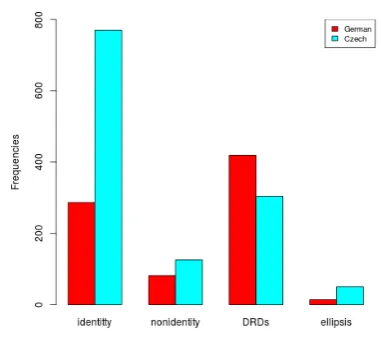
The differences get pronounced if we compare the distribu-tions for each category, see the barplot based on the nor-malised (per 10000) overall frequencies per relation in Fig-ure 2. So, we observe more variation for identity and dis-course relations, while the frequency distribution for ellip-sis and non-identity is similarly low.
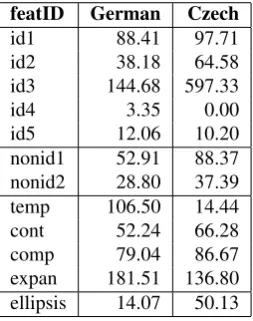
Taking a closer look into the subcategories in Table 4, il-lustrating overall frequencies per category (normalised per total number of words in texts), we find that the higher fre-quencies of IDENTITY relations in Czech exclusively stem
Figure 1: Discourse phenomena in German and Czech
Figure 2: Discourse phenomena in German and Czech
featID German Czech
id1 88.41 97.71
id2 38.18 64.58
id3 144.68 597.33
id4 3.35 0.00
id5 12.06 10.20
nonid1 52.91 88.37 nonid2 28.80 37.39
temp 106.50 14.44
cont 52.24 66.28
comp 79.04 86.67
expan 181.51 136.80 ellipsis 14.07 50.13
Table 4: Frequencies of discourse categories
trade unions in many countries]). This would be a part of the same lexical chain as the other mentions of Gew-erkschaften, but is not coreferent and, cannot be considered as an extension for the German coreference chain here. In languages with the definite article, anaphoric expressions mostly contain a formal definite marker which allows to (even automatically) extract most anaphors from the cor-pus. Czech, as a Slavic language without definite article, does not dispose a formal means with the help of which anaphoric expressions can be easily found and annotated. Thus, the annotation is completed on the base of semantic and referential criteria: everything that refers to the same discourse entity, according to the annotator, is marked as coreferential.
By contrast, the frequencies for DISCOURSE RELA-TIONS are higher in German than in Czech. As a similar tendency was observed in comparison to English (see e.g. Kunz et al. (in press)), German seems to be exceptional in signaling logico-semantic relations by an explicit discourse marker, especially in terms of temporal relations or rela-tions of expansion, as it is seen in Figure 3.
Figure 3: Discourse relations of in German and Czech
As for NON-IDENTITY, we foresee much higher frequen-cies when integrating further relations in the future. Finally, the higher number of NOMINAL ELLIPSIS in Czech than German points to a higher preference for expressing com-parison by fragments. This tendency towards implicitness may, however, stem from the greater syntactic flexibility of Czech relative to German.
5.
Conclusion and Discussion
We have performed a cross-lingual analysis of discourse phenomena, using resources annotated along two different frameworks. Our preliminary results show that interopera-ble schemes like the one used here permit a multilingual analysis of discourse-annotated corpora originating from different approaches. On the one hand, we are able to val-idate the interoperable scheme in an application. On the other hand, the successful application of the scheme indi-cates possible interoperability in existing resources. In this way, our methodology saves time and effort as no compila-tion of addicompila-tional resources is required. This is especially valuable for multilingual NLP which usually requires mul-tilingual data sets annotated according to the same scheme to build appropriate language models. Creation of such data sets is costly and time-consuming, and our approach can be a good solution in this case. Furthermore, the re-sults yield first insights into differences between German and Czech in terms of the annotated phenomena. At the same time, we are aware of the limitations the dataset at hand provides: although the texts are from the same text genres and have similar topics, the variation observed may be author- or source dependent, since the size of the dataset is small. Some of the differences could also be explained by the differences in the conceptualisations in the schemes. Nevertheless, our work is an important first step towards better comparing and harmonising available resources that are already enriched with annotations. Our future plans in-clude an expansion of the analyses in terms of corpus size, languages and factors influencing variation, e.g. authors, topics. A deeper analysis of textual examples in German and Czech will help us to improve and to refine the anal-ysed categories. Moreover, we plan to include spoken data into our analyses, and compare the distribution of discourse relations across spoken and written dimensions in both lan-guages. Additionally, we intend to test this scheme in fur-ther applications, e.g. for machine translation or ofur-ther NLP areas.
Acknowledgements
This work was made possible within the Textlink Action (ISCH COST Action IS1312)1. We also acknowledge support from the Grant Agency of the Czech Republic (grant 16-05394S). This work has been using language re-sources developed and stored and distributed by the LIN-DAT/CLARIN project of the Ministry of Education, Youth and Sports of the Czech Republic (project LM2015071). The project GECCo has been supported through a grant from the Deutsche Forschungsgemeinschaft (German Re-search Society). The German corpus can be queried via the CQPWeb interface provided through CLARIN-D (hdl:
11858/00-246C-0000-0023-8CF7-A).
6.
Bibliographical References
B¨uhrig, K. and House, J. (2004). Connectivity in trans-lation: Transitions from orality to literacy. In J. House
1
et al., editors, Multilingual Communication, pages 87– 114. Benjamins, Amsterdam.
Chambers, J., Cleveland, W., Kleiner, B., and Tukey, P. (1983). Graphical Methods for Data Analysis. Wadsworth.
Engel, U. (1999). Deutsch-polnische kontrastive Gram-matik. Groos, Heidelberg.
Guillou, L. (2012). Improving pronoun translation for sta-tistical machine translation. In EACL 2012, 13th Con-ference of the European Chapter of the Association for Computational Linguistics, Avignon, France, April 23-27, 2012, pages 1–10.
Halliday, M. and Hasan, R. (1976). Cohesion in English. Longman, London, New York.
Hardmeier, C. and Federico, M. (2010). Modelling pronominal anaphora in statistical machine translation. InIWSLT (International Workshop on Spoken Language Translation); Paris, France; December 2nd and 3rd, 2010., pages 283–289.
Kom´arek, M. (1994). On relative pronouns in czech and german. In Svˇetla ˇCmejrkov´a et al., editors,The Syntax of Sentence and Text. Jonh Benjamins.
Kunz, K., Degaetano-Ortlieb, S., Lapshinova-Koltunski, E., Menzel, K., and Steiner, E. (in press). Gecco – an empirically-based comparison of english-german co-hesion. In G. De Sutter, et al., editors, New Ways of Analysing Translational Behaviour in Corpus-Based Translation Studies. Mouton de Gruyter. TILSM series. Lapshinova, E., Nedoluzhko, A., and Kunz, K. (2015).
cross languages and genres: Creating a universal annota-tion scheme for textual relaannota-tions. In Ines Rehbein et al., editors, Proceedings of the Workshop on Linguistic An-notations, NAACL-2015, Denver, USA.
Lapshinova-Koltunski, E. and Kunz, K. (2014). Annotat-ing cohesion for multillAnnotat-ingual analysis. InProceedings of the 10th Joint ACL - ISO Workshop on Interoperable Semantic Annotation, Reykjavik, Iceland, May. LREC. Le Nagard, R. and Koehn, P. (2010). Aiding pronoun
translation with co-reference resolution. InProceedings of the Joint Fifth Workshop on Statistical Machine Trans-lation and MetricsMATR, WMT ’10, pages 252–261, Stroudsburg, PA, USA. Association for Computational Linguistics.
Nedoluzhko, A., Toldova, S., and Nov´ak, M. (2015). Coreference chains in czech, english and russian: Pre-liminary findings. Computational Linguistics and Intel-lectual Technologies, 14(21):474–486.
Nov´ak, M. and Nedoluzhko, A. (2015). Comparison of coreferential expressions in czech and english. Dis-cours: Revue de linguistique, psycholinguistique et in-formatique., 16:1–24.
Sgall, P., Hajicova, E., and Panevovˇa, J. (1986).The mean-ing of the sentence in its semantic and pragmatic aspects. Reidel, Dordrecht.
ˇSt´ıcha, F. (2003). Aesko-n ¨¨ Ameck ˜A¡ srovn ˜A¡vac ˜A gra-matika. Argo, Prague.
Taboada, M. and G´omez-Gonz´alez, M. (2012). Discourse markers and coherence relations: Comparison across
markers, languages and modalities. Linguistics and the Human Sciences, 6 (1-3):17–41.
Bonnie Webber, et al., editors. (2013). Proceedings of the Workshop on Discourse in Machine Translation. Asso-ciation for Computational Linguistics, Sofia, Bulgaria, August.
Bonnie Webber, et al., editors. (2015). Proceedings of the Second Workshop on Discourse in Machine Translation. Association for Computational Linguistics, Lisbon, Por-tugal, September.
Zik´anov´a, ˇS., Hajiˇcov´a, E., Hladk´a, B., J´ınov´a, P., M´ırovsk´y, J., Nedoluzhko, A., Pol´akov´a, L., Rysov´a, K., Rysov´a, M., and V´acl, J. (2015). Discourse and Coher-ence. From the Sentence Structure to Relations in Text. Studies in Computational and Theoretical Linguistics.
´
UFAL, Prague, Czech Republic.
Zinsmeister, H., Dipper, S., and Seiss, M. (2012). Abstract pronominal anaphors and label nouns in german and en-glish: selected case studies and quantitative investiga-tions. Translation: Computation, Corpora, Cognition, 2(1).
7.
Language Resource References
Bejˇcek, E., Hajiˇcov´a, E., Hajiˇc, J., J´ınov´a, P.,Ket-tnerov´a, V., Kol´aˇrov´a, V., Mikulov´a, M., M´ırovsk´y, J., Nedoluzhko, A., Panevov´a, J., Pol´akov´a, L., ˇSevˇc´ıkov´a, M., ˇStˇep´anek, J., and Zik´anov´a, ˇS. (2013). Prague de-pendency treebank 3.0.
Hansen-Schirra, S., Neumann, S., and Steiner, E. (2012). Cross-linguistic Corpora for the Study of Translations. Insights from the Language Pair English-German. de Gruyter, Berlin, New York.