The OpenCourseWare Metadiscourse (OCWMD) Corpus
Ghada Alharbi and Thomas Hain
Department of Computer Science, University of Sheffield Regent Court, 211 Portobello, Sheffield, S1 4DP, United Kingdom[email protected], [email protected]
Abstract
This study describes a new corpus of over 60,000 hand-annotated metadiscourse acts from 106 OpenCourseWare lectures, from two different disciplines: Physics and Economics. Metadiscourse is a set of linguistic expressions that signal different functions in the discourse. This type of language is hypothesised to be helpful in finding a structure in unstructured text, such as lectures discourse. A brief summary is provided about the annotation scheme and labelling procedures, inter-annotator reliability statistics, overall distributional statistics, a description of auxiliary data that will be distributed with the corpus, and information relating to how to obtain the data. The results provide a deeper understanding of lecture structure and confirm the reliable coding of metadiscursive acts in academic lectures across different disciplines. The next stage of our research will be to build a classification model to automate the tagging process, instead of manual annotation, which take time and efforts. This is in addition to the use of these tags as indicators of the higher level structure of lecture discourse.
Keywords:metadiscourse, disciplines, OpenCourseWare lectures
1.
Introduction
Academic lectures offer rich opportunities for studying a variety of complex discourse phenomena that help in build-ing system to interpret the information in lectures dis-course. Lectures contain regions where speakers intro-duce some concepts, emphasise others, interact with stu-dents, and engage in other interesting discourse phenom-ena. Thus, it is critical to locate these regions in order for a system to interpret lecture discourse. Moreover, lectures of-ten involve strategies used to indicate these regions, which in turn reflect both topical and functional structure, as well as other high-level discourse dynamics. These strategies are known asmetadiscourse(MD), which are linguistic ex-pressions that are often referred to as discourse about dis-course that has just occurred or is about to occur (Schiffrin, 1980; Crismore et al., 1993). Some examples of metadis-course expressions include theIntroduction(“Today I want to talk; Now moving on to”),Conclusion(“To conclude”), orPreviewing(“We’ll be coming to that”).
Metadiscourse in spoken lectures poses interesting chal-lenges to descriptive and theoretical models of discourse, as well as to downstream applications research, including the summarising of a meeting according to its activities (Niekrasz, 2012). Most recently, this has involved build-ing presentation skills tools usbuild-ing Ted Talks (Correia et al., 2014).
Previous work by Alharbi et al. (2015) considered only five metadiscourse tags of the selected schema for about 47 university lectures. However, the present study describes a new corpus of hand-annotated metadiscourse, consider-ing all the tags in the schema for roughly 106 lectures from different disciplines, namely Physics and Economics. The lectures were recorded at both Yale University and the Mas-sachusetts Institute of Technology; this constituted as part of the OpenCourseWare initiative.
In this paper, a description of the OpenCourseWare Metadiscourse (OCWMD) is provided, in addition to other information on how the annotation procedure and post-annotation verification phases, such as inter-agreement
measures, were conducted. The corpus is designed to be available online for research purposes, and in addition there is a plan for the future release of the automatic speech recognition transcriptions.
Future work will involve creating a classification model to automate the tagging process, which costs both time and ef-forts, and exploring different features for the model, such as lexical and prosodic information. In addition, we can check if we encounter any difference when we use the imperfect transcription that results from automatic speech recogni-tion. Furthermore, we intend to use these MD tags to find higher level structure in lecture, as a form of table of con-tents suitable for web browsing.
2.
Background
In the following we specifically list discourse analysis data and work that examines the function of the discourse for both written and spoken language.
In terms of written language, Marcu (2000) introduced the RST Discourse Treebank as a semantic-free theoretical framework of discourse relations; this was based on Rhetorical Structure Theory (RST) (Mann and Thompson, 1988). In RST, some relations are “intentional” whilst other are “subject matter” relations. Another related work is the contribution of Miltsakaki et al. (2008) to the Penn Discourse Treebank (PDTB) (Marcus et al., 1993); this was useful insofar as it classified discourse connectives according to their function. Teufel and Moens (2002) introduced a technique called argumentative zoning that assigns functions to sentences instead, with the aim of organising scientific articles into predefined zones, such as
Aim,MethodandBackground.
Physics Economics Overall
# Lect 57 49 106
# Token 488k 422k 910k
# Words 9k 11k 20k
# Utterance. 32k 31k 63k
Table 1: Lecture Corpus Statistics
MD Tag Abbreviation
Metalinguistic
Repairing REP
Reformulating REF
Commenting on Linguistic Form/Meaning CLF
Clarifying CLA
Managing Terminology MAT
Discourse
Or
g
anisation
Introduction INT
Conclusion CON
Delimiting DEL
Contextualising COT
Enumerating ENU
Endophoric PHO
Reviewing REV
Previewing PRE
Speech
Acts
Emphasising EMP
Exemplifying EXE
Arguing ARG
Suggesting SUG
Audience
Managing Comprehension MAC
Anticipating Audience’s Response AAR
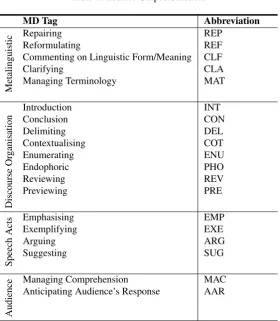
Table 2: A list of the final MD tags used in developing the OCWMD corpus. This also shows the mapping between MD tags and their higher-level functions.
be applied in the context of both written and spoken aca-demic discourse. This schema is based on three main cate-gories: Textual(strategies related to the structuring of dis-course), Interpersonal (related to the interaction with the different participants involved in the communication) and
Contextual (covering references from audio-visual mate-rials). Mauranen (2001) developed a schema for spoken language only. This author’s taxonomy is characterised by three key categories: Monologue,Dialogue and Inter-active. Both studies centre on the structuring of metadis-course and the number of participants, but not its function.
¨
Adel (2010) examined the functional approach of metadis-course for both written and spoken language; the author introduced a schema consisting of 23 finer-level functional groups. These are further structured into four high-level tasks ofMetalinguistic Comments,Discourse organisation,
Speech act labelsandReferences to the audience.
3.
Data
The proposed annotation scheme was applied to source material drawn from two OpenCourseWare platforms,
MIT1 and YALE2; these are distributed under a Creative-Commons license. The lectures, presented by professional and highly skilled speakers, are available in the form of high quality video and audio data, transcripts, and subtitles. The objective of such posting follows theOpenCourseWare
principle of wide accessibility. The decision to select these specific platforms was based on the high quality of the resources provided by these initiatives, as well as the availability of full lecture courses for a range of disciplines.
Another decision was necessary regarding the variety of disciplines to choose from, in order to formulate the fi-nal dataset. Lecture courses from two different disci-plines, Physics and Economics, were chosen. This deci-sion was primarily based on the availability of the lecture resources of similar introductory courses taught across the two different platforms, MIT OpenCourseWare and Open YALE Courses. For example, the Physics course from MIT OpenCourseWare is called Classical Mechanics, while the
1
http://ocw.mit.edu/index.htm
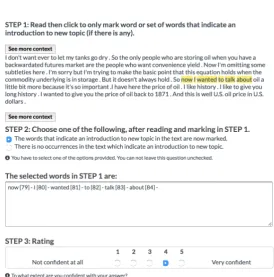
Figure 1: Example of the annotation interface used in annotating the categoryIntroduction
course from Open YALE Courses is called Fundamentals of Physics. These courses cover approximately the same scientific material but different lecturers from different in-stitutions teach them. Another reason for choosing these disciplines is to enable an investigation of whether there is a difference in detecting MD between Natural Science and Social Science lectures. Various corpus statistics for the new datasets are presented in Table 1.
4.
Annotation
The proposed annotation schema was adopted from ¨Adel (2010), which provides a fairly suitable fit owing to the fact that this scheme signals functions in the discourse. Sim-ilar annotation procedures of previous work are followed here, too (Alharbi et al., 2015), where the focus was only on Discourse OrganisationMD tags. In the following, a brief description of the participants, guidelines, annotation tool and preliminary study are presented.
4.1.
Participants
Four expert participants were involved in this study, along with the first author of this paper. All annotators were stu-dents, two of whom are working towards a PhD in physics; the other two are working towards a PhD in economics. The participants were trained via different examples for each MD category before taking part in the final annotation study.
4.2.
Guidelines
In order to facilitate the process for the annotators, cat-egories are annotated one at a time, with only one seg-ment with an average of 200 words (truncated to the clos-est end of utterance) per task, in order to manage
annota-tor cognitive loads. Thus, for every category in the anno-tation schema, there are a total of 2,440 annoanno-tation tasks for the Physics lectures and 2,110 annotation tasks for the Economics lectures. As a result, different instructions sets have been designed for each of the 19 MD category in the schema. The instructions consist of three essential steps: first read the text segment and highlight MD tag occur-rences; then confirm this finding in the second step; finally, the annotator is asked to rate their confidence score regard-ing this particular MD tag, on a scale out of 5. The use of the self-confidence score is to indicate how familiar the annotators are with the task at hand. These strategies were also followed in previous research, such as (Alharbi et al., 2015) and (Correia et al., 2014). It is worth noting that the final set of instructions was derived after several prelimi-nary trials.
4.3.
Tool
Annotation was conducted with the help of an tion tool, which is also useful in outlining the annota-tion instrucannota-tions as demonstrated in Figure 1. The tool was created and designed specifically for this task using HTML/XML languages and JavaScript functions. More-over, specific mechanisms were provided in order to facili-tate the work for the annotators, such as requesting them to highlight the target word or set of words that they consider are indications of the desired MD category. The same tool was also used in the annotation experiments conducted by Alharbi et al. (2015).
4.4.
Trial
anno-MD Tag Transcript
REV Let me remind you that everything I did so far in class came from analyzing the Lorentz transformations.
EMP And you should be really on top of those two marvelous equations because all the stuff we are doing is a consequence of that.
DEL|REV I won’t go over howwe derive them because I’ve done itmore than once.
REV But I remind you that if you’ve got an event that occurs at xtfor
one person and to a person moving to the right at velocity the same event will have coordinatesx`=x−ut.
NONE This is it .
EMP This is the key.
NONE From this by taking differences of two events you can get similar equations for coordinate differences.
REF In other words if two events are separated in space by x for one person andx`for another person and likewise in time then you get similar formula for differences.
NONE So differences are related the same way that coordinates themselves are. NONE But I will write it anyway because I will use it sometimes one way and
sometimes the other way.
NONE Even this one you can think of as a formula for a difference except one of the coordinates or the origin.
NONE So I put this to work.
NONE I got a lot of consequences from that.
REV You remember that
EXE|REV For example I said before take a clock that you are carrying with you. NONE Or let’s take a clock that I’m carrying with me and let’s see how it
looks to you.
EXE And let’s say it goes tick and it goes tick one more time.
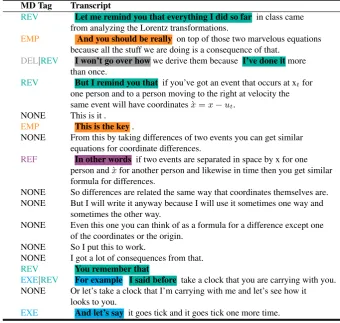
Figure 2: Example from physics lecture yale-phy0020014. ‘MD’: metadiscourse label (multiple tags are separated by ‘|’). For the purposes of illustration, each tag in the table is indicated by a unique font colour and the corresponding phrases have been highlighted with the same colour. The first author of the paper annotated these expressions.
tation study was conducted initially. This was intended to determine frequency estimates for tags appearing in the lec-ture data for Physics and Economics. In light of this, deci-sions relating to the matter of which MD tags were to be included were based on the frequency of the tags in this trial study. The tags ‘Marking Aside’, ‘Adding to topic’ and ‘Managing Audience Discipline’ were excluded from the final set of MD tags, due to their low occurrences in the trial study. Further modifications were also made to
¨
Adel’s schema. For example, the tag ‘Exemplifying’ was originally named ‘Managing the message’, and ‘Imagining Scenario’ was integrated with the ‘Exemplifying’ category. Thus, 19 MD tags were included in the final set of MD tags, and this excluded the non-label case. Table 2 presents this list, in combination with abbreviations for each tag that will be used herein. ¨Adel (2010) provides a precise definition for each MD tag in the selected list.
5.
Annotated Example
An example from one of the physics lectures is shown in Figure 2; it will serve as an illustration of some of the types of MD that one is able to observe in the corpus. The exam-ple also provides a taste of the frequency and comexam-plexity of MD information. For instance, two of the utterances in the example display more than one tag, as was the case with the third utterance, which has two tags: ‘Delimiting’ and ‘Reviewing’. In addition, of the 17 utterances within the excerpt, 8 have no labels. This is typical of many regions in
the corpus, which show no MD tag at all. This case seems typical in related work, for example in identifying MD in a presentation style corpus (Correia et al., 2014) and in de-tecting speech acts in messages (Qadir and Riloff, 2011).
6.
Reliability
In order to measure the degree of agreement between an-notators, we used one of the most commonly applied met-rics in NLP research (Carletta, 1996): Kappa. In particu-lar, Fleiss’s kappa coefficientκ(Fleiss, 1971), since there are three annotators for each annotation task as described above. A complete agreement corresponds toκ = 1, and no agreement corresponds toκ≤0. Similarly to the trail study, the decision of whether or not an utterance includes the discourse function of a certain MD tag is made based on the overall agreement between annotators; this is be-cause the primary objective of this study is to detect if an utterance contains an instance of metadiscursive acts. Thus, agreement between annotators is considered to exist if the intersection (in terms of number of words) between their annotations is not void. A stricter approach for computing the agreement at word-level is reported in Madnani et al. (2012) for an extraction task of such metadiscursive acts expressions.
at-Physics Economics
MD Tag κ Confidence κ Confidence
Metalinguistic
REP 0.76 3.80 0.73 3.60
REF 0.83 3.91 0.75 3.68
CLF 0.70 3.74 0.73 3.80
CLA 0.69 3.56 0.66 3.35
MAT 0.77 3.86 0.79 3.82
Total 0.75 3.75 0.73 3.65
Discourse
Or
g
anisation
INT 0.85 3.98 0.80 4.00
CON 0.79 4.00 0.77 3.80
DEL 0.80 3.93 0.74 3.76
COT 0.70 3.86 0.71 3.63
ENU 0.78 3.76 0.81 3.89
PHO 0.75 3.89 0.78 3.78
REV 0.80 3.97 0.81 3.98
PRE 0.77 3.81 0.76 3.85
Total 0.78 3.90 0.77 3.84
Speech
Acts
EMP 0.81 4.13 0.84 4.20
EXE 0.82 3.97 0.85 4.00
ARG 0.75 3.89 0.67 3.55
SUG 0.74 3.83 0.72 3.69
Total 0.78 3.95 0.77 3.86
Audience
MAC 0.71 3.78 0.69 3.71
AAR 0.80 3.99 0.74 3.90
Total 0.76 3.89 0.72 3.80
Overall 0.77 3.87 0.75 3.79
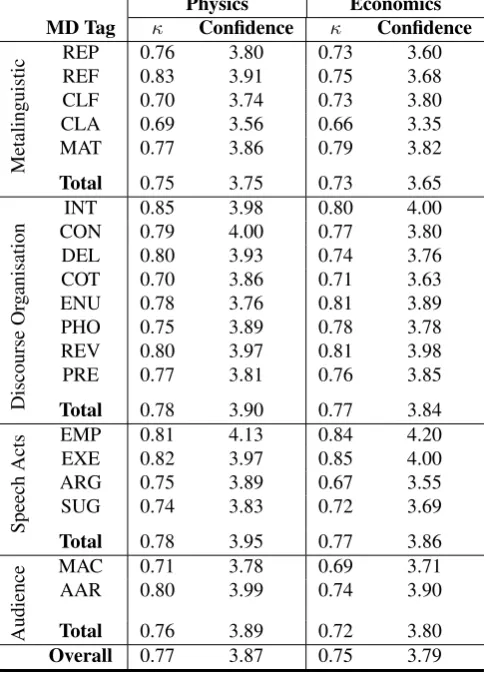
Table 3: Results in terms of inter-annotator agreement (Fleiss’s kappaκ) and the self-reported confidence scores.
tributed to the fact that each tag is dealt with individually. This is in contrast to previous work in Alharbi et al. (2015) on a subset of the dataset presented here and using only discourse organisation tags, such asIntroduction, which re-ports lower inter-annotator agreement. This is because the knowledge of the annotators increased and the guidelines for annotators were improved. However, in the present study there are some tags where even expert annotators have struggled to detect them compared to others, such as the CLARIFYING (CLA) tag for both disciplines and, the ARGUING (ARG) tag for the economics discipline. Previ-ous annotation work relating to similar phenomena reported similar situations (Correia et al., 2014). Self-reported con-fidence scores show all tags scoring above the middle of the scale (5). This generally indicates that annotators are famil-iar with the annotation task. In addition, annotators showed less confidence in markingMetalinguisticstags than other tags in the schema. Another important finding is that there is a direct association between having high agreement be-tween annotators and high self-confidence scores.
7.
Distributional Statistics
Basic statistics of MD tags for 106 lectures from the two different disciplines (Physics and Economics) are provided. Excluding the non-MD tag NONE, we find 11,466 total tags. This includes the utterances that have more than one tag. Table 4 shows the distribution of the tags in more de-tail. MD tags of the ‘Discourse Organisation’ type seem
to be the most frequent compared to the other tags. This finding is also consistent across the two disciplines, with nearly 2500 occurrences each. Another important finding is that the ‘Interaction with the Audience’ MD tags are less frequent and, again, this is consistent for both disci-plines. These observed similarities could indicate that MD tags are general expressions and, furthermore, that the dis-cipline knowledge may have no discernible effect on its oc-currences.
8.
Auxiliary Information
Further useful information is also included with the cor-pus. Word-level time information will be available, based on alignments from an automatic speech recogniser. Auto-matic transcriptions will also be provided. We recommend various ways in which one can group the large set of labels into a smaller set of classes, depending on the research fo-cus. For example, a convention was provided in the gold standard set in order to map each MD tag to its higher-level functions. This would formulate four general tags in total. Finally, we aim to attach other information that that may be useful when attempting to develop the automatic modeling of prosody.
9.
Conclusion
Physics Economics
CLA 285 4.68 300 5.50
MAT 545 8.95 319 5.85
Total 1112 20.96 821 15.05
Discourse
Or
g
anisation
INT 208 3.42 346 6.35
CON 104 1.71 123 2.26
DEL 87 1.43 82 1.50
COT 22 0.36 31 0.57
ENU 571 9.38 583 10.70
PHO 123 2.02 195 3.58
REV 834 13.70 685 12.57
PRE 536 8.81 396 7.27
Total 2485 40.83 2441 44.80
Speech
Acts
EMP 1234 20.27 1070 19.63
EXE 842 13.83 885 16.24
ARG 43 0.71 14 0.26
SUG 11 0.20 22 0.40
Total 2130 35.01 1991 36.53
Audience
MAC 218 3.58 110 2.02
AAR 113 1.86 45 0.83
Total 331 5.44 155 2.85
Overall 6058 18.93 5408 17.45
Table 4: A statistical summary of all the tags in the gold standard dataset for each discipline, showing the number of occurrences (#) and the frequency of each tag relative to all tags (%).
general strategies of a system trying to infer a lecture dis-course or understand it will be tied to these primitives. For example, if the purpose of an utterance is to emphasise some concept, the system then will easily determine what information is important to highlight for students, by fetch-ing those utterances labelled as important. In another exam-ple, a system may use utterances based on their functions to find higher level forms, such as table of content and dis-course structures analogous to paragraphs and chapters.
Lectures often involve strategies used to indicate the func-tions of utterances. These strategies are known as metadis-courses(MD), which are a set of linguistic expressions that signal different functions in the discourse. The proposed MD scheme consists of a set of categories that allow the process of labelling utterances with suitable functional cat-egories in an academic context. The experimental results show the reliability of the annotation scheme and confirm that MD as a linguistic phenomenon occurs frequently in academic lectures from different disciplines. The annotated corpus with MD labels would provide a valuable resource in the study of discourse as well as a source of training and testing for a discourse analysis system using MD labels in its utterance representation. Future work will involve cre-ating a classification model to automate the tagging pro-cess, which costs both time and efforts, and exploring dif-ferent features for the model, such as lexical and prosodic information. In addition, we can check if we encounter any
difference when we use the imperfect transcription that re-sults from automatic speech recognition. Furthermore, we intend to use these MD tags to find higher level structure in lecture, as a form of table of contents suitable for web browsing.
10.
Acknowledgements
The authors would like to acknowledge the valuable com-ments and suggestions of the reviewers, which have im-proved the quality of this paper. We also thank the anno-tators for taking part in this study. Many special thanks and appreciation go to the Royal Embassy of Saudi Arabia Cul-tural Bureau in London for funding this research.
11.
Bibliographical References
¨Adel, A. (2010). Just give kind of map of where we are going: A taxonomy of metadiscourse in spoken and writ-ten academic english. Nordic Journal of English Studies, 9(2):69–97.
Alharbi, G., Ng, R. W. M., and Hain, T. (2015). Annotat-ing Meta-discourse in Academic Lectures from Different Disciplines. pages 161–166.
Carletta, J. (1996). Assessing agreement on classification tasks: The kappa statistic. Computational Linguistics, 22(2).
(2014). Using the crowd to annotate metadiscursive acts.
In Proceedings 10th Joint ISO-ACL SIGSEM, page 102. Crismore, A., Markkanen, R., and Steffensen., M. S. (1993). Metadiscourse in persuasive writing a study of texts written by American and Finnish university stu-dents. Written communication, 10(2):39–71.
Fleiss, J. L. (1971). Measuring nominal scale agreement among many raters. Psychological bulletin, 76(5):378. Luukka, M.-R. (1992). Metadiscourse in academic texts.
In Conference on Discourse and the Professions, vol-ume 28, Uppsala, Sweden.
Madnani, N., Heilman, M., Tetreault, J., and Chodorow, M. (2012). Identifying high-level organizational elements in argumentative discourse. InProceedings of NAACL’12: HLT, pages 20–28.
Mann, W. C. and Thompson, S. A. (1988). Rhetorical structure theory: Toward a functional theory of text or-ganization.Text, 8(3):243–281.
Marcu, D. (2000). The Theory and Practice of Discourse Parsing and Summarization. MIT Press.
Marcus, M. P., Marcinkiewicz, M. A., and Santorini, B. (1993). Building a large annotated corpus of en-glish: The penn treebank. Computational linguistics, 19(2):313–330.
Mauranen, A. (2001). Reflexive academic talk: Observa-tions from micase. InCorpus linguistics in North Amer-ica Selections from the 1999 symposium, pages 165–178. Miltsakaki, E., Robaldo, L., Lee, A., and Joshi, A. (2008). Sense annotation in the penn discourse treebank. In Pro-ceedings of the LREC’08.
Niekrasz, J. (2012). Toward Summarization of Commu-nicative Activities in Spoken Conversation. Ph.D. thesis, University of Edinburgh.
Qadir, A. and Riloff, E. (2011). Classifying sentences as speech acts in message board posts. In Proceedings of the Conference on Empirical Methods in Natural Lan-guage Processing, pages 748–758. Association for Com-putational Linguistics.
Schiffrin, D. (1980). Meta-talk: Organizational and evaluative brackets in discourse. Socioogical Inquiry, 50(3?4):199–236.