Capturing the Interaction between Aggregation and Text
Planning in Two Generation S y s t e m s
Hua Cheng and Chris
M e l l i s hD i v i s i o n o f I n f o r m a t i c s , U n i v e r s i t y of E d i n b u r g h 80 S o u t h Bridge, E d i n b u r g h EH1 1HN, U K
huac, chrism@dai, ed. ac. uk
A b s t r a c t
In natural language generation, different gener- ation tasks often interact with each other in a complex way. We think that how to resolve the complex interactions inside and between tasks is more important to the generation of a co- herent text than how to model each individual factor. This paper focuses on the interaction be- tween aggregation and text planning, and tries to explore what preferences exist among the fea- tures considered by the two tasks. T h e prefer- ences are implemented in two generation sys- tems, namely I L E X - T S and a text planner us- ing a Genetic Algorithm. The evaluation em- phasises the second implementation and shows that capturing these preferences properly can lead to coherent text.
1 D i s c o u r s e c o h e r e n c e a n d a g g r e g a t i o n
hi NLG, theories based on domain-independent rhetorical relations, in particular, Rhetorical S t r u c t u r e Theory (Mann and Thompson, 1987), are often used in text planning, whose task is to select the relevant information to be ex- pressed and organise it into a hierarchical struc- ture which captures certain discourse prefer- ences such as preferences for the use of rhetori- cal relations.
In the theory of discourse structure developed by Grosz and Sidner (1986), each discourse seg- ment exhibits two types of coherence: local co- herence among utterances inside the segment, and global coherence between this segment and other discourse segments. Discourse segments are connected by either a dominaTzce relation or
a satisfaction-precedence relation.
There has been an effort to synthesise tile two accounts of discourse structure. X loser and Moore (1996) argue that the two theories have
considerable c o m m o n ground, which lies in the correspondence between the notion of domi- nance and nuclearity. It is possible to m a p between Grosz and Sidner's linguistic s t r u c t u r e and R S T text structure, and relation-based co- herence and global coherence capture similar discourse properties.
Oberlander et al. (1999) propose a dis- tinction between two types of discourse coher- ence: proposition-based coherence, which ex- ists between text spans connected by R S T re- lations except for object-attribute elaboration,
and entity-based coherence, which exists be-
tween spans of text in virtue of shared entities.
entity-based coherence captures the coherence
among adjacent propositions, which resembles
local coherence in Grosz and Sidner's theory. To generate a coherent text, the text planning process must try to achieve both local (entity- based) and global (relation-based) coherence. Since the task of aggregation is to combine sinl- ple representations together to form a complex one, which in the mean time leads to a shorter text as a whole, aggregation could affect the or- dering of text plans and the length of the whole text.. Therefore, it is closely related to tile task of maintaining b o t h types of coherence. Here we treat e m b e d d i n g as a type of aggregation.
There is no consensus as to where aggregation should happen or how it is related to other gen- eration processes (Wilkinson, 1995; Reape and Mellish, 1999). In many NLG systems, aggre- gation is a post planning process whose prefer- ences are only partially taken into a c c o u n t by the text planner.
1.1 A g g r e g a t i o n a n d l o c a l c o h e r e n c e
certain types of c e n t e r transition (e.g. cen- ter continuation) :are p r e f e r r e d :over:others (eig,. -; center shifting) (Centering Theory (Grosz et al., 1995)). Aggregation m a y affect text planning by taking away facts from a sequence featuring preferred center movements for embedding or subordination. As a result, the preferred cen- ter transitions in t h e original sequences could be cut off. For example, comparing the first two descriptions of.a necklace in Figure 1, 2 is less coherent than 1 because of the shifting from the description of the necklace to that of the de- signer, which is a side effect of embedding.
Since the centers of sentences are normally NPs and embedding adds non-restrictive com- ponents into an NP, it could affect the way a Cb
is realised (e.g. preventing it from being a pro- noun). As pointed o u t in (Grosz et al., 1995), different realisations (e.g. pronoun vs. definite description) are not equivalent with respect to their effect on coherence. Therefore, embedding could influence local coherence by forcing a dif- ferent realisation from that preferred by Center- ing Theory. There is an obvious need to balance the consideration for local coherence and stylis- tic preferences.
1.2 A g g r e g a t i o n a n d g l o b a l c o h e r e n c e Different types of aggregation need to be com- patible among themselves, in particular, embed- ding and semantic parataxis and hypotaxis. Us- ing the abstraction of RST, semantic parataxis concerns facts related by explicit multi-nuclear semantic relations (e.g. sequence and contrast)
or by implicit connections like parallel common parts. If two facts have at least two identi- cal parallel components, we say that a conjunct
or disjunct relation exists between them, and these relations are multi-nuclear relations. Se- mantic hypotaxis concerns facts connected by nucleus-satellite relations (e.g. cause). Seman- tic parataxis and hypotaxis feature in relation- based coherence a n d they depend on the text planner to put the related facts next to each other in order to p e r f o r m a combination.
(Cheng, 1998) describes interactions that need to be taken into account in aggrega- tion. Firstly, complex embedded components like non-restrictive clauses may interrupt tile semantic connection or syntactic similarity be- tween a set of clauses. Secondly, the possibilities of other types of aggregation should be consid-
ered for both the main fact and the fact to be -embedded .during .:embedding .decision. maki ng...
And thirdly, performing parataxis inside a hy- potaxis could convey wrong information.
We argue t h a t the effect of aggregation is not limited to the particular NP or sentence where aggregation happens, b u t to the coherence of the text as a whole. T h e complex interactions d e m a n d the features of aggregation to be eval- uated .together with other coherence~ features and aggregation to be planned as a part of text structuring. This requires better coordination between aggregation and other generation tasks as well as among different types of aggregation than is present in current NLG systems.
In this paper, we describe how to capture the above interactions as preferences among related features, and the implementation of the prefer- ences in two very different generation architec- tures to produce descriptions of museum objects on display.
2 P r e f e r e n c e s a m o n g c o h e r e n c e f e a t u r e s
We claim t h a t it is the relative preferences among features rather t h a n the absolute magni- tude of each individual one that play the crucial role in the production of a coherent text. In this section we discuss the preferences among fea- tures related to text planning, based on which those for embedding can be introduced.
2.1 P r e f e r e n c e s for g l o b a l c o h e r e n c e A semantic relation other than conjunct or dis- junet is preferred to be used whenever possible because it usually conveys interesting informa- tion about domain objects and leads to a coher- ent text span. If a conjunct relation shares a fact with a semantic relation, the conjunct should be suppressed. For example, in 3 of Figure 1. apart from other relations, there is an amplifica- tion relation signalled by indeed and a conjunct
between the last two propositions. Compared with 3, 4 is less preferred because it misses tile
amplification and the center transition from the necklace to an Arts and Crafts style jewel is not so smooth, whereas 3 expresses the amplifica-
1. This necklace is in the Arts and Crafts style. Arts and Crafts style jewels usually have an elaborate design. They tend to have floral motifs. For instance, this necklace has floral motifs. It was designed by Jessie King. King was Scottish. She once lived in London.
2. This necklace, w h i c h was d e s i g n e d by J e s s i e K i n g , is in the Arts and Crafts style. Arts and
Crafts style jewels usually have an elaborate design. They tend to have floral motifs. For instance, this necklace has floral motifs. King was Scottish. She once lived in London.
3. The necklace is in the Arts and Crafts style. It is set with jewels in that it features cabuchon stones. Indeed, an Arts and Crafts style jewel usually uses cabuchon stones. It usually uses oval stones.
4. The necklace is in the Arts and Crafts style. It is set. with jewels in that it features cabuchon stones. An Arts and Crafts style jewel usually uses cabuchon stones and oval stones.
Figure 1: Aggregation examples
of (Mellish et al., 1998a) which uses a joint re- lation to connect every two text spans t h a t do not have a semantic relation other t h a n object-
attribute elaboration a n d conjunct/disjunct in
between. Although joint is not preferred when other relations are present, it is b e t t e r t h a n missing presuppositions or e m b e d d i n g a con-
j u n c t relation inside a semantic relation. There-
fore, we have the following heuristics, where " A > B " means t h a t A is preferred over B.
H e u r i s t i c 1 Preferences among features for global coherence:
a semantic relation > C o n j u n c t / D i s j u n c t > Joint > presuppositions not met
Joint > Conjunct inside a semantic relation
2.2 P r e f e r e n c e s f o r l o c a l c o h e r e n c e
One way to achieve local coherence is to con- trol center transitions among utterances. In Centering Theory, Rule 2 specifies preferences a m o n g center movement in a locally coherent discourse segment: sequences of continuation
are preferred over sequences of retaining; which are then preferred over sequences of shifting.
B r e n n a n et el. (1987) also describe typical discourse topic movements in terms of center transitions between pairs of utterances. T h e y argue t h a t the order of coherence among the transitions is continuing > retaining > smooth
shifting > abrupt shifting. Instead of claiming
t h a t these are the best models, we use them simply as an example of linguistic models being used for evaluating features of text planning.
A type of center transition t h a t appears fre- quently in descriptive text is that the descrit)- tion starts with an object, but shifts to associ- ated objects or perspectives of that object. This
is a t y p e of abrupt shifting, b u t it is appropriate as long as the objects are highly associated to the original object (Schank, 1977). This phe- n o m e n o n is handled in the system of (Grosz, 1977), where subparts of an object are included into a focus space as the implicit foci when the object itself is to be included.
We call this center movement an associate
shifting, where the center moves from a trig-
ger e n t i t y to a closely associated entity. Our informal observation from m u s e u m descriptions shows t h a t associate shifting is preferred by hu- m a n writers to all other types of center move- ments except for continuation. There are two types of associate shifting: where the trigger is in the previous utterance or two entities in two adjacent utterances have the same trigger. There is no preference between them.
Heuristic 2 summarises the above preferences. We a d m i t that these are strict heuristics and t h a t h u m a n texts are sometimes more flexible.
H e u r i s t i c 2 Preferences among center transi- tions:
Continuation > Associate shifting > RetaiTI- ing > Smooth shifting > Abrupt shifting
2.3 P r e f e r e n c e s f o r b o t h t y p e s o f c o h e r e n c e
Two propositions can be connected in differ- ent ways, e.g. through a semmxtic relation or a s m o o t h center transition only. Since a semantic relation is always preferred, we have the follow- ing heuristic:
H e u r i s t i c 3 Preferences among semantic rela- tions and center transitions:
2.4 P r e f e r e n c e s f o r e m b e d d i n g Good embedding > Normal embedding >
We distinguish between.a.-good,.rwrmal,and-bad J o i n t > Bad embedding . . . =:--..~ .:-- ~ .--:.: ...
embedding based on the features it bears. We do Continuation + Smooth shifting + Joint >
not claim that the set of features is complete. In a different context, more criteria might have to be considered.
A good embedding is one satisfying all the fol-
lowing conditions:
1. The referring p a r t is an indefinite, a demon- strative or a bridging description (as de- fined in (Poesio et al., 1997)).
2. The e m b e d d e d p a r t can be realised as an adjective or a prepositional phrase (Scott and de Souza, 1990).
3. In the resulting text, the embedded part does not lie b e t w e e n text spans connected by semantic parataxis and hypotaxis.
4. There is an available syntactic slot to hold the e m b e d d e d part.
A good embedding is highly preferred and
should be performed whenever possible. A nor-
mal embedding is one satisfying condition 1, 3
and 4 and the e m b e d d e d part is a relative clause which provides additional information a b o u t the referent. Bad embeddings are all those left, for example, if there is no available syntactic slot for the e m b e d d e d part.
Since semantic parataxis has a higher priority than embedding (Cheng, 1998), a good embed-
ding should be less preferred than using a con-
junct relation, but it should be preferred over a
center continuation for it to happen.
To decide the interaction between an embed- ding and a center transition, we use the first two examples in Figure 1 again. The only difference between I and 2 is the position of the sentence
"This necklace was de.signed by Jessie King",
which can be represented in terms of features of local coherence and e m b e d d i n g as follows:
the last three sentences in 1: Joint + Contin- uation + Joint + Smooth shifting
the last two sentences plus embedding in 2:
Joint + Abrupt shifting + Normal embedding
1 is preferred over 2 because the center inoves more smoothly in 1. T h e heuristics derived from the above discussions are summarised below:
H e u r i s t i c 4 Preferences among features for embedding and center transition:
Abrupt shifting + Normal embedding Good embedding > Continuation + Joint Conjunct > Good embedding
The ' + ' symbol can be interpreted in different ways, depending on how the features are used in an NLG system. In a traditional s y s t e m , it means the coexistence of two features. In a sys- tem using numbers for planning, it can have the same meaning as the arithmetic symbol.
3 C a p t u r i n g t h e p r e f e r e n c e s i n I L E X
The architecture of text planning has a great effect on aggregation possibilities. In object de- scriptive text generation, there lacks a central overriding communicative goal which could be decomposed in a structured way into subgoals. The main goal is to provide interesting infor- mation about the target object. There are gen- erally only a small number of relations, mainly
object-attribute elaboration and joint. For such a
genre, a domain-dependent b o t t o m - u p planner (Marcu, 1997) or opportunistic planner (Mel- lish et al., 1998b) suits b e t t e r than a domain- independent top-down planner. In these archi- tectures, aggregation is important to text plan- ning because it changes the order in which infor- mation is expressed. The first implementation we will describe is based on ILEX (Oberlander et al., 1998).
ILEX is an adaptive hypertext generation system, providing natural language descriptions for museum objects. The b o t t o m - u p text plan- ning is fulfilled in two steps: a content selection procedure, where a set of fact nodes with high relevance is selected from the Content Potential (following a search algorithm), and a content structuring procedure, where selected facts are reorganised to form entity-chains (based on the theory of entity-based coherence), which repre- sent a coherent text arrangement.
In ILEX-TS, abstract referring expression de- termination and.aggxegation are performed d u r - . . : ing text structuring. For each fact whose Text S t r u c t u r e is being built, if an N P in the fact can take modifiers, the embedding process will find a list of elaboration facts to the referent and make embedding decisions based on the con- straints imposed by the N P form. The decisions include what to embed and what syntactic form the e m b e d d e d part should use.
Heuristic 1, 2 and 3 are followed n a t u r a l l y ~ by the I L E X text planner, which calculates the best RS tree and puts facts connected by the imaginary conjunct relation next to each other. It tries to feature center continuations as often as possible. When it needs to shift topic, it uses a s m o o t h shifting.
I L E X - T S has a set of embedding rules, where those rules featuring good embedding are al- ways used first, then a rule featuring a normal embedding. Bad embedding is not allowed at all. To coordinate different types of aggrega- tion, the algorithm checks parataxis and hy- potaxis possibilities for each nucleus fact and the fact to be embedded before it applies an e m b e d d i n g rule. These realise most of Heuris- tic 4 (except for the second set). However, be- cause the various factors are optimised in order (with no backtracking), there is no guarantee that the best overall text will be found. In addi- tion, complex interactions between aggregation and center transition cannot be easily captured.
4 T e x t p l a n n i n g u s i n g a G A
Although most heuristics can be followed in ILEX-TS, some interactions are missing, for ex- ample, 9 of Figure 1 will probably be generated. For b e t t e r coordination, we adopt the text plan- ner based on a Genetic Algorithm (GA) as de- scribed in (Mellish et al., 1998a). The task is. given a set of facts and a set of relations between facts, to produce a legal rhetoricalstrncture tree using all the facts and some relations.
A fact is represented in terms of a subject, a verb and a complement (as well as a unique identifier). A relation is represented in terms of the relation name, the two facts that are con- nected t) 3" the relation and a list of precondition facts which need to have been mentioned before the relation can be used i.
1As t h i s is an e x p e r i m e n t a l s y s t e m , the ability of t h e
A genetic algorithm is suitable for such a problem.because,:the..numher-.of.-possihle-com- binations is huge and the search space is not perfectly s m o o t h and unimodal (there can be m a n y good combinations). Also the generation task does not require a global o p t i m u m to be found. W h a t we need is a combination that is coherent enough for people to understand.
(Mellish et al., 1998a) summarises the genetic algorithm roughly as follows:
1. E n u m e r a t e a set of random initial se- quences by loosely following sequences of facts where consecutive facts mention the same entity.
2. Evaluate sequences by evaluating the rhetorical structure trees they give rise to.
3. Perform mutation and crossover on the se- quences.
4. Stop after a given n u m b e r of iterations, and return the tree for the "best" sequence.
T h e advantage of this approach is that it pro- vides a mechanism to integrate planning factors in the evaluation function and search for the best combinations of them. So it is an excellent framework for experimenting with the interac- tion between aggregation and text planning.
In the algorithm, the RS trees are right- branching and are almost deterministically built from sequences of facts. Given two sequences, crossover inserts a random segment from one sequence in a random position in the other to p r o d u c e two new sequences. Mutation selects a r a n d o m segment of a sequence and moves it into a random position in the same sequence.
To explore the whole space of aggregation. we decide not to perform aggregation on struc- tured facts or on adjacent facts in a linear se- quence because they might restrict the possibil- ities and even miss out good candidates. In- stead, we define a third o p e r a t o r called embed-
ding mutation. Suppose we have a sequence
[U1,U2,...,Ui,...,U.], where we call each element of the sequence a unit, which can be either a fact or a list of facts or units with no depth limit. For a list, we call its very first fact the main fact,
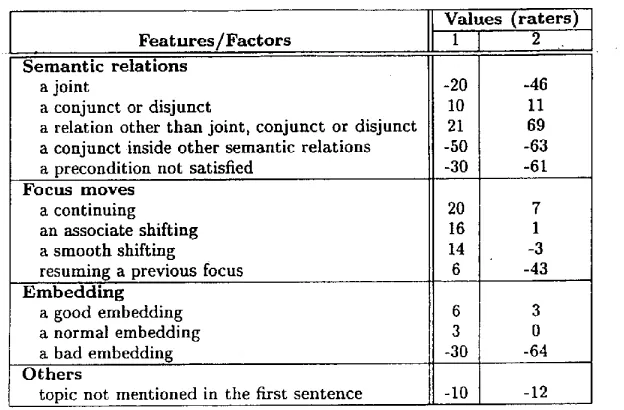
F e a t u r e s / F a c t o r s S e m a n t i c r e l a t i o n s
a j o i n t
a conjunct or d i s j u n c t
a r e l a t i o n o t h e r t h a n j o i n t , c o n j u n c t o r d i s j u n c t
a c o n j u n c t ,inside o t h e r s e m a n t i c r e l a t i o n s a p r e c o n d i t i o n n o t s a t i s f i e d
F o c u s m o v e s a c o n t i n u i n g a n a s s o c i a t e s h i f t i n g
a smooth shifting
r e s u m i n g a previous focus
E m b e d d i n g
a good embedding a normal e m b e d d i n g
a bad embedding
O t h e r s
topic not mentioned in the first sentence
V a l u e s ( r a t e r s ) 1 ] 2 ..
-20 -46
10 11
21 69
-50 -63 -30 -61
20 7
16 1
14 -3
6 -43
6 3 3 0 -30 -64
-10 -12
T a b l e 1: T w o different r a t e r s s a t i s f y i n g the same c o n s t r a i n t s
/ x
I % / \
i i ~ - - ~ t ! x x i I x
I x
I I ~ x i I
/ I x l
_ m
, -h-- . . . X . . . g . . . . -i~ .. . . T . . . i; . . . ~ ... ,o
F i g u r e 2: Scores for four m u s e u m descriptive t e x t s
into w h i c h the r e m a i n i n g facts in the list are to be e m b e d d e d . T h e e m b e d d i n g m u t a t i o n ran- d o m l y selects a unit Ui from the s e q u e n c e a n d a n e n t i t y in its m a i n fact. It t h e n collects all the u n i t s m e n t i o n i n g this e n t i t y a n d r a n d o m l y chooses o n e Uk. T h e list c o n t a i n i n g t h e s e two units [Ui,Uk] r e p r e s e n t s a r a n d o m e m b e d d i n g a n d will b e t r e a t e d as a single unit in l a t e r op- erations. It takes the. p o s i t i o n of Ui to p r o d u c e a new s e q u e n c e [U~,U2,...,[Ui,Uk],...,U,] a n d all r e p e t i t i o n s outside [Ui,U~:] are removed. T h i s s e q u e n c e is then e v a l u a t e d and o r d e r e d in t h e p o p u l a t ion.
T h e p r o b a b i l i t i e s of apl)lying the t h r e e o p e r a - tots are: 65% for crossow'r. 30% for e m b e d d i n g
m u t a t i o n and 5% for n o r m a l u m t a t i o n . T h i s is b e c a u s e the first two are more likely to p r o d u c e s e q u e n c e s b e a r i n g d e s i r e d p r o p e r t i e s by e i t h e r c o m b i n i n g the g o o d bits of two sequences or p e r f o r m i n g a r e a s o n a b l e a m o u n t of e m b e d d i n g , w h e r e a s n o r m a l m u t a t i o n is e n t i r e l y r a n d o m 2.
5 J u s t i f y i n g t h e G A e v a l u a t i o n f u n c t i o n
T h e linguistic t h e o r i e s discussed in S e c t i o n 2 o n l y give evidence in q u a l i t a t i v e terms. F o r a G A - b a s e d p l a n n e r to work, we have to c o m e up w i t h actual n u m b e r s t h a t can be used to evalu-
[image:6.596.180.492.55.260.2] [image:6.596.182.482.305.455.2]The s m a l l p o r t a b l e throne f r o m t h e t i m e o f t h e Q i a n l o n g E m p e r o r 1 7 3 6 - 9 5 is mad e . . . . of ~acquer~d`wo~d~.wit~T.de~rati~n-in~-g~d`~and.red~It-was-use~-in-the-private.apartrn~r~`~ ... " ... of the Imperial Palaces. The cover f r o m t h e r e i g n o f J i a q u i n g , 1 7 9 6 - 1 8 2 0 is woven in yellow
silk, w h i c h is t h e i m p e r i a l c o l o u r o f t h e Q i n g D y n a s t y , 1 6 4 4 - 1 9 1 1 . It would have covered the throne w h e n not in use.
The design on the seat is a i m p e r i a l f i v e c l a w e d dragon i n a circular m e d a l l i o n . On the inside of the arm pieces are small shelves. Precious possessions can be placed in small shelves and can be s t u d i e d as an aid to contemplation.
Figure 3: A g e n e r a t e d text scored the h i g h e s t , w i t h t h e e m b e d d e d p a r t s highlighted
Score2 Score3 Score4 Score5 Score6 Score1 . 9 5 6 7 .9337 .9631 .9419 .9515
Score2 .9435 .8819 .9280 .9185
Score3 .8650 .8462 .9574
Score4 .9503 .8940
Score5 .8486
Table 2: Correlations between six raters
ate an RS tree. Mellish et al. (1998a) present some scores for evaluating the basic features of a tree, but they make it clear t h a t the scores are there for descriptive purpose, not for making any serious claim a b o u t the best way of evalu- ating RS trees.
T h e methodology we adopted was t h a t we took the existing evaluation function and ex- tended it to take into account features for local coherence, embedding a n d semantic paratmxis. This resulted in rater 1 in Table 1, which sat- isfied all the heuristics mentioned in Section 2. We manually broke d o w n four human written museum descriptions into individual facts and relations and reconstructed sequences of facts with the same orderings and aggregations as in the original texts. We t h e n used our evaluation flmction to score the RS trees built from these sequences. In the m e a n time. we ran the GA algorithm for 5000 iterations on the facts and relations for 10 times. T h e results are shown in Figure 2, where the four line styles correspond to the four texts. The j a g g e d lines represent-the scores of the machine generated texts and the straight lines represent t h e scores for the corre- sponding human texts.
All human texts were scored among the high- est a n d machine generated texts can get scores very close to human ones sometimes. Since the human texts were w r i t t e n and revised bv mu- seum experts, they can be treated as "'nearly
b e s t texts". The figure shows t h a t the evalu-
a t i o n function based on our heuristics can find g o o d a n d correct combinations. The reason for a relatively bad text being generated sometimes m i g h t be t h a t really bad sequences were pro- d u c e d at the beginning. This could be improved by using certain heuristics to get better initial sequences. Also when the number of facts be- comes larger, more iterations are needed to get readable texts. Figure 3 gives a text generated using rater 1.
To justify our claim that it is the preferences a m o n g generation factors t h a t decide the coher- ence of a text, we fed the preferences into a con- s t r a i n t based program. If a feature can take a range of values, the program randomly selects a n u m b e r in that range. A number of raters compatible with the constraints were generated a n d one of them is given in Table 1 as rater 2. We then generated all possible combinations, in- cluding embedding, of seven facts from a h u m a n t e x t and used six randomly produced raters to score each of them.
To see to what extent the six raters agree with each other, we calculated t h e Pearson c o r r e l a - tion coefficient between them, which is shown in Table 2. We can claim from the table t h a t for this data, the scores from the six raters cor- relate, and we have a fairly good chance to be- lieve t h a t the six raters, randomly produced in a sense, agree with each other on evaluating the text and they measure basically the same thing.
Daniel Marcu. 1997. From local to global coherence: . A_ bottom=up.approach' to. text:planning.. 'In Pro-
ceedings of the Fourteenth National Conference on
Artificial Intelligence, pages 629-635, Providence,
Rhode Island.
Chris Mellish, Alistair Knott, Jon Oberlander, and Mick O'Donnell. 1998a. Experiments using stochastic search for text planning. In Proceed- ings of the 9th International Workshop on Natural
Language Generation, Ontario, Canada.
6 C o n c l u s i o n s a n d f u t u r e w o r k
. . . Chris:MeUish,: Mick O'_Donnell,:.Jon Oberlander, and Alistair Knott. 1998b. An architecture for op-
This paper describes an experiment with the preferences among features concerning aggrega- tion and text planning, in particular, we present an mechanism for how relevant features can be scored to contribute together to the planning of a coherent text. T h e statistical results partially justify our claim t h a t it is the preferences among generation features t h a t decide the coherence of a text.
Our experiment could be extended in many ways, for example, validating the evaluation function through empirical analysis of human assessments of the generated texts, and us- ing more texts to test the correlation between raters. The architecture based on the Genetic Algorithm can also be used for testing interac- tions between or within other text generation modules.
R e f e r e n c e s
Susan Brennan, Marilyn Walker Friedman, and Carl Pollard. 1987. A centering apporach to pronouns.
In Proceedings of the 25th Annual Meeting of the
Association for Computational Linguistics, pages
155-162, Stanford, CA.
Hua Cheng. 1998. Embedding new information into referring expressions. In Proceedings of COLING-
A CL '98, pages 1478-1480, Montreal, Canada.
Barbara Grosz and Candace Sidner. 1986. Atten- tions, intentions and the structure of discourse.
Computational Linguistics, 12:175-204.
Barbara Grosz, Aravind Joshi, and Scott Weinstein. 1995. Centering: A framework for modelling the local coherence of discourse. Computational Lin-
guistics, 21(2):203-226.
Barbara Grosz. 1977. T-he representation and use of focus in dialogue understanding. Technical report 151, SRI International.
William Mann and Sandra Thompson. 198.7. Rhetorical structure theory: A theory of text or- ganization. Technical Report ISI/RR-87-190, In- formation Sciences Institute, University of South- ern California.
portunistic text generation. In Proceedings of the 9th International Workshop on Natural Language
Generation, Ontario, Canada.
Marie Meteer. 1992. Expressibility and The Prob-
lem of Efficient Text Planning. Communication
in Artificial Intelligence. Pinter Publishers Lim- ited, London.
Megan Moser and Johanna Moore. 1996. Toward a synthesis of two accounts of discourse structure.
Computational Linguistics, 22(3):409-419.
Jon Oberlander, Mick O'Donnell, Ali Knott, and Chris Mellish. 1998. Conversation in the mu- seum: Experiments in dynamic hypermedia with the intelligent labelling explorer. New Review of
Hypermedia and Multimedia, 4:11-32.
Jon Oberlander, Alistair Knott, Mick O'Donnell, and Chris Mellish. 1999. Beyond elaboration: Generating descriptive texts containing it-clefts. In T Sanders, J Schilperoord, and W Spooren, editors, Text Representation: Linguistic and Psy-
cholinguistic Aspects. Benjamins, Amsterdam.
Franck Panaget. 1997. Micro-planning: A uni- fied representation of lexical and grammatical re- sources. In Proceeding of the 6th European Work-
shop on Natural Language Generation, pages 97-
106.
Massimo Poesio, Renata Vieira, and Simone Teufel. 1997. Resolving bridging references in unre- stricted text. Research paper hcrc-rp87, Centre for Cognitive Science, University of Edinburgh. Michael Reape and Chris Mellish. 1999. Just what
is aggregation anyway? In Proceedings of the 7th European Workshop on Natural Language Gener-
ation, pages 20-29, Toulouse, France.
Roger Schank. 1977. Rules and topics in conversa- tion. Cognitive Science, 1(1):421-441.
Donia Scott and Clarisse Sieckenius de Souza. 1990. Getting the-message across in rst-based text gen- eration. In R. Dale, C. Mellish, and M. Zock, edi- tors, Current Research in Natural Language Gen-
eration, pages 47-73. Academic Press.