Cross language Text Categorization by acquiring
Multilingual Domain Models from Comparable Corpora
Alfio Gliozzo and Carlo Strapparava
ITC-Irst
via Sommarive, I-38050, Trento, ITALY {gliozzo,strappa}@itc.it
Abstract
In a multilingual scenario, the classical monolingual text categorization problem can be reformulated as a cross language TC task, in which we have to cope with two or more languages (e.g. Englishand
Italian). In this setting, the system is trained using labeled examples in a source language (e.g. English), and it classifies documents in a different target language (e.g.Italian).
In this paper we propose a novel ap-proach to solve the cross language text categorization problem based on acquir-ing Multilacquir-ingual Domain Models from comparable corpora in a totally unsuper-vised way and without using any external knowledge source (e.g. bilingual dictio-naries). These Multilingual Domain Mod-els are exploited to define a generalized similarity function (i.e. a kernel function) among documents in different languages, which is used inside a Support Vector Ma-chines classification framework. The re-sults show that our approach is a feasi-ble and cheap solution that largely outper-forms a baseline.
1 Introduction
Text categorization (TC) is the task of assigning cat-egory labels to documents. Categories are usually defined according to a variety of topics (e.g. SPORT,
POLITICS, etc.) and, even if a large amount of
hand tagged texts is required, the state-of-the-art su-pervised learning techniques represent a viable and well-performing solution for monolingual catego-rization problems.
On the other hand in the worldwide scenario of the web age, multilinguality is a crucial issue to deal with and to investigate, leading us to reformulate most of the classical NLP problems. In particular, monolingual Text Categorization can be reformu-lated as across language TCtask, in which we have to cope with two or more languages (e.g. English
and Italian). In this setting, the system is trained using labeled examples in a source language (e.g.
English), and it classifies documents in a different target language (e.g.Italian).
In this paper we propose a novel approach to solve the cross language text categorization problem based on acquiring Multilingual Domain Models (MDM) from comparable corpora in an unsupervised way. A MDM is a set of clusters formed by terms in dif-ferent languages. While in the monolingual settings semantic domains are clusters of related terms that co-occur in texts regarding similar topics (Gliozzo et al., 2004), in the multilingual settings such clusters are composed by terms in different languages ex-pressing concepts in the same semantic field. Thus, the basic relation modeled by a MDM is the domain similarity among terms in different languages. Our claim is that such a relation is sufficient to capture relevant aspects of topic similarity that can be prof-itably used for TC purposes.
The paper is organized as follows. After a brief discussion about comparable corpora, we introduce
a multilingual Vector Space Model, in which docu-ments in different languages can be represented and then compared. In Section 4 we define the MDMs and we present a totally unsupervised technique to acquire them from comparable corpora. This methodology does not require any external knowl-edge source (e.g. bilingual dictionaries) and it is based on Latent Semantic Analysis (LSA) (Deer-wester et al., 1990). MDMs are then exploited to define a Multilingual Domain Kernel, a generalized similarity function among documents in different languages that exploits a MDM (see Section 5). The Multilingual Domain Kernel is used inside a Sup-port Vector Machines (SVM) classification frame-work for TC (Joachims, 2002). In Section 6 we will evaluate our technique in a Cross Language catego-rization task. The results show that our approach is a feasible and cheap solution, largely outperforming a baseline. Conclusions and future works are finally reported in Section 7.
2 Comparable Corpora
Comparable corpora are collections of texts in dif-ferent languages regarding similar topics (e.g. a col-lection of news published by agencies in the same period). More restrictive requirements are expected for parallel corpora (i.e. corpora composed by texts which are mutual translations), while the class of the multilingual corpora (i.e. collection of texts ex-pressed in different languages without any addi-tional requirement) is the more general. Obviously parallel corpora are also comparable, while compa-rable corpora are also multilingual.
In a more precise way, letL = {L1, L2, . . . , Ll}
be a set of languages, letTi ={ti1, ti2, . . . , tin}be a
collection of texts expressed in the languageLi ∈L,
and letψ(tjh, tiz)be a function that returns 1 iftiz is
the translation oftjhand 0 otherwise. Amultilingual corpus is the collection of texts defined by T∗ = S
iTi. If the functionψexists for every texttiz ∈T∗
and for every language Lj, and is known, then the
corpus isparallelandalignedat document level. For the purpose of this paper it is enough to as-sume that two corpora are comparable, i.e. they are composed by documents about the same topics and produced in the same period (e.g. possibly from dif-ferent news agencies), and it is not known if a
func-tionψ exists, even if in principle it could exist and
return 1 for a strict subset of document pairs. There exist many interesting works about us-ing parallel corpora for multilus-ingual applications (Melamed, 2001), such as Machine Translation, Cross language Information Retrieval (Littman et al., 1998), lexical acquisition, and so on.
However it is not always easy to find or build par-allel corpora. This is the main reason because the
weakernotion of comparable corpora is a matter re-cent interest in the field of Computational Linguis-tics (Gaussier et al., 2004).
The texts inside comparable corpora, being about the same topics (i.e. about the same semantic do-mains), should refer to the same concepts by using various expressions in different languages. On the other hand, most of the proper nouns, relevant enti-ties and words that are not yet lexicalized in the lan-guage, are expressed by using their original terms. As a consequence thesame entitieswill be denoted with the same words in different languages, allow-ing to automatically detect couples of translation pairs just by looking at the word shape (Koehn and Knight, 2002). Our hypothesis is that comparable corpora contain a large amount of such words, just because texts, referring to the same topics in differ-ent languages, will often adopt the same terms to denote the same entities1.
However, the simple presence of these shared words is not enough to get significant results in TC tasks. As we will see, we need to exploit these com-mon words to induce a second-order similarity for the other words in the lexicons.
3 The Multilingual Vector Space Model
Let T = {t1, t2, . . . , tn} be a corpus, and V = {w1, w2, . . . , wk} be its vocabulary. In the
mono-lingual settings, the Vector Space Model (VSM) is a
k-dimensional space Rk, in which the text tj ∈ T is represented by means of the vector t~j such that
thezthcomponent of~tj is the frequency ofwzintj.
The similarity among two texts in the VSM is then estimated by computing the cosine of their vectors in the VSM.
1According to our assumption, a possible additional
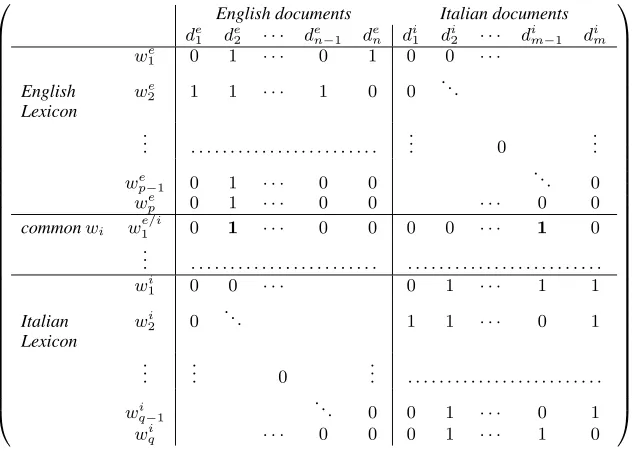
Unfortunately, such a model cannot be adopted in the multilingual settings, because the VSMs of dif-ferent languages are mainly disjoint, and the similar-ity between two texts in different languages would always turn out zero. This situation is represented in Figure 1, in which both the left-bottom and the rigth-upper regions of the matrix are totally filled by zeros.
A first attempt to solve this problem is to ex-ploit the information provided by external knowl-edge sources, such as bilingual dictionaries, to col-lapse all the rows representing translation pairs. In this setting, the similarity among texts in different languages could be estimated by exploiting the clas-sical VSM just described. However, the main dis-advantage of this approach to estimate inter-lingual text similarity is that it strongly relies on the avail-ability of a multilingual lexical resource containing a list of translation pairs. For languages with scarce resources a bilingual dictionary could be not eas-ily available. Secondly, an important requirement of such a resource is its coverage (i.e. the amount of possible translation pairs that are actually con-tained in it). Finally, another problem is that am-biguos terms could be translated in different ways, leading to collapse together rows describing terms with very different meanings.
On the other hand, the assumption of corpora comparability seen in Section 2, implies the pres-ence of a number of common words, represented by the central rows of the matrix in Figure 1.
As we will show in Section 6, this model is rather poor because of its sparseness. In the next section, we will show how to use such words as seeds to in-duce a Multilingual Domain VSM, in which second order relations among terms and documents in dif-ferent languages are considered to improve the sim-ilarity estimation.
4 Multilingual Domain Models
A MDM is a multilingual extension of the concept of Domain Model. In the literature, Domain Mod-els have been introduced to represent ambiguity and variability (Gliozzo et al., 2004) and successfully exploited in many NLP applications, such us Word Sense Disambiguation (Strapparava et al., 2004), Text Categorization and Term Categorization.
A Domain Model is composed by soft clusters of terms. Each cluster represents a semantic domain, i.e. a set of terms that often co-occur in texts hav-ing similar topics. Such clusters identifies groups of words belonging to the same semantic field, and thus highly paradigmatically related. MDMs are Domain Models containing terms in more than one language. A MDM is represented by a matrix D, contain-ing the degree of association among terms in all the languages and domains, as illustrated in Table 1.
MEDICINE COMPUTERSCIENCE
HIVe/i 1 0
AIDSe/i 1 0
viruse/i 0.5 0.5
hospitale 1 0
laptope 0 1
M icrosof te/i 0 1
clinicai 1 0
Table 1: Example of Domain Matrix. we denotes
English terms, wi Italian terms and we/i the
com-mon terms to both languages.
MDMs can be used to describe lexical ambiguity, variability and inter-lingual domain relations. Lexi-cal ambiguity is represented by associating one term to more than one domain, while variability is rep-resented by associating different terms to the same domain. For example the term virus is associated to both the domain COMPUTER SCIENCE and the
domain MEDICINEwhile the domain MEDICINE is
associated to both the terms AIDS and HIV. Inter-lingual domain relations are captured by placing dif-ferent terms of difdif-ferent languages in the same se-mantic field (as for example HIVe/i, AIDSe/i, hospitale, and clinicai). Most of the named
enti-ties, such asMicrosoftandHIV are expressed using the same string in both languages.
When similarity among texts in different lan-guages has to be estimated, the information con-tained in the MDM is crucial. For example the two sentences “I went to the hospital to make an HIV check” and “Ieri ho fatto il test dell’AIDS in clin-ica” (lit. yesterday I did the AIDS test in a clinic) are very highly related, even if they share no to-kens. Having an “a priori” knowledge about the inter-lingual domain similarity among AIDS, HIV,
English documents Italian documents
de1 de2 · · · den−1 den di1 di2 · · · dim−1 dim
Figure 1: Multilingual term-by-document matrix
recognize inter-lingual topic similarity. Obviously this relation is less restrictive than a stronger associ-ation among translassoci-ation pair. In this paper we will show that such a representation is sufficient for TC puposes, and easier to acquire.
In the rest of this section we will provide a formal definition of the concept of MDM, and we define some similarity metrics that exploit it.
Formally, letVi = {w1i, w2i, . . . , wiki}be the
vo-cabulary of the corpus Ti composed by document
expressed in the language Li, let V∗ = S iVi be
the set of all the terms in all the languages, and let k∗ = |V∗| be the cardinality of this set. Let D = {D1, D2, ..., Dd}be a set of domains. A DM
is fully defined by a k∗ ×d domain matrixD rep-resenting in each cell di,z thedomain relevanceof the ith term of V∗ with respect to the domain Dz.
The domain matrix D is used to define a function
D :Rk∗ → Rd, that maps the document vectors t~j expressed into the multilingual classical VSM, into the vectorst~0
j in themultilingual domain VSM. The
functionDis defined by2
2In (Wong et al., 1985) the formula 1 is used to define a
Generalized Vector Space Model, of which the Domain VSM is a particular instance.
D(t~j) =t~j(IIDFD) =t~0
j (1)
whereIIDFis a diagonal matrix such thatiIDF
i,i = IDF(wli), t~j is represented as a row vector, and IDF(wl
i)is theInverse Document Frequencyofwli
evaluated in the corpusTl.
The matrixDcan be determined for example us-ing hand-made lexical resources, such as WORD
-NET DOMAINS (Magnini and Cavagli`a, 2000). In
the present work we followed the way to acquire D automatically from corpora, exploiting the tech-nique described below.
4.1 Automatic Acquisition of Multilingual Domain Models
eigenvalues ofT, and all the remaining elements are set to 0. The parameter k0 is the dimensionality of
the Domain VSM and can be fixed in advance (i.e.
k0 =d).
In the literature (Littman et al., 1998) LSA has been used in multilingual settings to define a mul-tilingual space in which texts in different languages can be represented and compared. In that work LSA strongly relied on the availability of aligned parallel corpora: documents in all the languages are repre-sented in a term-by-document matrix (see Figure 1) and then the columns corresponding to sets of trans-lated documents are collapsed (i.e. they are substi-tuted by their sum) before starting the LSA process. The effect of this step is to merge the subspaces (i.e. the right and the left sectors of the matrix in Figure 1) in which the documents have been originally rep-resented.
In this paper we propose a variation of this strat-egy, performing a multilingual LSA in the case in which an aligned parallel corpus is not available.
It exploits the presence of common words among different languages in the term-by-document matrix. The SVD process has the effect of creating a LSA space in which documents in both languages are rep-resented. Of course, the higher the number of com-mon words, the more information will be provided to the SVD algorithm to find common LSA dimen-sion for the two languages. The resulting LSA di-mensions can be perceived as multilingual clusters of terms and document. LSA can then be used to define a Multilingual Domain MatrixDLSA.
DLSA=INVpΣk0 (2)
where IN is a diagonal matrix such that iNi
,i =
1 q
hw~0
i, ~wi0i
,w~0
iis theithrow of the matrixV
√Σ
k0.
Thus DLSA3 can be exploited to estimate
simi-larity among texts expressed in different languages (see Section 5).
3When
DLSAis substituted in Equation 1 the Domain VSM
is equivalent to a Latent Semantic Space (Deerwester et al., 1990). The only difference in our formulation is that the vectors representing the terms in the Domain VSM are normalized by the matrixIN, and then rescaled, according to their IDF value,
by matrixIIDF. Note the analogy with thetf idfterm weighting
schema, widely adopted in Information Retrieval.
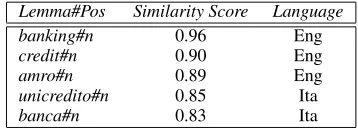
4.2 Similarity in the multilingual domain space As an example of the second-order similarity pro-vided by this approach, we can see in Table 2 the five most similar terms to the lemmabank. The similar-ity among terms is calculated by cosine among the rows in the matrix DLSA, acquired from the data
set used in our experiments (see Section 6.2). It is worth noting that the Italian lemmabanca(i.e. bank in English) has a high similarity score to the English lemmabank. While this is not enough to have a pre-cise term translation, it is sufficient to capture rele-vant aspects of topic similarity in a cross-language text categorization task.
Lemma#Pos Similarity Score Language banking#n 0.96 Eng credit#n 0.90 Eng amro#n 0.89 Eng unicredito#n 0.85 Ita banca#n 0.83 Ita
Table 2: Terms with high similarity to the English lemmabank#n, in the Multilingual Domain Model
5 The Multilingual Domain Kernel
Kernel Methods are the state-of-the-art supervised framework for learning, and they have been success-fully adopted to approach the TC task (Joachims, 2002).
The basic idea behind kernel methods is to em-bed the data into a suitable feature space F via a
mapping function φ : X → F, and then to use a
linear algorithm for discovering nonlinear patterns. Kernel methods allow us to build a modular system, as the kernel function acts as an interface between the data and the learning algorithm. Thus the ker-nel function becomes the only domain specific mod-ule of the system, while the learning algorithm is a general purpose component. Potentially any kernel function can work with any kernel-based algorithm, as for example Support Vector Machines (SVMs).
During the learning phase SVMs assign a weight
λi ≥ 0 to any example xi ∈ X. All the labeled
instances xi such that λi > 0 are called Support
of the closest support vectors, according to equation 3.
f(x) = n X
i=1
λiK(xi, x) +λ0 (3)
The kernel function K(xi, x) returns the
simi-larity between two instances in the input space X,
and can be designed just by taking care that some formal requirements are satisfied, as described in (Sch¨olkopf and Smola, 2001).
In this section we define the Multilingual Domain Kernel, and we apply it to a cross language TC task. This kernel can be exploited to estimate the topic similarity among two texts expressed in different languages by taking into account the external knowl-edge provided by a MDM. It defines an explicit map-ping D : Rk → Rk0 from the Multilingual VSM into the Multilingual Domain VSM. The Multilin-gual Domain Kernel is specified by
KD(ti, tj) = hD
(ti),D(tj)i q
hD(tj),D(tj)ihD(ti),D(ti)i
(4)
whereDis the Domain Mapping defined in
equa-tion 1. Thus the Multilingual Domain Kernel re-quires Multilingual Domain MatrixD, in particular DLSA that can be acquired from comparable cor-pora, as explained in Section 4.1.
To evaluate the Multilingual Domain Kernel we compared it to a baseline kernel function, namely the
bag of wordskernel, that simply estimates the topic similarity in the Multilingual VSM, as described in Section 3. The BoW kernel is a particular case of the Domain Kernel, in which D = I, and I is the identity matrix.
6 Evaluation
In this section we present the data set (two compara-ble English and Italian corpora) used in the evalua-tion, and we show the results of the Cross Language TC tasks. In particular we tried both to train the system on the English data set and classify Italian documents and to train using Italian and classify the English test set. We compare the learning curves of the Multilingual Domain Kernel with the standard BoW kernel, which is considered as a baseline for this task.
6.1 Implementation details
As a supervised learning device, we used the SVM implementation described in (Joachims, 1999). The Multilingual Domain Kernel is implemented by defining an explicit feature mapping as explained above, and by normalizing each vector. All the ex-periments have been performed with the standard SVM parameter settings.
We acquired a Multilingual Domain Model by performing the Singular Value Decomposition pro-cess on the term-by-document matrices representing the merged training partitions (i.e. English and Ital-ian), and we considered only the first 400 dimen-sions4.
6.2 Data set description
We used a news corpus kindly put at our dis-posal by ADNKRONOS, an important Italian news
provider. The corpus consists of 32,354 Ital-ian and 27,821 English news partitioned by ADNKRONOS in a number of four fixed
cate-gories: Quality of Life, Made in Italy,
Tourism, Culture and School. The corpus
is comparable, in the sense stated in Section 2, i.e. they covered the same topics and the same period of time. Some news are translated in the other language (butnoalignment indication is given), some others are present only in the English set, and some others only in the Italian. The average length of the news is about 300 words. We randomly split both the En-glish and Italian part into 75% training and 25% test (see Table 3). In both the data sets we postagged the texts and we considered only the noun, verb, adjec-tive, and adverb parts of speech, representing them by vectors containing the frequencies of each lemma with its part of speech.
6.3 Monolingual Results
Before going to a cross-language TC task, we con-ducted two tests of classical monolingual TC by training and testing the system on Italian and En-glish documents separately. For these tests we used the SVM with the BoW kernel. Figures 2 and 3 re-port the results.
4To perform the SVD operation we used LIBSVDC
English Italian Categories Training Test Total Training Test Total
Quality of Life 5759 1989 7748 5781 1901 7682
Made in Italy 5711 1864 7575 6111 2068 8179
Tourism 5731 1857 7588 6090 2015 8105
Culture and School 3665 1245 4910 6284 2104 8388 Total 20866 6955 27821 24266 8088 32354
Table 3: Number of documents in the data set partitions
0.5 0.55 0.6 0.65 0.7 0.75 0.8 0.85 0.9 0.95 1
0 0.1 0.2 0.3 0.4 0.5 0.6 0.7 0.8 0.9 1
F1 measure
Fraction of training data BoW Kernel
Figure 2: Learning curves for the English part of the corpus
0.5 0.55 0.6 0.65 0.7 0.75 0.8 0.85 0.9 0.95 1
0 0.1 0.2 0.3 0.4 0.5 0.6 0.7 0.8 0.9 1
F1 measure
Fraction of training data BoW Kernel
Figure 3: Learning curves for the Italian part of the corpus
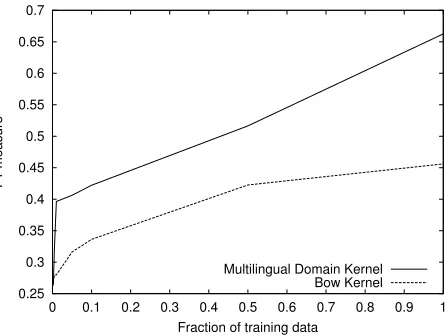
6.4 A Cross Language Text Categorization task As far as the cross language TC task is concerned, we tried the two possible options: we trained on the English part and we classified the Italian part, and we trained on the Italian and classified on the
En-0.15 0.2 0.25 0.3 0.35 0.4 0.45 0.5 0.55 0.6
0 0.1 0.2 0.3 0.4 0.5 0.6 0.7 0.8 0.9 1
F1 measure
Fraction of training data Multilingual Domain Kernel
Bow Kernel
Figure 4: Cross-language (training on Italian, test on English) learning curves
0.25 0.3 0.35 0.4 0.45 0.5 0.55 0.6 0.65 0.7
0 0.1 0.2 0.3 0.4 0.5 0.6 0.7 0.8 0.9 1
F1 measure
Fraction of training data Multilingual Domain Kernel
Bow Kernel
Figure 5: Cross-language (training on English, test on Italian) learning curves
glish part. The Multilingual Domain Model was ac-quired running the SVD only on the joint (English and Italian) training parts.
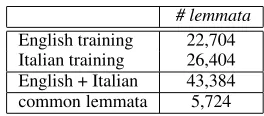
vocabu-# lemmata English training 22,704 Italian training 26,404 English + Italian 43,384 common lemmata 5,724
Table 4: Number of lemmata in the training parts of the corpus
lary of the merged training, and how many com-mon lemmata are present (about 14% of the total). Among the common lemmata, 97% are nouns and most of them are proper nouns. Thus the initial term-by-document matrix is a 43,384 × 45,132 matrix,
while theDLSA matrix is 43,384 ×400. For this
task we consider as a baseline the BoW kernel. The results are reported in Figures 4 and 5. An-alyzing the learning curves, it is worth noting that when the quantity of training increases, the per-formance becomes better and better for the Multi-lingual Domain Kernel, suggesting that with more available training it could be possible to go closer to typical monolingual TC results.
7 Conclusion
In this paper we proposed a solution to cross lan-guage Text Categorization based on acquiring Mul-tilingual Domain Models from comparable corpora in a totally unsupervised way and without using any external knowledge source (e.g. bilingual dictionar-ies). These Multilingual Domain Models are ex-ploited to define a generalized similarity function (i.e. a kernel function) among documents in differ-ent languages, which is used inside a Support Vec-tor Machines classification framework. The basis of the similarity function exploits the presence of com-mon words to induce a second-order similarity for the other words in the lexicons. The results have shown that this technique is sufficient to capture rel-evant aspects of topic similarity in cross-language TC tasks, obtaining substantial improvements over a simple baseline. As future work we will investi-gate the performance of this approach to more than two languages TC task, and a possible generaliza-tion of the assumpgeneraliza-tion about equality of the common words.
Acknowledgments
This work has been partially supported by the ONTOTEXT project, funded by the Autonomous Province of Trento under the FUP-2004 program.
References
S. Deerwester, S. T. Dumais, G. W. Furnas, T.K. Lan-dauer, and R. Harshman. 1990. Indexing by latent se-mantic analysis. Journal of the American Society for Information Science, 41(6):391–407.
E. Gaussier, J. M. Renders, I. Matveeva, C. Goutte, and H. Dejean. 2004. A geometric view on bilingual lexi-con extraction from comparable corpora. In Proceed-ings of ACL-04, Barcelona, Spain, July.
A. Gliozzo, C. Strapparava, and I. Dagan. 2004. Unsu-pervised and suUnsu-pervised exploitation of semantic do-mains in lexical disambiguation. Computer Speech and Language, 18:275–299.
T. Joachims. 1999. Making large-scale SVM learning practical. In B. Sch¨olkopf, C. Burges, and A. Smola, editors,Advances in kernel methods: support vector learning, chapter 11, pages 169 – 184. The MIT Press. T. Joachims. 2002. Learning to Classify Text using Sup-port Vector Machines. Kluwer Academic Publishers. P. Koehn and K. Knight. 2002. Learning a translation
lexicon from monolingual corpora. InProceedings of ACL Workshop on Unsupervised Lexical Acquisition, Philadelphia, July.
M. Littman, S. Dumais, and T. Landauer. 1998. Auto-matic cross-language information retrieval using latent semantic indexing. In G. Grefenstette, editor,Cross Language Information Retrieval, pages 51–62. Kluwer Academic Publishers.
B. Magnini and G. Cavagli`a. 2000. Integrating subject field codes into WordNet. InProceedings of LREC-2000, Athens, Greece, June.
D. Melamed. 2001. Empirical Methods for Exploiting Parallel Texts. The MIT Press.
B. Sch¨olkopf and A. J. Smola. 2001.Learning with Ker-nels. Support Vector Machines, Regularization, Opti-mization, and Beyond. The MIT Press.
C. Strapparava, A. Gliozzo, and C. Giuliano. 2004. Pat-tern abstraction and term similarity for word sense disambiguation. In Proceedings of SENSEVAL-3, Barcelona, Spain, July.
S.K.M. Wong, W. Ziarko, and P.C.N. Wong. 1985. Gen-eralized vector space model in information retrieval. InProceedings of the 8th