Entity Linking Leveraging
Automatically Generated Annotation
Wei Zhang
†Jian Su
‡Chew Lim Tan
†Wen Ting Wang
‡†
School of Computing
National University of Singapore
{z-wei, tancl}
@comp.nus.edu.sg
‡
Institute for Infocomm Research
{sujian, wwang}
@i2r.a-star.edu.sg
Abstract
Entity linking refers entity mentions in a document to their representations in a knowledge base (KB). In this paper, we propose to use additional information sources from Wikipedia to find more name variations for entity linking task. In addition, as manually creating a training corpus for entity linking is labor-intensive and costly, we present a novel method to automatically generate a large scale corpus annotation for ambiguous mentions leveraging on their unambi-guous synonyms in the document collec-tion. Then, a binary classifier is trained to filter out KB entities that are not simi-lar to current mentions. This classifier not only can effectively reduce the am-biguities to the existing entities in KB, but also be very useful to highlight the new entities to KB for the further popu-lation. Furthermore, we also leverage on the Wikipedia documents to provide ad-ditional information which is not availa-ble in our generated corpus through a domain adaption approach which pro-vides further performance improve-ments. The experiment results show that our proposed method outperforms the state-of-the-art approaches.
1
Introduction
The named entity (NE) ambiguation has raised serious problems in many areas, including web
people search, knowledge base population (KBP), and information extraction, because an entity (such as Abbott Laboratories, a diversified pharmaceuticals health care company) can be referred to by multiple mentions (e.g. “ABT” and “Abbott”), and a mention (e.g. “Abbott”) can be shared by different entities (e.g. Abbott Texas: a city in United States; Bud Abbott, an American actor; and Abbott Laboratories, a diversified pharmaceutical health care company).
Both Web People Search (WePS) task (Artiles et al. 2007) and Global Entity Detection & Rec-ognition task (GEDR) in Automatic Content Ex-traction 2008 (ACE08) disambiguate entity tions by clustering documents with these men-tions. Each cluster then represents a unique enti-ty. Recently entity linking has been proposed in this field. However, it is quite different from the previous tasks.
Given a knowledge base, a document collec-tion, entity linking task as defined by KBP-091 (McNamee and Dang, 2009) is to determine for each name string and the document it appears, which knowledge base entity is being referred to, or if the entity is a new entity which is not present in the reference KB.
Compared with GEDR and WePS, entity link-ing has a given entity list (i.e. the reference KB) to which we disambiguate the entity mentions. Moreover, in document collection, there are new entities which are not present in KB and can be used for further population. In fact, new entities with or without the names in KB cover more than half of testing instances.
1
Entity linking has been explored by several re-searchers. Without any training data available, most of the previous work ranks the similarity between ambiguous mention and candidate enti-ties through Vector Space Model (VSM). Since they always choose the entity with the highest rank as the answer, the ranking approaches hard-ly detect a situation where there may be a new entity that is not present in KB. It is also difficult to combine bag of words (BOW) with other fea-tures. For example, to capture the “category” information, the method of Cucerzan (2007) in-volves a complicated optimization issue and the approach has to be simplified for feasible com-putation, which compromises the accuracy. Be-sides unsupervised methods, some supervised approaches (Agirre et al. 2009, Li et al. 2009 and McNamee et al. 2009) also have been proposed recently for entity linking. However, the super-vised approaches for this problem require large amount of training instances. But manually creating a corpus is labor-intensive and costly.
In this paper, we explore how to solve the enti-ty linking problem. We present a novel method that can automatically generate a large scale corpus for ambiguous mentions leveraging on their unambiguous synonyms in the document collection. A binary classifier based on Support Vector Machine (SVM) is trained to filter out some candidate entities that are not similar to ambiguous mentions. This classifier can effec-tively reduce the ambiguities to the existing enti-ties in KB, and it is very useful to highlight the new entities to KB for the further population. We also leverage on the Wikipedia documents to provide additional information which is not available in our generated corpus through a do-main adaption approach which provides further performance improvements. Besides, more in-formation sources for finding more variations also contribute to the overall 22.9% accuracy improvements on KBP-09 test data over baseline. The remainder of the paper is organized as fol-lows. Section 2 reviews related work for entity linking. In Section 3 we detail our algorithm in-cluding name variation and entity disambigua-tion. Section 4 describes the experimental setup and results. Finally, Section 5 concludes the pa-per.
2
Related Work
The crucial component of entity linking is the disambiguation process. Raphael et al. (2007) report a disambiguation algorithm for geography. The algorithm ranks the candidates based on the manually assigned popularity scores in KB. The class with higher popularity will be assigned higher score. It causes that the rank of entities would never change, such as Lancaster (Califor-nia) would always have a higher rank than Lan-caster (UK) for any mentions. However, as the popularity scores for the classes change over time, it is difficult to accurately assign dynamic popularity scores. Cucerzan (2007) proposes a disambiguation approach based on vector space model for linking ambiguous mention in a doc-ument with one entity in Wikipedia. The ap-proach ranks the candidates and chooses the ent-ity with maximum agreement between the con-textual information extracted from Wikipedia and the context of a document, as well as the agreement among the category tags associated with the candidate entities. Nguyen and Cao (2008) refer the mentions in a document to KIM (Popov et al. 2004) KB. KIM KB is populated with over 40,000 named entities. They represent a mention and candidates as vectors of their con-textual noun phrase and co-occurring NEs, and then the similarity is determined by the common terms of the vectors and their associated weights. For linking mentions in news articles with a Wi-kipedia-derived KB (KBP-09 data set), Varma et al. (2009) rank the entity candidates using a search engine. Han and Zhao (2009) rank the candidates based on BOW and Wikipedia se-mantic knowledge similarity.
All the related work above rank the candidates based on the similarity between ambiguous men-tion and candidate entities. However, the ranking approach hardly detects the new entity which is not present in KB.
different domain which does not work well in the targeted news article domain.
3
Approach
In this section we describe our two-stage ap-proach for entity linking: name variation and entity disambiguation. The first stage finds vari-ations for every entity in the KB and generates an entity candidate set for a given query. The second stage is entity disambiguation, which links an entity mention with the real world entity it refers to.
3.1 Name Variation
The aim for Name Variation is to build a Knowledge Repository of entities that contains vast amount of world knowledge of entities like name variations, acronyms, confusable names, spelling variations, nick names etc. We use Wikipedia to build our knowledge repository since Wikipedia is the largest encyclopedia in the world and surpasses other knowledge bases in its coverage of concepts and up-to-date content. We obtain useful information from Wikipedia by the tool named Java Wikipedia Library2 (Zesch et al. 2008), which allows to access all information contained in Wikipedia.
Cucerzan (2007) extracts the name variations of an entity by leveraging four knowledge sources in Wikipedia: “entity pages”, “disam-biguation pages” “redirect pages” and “anchor text”.
Entity page in Wikipedia is uniquely identified by its title – a sequence of words, with the first word always capitalized. The title of Entity Page represents an unambiguous name variation for the entity. A redirect page in Wikipedia is an aid to navigation. When a page in Wikipedia is redi-rected, it means that those set of pages are refer-ring to the same entity. They often indicate syn-onym terms, but also can be abbreviations, more scientific or more common terms, frequent misspellings or alternative spellings etc. Disam-biguation pages are created only for ambiguous mentions which denote two or more entities in Wikipedia, typically followed by the word “ dis-ambiguation” and containing a list of references to pages for entities that share the same name. This is more useful in extracting the
abbrevia-2
http://www.ukp.tu-darmstadt.de/software/JWPL
tions of entities, other possible names for an ent-ity etc. Besides, both outlinks and inlinks in Wi-kipedia are associated with anchor texts that represent name variations for the entities.
Using these four sources above, we extracted name variations for every entity in KB to form the Knowledge Repository as Cucerzan’s (2007) method. For example, the variation set for entity
E0272065 in KB is {Abbott Laboratories, Ab-bott Nutrition, AbAb-bott …}. Finally, we can gen-erate the entity candidate set for a given query using the Knowledge Repository. For example, for the query containing “Abbott”, the entity candidate set retrieved is {E0272065, E0064214 …}.
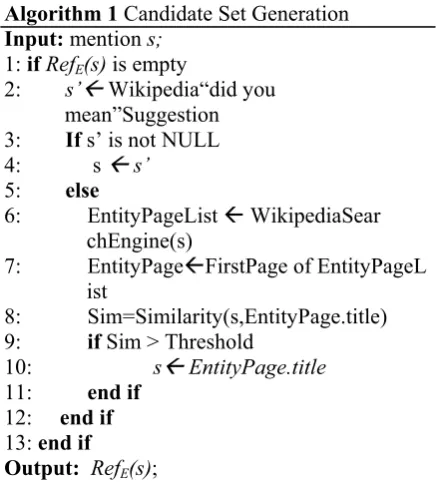
From our observation, for some queries the re-trieved candidate set is empty. If the entity for the query is a new entity, not present in KB, empty candidate set is correct. Otherwise, we fail to identify the mention in the query as a var-iation, commonly because the mention is a miss-pelling or infrequently used name. So we pro-pose to use two more sources “Did You Mean” and “Wikipedia Search Engine” when Cucerzan (2007) algorithm returns empty candidate set. Our experiment results show that both proposed knowledge sources are effective for entity link-ing. This contributes to a performance improve-ment on the final entity linking accuracy.
Did You Mean: The “did you mean” feature of Wikipedia can provide one suggestion for misspellings of entities. This feature can help to correct the misspellings. For example, “Abbot Nutrition” can be corrected to “Abbott Nutri-tion”.
Wikipedia Search Engine: This key word based search engine can return a list of relevant entity pages of Wikipedia. This feature is more useful in extracting infrequently used name.
Algorithm 1 Candidate Set Generation
Input: mention s; 1:ifRefE(s)is empty
2: s’ÅWikipedia“did you mean”Suggestion 3: If s’ is not NULL 4: s Å s’
5: else
6: EntityPageList Å WikipediaSear chEngine(s)
7: EntityPageÅFirstPage of EntityPageL ist
8: Sim=Similarity(s,EntityPage.title) 9: if Sim > Threshold
10: sÅ EntityPage.title
11: end if
12: end if
13: end if Output: RefE(s);
3.2 Entity Disambiguation
The disambiguation component is to link the mention in query with the entity it refers to in candidate set. If the entity to which the mention refers is a new entity which is not present in KB,
nil will be returned. In this Section, we will de-scribe the method for automatic data creation, domain adaptation from Wikipedia data, and our supervised learning approach as well.
3.2.1 Automatic Data Creation
The basic idea is to take a document with an un-ambiguous reference to an entity E1 and replac-ing it with a phrase which may refer to E1, E2 or others.
Observation: Some full names for the entities in the world are unambiguous. This phenomenon also appears in the given document collection of entity linking. The mention “Abbott Laborato-ries” appearing at multiple locations in the doc-ument collection refers to the same entity “a pharmaceuticals health care company” in KB.
From this observation, our method takes into account the mentions in the Knowledge Reposi-tory associated with only one entity and we treat these mentions as unambiguous name. Let us take Abbott Laboratories-{E0272065} in the Knowledge Repository as an example. We first
use an index and search tool to find the docu-ments with unambiguous mentions. Such as, the mention “Abbott Laboratories” occurs in docu-ment LDC2009T13 and LDC2007T07 in the document collection. The chosen text indexing and searching tool is the well-known Apache Lucene information retrieval open-source li-brary3.
Next, to validate the consistency of NE type between entities in KB and in document, we run the retrieved documents through a Named Entity Recognizer, to tag the named entities in the documents. Then we link the document to the entity in KB if the document contains a named entity whose name exactly matches with the unambiguous mention and type (i.e. Person, Organization and Geo-Political Entity) exactly matches with the type of entity in KB. In this example, after Named Entity Recognition, “Ab-bott Laboratories” in document LDC2009T13 is tagged as an Organization which is consistent with the entity type of E0272065 in KB. We link the “Abbott Laboratories” occurring in
LDC2009T13 with entity E0272065.
Finally, we replace the mention in the selected documents with the ambiguous synonyms. For example, we replace the mention “Abbott La-boratories” in document LDC2009T13 with
“Abbott” where Abbott-{E0064214, E0272065…} is an entry in Knowledge Reposi-tory. “Abbott” is ambiguous, because it is refer-ring not only to E0272065, but also to E0064214
[image:4.595.72.294.97.339.2]in Knowledge Repository. Then, we can get two instances for the created data set as Figure 1, where one is positive and the other is negative.
Figure 1: An instance of the data set
However, from our studies, we realize some limitations on our training data. For example, as shown in Figure 1, the negative instance for
E0272065 and the positive instance for
3
http://lucene.apache.org
(Abbott, LDC2009T13) E0272065 +
(Abbott, LDC2009T13) E0064214
…
E0064214 are
not in our created data set.
However, those instances exist in the current document collection. We do not retrieve them since there is no unambiguous mention for
E0064214 in the document collection.
To reduce the effect of this problem, we pro-pose to use the Wikipedia data as well, since Wikipedia data has training examples for all the entities in KB. Articles in Wikipedia often con-tain mentions of entities that already have a cor-responding article, and at least the first occur-rence of the mentions of an entity in a Wikipedia article must be linked to its corresponding Wiki-pedia article, if such an article exists. Therefore, if the mention is ambiguous, the hyperlink is disambiguating it. Next, we will describe how to incorporate Wikipedia data.
Incorporating Wikipedia Data. The docu-ment collection for entity linking is commonly from other domains, but not Wikipedia. To ben-efit from Wikipedia data, we introduce a domain adaption approach (Daumé III, 2007) which is suitable for this work since we have enough “target” domain data. The approach is to aug-ment the feature vectors of the instances. Denote by Xthe input space, and by Y the output space, in this case, X is the space of the real vectors ߮ሺሻ for the instances in data set and Y= {+1,-1} is the label. Ds is the Wikipedia domain dataset and Dt is our automatically created data set. Suppose for simplicity that X=RFfor some F > 0
(RF is the space of F-dimensions). The aug-mented input space will be defined by ܺෘ =R3F. Then, define mappings ߮s,߮t:XÆ ܺෘ for map-ping the Wikipedia and our created data set re-spectively. These are defined as follows:
߮ୱሺሻ ൌ൏ ߮ሺሻǡ ߮ሺሻǡ Ͳ
߮୲ሺሻ ൌ൏ ߮ሺሻǡͲǡ ߮ሺሻ
Where0=<0,0,…,0> RF is the zero vector. We use the simple linear kernel in our experiments. However, the following kernelized version can help us to gain some insight into the method. K
denotes the dot product of two vectors.
K(x,x’)=<߮ (x), ߮ (x’)>. When the domain is the same, we get: ܭሺݔǡ ݔᇱሻ ൌ൏ ߮ሺݔሻǡ ߮ሺݔǯሻ ൏ ߮ሺݔሻǡ ߮ሺݔǯሻ ൌ ʹܭሺݔǡ ݔᇱሻ. When they are from different domains, we get:ܭሺݔǡ ݔᇱሻ ൌ൏
߮ሺݔሻǡ ߮ሺݔǯሻ ൌ ܭሺݔǡ ݔᇱሻ. Putting this togeth-er, we have:
ܭ ൌ ൜ʹܭሺݔǡ ݔ
ᇱሻ
ܭሺݔǡ ݔᇱሻǤ
This is an intuitively pleasing result. Loosely speaking, this means that data points from our created data set have twice as much influence as Wikipedia points when making predictions about test data from document collection.
3.2.2 The Disambiguation Framework
To disambiguate a mention in document collec-tion, the ranking method is to rank the entities in candidate set based on the similarity score. In our work, we transform the ranking problem into a classification problem: deciding whether a mention refers to an entity on an SVM classifier. If there are 2 or more than 2 candidate entities that are assigned positive label by the binary classifier, we will use the baseline system (ex-plained in Section 4.2) to rank the candidates and the entity with the highest rank will be cho-sen.
In the learning framework, the training or test-ing instance is formed by (query, entity) pair. For Wikipedia data, (query, entity) is positive if there is a hyperlink from the article containing the mention in query to the entity, otherwise (query, entity) is negative. Our automatically created data has been assigned labels in Section 3.2.1. Based on the training instances, a binary classifier is generated by using particular learn-ing algorithm. Durlearn-ing disambiguation, (query,
entity) is presented to the classifier which then returns a class label.
Each (query,entity) pair is represented by the feature vector using different features and simi-larity metrics. We chose the following three classes of features as they represent a wide range of information - lexical features, word-category pair, NE type - that have been proved to be ef-fective in previous works and tasks. We now discuss the three categories of features used in our framework in details.
results only reaching recall 0.7. Thus, we use token-based features. The similarity metric we choose is cosine (using standard tf.idf weight-ing). Furthermore, we also take into account the co-occurring NEs and represent it in the form of token-based features. Then, the single cosine similarity feature is based on Co-occurring NEs and Bag of Words.
Word Category Pair. Bunescu (2007) dem-onstrated that word-category pairs extracted from the document and Wikipedia article are a good signal for disambiguation. Thus we also consider word-category pairs as a feature class, i.e., all (w,c) where w is a word from Bag of Words of document and c is a category to which candidate entity belongs.
NE Type. This feature is a single binary fea-ture to guarantee that the type of entity in docu-ment (i.e. Person, Geo-Political Entity and Or-ganization) is consistent with the type of entity in KB.
4
Experiments and Discussions
4.1 Experimental Setup
In our study,we use KBP-09 knowledge base and document collection for entity linking. In the current setting of KBP-09 Data, the KB has been generated automatically from Wikipedia. The KB contains 818,741 different entities. The doc-ument collection is mainly composed of news-wire text from different press agencies. The col-lection contains 1.3 million documents that span from 1994 to the end of 2008. The test data has 3904 queries across three named entity types: Person, Geo-Political Entity and Organization. Each query contains a document with an ambi-guous mention.
Wikipedia data can be obtained easily from the website4 for free research use. It is available in the form of database dumps that are released periodically. In order to leverage various infor-mation mentioned in Section 3.1 to derive name variations, make use of the links in Wikipedia to generate our training corpus and get word cate-gory information for the disambiguation, we fur-ther get Wikipedia data directly from the website. The version we used in our experiments was re-leased on Sep. 02, 2009. The automatically
4
http://download.wikipedia.org
created corpus (around 10K) was used as the training data, and 30K training instances asso-ciated with the entities in our corpus was derived from Wikipedia.
For pre-processing, we perform sentence boundary detection and Chunking derived from Stanford parser (Klein and Manning, 2003), Named Entity Recognition using a SVM based system trained and tested on ACE 2005 with 92.5(P) 84.3(R) 88.2(F), and coreference resolu-tion using a SVM based coreference resolver trained and tested on ACE 2005 with 79.5%(P), 66.7%(R) and 72.5%(F).
We select SVM as the classifier used in this paper since SVM can represent the stat-of-the-art machine learning algorithm. In our imple-mentation, we use the binary SVMLight devel-oped by Joachims (1999). The classifier is trained with default learning parameters.
We adopt the measure used in KBP-09 to eva-luate the performance of entity linking. This measure is micro-averaged accuracy: the number of correct link divided by the total number of queries.
4.2 Baseline Systems
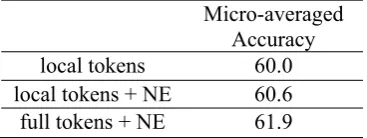
We build the baseline using the ranking ap-proach which ranks the candidates based on si-milarity between mention and candidate entities. The entity with the highest rank is chosen. Bag of words and co-occurring NEs are represented in the form of token-based feature vectors. Then tf.idf is employed to calculate similarity between feature vectors.
Micro-averaged Accuracy
local tokens 60.0
local tokens + NE 60.6
[image:7.595.91.275.72.141.2]full tokens + NE 61.9
Table 1: Results of the ranking methods
4.3 Experiment and Result
As discussed in Section 3.1, we exploit two more knowledge sources in Wikipedia: “did you mean” (DYM) and “Wikipedia search engine” (SE) for name variation step. We conduct some experiments to compare our name variation me-thod using Algorithm 1 in Section 3.1 with the name variation method of Cucerzan (2007). Ta-ble 2 shows the comparison results of different name variation methods for entity linking. The experiments results show that, in entity linking task, our name variation method outperforms the method of Cucerzan (2007) for both entity dis-ambiguation methods.
Name Variation Approaches
Ranking Method
Our Disambig-uation Method Cucerzan
(2007)
60.9 82.2
+DYM+SE 61.9 83.8
Table 2: Entity Linking Result for two name variation approaches. Column 1 used the base-line method for entity disambiguation step. Col-umn 2 used our proposed entity disambiguation method.
Table 3 compares the performance of different methods for entity linking on the KBP-09 test data. Row 1 is the result for baseline system. Row 2 and Row 3 show the results training on Wikipedia data and our automatically data re-spectively. Row 4 is the result training on both Wikipedia and our created data using the domain adaptation method mentioned in Section 3.2.1. It shows that our method trained on the automati-cally generated data alone significantly outper-forms baseline. Compared Row 3 with Row 2, our created data set serves better at training the classifier than Wikipedia data. This is due to the reason that Wikipedia is a different domain from newswire domain. By comparing Row 4 with
Row 3, we find that by using the domain adapta-tion method in Secadapta-tion 3.2.1, our method for entity linking can be further improved by 1.5%. Likely, this is because of the limitation of the auto-generated corpus as discussed in Section 3.2.1. In another hand, Wikipedia can comple-ment the missing information with the auto-generated corpus. So combining Wikipedia data with our generated data can achieve better result. Compared with baseline system using Cucerzan (2007) name variation method in Table 2, in to-tal our proposed method achieves a significant 22.9% improvement.
Micro-averaged
Accu-racy
Baseline 61.9 Wiki 79.9
Created Data 82.3
WikiÆ Created Data 83.8
Table 3: Micro-averaged Accuracy for Entity Linking
To test the effectiveness of our method to deal with new entities not present in KB and ex-isting entities in KB respectively, we conduct some experiments to compare with Baseline. Table 4 shows the performances of entity linking systems for existing entities (non-NIL) in KB and new entity (NIL) which is not present in KB. We can see that the binary classifier not only effectively reduces the ambiguities to the exist-ing entities in KB, but also is very useful to highlight the new entities to KB for the further population. Note that, in baseline system, all the new entities are found by the empty candidate set of name variation process, while the disam-biguation component has no contribution. How-ever, our approach finds the new entities not on-ly by the empty candidate set, but also leverag-ing on disambiguation component which also contributes to the performance improvement.
non-NIL NIL
Baseline 72.6 52.4
WikiÆ Created Data
79.2 87.8
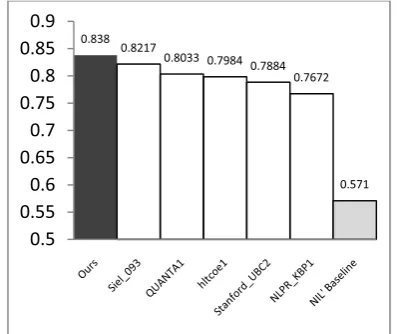
Finally, we also compare our method with the top 5 systems in KBP-09. Among them,
Siel_093 (Varma et al. 2009) and NLPR_KBP1
(Han and Zhao 2009) use similarity ranking ap-proach; Stanford_UBC2 (Agirre et al. 2009),
QUANTA1 (Li et al. 2009) and hltcoe1 (McNa-mee et al. 2009) use supervised approach. From the results shown in Figure 2, we observe that our method outperforms all the top 5 systems and the baseline system of KBP-09. Specifically, our method achieves better result than both simi-larity ranking approaches. This is due to the li-mitations of the ranking approach which have been discussed in Section 2. We also observe that our method gets a 5% improvement over
Stanford_UBC2. This is because they collect their training data from Wikipedia which is a different domain from document collection of entity linking, news articles in this case; while our automatic data generation method can create a data set from the same domain as the docu-ment collection. Our system also outperforms
[image:8.595.83.282.413.580.2]QUANTA1 and hltcoe1 because they train their model on a small manually created data set (1,615 examples), while our method can auto-matically generate a much larger data set.
Figure 2: A comparison with KBP09 systems
5
Conclusion
The purpose of this paper is to explore how to leverage the automatically generated large scale annotation for entity linking. Traditionally, without any training data available, the solution is to rank the candidates based on similarity. However, it is difficult for the ranking approach
to detect a new entity that is not present in KB, and it is also difficult to combine different fea-tures. In this paper, we create a large corpus for entity linking by an automatic method. A binary classifier is then trained to filter out KB entities that are not similar to current mentions. We fur-ther leverage on the Wikipedia documents to provide other information which is not available in our generated corpus through a domain adap-tion approach. Furthermore, new informaadap-tion sources for finding more variations also contri-bute to the overall 22.9% accuracy improve-ments on KBP-09 test data over baseline.
References
E. Agirre et al. Stanford-UBC at TAC-KBP. In Pro-ceedings of Test Analysis Conference 2009 (TAC 09).
J. Artiles, J. Gonzalo, and S. Sekine. 2007. The se-meval-2007 web evaluation: Establishing a benchmark for the web people search task. In Pro-ceeding of the Fourth International Work-shop on Semantic Evaluations (SemEval-2007).
J. Artiles, E. Amigo and J. Gonzalo. 2009. The role of named entities in Web People Search. In pro-ceeding of the 47th Annual Meeting of the Associa-tion for ComputaAssocia-tional Linguistics.
R. Bunescu. 2007. Learning for information extrac-tion from named entity recogniextrac-tion and disambig-uation to relation extraction. Ph.D thesis, Universi-ty of Texas at Austin, 2007.
T. H. Cormen, et al. 2001. Introduction To Algo-rithms (Second Edition). The MIT Press, Page 350-355.
S. Cucerzan. 2007. Large-Scale Named Entity Dis-ambiguation Based on Wikipedia Data. Empirical Methods in Natural Language Processing, June 28-30, 2007.
H. Daumé III. 2007. Frustratingly easy domain adap-tation. In Proceedings of the 45th Annual Meeting of the Association of Computational Linguistics .
C. H. Gooi and J. Allan. 2004. Cross-document core-ference on a large scale corpus. In proceedings of Human Language Technology Conference North American Association for Computational Linguis-tics Annual Meeting, Boston, MA.
X. Han and J. Zhao. NLPR_KBP in TAC 2009 KBP Track: A Two-Stage Method to Entity Linking. In
Proceedings of Test Analysis Conference 2009 (TAC 09).
0.838 0.8217
0.8033 0.7984 0.7884 0.7672
0.571
T. Joachims. 1999. Making large-scale SVM learning practical. In Advances in Kernel Methods - Sup-port Vector Learning. MIT Press.
D. Klein and C. D. Manning. 2003. Fast Exact Infe-rence with a Factored Model for Natural Language
Parsing. In Advances in Neural Information
Processing Systems 15 (NIPS 2002), Cambridge, MA: MIT Press, pp. 3-10.
F.LI et al. THU QUANTA at TAC 2009 KBP and
RTE Track. In Proceedings of Test Analysis Con-ference 2009 (TAC 09).
P. McNamee and H. T. Dang. 2009. Overview of the TAC 2009 Knowledge Base Population Track. In
Proceedings of Test Analysis Conference 2009 (TAC 09).
P.McNamee et al. HLTCOE Approaches to
Know-ledge Base Population at TAC 2009. In Proceed-ings of Test Analysis Conference 2009 (TAC 09).
H. T. Nguyen and T. H. Cao. 2008. Named Entity Disambiguation on an Ontology Enriched by Wi-kipedia. 2008 IEEE International Conference on Research, Innovation and Vision for the Future in Computing & Communication Technologies.
B. Popov et al. 2004. KIM - a Semantic Platform for Information Extraction and Retrieval. In Journal of Natural Language Engineering, Vol. 10, Issue 3-4, Sep 2004, pp. 375-392, Cambridge University Press.
V. Raphael, K. Joachim and M. Wolfgang, 2007. Towards ontology-based disambiguation of geo-graphical identifiers. In Proceeding of the 16th WWW workshop on I3: Identity, Identifiers, Identi-fications, 2007.
V.Varma et al. 2009. IIIT Hyderabad at TAC 2009. InProceedings of Test Analysis Conference 2009 (TAC 09).