Co-STAR: A Co-training Style Algorithm for Hyponymy Relation
Acquisition from Structured and Unstructured Text
Jong-Hoon Oh, Ichiro Yamada, Kentaro Torisawa, and Stijn De Saeger
Language Infrastructure Group, MASTAR Project,
National Institute of Information and Communications Technology (NICT)
{rovellia,iyamada,torisawa,stijn}@nict.go.jp Abstract
This paper proposes a co-training style algorithm called Co-STAR that acquires hyponymy relations simultaneously from structured and unstructured text. In Co-STAR, two independent processes for hy-ponymy relation acquisition – one dling structured text and the other han-dling unstructured text – collaborate by re-peatedly exchanging the knowledge they acquired about hyponymy relations. Un-like conventional co-training, the two pro-cesses in Co-STAR are applied to dif-ferent source texts and training data. We show the effectiveness of this al-gorithm through experiments on large-scale hyponymy-relation acquisition from Japanese Wikipedia and Web texts. We also show that Co-STAR is robust against noisy training data.
1 Introduction
Acquiring semantic knowledge, especially se-mantic relations between lexical terms, is re-garded as a crucial step in developing high-level natural language applications. This paper pro-poses Co-STAR (aCo-training STyleAlgorithm for hyponymy Relation acquisition from struc-tured and unstrucstruc-tured text). Similar to co-training (Blum and Mitchell, 1998), two hy-ponymy relation extractors in Co-STAR, one for structured and the other for unstructured text, it-eratively collaborate to boost each other’s perfor-mance.
Many algorithms have been developed to auto-matically acquire semantic relations from struc-tured and unstrucstruc-tured text. Because term pairs are encoded in structured and unstructured text in different styles, different kinds of evidence have been used for semantic relation acquisition:
Evidence from unstructured text: lexico-syntactic patterns and distributional similar-ity (Ando et al., 2004; Hearst, 1992; Pantel et al., 2009; Snow et al., 2006; De Saeger et al., 2009; Van Durme and Pasca, 2008);
Evidence from structured text:topic hierarchy, layout structure of documents, and HTML tags (Oh et al., 2009; Ravi and Pasca, 2008; Sumida and Torisawa, 2008; Shinzato and Torisawa, 2004).
Recently, researchers have used both structured and unstructured text for semantic-relation acqui-sition, with the aim of exploiting such different kinds of evidence at the same time. They ei-ther tried to improve semantic relation acquisition by putting the different evidence together into a single classifier (Pennacchiotti and Pantel, 2009) or to improve the coverage of semantic relations by combining and ranking the semantic relations obtained from two source texts (Talukdar et al., 2008).
In this paper we propose an algorithm called Co-STAR. The main contributions of this work can be summarized as follows.
• Co-STAR is a semi-supervised learning
have learned (more precisely, by transfer-ring reliable classification results on com-mon instances to one another) (see Section 4 for comparison Co-STAR and bilingual co-training). Unlike the ensemble semantic framework (Pennacchiotti and Pantel, 2009), Co-STAR does not have a single “master” classifier or ranker to integrate the differ-ent evidence found in structured and unstruc-tured text. We experimentally show that, at least in our setting, Co-STAR works better than a single “master” classifier.
• Common relation instances found in both
structured and unstructured text act as a
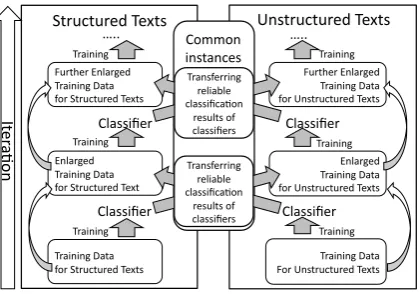
communication channelbetween the two ac-quisition processes. Each process in Co-STAR classifies common relation instances and then transfers its high-confidence classi-fication results to training data of the other process (as shown in Fig. 1), in order to im-prove classification results of the other pro-cess. Moreover, the efficiency of this ex-change can be boosted by increasing the “bandwidth” of this channel. For this pur-pose each separate acquisition process auto-matically generates a set of relation instances that are likely to benegative. In our experi-ments, we show that the above idea proved highly effective.
• Finally, the acquisition algorithm we propose is robust against noisy training data. We show this by training one classifier in Co-STAR with manually labeled data and train-ing the other with automatically generated but noisy training data. We found that Co-STAR performs well in this setting. This is-sue is discussed in Section 6.
This paper is organized as follows. Sections 2 and 3 precisely describe our algorithm. Section 4 describes related work. Sections 5 and 6 describe our experiments and present their results. Conclu-sions are drawn in Section 7.
2 Co-STAR
Co-STAR consists of two processes that simul-taneously but independently extract and classify
Structured Texts Unstructured Texts
Ite
ra
0o
n
Training Data for Structured Texts
Classifier Classifier
Training Training Enlarged
Training Data for Structured Text
Enlarged Training Data for Unstructured Texts
Training Data For Unstructured Texts
Classifier Classifier
Further Enlarged Training Data for Structured Texts
Further Enlarged Training Data for Unstructured Texts
Training
Figure 1: Concept ofCo-STAR.
hyponymy relation instances from structured and unstructured text. The core of Co-STAR is the collaboration between the two processes, which continually exchange and compare their acquired knowledge on hyponymy relations. This collabo-ration is made possible through common instances shared by both processes. These common in-stances are classified separately by each process, but high-confidence classification results by one process can be transferred as new training data to the other.
2.1 Common Instances
Let S and U represent a source (i.e. corpus)
of structured and unstructured text, respectively. In this paper, we use the hierarchical layout of Wikipedia articles and the Wikipedia category system as structured textS(see Section 3.1), and
a corpus of ordinary Web pages as unstructured textU. LetXSandXUdenote a set of hyponymy
relation candidates extracted from S and U,
re-spectively. XS is extracted from the
hierarchi-cal layout of Wikipedia articles (Oh et al., 2009) andXU is extracted by lexico-syntactic patterns
for hyponymy relations (i.e.,hyponymsuch as hy-ponymy) (Ando et al., 2004) (see Section 3 for a detailed explanation)
We define two types of common instances, called “genuine” common instances (G) and “ vir-tual” common instances (V). The set of common instances is denoted by Y = G∪V. Genuine
the other hand, term pairs are obtained as virtual common instances when:
• 1) they are extracted as hyponymy relation
candidates in eitherSorU and;
• 2) they do not seem to be a hyponymy rela-tion in the other text
The first condition corresponds to XS ⊕XU.
Term pairs satisfying the second condition are de-fined as RS and RU, where RS ∩XS = φ and RU∩XU =φ.
RS contains term pairs that are found in the
Wikipedia category system but neither term ap-pears as ancestor of the other1. For example, (
nu-trition,protein) and (viruses,viral disease), respec-tively, hold a category-article relation, where nu-tritionis not ancestor ofvirusesand vice versa in the Wikipedia category system. Here, term pairs, such as (nutrition, viruses) and (viral disease, nu-trition), can be ones inRS.
RU is a set of term pairs extracted from U
when:
• they are not hyponymy relation candidates in
XU and;
• they regularly co-occur in the same sentence
as arguments of the same verb (e.g., Acause
B or Ais made byB);
As a result, term pairs inRU are thought as
hold-ing some other semantic relations (e.g., A and B in “AcauseB” may hold a cause/effect relation) than hyponymy relation. Finally, virtual common instances are defined as:
• V = (XS⊕XU)∩(RS∪RU)
The virtual common instances, from the view-point of either SorU, are unlikely to hold a ponymy relation even if they are extracted as hy-ponymy relation candidates in the other text. Thus many virtual common instances would be a nega-tive example for hyponymy relation acquisition. On the other hand, genuine common instances (hyponymy relation candidates found in both S
1A term pair often holds a hyponymy relation if one term in the term pair is a parent of the other in the Wikipedia cat-egory system (Suchanek et al., 2007).
andU) are more likely to hold a hyponymy
re-lation than virtual common instances.
In summary, genuine and virtual common in-stances can be used as different ground for collab-oration as well as broader collabcollab-oration channel between the two processes than genuine common instances used alone.
2.2 Algorithm
We assume that classifier c assigns class label cl ∈ {yes, no} (“yes” (hyponymy relation) or “no” (not a hyponymy relation)) to instances in
x ∈ X with confidence value r ∈ R+, a
non-negative real number. We denote the classifica-tion result by classifiercasc(x) = (x, cl, r). We
used support vector machines (SVMs) in our ex-periments and the absolute value of the distance between a sample and the hyperplane determined by the SVMs as confidence valuer.
1: Input: Common instances (Y =G∪V) and
the initial training data (L0
SandL0U)
2: Output: Two classifiers (cnSandcnU)
3: i= 0 4: repeat
5: ciS :=LEARN(LiS) 6: ciU :=LEARN(LiU) 7: CRi
S :={ciS(y)|y∈Y,y /∈LiS∪LiU}
8: CRiU :={ciU(y)|y∈Y,y /∈LiS∪LiU} 9: for each (y, clS, rS) ∈ T opN(CRiS) and
(y, clU, rU)∈CRiUdo
10: if(rS > αandrU < β)
or (rS> αandclS =clU)then
11: L(Ui+1):=LU(i+1)∪ {(y, clS)}
12: end if 13: end for
14: foreach(y, clU, rU) ∈ T opN(CRiU)and (y, clS, rS)∈CRiSdo
15: if(rU > αandrS < β)
or (rU > αandclS =clU)then
16: L(Si+1):=LS(i+1)∪ {(y, clU)}
17: end if 18: end for 19: i=i+ 1
20: untilstop condition is met
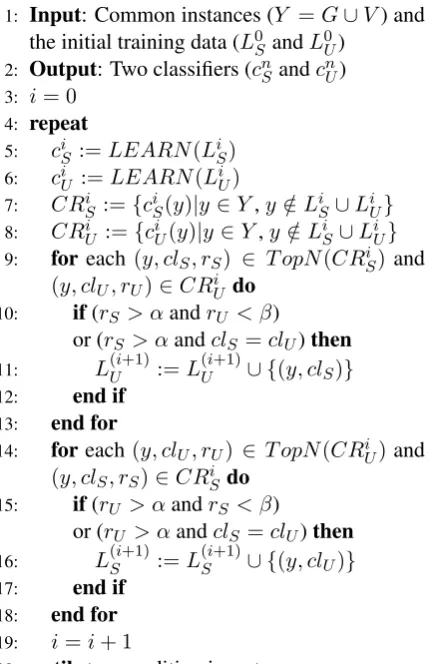
The Co-STAR algorithm is given in Fig. 2. The algorithm is interpreted as an iterative procedure 1) to train classifiers (ci
U, ciS) with the existing
training data (LiS and LiU) and 2) to select new
training instances from the common instances to be added to existing training data. These are re-peated until stop condition is met.
In the initial stage, two classifiers c0S and c0U
are trained with manually prepared labeled in-stances (or training data) L0
S and L0U,
respec-tively. The learning procedure is denoted by
c = LEARN(L) in lines 5–6, where cis a
re-sulting classifier. Then ci
S and ciU are applied
to classify common instances in Y (lines 7–8).
We denoteCRSi as a set of the classification
re-sults of ci
S for common instances, which are not
included in the current training data LiS ∪ LiU.
Lines 9–13 describe a way of selecting instances inCRi
S to be added to the existing training data
in U. During the selection,ciS acts as a teacher
and ciU as a student. T opN(CRiS) is a set of ci
S(y) = (y, clS, rS), whoserSis the top-N
high-est inCRiS. (In our experiments,N = 900.) The
teacher instructs his student the class label ofyif
the teacher can decide the class label ofy with a
certain level of confidence (rS > α) and the
stu-dent satisfies one of the following two conditions:
• the student agrees with the teacher on class label ofy(clS=clU) or
• the student’s confidence in classifying y is
low (rU < β)
rU < βenables the teacher to instruct his student
in spite of their disagreement over a class label. If one of the two conditions is satisfied, (y, clS)
is added to existing labeled instancesL(Ui+1). The roles are reversed in lines 14–18, so that ciU
be-comes the teacher andciSthe student.
The iteration stops if the change in the differ-ence between the two classifiers is stable enough. The stability is estimated byd(ciS, ciU)in Eq. (1),
where σi represents the change in the average
difference between the confidence values of the two classifiers in classifying common instances. We terminate the iteration if d(ciS, ciU)is smaller
than 0.001 in three consecutive rounds (Wang and
Zhou, 2007).
d(ciS, ciU) =|σi−σ(i−1)|/|σ(i−1)| (1)
3 Hyponymy Relation Acquisition
In this section we explain how each process ex-tracts hyponymy relations from its respective text source either Wikipedia or Web pages. Each pro-cess extracts hyponymy relation candidates (de-noted by (hyper,hypo) in this section). Because there are many non-hyponymy relations in these candidates2, we classify hyponymy relation can-didates into correct hyponymy relation or not. We used SVMs (Vapnik, 1995) for the classification in this paper.
3.1 Acquisition from Wikipedia
(a) Layout structure
Range
Siberian tiger Bengal tiger Subspecies
Taxonomy Tiger
Malayan tiger
(b) Tree structure
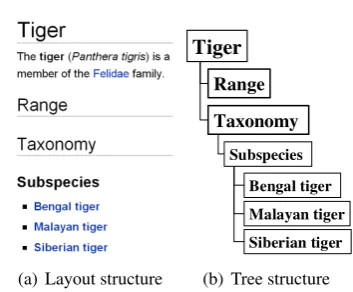
Figure 3: Example borrowed from Oh et al. (2009): Layout and tree structures of Wikipedia article TIGER
We follow the method in Oh et al. (2009) for acquiring hyponymy relations from the Japanese Wikipedia. Every article is transformed into a tree structure as shown in Fig. 3, based on the items in its hierarchical layout includingtitle,(sub)section headings, andlist items. Candidate relations are extracted from this tree structure by regarding a node as a hypernym candidate and all of its subor-dinate nodes as potential hyponyms of the hyper-nym candidate (e.g., (TIGER, TAXONOMY) and (TIGER, SIBERIAN TIGER) from Fig. 3). We ob-tained1.9×107Japanese hyponymy relation
can-didates from Wikipedia.
Type Description
Feature from Wikipedia Lexical Morphemes and POS ofhyperandhypo;hyperandhypothemselves (“WikiFeature”) Structure Distance betweenhyperandhypoin a tree structure;
Lexical patterns for article or section names, where listed items often appear; Frequently used section headings in Wikipedia (e.g., “Reference”);
Layout item type (e.g., section or list); Tree node type (e.g., root or leaf); Parent and children nodes ofhyperandhypo
Infobox Attribute type and its value obtained from Wikipedia infoboxes Feature from Web texts Lexical Morphemes and POS ofhyperandhypo;hyperandhypothemselves (“WebFeature”) Pattern Lexico-syntactic patterns applied tohyperandhypo;
PMI score between pattern and hyponymy relation candidate(hyper,hypo) Collocation PMI score betweenhyperandhypo
Noun Class Noun classes relevant tohyperandhypo
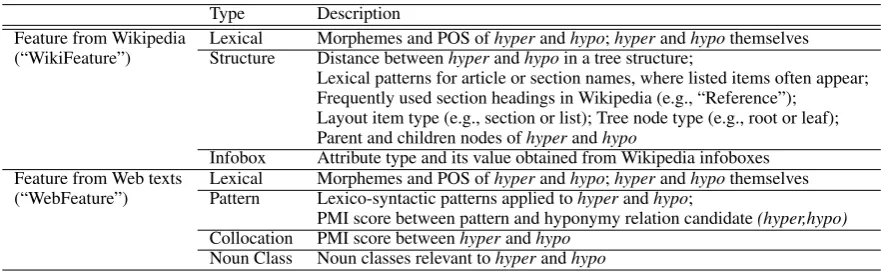
Table 1: Feature sets (WikiFeature and WebFeature):hyperandhyporepresent hypernym and hyponym parts of hyponymy relation candidates, respectively.
As features for classification we used lex-ical, structure, and infobox information from Wikipedia (WikiFeature), as shown in Table 1. Because they are the same feature sets as those used in Oh et al. (2009), here we just give a brief overview of the feature sets. Lexical features3 are used to recognize the lexical evidence for hyponymy relations encoded in hyper andhypo. For example, the common head morpheme tiger
in (TIGER, BENGAL TIGER) can be used as the lexical evidence. Such information is provided along with the words/morphemes and the parts of speech of hyper and hypo, which can be multi-word/morpheme nouns.
Structure features provide evidence found in layout or tree structures for hyponymy relations. For example, hyponymy relations (TIGER, BEN -GAL TIGER) and (TIGER,MALAYAN TIGER) can be obtained from tree structure “(root node, chil-dren nodes ofSubspecies)” in Fig 3.
3.2 Acquisition from Web Texts
As the target for hyponymy relation acquisition from the Web, we used 5 × 10⁷ pages from
the TSUBAKI corpus (Shinzato et al., 2008), a 108 page Japanese Web corpus that was
de-pendency parsed with KNP (Kurohashi-Nagao Parser) (Kurohashi and Kawahara, 2005). Hy-ponymy relation candidates are extracted from the corpus based on the lexico-syntactic patterns such as “hypo nado hyper (hyper such ashypo)” and “hypo to iu hyper (hyper called hypo)” (Ando 3MeCab (http://mecab.sourceforge.net/) was used to provide the lexical features.
et al., 2004). We extracted 6 × 10⁶ Japanese
hyponymy relation candidates from the Japanese Web texts. Features (WebFeature) used for classi-fication are summarized in Table 1. Similar to the hyponymy relation acquisition from Wikipedia, lexical features are used to recognize the lexical evidence for hyponymy relations.
Lexico-syntactic patterns for hyponymy rela-tion show different coverage and accuracy in hy-ponymy relation acquisition (Ando et al., 2004). Further if multiple lexico-syntactic patterns sup-port acquisition of hyponymy relation candidates, these candidates are more likely to be actual ponymy relations. The pattern feature of hy-ponymy relation candidates is used for these ev-idence.
We use PMI (point-wise mutual information) of hyponymy relation candidate (hyper, hypo) as a collocation feature (Pantel and Ravichandran, 2004), where we assume thathyper andhypoin candidates would frequently co-occur in the same sentence if they hold a hyponymy relation.
Semantic noun classes have been regarded as useful information in semantic relation acquisi-tion (De Saeger et al., 2009). EM-based clus-tering (Kazama and Torisawa, 2008) is used for obtaining 500 semantic noun classes4 from 5×
105nouns (including single-word and multi-word
ones) and their4×108dependency relations with 5×10⁵ verbs and other nouns in our target Web
Co-training Bilingual co-training Co-STAR (Blum and Mitchell, 1998) (Oh et al., 2009) (Proposed method)
Instance space Same Different Almost different
Feature space Split by human decision Split by languages Split by source texts Common instances Genuine-common Genuine-common Genuine-common and
(or All unlabeled) instances instances (Translatable) virtual-common instances
Table 2: Differences among co-training, bilingual co-training, and Co-STAR
corpus. For example, noun class C311 includes
biological or chemical substances such as tatou
(polysaccharide) and yuukikagoubutsu (organic compounds). Noun classes (i.e.,C311) relevant to
hyper andhypo, respectively, are used as a noun class feature.
4 Related Work
There are two frameworks, which are most rele-vant to our work – bilingual co-training and en-semble semantics.
The main difference between bilingual co-training and Co-STAR lies in an instance space. In bilingual co-training, instances are in different spaces divided by languages while, in Co-STAR, many instances are in different spaces divided by their source texts. Table 2 shows differences be-tween co-training, bilingual co-training and Co-STAR.
Ensemble semantics is a relation acquisition framework, where semantic relation candidates are extracted from multiple sources and a single ranker ranks or classifies the candidates in the fi-nal step (Pennacchiotti and Pantel, 2009). In en-semble semantics, one ranker is in charge of rank-ing all candidates extracted from multiple sources; while one classifier classifies candidates extracted from one source in Co-STAR.
5 Experiments
We used the July version of Japanese Wikipedia (jawiki-20090701) as structured text. We ran-domly selected 24,000 hyponymy relation candi-dates from those identified in Wikipedia and man-ually checked them. 20,000 of these samples were used as training data for our initial classifier, the rest was equally divided into development and test data for Wikipedia. They are called “WikiSet.” As unstructured text, we used 5×10⁷ Japanese
Web pages in the TSUBAKI corpus (Shinzato et
al., 2008). Here, we manually checked 9,500 hyponymy relation candidates selected randomly from Web texts. 7,500 of these were used as train-ing data. The rest was split into development and test data. We named this data “WebSet”.
In both classifiers, the development data was used to select the optimal parameters, and the test data was used to evaluate our system. We used TinySVM (TinySVM, 2002) with a polynomial kernel of degree 2 as a classifier.α(the threshold
value indicating high confidence), β (the
thresh-old value indicating low confidence), andT opN
(the maximum number of training instances to be added to the existing training data in each iter-ation) were selected through experiments on the development set. The combination of α = 1, β = 0.3, andT opN=900 showed the best perfor-mance and was used in the following experiments. Evaluation was done by precision (P), recall (R),
and F-measure (F).
5.1 Results
We compare six systems. Three of these, B1–B3, show the effect of different feature sets (“Wik-iFeature” and “WebFeature” in Table 1) and dif-ferent training data. We trained two separate clas-sifiers in B1 and B2, while we integrated feature sets and training data for training a single classi-fier in B3. The classiclassi-fiers in these three systems are trained with manually prepared training data (“WikiSet” and “WebSet”). For the purpose of our experiment, we considerB3as the closest possible approximation of the ensemble semantics frame-work (Pennacchiotti and Pantel, 2009).
• B1 consists of two completely independent
• B2is the same as B1, except that both clas-sifiers are trained with all available training data — WikiSet and WebSet are combined (27,500 training instances in total). However, each classifier only uses its own feature set (WikiFeature or WebFeature)5.
• B3adds amasterclassifier toB1. This third
classifier is trained on the complete 27,500 training instances (same as B2) using all available features from Table 1, including each instance’s SVM scores obtained from the two B1 classifiers6. The verdict of the master classifier is considered to be the final classification result.
The other three systems, BICO, B, and Co-STAR (our proposed method), are for compari-son between bilingual co-training (Oh et al., 2009) (BICO) and variants of STAR (B and STAR). Especially, we prepared B and Co-STAR to show the effect of different configura-tions of common instances on the Co-STAR al-gorithm. We use both B1 and B2 as the initial classifiers of B and STAR. We notate Co-B and Co-STAR without ‘∗’ when B1 is used as their initial classifier and those with ‘∗’ when B2 is used.
• BICO implements the bilingual co-training algorithm of (Oh et al., 2009), in which two processes collaboratively acquire hy-ponymy relations in twodifferent languages. For BICO, we prepared 20,000 English and 20,000 Japanese training samples (Japanese ones are the same as training data in the WikiSet) by hand.
• Co-Bis a variant of Co-STAR that uses only the genuine-common instances as common instances (67,000 instances)7, to demonstrate
5Note that training instances from WebSet (or WikiSet) can have WikiFeature (or WebFeature) if they also appear in Wikipedia (or Web corpus). But they can always have lexical feature, the common feature set between WikiFeature and WebFeature.
6SVM scores are assigned to the instances in training data in a 10-fold cross validation manner.
7Co-B can be considered as conventional co-training (Blum and Mitchell, 1998) in the sense that two classifiers collaborate through actual common instances.
the effectiveness of the virtual common in-stances.
• Co-STAR is our proposed method, which
uses both genuine-common and virtual-common instances (643,000 instances in to-tal).
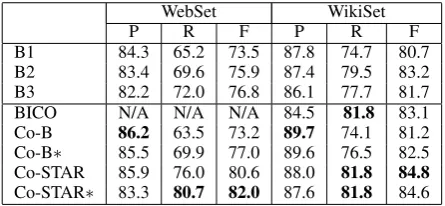
WebSet WikiSet
P R F P R F
B1 84.3 65.2 73.5 87.8 74.7 80.7 B2 83.4 69.6 75.9 87.4 79.5 83.2 B3 82.2 72.0 76.8 86.1 77.7 81.7
BICO N/A N/A N/A 84.5 81.8 83.1
Co-B 86.2 63.5 73.2 89.7 74.1 81.2 Co-B∗ 85.5 69.9 77.0 89.6 76.5 82.5 Co-STAR 85.9 76.0 80.6 88.0 81.8 84.8 Co-STAR∗ 83.3 80.7 82.0 87.6 81.8 84.6
Table 3: Comparison of different systems
Table 3 summarizes the result. Features for common instances in Co-B and Co-STAR are pre-pared in the same way as training data in B2, so that both classifiers can classify the common in-stances with their trained feature sets.
Comparison between B1–B3 shows that B2 and B3 outperform B1 in F-measure. More train-ing data used in B2–B3 (27,500 instances for both WebSet and WikiSet) results in higher per-formance than that of B1 (7,500 and 20,000 in-stances used separately). We think that the lexical features, assigned regardless of source text to in-stances in B2–B3, are mainly responsible for the performance gain over B1, as they are the least domain-dependent type of features. B2–B3 are composed of different number of classifiers, each of which is trained with different feature sets and training instances. Despite this difference, B2 and B3 showed similar performance in F-measure.
the automatically generated virtual-common in-stances. From these comparison, we can see that virtual-common instances coupled with genuine-common instances can be leveraged to enable more effective collaboration between the two clas-sifiers in Co-STAR.
As a result, our proposed method outperforms the others in F-measure by 1.4–8.5%. We ob-tained 4.3×10⁵ hyponymy relations from Web
texts and4.6×106ones from Wikipedia8.
6 Co-STAR with Automatically Generated Training Data
For Co-STAR, we need two sets of manually pre-pared training data, one for structured text and the other for unstructured text. As in any other su-pervised system, the cost of preparing the training data is an important issue. We therefore investi-gated whether Co-STAR can be trained for a lower cost by generating more of its training data auto-matically.
We automatically built training data for Web texts by using definition sentences9 and category names in the Wikipedia articles, while we stuck to manually prepared training data for Wikipedia. To obtain hypernyms from Wikipedia article names, we used definition-specific lexico-syntactic pat-terns such as “hyponym is hypernym” and “ hy-ponymis a type ofhypernym” (Kazama and Tori-sawa, 2007; Sumida and ToriTori-sawa, 2008). Then, we extracted hyponymy relations consisting of pairs of Wikipedia category names and their mem-ber articles when the Wikipedia category name and the hypernym obtained from the definition of the Wikipedia article shared the same head word. Next, we selected a subset of the extracted hyponymy relations that are also hyponymy re-lation candidates in Web texts, as positive in-stances for hyponymy relation acquisition from Web text. We obtained around 15,000 positive in-stances in this way. Negative inin-stances were cho-sen from virtual-common instances, which also originated from the Wikipedia category system and hyponymy relation candidates in Web texts 8We obtained them with 90% precision by setting the SVM score threshold to 0.23 for Web texts and 0.1 for Wikipedia.
9The first sentences of Wikipedia articles.
(around 293,000 instances).
The automatically built training data was noisy and its size was much bigger than manually pre-pared training data in WebSet. Thus 7,500 in-stances as training data (the same number of man-ually built training data in WebSet) were ran-domly chosen from the positive and negative in-stances with a positive:negative ratio of 1:410.
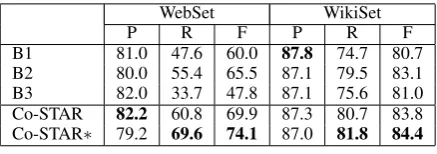
WebSet WikiSet
P R F P R F
B1 81.0 47.6 60.0 87.8 74.7 80.7 B2 80.0 55.4 65.5 87.1 79.5 83.1 B3 82.0 33.7 47.8 87.1 75.6 81.0 Co-STAR 82.2 60.8 69.9 87.3 80.7 83.8 Co-STAR∗ 79.2 69.6 74.1 87.0 81.8 84.4
Table 4: Results with automatically generated training data
With the automatically built training data for Web texts and manually prepared training data for Wikipedia, we evaluated B1–B3 and Co-STAR, which are the same systems in Table 3. The results in Table 4 are encouraging. Co-STAR was robust even when faced with noisy training data. Further Co-STAR showed better performance than B1– B3, although its performance in Table 4 dropped a bit compared to Table 3. This result shows that we can reduce the cost of manually preparing training data for Co-STAR with only small loss of the per-formance.
7 Conclusion
This paper proposed Co-STAR, an algorithm for hyponymy relation acquisition from structured and unstructured text. In Co-STAR, two indepen-dent processes of hyponymy relation acquisition from structured texts and unstructured texts, col-laborate in an iterative manner through common instances. To improve this collaboration, we in-troduced virtual-common instances.
Through a series of experiments, we showed that Co-STAR outperforms baseline systems and virtual-common instances can be leveraged to achieve better performance. We also showed that Co-STAR is robust against noisy training data, which requires less human effort to prepare it.
References
Ando, Maya, Satoshi Sekine, and Shun Ishiza. 2004. Automatic extraction of hyponyms from Japanese newspaper using lexico-syntactic patterns. InProc. of LREC ’04.
Blum, Avrim and Tom Mitchell. 1998. Combin-ing labeled and unlabeled data with co-trainCombin-ing. In
COLT’ 98: Proceedings of the eleventh annual con-ference on Computational learning theory, pages 92–100.
De Saeger, Stijn, Kentaro Torisawa, Jun’ichi Kazama, Kow Kuroda, and Masaki Murata. 2009. Large scale relation acquisition using class dependent pat-terns. InProc. of ICDM 2009, pages 764–769.
Hearst, Marti A. 1992. Automatic acquisition of hy-ponyms from large text corpora. InProceedings of the 14th conference on Computational linguistics, pages 539–545.
Kazama, Jun’ichi and Kentaro Torisawa. 2007. Ex-ploiting Wikipedia as external knowledge for named entity recognition. InProc. of Joint Conference on Empirical Methods in Natural Language Process-ing and Computational Natural Language Learn-ing, pages 698–707.
Kazama, Jun’ichi and Kentaro Torisawa. 2008. In-ducing gazetteers for named entity recognition by large-scale clustering of dependency relations. In
Proceedings of ACL-08: HLT, pages 407–415.
Kurohashi, Sadao and Daisuke Kawahara. 2005. KNP (Kurohashi-Nagao Parser) 2.0 users manual.
Oh, Jong-Hoon, Kiyotaka Uchimoto, and Kentaro Torisawa. 2009. Bilingual co-training for mono-lingual hyponymy-relation acquisition. InProc. of ACL-09: IJCNLP, pages 432–440.
Pantel, Patrick and Deepak Ravichandran. 2004. Au-tomatically labeling semantic classes. In Proc. of HLT-NAACL ’04, pages 321–328.
Pantel, Patrick, Eric Crestan, Arkady Borkovsky, Ana-Maria Popescu, and Vishnu Vyas. 2009. Web-scale distributional similarity and entity set expansion. In
Proceedings of EMNLP ’09, pages 938–947.
Pennacchiotti, Marco and Patrick Pantel. 2009. En-tity extraction via ensemble semantics. In Proceed-ings of the 2009 Conference on Empirical Methods in Natural Language Processing, pages 238–247.
Ravi, Sujith and Marius Pasca. 2008. Using structured text for large-scale attribute extraction. In CIKM-08, pages 1183–1192.
Shinzato, Keiji and Kentaro Torisawa. 2004. Ex-tracting hyponyms of prespecified hypernyms from itemizations and headings in web documents. In
Proceedings of COLING ’04, pages 938–944.
Shinzato, Keiji, Tomohide Shibata, Daisuke Kawa-hara, Chikara Hashimoto, and Sadao Kurohashi. 2008. Tsubaki: An open search engine infrastruc-ture for developing new information access. In Pro-ceedings of IJCNLP ’08, pages 189–196.
Snow, Rion, Daniel Jurafsky, and Andrew Y. Ng. 2006. Semantic taxonomy induction from heteroge-nous evidence. In Proceedings of the 21st Inter-national Conference on Computational Linguistics and the 44th annual meeting of the Association for Computational Linguistics, pages 801–808.
Suchanek, Fabian M., Gjergji Kasneci, and Gerhard Weikum. 2007. Yago: A Core of Semantic Knowl-edge. InProc. of WWW ’07, pages 697–706.
Sumida, Asuka and Kentaro Torisawa. 2008. Hack-ing Wikipedia for hyponymy relation acquisition. InProc. of the Third International Joint Conference on Natural Language Processing (IJCNLP), pages 883–888, January.
Talukdar, Partha Pratim, Joseph Reisinger, Marius Pasca, Deepak Ravichandran, Rahul Bhagat, and Fernando Pereira. 2008. Weakly-supervised acqui-sition of labeled class instances using graph random walks. InProc. of EMNLP08, pages 582–590.
TinySVM. 2002. http://chasen.org/˜taku/
software/TinySVM.
Van Durme, Benjamin and Marius Pasca. 2008. Find-ing cars, goddesses and enzymes: Parametrizable acquisition of labeled instances for open-domain in-formation extraction. In Proc. of AAAI08, pages 1243–1248.
Vapnik, Vladimir N. 1995. The nature of statistical learning theory. Springer-Verlag New York, Inc., New York, NY, USA.