Some Studies on Chinese Domain Knowledge Dictionary and Its
Application to Text Classification
Jingbo Zhu
Natural Language Processing Lab Institute of Computer Software & Theory
Northeastern University, Shenyang
Wenliang Chen
Natural Language Processing Lab Institute of Computer Software & Theory
Northeastern University, Shenyang
Abstract
In this paper, we study some issues on Chinese domain knowledge dictionary and its application to text classification task. First a domain knowledge hierar-chy description framework and our Chinese domain knowledge dictionary named NEUKD are introduced. Second, to alleviate the cost of construction of domain knowledge dictionary by hand, we use a boostrapping-based algorithm to learn new domain associated terms from a large amount of unlabeled data. Third, we propose two models (BOTW and BOF) which use domain knowl-edge as textual features for text catego-rization. But due to limitation of size of domain knowledge dictionary, we fur-ther study machine learning technique to solve the problem, and propose a BOL model which could be considered as the extended version of BOF model. Naïve Bayes classifier based on BOW model is used as baseline system in the comparison experiments. Experimental results show that domain knowledge is very useful for text categorization, and BOL model performs better than other three models, including BOW, BOTW and BOF models.
1 Introduction
It is natural for people to know the topic of the document when they see some specific words in the document. For example, when we read a
news, if title of the news includes a word “ྮᯢ (Yao Ming)”, as we know, “ྮᯢ(Yao Ming)” is a famous China basketball athlete in US NBA game, so we could recognize the topic of the document is about “㇂ ⧗,ԧ 㚆(Basketball, Sports)” with our domain knowledge. In this paper, we call the specific word “ྮ ᯢ(Yao Ming)” as a Domain Associated Term (DAT). A DAT is a word or a phrase (compound words) that enable humans to recognize intuitively a topic of text with their domain knowledge. In fact, domain knowledge is a kind of common-sense knowledge. We think that domain knowl-edge is very useful for text understanding tasks, such as text classification, document summariza-tion, and information retrieval.
In previous literatures, some researchers used knowledge bases for text understanding tasks(Scott et al., 1998), such as WordNet for English and HowNet for Chinese. We know that WordNet and HowNet are lexical and semantic knowledge resources. Other researchers tried to use commonsense knowledge such as field-associated terms for text understanding tasks(M. Fuketa et al., 2000, Sangkon Lee and Masami Shishibori, 2002). But the problem of limitation of size of such knowledge base is still a key bot-tleneck for using domain knowledge dictionary for text understanding tasks, and how to solve it is an ongoing research focus.
problem and improve performance of text classi-fication using domain knowledge dictionary?
2 Domain Knowledge Dictionary
We first introduce briefly domain knowledge hierarchy description framework (DKF) which includes three levels: Domain Level (DL), Do-main Feature Level (DFL) and Domain Associ-ated Term Level (DATL). The DL is the top level which defines many domains, such as “ԧ 㚆(Sports)”, “ݯџ(Military Affairs)”. The DFL is the second level which defines many domain features. A domain defined in the DL has a lot of domain features defined in the DFL. For example, domain “ݯџ(Military Affairs)” has many domain features, such as “ݯ 䯳(Army Feature)”, “℺఼(Weapon Feature)” and “ѝ (War Feature)”. The DATL is the third level which defines many domain associated terms. Many domain associated terms could indicate a same domain feature defined in the DFL. For example, some domain associated terms, such as
some domain associated terms, such as “Ёϰ ѝ(Mid-East War)”, “Ӟᢝܟѝ(Iraq War)” and “䰓ᆠ∫ѝ(Afghanistan War)”, indicate domain feature “ѝ(War)”.
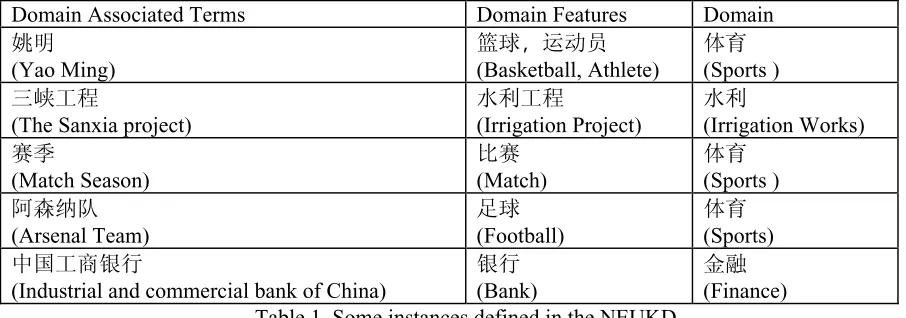
Since 1996 we employed a semi-automatic machine learning technique to acquire domain knowledge from a large amount of labeled and unlabeled corpus, and built a general-purpose domain knowledge dictionary named NEUKD according to the domain knowledge hierarchy description framework(Zhu Jingbo et al., 2002). Items defined in the NEUKD include domain associated term, domain feature and domain. Currently 40 domains, 982 domain features and more than 610,000 domain associated terms are defined in the NEUKD. Some instances of NEUKD are given in Table 1. Because the size of NEUKD is limited, so in following content we will study machine learning techniques to solve the problem of using NEUKD for text classification task.
Domain Associated Terms Domain Features Domain ྮᯢ
(Yao Ming)
㇂⧗, 䖤ࡼਬ (Basketball, Athlete)
ԧ㚆 (Sports ) ϝኵᎹ
(The Sanxia project)
∈߽Ꮉ
(Irrigation Project)
∈߽
(Irrigation Works) 䌯ᄷ
(Match Season)
↨䌯 (Match)
ԧ㚆 (Sports ) 䰓Ể㒇䯳
(Arsenal Team)
䎇⧗ (Football)
ԧ㚆 (Sports) ЁᎹଚ䫊㸠
(Industrial and commercial bank of China)
䫊㸠 (Bank)
䞥㵡 (Finance) Table 1. Some instances defined in the NEUKD
3 Bootstrapping-based DAT Learning Algorithm
To extend domain knowledge dictionary, in this paper, we will use a feature learning algorithm based on bootstrapping (FLB)(Zhu Jingbo et al., 2004) to learning new DATs. In the FLB learn-ing procedure, some seed words are given in advance. In fact, seed words are some important DATs. For example, ten seed words of domain “䞥㵡(finance)” are㙵⼼(stock), 䞥㵡(finance), 䌋ℒ(loan), 䆕ࠌ(stock), 䋶㒣(finance and eco-nomics), 䫊㸠(bank), ᬊ(tax), ∛(foreign
exchange), ᡩ 䌘(investment) and 㙵 Ꮦ(stock market).
The FLB learning procedure is described as follows:
z Initialization: Use a small number of seed words initialize DAT set
z Iterate Bootstrapping:
¾ Candidate DAT Learner: Learn some
new DATs as candidate DATs from unlabeled data.
¾ Evaluation: Score all candidate DATs,
considered as candidate DATs. In fact, we can regard bootstrapping as iterative clustering. In the evaluation step of FLB algorithm, RlogF metric method(Ellen Riloff, Rosie Jones, 1999) is used as evaluation function which assigns a score to a word(candidate DAT). The score of a word is computed as:
i i
i
Log
F
w
X
R
w
M
(
)
2(
,
)
u
(1)Where F(wi,X) is the frequency of co-occurrence of word wi and X (set of seed words) in the same sentence, F(wi) is the frequency of wi in the cor-pus, and Ri=F(wi,X)/F(wi). The RlogF metric tries to strike a balance between reliability and frequency: R is high when the word is highly correlated with set of seed words, and F is high when the word and X highly co-occur in the same sentence.
In the experiments, we use the corpus from 1996-1998 People’s Daily as unlabeled data which has about 50 million words. For domain “㊄ Ⲣ(finance)”, we select ten seed words shown in above example, the bootstrapping-based DAT learning algorithm obtains 65% pre-cision performance within top-1000 new learned DATs according to human judgment.
4 Domain Knowledge based Text Clas-sification
In this paper, naïve Bayes(NB) model (McCallum and K.Nigam, 1998) is used to build text classifier. We want to study how to use our Chinese domain knowledge dictionary NEUKD to improve text categorization.
4.1 BOW Model
The most commonly used document representa-tion is the so called vector space model(G.Salton and M.J.McGill, 1983). In the vector space model, documents are represented by vectors of terms (textual features, e.g. words, phases, etc.). Conventional bag-of-words model (BOW) uses common words as textual features. In the com-parison experiments, we use the BOW model as baseline NB system.
4.2 BOTW Model
As above mentioned, more than 610000 domain associated terms (DATs) are defined in the NEUKD, such as “ྮᯢ(Yao Ming) ”, “ϝኵᎹ (The Sanxia project)”, and “ЁᎹଚ䫊㸠 (Industrial and commercial bank of China)” shown in table 1. We use domain associated
terms and common words as textual features, called BOTW models (short for bag-of-terms and words model). For example, in the previous examples, the DAT “ϝኵᎹ(The Sanxia pro-ject, Sanxia is a LOCATION name of China)” can be used as a textual feature in BOTW model. But in BOW model(baseline system) we con-sider two common words “ϝኵ(The Sanxia)” and “Ꮉ(project)” as two different textual fea-tures.
4.3 BOF Model
Similar to BOTW model, we use domain fea-tures as textual feafea-tures in the NB classifier, called BOF model (short for bag-of-features model). In BOF model, we first transform all DATs into domain features according to defini-tions in the NEUKD, and group DATs with same domain features as a cluster, called Topic Cluster. For Examples, Topic Cluster “ԧ 㚆 (sports)” includes some DATs, such as “䌯ᄷ (match season)”, “䰓Ể㒇䯳(Arsenal)”, “ᅏㄬળ (Olympic Games)”, “Ц Ч ⧗(Table Tennis)”, “ྮᯢ(Yao Ming)”. In BOF model, we use topic clusters as textual features for text categorization. Also the classification computation procedure of BOF model is same as of BOW model.
4.4 BOL Model
To solve the problem of the limitation of NEUKD, in this paper, we propose a machine learning technique to improve BOF model. The basic ideas are that we wish to learn new DATs from pre-classified documents, and group them into the predefined topic clusters which are formed and used as textual features in BOF model discussed in section 4.3. Then these new topic clusters could be used as textual features for text categorization. We call the new model as BOL model(short for bag-of-learned features model) which could be consider as an extended version of BOF model.
First we group all DATs originally defined in NEUKD into a lot of topic clusters as described in BOF model, which are used as seeds in fol-lowing learning procedure. Then we group other words (not be defined in NEUKD) into these topic clusters. The Learning algorithm is de-scribed as following:
- Preprocessing: Text segmentation,
are not defined in NEUKD will be grouped into topic clusters in this process.
- Initialization: These words, which are de-fined in NEUKD, are first added to corre-sponding topic clusters according to their associated domain features, respectively. - Iteration: Loop until all candidate words
have been put into topic clusters:
Measure similarity of a candidate word and each topic cluster, respectively. Put the candidate word into the most
similar topic cluster(Note that a word can only be grouped into one cluster). The important issue of above procedures is how to measure the similarity between a word and a topic cluster. Chen Wenliang et. al.(2004) proposed a measure for word clustering algo-rithm used in text classification. So in this paper, we use Chen’s measure to measure the similarity between a word and a topic cluster in above learning algorithm. The similarity of a word wt and a topic cluster fj is defined as
| | random variable over classes C, and its distribu-tion given a particular word wt. N(fi) denote the number of words in the topic cluster fi, W is the list of candidate words.
To describe how to estimate distribution P(C|f) , we first assume that in the beginning of learning procedure, only a word w1 is included in topic cluster f1, we could say that P(C|f1) = P(C|w1). When a new word w2 is added into topic cluster f1, we could get a new topic cluster f2. How to estimate the new distribution P(C|f2) is key step, where f2=w2Ģf1. We could use the following formula (3) to estimate distribution P(C|f2) =P(C|w2Ģf1). Similarly, we could know if the new word wn is added into topic cluster fn-1
to form a new topic cluster fn, we also could es-timate P(C|fn)=P(C|wnĢfn-1) following this way, and so on.
We turn back the question about how to meas-ure the difference between two probability distributions. Kullback-Leibler divergence is used to do this. The KL divergence between two class distributions induced by wt and ws is writ-ten as
In preprocessing step, the CHI statistic meas-ures the lack of independence of feature t and
Where t refers to a feature and c refers to a cate-gory, A is the number of times t and c co-occur, B is the number of times t occurs without c, C is the number of times c occurs without t, D is the number of times neither c nor t co-occur, and N is the total number of documents.
5 Experimental Results
In this paper, we use naïve Bayes for classifying documents. Here we only describe multinomial naïve Bayes briefly since full details have been presented in the paper(McCallum and K.Nigam, 1998). The basic idea in naïve Bayes approaches is to use the joint probabilities of words and categories to estimate the probabilities of catego-ries when a document is given. Given a docu-ment d for classification, we calculate the probabilities of each category c as follows:
size of T,ti is the ith word in the vocabulary, and P(ti|c) thus represents the probability that a ran-domly drawn word from a ranran-domly drawn document in category c will be the word ti.
In the experiments, we use NEU_TC data set(Chen Wenliang et. al. 2004) to evaluate the performance of baseline NB classifier and our classifiers. The NEU_TC data set contains Chi-nese web pages collected from web sites. The pages are divided into 37 classes according to “Chinese Library Categorization”(CLCEB, 1999). It consists of 14,459 documents. We do not use tag information of pages. We use the toolkit CipSegSDK(Yao Tianshun et. al. 2002) for word segmentation. We removed all words that had less than two occurrences. The resulting vocabulary has about 60000 words.
In the experiments, we use 5-fold cross vali-dation where we randomly and uniformly split each class into 5 folds and we take four folds for training and one fold for testing. In the cross-validated experiments we report on the average performance. For evaluating the effectiveness of category assignments by classifiers to docu-ments, we use the conventional recall, precision and F1 measures. Recall is defined to be the
ra-tio of correct assignments by the system divided by the total number of correct assignments. Pre-cision is the ratio of correct assignments by the system divided by the total number of the sys-tem’s assignments. The F1 measure combines recall (r) and precision (p) with an equal weight in the following form:
p r
rp p
r F
2 ) , (
1
In fact, these scores can be computed for the binary decisions on each individual category first and then be averaged over categories. The way is called macro-averaging method. For evaluating performance average across class, we use the former way called micro averaging method in this paper which balances recall and precision in a way that gives them equal weight. The micro-averaged F1 measure has been widely used in cross-method comparisons.
To evaluate the performance of these four models based on NB classifier, we construct four systems in the experiments, including BOW, BOTW, BOF and BOL classifier. CHI measure is used to feature selection in all text classifiers.
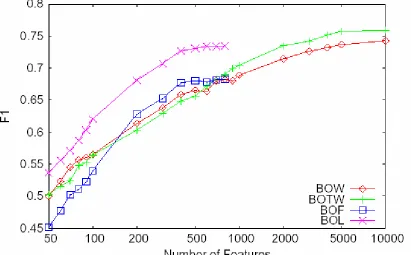
Figure 1. Experimental results of BOW, BOTW, BOF, BOL classifiers
In figure 1, we could find that BOTW classi-fier always performs better than BOW classiclassi-fier when the number of features is larger than about 500. From comparative experimental results of BOTW and BOW classifiers, we think that
fea-tures) for BOF and BOL classifier is less than 1000. When the number of features is between 200 and 1000, BOF classifier performs better than BOW and BOTW classifiers. It is also ob-vious that BOL classifier always performs better than other three classifiers when the number of features is less than 1000. As above mentioned, in BOL model, we use a machine learning tech-nique to solve the problem of limitation of size of NEUKD, and group rest 65.01% words into predefined topic clusters as textual features in BOL model. So the classifier based on BOL model can yield better performance than BOF model.
6 Conclusions and Future Work
In this paper, we first introduce our Chinese do-main knowledge dictionary NEUKD. To allevi-ate the cost of construction of domain knowledge dictionary by hand, we propose a boostrapping-based algorithm to learn new do-main associated terms from a large amount of unlabeled data. This paper studies how to im-prove text categorization by using domain knowledge dictionary. To do it, we propose two models using domain knowledge as textual fea-tures. The first one is BOTW model which uses domain associated terms and common words as textual features. The other one is BOF model which uses domain features as textual features. But due to limitation of size of domain knowl-edge dictionary, many useful words are lost in the training procedure. We study and use a ma-chine learning technique to solve the problem to improve knowledge-based text categorization, and propose a BOL model which could be con-sidered as the extension version of BOF model. Comparison experimental results of those four models (BOW, BOTW, BOF and BOL) show that domain knowledge is very useful for im-proving text categorization. In fact, a lot of knowledge-based NLP application systems have to face the problem of limitation of size of knowledge bases. Like our work discussed in this paper, we think that using machine learning techniques is a good way to solve such problem. In the future work, we will study how to apply the domain knowledge to improve other text un-derstanding tasks, such as information retrieval, information extraction, topic detection and track-ing (TDT).
Acknowledgements
This research was supported in part by the Na-tional Natural Science Foundation of China & Microsoft Research Asia (No. 60203019), the Key Project of Chinese Ministry of Education (No. 104065), and the National Natural Science Foundation of China (No. 60473140).
References
Chen Wenliang, Chang Xingzhi, Wang Huizhen, Zhu Jingbo, and Yao Tianshun. 2004. Automatic Word Clustering for Text Categorization Using
Global Information. First Asia Information
Re-trieval Symposium (AIRS 2004), LNCS, Beijing, pp.1-6
CLCEB. 1999. China Library Categorization Edito-rial Board. China Library Categorization (The 4th
ed.) (In Chinese), Beijing, Beijing Library Press.
Ellen Riloff, Rosie Jones. 1999. Learning Dictionar-ies for Information Extraction by Multi-Level
Bootstrapping, Proceedings of the Sixteenth
Na-tional Conference on Artificial Intelligence.
G.Salton and M.J.McGill, 1983. An introduction to
modern information retrieval, McGraw-Hill.
McCallum and K.Nigam. 1998. A Comparison of Event Models for naïve Bayes Text Classification,
In AAAI-98 Workshop on Learning for Text Cate-gorization.
M. Fuketa, S.Lee, T.Tsuji, M.Okada and J. Aoe. 2000. A document classification method by using field
associated words. International Journal of
Infor-mation Sciences. 126(1-4), p57-70
Sangkon Lee, Masami Shishibori. 2002. Passage
seg-mentation based on topic matter, International
journal of computer processing of oriental lan-guages, 15(3), p305-339.
Scott, Sam㧘Stan Matwin. 1998. Text classification
using WordNet hypernyms. Proceedings of the
COLING/ACL Workshop on Usage of WordNet in Natural Language Processing Systems, Montreal. Yao Tianshun, Zhu Jingbo, Zhang li, and Yang Ying,
2002. Natural Language Processing- research on making computers understand human languages,
Tsinghua University Press, (In Chinese).
Zhu Jingbo and Yao Tianshun. 2002. FIFA-based
Text Classification, Journal of Chinese
Informa-tion Processing, V16, No3.(In Chinese)
Zhu Jingbo, Chen Wenliang, and Yao Tianshun. 2004. Using Seed Words to Learn to Categorize Chinese
Text.Advances in Natural Language Processing: