PAT-Trees with the Deletion Function as the Learning Device
for Linguistic Patterns
Keh-Jiann Chen, W e n Tsuei, and L e e - F e n g Chien CKIP, Institute o f Information Science, A c a d e m i a Sinica, Nankang, Taipei 1 15, T a i w a n
Abstract
In this study, a learning device based on the PAT- tree data structures was developed. The original PAT-trees were enhanced with the deletion function to emulate human learning competence. The learning process worked as follows. The linguistic patterns from the text corpus are inserted into the PAT-tree one by one. Since the memory was limited, hopefully, the important and new patterns would be retained in the PAT-tree and the old and unimportant patterns would be released from the tree automatically. The proposed PAT-trees with the deletion function have the following advantages. 1) They are easy to construct and maintain. 2) Any prefix sub- string and its frequency count through PAT-tree can be searched very quickly. 3) The space requirement for a PAT-tree is linear with respect to the size of the input text. 4) The insertion of a new element can be carried out at any time without being blocked by the memory constraints because the free space is released through the deletion of unimportant elements.
Experiments on learning high frequency bi- grams were carried out under different memory size constraints. High recall rates were achieved. The results show that the proposed PAT-trees can be used as on-line learning devices.
1. Introduction
Human beings remember useful and important information and gradually forget old and unimportant information in order to accommodate new information. Under the constraint of memory
capacity, it is important to have a learning mechanism that utilizes memory to store and to retrieve information efficiently and flexibly without loss of important information. We don't know how human memory functions exactly, but the issue of creating computers with similar competence is one of the most important problems being studied. We are especially interested in computer learning of linguistic patterns without the problem of running out of memory.
strings are not unique in a text as semi-infinite strings are, fl-equency counts are stored in tree nodes, in addition to its searching functions, the frequencies of any prefix sub-strings can be accessed very easily in the modified PAT-tree. Hence, statistical evaluations between sub-strings, such as probabilities, conditional probabilities, and mutual information, can be computed.
It is easy to insert new elements into PAT- trees, but memory constrains have made them unable to accept unlimited amounts of information, h e n c e limiting their potential use as learning devices. In reality, only important or representative data should be retained. Old and unimportant data can be replaced by new data. Thus, aside froln the original PAT-tree, the deletion mechanism was implemented, which allowed memory to be teleased for the purpose of storing the most recent inputs when the original melnory was exhausted. With this mechanism, the PAT-tree is now enhanced and has the ability to accept unlimited amounts of information. Once evaluation functions for data importance are obtained, the PAT-tree will have the potential to be an on-line learning device. We review the original PAT-tree and its properties in section 2. In section 3,we describe the PAT-tree with deletion in detail. In section 4, we give the results obtained after different deletion criteria were tested to see how it performed on learning word bi-gram collocations under different sizes of memory. Some other possible applications and a simple conclusion are given in the last section.
2. The Original PAT-tree
In this section, we review the original version of the PAT-tree and provide enough background information for the following discussion.
2.1 D e f i n i t i o n o f P a t - t r e e
2.1.1 P A T R I C I A
Before defining the PAT-tree, we first show how PATRICIA works.
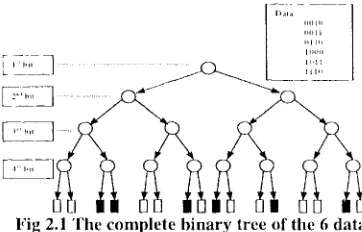
PATRICIA is a special kind of trie[Fredkin 60]. In a trie, there are two different kinds of nodes--branch decision nodes and element nodes. Branch decision nodes are the search decision- makers, and the element nodes contain real data. To process strings, if branch decisions are made on each bit, a complete binary tree is formed
where the depth ix equal to the number of bits of the longest strings. For example, suppose there are 6 strings in the data set, and that each is a bits long. Then, the complete binary search tree is that shown in Fig. 2.1.
i] 1 I
...
Fig 2.1 The complete binary tree of the 6 data
Apparently, it is very wasteful. Many element nodes and branch nodes are null. If those nodes are removed, then a tree called a "compressed digital search trie" [Flajolet 86], as shown in Fig. 2.2, is formed. It is more efficient, but an additional field to denote the comparing bit for branching decision should be included in each decision node. In addition, the searched results may not exactly match the input keys, since only some of the bits are compared during the search process. Therefore, a matching between the searched results and their search keys is required.
Morrison [Morrison, 68] improved the trie structure further. Instead of classifying nodes into branch nodes and element nodes, Morrison combined the above two kinds of nodes into a uniform representation, called an augmented branch node. The structure of an augmented branch node is the same as that of a decision node of the trie except that an additional field for storing elements is included. Whenever an e l e m e n t should be inserted, it is inserted "up" to a branch node instead of creating a new element node as a leaf node. For example, the compressed digital search trie s h o w n in Fig 2.2 has the equivalent PATRICIA like Fig 2.3. It is noticed that each element is stored in an upper node or in itself, flow the data e l e m e n t s are inserted will be discussed in the next section. A n o t h e r difference here is the additional root node. This is because in a binary tree, the number of leaf nodes is always
greater than that of internal nodes by one.
[image:2.612.337.518.164.280.2]0010 0011 1000 1Oll
Fig. 2.2 Compressed digital search trie.
Fig 2.3 PATRICIA
2.1.2 PAT-tree
Gonnet [Gonnet, 87] extended PATRICIA to handle semi-infinite strings. The data structure is called a PAT-tree. It is exactly like PATRICIA except that storage for the finite strings is replaced by the starting position of the semi-infinite strings in the text.
Suppose there is a text T with n basic units.
T = t f l u = . . . t t , , . Consider the prefix sub-strings of
T's which start from certain positions and go on as necessary to the right, such as u ~ u = . . . u , , . . .
u = u 3...u,, . . . u 3 u 4 . . . u , , .... and so on. Since each
of these strings has got an end to the left but none to the right, they are so-called semi-infinite strings. Note here that whenever a semi-infinite string extends beyond the end of the text, null characters are appended. These null characters are different from any basic units in the text. Then, all the semi-infinite strings starting from different positions are different. Owing to the additional field for comparing bits in each decision node of PATRICIA, PATRICIA can handle branch decisions for the semi-infinite strings (since after all, there is only a finite number of sensible decisions to separate all the elements of semi- infinite strings in each input set). A PAT-tree is constructed by storing all the starting positions of semi-infinite strings in a text using PATRICIA.
There are many useful functions which can easily be implemented on PAT-trees, such as prefix searching, range searching, longest
repetition searching and so on.
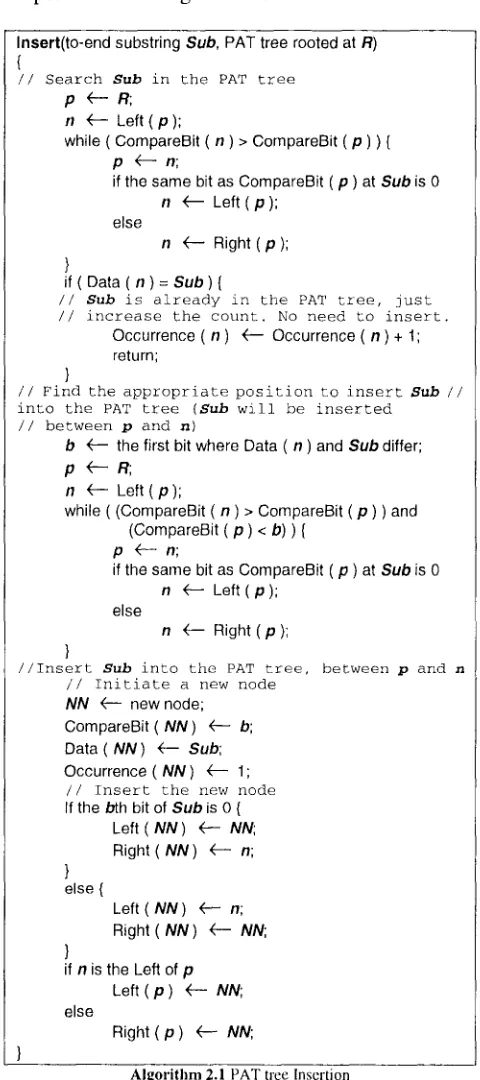
Insert(to-end substring Sub, PAT tree rooted at R)
/ S e a r c h S u b in t h e P A T t r e e
p ( - - R ;
n <-- Left(p):
while ( CompareBit ( n ) > CompareBit ( p ) ) {
p <---n;
if the same bit as CompareBit ( p ) at Sub is 0 n ~--- L e f t ( p ) ;
else
n ~ R i g h t ( p ) ;
}
if ( Data ( n ) = Sub) {
// ~ u b is a l r e a d y i n t h e P A T tree, j u s t // i n c r e a s e t h e c o u n t . N o n e e d to i n s e r t .
Occurrence ( n ) ~ - Occurrence ( n ) + 1;
return;
}
/ F i n d t h e a p p r o p r l a t e p o s i t i o n to i n s e r t B u b //
i n t o t h e P A T t r e e ( S u b w i l l b e inserted
// b e t w e e n p a n d n)
b ~ - the first bit where Data ( n ) and Sub differ;
p ~ - - R ; n ~-- L e f t ( p ) ;
while ( (CompareBit ( n ) > CompareBit ( p ) ) and (CompareBit ( p ) < b) ) {
p ~ - - n ;
if the same bit as CompareBit ( p ) at Sub is 0 n ~ L e f t ( p ) ;
else
n ~ - Right ( p ) ;
}
/ / I n s e r t S u b i n t o t h e P A T t r e e , b e t w e e n p a n d // I n i t i a t e a n e w n o d e
NN ( - - new node; CompareBit ( N N ) ~-- b;
Data ( N N ) ~-- Sub;
Occurrence ( N N ) ~ 1;
// I n s e r t t h e n e w n o d e If the bth bit of Sub is 0 {
}
else {
Left ( N N ) ~ - NN;
Right ( N N ) 4-- n;
Left ( N N ) ~-- n;
Right ( N N ) ( - - NN;
if n is the Left of p
Left ( p ) ~-- NN;
else
Right ( p ) ~-- NN;
Algorithm 2.1 PAT tree Insertion
[image:3.612.305.545.95.635.2] [image:3.612.105.247.100.178.2]way, the saved strings will not necessarily be unique. Thus, the frequency counts of the strings must be added. A field denoting the frequency of a prefix was also added to the tree node. With these changes, the PAT-tree is more than a tool for searching prefixes; it also provides their frequencies.
The data structure of a complete node of a PAT-tree is as follows.
N o d e : a r e c o r d o f
Decision bit: an integer to denotc the decision bit. Frequency: the frequency count of the prefix sub-
string.
Data element: a data string or a pointer of a semi- infinite string.
Data count: the frequency count of the data string. Left: the left pointer points downward to tim left
sub-trec or points upward to a data nodc. Right: the right pointer points downward to the
right sub-tree or points upward to a data node.
E n d of the r e c o r d .
The construction process lk)r a PAT-tree is nothing more than a consecutive insertion process for input strings. The detailed insertion procedure is
given in Algorithm 2.1 and the searching
procedure in Algorithm 2.2.
SearchforFrcquencyof ( l'attern )
(
p ( - - R f t h e root of PAT-tree*/; n ~-- Left ( p ) ;
while ( ( CompareBit ( n ) > CompareBit ( p ) ) and ( CompareBit ( n ) _< total bits of Pattern ) )
{
p (--- n;
if the "CompareBit ( p )"th bit of Pattern is 0 n ( - - L e f t ( p ) ;
else
n (--- Right ( p ) ; }
if ( Data ( n ) :/: Pattern ) return 0;
if ( CompareBit ( n ) > total bits of Pattern ) return TerminalCounts ( n ); else
return Occurrence ( n );
Algorithm 2.2 Search for frequency of a imttern ill PAT-tree
The advantages of PAT-trees are as follows: (1) They are easy to construct and rnaintain. (2) Any prefix sub-string and its frequency count can be found very quickly using a PAT-tree. (3) The
space requirement for a PAT-tree is linear to the size of the input text.
3. Pat-tree with the deletion function
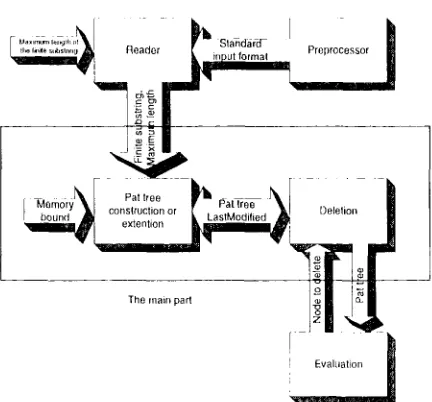
The block diagram of the PAT-tree with the deletion function is shown in figure 3.1.
(
Pat tree[
1
M0mo y ~ i Pat tree ] ~
I ILl construction or l . ,, le Deletion ml bound LaslModlfled
[image:4.612.320.536.163.364.2]i)I I ~ i
Fig. 3.1 The Block Diagram (if PAT-tree Construction.
hnplementing the deletion function requires two functions. One is the evaluation function that evaluates the data elements to find the least important element. The second function is release of the least important element from the PAT-tree and return of the fi'eed node.
3.1 T h e E v a l u a t i o n f u n c t i o n
Due to the limited memory capacity of a PAT-tree,
old and unimportant elements have to be
element. Of course, different importance measures can be employed, such as mutual information or conditional probability between a prefix and suffix. Nonetheless, the frequency count is a very simple and useful measurement.
To simplify the matter, a unified criterion is adopted. Under this criterion no additional storage is needed to register time. A time lapse will be delayed in order to revisit and evaluate a node, and hopefully, the frequency counts of important elements will be increased during the time lapse. It is implemented by way of a circular-like array of tree nodes. A PAT-tree will be constructed by inserting new elements. The insertion process takes a free node for each element fl'om the array in the increasing order of their indexes until the array is exhausted. The deletion process will then be triggered. The evaluation process will scan the elements according to the array index sequence, which is different from the tree order, to find the least important element in the first k elements to delete. The freed node will be used to store the newly arriving element. The next position of the current deleted node will be the starting index of the next k nodes for evaluation. In this way, it is guaranteed that the minimal time lapse to visit the same node will be at least the size of the PAT-tree divided by k.
In section 4, we describe experiments carried out on the learning of high fiequency word bi- grams. The above mentioned time lapse and the frequency measurement for importance were used as the evaluation criteria to determine the learning performance under different memory constraints. 3.2 The Deletion function
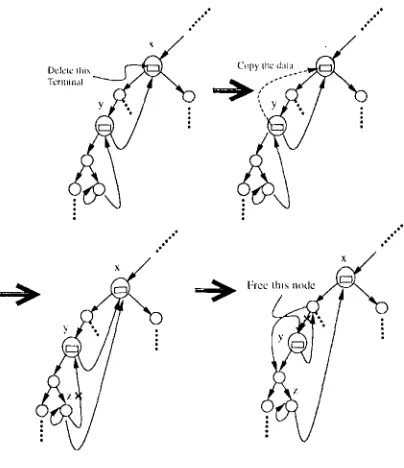
Deleting a node from a PAT-tree is a bit complicated since the proper structure of the PAT- tree has to be maintained after the deletion process. The pointers and the last decision node have to be modified. The deletion procedure is illustrated step by step by the example in Fig. 3.2. Suppose that the element in the node x has to be deleted, i.e. the node x has to be returned free. Hence, the last decision node y is no longer necessary since it is the last decision bit which makes the branch decision between DATA(x) and the strings in the left subtree of y. Therefore, DATA(x) and DECISION(y) can be removed, and the pointers have to be reset properly. In step 1, a) DATA(x) is replaced by DATA(y), b) the backward pointer in
z pointing to y is replaced by x, and c) the pointer of the parent node of y which points to y is replaced by the left pointer of y. After step 1, the PAT-tree structure is properly reset. However the node y is deleted instead of x° This will not affect the searching of the PAT-tree, but it will damage the algorithm of the evaluation function to keep the time lapse properly. Therefore, the whole record of the data in x is copied to y, and is reset to the left pointer of the parent node of x be y in the step 2. Of course, it is not necessary to divide the deletion process into the above two steps. This is just for the sake of clear illustration. In the actual implementation, management of those pointers has to be handled carefully. Since there is no backward pointer which points to a parent decision node, the relevant nodes and their ancestor relations have to be accessed and retained after searching DATA(x) and DATA(y).
°°"
Delete lilis Tcrlll[fl~[
I
° ° . ' °
X
o° .°°*
Cvp) Ihc d:lt;i .
- ' > C ...
[image:5.612.314.516.323.557.2]o*~ x Fr
Fig. 3.2 Tile deletion process
4. Learning word collocations by
Pat-trees
4.1 The testing environment
We used the Sinica corpus as our testing data. The Sinica corpus is a 3,500,000-word Chinese corpus in which the words are delimited by blanks and tagged with their part-of-speeches[Chen 96]. To simplify the experimental process, the word length was limited to 4 characters. Those words that had rnore than four characters were truncated. A preprocessor, called reader, read the word bi- grains from the corpus sequentially and did the truncation. Then the reader fed the bi-grams to the construction process for the Pat-tree. There were 2172634 bigrams and 1180399 different bi-grams. Since the number of nodes in the PAT-trees was much less than the number of input bi-grams, the deletion process was carried out and some bi- grams was removed fl-om the PAT-tree. The recall rates of each different frequency bi-grams under the different memory constraints were examined to determine how the PAT-tree performed with learning important infornlation.
4.2 Experimental ResuLts
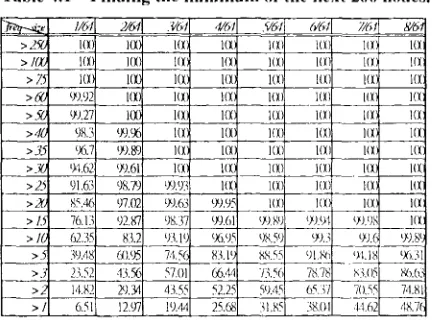
Table 4.1 Finding the minimnnl of t h e n e x t 200 nodes.
> 2 % I(I I(X) I(1', 1(I 1(1) l(i;) 1(I IC(
> 105 l(l( ICX) l{l(l I(I I(1) I(l{I I(/ 1(/
> 7..5 1(1 1(13 10('. l(X 1(1) 1(1(1 l(X 1(I
> ( ~ 99.9~ I(101 I(1) I(3( I(11 ! l(X) I11 I('/
>56 tY),23 IDI) 1(I} l(* tCX) 1(ll ill 1(I
>46 98.7 99.% L(E l(X I(X) 1(1) I(I 1{/
>33 t)6.] ~#).N I(I] l(I 1(/) 1(11 I(I i(/
>_76 9.1.6: ~/').61' l(X] I(X l(]() I(11 I(l I1~(
>23 91.6: 98.79 ~)9.93 Ill 1(1) I(/) I(1 Ill
>2(, 85.,1( 97.02 cl).63 '-t).9_' l(l) ](E I(/ I(I
> L5 76.12 92.87 98.37 c~).61 ~)89 99.9 ~. ~>).% I(I
> 16 62.3-' 83.2 % 1~ 96.9~ 98.59 9).3 99.( 99.8 t
> 3 39.4~ 6(1.% 74.5(: 8~.1 ~. ~;8.~q ~ ) l ~ ol.)~. %.31
>.7 2 57 43.56 57.(/I (26.4<: 73.56 7878 >,3.0~ ?~).6!
>,~ 1,1.8~ 29.34 43.55 52.2~ 59A5 65.37 7 .5 < 7,1.81
> 6.51 12.97 19.44 25.6{ 31.85 38.01 .14.62: 48.7£
Different time lapses and P A T - t r e e sizes were tested to see h o w they p e r f o r m e d by c o m p a r i n g the results with the ideal cases. The ideal cases were o b t a i n e d using a p r o c e d u r e in which the input bi-grams w e r e pre-sorted a c c o r d i n g to their f r e q u e n c y counts. The bi-grams w e r e inserted in d e s c e n d i n g order of their frequencies. Each bi-gram was
inserted n times, w h e r e n was its frequency. A c c o r d i n g to the deletion criterion, under such an ideal case, the P A T - t r e e will retain as m a n y high f r e q u e n c y bi-grams as it can.
Tahle 4.2 Input bi-grams in descending order of their
f r e { uencies.
~ . 1/64 2164 _V64 4/~t $/64 6/~ 7/(4 ,~'64
>250 I(X: 1111 I(E I(I ](l iCX I(l I(/
>/OO 1([: 1(1) I(11 I(11 I(1 I([ l(X I(/ > Z5 l(X) i(I) I11) 1(1} 1(~: I(X: I(1: I(X: >t~t'2 1(11 I(/) I{X) II11 l(~: I(I 111: I{l:
>_~2 IIII [(I) Ill} I{XI 1(1: t(I 1(1 l(Y
>40 Jill Ill) I(l) I(11 I(Xl Ill: Ill: I(F
>35 l[xI I(ll ]IX) Ill} I(~] Ill2 ](l: I(E
> J O liU I(D I(11 1(11 1(1: Ill: Ill: I(/:
> 2f I(XI I(/I I(ll 1(11 I(1: I(I I(I: I(/: >~7 I(11 I(11 I(XI I(11 1if I(I l(I I(~:
>/.5 I(11 I(~l l(X) l i e ](X: I(I 1(1 l(l
> ] 0 I(I) l(X) ](D 103 I(X: I(K 1(/: l(l] >5 40.H 92,26 I(1) I(X] Ill; I(I I(X I(1:
> d 24 48 72 % II1: 1(1 1(1: 1(1
> 2 I ~ N) 45 (~ 75 cX 1(1] ](1:
> l 6.55 13,1 19.65 26.1~ 32.7,1 39,2~ ,~.2( 52.N
The deletion process worked as follows. A fixed number of nodes were checked starting from the last modified node, and the one with the minimal frequency was chosen for deletion. Since the pointer was moving forward along the index of the array, a time lapse was guaranteed to revisit a node. Hopefully the high frequency bi-grams would reoccur during the time lapse. Different forward steps, such as I00, 150, 200, 250, and 300, were tested, and the results show that deletion of the least important elements within 200 nodes led to the best result. However the performance results of different steps were not very different. Table 4.1 shows the testing results of step size 200 with different PAT-tree sizes. Table 4.2 shows the results under the ideal cases. Comparing the results between Table 4.1 and Table 4.2, it is seen that the recall rates of the important bi-grams under the normal learning process were satisfactory. Each row denotes the recall rates of a bi-gram greater than the frequency under different sizes of PAT-tree. For instance, the row 10 in Table 4.1 shows that the bi-grams which had the frequency greater than 20, were retained as follows: 85.46%, 97.02%, 99.63%, 99.95%, 100%, 100%, 100%, and 100%, when the size of the PAT-tree was 1/64, 2/64 ... 8/64 of the total nulnber of the different bi-granls, respectively.
5. Conclusion
[image:6.612.318.534.155.325.2] [image:6.612.73.290.402.562.2]deletion are the eflqcient searching for patterns and its on-line learning property. It has the potential to be a good on-line training tool. Due to the fast growing WWW, the supply of electronic texts is almost unlimited and provides on-line training data for natural language processing. Following are a few possible applications of PAT- trees with deletion.
a) Learning of high frequency patterns by inputting unlimited amounts of patterns. The patterns might be character/word n-grams or collocations. Thus, new words can be extracted. The language model of variable length n-granls can be trained.
b) The most recently inserted patterns will be retained in the PAT-tree for a while as if it has a short term memory. Therefore, it can on-line adjust the language model to adapt to the current input text.
c) Multiple PAT-trees can be applied to learn the characteristic patterns of different domains or different style texts. They can be utilized as signatures for auto-classification of texts.
With the deletion mechanism, the memory limitation is reduced to some extent. The performance of the learning process also relies on the good evaluation criteria. Different applications require different evaluation criteria. Therefore, under the current PAT-tree system, the evaluation function is left open for user design.
Suffix search can be done through construction of a PAT-tree containing reverse text. Wildcard search can be done by traversing sub- trees. When a wildcard is encountered, an indefinite number of decision bits should be skipped.
To cope with the memory limitation on the core memory, secondary memory might be required. In order to speed up memory accessing, a PAT-tree can be split into a PAT-forest, Each time, only the top-level sub-tree and a demanded lower level PAT-tree will resided in the core memory. The lower level PAT-tree will be swapped according to demand.
References
de la Briandais, R. 1959. File searching using variable length keys. AFIPS western JCC, pp. 295-98, San Francisco. Calif.
Chen, Keh-Jiann, Chu-Reu Huang, Li-Ping Chang and Hui-Li Hsu. 1996. Sinica Corpus: Design
Meghodology for Balanced Copra. l l 'h Pacific Asia Conference on Language, Information, and Computation (PA CLIC I1). pp. 167-176. Flajolet, P. and R. Sedgewick. 1986. Digital
search trees revisited. SlAM J Computing, 15;748-67.
Frakes, William B. and Ricardo Baeza-Yates. 1992. Information Retrieval, Data Structures and Algorithms. Prentice-Hall.
Fredkin, E. 1960. Trie memory. CACM. 3, 490- 99.
Gonnet, G. 1987. PAT 3.1: An Efficient Text Searching System, User's Mannual. UW Centre for the New OED, University of Waterloo. Hung, J. C. 1996. Dynamic Language Modeling
for Mandarin Speech Retrieval for Home Page Information. Master thesis, National Taiwan University.