PULSE WIDTH MODULATION TECHNIQUE FOR
DIODE CLAMPED MULTI-LEVEL (THREE & FIVE
LEVEL) INVERTER FOR THD ANALYSIS
Akhlakur Rahman
1,
Mr. Jitendra Kumar Garg
2, Danish Chaudhary
31
Student, M.Tech,
2Associate Prof., Department of Electrical & Electronics Engineering,
Alfalah University, (India)
3
Assistant Prof., Department of Electrical & Electronics Engineering, LKCE, Ghaziabad, (India)
ABSTRACT
The conventional two Level Inverter has many limitations for high voltage and high power application.
Multilevel inverter becomes very popular for high voltage and high power application. The multilevel began
with the three level converters. The elementary concept of a multilevel converter to achieve higher power to use
a series of power semiconductor switches with several lower voltage dc source to perform the power conversion
by synthesizing a staircase voltage waveform. However, the output voltage is smoother with a three level
converter, in which the output voltage has three possible values. This results in smaller harmonics, but on the
other hand it has more components and is more complex to control. In this paper, study of different three level
& five level inverter topologies and SPWM technique is explain and SPWM technique has been applied to
formulate the switching pattern for three level and five level diode clamped inverter that minimize the harmonic
distortion at the inverter output. This paper deals with comparison of simulation results of three levels and five
level diode clampedinverter.
Keywords: Inverter, Topologies of Multilevel, THD, Sinusoidal Pulse Width Modulation,
Waveform, Three level Inverter, Five Level Inverter.
I. INTRODUCTION
The power in the battery is in DC mode and the motor that drives the wheels usually uses AC power, therefore
there should be a conversion from DC to AC by a power converter. Inverters can do this conversion. The
simplest topology that can be used for this conversion is the two-level inverter that consists of four switches.
Each switch needs an anti-parallel diode, so there should be also four anti parallel diodes. There are also other
topologies for inverters. A multilevel inverter is a power electronic system that synthesizes a sinusoidal voltage
output from several DC sources. These DC sources can be fuel cells, solar cells, ultra capacitors, etc. The main
idea of multilevel inverters is to have a better sinusoidal voltage and current in the output by using switches in
series. Since many switches are put in series the switching angles are important in the multilevel inverters
because all of the switches should be switched in such a way that the output voltage and current have low
voltage with low THD is desirable, but increasing the number of levels needs more hardware, also the control
will be more complicated. It is a tradeoff between price, weight, complexity and a very good output voltage with
lower THD.
II. INVERTER
The DC - AC converter, also known as the inverter, converts dc power to ac power at desired output voltage and
frequency. The dc power input to the inverter is obtained from an existing power supply network or from a
rotating alternator through a rectifier or a battery, fuel cell, photovoltaic array or magneto hydrodynamic
generator. The filter capacitor across the input terminals of the inverter provides a constant dc link voltage.The
inverter therefore is an adjustable-frequency voltage source. The configuration of ac to dc converter and dc to ac
inverter is called a dc-link converter. Inverters is, referring to the type of the supply source and topology
relationship of the power circuit, can be classified as voltage source inverters (VSIs) and current source inverters
(CSIs). In this project only the voltage source inverter will be discuss. Furthermore, the power inverter can
produce different types of output wave form such as square wave, modified sine wave, and pure sine wave
signal. These signal outputs represent different qualities of power output. Square wave inverters result in uneven
power delivery that is not efficient for running most devices. Square wave inverters were the first types of
inverters made and are obsolete.
III. MULTILEVEL INVERTER
Now a day’s many industrial applications have begun to require high power. Some appliances in the industries
however require medium or low power for their operation. Using a high power source for all industrial loads
may prove beneficial to some motors requiring high power, while it may damage the other loads. Some medium
voltage motor drives and utility applications require medium voltage. The multi level inverter has been
introduced since 1975 as alternative in high power and medium voltage situations. The Multi level inverter is
like an inverter and it is used for industrial applications as alternative in high power and medium voltage
situationsThe need of multilevel converter is to give a high output power from medium voltage source. Sources
like batteries, super capacitors, solar panel are medium voltage sources. The multi level inverter consists of
several switches. In the multi level inverter the arrangement switches’ angles are very important.
IV. TOPOLOGY OF MULTILEVEL INVERTER
The basic three types of multilevel topologies used are
Diode clamped multilevel inverters
Flying capacitors multilevel inverter or Capacitor clamped multilevel inverter
Cascaded inverter with separate dc sourceV. DIODE CLAMPED MULTILEVEL INVERTER
The first invention in multilevel converters was the so-called neutral point clamped inverter. It was initially
level. The main concept of this inverter is to use diodes to limit the power devices voltage stress. The voltage
over each capacitor and each switch is Vdc. An n level inverter needs (n-1) voltage sources, 2(n-1) switching
devices and (n-1) (n-2) diodes.
As the number of levels increases the harmonic content of the output waveform decreases the filter size.
Lower switching losses due to the devices being switched at the fundamental frequency without increasing the
harmonic content in the output. Its Reactive power flow can be controlled, as this does not cause unbalance in
the capacitor voltages. It also has fast dynamic response. & in this back to back operation is possible.
But due to high number of clamping diodes is required as the number of levels increase. Its active power
transfer causes unbalance in the DC-bus capacitors, this complicates the control of the system.
VI. 3-LEVEL DIODE CLAMPED MULTILEVEL INVERTER
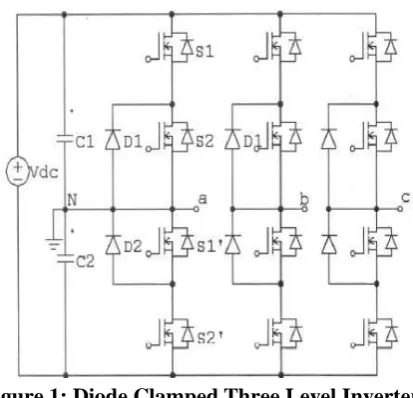
In a 3-level diode clamped multilevel n=3so that, its:
Number of switches = 2(n-1) =4 Number of diodes = (n-1)*(n-2) =2
Number of capacitors = (n-1) =2
The diode clamped multilevel inverter uses capacitors in series to divide up the DC bus voltage into a set of
voltage levels. To produce m levels of the phase voltage, an m level diode clamp inverter needs (m-1) capacitors
on the DC bus.
Figure 1: Diode Clamped Three Level Inverters
VII. 5 - LEVEL DIODE CLAMPED MULTILEVEL INVERTER
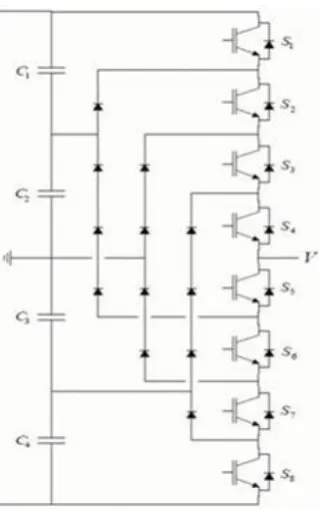
In a 5-level diode clamped multilevel the value forn=5. Therefore
Number of switches = 2(n-1)= 8 Number of diodes = (n-1)* (n-2) =12
A 5-level diode clamped multilevel inverter is shown in Fig. 2. For example to have Vdc/2 in the output,
switches S1 to S4 should conduct at the same time. For each voltage level four switches should conduct. As it
can be seen in Table.1 the maximum output voltage in the output is half of the DC source. It is a drawback of
the diode clamped multilevel inverter. This problem can be solved by using a two times voltage source or
cascading two diode clamped multilevel inverters
Figure 2: Diode Clamped five level Inverters
VIII. TOTAL HARMONIC DISTORTION (THD)
Power sources act as non-linear loads, drawing a distorted waveform that contains harmonics. These harmonics
can cause problems ranging from telephone transmission interference to degradation of conductors and
insulating material in motors and transformers. Therefore it is important to gauge the total effect of these
harmonics. The summation of all harmonics in a system is known as total harmonic distortion (THD). This
paper will attempt to explain the concept of THD and its effects on electrical equipment. It will also outline the
low THD of the Associated Power Technologies (APT) line of programmable sources and how these can be
used to more effectively test equipment. Total harmonic distortion is a complex and often confusing concept to
grasp. However, when broken down into the basic definitions of harmonics and distortion, it becomes much
easier to understand
Harmonics have frequencies that are integer multiples of the waveform’s fundamental frequency. For example, given a 60Hz fundamental waveform, the 2nd, 3rd, 4th and 5th harmonic components will be at 120Hz, 180Hz,
240Hz and 300Hz respectively. Thus, harmonic distortion is the degree to which a waveform deviates from its
pure sinusoidalValues as a result of the summation of all these harmonic elements. The ideal sine wave has zero
harmonic components. In that case, there is nothing to distort this perfect wave.
Total harmonic distortion, or THD, is the summation of all harmonic components of the voltage or current
The formula above shows the calculation for THD on a voltage signal. The end result is a percentage comparing
the harmonic components to the fundamental component of a signal. The higher the percentage, the more
distortion that is present on the mains signal
IX. SIMULINKMODEL & WAVEFORMS
Simulation was carried out to observe the improvement in the line voltage THD and as the inverter level
increases from 3-level to 5-level.
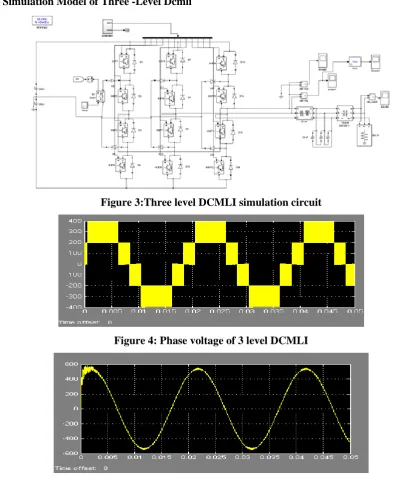
9.1 Simulation Model of Three -Level Dcmli
Figure 3:Three level DCMLI simulation circuit
Figure 4: Phase voltage of 3 level DCMLI
Figure 6:THD level of 3 Level DCMLI
Figure 7: THD Waveform of the output of 3-Level DCMLI
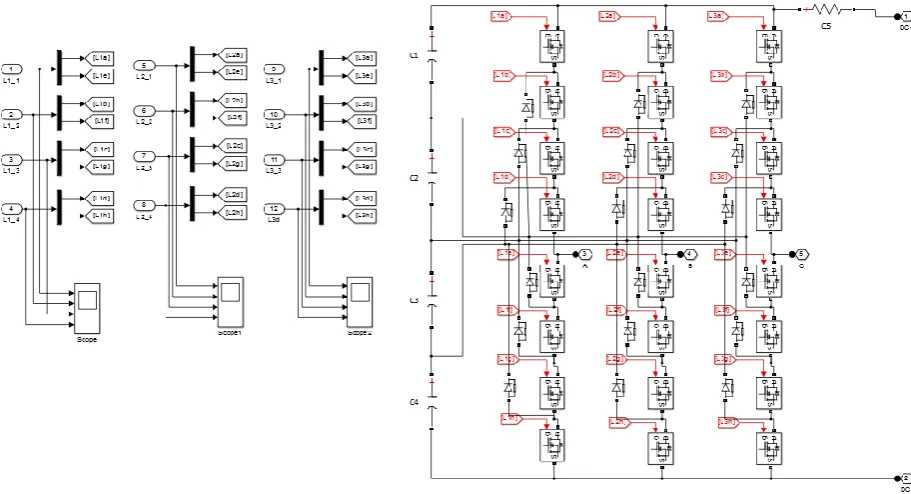
9.2 Simulation Model of Five-Level Dcmli
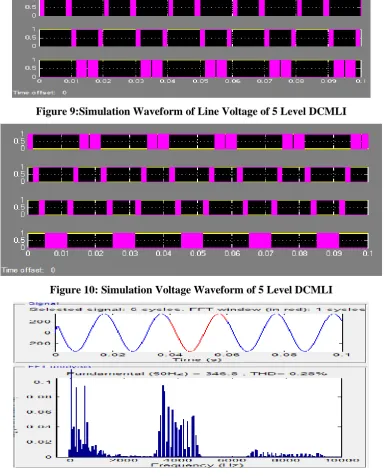
Figure 9:Simulation Waveform of Line Voltage of 5 Level DCMLI
Figure 10: Simulation Voltage Waveform of 5 Level DCMLI
Figure 11: THD Waveform of the Output of 5-level DCMLI
X. RESULTS
Simulation was carried out to observe the improvement in the line voltage and THD for RL load as the inverter
Table1:Simulation Result for THD of 3 &5 level DCMLI
Multilevel inverter
Fundamental
Frequency(f)
Voltage Level
% of THD
Three level DCMLI
50HZ
537.6(V)
1.27%
Five level DCMLI
50HZ
346.89(V)
0.28%
XI. CONCLUSION
In this paper Pulse Width Modulation Technique is applied on diode clamped multilevel inverters and
percentage of total harmonic distortions of three and five levels of inverter are simulated and compared. The
simulated results are presented in this paper and it is concluded, we can see that in above Table: 1, the % THD
of three level inverter is 1.27% at voltage level 537.6(v)& the % THD of five levels is 0.28% at voltage level 346.89(v). When the voltage level is decreases, and no. of level is increases the total harmonic distortion will decreases.
REFRENCES
[1] A. K. Gupta and A. M. Khambadkone, “A general space-vector PWM algorithm for multilevel inverters,
including operation in over modulation range,” IEEE Trans. Power Electron., vol. 22, no. 2, pp. 517– 526,Mar. 2007
[2] A. Nabae, I. Takahashi, and H. Akagi, „A new neutral point clamped PWM inverter‟, ZEEETrans.,
1981,1A-17,(5), pp.518-523.
[3] N. S. Choi, J. G. Cho, and G. H. Cho, “A general circuit topology of multilevel inverter,” IEEE PESC’91,
1991, pp. 96–103.
[4] S., Mishra A., B. Srinivas, “Control of Voltage Source Inverters using PWM/SVPWM for Adjustable
Speed Drive Applications”, Dept. of ElectricalEngineering, National Institute Of Technology Rourkela,
Rourkela - 769008 , May 2009
[5] N. Mohan Teja, R S Ravi Sankar, P. Harsha, V. UmaShankar’A Novel Method of Diode Clamped Multi-Level Inverter using PWM Technique’IJIES
[6] P S BHIMBHRApower electronics.
[7] M.RASHID, POWER ELECTRONICS
[8] G. Laxminarayana1,K.pradeep comparative analysis of 3,5&7 level inverter using space vector PWM(IJAREEIE Vol.2 Issue.7,2013)
[9] Operation and Design of Multilevel InvertersDr. Keith Corzine University of Missouri–Rolla
[10] C.Boonmee,Y.Kumsuwan,“A Phase- Shifted Carrier- Based PWM Technique For Cascaded H-Bridge
Inverters Application In Standalone PV System,” IN PROC. IEEE. CONF.,SEP. 2012, VOL. 4, PP.
[11] F.Z.PENG and J.S.Lai, “A Static VAR Generator Using A Staircase Waveform Multilevel Voltage -
Source Converter,” IN PROC. PCIM/POWER QUALITY, 1994, PP. 58-66. “Power Converter Options