Method for Detecting an Open Switch Fault in a Grid
Connected Npc Inverter System
B.Vishnuvardha & K.Mahender
ABSTRACT: In this paper we are implementing a three level converter which is utilized as the power converter of wind turbine due to its advantage like high efficiency, low collector emitter voltage and low current total harmonic distortion. According to the interior permanent magnet synchronous generator it has the better size and efficiency. Therefore according to the wind turbine system which consist of the three level converter and IPMSG and fault tolerant control for the open circuit fault of switches which is used to improve the reliability. Therefore according to the paper which is perform on the open circuit fault of the outer switches in the three level rectifiers which is connected to the IPMSG .according to the effect ofSx1 andSx4 open-circuit faults have been analysis which is based upon the proposed in the tolerant control. Therefore according to the proposed tolerant control which is maintain in normal operation such as sinusoidal control which is under the open fault of the outer switches by adding a compensation value to the reference voltages. By using the simulation result we can analysis the performance of the proposed system.
I. INTRODUCTION
The power capacity of a wind turbine system has been increasing consistently, leading to the development of generators with large power capacity [1]–[3]. There are many types of generators. Permanent magnet synchronous generators (PMSGs) have high efficiency and high reliability compared with induction generators. This is because external excitation is not required and there are no copper losses in the rotor circuits. Moreover, because of the smaller size of the PMSG, the weight of the wind turbine is reduced [4].
Among various PMSGs, interior PMSGs (IPMSGs) are especially advantageous from the standpoints of efficiency and power generation owing to the use of the reluctance torque [4]–[7]. Generators requiring high voltage need to use multilevel converter topologies to reduce the collector–emitter voltage per switch. Among multilevel topologies, three-level topologies such as the three-level neutral-point clamped (3L-NPC) and T-type topologies are applied in wind turbine systems with a wide power range.
Furthermore, the three-level topology guarantees high efficiency and low-current total harmonic distortion (THD) in comparison with the twolevel topology [8]–[11]. The 3L-NPC topology is vulnerable to switch faults because many switches are used. Switch fault detection and tolerant control
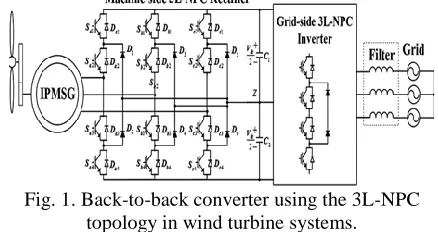
methods for switch faults should be implemented to improve the reliability of wind turbine systems. Switch faults are divided into a short-circuit fault and an open-circuit fault [12]. The short-circuit fault normally leads to a breakdown of the entire system; therefore, fault detection and tolerant control methods for the short-circuit fault require additional circuits. On the other hand, the open-circuit fault leads to current distortion, which can lead to a breakdown if it persists for a long time; therefore, the open-circuit fault should be detected, and the tolerant controls are necessary [9], [12]–[15]. In wind turbine systems, a back-to-back converter is used to transfer power from the generator to the grid. A back-toback converter using the 3L-NPC topology is shown in Fig. 1.
Fig. 1. Back-to-back converter using the 3L-NPC topology in wind turbine systems.
This consists of the machine-side 3L-NPC rectifier, the dc-link, and the grid-side 3L-NPC inverter. Depending on the operating conditions, tolerant controls can be applied for the rectifier or the inverter because the current paths of the rectifier and the inverter are different [9], [13]–[15]. In addition, the different structure of the three-level topologies should be considered in the tolerant controls [9], [13]. In the 3L-NPC inverter, the open-circuit fault of the inner switch causes the outer switch connected it to be infeasible; therefore, changing only the switching method does not become a solution for the open-circuit fault, and the additional devices such as fuses and switches should be added for achieving the tolerant operation under the open-circuit fault of the inner switch.
state without any additional devices [14]. In addition, the reactive current is injected to eliminate current distortion caused by the open-circuit fault of the outer switch [22]. This method can also be applied for the T-type rectifier. The T-type rectifier is advantageous on the tolerant control because the switches in a leg are independent of each other. Many tolerant control methods for the open-circuit fault of the inner switch, which can be used in both the T-type inverter and rectifier, were proposed . However, according to the specification of the PMSG, an open-circuit fault of the outer switch can cause current distortion as much as when an open circuit fault of the inner switch occurs [22]. Rectifiers with IPMSGs can operate to generate maximum power at pfsother than unity. IPMSGs provide more power
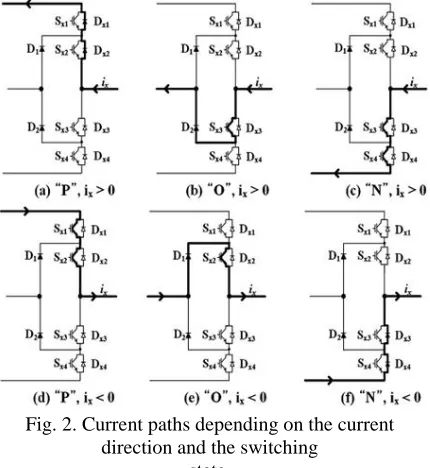
Fig. 2. Current paths depending on the current direction and the switching
state.
when rectifiers operate at a uniquepf[4]–[7]. In such a case, an open-circuit fault of the outer switches (Sx1andSx4) causes current distortion and torque fluctuation, which can lead to vibration of the wind turbine. In this paper, the reason for the current distortion caused by the outer switches (Sx1 andSx4) is analyzed, and then, on the basis of this analysis, a tolerant control forSx1 andSx4 open-circuit faults is proposed. In the proposed tolerant control, the switch with an open-circuit fault is not used to generate the input voltages of the three-level rectifier by adding a compensation value to the reference voltages. The compensation value is simply calculated and thepfdoes not change in the proposed tolerant control.
III. OPEN-CIRCUITFAULTANALYSIS OFOUTERSWITCHES
There are three switching states (P, N, and O) in the 3L-NPC rectifier [9]. Six current paths can be generated depending on the current direction and the switching state, and these are shown in Fig. 2 [23]. Fig. 3 shows the input current generation process of a rectifier with unitypf. The rectifier current is Irec, the rectifier voltage is Vrec, and the back electromotive force (EMF) is VEMF.
Fig. 3. Rectifier operation at unitypf. TABLE I
CURRENTPATHCOMPOSITIONDEPENDING ON THEPART OFFIG.3
The phase difference betweenVEMF andVrec, which causes the current flow, is controlled to match the phase ofIrec up with the phase of the corresponding VEMF. One period of Irec can be divided into four parts depending on the polarity ofIrec and Vrec. The generated current paths are different depending on the part, and these are summarized in Table I. In parts A and C, the O switching state causes the input current flow; therefore, this is called the valid switching state.
In parts B and D, the P and N switching stages are the valid switching state where the current flows through the switches. When the rectifier operates with unitypf, parts A and C are large, and parts B and D are small. If parts B and C are very small as much as be ignored, theSx1andSx4open-circuit faults can be ignored [22], [23].
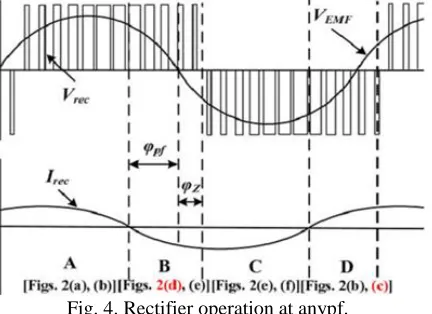
the phase difference (ϕpf) betweenIref andVEMFcaused by thepf.InFig.4, part B (or part D) consists ofϕZ andϕpf, and their lengths increase. This means that the current can be more distorted by the open-circuit fault of the outer switches compared to when ϕZ alone is considered
Fig. 4. Rectifier operation at anypf.
Case I can be ignored becauseϕZ is determined depending on the operating condition of the rectifier and the PMSG. However, becauseϕpf is determined by thepf, Case II should be considered when the IPMSG is employed. The current distortion caused by the open-circuit fault of the outer switches is shown in Fig. 5 for variouspfs. Owing to the infeasible open-circuit fault switch, the current becomes zero during the range consisting ofϕZandϕpf.TheSx1open-circuit fault makes the current path of Fig. 2(d) infeasible.
The current path of Fig. 2(d) belongs to part B; therefore, theSx1 opencircuit fault causes distortion in the negative current as shown in Fig. 5(a) and (c). On the contrary, the Sx4 open-circuit fault leads to distortion in the positive current as shown in Fig. 5(b) and (d) because the current path of Fig. 2(c) related to theSx4 open-circuit fault belongs to part D.
Fig. 5. Current distortion depending on the open-circuit fault and thepf:(a)
0.95pf, Sx1 circuit fault, (b) 0.95pf, Sx4 open-circuit fault, (c) 0.9pf,
Sx1 open-circuit fault, and (d) 0.9pf,Sx4 open-circuit fault
III.TOLERANT CONTROL FOROPEN-CIRCUIT FAULT OF OUTERS WITCHES
An existing tolerant control method for the open-circuit fault of the outer switches isreactive current injection [22]. This method changes the phase ofIrecso that it corresponds with the phase ofVrec. This means that parts B and D are eliminated. However, this tolerant control method has the disadvantage of low-power generation efficiency of the generator because the PMSG has efficient operating condition which depends on the pfof the rectifier. In general, the unitypfis required for the best operating condition of a surface PMSG. The rectifier voltage (Vrec) without the current path related to the open-circuit fault switch is generated by changing the reference voltages. To explain the proposed tolerant control, theSx1open-circuit fault is used as an example.
A. Compensation Voltage (Vcomp) Calculation
Three-phase reference voltages (Vx,ref, x=a, b, c)areexpressed as
𝑉𝑎,𝑟𝑒𝑓= 𝑉𝑚𝑎𝑔cos(2𝜋𝑓𝑠𝑡)
𝑉𝑏,𝑟𝑒𝑓= 𝑉𝑚𝑎𝑔cos(2𝜋𝑓𝑠𝑡 − 2𝜋 3⁄ )
𝑉𝑐,𝑟𝑒𝑓= 𝑉𝑚𝑎𝑔cos(2𝜋𝑓𝑠𝑡 + 2𝜋 3⁄ ) (1)
whereVmagis the magnitude of the reference voltages, and fs is the fundamental frequency. The offset voltage (Voffset) is added to each reference voltage to expand the range of the modulation index(Ma = √ 3× Vmag/Vdc). Voffset
and the changed reference voltages
(Vx,ref,offset,x=a, b, c) are expressed as
𝑉𝑜𝑓𝑓𝑠𝑒𝑡= − (𝑉𝑟𝑒𝑓,𝑚𝑎𝑥+ 𝑉𝑟𝑒𝑓,𝑚𝑖𝑛) 2⁄ (2)
𝑉𝑎,𝑟𝑒𝑓,𝑜𝑓𝑓𝑠𝑒𝑡 = 𝑉𝑎,𝑟𝑒𝑓+ 𝑉𝑜𝑓𝑓𝑠𝑒𝑡
𝑉𝑏,𝑟𝑒𝑓,𝑜𝑓𝑓𝑠𝑒𝑡= 𝑉𝑏,𝑟𝑒𝑓+ 𝑉𝑜𝑓𝑓𝑠𝑒𝑡
𝑉𝑐,𝑟𝑒𝑓,𝑜𝑓𝑓𝑠𝑒𝑡= 𝑉𝑏,𝑟𝑒𝑓+ 𝑉𝑜𝑓𝑓𝑠𝑒𝑡
(3)
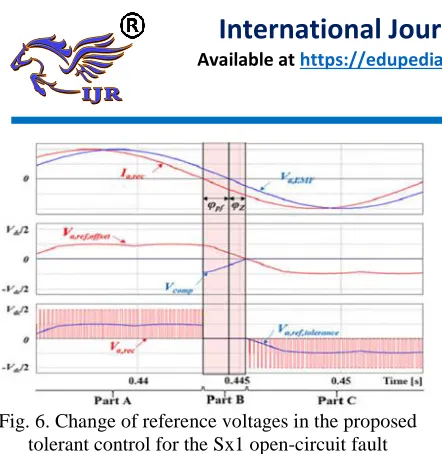
Fig. 6. Change of reference voltages in the proposed tolerant control for the Sx1 open-circuit fault
(0.95pf).
open-circuit fault is changed to zero as shown in Fig. 6. As a result, the current path of Fig. 2(d) disappears because the O switching state is only used in part B. To make the reference voltage zero,|Vcomp| is assigned the magnitude of the reference voltage (Vx,ref,offset) containing the open-circuit fault, and Vcompcan be expressed as
𝑉𝑐𝑜𝑚𝑝= −𝑉𝑥,𝑟𝑒𝑓,𝑜𝑓𝑓𝑠𝑒𝑡(𝑥 =
𝑎 𝑝ℎ𝑎𝑠𝑒 𝑐𝑜𝑛𝑡𝑎𝑖𝑛𝑖𝑛𝑔 𝑜𝑝𝑒𝑛 𝑐𝑖𝑟𝑐𝑢𝑖𝑡𝑒𝑑 𝑓𝑎𝑢𝑙𝑡 𝑠𝑤𝑖𝑡𝑐ℎ)
(4)
The proposed tolerant control is implemented by adding Vcomp to the reference voltages (Vx,ref,offset, x=a, b, c). The new reference voltages (Vx,ref,tolerance, x=a, b, c) of the proposed tolerant control are expressed as
𝑉𝑎,𝑟𝑒𝑓,𝑡𝑜𝑙𝑒𝑟𝑎𝑛𝑐𝑒= 𝑉𝑎,𝑟𝑒𝑓,𝑜𝑓𝑓𝑠𝑒𝑡+ 𝑉𝑐𝑜𝑚𝑝
𝑉𝑏,𝑟𝑒𝑓,𝑡𝑜𝑙𝑒𝑟𝑎𝑛𝑐𝑒= 𝑉𝑏,𝑟𝑒𝑓,𝑜𝑓𝑓𝑠𝑒𝑡+ 𝑉𝑐𝑜𝑚𝑝
𝑉𝑐,𝑟𝑒𝑓,𝑡𝑜𝑙𝑒𝑟𝑎𝑛𝑐𝑒= 𝑉𝑏,𝑟𝑒𝑓,𝑜𝑓𝑓𝑠𝑒𝑡+ 𝑉𝑐𝑜𝑚𝑝 (5) B. Compensation Range for AddingVcomp
By addingVcomp to each reference voltage, the use of the current path related to the open-circuit fault switch will be precluded. To achieve this perfectly,Vcompis added for the suitable range and position. The compensation range, which is part B or part D of Fig. 4, consists ofϕZandϕpf. ϕZcan be calculated with the equivalent circuit of the PMSG and the three-level rectifier [22].ϕZ, which is the phase difference betweenVEMFand Vrec, is expressed as
𝜑𝑧= tan−1(
−|𝐼𝑟𝑒𝑐|∗2𝜋𝑓𝑠𝐿
𝑉𝐸𝑀𝐹−|𝐼𝑟𝑒𝑓 |𝑅) (6)
whereRandLare the equivalent resistance and inductance of the PMSG, and fs is the fundamental frequency representing the angular frequency of the PMSG. ϕpf, which is the phase difference between VEMFandIrec, is related to the pf. ϕpf can be calculated by thepfand this is
Fig. 7. Compensation position on the basis ofVEMF’s angle (θEMF).
TABLE I I
Compensation range depending On The position Of The open-Circuit
Fault
expressed as
𝜑𝑝𝑓= cos−1(𝑝𝑓) (7)
If the d–q control theorem is used,ϕpf can be calculated as
𝜑𝑝𝑓= cos−1( 𝐼𝑞𝑒
√𝐼𝑞𝑒2+𝐼𝑑𝑒2
) (8)
Fig. 8. Proposed tolerant control considering neutral-point voltage balance under theSa1 open-circuit fault.
TABLE III
Principle Of The proposed tolerant control depending On The Position Of The open-Circuit fault
C. Considering Neutral-Point Voltage Balance
The compensation voltage which is one of the offset voltages can cause neutral-point voltage unbalance becauseVcomp calculated from (4) is a one-sided voltage [10], [24]. Therefore, two dc-link capacitors have different values depending on the polarity of Vcomp generated for the open-circuit fault. The neutral-point voltage unbalance increases the voltage stress on the switch and the current THD [24]. The proposed tolerant control for the open-circuit fault of the outer switches has to incorporate a solution for the neutralpoint voltage unbalance problem.
Therefore, as mentioned earlier, Vcomp is added for the corresponding compensation position depending on the position of the open-circuit fault, and then, Vcomp is also added in the diametrically opposite compensation position to balance the neutral-point voltage. Fig. 8 shows the concept of proposed tolerant control considering the neutral-point voltage balance when the Sa1 open-circuit fault occurs. In Fig. 8, Vcomp is added for the compensation range[(0 ◦−ϕpf)∼(0 ◦+ϕZ)]which corresponds to the position for theSa1 open-circuit fault; in addition,Vcomp is also added for the diametrically opposite compensation range [(180
◦−ϕpf)∼(180 ◦+ϕZ)], which is the range for the Sa4 open-circuit fault. TwoVcomps added in two positions have opposite polarity, and this results in the balanced neutral-point voltage. The final principles of the proposed tolerant control with the neutral-point voltage balance are summarized in Table III.
Fig. 9. Vx,ref,tolerance(x=a,b,c) andVcompdepending on thepfwhenMa is 0.5.
Fig. 10. Applicablepfrange of the proposed tolerant control depending onMa.
D. Limitation of Proposed Tolerant Control
Vx,ref,tolerance cannot exceed a limitation voltage (Vlimit )which is restricted by the dc-link voltage (Vdc). Therefore, Vcomp is limited as follows
𝑉𝑐𝑜𝑚𝑝< 𝑉𝑙𝑖𝑚𝑖𝑡− 𝑉𝑟𝑒𝑓,𝑚𝑎𝑥 (9)
Fig. 10 shows the applicablepfrange for various values ofMa. The shaded part of Fig. 10 represents the applicable operation range. The proposed tolerant control is feasible over the entire factor range when Ma is smaller than 0.5. By increasing Ma from 0.5, the applicable operation range decreases. In Fig 10.
Table I V
Ipmsg Parameters Insimulation
Table V
Currentthdandrms Valuescomparison(600rpm,0.95pf)
the applicable operation range shown as ARpf is largest when only thepfrelated to ϕpf is taken into account. However, a largeϕZmeans that large portion of the compensation range is reserved forϕZ, and the rest can be used to compensate ϕpf. Therefore,ϕZcaused by the impedance of the PMSG reduces the applicablepfrange, and it is shown inARpf,ZwithϕZ=10. ϕZis determined by the operation conditions and parameters of the PMSG shown in (6). The proposed tolerant control has a limitation on its operation range that depends on thepfandMa. However, considering that wind turbine systems do not always operate with the rated wind speed (highMa) and that the operatingpfof the rectifier with an IPMSG is not too low, the proposed tolerant control can clearly be effective.
IV. SIMULATIONRESULTS
The simulation is performed using the PSIM tool. The 3L-NPC rectifier of the back-to-back converter with 2.5-MW IPMSG is only considered in the simulation. The IPMSG parameters used in the simulation are shown in Table IV. The proposed
tolerant control for the open-circuit fault of the outer switches (Sx1,Sx4)is implemented for differentpfsand generator speeds. Fig. 11 shows the simulation results of the proposed tolerant control when the Sa1 open-circuit fault occurs. The speed of the PMSG is 600 rpm,Ma is 0.35, and the pfof the rectifier is 0.95. Owing to the Sa1 open-circuit fault, the negative current is distorted as shown in Fig. 11(a). After the proposed tolerant control is applied, the reference voltages are changed byVcomp for the corresponding ranges[(0 ◦−ϕpf)∼ (0 ◦+ϕZ),(180 ◦−ϕpf)∼(180 ◦+ϕZ)]which are defined in Table III. As a result, the a-phase pole voltage (Van) is clamped to 0 at their ranges as shown in Fig. 11(b) and the current distortion is eliminated completely.
In addition, the two dc-link capacitor voltages are balanced. The proposed tolerant control is effective for the pf transition operation of the rectifier. Fig. 12 shows the results when the proposed tolerant control is applied and the pfis changed from 0.95 to 0.9. The compensation range is extended as much as the pf decreases and the currents are maintained without distortion continuously. Moreover, we know that the peak value of Vc,ref,tolerance becomes large because the pf decreases which was discussed in Section III.
(a)
(b)
Fig. 11. Simulation results with the proposed tolerant control under the Sa1 open-circuit fault (600 rpm,Ma
Fig. 12. Simulation results with the proposed tolerant control under theSa1 open-circuit fault (600 rpm,Ma
=0.35, pf-transition from 0.95 to 0.9).
Fig. 13. Simulation results with the proposed tolerant control under theSa1 open-circuit fault (1000 rpm,Ma
=0.59,0.95pf)
Fig. 13 shows the performance of the proposed tolerant control under the Sa1 open-circuit fault at different speed (1000 rpm) of the PMSG whenMa is 0.59. Similar to Fig. 11, the distorted currents are corrected after the proposed tolerant control is applied. However, the peak value ofVc,ref,tolerance is close toVlimit(Vdc/2)at 0.95pf, which is different from what is shown in Fig. 11. This is becauseMaof Fig. 13 has a smaller applicable operation range than that of Fig. 11, which can be seen in Fig. 10. Table V shows the current THD results before and after the proposed tolerant control is applied. The current THD is increased by theSa1 open-circuit fault; however, owing to the proposed tolerant control, the current THD is restored as good as normal state without any open-circuit fault.
VI. CONCLUSION
According to the paper which is developed the tolerant control for the open-circuit fault of the outer switches in three-level rectifiers (both 3L-NPC and T-type topologies) which is utilized in the wind turbine systems. According to the basis of the analysis of the tolerant control for each open-circuit fault which is proposed about the neutral-point voltage balance. Moreover according to the control
system which is implemented by adding a compensation voltage (Vcomp) to the reference voltages for the corresponding compensation ranges depending on the position of the open-circuit fault. From the fig :10 we can analysis the control which is used in both the 3L-NPC and T-type rectifiers and guaranting during the normal operation without a change of thepfin the applicable operation range which is depend upon the modulation index (Ma) and the pf. By using the simulation result we can analysis the performance of the proposed system.
REFERENCES
[1] A. Isidori, F. M. Rossi, F. Blaabjerg, and K. Ma, “Thermal loading and reliability of 10-MW multilevel wind power converter at different wind roughness classes,”IEEE Trans. Ind. Appl., vol. 50, no. 1, pp. 484–494, Jan./Feb. 2014.
[2] H. G. Jeong, K. B. Lee, S. Chio, and W. Choi, “Performance improvement of LCL-filter-based grid-connected inverters using PQR power transformation,”IEEE Trans. Power Electron., vol. 25, no. 5, pp. 1320–1330, May 2010.
[3] S. Li, T. A. Haskew, R. P. Swatloski, and W. Gathings, “Optimal and direct-current vector control of direct-driven PMSG wind turbines,”IEEE Trans. Power Electron., vol. 27, no. 5, pp. 2325–2337, May 2012.
[4] W. Qiao, L. Qu, and R. G. Harley, “Control of IPM synchronous generator for maximum wind power generation considering magnetic saturation,” IEEE Trans. Ind. Appl., vol. 45, no. 3, pp. 1095– 1105, May/Jun. 2009.
[5] S. Morimoto, H. Nakayama, M. Sanada, and Y. Takeda, “Sensorless output maximization control for variable-speed wind generation system using IPMSG,” IEEE Trans. Ind. Appl., vol. 41, no. 1, pp. 60–67, Jan./Feb. 2005.