www.ijsernet.org Page 1
EFFECT OF FINANCIAL MANAGEMENT PRACTICES ON
PERFORMANCE OF SELECTED SMALL AND MEDIUM ENTERPRISES
IN LIMURU TOWN, KENYA
Lincoln Rugui, MBA
(MBA Student- St. Paul’s University, Kenya; Job Omagwa, PhD
(School of Business, Kenyatta University, Kenya;
ABSTRACT
The study sought to determine the effect of financial management practices on performance of selected Small and Medium Enterprises (SMEs) in Lemur Town, Kenya. SME performance is affected by financial constraints, financial illiteracy, working capital management, ownership structure, regulatory framework and macroeconomic factors. In Kenya, empirical evidence on effect of financial management practices and performance of SMEs is limited especially in the context of cosmopolitan towns like Lemur in Kenya. The study employed descriptive research design. The target population was 388 registered SMEs in the retail business in Lemur Town. Purposive sampling technique was used to sample 39 respondents. Data was collected using questionnaires. Data was analyzed through descriptive statistic (means and standard deviation), correlation analysis and multiple regression analysis. The study found that firms financing and ownership structure have fairly strong positive correlation with performance, while cash management does not have a positive correlation with performance. With a P value of0.000, which is less than the significant level of 0.05.The model was found to be a good fit. Consequently, financial management practices were found to be good measures of performance the SMEs studied. The study concluded that SMEs need to outsource more avenues of financing and improve on innovations and research, networks and partnerships with all stakeholders especially financial institutions.
Keywords: Financial management, small and medium enterprises, performance, ownership structure and working capital management.
Introduction and Background
www.ijsernet.org Page 2 SME performance is also affected by financial constraints, financial illiteracy, lack of financial and marketing information, poor financial management skills, poor working capital management, ownership structure, rigid regulatory frameworks and macroeconomic factors Mbogo, (2011). These affect Sestet profits, net worth and operational costs. SMEs sources of finance are owner’s savings, families and friends, trade credits, leasing, bank overdrafts, youth funds, Sacco, women funds, camas, micro-finance and commercial banks (Agway. SMEs performance is determined by access to affordable, adequate and less risky finances. SMEs need financial management skills, financial information, research and innovation, network and partnership with all stakeholders to enable them outsource finances, expertise, innovative investments and market(Nene, 2014).
SMEs in Lemur Town, Kenya, are enterprises in the industries of technology, agriculture, education, health, hospitality, security, transportation, construction, manufacturing, and retail. They employ between one and ten employees. They facilitate entrepreneurship, income and wealth creation and reduce poverty. Mungaray, Ramírez-Urquidy, Texis, Ledezma, and Ramírez (2007) argued that SMEs make efficient use of resources than large enterprise. They create skills, harness innovation, utilize ideal funds and talents, and create wealth. SMEs rely on a personalized, tailor-made service. Esselaar, Stork, Ndiwalana, and Deen-Swarray, (2006) highlights that SMEs provide quality products/services, fair prices and customized customer service. SMEs differ from large enterprises in planning, directing, controlling, organizing and coordinating resources, management structure, culture, research and innovations, networking and partnership, and marketing.
Statement of the Problem
The SMEs sector remains an integral part of the Kenyan economy, contributing to employment, GDP, entrepreneurship, income and wealth creation (Kenya. Hence, SMEs performance in Lemur Town seems to be challenged by several externalities such as financial structures, financial constraints, financial illiteracy, ownership structures, working capital management, macroeconomic factors and regulatory framework, which hinder them to capitalize on financial and investments opportunities, competitiveness, growth and profitability (Nene, 2014). Akorsu and Agyapong (2012) identified “alternative model for rising funds, by focusing on why lenders were cynical in advancing credit to SMEs”. SMEs in Lemur Town are financially constrained to invest and grow their business into competitive ventures, that is in products/services and/or processes. The study found that inappropriate risk management and information asymmetry limits their financial access, and thus limits their competitiveness and performance. However, there remains limited empirical literature to link financial management practices and performance of SMEs in Lemur Town, Kenya.
www.ijsernet.org Page 3 infrastructure have been viewed as a critical element for the performance of the SMEs studied. However, despite these challenges, the factors explaining the effect of SMEs performance were not fully explored by the study. Hence, the study sought to determine the effect of financial management practices on performance of SMEs in Lemur Town, Kenya.
Objectives
The study sought to achieve the following specific objectives:
i. To determine the effect of Firms Financing on performance of selected SMEs in Lemur Town, Kenya.
ii. To assess the effect of Ownership Structure on performance of selected SMEs in Lemur Town, Kenya.
iii. To establish the effect of Working Capital Management on performance of selected SMEs in Lemur Town, Kenya.
*The study formulated and tested null hypotheses (at significance level of 0.05) in view of each specific objective.
Significance of the Study
The study will be significant to SMEs owners/managers, who will acquire strategies in financing, management, marketing and innovations, to improve SMEs performance, profitability and growth. The Government will formulating policies and frameworks that favor SMEs creations, performance and growth, affordable finances, lower trade barriers, easier registration, licensing and tax incentives. Prospecting entrepreneurs will be enlighten on capitalization, opportunities, constrains and requirements for better SMEs performance, growth and profitability. The study will provide a reference material for future researchers and scholars who would want to venture into this area of study. The researcher will also benefit from the study, as the research is a partial fulfilment in a requirement to attaining a master’s degree.
Review of Literature
The study reviewed various key theories as well as empirical evidence captured hereunder.
a. Theoretical Review
The section reviews theories that anchor the study in terms of variables.
www.ijsernet.org Page 4 returns, and taxation has no effect on debts. But in the real world, there are taxes, transaction costs and bankruptcy costs, differences in borrowing costs, information asymmetries and debt has a tax benefit as it is tax deductible.
Trade-off Theory: Modigliani and Miller (1958) argue that optimal capital structure needs to be reached by outsourcing all possible alternatives in capital structure. The theory recognizes the tax benefit from interest payments which is tax deductible. Frank and Goyal (2003),Frank and Goyal (2008) points that SMEs should analysis various financial instruments costs-benefits outcome. Interior financial solutions are optimized to balance marginal costs with marginal benefits. Leverage has a positive relation with profitability and trade-off theory concur that profitable firms should borrow more, but profitable firms prefer retained earnings over debt. Profitable firms enjoys interest tax shield, hence bankruptcy costs are low. There is a positive relation between debt and assets tangibility. SMEs through trade-off theory can maximize performance by analyzing investments through costs-benefits criteria.
Pecking Order Theory: Myers (1984) argued that SMEs prefers retain earnings, internal to external financing, debt to equity and short-term debt to long-term debt. Due to information asymmetry and the costs of information, retained earnings are preferred than debt and debt is preferred than equity. SMEs prefer finances that do not interfere with their ownership. SMEs owners/managers know the performance, profitability and growth prospects of their firms. External lenders expect SMEs to explain their investment plans and expose internal information and operations. Mazzarol (2014) argued that SMEs size, profitability and growth prospects are related to leverage as proposed by pecking-order theory. Newman et al. (2012) argued that, under pecking-order theory leverage is negatively related to profitability and positively related to size and assets tangibility of SMEs. SMEs prefer finances that do not require assets as collateral, such as their savings, families and friends, leasing, trade credit and bank overdrafts.
b. Empirical Review
The section highlights key studies relevant to the study. Mafasiya et al. (2010)found that SMEs contribute to employment creation, poverty alleviation, GDP, innovations, income and wealth creation, increased exports, economic growth and development. Inadequate research and innovations in SMEs causes poor performance. In Ghana, SMEs had not been fully incorporated in the economy before inception of the Economic Recovery Program (ERP) (Abort. SMEs have been found to improving efficiency and effectiveness of resources, markets and industries, and facilitating long-term economic growth in poor countries. Balling et al. (2009)found that SMEs are financially constrained due to lack of financial management skills, financial information, higher interest rate, low creditworthiness, low collateral and information asymmetry.
www.ijsernet.org Page 5 do not have adequate resources to finance operations and investments. Mafasiya et al. (2010)document a negative relationship between profitability and bank lending. Banks prefer highly profitable firms hence such firms prefer retained earnings than debts. They may decline lucrative projects that apply for loans. Abor and Biekpe (2007),Tang et al. (2007)found that SMEs in Ghana sort growth, profitability and a market expansion strategy, focusing on innovation and research, networks and partnership, costs efficiency, quality products/services/processes and after-sales services. Schafer found that banks need to invest in innovative information technologies to embrace electronic banking such as mobile money, agency banking and internet banking. So as to improve efficiency and effectiveness on banking, that is, minimizes the transaction costs for SMEs and maximizes returns on banks. Online SME businesses are more profitable, convenient and generate more revenues than convectional SMEs. SMEs can research online for banking products, interest rates comparison and choose lenders that best fit their interests. SMEs prefers e-banking for conveniences, efficiency and effectiveness, round the clock services and access to their accounts remotely.
Research Methodology
The study employed descriptive research design. The target population was 388 registered SMEs (Lemur Municipality, Kenya) in the retail business in Lemur Town. Purposive sampling technique was adapted in gathering the sample size. According to Magenta and Magenta (2003), 10%-30% of the target population can formulate an adequate sample size. 39 SMEs out of 388 SMEs in Lemur Town. The sample size was 78 respondents (2 from each SME that is owner and manager).Purposive sampling is purposely targeting a particular group of people which the researcher believes to be reliable for the study Combo and Tromp (2006).Data was collected through structured, close-ended questionnaires. Data was analyzed using descriptive analysis (means and standard deviation) and multiple regression analysis. The regression model is captured below:
Y = β0+ β1X1 + β2X2 + β3X3 + e Where:
Y = Performance βo = Constant
B1-B3 = Beta coefficients
X1= Working Capital Management X2= Firms Financing
X3 =Ownership Structure
e= Error Term
www.ijsernet.org Page 6 Data was analyzed through descriptive analysis (means and standard deviation) and multiple regression analysis, to test the nature and strength of relationship between the effect of firms financing, ownership structure and working capital management on the performance of SMEs.
a. Descriptive Analysis
SMEs strongly agreed at 3.55that firms financing impact their performance. Most SMEs preferred internal finance to external finance, short-term loans to long-term loans, debt to equity and trade credit, leasing, bank overdraft to bank loans. SMEs feared bank loans due to their unforeseeable unstable income. Some SMEs lack collateral, creditworthiness, negotiations skills, financial information and financial management skills to adequately source and utilize finances. They also failed to make and keep proper records of financial statements, and thus banks shy away from granting them credit.
SMEs strongly agreed at 3.33that ownership structure affect their performance. SMEs preferred co-owned to sole-owned, education and experience, networks and partnerships with all industrial stakeholders, to improve their performance. SMEs owners/managers preferred integrated education and experience that strive better performance than those with only one element. Younger entrepreneurs are more aggressive in harnessing superior performance for their businesses. SMEs strongly agreed at 4.53that they need to manage their debtors well to effect optimal performance. SMEs need to extend credit to their customers.
b. Multiple Regression Analysis
The section presents output in 3 Tables: Model Summary, ANOVA and Coefficients Table. P-values are interpreted in reference to significance level of 0.05.
Table 1: Model Summary
The Model Summary table present correlation between independent and dependent variable.
Model R R Square Adjusted R Square
Std. Error of the Estimate
1 .568 .323 .294 .950
Dependent Variable: Performance
www.ijsernet.org Page 7 Source: Research Data, 2016
Results in Table 4.5 above indicate that, the simple correlation (R) shows a fairly strong positive correlation between firms financing, ownership structure and working capital management on performance of SMEs. The R square (R2) shows that 32.3% of SMEs performance changes are explained by firms financing, ownership structure and working capital management.
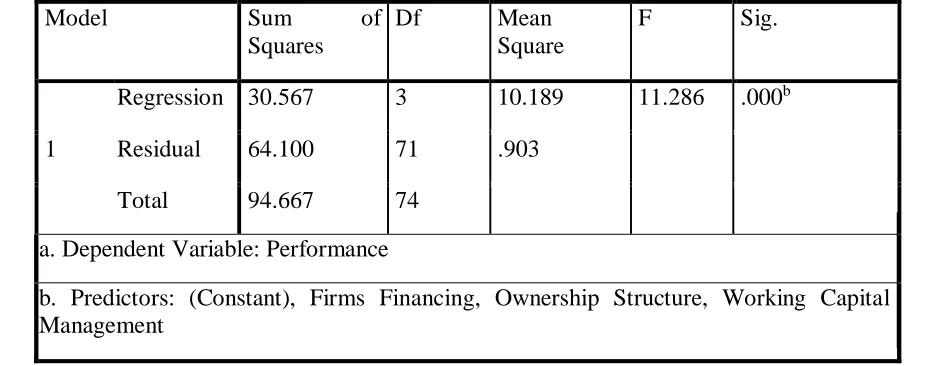
Table 2: ANOVA Table
The ANOVA Table present multiple regression analysis between the independent and dependent variable.
Model Sum of Squares
Df Mean Square
F Sig.
1
Regression 30.567 3 10.189 11.286 .000b
Residual 64.100 71 .903
Total 94.667 74
a. Dependent Variable: Performance
b. Predictors: (Constant), Firms Financing, Ownership Structure, Working Capital Management
Source: Research Data, 2016 Significant Level= 0.05
Results in Table 4.6 above indicate the overall goodness of fit in terms of the extent to which financial management practices collectively explain the performance of SMEs studied. The P value is 0.000, which is less than the significant level of 0.05. Hence, the model overall is a good fit. Consequently, financial management practices are a good measure of performance of SMEs studied.
www.ijsernet.org Page 8 Coefficients
Model Unstandardized Coefficients
Standardize d
Coefficient s
t Sig.
B Std. Error Beta
1 (Constant) .595 1.211 .491 .625
Working Capital Management
-.004 .161 -.003 -.025 .980
Firms Financing .792 .237 .395 3.343 .001
Ownership Structure -.237 .104 -.258 -2.281 .026
Source: Research Data, 2016 Significant Level= 0.05
The following regression function is extracted from Table 4.7.
Y= 0.595 - 0.004X1 + 0.792X2-0.237X3
Where: Y = SMEs performance, β0 is constant, X1 =Working Capital Management, X2 = Firms Financing, X3 = Ownership Structure. The beta coefficients indicate the change in performance attributed to a unit change in the predictor variables all other factors held constant. Hence, a unit change in Working Capital Management causes a -0.004 change in SMEs performance, while all other factors held constant. A unit change in Firms Financing causes a 0.792 change in SMEs performance, while all other factors held constant, and a unit change in Ownership Structure causes a -0.237 change in SMEs performance, when all other factors are held constant.
Hypotheses were tested at a significance level of 0.05.In view of the results presented in the coefficients table above, working capital management was found to be insignificant in affecting performance since a P-value of 0.980 means the variable does not have a significant effect on performance of SMEs. With ape value of 0.001, firms financing has a significant effect on performance of SMEs. Considering a P value of 0.026, ownership structure has a significant effect on performance of SMEs. Hence, to a great extent, financial management practices have a significant effect on performance of SMEs in Lemur town, Kenya.
Discussion
www.ijsernet.org Page 9 Mafasiya et al. (2010) document a negative relationship between profitability and bank lending. Banks prefer highly profitable firms hence such firms prefer retained earnings than debts. The study established that firms financing and ownership structure has a strong positive significant effect on the performance of SMEs, while working capital management doesn’t. The Calice, Chando, and Sekioua (2012)study challenges on SMEs performance, and found obstacles constraining banks further engagement with SMEs, including SME-related factors, macroeconomic factors, business regulation, legal and contractual environment, the lack of a more proactive government attitude towards the segment, and some bank-specific factors. The study found that SMEs are financial constrained, and they lack collateral, creditworthiness, ability to pay and bankable project to secure bank loans. SMEs preferred finances that are adequate, affordable and less risky (Balling et al. 2009). SMEs preferred internal finances to external finances, short-term debt to long-term debt, debt to equity.
Akorsu and Agyapong (2012) identified “alternative model for rising funds, by focusing on why lenders were cynical in advancing credit to SMEs”. The study found that SMEs agreed that they should source for alternative instruments of finance such as financial markets, crowd-funding and mutual guarantee schemes that would fund them at lower costs and risk. SMEs preferred retained earnings, their own savings, families and friends, trade credit, leasing and bank overdrafts over bank loans. Christopher found that trade credit, leasing and overdraft are some sources of external finance for most Nigerian SMEs. About 35% of SMEs in Singapore meet their funding through venture capital. In developing countries, SMEs are turning to Microfinance Institutions (MFIs) for financial assistance. The study found that SMEs financing boost entrepreneurship, economic growth, research and innovations, business capitalization, employment creation, poverty alleviation, income and wealth creation. SMEs shy away from bank loans due to lack of collateral, creditworthiness and low ability to pay. Tiwari et al. (2007)study found that financial institutions perceive SMEs as risky ventures, with information asymmetries, and require adequate collateral to minimize their risks. The study found that leverage is attributed with SMEs age, size and assets tangibility, profitability and growth prospects. They also refrain bank loans due to hectic bank procedures and requirements
Conclusion and Recommendation
www.ijsernet.org Page 10 SMEs should broaden their financing instruments range to financial markets, Sacco, crowd-funding and mutual guarantee schemes, to enable them innovate, grow, develop and research. SMEs should embrace financial literacy, financial information and financial management skills to effect optimal performance. SMEs need affordable, adequate and less risky finances through partnership with financial institutions. Banks should simplify their procedures and lower their costs of lending, collateral requirement and have friendly mitigation mechanism when SMEs are stranded in loan repayment.Governments should create a supportive SME enabling environment that is macroeconomic factors, infrastructures, business regulation, legal and contractual environment. Universities should enrol entrepreneurship programs to equip, empower and inspire SMEs. Academicians and researchers should research on favourable factors that can improve performance of SMEs, and measures to mitigate their challenges.
Contribution to Knowledge
This study contributes to the performance of SMEs on financial management practices. SMEs can incorporating these findings in their business model, mitigate the challenges, and harness superior performance. Researcher and academicians may adapt these findings in their future research on performance of SMEs. Regulators may adapt these findings in their future policy making relating to SMEs and economic advancement.
References
Abdulsaleh, A. M., & Worthington, A. C. (2013). Small and Medium-Sized Enterprises Financing: A Review of Literature. International Journal of Business and Management,
Abdul Riemann and Mohamed Nasr (2007), Working Capital Management And Profitability – Case Of Pakistani Firms, International Review of Business Research Papers Vol.3 No.1. March 2007, Pp.279 – 300 279
Abor, J. (2004). Internationalisation and Financing Options of Ghanian SMEs. Acta Commercii,
4(1), 60–72.
Abor, J., & Biekpe, N. (2007). Small Business Reliance on Bank Financing in Ghana. Emerging Markets Finance and Trade, 43(4), 93–102. http://doi.org/10.2753/REE1540
Abor, J., & Quartey, P. (2010). Issues in SME Development in Ghana and South Africa.
International Research Journal of Finance and Economics, 39(39), 218–228. http://doi.org/ISSN 1450-2887
www.ijsernet.org Page 11 Agwu, M. O. (2014). Issues, Challengesand Prospectsof Small and Medium Scale Enterprises (SMEs) in Port-Harcourt City,. European Journal of Sustainable Development, 3(1), 101
Akerlof, G. A. (1970). The Market for “Lemons”: Quality Uncertainty and the Market Mechanism. Quarterly Journal of Economics, 84(3), 488–500. http://doi
Akorsu, P. K., & Agyapong, D. (2012). Alternative Model for Financing SMEs in Ghana.
International Journal of Arts and Commerce, 1(5), 136–148.
Ardjouman, D., & Asma, B. (2015). Marketing Management Strategies Affecting Performance of Small and Medium Enterprises (SMEs) in Cote d’Ivoire. International Journal of Business and Social Science, 6(4), 141–150. Retrieved from www.ijbssnet.com
Atieno, R. (2001). Formal and informal institutions ’ lending policies and access to credit by
small-scale enterprises in Kenya: An empirical assessment. AERC Research Paper 111 African Economic Research Consortium, Nairobi (Vol. ISBN 9966-).
Kinyua, A. N. (2014). Factors Affecting the Performance of Small and Medium Enterprises in the Jua Kali Sector In Nakuru Town, Kenya. IOSR Journal of Business and Management Ver. IV, 16(1), 2319–7668. http://doi.org/10.9790/487X-16148093
Kothari, C. (2004). Research methodology: methods and techniques. New Age International. http://doi.org/http://196.29.172.66:8080/jspui/bitstream/123456789/2574/1/Research %
Lecerf, M.-A. (2012). Internationalization and Innovation: The Effects of a Strategy Mix on the Economic Performance of French SMEs. International Business Research, 5(6), 2–3.
Leland, H. E., & Pyle, D. H. (2016). American Finance Association Informational Asymmetries ,
Mazzarol, T. (2014). Financial Management in SMEs. Small Enterprise Research, 21(1), 2–3.
Mbogo, M. (2011). Influence of managerial accounting skills on SME’s on the success and growth of small and medium enterprises in Kenya. Journal of Language, Technology & Entrepreneurship in Africa, 3(1), 109–132. http://doi.org/10.4314/jolte.v3i1.66602
Modigliani, F., & Miller, M. H. (1958). The Cost of Capital, Corporation Finance and the Theory of Investment. The American Economic Review, 48(3), 261–297.
http://doi.org/10.4013/base.20082.07
www.ijsernet.org Page 12 Learning in Small Entrepreneurs and Higher Education Students Through service learning programs. International Journal of Business Research, 7(3), 10–28.
Mwangi, L. W., Makau, S. M., & Kosimbei, G. (2014). Relationship between Capital Structure and Performance of Non- Financial Companies Listed In the Nairobi Securities Exchange, Kenya. Global Journal of Contemporary Research in Accounting, Auditing and Business Ethics, 1(2), 72–90.
Myers, S. C. (1984). Finance Theory and Financial Strategy. Interfaces, 14(1), 126–137. http://doi.org/10.1287/inte.14.1.126
Myers, S. C. (2001). Capital Structure. Journal of Economic Perspectives, 15, 81–102. http://doi.org/10.1257/jep.15.2.81
Nene, D. M. (2014). An Evaluation of the Main Factor Affecting Credit in Nairobi County.
Newman, a., Gunessee, S., & Hilton, B. (2012). Applicability of financial theories of capital structure to the Chinese cultural context: A study of privately owned SMEs.
International Small Business Journal, 30(1), 65–83.
http://doi.org/10.1177/0266242610370977
Ngugi, J. N., & Bwisa, H. (2013). Factors Influencing Growth Of Group Owned Small And Medium Enterprises: A Case Of One Village One Product Enterprises. International
Journal of Education and Research, 1(8), 1–14. Retrieved from