An Analysis of Structural Changes in the Indian Banking Sector
Dr. Archana Fulwari
Assistant Professor, Department of Business Economics,Faculty of Commerce,
The Maharaja Sayajirao University of Baroda
Email Id:
[email protected]
Contact No. 9824523351
Postal Address:
A-6, Shivangi Society, Vasna Jakat Naka, Vadodara 390007, Gujarat, India
Abstract
:Banking reforms were introduced in India along with the adoption of reform measures for the Indian economy in 1991. These reforms were aimed at creating an enabling environment for banks, strengthening them and improving their institutional and legal framework. Some of the highlights of these reforms are greater operational autonomy to banks, adoption of prudential norms, liberalization of FDI norms in the banking sector, and easing of entry of private sector banks. The impact of these measures is manifested in functional and regional expansion of banking services, changing ownership structure, increased level of competition, greater efforts to improve efficiency in operations, increased adoption of technology in the provision of banking services, and so on. In this context, this paper undertakes a study of the trends, progress and structural changes in the banking sector in India in the post reforms period. The structural changes are captured by examining ownership type of banks, share of bank groups in total assets of the banking sector, growth in deposits and credit, and changes in competitive scenario among the various bank groups.
Keywords: Indian Banking Sector; Banking Reforms; Structural changes; Bank-groups
JEL Classification: G21, L10
1. Introduction
It is a well established fact that banks are the lifeline of any economic system. Banks help accelerate the pace of growth of economic production and consumption by providing much needed financial resources. It is no revelation therefore that banking activities in India find a presence since the Vedic period as trade and commerce flourished. Since then the Indian banking system has come a long way from a fragile
system to its present form characterized by dynamism. Nationalization of banks in 1969 brought social banking much into focus leading to rapid bank expansion in the otherwise neglected regions and made credit accessible to hitherto ignored sectors, particularly, agriculture, micro and small scale productive units and people belonging to the lower income group.
However, like it happens in the case of any overstretched system, the systemic weaknesses of the Indian banking sector became too blatant to be ignored any further. Low capital base, pre-emption of deposits by the government, mandatory lending to priority sector, absence of the practice of financial prudence in its operations and political interference resulted into unwieldy and clumsy banking sector. The complex web of a highly segmented loan market in which the Reserve Bank of India regulated interest rates for just about any purpose left little scope for banks to undertake commercially viable operations. It is in this context that in 1985 some consolidation measures were undertaken with respect to the functioning of the commercial banks until the banking reforms were let rolling following the recommendations of the Narasimham Committee.
Following the financial sector reforms, particularly, banking reforms, the banking sector in India has gained a great degree of dynamism. From a highly regulated system, it has become increasingly market driven over the years. Much of this dynamism is captured by the expansion in banking activities as measured by deposit mobilization, credit expansion, increase in number of offices and increased competition, driving banks to look for newer sources of income, and so on.
2. Review of Literature
banking sector in India. These include Ratti (2012), Goyal and Joshi (2012), Mishra and Sahoo (2013), Manikyam (2014), Sharma and Shekhar (2015), Bhosale (2015), Roy (2017), Chandanani, Singh and Majumdar (2017), Barua, Roy and Raychaudhuri (2017), etc., who have analysed the structural changes over different phases that the Indian banking sector has evolved through, and its impact on the competitive positions, productivity and efficiency of banks measured by alternative parameters.
Bikker and Spierdijk (2008) have examined the changes in the competitive scenario in the banking sector across the world. They conclude that while emerging markets have witnessed increase in the level of competition, there is a downward trend in most of the western economies. They attribute the fall in the degree of competition “to increased bank size and shift from traditional intermediation to off-balance sheet activities.” Introduction of technology in banking services is one of the important factors in changing the competitive scenario in the banking sector. They also consider fall in the number of banks and rise in the market concentration in terms of increase in the market held by the largest banks as indicative of improved levels of efficiency among banks.
Mulyaningsih and Daly (2011) have examined the banking sector of Indonesia by segregating the banks into three sizes namely, small, medium and large, and then analysing the level of concentration in each category. Their study supports the view that market concentration harms competition. Their findings suggest that the segment of mid-sized banks was most competitive while the large banks’ segment was least competitive. Consolidation of the banking sector in Indonesia improved the level of competition because most mergers and acquisitions were of the small and medium sized banks.
Ratti (2012) considers mergers and consolidation of banking system as the cause behind high degree of concentration in the sector. She measures the level of concentration in terms of the percentage shares of bank groups in total number of bank branches, deposits and assets. Sohrab Uddin and Suzuki (2014) have examined the changing structure of the banking sector in Bangladesh in terms of trends in number of banks and branches and growth rates in the deposits, credit and assets of various bank groups. Thorsten Becky Olivier De Jonghez Glenn Schepens discuss about the deregulation of banking sector in terms of liberal branch expansion and
resultant instability of the sector as heightened competition drives banks to riskier exposures.
3. Objectives of the Study and
Methodology
In the light of the review of literature, this paper seeks to examine the structural changes that have taken place in the Indian Banking System (IBS) since the introduction of banking sector reforms as a part of the broader financial sector reforms. The study is based on data on scheduled commercial banks, excluding the Regional Rural Banks, for the period 1990 to 2017. The data is sourced from various publications of the Reserve Bank of India.
The study uses various indicators to measure structural changes in the IBS that capture dimensions such as changes in ownership structure, expansion of the banking activities in terms of number of offices, deposit mobilization and advancing of credit, population group wise spread of banking sector, total assets of the banks etc. The scope of this study is limited to bank group-wise examination of various measures namely, public sector banks, private sector banks and foreign banks, rather than bank-wise.
4. Analysis of Selected Dimensions of the
Structure of Indian Banking Sector
4.1 Ownership structure of the Indian
Banking Sector
Between the years 1990 and 2005, the number of banks with government ownership remained the 28. In contrast, the number of domestic private sector banks grew from 25 to 31, although a decline from the peak count of 35 banks in mid-1990s. Foreign banks increased in number from 22 in 1990 to 31 in 2005 after a phase of consolidation from the count of 44 banks in 1999. Fig. 1 and 2 show the number of banks in terms of their ownership structure for the year 1990 and 2017 respectively.
Fig 1. Ownership-wise Number of Bank Groups
Fig 2. Ownership-wise Number of Bank Groups
Source: Trends and Progress of Banking in India, RBI Publication.
Over the period 2005 to 2017, a different picture emerged in terms of the ownership structure of the banking sector. In the year 2017, 55 percent of the banks belonged to the group of foreign sector banks, with their number growing from 31 to 49 between the years 2005 and 2017.Domestic private sector banks have steadily declined in number in the later years of the decade of 2010. In the same period, high degree of consolidation has been
effected in the number of public sector banks. Their number reduced from 28 to 20 in the 2018 with the merger of all SBI associated banks with the State Bank of India. Further merger of Nationalized Banks, viz, Dena Bank and Vijaya Bank with the Bank of Baroda will reduce the total number of public sector banks to 18. A substantial degree of privatization of the Indian banking sector is manifested in the dynamic ownership pattern that has emerged over the 27 years since 1990. It is a matter of great academic interest and policy implications to analyse how effective would a prune banking system be for the economy.
4.2 Asset Structure of the Indian Banking
Sector
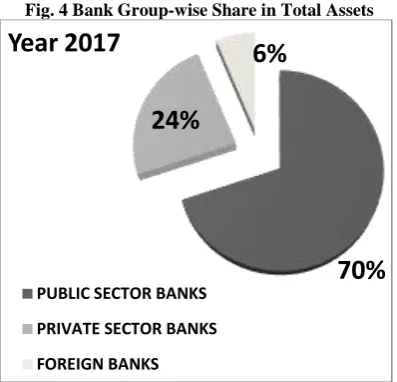
Despite the ownership structure exhibiting substantial changes, if the structure of the IBS is examined in terms of share of these bank groups in the total assets held by them, public sector banks continue to claim the lion’s share. Their total assets grew 33 times over the 27 year period, reflecting a compound annual growth rate (CAGR) of 14 percent. In the year 2017, public sector banks had a share of 70 percent in the total assets of the three bank groups. The share of private sector banks in total assets of banks increased steadily from three percent in 1990 to 12 percent in 2000 and 24 percent in 2017. They recorded a whopping 311 times increase in the volume of their total assets, that is, a CAGR of nearly 24 percent. The assets of foreign banks grew at a compound rate of 15 percent per annum, with their assets in the year 2017 being 50 times more than that in the year 1990. Fig. 3 and 4 depict the changes in the total assets of the bank groups for the years 1990 and 2017 respectively.
Fig. 3 Bank Group-wise Share in Total Assets
28
25
22
YEAR: 1990 PUBLIC SECTOR BANKS PRIVATE SECTOR BANKS
20
21
49
YEAR: 2017 PUBLIC SECTOR BANKS PRIVATE SECTOR BANKS
91%
3%
6%
Year 1990
The highest growth, therefore, was registered by the private sector banks whose claim in the total assets of the banking sector (excluding Regional Rural Banks) grew by eight times from three percent to 24 percent, over the entire study period. Share of public sector banks in total assets of banks fell by one-fourth over the same period. It may be noted that though the number of foreign banks increased every year since the deregulation of entry norms, in terms of share in total assets of the banking sector, assets of foreign banks remained a dismal six percent over the entire period of study. This is because of the limited number of offices of foreign banks in India.
Fig. 4 Bank Group-wise Share in Total Assets
Source: Publications of RBI
4.3 Deposit Growth of various Bank Groups
An important dimension of banking structure is the expansion in deposit mobilization. Table 1 shows the trends in deposits of the three bank groups. Deposits of banks have increased tremendously over the 27 years period. Domestic private sector banks have gained the fastest momentum, with their deposits growing at the compound annual rate of more than 24 percent while deposits of both public sector banks and foreign banks have grown at similar rate of 15 percent. The growth of deposits of private sector banks is significant because the number of domestic private sector banks has continuously declined. However, there are several business houses and NBFCs that are aspiring for banking licenses.
Table 1: Bank group-wise Growth in Deposits:CAGR
Period Public Sector
Banks
Private Sector Banks
Foreign Banks
1990-2000 15.55 29.85 18.37
2000-2010 18.02 23.59 17.16
2010-2017 11.93 17.35 10.03
1990-2017 15.50 24.19 15.71
Source: Author’s computations based on data sourced from Publications of RBI
According the Global Findex Report 2017 (World Bank Group), while the number of account holders in India has improved to 80 percent after the Jan Dhan Yojana launched by the government, only about 25 percent of adult bank account holders used them for holding savings in the previous year. Also, less than ten percent of adults in India have borrowed from financial institutions. Moreover, in absolute figures 191 million adults in India are still without a single bank account. This reflects the immense scope of more players to enter and be viable in the sector. It may not be unwarranted to presume a significant role of private sector banks in the IBS in future.
4.4 Competitive Scenario of the Indian
Banking Sector
An important dimension of the structure of banking sector is the nature of competition in the sector reflected in the degree of concentration. Level of concentration indicates the extent to which the market is dominated by a few banks. Size distribution of banks is an important measure of the degree of concentration. Size of a bank has been measured in terms of its market share in the volume of total credit flow from the banking sector. In other words, most studies examine the level of competition or the level of concentration by making individual banks as the unit of study. However, in this study there is a departure from this practice, and the size dimension is examined in terms of relative size of the three bank groups. The merit of examining bank-group wise competitive scenario is that it throws light on the ownership-type based competition, rather than individual banks irrespective of their ownership type. For this purpose, an average measure of size has been computed by dividing the credit volume of an entire bank-group by the number of banks in that particular group for the given year.
It is observed that the average credit flow for both public sector banks and domestic private sector banks has increased along with fall in the number of banks in these two categories of banks, indicating the increased level of intra-bank-group concentration. However, at this juncture in the evolution of the banking system in India, this may be considered as a measure of consolidation rather concentration of the banking sector. In the case of foreign banks, the number of banks has more than
70%
24%
6%
Year 2017
PUBLIC SECTOR BANKS
PRIVATE SECTOR BANKS
doubled over the 27 years and accordingly the average credit flow has increased but by the smallest proportion compared to other bank-groups, indicating greater degree of competition amongst them. The significance of this analysis needs to be appreciated in the context of the fact that foreign bank branches are highly concentrated in the metropolitan cities and lack wide network of branches across the country. More than half the number of foreign banks has just one branch in metropolitan cities only or one branch across rural, semi-urban and/or urban areas. This would pose a greater challenge for existing and potential foreign banks to gain competitive edge over the other bank-groups without improving their network of branches.
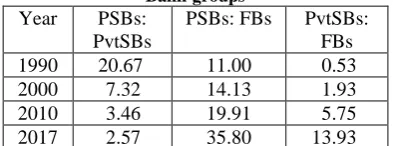
As regards the degree of competition in the banking sector in India, an interesting picture emerges if we look at the relative size of average credit flow of the three bank-groups. Since Public Sector Banks have traditionally held the large chunk of the banking sector in India, this paper measures the changes in the relative credit flow of private sector banks and foreign banks vis-a-vis public sector banks over the period of 27 years from 1990 to 2017. The results are exhibited in Table 2.
Interestingly, in the pre-liberalization period in 1990, the average credit flow of public sector banks was nearly 21 times greater than that of the private sector banks, which has dramatically reduced to seven, three and 2.57 times for the years 2000, 2010 and 2017. This indicates closing up of the gap between public and private sector banks in India in terms of their market presence, if not market power.
Table 2. Ratio of Average Credit Flows of Various Bank-groups
Year PSBs:
PvtSBs
PSBs: FBs PvtSBs: FBs
1990 20.67 11.00 0.53
2000 7.32 14.13 1.93
2010 3.46 19.91 5.75
2017 2.57 35.80 13.93
Source: Author’s computations as explained in the text
However, the same analysis for foreign banks reveals that there is widening gap between them and the public sector banks as far as their market presence is concerned. Between the private sector banks and foreign banks too there is a widening gap in market presence although it is not as pronounced as when the comparison is made with
public sector banks. A faster way perhaps to cover this gap would be for foreign banks to tie up private sector banks in India to rapidly increase their market presence by leveraging on the wider branch network of the latter. The significance of this measure of the level of competition in the banking sector lies in that it is indicative of long run trend in market presence of various bank-groups and hints at the future structural scenario in the banking sector.
5. Conclusion
The analysis of the Indian Banking Sector in terms of ownership pattern, total assets, deposit mobilization and level of competition reveals interesting structural changes that have taken place over more than two decades in the post liberalization period. Banking sectors across the world are undergoing systemic changes as countries seek to address the issue of what an optimum banking system should be given their domestic economy characteristics as well as rising degree of globalization. The banking sector in India too is at a very critical juncture. Lot of deliberations are being made regarding the appropriate structure that would yield maximum contribution as a catalyst of economic growth. In the context of the view being considered regarding creating a three tiered banking structure that has a few large banks comparable to the State Bank of India at the top, a few regional banks at the second level and mid-sized banks at the third level, this study has attempted to capture how the banking sector reforms have unfolded so far in terms of its implications for the structure of the sector. The finding of this study can be further extended to examining other elements of structural changes in the banking sector, bank-wise analysis as well as impact of structural changes on the performance of banks.
6. Acknowledgement:
This research work is part of a minor research project funded by the Research and Consultancy Cell of The Maharaja Sayajirao University of Baroda, Vadodara, Gujarat, India.
7. References:
[i] Bhosale, M. D.(2015), “Indian Banking Sector at a Glance”, International Research Journal of Engineering and Technology, 2(1): 212 -221
Tjalling C. Koopmans Research Institute Discussion Paper Series 08-04
http://www.koopmansinstitute.uu.nl
[iii] Chandanani, P. Singh, K. and Majumdar, (2017), “Market Structure and Competition in the Banking Industry: A Review of Literature, Indian Journal of Finance, 11(3).
[iv] Ghosh, D. R. (2017), “Indian Banking Sector in Transition”, The Management Accountant, 52(1). www.icmai.in
[v] Goyal, K.A. and Joshi, V. (2012):” Indian Banking Industry: Challenges and Opportunities”, International Journal of Business Research and Management, 3(1):18-28.
[vi] Khan, H. H., Ahmad, R. B., and Gee, C. S. (2016), “Correction: Market Structure, Financial Dependence and Industrial Growth: Evidence from the Banking Industry in Emerging Asian Economies”, PLOS ONE, 11(9)
[vii] Manikyam, K. R. (2014), “Indian Banking Sector – Challenges and Opportunities”, Journal of Business and Managemen,16(2):52-6.
[viii] Mishra, P. and Sahoo, D. (2013), “Structure, Conduct and Performance of Indian Banking Sector”, Review of Economic Perspective, 12(4).
[ix] Mohan, R. and Ray, P. (2017), “Indian Financial Sector: Structure, Trends and Turns”, IMF Working Paper.
[x] Mulyaningsih, T and Daly, A (2011), “Competitive Conditions in Banking Industry: An Empirical Analysis of the Consolidation, Competition and Concentration in the Indonesia Banking Industry Between 2001 and 2009”, Bulletin of Monetary Economics and Banking’, pp: 141-175
[xi] Ratti, M. (2012): “Indian Financial System & Indian Banking Sector: A Descriptive Research Study”, International Journal of Management and Social Sciences Research, 1(1).
[xii] Sathye, M. (2005), “Privatization, Performance, and Efficiency: A Study of Indian Banks”, Vikalpa, 30(1).
[xiii] Sharma, D.,Sharma, A. K. and Barua, M. K. (2013) “Efficiency and Productivity of Banking Sector: A Critical Analysis of Literature and Design of Conceptual Model”, Qualitative Research in Financial Markets, 5(2):195-224, https://doi.org/10.1108/QRFM-10-2011-0025 [xiv] Sharma, N. L. and Shekhar, S. (2015): “Indian Banking Industry: Challenges and Opportunities”, G- Journal of Education, Social Science and Humanities, 1(1).
[xv]Sohrab Uddin, S. M. and Suzuki, Y. (2014) “The impact of Competition on Bank Performance in Bangladesh: An Empirical Study”, International
Journal of Financial Services Management, 7(1): 73-94.
[xvi] Thorsten Becky Olivier De Jonghez Glenn Schepensx () “Banl Competition and Stability: Reconciling Conflicting Empirical Evidence”, [xvii]
http://profit.ndtv.com/news/banking- finance/article-government-looking-at-4-5-large-sized-state-owned-banks-report-1422048