Further results on the distinctness of binary
sequences derived from primitive sequences modulo
square-free odd integers
Qun-Xiong Zheng and Wen-Feng Qi
Abstract
This paper studies the distinctness of primitive sequences over Z=(M)modulo2, whereM is an odd integer that is composite and square-free, andZ=(M)is the integer residue ring moduloM. A new suf cient condition is given for ensuring that primitive sequences generated by a primitive polynomial f(x) over Z=(M) are pairwise distinct modulo 2. Such result improves a recent result obtained in our previous paper [27] and consequently the set of primitive sequences overZ=(M)that can be proven to be distinct modulo 2 is greatly enlarged.
Index Terms
Stream ciphers, linear recurring sequences, primitive polynomials, primitive sequences, modular reductions.
I. INTRODUCTION
Throughout the paper, for an integer m 2, let Z=(m) denote the integer residue ring modulo m. We choose f0;1; : : : ; m 1g as the complete set of representatives for the elements of the ringZ=(m). Thus
a sequence a over Z=(m) is usually seen as an integer sequence over f0;1; : : : ; m 1g. Moreover, for an integer a and a positive integer b 2, we denote the least nonnegative residue of a modulob by[a]modb, and similarly for a sequence a= (a(t))t 0 over Z=(m), denote [a]modb = ([a(t)]modb)t 0.
Letpbe a prime number andea positive integer. During the past two decades, the maximal period linear recurring sequences over Z=(pe), called primitive sequences over Z=(pe), have been paid much attention.
An enormous amount of effort is directed toward the study of nding useful mappings to derive good pseudorandom sequences from primitive sequences over Z=(pe), which are called compression mappings
in literature, and proving that they are injective. Generally there are two kinds of compression mappings: one is based on e-variable functions over Z=(p) [1], [9], [10], [15], [16], [18], [19], [21], [30], [31]; the other is based on the modular arithmetic [11], [34]. Besides, the pseudorandom properties of these compression sequences are also extensively studied, such as periodicity [5], [12], [13], linear complexity [2], [4], [14], [17] and distribution properties [7], [8], [20], [24], [25], [32], [33].
Recently research interests on primitive sequences over Z=(pe) are further extended to primitive se-quences over Z=(M) [3], [26]-[29], where M is a square-free odd integer. One of important reasons for this is that the period of a primitive sequence aof order n over Z=(pe)is undesirable if e 2. Recall that
the period per(a) of a primitive sequence a of order n over Z=(pe) is equal to pe 1 (pn 1) pe+n 1 [23]. It can be seen that for a xedpe withe 2, the periodper(a)increases slowly and far less than pe n
as nincreases. Therefore, to meet the requirement of long period in practical applications (such as 264), n should be chosen large enough, which will be high resource consumption in hardware and software implementation. For example, to generate a sequence with period not less than 264 over Z=(28), Z=(216) and Z=(232), the number of bit-registers required must be larger than 456, 784 and 1056, respectively. However for many choices of M, primitive sequences over Z=(M) have no such periodic weakness. For cryptographic applications, the moduli of the form 2e 1 have attracted much attention since the
This work was supported by NSF of China under Grant No. (61272042, 61100202, 61070178).
operation “mod 2e 1” can be ef ciently implemented both in hardware and software, and this offers
new possibilities for advancement in the solution of applying linear recurring sequences over integer residue rings. For instance, primitive sequences over Z=(231 1) are used to design the ZUC algorithm, a stream cipher that is the core of the standardized 3GPP con dentiality algorithm 128-EEA3 and the 3GPP integrity algorithm 128-EIA3, see [6].
By applying the operation mod 2 to primitive sequences over Z=(M), one can easily obtain a class of binary sequences, called modulo 2 reductions of primitive sequences over Z=(M). It is thought that the operation mod 2 destroys the original linear recurrence relation of primitive sequences over Z=(M) and the obtained binary sequences should have many desirable cryptographic properties if the modulus M and the order n are carefully chosen. As for cryptographic interests, one of the most concerned problems is whether these modulo 2 reductions are pairwise distinct, that is, whether a =b iff [a]mod 2 = [b]mod 2, where a and b are two primitive sequences generated by a primitive polynomial f(x) over Z=(M). If the distinctness holds, then there is a one-to-one correspondence between primitive sequences and their modulo 2 reductions, which implies that every modulo 2 reduction preserves all the information of its original primitive sequence. Moreover, the distinctness also guarantees that the period of these modulo 2 reductions attains the maximum possible value.
For a special case where M is an odd prime number, the problem presented above has been completely solved in [34]. However, if M has at least two different prime divisors, there indeed exist many primitive sequences of order 1over Z=(M) such that their modulo 2reductions are the same [3]. It is long unclear whether primitive sequences of order n 2 over Z=(M) are pairwise distinct modulo 2. In [3], for the case M =pq, a product of two different odd prime numbers, a suf cient condition was given for(n; p; q) such that primitive sequences generated by a primitive polynomial of degree n over Z=(pq) are distinct modulo 2. Then in [26] based on a new result on the element distribution property of primitive sequences over Z=(pq), the set of primitive sequences that can be proved to be distinct modulo 2is further enlarged. In [28], for a special modulus M = 232 1, a relatively complete result was obtained by taking full use of the arithmetic properties of primitive sequences over Z=(232 1). However, for the case of a general modulus M that is odd, composite, and square-free, the distinctness of primitive sequences over Z=(M) modulo 2has been quite resistant to proof. Until now only a class of primitive sequences of order 2n0+ 1
(n0 1) over Z=(M) are proved to be distinct modulo 2 in [27]. Besides there are several papers [28],
[29], [32] study the distinctness of primitive sequences overZ=(M)moduloH, whereH >2has a prime divisor coprime with M, and in particular in [29] a relatively complete result had been obtained for a general modulus M that is odd, composite and square-free.
In this paper, we further study the modulo 2 distinctness of primitive sequences of order n 2 over
Z=(M), where M is an odd integer that is composite and square-free. A new suf cient condition (see Theorem 2) is given for ensuring that primitive sequences generated by a primitive polynomial f(x) over Z=(M) are pairwise distinct modulo 2. Compared with [27, Theorem 19], it can be seen that the condition that (M; n) is a distinguishable pair (the de nition of a distinguishable pair see [27, De nition 3]) is deleted in the new result, and so the generating polynomial can be a primitive polynomial of degree n 2, rather than a typical primitive polynomial of degree2n0+ 1(see [27, Remark 5]). As a result, the
set of primitive sequences over Z=(M)that can be proven to be distinct modulo 2is greatly enlarged. In particular, two relatively complete results (see Theorem 7 and Theorem 10) are obtained for two special cases: one is that v2(pn1 1) =v2(pn2 1) = =v2(pnr 1), where M =p1p2 pr is the canonical
factorization ofM andv2(m)denotes the greatest nonnegative integer k such that2kdivides m; the other is that the generating polynomial is a typical primitive polynomial over Z=(M).
The rest of the paper is organized as follows. Section II presents some necessary preliminaries. Section III gives the main results of this paper. Finally, conclusions are drawn in Section IV.
II. PRELIMINARIES
for all integer i 0, where n is a positive integer andc0; c1; : : : ; cn 1 2Z=(m) are constant coef cients, thenais called alinear recurring sequenceof ordern overZ=(m)generated byf(x) =xn cn 1xn 1
c0 (or a is a sequence of order n over Z=(m) in short). For convenience, the set of sequences generated by f(x) overZ=(m)is generally denoted byG(f(x); m). Particular interests for cryptography are the maximal period linear recurring sequences also called primitive sequences over Z=(m), which are
generated by primitive polynomials overZ=(m). Next we introduce the de nitions of primitive polynomials
and primitive sequences over Z=(m).
Let f(x) be a monic polynomial of degree n over Z=(m). If f(0) is an invertible element in Z=(m),
then there exists a positive integer T such that xT 1 is divisible byf(x) inZ=(m)[x]. The minimum of
such T is called the period of f(x)over Z=(m) and denoted byper(f(x); m). For the case thatm is a prime power, say m =pe, it is known that per(f(x); pe) pe 1(pn 1), see [23]. If per(f(x); pe) =
pe 1(pn 1), then f(x) is called a primitive polynomial of degree n over Z=(pe). A sequence a over
Z=(pe) is called a primitive sequence of order n if a is generated by a primitive polynomial of degree n over Z=(pe) and [a]modp is not an all-zero sequence. A primitive sequence a of order n over Z=(pe) is (strictly) periodic and the period per(a) is equal to pe 1(pn 1), see [23]. For the case of a general
integer m, assume m =pe11 pe22 per
r is the canonical factorization of m. A monic polynomial f(x) of
degree n over Z=(m)is called a primitive polynomial if for everyi2 f1;2; : : : ; rg, f(x) (modpei i ) is a
primitive polynomial of degree n over Z=(pei
i ). A sequence a overZ=(m)is called a primitive sequence
of order n if a is generated by a primitive polynomial of degree n over Z=(m) and [a]modp
i is not an
all-zero sequence for every i 2 f1;2; : : : ; rg, that is, [a]modpei
i is a primitive sequence of order n over
Z=(pei
i ). It can be seen that the period of a primitive polynomial of degree n over Z=(m) and that of a
primitive sequence of order n over Z=(m) are both equal to
lcm pe11 1(pn1 1); p2e2 1(pn2 1); : : : ; per 1
r (p
n
r 1) .
For convenience, the set of primitive sequences generated by a primitive polynomial f(x)over Z=(m) is generally denoted by G0(f(x); m).
Finally we introduce a special class of primitive polynomials called typical primitive polynomials, which were rst proposed and studied in [22].
Let M be a square-free odd integer with the canonical factorization as M = p1p2 pr. An element
2Z=(M)is called aprimitive element inZ=(M) if[ ]modp
i is a primitive element in Z=(pi)for every
i 2 f1;2; : : : ; rg, i.e., the multiplicative order of [ ]modp
i in Z=(pi) is equal to pi 1. It is clear that if
is a primitive element in Z=(M), then for any divisor R > 1 of M, [ ]modR is a primitive element in
Z=(R). Let f(x) be a primitive polynomial of degree n over Z=(M). In the theory of nite elds, it is
easy to see that there is a unique element f 2Z=(M) such that x fmodf(x) holds over Z=(M), where = lcm pn1 1
p1 1;
pn
2 1
p2 1; : : : ;
pn r 1
pr 1 . We say that f is the associated element of f(x) over Z=(M). De nition 1: ([22]) A primitive polynomial f(x)of degreenover Z=(M)is called atypical primitive
polynomialif f is a primitive element inZ=(M), where f is the associated element off(x)overZ=(M). We note that a primitive polynomial is not always a typical primitive polynomial, see for example [22, Example 6]. In [22], some necessary and suf cient conditions for the existence of typical primitive polynomials of degree n over Z=(M) were presented. Here we emphasize that the existence of typical primitive polynomials of degree n over Z=(M) only depends on the arithmetic properties of M and n, see [22, Lemma 7]. If the modulus is not square-free, say m=pem0 for some prime power pe with e 2
and some integer m0 1, indeed one can de ne a typical primitive polynomial overZ=(m) analogously. However, unlike the case of Z=(M), the existence of typical primitive polynomials of degree n over
Z=(m) depends on individual primitive polynomials besides n and m, for more details see [22, Section 4].
III. MAIN RESULTS
t 2 f0;1; : : : ; T 1g such that a(t) =s.
Then we can make our main result explicit in the following statement.
Theorem 2: Let M be a positive odd integer that is composite and square-free, and let f(x) be a primitive polynomial of degree n 2 over Z=(M), and let f be the associated element of f(x) over
Z=(M). If
(1) for any sequence z 2G0(f(x); M), every element in Z=(M) occurs in the sequence z; and (2) for any divisor R > 1 of M, there is an integer kR > 0 such that
h
kR f
i
modR is a positive even
number,
then for a; b2G0(f(x); M), a=b iff [a]
mod 2= [b]mod 2.
Remark 3: If the conditions of Theorem 2 are satis ed, then for any sequence a 2 G0(f(x); M),
theoretically there is an algorithm to recover a from [a]mod 2. Therefore in this sense we say that [a]mod 2 contains all the information of the original primitive sequence a. Moreover, the period of [a]mod 2 attains the maximum possible value, that is per([a]mod 2) = per(a)(the prove is similar with that of [28, Theorem 2-(ii)]).
The rest of this section is divided into two subsections. In Subsection III-A we discuss the validity of the conditions of Theorem 2 by combining theoretical analysis and computer experiment, and then in Subsection III-B we give the proof of Theorem 2.
A. Discussions on the conditions of Theorem 2
First we focus on Condition (1) of Theorem 2. Based on some estimates of exponential sums over integer residue rings, a suf cient condition was given in [27, Theorem 9] such that Condition (1) of Theorem 2 is valid for all primitive polynomials of degree n over Z=(M).
Lemma 4: ([27, Theorem 9]) Let M, n and f(x) be described as in Theorem 2. Suppose M = p1p2 pr is the canonical factorization of M. Then Condition (1) of Theorem 2 is valid if
r
X
k=2
X
1 i1< <ik r
Qk
j=1(pij 1)p n=2
ij
lcm pn
i1 1; : : : ; pnik 1
<1
r
X
i=1
pi 1
pn
i 1
. (1)
In theory it was proved that for any given square-free odd integer M, inequality (1) is satis ed if n is suf ciently large, see [27, Theorem 11]. Furthermore, experimental data show that inequality (1) is satis ed for most of M if n > 6, see [27, Table 1] for more details.
Next we focus on Condition (2) of Theorem 2. For a given primitive polynomial f(x) of degree n over Z=(M), one can easily calculate the value of f, and so the validity of Condition (2) of Theorem 2 can be directly checked. It is clear that the validity of Condition (2) of Theorem 2 depends on individual primitive polynomials. If Condition (2) of Theorem 2 is valid for all primitive polynomials of degree n over Z=(M), then we say that it is valid for(M; n).
Let M = p1p2 pr be the canonical factorization of M and i the set of all primitive elements in
Z=(pi) for i2 f1; : : : ; rg. Since f(x) (modpi) is also a primitive polynomial over Z=(pi), in the theory
of nite elds there exists a primitive element i 2 i such that
x
pni 1 pi 1
imod (f(x); pi) for i2 f1; : : : ; rg,
where the notation “A Bmod (f(x); p)” means that A Bmodf(x) holds over Z=(p). Denote
= lcm p
n
1 1 p1 1
; : : : ;p
n
r 1
pr 1
and i =
[ ]modpn i 1 pn
i 1 pi 1
for i2 f1; : : : ; rg.
Then we have that
x i
and so by the Chinese Remainder Theorem together with the fact that x fmod (f(x); M), we get that
f x Lift( 11; : : : ; rr) mod (f(x); M),
where Lift( 1
1 ; : : : ;
r
r ) denotes the unique integer L between 0 and M 1 such that
L i
i modpi for i2 f1; : : : ; rg.
Observing that Condition (2) of Theorem 2 is necessarily valid for (M; n) if it is valid for every f 2
fLift( 1
1 ; : : : ; rr)j( 1; : : : ; r)2 1 : : : rg. Therefore, based on this observation, the proportions
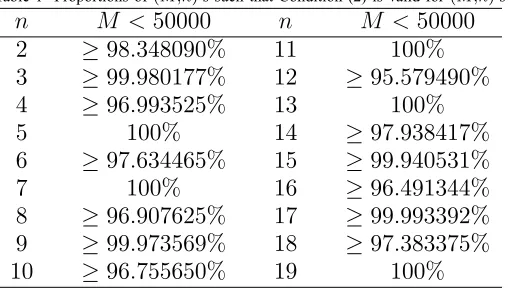
of (M; n)'s such that Condition (2) of Theorem 2 is valid for (M; n)'s are tested under some ranges of M and n, and the results are listed in Table 1. For example, the proportion is at least 98:348090% for n = 2 and all odd integersM <50000that are composite and square-free. It can be see from Table1that Condition (2) of Theorem 2 is in fact highly valid and can be valid for the great majority of (M; n)'s.
Table 1 Proportions of(M;n)'s such that Condition (2) is valid for(M;n)'s
n M <50000 n M <50000 2 98:348090% 11 100% 3 99:980177% 12 95:579490% 4 96:993525% 13 100% 5 100% 14 97:938417% 6 97:634465% 15 99:940531% 7 100% 16 96:491344% 8 96:907625% 17 99:993392% 9 99:973569% 18 97:383375% 10 96:755650% 19 100%
Remark 5: There do exist primitive polynomialsf(x)such that Condition(2) of Theorem 2 is invalid. For example, it can be veri ed that f(x) =x2+x+ 80 is a primitive polynomial over Z=(7 13) and
f x
lcm 727 11;13213 11
3 mod (f(x);7 13).
Then
t
f mod 7 13 t 0
= (1;3;9;27;81;61; : : :)
is a sequence over Z=(7 13) with period 6. It can be seen that Condition (2) of Theorem 2 is invalid for f(x).
Finally we present some further results for the following two cases:
Case 1: v2(pn1 1) = v2(pn2 1) = = v2(pnr 1), where M = p1p2 pr is the canonical
factorization of M and v2(m) denotes the greatest nonnegative integer k such that 2k divides m;
Case 2: f(x) is a typical primitive polynomial over Z=(M).
First we deal with Case 1. In this case, we will show that Condition (2) of Theorem 2 is always valid.
Lemma 6: Let M, n, f(x) and f be described as in Theorem 2. Suppose M = p1p2 pr is the
canonical factorization of M. Then Condition (2) of Theorem 2 is valid if v2(pn1 1) = v2(pn2 1) = =v2(pnr 1).
Proof: Set T = lcm (pn
1 1; : : : ; pnr 1) and = lcm pn
1 1
p1 1; : : : ;
pn r 1
pr 1 . To prove the lemma, it
suf ces to show that
T =2
f M 1 modM, (2)
since (2) implies that the congruence
T =2
f R 1 modR
Since v2(pn1 1) = v2(pn2 1) = = v2(pnr 1) by assumption, we get that v2(T) = v2(pni 1)
for i2 f1; : : : ; rg, and so T
2
pni 1 2 modp
n
i 1 for i2 f1; : : : ; rg. (3)
Note that f(x) (modpi) is a primitive polynomial of degree n over the nite eld Z=(pi). In the theory
of nite elds, it is clear that
xpni 1 1 mod (f(x); p
i) and x(p n
i 1)=2 1 mod (f(x); p
i) for i2 f1; : : : ; rg. (4)
Then (3) and (4) together with the fact that x fmod (f(x); M) yield
T =2
f x
T =2 x(pn
i 1)=2 1 mod (f(x); p
i) for i2 f1; : : : ; rg,
which implies that
T =2
f 1 modpi for i2 f1; : : : ; rg. (5)
Therefore (2) follows from (5). This completes the proof.
The following Theorem 7 immediately follows from Theorem 2, Lemma 4 and Lemma 6.
Theorem 7: LetM,nandf(x)be described as in Theorem 2. SupposeM =p1p2 pris the canonical
factorization of M. If (1) Prk=2P1 i1< <i
k r Qk
j=1(pij 1)p n=2 ij
lcm pn
i1 1;:::;pnik 1
<1 Pri=1 pi 1 pn
i 1; and
(2) v2(pn1 1) =v2(pn2 1) = =v2(pnr 1),
then for a; b2G0(f(x); M), a=b iff [a]
mod 2= [b]mod 2.
Next we deal with Case 2. In this case f is a primitive element in Z=(M), and so for any divisor R > 1of M, tf
modR t 0 is a primitive sequence of order 1 generated byx f modR over Z=(R).
Then we shall use the following Conjecture 8 on primitive sequences of order 1, which was made in [27, Conjecture 15].
Conjecture 8: (Even Conjecture) Let m be a square-free odd integer. For every primitive sequencea of order 1 over Z=(m), there exists an even element occurring in a.
Remark 9: The correctness of Conjecture 8 has been veri ed for all square-free odd integers less than 300;000. Moreover, although Conjecture 8 is not completely proven by now, a asymptotic result was obtained in [27, Theorem 18] which implies that Conjecture 8 is true for almost all square-free odd integers.
Therefore, in the case of Case 2, Theorem 2 can be represented as the following Theorem 10, which is an improvement of [27, Theorem 19] since the strongest condition of [27, Theorem 19], that is (M; n) is a typical primitive pair, is deleted in Theorem 10.
Theorem 10: LetM andnbe described as in Theorem 2, and letf(x)be a typical primitive polynomial of degree n over Z=(M). If
(1) for any sequence z 2G0(f(x); M), every element in Z=(M) occurs in the sequence z; and
(2) Conjecture 8 is true form 2DM, where DM is the set of all divisors ofM that are greater than1,
then for a; b2G0(f(x); M), a=b iff [a]
mod 2= [b]mod 2.
In [27, Theorem 14], based on some estimates of exponential sums over integer residue rings, a suf cient condition was given for m such that Conjecture 8 is true for m.
Lemma 11: ([27, Theorem 14]) Given a square-free odd integer m, Conjecture 8 is true for m if
m+ 1 4
X
djm d>1
d3=2 (d)
lnd +1
5 ,
Note that Conjecture 8 naturally holds for the case where m is a prime number, and so we can immediately get the following Corollary 12 by replacing Condition (1) and (2) of Theorem 10 with the estimate of Lemma 4 and Lemma 11, respectively.
Corollary 12: LetM andnbe described as in Theorem 2, and letf(x)be a typical primitive polynomial of degree n over Z=(M). Suppose M =p1p2 pr is the canonical factorization of M. If
(1) Prk=2P1 i1< <i
k r Qk
j=1(pij 1)pn=ij2
lcm pn
i1 1;:::;pnik 1
<1 Pri=1 pi 1 pn
i 1; and
(2) m4+1 P
djm d>1
d3=2
(d)
lnd+ 1
5 for every nonprime divisor m of M,
then for a; b2G0(f(x); M), a=b iff [a]
mod 2= [b]mod 2.
B. Proof of Theorem 2
This subsection is devoted to the proof of Theorem 2. We rst give a necessary lemma.
Lemma 13: Let M, n, f(x) and f be described as in Theorem 2. If
(1) for any sequence z 2G0(f(x); M), every element in Z=(M) occurs in the sequence z; and (2) there exists an integer kM >0 such that
h
kM f
i
modM is a positive even number,
then for a; b2G0(f(x); M) with [a]
mod 2 = [b]mod 2, there is a prime divisor p of M such that [a]modp =
[b]modp.
Proof: Suppose, on the contrary, that [a]modp 6= [b]modp for any prime divisor p of M. Then it is clear that c= [a b]modM is a primitive sequence generated by f(x) over Z=(M), i.e. c2G0(f(x); M).
By Condition (1) there is an integer t 0 such that c(t ) = 1, i.e. [a(t ) b(t )]modM = 1. Then [a(t )]mod 2 = [b(t )]mod 2 implies that
a(t ) = 0 and b(t ) = M 1.
Since x fmodf(x) holds over Z=(M) for some positive integer and by Condition (2) there is an integer kM 0 such that C :=
h
kM f
i
modM is a positive even number, we get that
x kM kM
f Cmodf(x) (6)
holds over Z=(M). Then by applying (6) to a and b, respectively, we get that
a(t + kM) = [C 0]modM = 0 and b(t + kM) = [C (M 1)]modM =M C,
which yield
[a(t + kM)]mod 2 = 06= 1 = [b(t + kM)]mod 2,
a contradiction to the assumption that [a]mod 2 = [b]mod 2. Therefore, there at least exists a prime divisor p of M such that [a]modp = [b]modp. This completes the proof.
Now we start to prove Theorem 2.
Proof: [Proof of Theorem 2] Since the necessary condition is trivial, in the following, we only prove the suf cient condition.
If a; b2G0(f(x); M)satisfying [a]
mod 2 = [b]mod 2, then by Lemma 13 there is a prime divisor p of M such that [a]modp = [b]modp. Denote byR the greatest divisor of M satisfying[a]modR= [b]modR. Then it is clear that R is divisible by p. In the following it suf ces to show that R =M.
Suppose, on the contrary, that R < M.
Let us denote Q = M=R. Then we have that Q > 1 and [a]modq 6= [b]modq for any prime divisor q of Q. Since M is square-free, it is clear that gcd(R; Q) = 1. By the Chinese Remainder Theorem, there exist unique sequences u1 over Z=(R) and u2 over Z=(Q) such that
where [Q u1+R v1]modM = ([Q u1(t) +R v1(t)]modM)t 0. Moreover, it can be seen that u1 2 G0(f(x); R) and v
1 2G0(f(x); Q). Analogously, we have that
b = [Q u2+R v2]modM, (8)
where u2 2G0(f(x); R) and v
2 2G0(f(x); Q). Since [a]modR = [b]modR, it follows that u1 =u2, and so [a b]modM = [R (v1 v2)]modM =R [v1 v2]modQ.
Furthermore, for any prime divisor q of Q, since [a]modq 6= [b]modq, we have that [v1]modq 6= [v2]modq, and so [v1 v2]modQ 2G0(f(x); Q). Set
z = [Q u1+R (v1 v2)]modM.
Then it can be seen that z2G0(f(x); M). Hence Condition(1) implies that (u
1(t);[v1(t) v2(t)]modQ) runs through the set Z=(R) Z=(Q) as t runs from 0 to per(z) 1.
Choose an integer t 0 such that u1(t ) =u2(t ) = 0 and
[v1(t ) v2(t )]modQ = 1. (9)
Then (7) and (8) yield
a(t ) =R v1(t ) and b(t ) =R v2(t ).
Since [a(t )]mod 2= [b(t )]mod 2 and [R]mod 2 = 1, we obtain that
[v1(t )]mod 2= [v2(t )]mod 2. (10)
Combining (9) and (10) we can deduce that
v1(t ) = 0 and v2(t ) =Q 1,
and so
a(t ) = 0 and b(t ) =M R.
Since x fmodf(x) holds over Z=(M) for some positive integer , we have that
x k kfmodf(x) (11)
holds over Z=(M) for any integer k 0. Applying (11) to a and b, respectively, we get that
a(t + k) = a(t ) kf
modM = 0
and
b(t + k) = b(t ) kf
modM =M R k
f modQ.
By the assumption of Condition (2) there exists an integerkR 0such that
h
kR f
i
modQ is a positive even
number, we get that
[a(t + kR)]mod 2 = 06= 1 = [b(t + kR)]mod 2,
IV. CONCLUSIONS
Let M be an odd integer that is composite and square-free and Z=(M) the integer residue ring modulo M. One of the most attractive problems for primitive sequences of order n over Z=(M) is whether their modulo 2 reductions are pairwise distinct, that is a = b iff [a]mod 2 = [b]mod 2, where a and b are two primitive sequences generated by a primitive polynomial of degree n over Z=(M). It is known that the problem is not true if n = 1. For example, a = (5;4;20;16;17;1;5; : : :) and b = (13;2;10;8;19;11;13; : : :) are two primitive sequences of order 1 generated by x 5 over Z=(21).
It can be seen that [a]mod 2 = [b]mod 2 whereas a6=b. However, until now no counterexample is found for n 2. Based on extensive experiments and the results obtained in this paper, it is further believed that the problem should be true for n 2. A complete solution to this problem will be one of the subjects of our future work and it may rely on more investigations on the distribution properties of primitive sequences over Z=(M), as well as more profound results in number theory.
REFERENCES
[1] D. N. Bylkov and A. A. Nechaev, “An algorithm to restore a linear recurring sequence over the ringR=Zpnfrom a linear complication
of its highest coordinate sequence,”Discr. Math. Appl., vol. 20, no. 5-6, pp. 591-609, 2010.
[2] A. H. Chan and R. Games, “On the linear span of binary sequences from nite geometries,” inAdvances in Cryptology — Crypto'86, Lecture Notes in Computer Science. Berlin, Germany: Springer-Verlag, 1987, vol. 263, pp. 405-417.
[3] H. J. Chen and W. F. Qi, “On the distinctness of maximal length sequences overZ=(pq)modulo2,”Finite Fields Appl., vol. 15, pp. 23-39, 2009.
[4] Z. D. Dai, T. Beth and D. Gollman, “Lower bounds for the linear complexity of sequences over residue ring,” inAdvances in Cryptology — EUROCRYPT'90, Lecture Notes in Computer Science. Berlin, Germany: Springer-Verlag, 1991, vol. 473, pp. 189-195.
[5] Z. D. Dai, “Binary sequences derived from ML-sequences over rings I: periods and minimal polynomials,”J. Crypt., vol. 5, pp. 193-207, 1992.
[6] ETSI/SAGE Speci cation, “Speci cation of the 3GPP con dentiality and integrity algorithms 128-EEA3 & 128-EIA3. Document 4: Design and evaluation report; version: 2.0; data: 9th Sep. 2011,” Tech. rep., 2011.
[7] S. Q. Fan and W. B. Han, “Random properties of the highest level sequences of primitive sequences overZ=(2e),” IEEE Trans. Inf.
Theory,vol. 49, no. 6, pp. 1553–1557, 2003.
[8] H. G. Hu, D. G. Feng and W. L. Wu, “Incomplete exponential sums over galois rings with applications to some binary sequences derived fromZ=(2l),”IEEE Trans. Inf. Theory,vol. 52, no. 5, pp. 2260–2265, 2006.
[9] M. Q. Huang, “Analysis and cryptologic evaluation of primitive sequences over an integer residue ring,” Ph.D. dissertation, Graduate School of USTC, Academia Sinica, Beijing, China, 1988. (in Chinese)
[10] M. Q. Huang and Z. D. Dai, “Projective maps of linear recurring sequences with maximalp-adic periods,”Fibonacci Quart.,vol. 30, pp. 139-143, 1992.
[11] A. Klapper and M. Goresky, “2-Adic shift registers,” inFast Software Encryption,Lecture Notes in Computer Science. Berlin, Germany: Springer-Verlag, 1993, vol. 809, pp. 174-178.
[12] A. Klapper and M. Goresky, “Large period nearly deBruijn FCSR sequences (extended abstract),” in: Advances in Cryptology — EUROCRYPT'95, Lecture Notes in Computer Science. Berlin, Germany: Springer-Verlag, 1995, vol. 921, pp. 263-273.
[13] A. Klapper and M. Goresky, “Feedback shift registers, 2-adic span, and combiners with memory,”J. Crypt.,vol. 10, no. 2, pp. 111-147, 1997.
[14] V. L. Kurakin, “The rst coordinate sequence of a linear recurrence of maximal period over a Galois ring,”Discr. Math. Appl.,vol. 4, no. 2, pp. 129–141, 1994.
[15] A. S. Kuzmin and A. A. Nechaev, “Linear recurring sequences over Galois ring,”Russian Math. Surv., vol. 48, pp. 171-172, 1993. [16] A. S. Kuzmin, G. B. Marshalko and A. A. Nechaev, “Reconstruction of a linear recurrence over a primary residue ring,”Memoires in
Discr. Math., vol. 12, pp. 155-194, 2009. (in Russian)
[17] A. S. Kuzmin, “Lower estimates for the ranks of coordinate sequences of linear recurrent sequences over primary residue rings of integers,”Russian Math. Surv., vol. 48, pp. 203-204, 1993.
[18] W. F. Qi, J. H. Yang and J. J. Zhou, “ML-sequences over ringsZ=(2e),” inAdvances in Cryptology — ASIACRYPT'98, Lecture Notes in Computer Science. Berlin, Germany: Springer-Verlag, 1998, vol. 1514, pp. 315-325.
[19] W. F. Qi and X. Y. Zhu, “Compressing mappings on primitive sequences over Z=(2e)and its Galois extension,”Finite Fields Appl., vol. 8, pp. 570-588, 2002.
[20] P. Sole and D. Zinoviev, “The most signi cant bit of maximum length sequences overZ=(2l): autocorrelation and imbalance,”IEEE
Trans. Inf. Theory,vol. 50, no. 8, pp. 1844–1846, 2004.
[21] T. Tian and W. F. Qi, “Injectivity of compressing maps on primitive sequences over Z=(pe),” IEEE Trans. Inf. Theory, vol. 53, pp. 2966-2970, 2007.
[22] T. Tian and W. F. Qi, “Typical primitive polynomials over integer residue rings,” Finite Fields Appl., vol. 15, pp. 796-807, 2009. [23] M. Ward, “The arithmetical theory of linear recurring series,”Trans. Amer. Math. Soc.,vol. 35, pp. 600-628, 1933.
[24] H. Xu and W. F. Qi, “Partial period distribution of FCSR sequences,”IEEE Trans. Inf. Theory,vol. 49, no. 3, pp. 761-765, 2003. [25] Q. X. Zheng and W. F. Qi, “Distribution properties of compressing sequences derived from primitive sequences over Z=(pe),”IEEE
[26] Q. X. Zheng and W. F. Qi, “A new result on the distinctness of primitive sequences overZ=(pq)modulo2,”Finite Fields Appl., vol. 17, pp. 254-274, 2011.
[27] Q. X. Zheng, W. F. Qi and T. Tian, “On the distinctness of binary sequences derived from primitive sequences modulo square-free odd integers,”IEEE Trans. Inf. Theory, to be published. Available at: http://dx.doi.org/10.1109/TIT.2012.2212694.
[28] Q. X. Zheng, W. F. Qi and T. Tian, “On the distinctness of modular reductions of primitive sequences overZ= 232 1 ,”Des. Codes
Cryptogr.,to be published. Available at: http://dx.doi.org/10.1007/s10623-012-9698-y.
[29] Q. X. Zheng, W. F. Qi and T. Tian, “On the distinctness of modular reductions of primitive sequences modulo square-free odd integers,”
Inf. Proc. Lett.,vol. 112, no. 22, pp. 872-875, 2012.
[30] X. Y. Zhu and W. F. Qi, “Compression mappings on primitive sequences overZ=(pe),”IEEE Trans. Inf. Theory, vol. 50, pp. 2442-2448, 2004.
[31] X. Y. Zhu and W. F. Qi, “Further result of compressing maps on primitive sequences modulo odd prime powers,” IEEE Trans. Inf. Theory, vol. 53, pp. 2985-2990, 2007.
[32] X. Y. Zhu and W. F. Qi, “Uniqueness of the distribution of zeroes of primitive level sequences overZ=(pe),”Finite Fields Appl., vol. 11, pp. 30-44, 2005.
[33] X. Y. Zhu and W. F. Qi, “Uniqueness of the distribution of zeroes of primitive level sequences overZ=(pe)(II),”Finite Fields Appl., vol. 13, pp. 230-248, 2007.