Can Code Polymorphism Limit Information Leakage?
Antoine Amarilli1, Sascha M¨uller2, David Naccache1, Daniel Page3, Pablo Rauzy1, and Michael Tunstall3
1 ´
Ecole normale sup´erieure, D´epartement d’informatique
45, rue d’Ulm,f-75230, Paris Cedex 05, France.
{name.surname}@ens.fr
2 Technische Universit¨at Darmstadt, Security Engineering
Hochschulstraße 10,d-64289 Darmstadt, Germany.
3
University of Bristol
Merchant Venturers Building, Woodland Road, Bristol,bs8 1ub,uk.
{page,tunstall}@cs.bris.ac.uk
Abstract. In addition to its usual complexity assumptions, cryptography silently assumes that information can be physically protected in a single location. As one can easily imagine, real-life devices are not ideal and information may leak through different physical side-channels. It is a
known fact that information leakage is a function of both the executed codeF and its inputx.
In this work we explore the use of polymorphic code as a way of resisting side channel attacks. We present experimental results with procedural and functional languages. In each case we rewrite the
protected code code Fi before its execution. The outcome is a genealogy of programs F0, F1, . . .
such that for all inputsxand for all indexesi̸=j⇒Fi(x) =Fj(x) andFi̸=Fj. This is shown to
increase resistance to side channel attacks.
1
Introduction
From a security perspective, the advent of a software monoculture is an oft cited problem. Monoculture software is coarsely defined as programs (e.g., Internet Explorer), generated from the same source code by the same compiler (e.g., Visual Studio) and executed on the same processor family (e.g., Intel x86) under control of the same operating system (e.g., Windows). The premise is that monoculture makes attacks easier: an attack against any one member can be applied directly to the entire population; analogues exist in biology where monocultures and parthenogenesis are known to ease the spread of disease and lessen adaptation to environmental changes.
Various (seemingly different) protections attempt to break software monoculture through diversifi-cation. A simple example is that of Address Space Layout Randomization (aslr): if each program is executed within a different address offset, then any assumptions an opponent makes on the location of a particular datum limits attacks to a smaller subset of the population.
This argument is equally relevant to embedded security and side-channel resilience, even if one accepts Kerckhoffs’ principle (that cryptographic security should lay in the key alone). Defenders endeavor to make attacks harder by randomizing execution: even if opponents know the program being executed, their task of exploiting leakage is harder since they cannot focus their analysis with accuracy.
Background and Related WorkFocusing specifically on temporal randomization (e.g., ignoring mask-ing and related techniques), the term desynchronization is often used. The basic idea is to somehow alter normal program execution by “shuffling” instructions on-the-fly. This roughly means that the i-th in-struction is no longer executed during thei-th execution cycle: the defender either swaps it with another instruction or inserts delays that cause the code to execute during aj-th cycle.
for( int i = 0; i < 16; i++ ) { S[ i ] = SBOX[ S[ i ] ]; }
To randomise the order of accesses to SBOX, one idea would be to maintain a tableTwhere the i-th entry,i.e.,T[i], is initially set toifor 0≤i<16. This table can be used for indirection as follows:
for( int i = 0; i < 16; i++ ) { S[ T[ i ] ] = SBOX[ S[ T[ i ] ] ]; }
Note that this represents what one might termonlineoverhead in the sense that the indirection’s cost is paid during every program execution. Of course the trade-off is that table T can be updated, more specifically randomized, at regular intervals (e.g., after each execution of the program) to ensure that S-box accesses are reordered. Suchre-randomization is achievable using something as simple as:
t = rand() & 0xF;
for( int i = 0; i < 16; i++ ) { T[ i ] = T[ i ] ^ t;
}
This update ofTrepresents what we termofflineoverhead: although the computational toll is not paid before run-time, the cost is offline in the sense that it is not borne during the execution of the program itself. Related work includes (but is certainly not limited to):
– Herbstet al. [7] describe the use of “randomization zones” within anaesimplementation; the basic idea is to randomly reorder instructions within selected round functions, thus temporally skewing them in an execution profile.
– Mayet al.[12] describenondet, a processor design idiom that harnesses Instruction Level Parallelism
(ilp) within a given instruction stream to issue instructions for execution in a random (yet valid) order. This essentially yields a hardware-supported and hence more fine-grained and more generic, version of the above.
– A conceptually similar idea is the design of re-randomizable Yao circuits by Gentry et al. [6]; the goal in both cases is to prevent leakage and in a sense construct per-use programs (circuits) via randomization.
– Many proposals have made use of random timing delays,i.e., temporal skewing. For example Clavier
et al. [3] describe a method which uses the interrupt mechanism while Tunstall and Benoˆıt [16]
describe a similar software-based approach.
– A vast range of program obfuscation techniques have appeared in the literature (see [4] for an overview) and are used in industry. The typical goals are to make reverse engineering harder and diversify the form of installed software; other applications include the area of watermarking.
Goals and Contribution We consider the use of program self-modification as a means to allow a more general-purpose analogue of the above; we aim to describe an approach which
1. can be automated in a compiler (noting that parallelizing compilers can already identify light-weight threads in programs), and
The basic idea is to (randomly) rewrite the program before execution and limit all overhead to being offline. The online overhead would be essentially nil: the overhead is associated purely with the number of static instructions in the program, i.e., the cost of rewriting, rather than the number of dynamic instructions executed. A fully randomized rewriting approach would be costly since it demands analysis and management of instruction dependencies: in a sense, this would be trying to do in software what
a nondet processor does in hardware. We nonetheless explore this approach concretely using Lisp in
Section 5. A conceptually simpler approach would be to follow the reasoning of Leadbitter [11] who imagines randomization as choices between threads which arealreadyfree from dependencies.
More formally, lettingc=F0(k, m) denote a cryptographic program run on public inputmand secret inputkin a protected device, we explore ways to codeF0in such a way that after each executionFi will rewrite itself asFi+1 whose instructions differ from those ofFi before returningc.
In other words ∀i, j, m, k, Fi(k, m) = Fj(k, m), but i ̸= j ⇒ Fi ̸= Fj, a property that makes the attacker’s signal collection task much harder.
2
Algorithmic Description
We represent the straight-line program fragment under consideration as a graph withnlevels; each level contains a number of nodes which we termbuckets. Gi denotes a list of buckets at the i-th level, with
|Gi| giving the length of this list.Gi,j denotes a list of instructions in the j-th bucket at the i-th level, with|Gi,j|giving the length of the list andGi,j[k] giving thek-th instruction.
Consider two instructionsins1andins2that reside in buckets at thei-th andj-th level respectively:
ins1 maybe dependant onins2 iffi > j,ins1andins2mustbe independent ifi=j. Informally, levels represent synchronization points: for some i > j, no instruction within the i-th level can be executed until every instruction within the j-th level has been executed. As such, buckets within a level can be viewed as threads and each level as a thread team: for somei > j andk, instructions within bucketsi
andj can execute in parallel (or constituent instructions be scheduled in any order) if both buckets are at levelk.
Our approach is to maintain in memory two copies of program instructions: a static version (source
program) and a dynamic version (target program). The target program is actually executed at
run-time. At some parameterized interval, the target program is rewritten using instructions extracted from the source program. The rewriting process is driven by the program graph which describes the source program structure: the goal is to use the structure to randomize the order according to which instructions are written into the target program while preserving dependencies. This is possible since the layer and buckets are essentially a pre-computed description of instructions inter(in)dependencies. The rewriting process is performed at run-time with a granularity matching the level of execution randomization (which relates loosely to the level of security) dictated by the context.
2.1 Bucket Types
To facilitate rewriting we define two bucket-types. Where we previously denoted a bucket asGi,jwe now writeGt
i,j for a type-tbucket. Consider two bucketsGandG′, both at leveliin the program graph:
Type-1 if the bucket is of type-1 this means we must extract allinstructions in one go. This ensures that if we selectGand thenG′, the instructions fromGare written in a contiguous block within the target program andtheninstructions fromG′ are written in a second contiguous block.
Type-2 if the bucket is of type-2 this means we can extract asingleinstruction at a time. This means that if we selectGand thenG′, instructions can be freely interleaved with each other.
Algorithm 1: initializes the indirection lists driving the program rewriting process. Input: A program graphGwithnlevels representing a source programS.
1 fori= 0upton−1do
2 Lettbe the type of buckets withinGi.
3 Ri← ∅
4 if t= 1then
5 forj= 0upto|Gi| −1do
6 Appendjto the listRi.
7 end for
8 end if
9 else if t= 2then
10 forj= 0upto|Gi| −1do
11 fork= 0upto|Gi,j| −1do
12 Appendjto the listRi.
13 end for
14 end for
15 end if
16 end for
2.2 Rewriting Algorithms
One can remove the restriction at extra cost, but to simplify discussion assume that all buckets at a particular level in the program graph are of the same type. To drive the rewriting process, Algorithm 1 is first used to initialize nindirection lists: Ri is the i-th such list whose j-th element is denoted Ri[j]. This effectively setsRi =⟨0,1, . . . ,|Gi| −1⟩if the buckets withinGi are of type-1, or
Ri =⟨ 0| {z },0, . . . ,0
|Gi,0|elements
, 1,1, . . . ,1
| {z }
|Gi,1|elements
, . . .⟩
if buckets are of type-2. The lists relate directly to tableTused within the example in Section 1. When the program needs to be rewritten, Algorithm 2 is invoked: one level at a time, instructions from the source programSare selected at random, driven by the associated indirection list, to form the target program T. Note that before this process starts, each indirection list is randomly shuffled; this can be done, for example, by applying a Fisher-Yates shuffling [9, Page 145-146] driven by a suitable
lcg-basedprng[9, Page 10-26].
3
Concrete Implementation
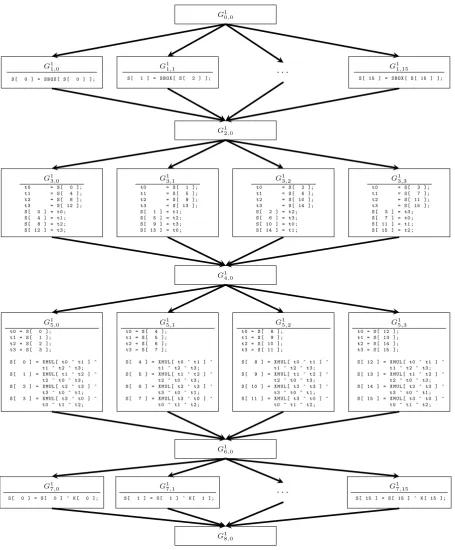
As an example, consider anaesimplementation [5] using an eight-bit software data-path; we represent the state matrix using a sixteen-element arrayS. One can describe instructions that comprise a standard, non-finalaesround (i.e.,SubBytesyShiftRowsyMixColumnsyAddRoundKey), as a program graph. Using both C and continuation dots for brevity, such a program graph is shown in Figure 1.
– For the example (and in general) one can specialize the program rewriting algorithm once the source program is fixed. e.g. all loops can be unrolled, empty levels or levels with a single bucket can be processed at reduced cost and special case treatment can be applied to levels with a single bucket type.
– The MixColumns layer houses buckets that can be split into smaller parts depending on register
G1 0,0
G1 1,0
S [ 0 ] = S B O X [ S [ 0 ] ];
G1 1,1
S [ 1 ] = S B O X [ S [ 2 ] ]; · · ·
G1 1,15
S [ 15 ] = S B O X [ S [ 15 ] ];
G1 2,0
G13,0
t0 = S [ 0 ];
t1 = S [ 4 ];
t2 = S [ 8 ];
t3 = S [ 12 ]; S [ 0 ] = t0 ; S [ 4 ] = t1 ; S [ 8 ] = t2 ; S [ 12 ] = t3 ;
G13,1
t0 = S [ 1 ];
t1 = S [ 5 ];
t2 = S [ 9 ];
t3 = S [ 13 ]; S [ 1 ] = t1 ; S [ 5 ] = t2 ; S [ 9 ] = t3 ; S [ 13 ] = t0 ;
G13,2
t0 = S [ 2 ];
t1 = S [ 6 ];
t2 = S [ 10 ]; t3 = S [ 14 ]; S [ 2 ] = t2 ; S [ 6 ] = t3 ; S [ 10 ] = t0 ; S [ 14 ] = t1 ;
G13,3
t0 = S [ 3 ];
t1 = S [ 7 ];
t2 = S [ 11 ]; t3 = S [ 15 ]; S [ 3 ] = t3 ; S [ 7 ] = t0 ; S [ 11 ] = t1 ; S [ 15 ] = t2 ;
G14,0
G1 5,0
t0 = S [ 0 ]; t1 = S [ 1 ]; t2 = S [ 2 ]; t3 = S [ 3 ];
S [ 0 ] = X M U L [ t0 ^ t1 ] ^ t1 ^ t2 ^ t3 ; S [ 1 ] = X M U L [ t1 ^ t2 ] ^
t2 ^ t0 ^ t3 ; S [ 2 ] = X M U L [ t2 ^ t3 ] ^
t3 ^ t0 ^ t1 ; S [ 3 ] = X M U L [ t3 ^ t0 ] ^
t0 ^ t1 ^ t2 ;
G1 5,1
t0 = S [ 4 ]; t1 = S [ 5 ]; t2 = S [ 6 ]; t3 = S [ 7 ];
S [ 4 ] = X M U L [ t0 ^ t1 ] ^ t1 ^ t2 ^ t3 ; S [ 5 ] = X M U L [ t1 ^ t2 ] ^
t2 ^ t0 ^ t3 ; S [ 6 ] = X M U L [ t2 ^ t3 ] ^
t3 ^ t0 ^ t1 ; S [ 7 ] = X M U L [ t3 ^ t0 ] ^
t0 ^ t1 ^ t2 ;
G1 5,2
t0 = S [ 8 ]; t1 = S [ 9 ]; t2 = S [ 10 ]; t3 = S [ 11 ];
S [ 8 ] = X M U L [ t0 ^ t1 ] ^ t1 ^ t2 ^ t3 ; S [ 9 ] = X M U L [ t1 ^ t2 ] ^
t2 ^ t0 ^ t3 ; S [ 10 ] = X M U L [ t2 ^ t3 ] ^
t3 ^ t0 ^ t1 ; S [ 11 ] = X M U L [ t3 ^ t0 ] ^
t0 ^ t1 ^ t2 ;
G1 5,3
t0 = S [ 12 ]; t1 = S [ 13 ]; t2 = S [ 14 ]; t3 = S [ 15 ];
S [ 12 ] = X M U L [ t0 ^ t1 ] ^ t1 ^ t2 ^ t3 ; S [ 13 ] = X M U L [ t1 ^ t2 ] ^
t2 ^ t0 ^ t3 ; S [ 14 ] = X M U L [ t2 ^ t3 ] ^
t3 ^ t0 ^ t1 ; S [ 15 ] = X M U L [ t3 ^ t0 ] ^
t0 ^ t1 ^ t2 ;
G16,0
G1 7,0
S [ 0 ] = S [ 0 ] ^ K [ 0 ];
G1 7,1
S [ 1 ] = S [ 1 ] ^ K [ 1 ]; · · ·
G1 7,15
S [ 15 ] = S [ 15 ] ^ K [ 15 ];
G1 8,0
Fig. 1.A program graph for one aesround; the graph consists of 9 levels, with levels 0, 2, 4, 6 and 8 acting
as synchronization points. Note thatSBOXand XMULrepresent precomputed tables for theaesS-box andxtime
Algorithm 2: randomly rewrites the source program into a target program. Input: A program graphGwithnlevels representing a source programS.
Output: The target programT representing a valid, randomized reordering of instructions fromS.
1 SetT ← ∅
2 fori= 0upton−1do
3 Shuffle the listRi.
4 end for
5 fori= 0upton−1do
6 Lettbe the type of buckets withinGi.
7 if t= 1then
8 forj= 0upto|Ri| −1do
9 j′←Ri[j]
10 fork= 0upto|Gi,j′| −1do
11 LetI be the next unprocessed instruction inGi,j′.
12 AppendIto the target programT.
13 end for
14 end for
15 end if
16 else if t= 2then
17 forj= 0upto|Ri| −1do
18 j′←Ri[j]
19 LetI be the next unprocessed instruction inGi,j′.
20 AppendIto the target programT.
21 end for
22 end if
23 end for
24 returnT
4
Experimental Evaluation
Algorithm 2 was implemented on anarm7microprocessor. In this section we describe the performance of an unrolled reordered aes implementation and how one could attack such an implementation. We compare this with a straightforward unrolledaesimplementation.
4.1 Performance
A standard (unprotected) unrolledaesimplementation and a polymorphicaescode were written for an
arm7 microprocessor. The polymorphic version is only 1.43 times slower than the unrolled aes (7574
cyclesvs.5285), a time penalty which is not very significant for most practical purposes. This comparison is only indicative as faster polymorphic programs are possible (our rewriting function was written in C with no optimizations). Nonetheless, the polymorphic aes code requires a significant amount of extra
ramwhich might be problematic on some resource constrained devices.
4.2 Attacking a Standard aes Implementation
A standardaescode will call each sub-function deterministically. This typically involves constructing a loop that will go through all the indexes required to compute a given function in a fixed order. These loops are typically seen in the instantaneous power consumption, as a pattern of nine distinct patterns corresponding to theaes’ first nine rounds. The last round is typically represented by a different pattern because of the absence of theMixColumnfunction.
peaks that corresponds to the SubBytes function and two patterns of four peaks that correspond to the generation of the next subkey. ShiftRow occurs between these functions but is not visible in the power consumption. The exclusive or with this subkey can be seen on the right hand side of Figure 2, which means that the remaining area between this exclusive or and the generation of the subkey is where
MixColumnis computed. However, no obvious pattern can be seen without plotting this portion of the
trace with a higher resolution.
It is known that power consumption is typically proportional to the Hamming weight of the values being manipulated at a given point in time. This can be used to validate hypotheses on portions of the secret key being used in a given instance [2,10]. For example, the correlation between the Hamming weight
ofSubBytes’s output the power consumption traces can be computed in a pointwise manner for a given
key hypothesis, in this case we only need to form a hypothesis on one secret key byte. If the hypothesis is correct a significant correlation will be visible as shown in the right hand graphic of Figure 2, we note that the maximum correlation coefficient is∼0.6. If the key hypothesis is incorrect then no significant hypothesis will be present.
1000 encryption power consumption traces were taken where the secret key was a fixed value and the plaintext randomly changed for each trace. The right hand graphic of Figure 2 shows a trace of the correlation between the points of the power consumption traces and the Hamming weight of the result of the first byte produced by the SubBytes function given that the secret key is known. That is, the correlation is computed between the list of Hamming weights and the values of the first point of each trace, the values of the second point of each trace,etc. to form a trace of correlation values. The first peak corresponds to the point in time at which the first byte is produced in SubBytes and indicates which of the sixteen peaks corresponds to that byte being produced. The subsequent peaks in the correlation trace indicate the instants where the same byte is manipulated byMixColumns.
4.3 Attacking an Unrolled aes Implementation
The typical power consumption trace of an unrolledaes is shown in the left part of Figure 3.
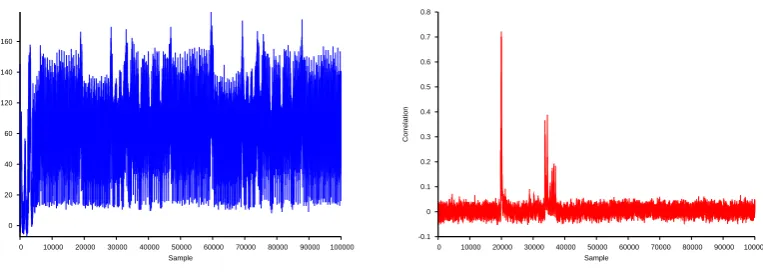
In Figure 4, we note that the maximum correlation coefficient for an unrolled implementation is∼0.7. Figure 4 is the analogous of 2 under identical experimental conditions (1000 tracesetc). Interpretation remains the same: the subsequent peaks in the correlation trace indicate the instants at which the same byte is manipulated inMixColumnsbut have a lower correlation coefficient.
The left graph of Figure 6 shows the maximum observed correlation for all 256 possible hypotheses for one observed key forxpower consumption traces. Incorrect hypotheses are plotted in grey and the correct hypothesis is plotted in black. We note that ∼100 traces suffice to distinguish the correct hypothesis from the incorrect hypotheses.
4.4 Attacking a Polymorphic aes Implementation
A polymorphicaes, as described in Section 3 was implemented on an arm7. The power consumption for the round function changes considerably. In the implementation, the subset of opcodes used has a lower average power consumption and features local peaks in the power consumption caused by the call and return from the subfunctions in the individual round (right part of Figure 3). The individual round functions can only be identified by the time required to compute them as the patterns visible in Figure 2 are no longer present. These peaks can easily be removed by implementing the round function as one function. However, this feature is convenient for our analysis.
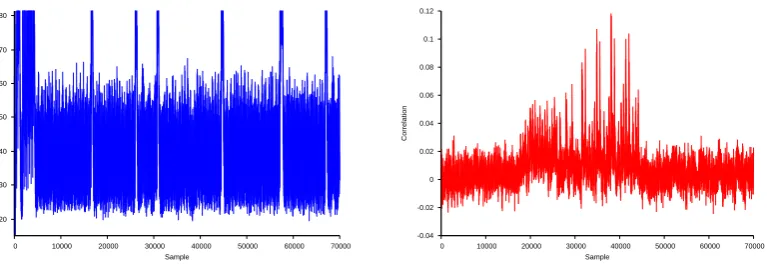
Figure 5 is the equivalent of Figure 4 for a polymorphic aes. Figure 5 features two groups of peaks, the first of which has a correlation of∼0.06; this group is caused by the sixteen possible positions where the byte output from theSBOX indexed by the exclusive-or of the first plaintext byte and the first byte of the secret key is created. A second series of peaks representing a correlation of∼0.1 is visible. This series of peaks is caused by the sixteen possible positions where the same byte can be manipulated in
theMixColumnfunction. We can note that these correlation coefficients are very low and 20,000 power
consumption curves were required to produce a correlation coefficient that is significantly larger than the surrounding noise.
0 40 80 120 160
0 5000 10000 15000 20000 25000 30000 35000 40000 45000 50000
Voltage (mV)
Sample
-0.2 -0.1 0 0.1 0.2 0.3 0.4 0.5 0.6
0 5000 10000 15000 20000 25000 30000 35000 40000 45000 50000
Correlation
Sample
Fig. 2.Power consumption trace of a single round of anaesencryption performed by an arm7microprocessor (left) and a Differential Power Analysis signal (right).
0 40 80 120 160
0 50000 100000 150000 200000 250000 300000 350000 400000 450000 500000
Voltage (mV)
Sample
0 40 80 120 160
0 50000 100000 150000 200000 250000 300000 350000 400000 450000
Voltage (mV)
Sample
Fig. 3.Power consumption trace of an unrolledaesonarm7. Unprotected (left) and polymorphic (right) codes.
0 20 40 60 120 140 160
0 10000 20000 30000 40000 50000 60000 70000 80000 90000 100000
Voltage (mV)
Sample
-0.1 0 0.1 0.2 0.3 0.4 0.5 0.6 0.7 0.8
0 10000 20000 30000 40000 50000 60000 70000 80000 90000 100000
Correlation
Sample
Fig. 4. The rightmost trace is the correlation between the power consumption and the output of the S-box
that operates on the ⊕of the first plaintext byte and the secret key. The leftmost trace shows a sample power
20 30 40 50 60 70 80
0 10000 20000 30000 40000 50000 60000 70000
Voltage (mV)
Sample
-0.04 -0.02 0 0.02 0.04 0.06 0.08 0.1 0.12
0 10000 20000 30000 40000 50000 60000 70000
Correlation
Sample
Fig. 5.The analogous of Figure 4 for the polymorphic code. In the leftmost trace the round functions are divided up by peaks in the power consumption.
0 0.1 0.2 0.3 0.4 0.5 0.6 0.7 0.8
1 250 500 750 1000 1250 1500 1750 2000
Correlation
Sample Size
0 0.05 0.1 0.15 0.2 0.25 0.3 0.35 0.4
1 1000 2000 3000 4000 5000 6000 7000 8000
Correlation
Sample Size
the correct hypothesis is plotted in black. We note that ∼2,500 traces are required to distinguish the correct hypothesis from the incorrect ones. This is considerably more than required to distinguish the correct hypotheses when attacking a non-polymorphicaes.
5
Can Lisp-Like Languages Help?
A further sophistication step consists in requiringFiandFi+1to have an extreme difference. While we do not provide a rigorous definition of the wordextreme, the aim of our next experiment, nicknamedPastis, is to illustrate the creation of a program able to rewrite itself in a way that does not alter functionality but potentially changesall its code. We call a codefully polymorphic if any instruction ofFi can potentially change inFi+1.
The code was designed with two goals in mind: illustrate the way in which fully polymorphic code is designed and provide a platform allowing to comfortably test the efficiency of diverse replacement rules as a step stone towards the design of a fully polymorphicaescode.
Such techniques can already be seen in polymorphic viruses as a way to foil signature-based detection attempts by anti-virus software; they also appear in code obfuscation systems. Readers can refer to [17] for more information on this topic.
Pastisis written in Scheme for themitScheme implementation [15]. The payload to transform (e.g.
anaes) also has to be written in Scheme and is restricted to the subset of the Scheme syntax which the rewriting system is able to understand (Of course, since the rewriting engine has to rewrite itself, it is itself written using this limited subset of Scheme).
Pastisis modular in a way making it easy to install new rewriting rules. Rules must change the source
code’s form while keeping it functionally equivalent. In this paper we voluntarily provide illustrative rules which could not work indefinitely because they tend to make the size of the code increase.
5.1 Structure
The top-levelPastisfunction ispastis-generator. It creates the self-rewriting program from the pay-load and a rewriting function (which takes code as input and produces functionally equivalent rewritten code as its return value).
The produced code behaves functionally like the payload function: it will be evaluated to the same value if it gets the same parameters. However, it will additionally print, during the evaluation, a rewritten, equivalent version of itself.
Of course, the rewritten version is still functionally equivalent to the original payload and will also produce a rewritten version of itself, which, in turn, can be run, and so on,ad infinitum(forgetting about the growing size of the rewritten code,i.e., assuming that we have an infinite amount of memory).
Internal Structure The use of thepastis-generatorfunction is quite straightforward; its role is to provide a convenient mechanism to weld the payload and rewriter together to make self-rewriting possible. Here is an example of the use ofpastis-generator. The payload here is a simple function which adds 42 to its parameter and the rewriter is the identity function.
(pastis-generator
’((payload . (lambda (x) (+ 42 x))) (rewriter . (lambda (x) x))))
(lambda (args)
(define (pastis-rewrite x) ((lambda (x) x) x)) (define (pastis-payload x)
((lambda (x) (+ 42 x)) x)) (define (pastis-ls l)
(map (lambda (x) (write (pastis-rewrite x)) (display " ")) l)) (define (pastis-code l)
(display "(") (pastis-ls l)
(display "(pastis-code ’(") (pastis-ls l)
(display ")) (pastis-payload args))\n")) (pastis-code
’(lambda (args)
(define (pastis-rewrite x) ((lambda (x) x) x)) (define (pastis-payload x)
((lambda (x) (+ 42 x)) x)) (define (pastis-ls l)
(map (lambda (x) (write (pastis-rewrite x)) (display " ")) l)) (define (pastis-code l)
(display "(") (pastis-ls l)
(display "(pastis-code ’(") (pastis-ls l)
(display ")) (pastis-payload\nargs))\n")))) (pastis-payload args))
5.2 Step by Step Explanations
The code generated bypastis-generatorseems complicated, but its structure is in fact very similar to that of the following classical quine4.
(define (d l) (map write-line l))
(define (code l) (d l) (display "(code ’(\n") (d l) (display "))\n")) (code ’(
(define (d l) (map write-line l))
(define (code l) (d l) (display "(code ’(\n") (d l) (display "))\n"))))
Adding a payload to this quine is quite straightforward.
(define (payload) (write "Hello, World!\n")) (define (ls l) (map write-line l))
(define (code l) (ls l) (display "(code ’(\n") (ls l) (display "))\n")) (payload)
(code ’(
(define (payload) (write "Hello, World!\n")) (define (ls l) (map write-line l))
(define (code l) (ls l) (display "(code ’(\n") (ls l) (display "))\n")) (payload)))
4
Given Pastis’s role, it is quite easy to see that it is related to quines. The only difference is that
Pastis has to modify its code before printing it, instead of printing it verbatim as regular quines do.
This is also quite easy to do.
However, deeper technical changes are required if we want to be able to pass parameters to the payload because the classical quine’s structure does not permit this. The solution is to make a quine that is also a λ-expression (instead of a list of statements). This is possible, thanks to S-expressions.
The way the quine works relies on the fact that its code is a list of statements and that the last one can take a list of the previous ones as arguments. Making the whole quine a λ-expression in order to accept arguments for the payload means making it a single expression. But thanks to the language used, it appears that this single expression isstilla list. This enables us to solve our problem. Here is the result:
(lambda (args)
(define (payload x) (+ x 42)) (define (ls l) (map write-line l)) (define (code l)
(display "(")
(ls l) (display "(code ’(")
(ls l) (display "))\n(payload x))")) (code ’(lambda (x)
(define (payload x) (+ x 42)) (define (ls l) (map write-line l)) (define (code l)
(display "(")
(ls l) (display "(code ’(")
(ls l) (display "))\n(payload x))")))) (payload args))
5.3 Rewriter
In addition to pastis-generator, we also provide a rewriter function. Its role is to call specialized rewriters for each keyword, which will call rewriters recursively on their arguments if appropriate.
Specialized rewriters randomly choose a way to rewrite the top-level construct. In our example, the implemented rules are any interchange between if, case and cond (i.e. if! cond ! case ! if) along with the transformation if (condition) {A} else {B} if (!condition) {B} else {A}. It is easy and trivial to change these rules.
5.4 Results
Pastiswas tested with a simple payload and the example rewriter provided.
The code size increases steadily with generations, which seems to demonstrate that the rewriter
function provided often adds new constructs, but seldom simplifies out the useless ones. As is clear from
Pastis’ structure, code size grows linearly as generations pass (right-hand graphic of Figure 7). In our
experiment code size in megabytes seemed to grow as∼15.35×generation.
The produced code is still fairly recognizable: keywords are not rewritten and highly specific inter-mediate variables appear everywhere in the code. Furthermore, the numerous tautological conditional branches (of the form(if #t foo #!unspecific)) and useless nesting of operators are also a sure way to identify code produced by Pastis. It is unclear if such artifacts could be used to conduct template power attacks to identify and remove polymorphic transformations. Given that a Lisp smart card does not exist to the best of that authors’ knowledge, we could not practically test the effectiveness of this countermeasurein vivo.
(lambda (args) (define (pastis-rewrite x) ((lambda (x) (define (rewrite-if s) (define get-cond (rewrite (cadr s))) (define get-then (rewrite (caddr s))) (define get-else (let ((key90685615124305205095555138 (not (not (not (null? (cdddr s))))))) (let
((key45066295344977747537902121 key90685615124305205095555138)) (let
((key34753038157635856050333413 (not (or (eq? key45066295344977747537902121 (quote #f)))))) (let ((key74822769707555069929340259 (not (or (eq? key34753038157635856050333413 (quote #f)))))) (cond ((not (not (not (not (or (eq? key74822769707555069929340259 (quote #t))))))) (let ((key15300951404900453619092096 #t)) (if (or (eq?
key15300951404900453619092096 (quote #t))) (begin (case #t ((#t) (let
((key8783884258550845645406647 (not (or (eq? key74822769707555069929340259 (quote #t)))))) (case (not (or (eq? key8783884258550845645406647 (quote #f)))) ((#t) (let ((key41701470274885460121759385 key8783884258550845645406647)) (if (not (not (or (eq? key41701470274885460121759385 (quote #t))))) (if (not (or (eq?
key41701470274885460121759385 (quote #t)))) (let ((key98134142793119041861980707 #t)) (if (or (eq? key98134142793119041861980707 (quote #t))) (begin 42)
It is interesting to note that the self-referencing nature of Pastismakes it extremely hard to debug. When the third generation fails to run, for example, one needs to find the bug in the third generation code, identify what caused the second generation to produce it – and finally which code in the first generation caused the second generation to work this way. Several cases of bugs only occurring after several generations appeared during the development of Pastis.
Readers wishing to experiment with the three main program modulesrewriters.scm, rewrite.scm
andgenerator.scmcan download them from [14].
5.5 Possible Extensions
The current rewriterfunction only serves as an example. First, it leaves several recognizable features in the code. More importantly, the transformations it applies are not very deep, since one could simply decide to only usecondconstructs, systematically rewrite allifandcase constructs tocondand focus on the rewriting of cond. To be more precise, if and case can be seen as Scheme syntactic sugar; it would probably be better to restrict the rewriting to a bare bones subset of the Scheme syntax, convert everything to this subset before rewriting and possibly convert some things back to syntactic sugar forms to make the rewritten code look more natural.
Several transformations could be applied instead of the simplistic operations done by ourrewriter
function. Here are a few ideas:
α-Renaming The current rewriterdoes not rename variables at all. A way to do this would be to keep an environment indicating current renamings. When we encounter a definition, we change the name and add the original and rewritten name to the environment. When we encounter a name, we change it to the appropriate rewritten name by a simple lookup in the environment. It is assumed that when the Scheme virtual machine processes names, power signatures caused by processing different names will differ as well.
β-Reduction andβ-Expansion A possible rewriting method would be to performβ-reductions (in the usualλ-calculus sense). Conversely, it would also be possible to performβ-expansions: select a sub-term, replace it by a variable and replace the whole expression by a function in this variable applied to the selected sub-term, taking all necessary care to prevent variable capture problems (roughly, ensuring that the operation does not bind other occurrences of the new variable and that the bindings of the sub-terms are still the same).
Adding and Removing Definitions This would be the ability for the rewriter to add or remove local definitions when possible. When the rewriter sees an expression E(expr) it could replace it with (let
((const expr)) E(const)). This is very similar to the aforementionedβ-reduction and expansion ideas
and could be implemented in a similar way.
6
Avoiding Code Growth
While Pastis is conceptually interesting, the code growth problem makesPastis useless for practical purposes. Let F0 be the first generation of a self-rewriting program. Besides a payload representing the actual code’s purpose, F0 also contains a non-deterministic rewriting function H. H takes as input a version of the program and outputs another version, so that∀i∈N,Fi=H(Fi−1) withi̸=j⇒Fi̸=Fj while retaining the code’s core functionality,i.e.Fi(m, k) =F0(m, k)∀i, m, k, as shown in the left hand-side of Figure 7.
As in the basic Pastisexample the size ofFi is monotonically increasing5(i.e., size(Fi+1)≥size(Fi) with overwhelming probability), it is desirable to look for a different rewriting scheme6.
An interesting alternative approach is to keep a representation of the original function F0 withinFi and always rewriteF0differently. To ensure that each time a different program is created, the indexiof the next version is passed to H: Fi =H(F0, i). HavingFi completely determined by F0 and the index
i can be helpful, especially for debugging purposes. However, this approach has a crucial drawback: An attacker may be able pre-compute allFi and analyze them for side channel information leakage, thereby weakening the polymorphic protection. Thus, it is advisable to have an additional randomness source that makesH non-deterministic. IfH is truly non-deterministic, there is no need to passias an argument to
H because each call of H(F0) creates a new, randomized version of F0. The left-hand side of Figure 8 illustrates such a system.
Note that at each rewritten generation,Fi is completelydiscarded and only the description of F0 is used again for the new code generation. In addition, the description ofF0does not need to be included in clear. If desired by the setting, it can instead be encrypted with a random key. For this, the corresponding encryption and decryption function as well as the random key, must be included withFi and upon each code rewrite, the encrypted description ofF0 must be decrypted, rewritten by H, and encrypted again with a new random key. Interestingly, if the payload itself contains a block-cipher code, this code can be also used for encryptingF0; thus no additional encryption routine needs to be embedded in the program. This encryption approach bears some similarities to techniques used by polymorphic viruses.
6.1 Separating H From Fi
Pastisis primarily meant for the protection of cryptographic functions from certain types of side-channel
attacks. To this end,Pastis’ primary goal is to rewrite the payload, while the rewriting processH itself is not directly subject to such attacks and thus may not need to be rewritten at all. This is because the functionality ofH is independent of the public message inputmand the secret inputk.
Thus, it may appear fit for purpose to rewrite only F0 and keep H intact. Such an approach is interesting as in many cases, H will be much more complex than the payload and may become even more complex (and maybe less efficient) after being rewritten, as rewriting rules can have a detrimental effect on the size and the efficiency ofH. However, in some cases side channels emanating fromH may leak information about the rewriting process and thus about the code ofFi. If this is the case, then the information gained from the attack could be used to subsequently create attacks onFi. If, however, such an indirect attack onFiis considered infeasible or unlikely for a particular instance of polymorphic code, then the approach of not rewriting H can be a practicable way to improve code efficiency. This may also allow for more complex rewriting rules that would not be possible ifH had to be expressed in the possibly restricted realm of rewritable code (for example, the limited subset of Scheme used inPastis). This motivates the suggestion of yet another modification of our paradigm: Instead of having H be a part of Fi, we may considerH and Fi as separate functions. On each invocation H is called first. H
5
Code size is monotonically increasingon the average, we neglect the unlikely cases where rewriting will cause
a decrease in code size. 6
code_generation1
rewriter payload
generator
args1 payload(args1)
code_generation2
args2 payload(args2)
code_genration3
args3 payload(args3)
etc...
code size in MB
number of generations
20 40 60 80 100 0.5
1.0 1.5
Fig. 7.Summary of the use of Pastis(left) and typical evolution of code size with generations (right).
F1=code_generation1(including H)
rewriter payload
generator
args1 payload(args1)
args2 payload(args2)
args3 payload(args3)
etc... Description of F0
Description of F0
Description of F0 F2=code_generation2(including H)
F3=code_generation3(including H)
F1=code_generation1
rewriter payload
generator
args1 payload(args1)
args2 payload(args2)
args3 payload(args3)
etc... Description of F0
F2=code_generation2
F3=code_generation3
Rewriting logic H
Description of F0Rewriting logic H
Description of F0Rewriting logic H
loads the description of F0 and takes as additional (implicit) input either an index iand/or a source of randomness and outputsFi, which – as above – has the same functionality asF0 but is rewritten.
After rewriting F0 as Fi, H passes the inputs{m, k} to Fi to execute the desired payload. This is illustrated in the right-hand side of Figure 8.
6.2 Randomizing Compilers: A Practical Approach
It remains to decide how such a “description of F0” that is included in each code generation should be chosen. From an implementor’s perspective, the form of F0’s description must be chosen such that it consists only of elements that are understood by the rewriting engine while at the same time allows for a fast creation ofFi for alli. While it may appear natural to use the same type forF0as forFi (i.e., code that can directly be executed), using a more abstract representation has some advantages: For example, if a program is represented under the form of a syntax tree, it can be straightforward to analyze to find permutations of code blocks (i.e., subtrees) that do not change the code’s semantics. This is similar to
our bucketsidea in Section 2. When, in contrast, the program is represented as virtual machine code,
such code rearrangements may be much more difficult to identify. Thus,F0should be described in a more abstract way and converted by H to a more concrete representation. In fact, we may consider H as a
compilerthat transforms code from a high-level language into a less abstract one.
For example, F0 may be represented by a gimple tree. gimple [13] is a rather simple
language-independent tree-representation of functions used extensively by thegnuCompiler Collection (gcc) in various stages of the compilation process. Source code from any language supported bygccis transformed
into gimple which is then analyzed and optimized before being converted to the target language (for
example, machine code).7 Representing functions under gimple removes much of the complexity from the compiler that would be needed when working directly with a high-level language like C++. This makes compilation very fast.
gcc applies many optimizations togimpletrees which may change their form in several ways. This
can be used to create very powerful polymorphic code: randomizing which of these optimizations are done and how exactly they are applied to the tree leads to many different possible results, all of which yield semantically equivalent code. Randomization can also be applied to the next compilation steps which turn thegimpletree into the target language. As there are many ways to encode constructs like anifor simple arithmetic expressions into machine code, a great variety of possible realizations of such constructs can be found.
Thus, an extensive polymorphic framework can be built by using arandomizingversion of the parts ofgccthat deal withgimpletrees and transform them to machine code asH. Such a framework would allow the execution of very elaborate rewriting rules while preserving efficiency by only dealing with
gimpleinstead of source code.
The implementation of this approach is an idea that is yet to be explored – left as future work.
Acknowledgements
The work described in this paper has been supported in part by the European CommissionistProgramme under Contractict-2007-216676 ecrypt iiandepsrcgrantep/f039638/1.
References
1. G. Bertoni, L. Breveglieri, P. Fragneto, M. Macchetti and S. Marchesin, Efficient Software Implementation
ofaeson 32-Bit Platforms,Cryptographic Hardware and Embedded Systems (ches), Springer-Verlaglncs
2523, 159–171, 2002.
2. E. Brier, C. Clavier and F. Olivier, Correlation Power Analysis with a Leakage Model,ches2004,
Springer-Verlaglncs3156, 16–29, 2004.
3. C. Clavier, J.-S. Coron and N. Dabbous, Differential Power Analysis in the Presence of Hardware
Coun-termeasures,Cryptographic Hardware and Embedded Systems (ches), Springer-Verlaglncs1965, 252–263,
2000.
7
4. C. Collberg and C. Thomborson, Watermarking, tamper-proofing, and obfuscation - tools for software
pro-tection,ieeeTransactions on Software Engineering, 28 (8), 735–746, 2002.
5. J. Daemen and V. Rijmen, The Design of Rijndael, Springer-Verlag, 2002.
6. C. Gentry, S. Halevi and V. Vaikuntanathan, i-Hop Homomorphic Encryption and Rerandomizable Yao
Circuits,Advances in Cryptologycrypto2010, Springer-Verlaglncs6223, 155-172, 2010.
7. C. Herbst, E. Oswald and S. Mangard, An aes Smart Card Implementation Resistant to Power Analysis
Attacks,Applied Cryptography and Network Security (accs), Springer-Verlaglncs3989, 239–252, 2006.
8. D. Hofstadter, G¨odel, Escher, Bach: An Eternal Golden Braid, Basic Books, (1999) [1979].
9. D. Knuth,The Art of Computer Programming, Volume 2: Seminumerical Algorithms (3rd Edition), Addison
Wesley, 1998.
10. P. Kocher, J. Jaffe and B. Jun, Differential Power Analysis,Advances in Cryptologycrypto1999,
Springer-Verlaglncs1666, 388–397, 1999.
11. P. Leadbitter, D. Page and N. Smart, Non-deterministic Multi-threading,ieeeTransactions on Computers,
56 (7), 992–998, 2007.
12. D. May, H. Muller and N. Smart, Non-deterministic Processors, Australasian Conference on Information
Security and Privacy (acisp), Springer-Verlaglncs2119, 115–129, 2001.
13. J. Merrill,genericandgimple: A new tree representation for entire functions, Technical report, Red Hat,
Inc. (2003)gccDeveloper’s Summit.
14. http://pablo.rauzy.name/files/cryptomorph-sources.zip
15. http://www.gnu.org/software/mit-scheme/
16. M. Tunstall and O. Benoˆıt, Efficient Use of Random Delays in Embedded Software,Information Security
Theory and Practices (wistp), Springer-Verlaglncs4462, 27–38, 2007.
17. Z. Xin, H. Chen, H. Han, B. Mao and L. Xie, Misleading Malware Similarities Analysis by Automatic Data