Random Oracles in a Quantum World
Dan Boneh1, ¨Ozg¨ur Dagdelen2, Marc Fischlin2, Anja Lehmann3, Christian Schaffner4, and Mark Zhandry1
1
Stanford University, USA 2
CASED & Darmstadt University of Technology, Germany 3IBM Research Zurich, Switzerland
4
University of Amsterdam and CWI, The Netherlands
Abstract. The interest in post-quantum cryptography — classical sys-tems that remain secure in the presence of a quantum adversary — has generated elegant proposals for new cryptosystems. Some of these sys-tems are set in the random oracle model and are proven secure relative to adversaries that have classical access to the random oracle. We argue that to prove post-quantum security one needs to prove security in the quantum-accessiblerandom oracle model where the adversary can query the random oracle with quantum state.
We begin by separating the classical and quantum-accessible random or-acle models by presenting a scheme that is secure when the adversary is given classical access to the random oracle, but is insecure when the adversary can make quantum oracle queries. We then set out to develop generic conditions under which aclassical random oracle proof implies security in thequantum-accessible random oracle model. We introduce the concept of a history-free reduction which is a category of classical random oracle reductions that basically determine oracle answers inde-pendently of the history of previous queries, and we prove that such reductions imply security in the quantum model. We then show that certain post-quantum proposals, including ones based on lattices, can be proven secure using history-free reductions and are therefore post-quantum secure. We conclude with a rich set of open problems in this area.
Keywords: Quantum, Random Oracle, Signatures, Encryption
1
Introduction
As it is often the case, the most efficient constructions in lattice-based cryp-tography are set in the random oracle (RO) model [BR93]. For example, Gentry, Peikert, and Vaikuntanathan [GPV08] give elegant random oracle model con-structions for existentially unforgeable signatures and for identity-based encryp-tion. Gordon, Katz, and Vaikuntanathan [GKV10] construct a random oracle model group signature scheme. Boneh and Freeman [BF11] give a random or-acle homomorphic signature scheme and Cayrel et al. [CLRS10] give a lattice-based signature scheme using the Fiat-Shamir random oracle heuristic. Some of these lattice constructions can now be realized without random oracles, but at a significant cost in performance [CHKP10,ABB10a,Boy10].
Modeling Random Oracles for Quantum Attackers. While quantum re-sistance is good motivation for lattice-based constructions, most random oracle systems to date are only proven secure relative to an adversary with classical access to the random oracle. In this model the adversary is given oracle access to a random hash functionO:{0,1}∗→ {0,1}∗and it can only “learn” a value O(x) by querying the oracle O at the classical state x. However, to obtain a concrete system, the random oracle is eventually replaced by a concrete hash function thereby enabling a quantum attacker to evaluate this hash function on quantum states. To capture this issue in the model, we allow the adversary to evaluate the random oracle “in superposition”, that is, the adversary can submit quantum states|ϕi=P
αx|xito the oracle O and receives back the evaluated statePα
x|O(x)i(appropriately encoded to make the transformation unitary). We call this the quantum(-accessible) random oracle model. It complies with similar efforts from learning theory [BJ99,SG04] and computational complex-ity [BBBV97] where oracles are quantum-accessible, and from lower bounds for quantum collision finders [AS04]. Still, since we are only interested in classical cryptosystems, honest parties and the scheme’s algorithms can access O only via classical bit strings.
Proving security in the quantum-accessible RO model is considerably harder than in the classical model. As a simple example, consider the case of digital signatures. A standard proof strategy in the classical settings is to choose ran-domly one of the adversary’s RO queries and embed in the response a given instance of a challenge problem. One then hopes that the adversary uses this re-sponse in his signature forgery. If the adversary makesqrandom oracle queries, then this happens with probability 1/q and since q is polynomial this success probability is sufficiently high for the proof of security in the classical setting. Unfortunately, this strategy fails completely in the quantum-accessible random oracle model since everyrandom oracle query potentially evaluates the random oracle at exponentially many points. Therefore, embedding the challenge in one response will be of no use to the reduction algorithm. This simple example shows that proving security in the classical RO model does not necessarily prove post-quantum security.
– Adaptive Programmability: The classical random oracle model allows a sim-ulator to program the answers of the random oracle for an adversary, often adaptively. Since the quantum adversary can query the random oracle with a state in superposition, the adversary may get some information about all exponentially many values right at the beginning, thereby making it difficult to program the oracle adaptively.
– Extractability/Preimage Awareness: Another application of the random ora-cle model for classical adversaries is that the simulator learns the pre-images the adversary is interested in. This is, for example, crucial to simulate de-cryption queries in the security proof for OAEP [FOPS01]. For quantum-accessible oracles the actual query may be hidden in a superposition of ex-ponentially many states, and it is unclear how to extract the right query. – Efficient Simulation: In the classical world, we can simulate an
exponential-size random oracle efficiently via lazy sampling: simply pick random but consistent answers “on the fly”. With quantum-accessible random oracles the adversary can evaluate the random oracle on all inputs simultaneously, making it harder to apply the on-demand strategy for classical oracles. – Rewinding/Partial Consistency: Certain random oracle proofs [PS00] require
rewinding the adversary, replaying some hash values but changing at least a single value. Beyond the usual problems of rewinding quantum adversaries, we again encounter the fact that we may not be able to change hash values unnoticed. We note that some form of rewinding is possible for quantum zero-knowledge [Wat09].
We do not claim that these problems are insurmountable. In fact, we show how to resolve the issue of efficient simulation by using (quantum-accessible) pseudorandom functions. These are pseudorandom functions where the quan-tum distinguisher can submit quanquan-tum states to the pseudorandom or random oracle. By this technique, we can efficiently simulate the quantum-accessible ran-dom oracle through the (efficient) pseudoranran-dom function. While pseudoranran-dom functions where the distinguisher may use quantum power but only gets classi-cal access to the function can be derived from quantum-immune pseudorandom generators [GGM86], it is an open problem if the stronger quantum-accessible pseudorandom functions exist.
Note, too, that we do not seek to solve the problems related to the random oracle model which appear already in the classical settings [CGH98]. Instead we show that for post-quantum security one should allow for quantum access to the random oracle in order to capture attacks that are available when the hash function is eventually instantiated.
1.1 Our Contributions
Separation. We begin with a separation between the classical and quantum-accessible RO models by presenting a two-party protocol which is:
– secure against quantum attackers with classical access to the random oracle model, but insecure underany implementation of the hash function, and – insecure in the quantum-accessible random oracle model.
The protocol itself assumes that (asymptotically) quantum computers are faster than classical (parallel) machines and uses the quadratic gap due to Grover’s algorithms and its application to collision search [BHT98] to separate secure from insecure executions.
Constructions. Next, we set out to give general conditions under which a classical RO proof implies security for a quantum RO. Our goal is to provide generic tools by which authors can simply state that their classical proof has the “right” structure and therefore their proof implies quantum security. We give two flavors of results:
– For signatures, we define a proof structure we call a history-free reduction which roughly says that the reduction answers oracle queries independently of the history of queries. We prove that any classical proof that happens to be a history-free reduction implies quantum existential unforgeability for the signature scheme. We then show that the GPV random oracle signature scheme [GPV08] has a history-free reduction and is therefore secure in the quantum settings.
Next, we consider signature schemes built from claw-free permutations. The first is the Full Domain Hash (FDH) signature system of Bellare and Rog-away [BR93], for which we show that the classical proof technique due to Coron [Cor00] is history-free. We also prove the quantum security of a variant of FDH due to Katz and Wang [KW03] which has a tight security reduction. Lastly, we note that, as observed in [GPV08], claw-free permutations give rise to preimage sampleable trapdoor functions, which gives another FDH-like signature scheme with a tight security reduction. In all three cases the re-ductions in the quantum-accessible random oracle model achieve essentially the same tightness as their classical analogs.
Interestingly, we do not know of a history-free reduction for the generic Full Domain Hash of Bellare and Rogaway [BR93]. One reason is that proofs for generic FDH must somehow program the random oracle, as shown in [FLR+10]. We leave the quantum security of generic FDH as an interest-ing open problem. It is worth notinterest-ing that at this time the quantum secu-rity of FDH is somewhat theoretical since we have no candidate quantum-secure trapdoor permutation to instantiate the FDH scheme, though this may change once a candidate is proposed.
– For encryption we prove the quantum CPA security of an encryption scheme due to Bellare and Rogaway [BR93] and the quantum CCA security of a hybrid encryption variant of [BR93].
heuristic to aΣ identification protocol, for example, as suggested in [CLRS10]. Similarly, proving security of generic FDH is still open. For CCA-secure encryp-tion, it is unknown if generic CPA to CCA transformations, such as [FO99], are secure in the quantum settings. Similarly, it is not known if lattice-based identity-based encryption systems secure in the classical RO model (e.g. as in [GPV08,ABB10b]) are also secure in the quantum random oracle model. Related Work. The quantum random oracle model has been used in a few previous constructions. Aaronson [Aar09] uses quantum random oracles to con-struct unclonable public-key quantum money. Brassard and Salvail [BS08] give a modified version of Merkle’s Puzzles, and show that any quantum attacker must query the random (permutation) oracle asymptotically more times than honest parties. Recently, a modified version was proposed that restores some level of se-curity even in the presence of a quantum adversary [BHK+11]. Quantum random oracles have also been used to prove impossibility results for quantum compu-tation. For example, Bennett et al. [BBBV97] show that relative to a random oracle, a quantum computer cannot solve all of NP.
Some progress toward identifying sufficient conditions under which classical protocols are also quantum immune has been made by Unruh [Unr10] and Hall-gren et al. [HSS11]. These results show that, if a cryptographic protocol can be shown to be (computationally [HSS11] resp. statistically [Unr10]) secure in Canetti’s universal composition (UC) framework [Can01] against classical ad-versaries, then the protocol is also resistant against (computationally bounded resp. unbounded) quantum adversaries. This, however, means that the underly-ing protocol must already provide strong security guarantees in the first place, namely, universal composition security, which is typically more than the afore-mentioned schemes in the literature satisfy. This also applies to similar results by Hallgren et al. [HSS11] for so-called simulation-based security notions for the starting protocol. Furthermore, all these results do not seem to be applicable immediately to the random oracle model where the quantum adversary now has quantumaccess to the random function (but where the ideal functionality for the random oracle in the UC framework would have only been defined for classical access according to the classical protocol specification), and where the question of instantiation is an integral step which needs to be considered.
2
Preliminaries
A non-negative function=(n) is negligible if, for all polynomialsp(n) we have that (n)< p(n)−1 for all sufficiently largen. The variational distance between two distributionsD1 andD2 overΩis given by
|D1−D2|= X
x∈Ω
|Pr[x|D1]−Pr[x|D2]|.
A classical randomized algorithmA can be thought of in two ways. In the first,Ais given an inputx,Amakes some coin tosses during its computation, and ultimately outputs some valuey. We denote this action byA(x) whereA(x) is a random variable. Alternatively, we can giveAboth its inputxand randomnessr
in which case we denote this action asA(x;r). For a classical algorithm,A(x;r) is deterministic. An algorithmA runs is probabilistic polynomial-time (PPT) if it runs in polynomial time in the security parameter (which we often omit from the input for sake of simplicity).
2.1 Quantum Computation
We briefly give some background on quantum computation and refer to [NC00] for a more complete discussion. A quantum system Ais associated to a (finite-dimensional) complex Hilbert space HA with an inner product h·|·i. The state of the system is described by a vector |ϕi ∈ HA such that the Euclidean norm
k |ϕi k = phϕ|ϕi is 1. Given quantum systems A and B over spaces HA and
HB, respectively, we define the joint or composite quantum system through the tensor product HA⊗ HB. The product state of |ϕAi ∈ HA and |ϕBi ∈ HB is denoted by |ϕAi ⊗ |ϕBior simply|ϕAi |ϕBi. An n-qubit system lives in the joint quantum system of n two-dimensional Hilbert spaces. The standard or-thonormal computational basis|xifor such a system is given by|x1i ⊗ · · · ⊗ |xni for x=x1. . . xn. Any (classical) bit string xis encoded into a quantum state as |xi. An arbitrary pure n-qubit state |ϕi can be expressed in the computa-tional basis as|ϕi=P
x∈{0,1}nαx|xiwhereαxare complex amplitudes obeying P
x∈{0,1}n|αx|2= 1.
Transformations. Evolutions of quantum systems are described by unitary trans-formations withIAbeing the identity transformation on registerA. Given a joint quantum system overHA⊗ HB and a transformationUA acting only onHA, it is understood thatUA|ϕAi |ϕBirefers to (UA⊗IB)|ϕAi |ϕBi.
Information can be extracted from a quantum state |ϕi by performing a positive-operator valued measurement (POVM) M ={Mi} with positive semi-definite measurement operatorsMithat sum to the identityPiMi=I. Outcome
i is obtained with probability pi = hϕ|Mi|ϕi. A special case are projective measurements such as the measurement in the computational basis of the state
|ϕi = P
xαx|xi which yields outcome x with probability |αx|2. We can also do a partial measurement on some of the qubits. The probability of the partial measurement resulting in a stringxis the same as if we measured the whole state, and ignored the rest of the qubits. In this case, the resulting state will be the same as|φi, except that all the strings inconsistent withxare removed. This new state will not have a norm of 1, so the actual superposition is obtained by dividing by the norm. For example, if we measure the firstn bits of |φi=P
x,yαx,y|x, yi, we will obtain the measurementxwith probabilityP
the resulting state will be
|xiX
y
αx,y q
P
y0|αx,y0|2
|yi.
Following [BBC+98], we model a quantum attackerA
Q with access to (pos-sibly identical) oracles O1, O2, . . . by a sequence of unitary transformations
U1, O1, U2, . . . , OT−1, UT over k = poly(n) qubits. Here, oracle Oi :{0,1}n →
{0,1}m maps the first n+m qubits from basis state |xi |yi to basis state
|xi |y⊕Oi(x)i for x ∈ {0,1}n and y ∈ {0,1}m. If we require the access to
Oito be classical instead of quantum, the first nbits of the state are measured before applying the unitary transformation corresponding to Oi. Notice that any quantum-accessible oracle can also be used as a classical oracle. Note that the algorithm AQ may also receive some input|ψi. Given an algorithm AQ as above, with access to oraclesOi, we sometimes writeA|
O1(·)i,|O2(·)i,...
Q to indicate
that the oracle is quantum-accessible (contrary to oracles which can only process classical bits).
To introduce asymptotics we assume thatAQ is actually a sequence of such transformation sequences, indexed by parametern, and that each transformation sequence is composed out of quantum systems for input, output, oracle calls, and work space (of sufficiently many qubits). To measure polynomial running time, we assume that each Ui is approximated (to sufficient precision) by members of a set of universal gates (say, Hadamard, phase, CNOT and π/8; for sake of concreteness [NC00]), where at most polynomially many gates are used. Fur-thermore,T =T(n) is assumed to be polynomial, too. Note thatT also bounds the number of oracle queries.
We define the Euclidean distance||φi − |ψi|between two states as the value P
x|αx−βx|2
12 where |φi=P
xαx|xiand|ψi=Pxβx|xi.
Defineqr(|φti) to be the magnitude squared ofrin the superposition of query
t. We call this the query probability ofrin queryt. If we sum over allt, we get the total query probability of r.
We will be using the following lemmas:
Lemma 1 ([BBBV97] Theorem 3.1).Let|ϕiand|ψibe quantum states with Euclidean distance at most . Then, performing the same measurement on |ϕi
and|ψiyields distributions with statistical distance at most4.
Lemma 2 ([BBBV97] Theorem 3.3). Let AQ be a quantum algorithm run-ning in time T with oracle access toO. Let >0and letS⊆[1, T]× {0,1}n be a set of time-string pairs such thatP
(t,r)∈Sqr(|φti)≤. If we modifyOinto an oracle O0 which answers each query r at timet by providing the same stringR
(which has been independently sampled at random), then the Euclidean distance between the final states of AQ when invoking O andO0 is at most
√
2.2 Quantum-Accessible Random Oracles
In the classical random oracle model [BR93] all algorithms used in the system are given access to the same random oracle. In the proof of security, the reduction algorithm answers the adversary’s queries with consistent random answers.
In the quantum settings, a quantum attacker issues a random oracle query which is itself a superposition of exponentially many states. The reduction al-gorithm must evaluate the random oracle at all points in the superposition. To ensure that random oracle queries are answered consistently across queries, it is convenient to assume that quantum-resistant pseudorandom functions exist, and to implement this auxiliary random oracle with such a PRF.
Definition 1 (Pseudorandom Function).A quantum-accessible pseudoran-dom function is an efficiently computable function PRF where, for all efficient quantum algorithms D,
Pr[D
PRF(k,·)(1n) = 1]−Pr[DO(·)(1n) = 1] <
where = (n) is negligible in n, and where O is a random oracle, the first probability is over the keys k of length n, and the second probability is over all random oracles and the sampling of the result of D.
We note that, following Watrous [Wat09], indistinguishability as above should still hold for any auxiliary quantum stateσgiven as additional input toD(akin to non-uniformity for classical algorithms). We do not include such auxiliary information in our definition in order to simplify.
We say that an oracle O0 is computationally indistinguishable from a ran-dom oracle if, for all polynomial time quantum algorithms with oracle access, the variational distance of the output distributions when the oracle isO0 and when the oracle is a truly random oracle O is negligible. Thus, simulating a random oracle with a quantum-accessible pseudorandom function is computationally in-distinguishable from a true random oracle.
2.3 Hard Problems for Quantum Computers
We will use the following general notion of a hard problem.
Definition 2 (Problem).A problem is a pairP = (GameP, αP)where GameP specifies a game that a (possibly quantum) adversary plays with a classical chal-lenger. The game works as follows:
• On input 1n, the challenger computes a value x, which it sends to the ad-versary as its input
• The adversary is then run onx, and is allowed to make classical queries to the challenger.
• The adversary then outputs a valuey, which it sends to the challenger.
• The challenger then looks at x, y, and the classical queries made by the adversary, and outputs1 or0.
The value αP is a real number between 0 (inclusive) and 1 (exclusive). It may also be a function ofn, but for this paper, we only need constantαP, specifically
αP is always 0 or 12.
We say that an adversaryAwins the game GameP if the challenger outputs 1. We define the advantage AdvA,P ofAin problemP as
AdvA,P =|Pr[Awins in GameP]−αP|
Definition 3 (Hard Problem). A problem P = (GameP, αP) is hard for quantum computers if, for all polynomial time quantum adversaries A, AdvA,P is negligible.
2.4 Cryptographic Primitives
For this paper, we define the security of standard cryptographic primitives in terms of certain problems being hard for quantum computers. We give a brief sketch here and refer to the appendix for supplementary details.
A trapdoor function F is secure if Inv(F) = (GameINV(F),0) is a hard problem for quantum computers, where in GameINV, an adversary is given a random element y and public key, and succeeds if it can output an inverse for
3
Separation Result
In this section, we discuss a two-party protocol that is provably secure in the ran-dom oracle model against both classical and quantum adversaries with classical access to the random oracle (and when using quantum-immune primitives). We then use the polynomial gap between the birthday attack and a collision finder based on Grover’s algorithm to show that the protocol remains secure for cer-tain hash functions when only classical adversaries are considered, but becomes insecure for any hash function if quantum adversaries are allowed. Analyzing the protocol in the stronger quantum random oracle model, where we grant the adversary quantum access to the random oracle, yields the same negative result.
3.1 Preliminaries
We start this section by presenting the necessary definitions and assumptions for our construction. For sake of simplicity, we start with a quantum-immune identification scheme to derive our protocol; any other primitive or protocol can be used in a similar fashion.
Identification Schemes. An identification scheme IS consists of three efficient algorithms (IS.KGen,P,V) whereIS.KGenon input 1nreturns a key pair (sk,pk). The joint execution ofP(sk,pk) and V(pk) then defines an interactive protocol between the prover P and the verifierV. At the end of the protocol V outputs a decision bit b ∈ {0,1}. We assume completeness in the sense that for any honest prover the verifier accepts the interaction with outputb= 1. Security of identification schemes is usually defined by considering an adversaryAthat first interacts with the honest prover to obtain some information about the secret key. In a second stage, the adversary then plays the role of the prover and has to make a verifier accept the interaction. We say that an identification scheme is sound if the adversary can convince the verifier with negligible probability only. (Near-)Collision-Resistant Hash Functions. A hash functionH= (H.KGen,H.Eval) is a pair of efficient algorithms such that H.KGen for input 1n returns a key
k (which contains 1n), and
H.Eval for input k and M ∈ {0,1}∗
determinis-tically outputs a digest H.Eval(k, M). For a random oracle H we use k as a “salt” and consider the random function H(k,·). The hash function is called near-collision-resistant if for any efficient algorithm Athe probability that for
k ← H.KGen(1n), some constant 1 ≤ ` ≤ n and (M, M0) ← A(k, `) we have M 6=M0 butH.Eval(k, M)|`=H.Eval(k, M0)|`, is negligible (as a function ofn). Here we denote byx|` the leading`bits of the stringx. Note that for`=nthe above definition yields the standard notion of collision-resistance.
Grover’s Algorithm and Quantum Collision Search. Grover’s algorithm [Gro96,Gro98] performs a search on an unstructured database withN elements in timeO(√N) while the best classical algorithm requiresO(N) steps. Roughly, this is achieved by using superpositions to examine all entries “at the same time”. Brassard et al. [BHT98] showed that this speed-up can also be obtained for solving the col-lision problem for a hash function H : {0,1}∗ → {0,1}n. Therefore, one first selects a subsetKof the domain{0,1}∗ and then applies Grover’s algorithm on
an indicator functionf that tests for any inputM ∈ {0,1}∗\Kif there exists an M0 ∈Ksuch thatH(M) =H(M0) holds. By setting|K|=√3
2n, the algorithm finds a collision afterO(√3
2n) evaluations ofH with probability at least 1/2. Computational and Timing Assumptions. To allow reasonable statements about the security of our protocol we need to formalize assumptions concerning the computational power of the adversary and the time that elapses on quantum and classical computers. We first demand that the speed-up one can gain by using a parallel machine with many processors, is bounded by a fixed term. This basically resembles the fact that in the real world there is only a concrete and finite amount of equipment available that can contribute to such a performance gain.
Assumption 1 (Parallel Speed-Up) Let T(C) denote the time that is re-quired to solve a problem C on a classical computer, andTP(C)is the required time that elapses on a parallel system. Then, there exist a constantα≥1, such that for any problemC it holds that TP(C)≥T(C)/α.
We also introduce two assumptions regarding the time that is needed to evaluate a hash function or to send a message between two parties. Note that both assumptions are merely for the sake of convenience, as one could patch the idea by relating the timings more rigorously. The first assumption states that the time that is required to evaluate a hash function H is independent of the input and the computational environment.
Assumption 2 (Unit Time) For any hash functionH and any input message
M (resp.MQ for quantum-state inputs) the evaluation ofH(M)requires a con-stant timeT(H(M)) =TP(H(M)) =TQ(H(MQ))(where TQ denotes the time that elapses on a quantum computer).
Furthermore, we do not charge any extra time for sending and receiving messages, or for any computation other than evaluating a hash function (e.g., maintaining lists of values).
Assumption 3 (Zero Time) Any computation or action that does not require the evaluation of a hash function, costs zero time.
future, as indicated by Bernstein [Ber09]. That is, Bernstein discussed that the overall costs of a quantum computation can be higher than of massive paral-lel computation. However, as our work addresses conceptional issues that arise whenefficient quantum computers exist, this assumption is somewhat inherent in our scenario.
3.2 Construction
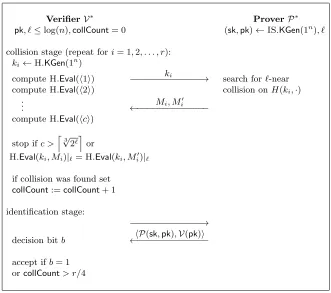
We now present our identification scheme between a proverP and a verifierV. The main idea is to augment a secure identification scheme IS by a collision-finding stage for some hash function H. In this first stage, the verifier checks if the prover is able to produce collisions on a hash function in a particular time. More precisely, the verifier starts for timekeeping to evaluate the hash function H.Eval(k,·) on the messages hci for c = 1,2, . . . ,l3
√
2`m for a key k chosen by the verifier and wherehcistands for the binary representation ofcwith logl√32`m bits. The prover has now to respond with a near-collision M 6= M0
such that H.Eval(k, M) =H.Eval(k, M0) holds for the first`bits. One round of the collision-stage ends if the verifier either receives such a collision or finishes its 3
√
2` hash evaluations. The verifier and the receiver then repeat such a round
r= poly(n) times, sending a fresh keykin each round.
Subsequently, both parties run the standard identification scheme. At the end, the verifier accepts if the prover was able to find enough collisions in the first stage or identifies correctly in the second stage. Thus, as long as the prover is not able to produce collisions in the required time, the protocol mainly resembles theISprotocol.
Completeness of theIS∗ protocol follows easily from the completeness of the underlyingIS scheme.
Security against Classical and Quantum Adversaries. To prove security of our protocol, we need to show that an adversaryAafter interacting with an honest prover P∗, can subsequently not impersonateP∗ such thatV∗ will accept the
identification. Let`be such that ` >6 log(α) whereαis the constant reflecting the bounded speed-up in parallel computing from Assumption (1). By assuming that IS = (IS.KGen,P,V) is a quantum-immune identification scheme, we can show that IS∗ is secure in the standard random oracle model against classical and quantum adversaries.
The main idea is that for the standard random oracle model, the ability of finding collisions is bounded by the birthday attack. Due to the constraint of granting only timeO(√32`) for the collision search and setting` >6 log(α), even an adversary with quantum or parallel power is not able to make at least √2` random oracle queries. Thus, A has only negligible probability to respond in more than 1/4 of rrounds with a collision.
VerifierV∗
ProverP∗
pk, `≤log(n),collCount= 0 (sk,pk)←IS.KGen(1n), `
collision stage (repeat fori= 1,2, . . . , r):
ki←H.KGen(1n)
computeH.Eval(h1i) −−−−−−−−−−−−−−→ki search for`-near computeH.Eval(h2i) collision onH(ki,·)
. .
. Mi, M
0 i ←−−−−−−−−−−−−−− computeH.Eval(hci)
stop ifc >l√32`mor
H.Eval(ki, Mi)|`=H.Eval(ki, Mi0)|`
if collision was found set
collCount:=collCount+ 1
identification stage:
−−−−−−−−−−−−−−→
decision bitb ←−−−−−−−−−−−−−−hP(sk,pk),V(pk)i
accept ifb= 1 orcollCount> r/4
Fig. 1.TheIS∗-Identification Protocol
close to the birthday bound. Note that this property is particularly required from the SHA-3 candidates [NIS07].
However, for adversariesAQ with quantum power, such an instantiation is not possible forany hash function. This stems from the fact thatAQcan locally evaluate a hash function on quantum states which in turns allows it to apply Grover’s search algorithm. Then an adversary will find a collision in time √32` with probability at least 1/2, and thus will be able to provider/4 collisions with noticeable probability. The same result holds in the quantum-accessible random oracle model, since Grover’s algorithm only requires (quantum) black-box access to the hash function.
4
Signature Schemes in the Quantum-Accessible Random
Oracle Model
We now turn to proving security in the quantum-accessible random oracle model. We present general conditions for when a proof of security in the classical random oracle model implies security in the quantum-accessible random oracle model. The result in this section applies to signatures whose classical proof of security is a history-free reduction as defined next. Roughly speaking, history-freeness means that the classical proof of security simulates the random oracle and sig-nature oracle in a history-free fashion. That is, its responses to queries do not depend on responses to previous queries or the query number. We then show that a number of classical signature schemes have a history-free reduction thereby proving their security in the quantum-accessible random oracle model.
Definition 4 (History-free Reduction). A random oracle model signature schemeS = (G, SO, VO)has a history-free reduction from a hard problemP = (GameP,0)if there is a proof of security that uses a classical PPT adversary A forS to construct a classical PPT algorithmB for problem P such that:
• Algorithm B for P contains four explicit classical algorithms: START,
RANDOc, SIGNOc, and FINISHOc. The latter three algorithms have
ac-cess to a shared classical random oracle Oc. These algorithms, except for
RANDOc, may also make queries to the challenger for problemP. The
al-gorithms are used as follows:
(1) Given an instance x for problem P as input, algorithm B first runs
START(x) to obtain(pk, z)where pkis a signature public key andz is private state to be used by B. AlgorithmB sendspk toAand plays the role of challenger toA.
(2) WhenAmakes a classical random oracle query toO(r), algorithmB re-sponds withRANDOc(r, z). Note thatRANDis given the current query as input, but is unaware of previous queries and responses.
(3) When A makes a classical signature query S(sk, m), algorithm B re-sponds with SIGNOc(m, z).
(4) WhenAoutputs a signature forgery candidate (m, σ), algorithm B out-putsFINISHOc(m, σ, z).
• There is an efficiently computable function INSTANCE(pk) which pro-duces an instancexof problemP such thatSTART(x) = (pk, z)for somez. Consider the process of first generating (sk,pk) fromG(1n), and then com-putingx=INSTANCE(pk). The distribution ofxgenerated in this way is negligibly close to the distribution ofxgenerated in GameP.
• SIGNOc either aborts (and hence B aborts) or it generates a valid signa-ture relative to the oracle O(r) = RANDOc(r, z) with a distribution negli-gibly close to the correct signing algorithm. The probability that none of the signature queries abort is non-negligible.
• If(m, σ)is a valid signature forgery relative to the public keypkand oracle
O(r) =RANDOc(r, z)then the output ofB(i.e.FINISHOc(m, σ, z)) causes the challenger for problemP to output 1 with non-negligible probability. ut
We now show that history-free reductions imply security in the quantum settings. Theorem 1. Let S = (G, S, V) be a signature scheme. Suppose that there is a history-free reduction that uses a classical PPT adversary A for S to con-struct a PPT algorithmB for a problemP. Further, assume thatP is hard for polynomial-time quantum computers, and that quantum-accessible pseudorandom functions exist. ThenSis secure in the quantum-accessible random oracle model.
Proof. The history-free reduction includes five (classical) algorithms START,
RAND, SIGN, FINISH, and INSTANCE, as in Definition 4. We prove the quantum security of S using a sequence of games, where the first game is the standard quantum signature game with respect toS.
Game 0.Define Game0 as the game a quantum adversaryAQ plays for prob-lem Sig-Forge(S). Assume towards contradiction that AQ has a non-negligible advantage.
Game 1. Define Game1 as the following modification to Game0: after the challenger generates (sk,pk), it computes x ← INSTANCE(pk) as well as (pk, z) ← START(x). Further, instead of answering AQ’s quantum random oracle queries with a truly random oracle, the challenger simulates for AQ a quantum-accessible random oracle Oquant as an oracle that maps a basis ele-ment|x, yiinto the elementx, y⊕RAND
Oq(x, z), whereO
qis a truly random quantum-accessible oracle. The history-free guarantee on RAND ensures that
Oquant is computationally indistinguishable from random for quantum adver-saries. Therefore, the success probability ofAQ in Game1 is negligibly close to its success probability in Game0, and hence is non-negligible.
Game 2. Modify the challenger from Game1 as follows: instead of generating (sk,pk) and computingx=INSTANCE(pk), start off by running the challenger for problem P. When that challenger sends x, then start the challenger from Game1 using this x. Also, when AQ asks for a signature on m, answer with
SIGNOq(m, z). First, sinceINSTANCEis part of a history-free reduction, this
change in how we compute x only negligibly affects the distribution ofx, and hence the behavior of AQ. Second, as long as all signing algorithms succeed, changing how we answer signing queries only negligibly affects the behavior of
AQ. Thus, the probability thatAQ succeeds is the product of the following two probabilities:
• The probability that AQ produces a valid forgery given that the signing queries were answered successfully.
The first probability is non-negligible by assumption, and the second is negligibly close to the success probability of AQ in Game1, which is also non-negligible. This means that the success probability ofAQ in Game3is non-negligible.
Game 3. Define Game3 as in Game2, except that for two modifications to the challenger: First, it generates a key k for the quantum-accessible PRF. Then, to answer a random oracle query Oq(|φi), the challenger applies the unitary transformation that takes a basis element |x, yi into |x, y⊕PRF(k, x)i. If the success probability in Game3 was non-negligibly different from that of Game2, we could construct a distinguisher forPRFwhich plays both the role ofAQ and the challenger. Hence, the success probability in Game3 is negligibly close to that of Game2, and hence is also non-negligible.
Given a quantum adversary that has non-negligible advantage in Game 3 we construct a quantum algorithmBQ that breaks problem P. WhenBQ receives instancexfrom the challenger for problemP, it computes (pk, z)←START(x) and generates a keykforPRF. Then, it simulatesAQonpk.BQ answers random oracle queries using a quantum-accessible function built fromRANDPRF(k,·)(·, z) as in Game 1. It answers signing queries using SIGNPRF(k,·)(·, z). Then, when
AQ outputs a forgery candidate (m, σ), BQ computesFINISHPRF(k,·)(m, σ, z),
and returns the result to the challenger for problemP.
Observe that the behavior ofAQin Game3is identical to that as a subroutine ofBQ. Hence,AQ as a subroutine ofBQ will output a valid forgery (m, σ) with non-negligible probability. If (m, σ) is a valid forgery, then sinceFINISHis part of a history-free reduction,FINISHPRF(k,·)(m, σ, z) will cause the challenger for problemP to accept with non-negligible probability. Thus, the probability that
P accepts is also non-negligible, contradicting our assumption thatPis hard for quantum computers.
Hence we have shown that any polynomial quantum algorithm has negligible advantage against problem Sig-Forge(S) which completes the proof. ut
We note that, in every step of the algorithm, the adversaryAQ remains in a pure state. This is because, in each game,AQ’s state is initially pure (since it is classical), and every step of the game either involves a unitary transformation, a partial measurement, or classical communication. In all three cases, if the state is pure before, it is also pure after.
4.1 Secure Signatures From Preimage Sampleable Trapdoor Functions (PSF)
We now use Theorem 1 to prove the security of the Full Domain Hash signature scheme when instantiated with a preimage sampleable trapdoor function (PSF), such as the one proposed in [GPV08]. Loosely speaking, a PSF F is a tuple of PPT algorithms (G,Sample, f, f−1) where G(·) generates a key pair (pk,sk),
f(pk,·) defines an efficiently computable function, f−1(sk, y) samples from the set of pre-images of y, and Sample(pk) samples x from the domain of f(pk,·) such that f(pk, x) is statistically close to uniform in the range off(pk,·). The PSF of [GPV08] is not only one-way, but is also collision resistant.
Recall that the full domain hash (FDH) signature scheme [BR93] is defined as follows:
Definition 5 (Full Domain Hash).LetF = (G, f, f−1)be a trapdoor permu-tation, and O a hash function whose range is the same as the range of f. The full domain hash signature scheme is S= (G, T, V)where:
• G=G0
• SO(sk, m) =f−1(sk, O(m))
• VO(pk, m, σ) = (
1 if O(m) =f(pk, σ) 0 otherwise
Gentry et al. [GPV08] show that the FDH signature scheme can be instan-tiated with a PSFF = (G,Sample, f, f−1) instead of a trapdoor permutation. Call the resulting system FDH-PSF. They prove that FDH-PSF is secure against classical adversaries, provided that the pre-image sampling algorithm used dur-ing signdur-ing is derandomized (e.g. by usdur-ing a classical PRF to generate its random bits). Their reduction is not quite history-free, but we show that it can be made history-free.
Consider the following reduction from a classical adversaryAfor the FDH-PSF schemeS to a classical collision finderB forF:
• On inputpk,B computesSTART(pk) := (pk,pk), and simulates Aonpk.
• WhenAqueries O(r),B responds with
RANDOc(r,pk) :=f(pk,Sample(1n;O c(r))).
• WhenAqueries S(sk, m),B responds with
SIGNOc(m,pk) :=Sample(1n;Oc(m)).
• WhenAoutputs (m, σ),B outputs
FINISHOc(m, σ,pk) := Sample 1n;Oc(m)
, σ. In addition, we define INSTANCE(pk) := pk. Algorithms INSTANCE and
STARTtrivially satisfy the requirements of history-freeness (Definition 4).
Lemma 3. SayAis a quantum algorithm that makesqquantum oracle queries. Suppose further that we draw the oracleOfrom two distributions. The first is the random oracle distribution. The second is the distribution of oracles where the value of the oracle at each inputxis identically and independently distributed by some distribution D whose variational distance is within from uniform. Then the variational distance between the distributions of outputs ofAwith each oracle is at most4q2√.
Proof Sketch. We show that there is a way of moving from O to OD such that the oracle is only changed on inputs in a set K where the sum of the amplitudes squared of allk∈K, over all queries made byA, is small. Thus, we can use Lemma 2 to show that the expected behavior of any algorithm making polynomially many quantum queries toO is only changed by a small amount.
u t
Lemma 3 shows that we can replace a truly random oracleOwith an oracle
ODdistributed according to distributionDwithout impactingA, providedDis close to uniform. Note, however, that while this change only affects the output ofAnegligibly, the effects are larger than in the classical setting. IfAonly made classical queries to O, a simple hybrid argument shows that changing to OD affects the distribution of the output of A by at mostq, as opposed to 4q2√
in the quantum case. Thus, quantum security reductions that use Lemma 3 will not be as tight as their classical counterparts.
We now show that the reduction above is history-free.
Theorem 2. The reduction above applied to FDH-PSF is history-free.
Proof. The definition of a PSF implies that the distribution off(pk,Sample(1n)) is within sample of uniform, for some negligible sample. Now, since O(r) =
RANDOc(r,pk) = f(pk,Sample(1n;O
c(r))) and Oc is a true random oracle, the quantityO(r) is distributed independently according to a distribution that issample away from uniform. Define a quantum oracleOquant which transforms the basis state |x, yi into |x, y⊕O(x)i. Using Lemma 3, for any algorithm B
making q random oracle queries, the variational distance between the proba-bility distributions of the outputs of B using a truly random oracle and the “not-quite” random oracle Oquant is at most 4q2
√
sample, which is still negligi-ble. Hence,Oq is computationally indistinguishable from random.
Gentry et al. [GPV08] also show that SIGNOc(m,pk) is consistent with
RANDOc(·,pk) for all queries, and that if A outputs a valid forgery (m, σ),
FINISHOc(m, σ,pk) produces a collision forF with probability 1−2−E, where
E is the minimum over all y in the range of f(pk,·) of the min-entropy of the distribution on σ given f(pk, σ) = y. The PSF of Gentry et al. [GPV08] has super-logarithmic min-entropy, so 1−2−E is negligibly close to 1, though any constant non-zero min-entropy will suffice to make the quantity a non-negligible
fraction of 1. ut
gives a collision finding adversary B forF with advantage negligibly close to, provided that the lower bound overyin the range off(pk,·) of the min-entropy ofσgivenf(pk, σ) =yis super-logarithmic. If the PSF has a min-entropy of 1, the advantage ofB is still/2.
The following corollary, which is the main result of this section, follows from Theorems (1) and (2).
Corollary 1. If quantum-accessible pseudorandom functions exist, and F is a secure PSF against quantum adversaries, then the FDH-PSF signature scheme is secure in the quantum-accessible random oracle model.
4.2 Secure Signatures from Claw-Free Permutations
In this section, we show how to use claw-free permutations to construct three sig-nature schemes that have history-free reductions and are therefore secure in the quantum-accessible random oracle model. The first is the standard FDH from Definition 5, but when the underlying permutation is a claw-free permutation. We adapt the proof of Coron [Cor00] to give a history-free reduction. The second is the Katz and Wang [KW03] signature scheme, and we also modify their proof to get a history-free reduction. Lastly, following Gentry et al. [GPV08], we note that claw-free permutations give rise to a pre-image sampleable trapdoor func-tion (PSF), which can then be used in FDH to get a secure signature scheme as in Section 4.1. The Katz-Wang and FDH-PSF schemes from claw-free permuta-tions give a tight reduction, whereas the Coron-based proof loses a factor of qs in the security reduction, whereqsis the number of signing queries.
Recall that a claw-free pair of permutations [GMR88] is a pair of trapdoor permutations (F1,F2), whereFi= (Gi, fi, fi−1), with the following properties:
• G1=G2. Define G=G1=G2.
• For any keypk,f1(pk,·) andf2(pk,·) have the same domain and range.
• Given only pk, the probability that any PPT adversary can find a pair (x1, x2) such that f1(pk, x1) =f2(pk, x2) is negligible. Such a pair is called a claw.
Dodis and Reyzin [DR03] note that claw-free permutations are a general-ization of trapdoor permutations with a random reduction. A random self-reduction is a way of taking a worst-case instancexof a problem, and converting it into a random instancey of the same problem, such that a solution toygives a solution to x. Dodis and Reyzin [DR03] show that any trapdoor permutation with a random self reduction (e.g. RSA) gives a claw-free pair of permutations. We note that currently there are no candidate pairs of claw-free permutations that are secure against quantum adversaries, but this may change in time.
Hash scheme, in the classical world. That is, Coron’s reduction loses a factor of approximatelyqs, the number of signing queries, as apposed toqh, the num-ber of hash queries. Of course, the RSA trapdoor permutation is not secure against quantum adversaries, but his reduction can be applied to any claw-free permutation and is equivalent to a history-free reduction with similar tightness. To construct a FDH signature scheme from a pair of claw-free permutations (F1,F2), we simply instantiate FDH withF1, and ignore the second permutation
F2, to yield the following signature scheme
• Gis the generator for the pair of claw-free permutations.
• SO(sk, m) =f1−1(sk, O(m))
• VO(pk, m, σ) = 1 if and only if f
1(pk, σ) =O(m).
We now present a history-free reduction for this scheme. The random oracle for this reduction, Oc(r), returns a random pair (a, b), where a is a random element from the domain ofF1andF2, andbis a random element from{1, ..., p} for somepto be chosen later.
We construct history-free reduction from a classical adversaryA forS to a classical adversaryB for (F1,F2). AlgorithmB, on inputpk, works as follows:
• ComputeSTART(pk, y) = (pk,pk), and simulateA onpk. Notice thatz=
pkis the state saved byB.
• WhenA queriesO(r), computeRANDOc(r,pk). For each stringr,RAND works as follows: compute (a, b)←Oc(r). If b= 1, return f2(pk, a). Other-wise, returnf1(pk, a)
• WhenAqueriesS(sk, m), computeSIGNOc(m,pk).SIGNworks as follows: compute (a, b)←Oc(m) and returnaifb6= 1. Otherwise, fail.
• When A returns (m, σ), compute FINISHOc(m, σ,pk).
FINISH works as follows: compute (a, b)←Oc(m) and output (σ, a).
In addition, we have INSTANCE(pk) =pk and START(INSTANCE(pk)) = (pk,pk), soINSTANCEandSTARTsatisfy the required properties.
Theorem 3. The reduction above is in history-free form.
Proof. RANDOc(r,pk) is completely random and independently distributed, as
f1(pk, a) andf2(pk, a) are both random (fb(pk,·) is a permutation andais truly random). As long asb6= 1, where (a, b) =Oc(m),SIGNOc(m,pk) will be consis-tent withRAND. This is because becauseVRANDOc(·,pk)(pk, m,
SIGNOc(m,pk))
outputs 1 ifRANDOc(m,pk) =f1(pk,SIGNOc(m,pk)). ButRANDOc(m,pk) =
f1(pk, a) (sinceb= 1), and6 SIGNOc(m,pk)) =a. Thus, the equality holds. The
probability over all signature queries of no failure is (1−1/p)qSIGN. If we chose p=qSIGN, this quantity is at leaste−1−o(1), which is non-negligible.
outa, so the case where b= 1 andais the preimage ofO(m) underf2, and the case whereb6= 1 and ais the preimage ofO(m) underf1 are indistinguishable. Thus,b= 1 with probability 1/p. Thus,Bconverts a valid signature into a claw
with non-negligible probability. ut
Corollary 2. If quantum-accessible pseudorandom functions exists, and(F1,F2) is a pair claw-free trapdoor permutations, then the FDH scheme instantiated with
F1 is secure against quantum adversaries.
Note that in this reduction, our simulated random oracle is truly random, so we do not need to rely on Lemma 3. Hence, the tightness of the reduction will be the same as the classical setting. Namely, if the quantum adversary A
has advantage when making qSIGN signature queries, B will have advantage approximately /qSIGN.
The Katz-Wang Signature Scheme In this section, we consider a variant of FDH due to Katz and Wang [KW03]. This scheme admits an almost tight security reduction in the classical world. That is, if an adversary has advantage
, the reduction gives a claw finder with advantage/2. Their proof of security is not in history-free form, but it can be modified so that it is in history-free form. Given a pair of trapdoor permutation (F1,F2), the construction is as follows:
• Gis the key generator forF.
• SO(sk, m) =f−1
1 (sk, O(b, m)) for a random bitb.
• VO(pk, m, σ) is 1 if eitherf
1(pk, σ) =O(0, m) orf1(pk, σ) =O(1, m) We construct a history-free reduction from an adversaryA for S to an ad-versary B for (F1,F2). The random oracle for this reduction, Oc(r), generates a random pair (a, b), where ais a random element from the domain of F1 and
F2, andbis a random bit. On input pk,B works as follows:
• ComputeSTART(pk, y) = (pk,pk), and simulateA onpk. Notice thatz=
pkis the state saved byB.
• WhenAqueries O(b, r), compute RANDOc(b, r,pk). For each string (b, r),
RANDworks as follows: compute (a, b0) =Oc(r). Ifb=b0, returnf1(pk, a). Otherwise, returnf2(pk, a).
• WhenAqueriesS(sk, m), computeSIGNOc(m,pk).SIGNworks as follows: compute (a, b) =Oc(m) and returna.
• When A returns (m, σ), compute FINISHOc(m, σ,pk). FINISH works as follows: compute (a, b) =Oc(m). Ifσ=a, abort. Otherwise, output (σ, a). In addition, we have INSTANCE(pk) =pk and START(INSTANCE(pk)) = (pk,pk), soINSTANCEandSTARTsatisfy the required properties.
Proof. RANDOc(b, r,pk) is completely random and independently distributed, as f1(pk, a) andf2(pk, a) are both random (fb is a permutation and ais truly random). Observe that f1(pk,SIGNOc(m,pk)) = f1(pk, a) = O(b, m) where (a, b) = Oc(m). Thus, signing queries are always answered with a valid signa-ture, and the distribution of signatures is identical to that of the correct signing algorithm sincebis chosen uniformly.
SupposeAreturns a valid forgery (m, σ). Let (a, b) =Oc(m). There are two cases, corresponding to whether σ corresponds to a signature using b or 1−b. In the first case, we have f1(pk, σ) = O(b, m) =f1(pk, a), meaning σ =a, so we abort. Otherwise,f1(pk, σ) =O(1−b, m) =f2(pk, a), so (σ, a) form a claw. Since the adversary never asked for a signing query on m, these two cases are indistinguishable by the same logic as the proof for FDH. Thus, the probability of failure is at most a half, which is non-negligible. ut
Corollary 3. If quantum-accessible pseudorandom functions exists, and(F1,F2) is a pair claw-free trapdoor permutations, then the Katz-Wang signature scheme instantiated with F1 is secure against quantum adversaries.
As in the case of FDH, our simulated quantum-accessible random oracle is truly random, so we do not need to rely on Lemma 3. Thus, the tightness of our reduction is the same as the classical case. In particular, if the quantum adversaryAQ has advantage thenB will have advantage/2.
PSF Signatures from Claw-Free Permutations Gentry et al. [GPV08] note that Claw-Free Permutations give rise to pre-image sampleable trapdoor functions (PSFs). These PSFs can then be used to construct an FDH signature scheme as in Section 4.1.
Given a pair of claw-free permutations (F1,F2), define the following PSF:G is just the generator for the pair of permutations. Sample(pk) generates a random bitband randomxin the domain offb, and returns (x, b).f(pk, x, b) =fb(pk, x), and f−1(sk, y) = (f−1
b (sk, y), b) for a random b. Suppose we have a collision ((x1, b1),(x2, b2)) for this PSF. Then
fb1(pk, x1) =f(pk, x1, b1) =f(pk, x2, b2) =fb2(pk, x2)
Ifb1=b2, thenx1=x2sincefb1 is a permutation. But this is impossible since (x1, b1) 6= (x2, b2). Thus, b1 6= b2, so one of (x1, x2) or (x2, x1) is a claw for (F1,F2).
Hence, we can instantiate FDH with this PSF to get the following signature scheme:
• Gis the generator for the permutations.
• SO(sk, m) = (f−1
b (sk, O(m)), b) for a random bitb.
• VO(pk, m,(σ, b)) = 1 if and only iffb(pk, σ) =O(m).
loss of a factor of two in the tightness of the reduction). In particular, if we have a quantum adversary AQ forE with advantage , we get a quantum algorithm
BQ for the PSF with advantage /2, which gives us a quantum algorithm CQ that finds claws of (F1,F2) with probability/2.
5
Encryption Schemes in the Quantum-Accessible
Random Oracle Model
In this section, we prove the security of two encryption schemes. The first is the BR encryption scheme due to Bellare and Rogaway [BR93], which we show is CPA secure. The second is a hybrid generalization of the BR scheme, which we show is CCA secure.
Ideally, we could define a general type of classical reduction like we did for signatures, and show that such a reduction implies quantum security. Unfor-tunately, defining a history-free reduction for encryption is considerably more complicated than for signatures. We therefore directly prove the security of two random oracle schemes in the quantum setting.
5.1 CPA Security of BR Encryption
In this section, we prove the security of the BR encryption scheme [BR93] against quantum adversaries:
Definition 6 (BR Encryption Scheme).LetF= (G0, f, f−1)be an injective trapdoor function, andO a hash function with the same domain asf(pk,·). We define the following encryption scheme, E= (G, E, D) where:
• G=G0
• EO(pk, m) = (f(pk, r), O(r)⊕m)for a randomly chosen r.
• DO(sk,(y, c)) =c⊕f−1(sk, y)
A candidate quantum-immune injective trapdoor function can be built from hard problems on lattices [PW08].
Theorem 5. If quantum-accessible pseudorandom functions exists and F is a quantum-immune injective trapdoor function, then E is quantum CPA secure.
We omit the proof of Theorem 5 because the CPA security of the BR encryption scheme is a special case of the CCA security of the hybrid encryption scheme in the next section.
5.2 CCA Security of Hybrid Encryption
Definition 7 (Hybrid Encryption Scheme). Let F = (G0, f, f−1) be an injective trapdoor function, andES = (ES, DS)be a CCA secure symmetric key encryption scheme, and O a hash function. We define the following encryption scheme, E= (G, E, D)where:
• G=G0
• EO(pk, m) = (f(pk, r), ES(O(r), m))for a randomly chosenr.
• DO(sk,(y, c)) =D
S(O(r0), c)wherer0=f−1(sk, y)
We note that the BR encryption scheme from the previous section is a special case of this hybrid encryption scheme where ES is the one-time pad. That is, ES(k, m) =k⊕mandDS(k, c) =k⊕c.
Theorem 6. If quantum-accessible pseudorandom functions exists,Fis a quantum-immune injective trapdoor function, andES is a quantum CCA secure symmetric key encryption scheme, then E is quantum CCA secure.
Proof. Suppose we have an adversary AQ that breaks E. We start with the standard security game for CCA secure encryption:
Game 0.Define Game0as the game a quantum adversaryAQ plays for problem Asym-CCA(E).
Game 1.Define Game1as the following game: the challenger generates (sk,pk)←
G(1n), a randomrin the domain of F, a randomkin the key space ofE
S, and
computesy =f(pk, r). The challenger has access to a quantum-accessible ran-dom oracleOq whose range is the key space of ES. It then sends pkto AQ. The challenger answers queries as follows:
• Random oracle queries are answered with the random oracleOquant, which takes a basis element|x, yiinto|x, y⊕Oq(f(pk, x))i.
• Decryption queries on (y0, c0) are answered as follows: Case 1: Ify=y0, respond with DS(k, c0).
Case 2: Ify6=y0, respond with DS(Oq(y0), c0).
• The challenge query on (m0, m1) is answered as follows: choose a random
b. Then, respond with (y, ES(k, mb)).
WhenAQ responds withb0, we say thatAQ won ifb=b0.
Observe that, becausef is injective andOq is random, the oracleOquantis a truly random oracle with the same range as Oq. The challenge ciphertext (y, c) seen by AQ is distributed identically to that of Game0. Further, it is a valid encryption of mb relative to the random oracle beingOquant ifOq(y) =k. For
y06=y, the decryption of (y0, c0) is
• The challenge query and decryption query answering algorithms never query
Oq ony.
• Each quantum random oracle query from the adversary to Oquant leads to a quantum random oracle query from the challenger to Oq. The query magnitude of y in the challenger’s query to Oq is the same as the query magnitude ofr in the adversary’s queryOquant.
Letbe the sum of the square magnitudes ofy over all queries made toOq (i.e. the total query probability ofy). This is identical to the total query probability ofrover all queriesAQ makes toOquant.
We now construct a quantum algorithmBFOq that uses a quantum-accessible random oracleOq, and invertsf with probability/q, whereqis the number of random oracle queries made by AQ. B
Oq
F takes as input (pk, y), and its goal is
to outputr=f−1(sk, y).BFOq works as follows:
• Generate a random k in the key space of ES. Also, generate a random i∈ {1, ..., q}. Now, send pktoAQ and play the role of challenger toAQ.
• Answer random oracle queries with the random oracleOquant, which takes a basis element|x, yiinto|x, y⊕Oq(f(pk, x))i.
• Answer decryption queries on (y0, c0) as follows: Case 1: Ify=y0, respond with DS(k, c0). Case 2: Ify6=y0, respond with D
S(Oq(y0), c0).
• Answer the challenge query on (m0, m1) as follows: choose a random b. Then, respond with (y, ES(k, mb)).
• At the ith random oracle query, sample the query to getr0, and output r0
and terminate.
Comparing our definition ofBFOq to Game1, we can conclude that the view seen byAQin both cases is identical. Thus, the total query probability thatAQmakes to Oquant at the pointris . Hence, the probability thatB
Oq
F outputsr is/q.
If we assume thatF is secure against quantum adversaries that use a quantum-accessible random oracle, then this quantity, and hence, must be negligible. As in the case of signatures (Section 4), we can replace this assumption with the assumption thatF is secure against quantum adversaries (i.e. with no access to a quantum random oracle) and that pseudorandom functions exists to reach the same conclusion.
Now, assume that the success probability ofAQ in Game1 is non-negligible. We now define a quantum algorithmBOq
ES that uses a quantum-accessible random oracleOq to break the CCA security ofES.B
Oq
ES works as follows:
• On input 1n, generate (sk,pk) ←G(1n). Also, generate a random r, and computey=f(pk, r). Now sendpktoAQ and play the role of challenger to
AQ.
• Answer random oracle queries with the random oracleOquant, which takes a basis element|x, yiinto|x, y⊕Oq(f(pk, x))i.
• Answer decryption queries on (y0, c0) as follows: Case 1: Ify=y0, ask theE
S challenger for a decryptionDS(k, c0) to obtain
m0. Returnm0 toA
Q.
Case 2: Ify6=y0, respond with DS(Oq(y0), c0).
• Answer the challenge query on (m0, m1) by forwarding the pairES. When
the challenger responds withc(which equals ES(k, mb) for someb), return (y, c) toAQ.
• WhenAQ outputsb0, output b0 and halt. Comparing our definition of BOq
ES to that of Game1, we can conclude that the view of AQ in both cases is identical. Thus, AQ succeeds with non-negligible probability. IfAQ succeeds, it means it returnedb, meaningB
Oq
ES also succeeded. Thus, we have an algorithm with a quantum random oracle that breaks ES.
This is a contradiction if ES is CCA secure against quantum adversaries with
access to a quantum random oracle, which holds sinceES is CCA secure against
quantum adversaries and quantum-accessible pseudorandom functions exist, by assumption.
Thus, the success probability of AQ in Game1 is negligible, so the success probability of AQ in Game0 is also negligible. Hence, we have shown that all polynomial time quantum adversaries have negligible advantage in breaking in breaking the CCA security ofE, soE is CCA secure. ut
6
Conclusion
We have shown that great care must be taken if using the random oracle model when arguing security against quantum attackers. Proofs in the classical case should be reconsidered, especially in case the quantum adversary can access the random oracle with quantum states. We also developed conditions for translating security proofs in the classical random oracle model to the quantum random oracle model. We applied these tools to certain signature and encryption schemes. The foremost question raised by our results is in how far techniques for “classical random oracles” can be applied in the quantum case. This stems from the fact that manipulating or even observing the interaction with the quantum-accessible random oracle would require measurements of the quantum states. That, however, prevents further processing of the query in a quantum manner. We gave several examples of schemes that remain secure in the quantum setting, provided quantum-accessible pseudorandom functions exist. The latter primitive seems to be fundamental to simulate random oracles in the quantum world. Showing or disproving the existence of such pseudorandom functions is thus an important step.
Many classical random oracle results remain open in the quantum random oracle settings. It is not known how to prove security of generic FDH signatures as well as signatures derived from the Fiat-Shamir heuristic in the quantum random oracle model. Similarly, a secure generic transformation from CPA to CCA security in the quantum RO model is still open.
Acknowledgments
We thank Chris Peikert for helpful comments. Dan Boneh was supported by NSF, the Air Force Office of Scientific Research (AFO SR) under a MURI award, and by the Packard Foundation. Marc Fischlin and Anja Lehmann were supported by grants Fi 940/2-1 and Fi 940/3-1 of the German Research Founda-tion (DFG). ¨Ozg¨ur Dagdelen and Marc Fischlin were also supported by CASED (www.cased.de). Christian Schaffner is supported by a NWO VENI grant.
References
Aar09. Scott Aaronson. Quantum copy-protection and quantum money. In Struc-ture in Complexity Theory Conference, pages 229–242, 2009.
ABB10a. Shweta Agrawal, Dan Boneh, and Xavier Boyen. Efficient lattice (H)IBE in the standard model. InProc. of Eurocrypt’10, volume 6110 ofLNCS, pages 553–572, 2010.
ABB10b. Shweta Agrawal, Dan Boneh, and Xavier Boyen. Lattice basis delegation in fixed dimension and shorter ciphertext hierarchical IBE. In Proc. of Crypto’10, volume 6223 ofLNCS, pages 98–115, 2010.
BBBV97. Charles H. Bennett, Ethan Bernstein, Gilles Brassard, and Umesh V. Vazi-rani. Strengths and weaknesses of quantum computing. SIAM J. Comput., 26(5):1510–1523, 1997.
BBC+98. R. Beals, H. Buhrman, R. Cleve, M. Mosca, and R. de Wolf. Quantum lower bounds by polynomials. In Proceedings of the Annual Symposium on Foundations of Computer Science (FOCS) 1998, pages 352–361. IEEE Computer Society Press, 1998.
Ber09. Daniel J. Bernstein. Cost analysis of hash collisions: Will quantum comput-ers make SHARCS obsolete? InSHARCS’09: Special-purpose Hardware for Attacking Cryptographic Systems, 2009.
BF11. Dan Boneh and David Freeman. Homomorphic signatures for polynomial functions. InAdvances in Cryptology — EUROCRYPT 2011, volume 6632, pages 149–168, 2011.
BHK+11. Gilles Brassard, Peter Hoyer, Kassem Kalach, Marc Kaplan, Sophie La-plante, and Louis Salvail. Merkle puzzles in a quantum world. InAdvances in Cryptology — Crypto 2011, Lecture Notes in Computer Science. Springer-Verlag, 2011.
BHT98. Gilles Brassard, Peter Høyer, and Alain Tapp. Quantum cryptanalysis of hash and claw-free functions. In LATIN: : Theoretical Informatics, Latin American Symposium, pages 163–169. Springer-Verlag, 1998.
BJ99. Nader H. Bshouty and Jeffrey C. Jackson. Learning DNF over the uniform distribution using a quantum example oracle. SIAM Journal on Computing, 28(3):1136–1153, 1999.
Boy10. Xavier Boyen. Lattice mixing and vanishing trapdoors : A framework for fully secure short signatures and more. InProc. of PKC 2010, LNCS, 2010. BR93. Mihir Bellare and Phillip Rogaway. Random oracles are practical: A paradigm for designing efficient protocols. In Proc. of ACM Conference on Computers and Communication Security, pages 62–73, 1993.
BS08. Gilles Brassard and Louis Salvail. Quantum Merkle Puzzles. Second Inter-national Conference on Quantum, Nano and Micro Technologies (ICQNM 2008), pages 76–79, February 2008.
Can01. Ran Canetti. Universally composable security: A new paradigm for crypto-graphic protocols. InProceedings of the Annual Symposium on Foundations of Computer Science (FOCS) 2001. IEEE Computer Society Press, for an updated version seeeprint.iacr.org, 2001.
CGH98. Ran Canetti, Oded Goldreich, and Shai Halevi. The random oracle method-ology, revisited. InProceedings of the Annual Symposium on the Theory of Computing (STOC) 1998, pages 209–218. ACM Press, 1998.
CHKP10. David Cash, Dennis Hofheinz, Eike Kiltz, and Chris Peikert. Bonsai trees, or how to delegate a lattice basis. InProc. of Eurocrypt’10, pages 523–552, 2010.
CLRS10. Pierre-Louis Cayrel, Richard Lindner, Markus R¨uckert, and Rosemberg Silva. Improved zero-knowledge identification with lattices. Provable Se-curity, pages 1–17, 2010.
Cor00. Jean-S´ebastien Coron. On the exact security of full domain hash. In Ad-vances in Cryptology — CRYPTO 2000, pages 229–235. Springer, 2000. DR03. Yevgeniy Dodis and Leonid Reyzin. On the power of claw-free permutations.
Security in Communication Networks, pages 55–73, 2003.