The Wonderful World of Global Random Oracles
Jan Camenisch1, Manu Drijvers1,2, Tommaso Gagliardoni1, Anja Lehmann1, and Gregory Neven1
1
IBM Research – Zurich, S¨aumerstrasse 4, 8803 R¨uschlikon, Switzerland
{jca,mdr,tog,anj,nev}@zurich.ibm.com
2 Department of Computer Science, ETH Zurich, 8092 Z¨urich, Switzerland
Abstract. The random-oracle model by Bellare and Rogaway (CCS’93) is an indispensable tool for the security analysis of practical crypto-graphic protocols. However, the traditional random-oracle model fails to guarantee security when a protocol is composed with arbitrary protocols that use thesame random oracle. Canetti, Jain, and Scafuro (CCS’14) put forth aglobal but non-programmable random oracle in the General-ized UC framework and showed that some basic cryptographic primitives with composable security can be efficiently realized in their model. Be-cause their random-oracle functionality is non-programmable, there are many practical protocols that have no hope of being proved secure using it. In this paper, we study alternative definitions of a global random or-acle and, perhaps surprisingly, show that these allow one to prove GUC-secure existing, very practical realizations of a number of essential crypto-graphic primitives including public-key encryption, non-committing en-cryption, commitments, Schnorr signatures, and hash-and-invert signa-tures. Some of our results hold generically for any suitable scheme proven secure in the traditional ROM, some hold for specific constructions only. Our results include many highly practical protocols, for example, the folklore commitment scheme H(mkr) (where m is a message and r is the random opening information) which is far more efficient than the construction of Canetti et al.
1
Introduction
The random-oracle model (ROM) [3] is an overwhelmingly popular tool in cryp-tographic protocol design and analysis. Part of its success is due to its intuitive idealization of cryptographic hash functions, which it models through calls to an external oracle that implements a random function. Another important factor is its capability to provide security proofs for highly practical constructions of important cryptographic building blocks such as digital signatures, public-key encryption, and key exchange. In spite of its known inability to provide provable guarantees when instantiated with a real-world hash function [14], the ROM is still widely seen as convincing evidence that a protocol will resist attacks in practice.
instance of the protocol. Security can therefore no longer be guaranteed when a protocol is composed. Addressing this requires composable security notions such as Canetti’s Universal Composability (UC) framework [10], which have the advantage of guaranteeing security even if protocols are arbitrarily composed.
UC modeling. In the UC framework, a random oracle is usually modeled as an ideal functionality that a protocol uses as a subroutine in a so-called hybrid model, similarly to other setup constructs such as a common reference string (CRS). For example, the random-oracle functionality FRO[21] simply assigns a random output valuehto each inputmand returnsh. In the security proof, the simulator executes the code of the subfunctionality, which enables it to observe the queries of all involved parties and to program any random-looking values as outputs. Setup assumptions play an important role for protocols in the UC model, as many important cryptographic primitives such as commitments simply cannot be achieved [13]; other tasks can, but have more efficient instantiations with a trusted setup.
An important caveat is that this way of modeling assumes that each instance of each protocol uses its own separate and independent instance of the subfunc-tionality. For a CRS this is somewhat awkward, because it raises the question of how the parties should agree on a common CRS, but it is even more problematic for random oracles if all, supposedly independent, instances ofFROare replaced in practice with thesame hash function. This can be addressed using the Gen-eralized UC (GUC) framework [12] that allows one to model different protocol instances sharing access to global functionalities. Thus one can make the setup functionality globally available to all parties, meaning, including those outside of the protocol execution as well as the external environment.
Global UC random oracle. Canetti, Jain, and Scafuro [15] indeed applied the GUC framework to model globally accessible random oracles. In doing so, they discard the globally accessible variant of FRO described above as of little help for proving security of protocols because it is too “strict”, allowing the simulator neither to observe the environment’s random-oracle queries, nor to program its answers. They argue that any shared functionality that provides only public information is useless as it does not give the simulator any advantage over the real adversary. Instead, they formulate a global random-oracle functionality that grants the ideal-world simulator access to the list of queries that the environment makes outside of the session. They then show that this shared functionality can be used to design a reasonably efficient GUC-secure commitment scheme, as well as zero-knowledge proofs and two-party computation. However, their global random-oracle functionality rules out security proofs for a number of practical protocols, especially those that require one to program the random oracle.
that the simple variant discarded by Canetti et al. surprisingly suffices to prove the GUC-security of a number of truly practical constructions for useful cryp-tographic primitives such as digital signatures and public-key encryption. We achieve these results by carefully analyzing the minimal capabilities that the simulator needs in order to simulate the real-world (hybrid) protocol, while fully exploiting the additional capabilities that one has in proving the indistin-guishability between the real and the ideal worlds. In the following, we briefly describe the different random-oracle functionalities we consider and which we prove GUC-secure using them.
Strict global random oracle. First, we revisit the strict global random-oracle functionalityGsRO described above and show that, in spite of the arguments of Canetti et al. [15], it actually suffices to prove the GUC-security of many practical constructions. In particular, we show that any digital signature scheme that is existentially unforgeable under chosen-message attack in the traditional ROM also GUC-realizes the signature functionality with GsRO, and that any
public-key encryption (PKE) scheme that is indistinguishable under adaptive chosen-ciphertext attack in the traditional ROM GUC-realizes the PKE functionality under GsRO with static corruptions.
This result may be somewhat surprising as it includes many schemes that, in their property-based security proofs, rely on invasive proof techniques such as rewinding, observing, and programming the random oracle, all of which are tools that the GUC simulator is not allowed to use. We demonstrate, however, that none of these techniques are needed during the simulation of the protocol, but rather only show up when proving indistinguishability of the real and the ideal worlds, where they are allowed. A similar technique was used It also does not contradict the impossibility proof of commitments based on global setup functionalities that simply provide public information [12, 13] because, in the GUC framework, signatures and PKE do not imply commitments.
Programmable global random oracles. Next, we present a global random-oracle functionalityGpRO that allows the simulator as well as the real-world adversary to program arbitrary points in the random oracle, as long as they are not yet defined. We show that it suffices to prove the GUC-security of Camenisch et al.’s non-committing encryption scheme [8], i.e., PKE scheme secure against adaptive corruptions. Here, the GUC simulator needs to produce dummy ciphertexts that can later be made to decrypt to a particular message when the sender or the receiver of the ciphertext is corrupted. The crucial observation is that, to embed a message in a dummy ciphertext, the simulator only needs to program the random oracle atrandom inputs, which have negligible chance of being already queried or programmed. Again, this result is somewhat surprising asGpRO does not give the simulator any advantage over the real adversary either.
We also define a restricted variant GrpRO that, analogously to the
was programmed on a particular point. If the adversary tries to cheat by pro-gramming the random oracle, then honest parties have a means of detecting this misbehavior. However, we will see that the simulator can hide its programming from the adversary, giving it a clear advantage over the real-world adversary. We use it to GUC-realize the commitment functionality through a new construction that, with only two exponentiations per party and two rounds of communication, is considerably more efficient than the one of Canetti et al. [15], which required five exponentiations and five rounds of communication.
Programmable and observable global random oracle. Finally, we describe a global random-oracle functionality GrpoRO that combines the restricted forms of
pro-grammability and observability. We then show that this functionality allows us to prove that commitments can be GUC-realized by the most natural and effi-cient random-oracle based scheme where a commitmentc=H(mkr) is the hash of the random opening informationrand the messagem.
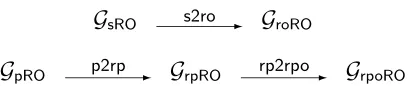
Transformations between different oracles. While our different types of oracles allow us to securely realize different protocols, the variety in oracles partially defies the original goal of modeling the situation where all protocols use the same hash function. We therefore explore some relations among the different types by presenting efficient protocol transformations that turn any protocol that securely realizes a functionality with one type of random oracle into a protocol that securely realizes the same functionality with a different type.
Other related work. Dodis et al. [17] already realized that rewinding can be used in the indistinguishability proof in the GUC model, as long as it’s not used in the simulation itself. In a broader sense, our work complements existing studies on the impact of programmability and observability of random oracles in security reductions. Fischlin et al. [18] and Bhattacharyya and Mukherjee [6] have proposed formalizations of non-programmable and weakly-programmable random oracles, e.g., only allowing non-adaptive programmability. Both works give a number of possibility and impossibility results, in particular that full-domain hash (FDH) signatures can only be proven secure (via black-box reduc-tions) if the random oracle is fully programmable [18]. Non-observable random oracles and their power are studied by Ananth and Bhaskarin [1], showing that Schnorr and probabilistic RSA-FDH signatures can be proven secure. All these works focus on the use of random oracles in individual reductions, whereas our work proposes globally re-usable random-oracle functionalities within the UC framework. The strict random oracle functionalityGsRO that we analyze is com-parable to a non-programmable and non-observable random oracle, so our result that any unforgeable signature scheme is also GUC-secure w.r.t.GsROmay seem
to contradict the above results. However, the GsRO functionality imposes these
Summary. Our results clearly paint a much more positive picture for global random oracles than was given in the literature so far. We present several formu-lations of globally accessible random-oracle functionalities that allow to prove the composable security of some of the most efficient signature, PKE, and com-mitment schemes that are currently known. We even show that the most natural formulation, the strict global random oracleGsROthat was previously considered useless, suffices to prove GUC-secure a large class of efficient signature and en-cryption schemes. By doing so, our work brings the (composable) ROM back closer to its original intention: to provide anintuitive idealization of hash func-tions that enables to prove the security ofhighly efficient protocols. We expect that our results will give rise to many more practical cryptographic protocols that can be proven GUC-secure, among them known protocols that have been proven secure in the traditional ROM model.
2
Preliminaries
In the rest of this work, we use “iff” for “if and only if”, “w.l.o.g.” for “without loss of generality”, and n ∈ N to denote the security parameter. A function
ε(n) isnegligibleif it is asymptotically smaller than 1/p(n) for every polynomial functionp. We denote byx $
←−X thatxis a sample from the uniform distribution over the setX. WhenAis a probabilistic algorithm, theny:=A(x;r) means that
yis assigned the outcome of a run ofAon inputxwith coinsr. Two distributions
X andY over a domainΣ(n) are said to becomputationally indistinguishable, written X ≈Y, if for any PPT algorithm A,|A(X(s))− A(Y(s))|is negligible for alls∈Σ(n).
2.1 The Basic and Generalized UC Frameworks
Basic UC. The universal composability (UC) framework [10, 9] is a framework to define and prove the security of protocols. It follows the simulation-based security paradigm, meaning that security of a protocol is defined as the simulatability of the protocol based on an ideal functionalityF. In an imaginary ideal world, parties hand their protocol inputs to a trusted party running F, where F by construction executes the task at hand in a secure manner. A protocol π is considered a secure realization ofF if the real world, in which parties execute the real protocol, is indistinguishable from the ideal world. Namely, for every real-world adversary A attacking the protocol, we can design an ideal-world attacker (simulator)Sthat performs an equivalent attack in the ideal world. As the ideal world is secure by construction, this means that there are no meaningful attacks on the real-world protocol either.
guarantees that π composed with π0 (i.e., replacing π0 with F0) is a secure
realization ofF.
Security is defined through an interactive Turing machine (ITM) Z that models the environment of the protocol and chooses protocol inputs to all par-ticipants. Let EXECπ,A,Z denote the output of Z in the real world, running
with protocolπand adversaryA, and letIDEALF,S,Z denote its output in the
ideal world, running with functionalityF and simulatorS. Protocolπsecurely realizes F if for every polynomial-time adversaryA, there exists a simulatorS
such that for every environment Z,EXECπ,A,Z≈IDEALF,S,Z.
Generalized UC. A Basic UC protocol using random oracles is modeled as aFRO -hybrid protocol. Since an instance of a Basic UC functionality can only be used by a single protocol instance, this means that every protocol instance uses its own random oracle that is completely independent of other protocol instances’ random oracles. As the random-oracle model is supposed to be an idealization of real-world hash functions, this is not a very realistic model: Given that we only have a handful of standardized hash functions, it’s hard to argue their independence across many protocol instances.
To address these limitations of Basic UC, Canetti et al [12] introduced the Generalized UC (GUC) framework, which allows for shared “global” ideal func-tionalities (denoted by G) that can be used by all protocol instances. Addi-tionally, GUC gives the environment more powers in the UC experiment. Let GEXECπ,A,Z be defined asEXECπ,A,Z, except that the environmentZ is no
longer constrained, meaning that it is allowed to start arbitrary protocols in addition to the challenge protocolπ. Similarly, GIDEALF,S,Z is equivalent to
IDEALF,S,Z but Z is now unconstrained. If π is a G-hybrid protocol, where G is some shared functionality, thenZ can start additional G-hybrid protocols, possibly learning information about or influencing the state ofG.
Definition 1. Protocol π GUC-emulates protocol ϕ if for every adversary A
there exists an adversary S such that for all unconstrained environments Z, GEXECπ,A,Z≈GEXECϕ,S,Z.
Definition 2. ProtocolπGUC-realizes ideal functionalityF if for every adver-sary A there exists a simulator S such that for all unconstrained environments
Z,GEXECπ,A,Z≈GIDEALF,S,Z.
pro-tocol, but can additionally query the shared functionalityGthrough dummy par-ties that are not part of the challenge protocol. The EUC experiment is equivalent to the Basic UC experiment, except that it considers G-externally constrained environments: AG-subroutine respecting protocolπEUC-emulates a protocolϕ
if for every polynomial-time adversaryA there is an adversaryS such that for every G-externally constrained environment EXECGπ,A,Z ≈ EXECGϕ,S,Z. Fig-ure 2(b) depicts EUC-emulation and shows that this setting is much simpler to reason about than GUC-emulation: We can reason about this static setup, rather than having to imagine arbitrary protocols running alongside the chal-lenge protocol. Canetti et al. prove that showing EUC-emulation is useful to obtain GUC-emulation.
Theorem 1. Letπbe a G-subroutine respecting protocol, then protocolπ GUC-emulates protocol ϕif and only ifπ G-EUC-emulates ϕ.
Conventions. When specifying ideal functionalities, we will use some conventions for ease of notation. For a non-shared functionality with session idsid, we write “On inputxfrom partyP”, where it is understood the input comes from machine (P,sid). For shared functionalities, machines from any session may provide input, so we always specify both the party identity and the session identity of machines. In some cases an ideal functionality requires immediate input from the adversary. In such cases we write “wait for inputxfrom the adversary”, which is formally defined by Camenisch et al. [7].
2.2 Basic Building Blocks
One-Way Trapdoor Permutations. A (family of)one-way trapdoor permutations is a tuple OWTP := (OWTP.Gen,OWTP.Sample,OWTP.Eval,OWTP.Invert) of PPT algorithms. On input n; OWTP.Gen outputs: a permutation domain Σ
(e.g.,ZN for an RSA modulusN), and efficient representations of, respectively, a permutationϕin the family (e.g., an RSA public exponente), and of its inverse
ϕ−1 (e.g., an RSA secret exponentd). Security requires that no PPT adversary can invert a pointy=ϕ(x) for a random challenge template (Σ, ϕ, y) with non-negligible probability. We will often use OWTPs to generate public and secret keys for, e.g., signature schemes or encryption schemes by, e.g., setting pk = (Σ, ϕ) andsk=ϕ−1. W.l.o.g. in the following we assume that the representation ofΣalso includes the related security parametern, and secret keys also include the public part. Notice that, in general, OWTP.Invert also takes ϕ as input, although in practice this might be unnecessary, depending on the particular OWTP in exam.
Signature Schemes. A (stateless)signature schemeis a tupleSIG= (KGen,Sign,
GsRO– functionality for the strict global random oracle.
Parameters:output size`(n) Variables:initially empty listListH
1. Query: on input (HashQuery, m) from a machine (P,sid), proceed as follows. – Findhsuch that (m, h)∈ListH. If no suchhexists, leth←− {$ 0,1}`(n)and store
(m, h) inListH.
– Output (HashConfirm, h) to (P,sid).
Fig. 1: The strict global random oracle functionalityGsROthat does not give any extra power to anyone (mentioned but not defined by Canetti et al. [15]).
as input a public key pk (and we write this as a shorthand notationVerifypk), a message m and a signature σ, and outputs a single bit denoting acceptance or rejection of the signature. The standard security notion we assume for signa-ture schemes is existential unforgeability under chosen message attacks (EUF-CMA) [20], which we recall here briefly. In such game-based security notion, an adversary is allowed to perform a number of signature queries, adaptively, on messages of his choice for a secret key generated by a challenger. Then, he wins the game if he manages to output a valid signature for a fresh message for that key. We say that a signature scheme is EUF-CMA secure if no PPT adversary can win this game with more than negligible probability.
Public-Key Encryption Schemes. A public-key encryption scheme is a tuple of PPT algorithms Π = (KGen,Enc,Dec). On input n, KGen outputs a pub-lic/private key pair (pk,sk). Enc takes as input a public key pk (and we write this as a shorthand notationEncpk) and a plaintextm, and outputs a ciphertext
c.Dectakes as input a secret keysk(and we write this as a shorthand notation Decsk) and a ciphertextc, and outputs either⊥mor a messagem. The standard security notion we assume for public-key encryption schemes is indistinguisha-bility under adaptive chosen message attacks (IND-CCA2) [2], which we recall here briefly. In such game-based security notion, an adversary sends a challenge plaintext of his choice to an external challenger, who generates a key pair and either responds to the adversary with an encryption of the challenge plaintext, or with the encryption of a random plaintext (having the same leakage as the original plaintext, in case we are considering corruption models), the goal of the adversary being to distinguish which is the case. We say that a PKE scheme is IND-CCA2 secure if no PPT adversary can win this game with more than neg-ligible advantage over guessing, even if allowed to query adaptively a decryption oracle on any ciphertext of his choice – except the challenge ciphertext.
3
Strict Random Oracle
(a) Local random oracle: the simulator simulates the RO and has full control.
(b) Global random oracle: the random or-acle is external to the simulator.
Fig. 2: The UC experiment with a local random oracle (a) and the EUC experi-ment with a global random oracle (b).
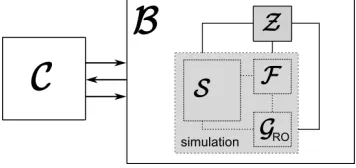
Fig. 3: ReductionBfrom a real-world adversaryAand a black-box environment
Z, simulating all the ideal functionalities (even the global ones) and playing against an external challengerC.
fresh inputm, a random valuehis chosen, while on repeating inputs, a consistent answer is given back. This natural definition was discussed by Canetti et al. [15] but discarded as it does not suffice to realize FCOM. While this is true, we will argue thatGsRO is still useful to realize other functionalities.
The code of GsRO is identical to that of a local random oracle FRO in UC. In Basic UC, this is a very strong definition, as it gives the simulator a lot of power: In the ideal world, it can simulate the random oracle FRO, which gives it the ability to observe all queries and program the random oracle on the fly (cf. Figure 2(a)). In GUC, the global random oracleGsROis present in both worlds and the environment can access it (cf. Figure 2(b)). In particular, the simulator is not given control ofGsROand hence cannot simulate it. Therefore, the simulator has no more power over the random oracle than explicitly offered through the interfaces of the global functionality. In the case of GsRO, the simulator can neither program the random oracle, nor observe the queries made.
as depicted in Figure 3, the reduction algorithmBsimulates the complete view of the environment Z, including the global GsRO, allowing B to freely observe
and program GsRO. As a matter of facts, B can also rewind the environment
here – another power that the simulator S does not have but is useful in the security analysis of many schemes. It turns out that for some primitives, the EUC simulator does not need to program or observe the random oracle, but only needs to do so when proving that no environment can distinguish between the real and the ideal world.
This allows us to prove a surprisingly wide range of practical protocols se-cure with respect to GsRO. First, we prove that any signature scheme proven to be EUF-CMA in the local random-oracle model yields UC secure signatures with respect the global GsRO. Second, we show that any public-key encryption scheme proven to be IND-CCA2 secure with local random oracles yields UC secure public-key encryption (with respect to static corruptions), again with the global GsRO. These results show that highly practical schemes such as Schnorr signatures [23], RSA full-domain hash signatures [3, 16], RSA-PSS signatures [5], RSA-OAEP encryption [4], and the Fujisaki-Okamoto transform [19] all remain secure when all schemes share a single hash function that is modeled as a strict global random oracle. This is remarkable, as their security proofs in the local random-oracle model involve techniques that are not available to an EUC simula-tor: signature schemes typically require programming of random-oracle outputs to simulate signatures, PKE schemes typically require observing the adversary’s queries to simulate decryption queries, and Schnorr signatures need to rewind the adversary in a forking argument [22] to extract a witness. However, it turns out, this rewinding is only necessary in the reduction B showing that no dis-tinguishing environment Z can exist and we can show that all these schemes can safely be used in composition with arbitrary protocols and with a natural, globally accessible random-oracle functionalityGsRO.
3.1 Composable Signatures using GsRO
LetSIG = (KGen,Sign,Verify) be an EUF-CMA secure signature scheme in the ROM. We show that this directly yields a secure realization of UC signatures
FSIG with respect to a strict global random oracle GsRO. We assume that SIG uses a single random oracle that maps to {0,1}`(n). Protocols requiring multi-ple random oracles or mapping into different ranges can be constructed using standard domain separation and length extension techniques.
We defineπSIGto beSIGphrased as a GUC protocol. Whenever an algorithm
ofSIG makes a call to a random oracle,πSIGmakes a call toGsRO.
1. On input (KeyGen,sid), signerP proceeds as follows.
– Check thatsid= (P,sid0) for some sid0, and no record (sid,sk) exists.
– Run (pk,sk)←SIG.KGen(n) and store (sid,sk).
– Output (KeyConf,sid,pk).
2. On input (Sign,sid, m), signerP proceeds as follows.
FSIG – functionality for public-key signatures.
Variables:initially empty recordskeyrecandsigrec.
1. Key Generation.On input (KeyGen,sid) from a partyP. – Ifsid6= (P,sid0) or a record (keyrec,sid,pk) exists, thenabort.
– Send (KeyGen,sid) to A and wait for (KeyConf,sid,pk) from A. If a record (sigrec,sid,∗,∗,pk,∗) exists,abort(Consistency).
– Create record (keyrec,sid,pk). – Output (KeyConf,sid,pk) toP.
2. Signature Generation.On input (Sign,sid, m) fromP. – Ifsid6= (P,sid0) or no record (keyrec,sid,pk) exists, thenabort. – Send (Sign,sid, m) toA, and wait for (Signature,sid, σ) fromA. – If a record (sigrec,sid, m, σ,pk,false) exists, thenabort.
– Create record (sigrec,sid, m, σ,pk,true) (Completeness). – Output (Signature,sid, σ) toP.
3. Signature Verification.On input (Verify,sid, m, σ,pk0) from some partyV. – If a record (sigrec,sid, m, σ,pk0, b) exists, setf←b(Consistency).
– Else, if a record (keyrec,sid,pk) exists, P is honest, and no record (sigrec,sid, m,∗,pk,true) exists, setf←0 (Unforgeability).
– Else, send (Verify,sid, m, σ,pk0) toAand wait for (Verified,sid, b), and setf←b. – Create a record (sigrec,sid, m, σ,pk0, f) and output (Verified,sid, f) toV.
Fig. 4: The signature functionalityFSIGdue to Canetti [11].
– Output (Signature,sid, σ) withσ←SIG.Sign(sk, m). 3. On input (Verify,sid, m, σ,pk0) a verifierV proceeds as follows.
– Output (Verified,sid, f) withf ←SIG.Verify(pk0, σ, m).
We will prove that πSIG will realize UC signatures. There are two main
ap-proaches to defining a signature functionality: using adversarially provided al-gorithms to generate and verify signature objects (e.g., the 2005 version of [9]), or by asking the adversary to create and verify signature objects (e.g., [11]). For a version using algorithms, the functionality will locally create and verify signature objects using the algorithm, without activating the adversary. This means that the algorithms cannot interact with external parties, and in particu-lar communication with external functionalities such as a global random oracle is not permitted. We could modify an algorithm-based FSIG to allow the sign and verify algorithms to communicateonly with a global random oracle, but we choose to use anFSIGthat interacts with the adversary as this does not require special modifications for signatures with global random oracles.
Theorem 2. IfSIG is EUF-CMA in the random-oracle model, thenπSIG
GUC-realizesFSIG (as defined in Figure 4) in theGsRO-hybrid model.
Proof. By the fact thatπSIGisGsRO-subroutine respecting and by Theorem 1, it is
1. Key Generation. On input (KeyGen,sid) from FSIG, wheresid = (P,sid0)
andP is honest.
– Simulate honest signer “P”, and give it input (KeyGen,sid).
– When “P” outputs (KeyConf,sid,pk) (where pk is generated according toπSIG), send (KeyConf,sid,pk) toFSIG.
2. Signature Generation. On input (Sign,sid, m) from FSIG, where sid = (P,sid0) andP is honest.
– Run simulated honest signer “P” with input (Sign,sid, m).
– When “P” outputs (Signature,sid, σ) (whereσis generated according to
πSIG), send (Signature,sid, σ) toFSIG.
3. Signature Verification.On input (Verify,sid, m, σ,pk0) fromFSIG, where sid= (P,sid0).
– Runf ←−SIG.Verify(pk0, σ, m), and send (Verified,sid, f) toFSIG.
We must show thatπSIGrealizesFSIGin the Basic UC sense, but with respect
toGsRO-externally constrained environments, i.e., the environment is now allowed to access GsRO via dummy parties in sessions unequal to the challenge session. Without loss of generality, we prove this with respect to the dummy adversary. During key generation,S invokes the simulated honest signer P, so the re-sulting keys are exactly like in the real world. The only difference is that in the ideal world FSIG can abort key generation in case the provided public key pk already appears in a previoussigrecrecord. But if this happens it means thatA
has successfully found a collision in the public key space, which must be expo-nentially large as the signature scheme is EUF-CMA by assumption. This means that such event can only happen with negligible probability.
For a corrupt signer, the rest of the simulation is trivially correct: the ad-versary generates keys and signatures locally, and if an honest party verifies a signature, the simulator simply executes the verification algorithm as a real world party would do, andFSIGdoes not make further checks (the unforgeability
check is only made when the signer is honest). When an honest signer signs, the simulator creates a signature using the real world signing algorithm, and when
FSIG asks the simulator to verify a signature, S runs the real world verifica-tion algorithm, andFSIGkeeps records of the past verification queries to ensure consistency. As the real world verification algorithm is deterministic, storing ver-ification queries does not cause a difference. Finally, whenSprovidesFSIGwith a signature,FSIGchecks that there is no stored verification query exists that states the provided signature is invalid. By completeness of the signature scheme, this check will never trigger.
The only remaining difference is that FSIG prevents forgeries: if a verifier uses the correct public key, the signer is honest, and we verify a signature on a message that was never signed,FSIGrejects. This would change the verification outcome of a signature that would be accepted by the real-world verification algorithm. As this event is the only difference between the real and ideal world, what remains to show is that this check changes the verification outcome only with negligible probability. We prove that if there is an environment that causes this event with non-negligible probability, then we can use it to construct a forger
Our forgerBplays the role ofFSIG,S, and even the random oracleGsRO, and
has black-box access to the environmentZ. Then Breceives a challenge public keypkand is given access to a signing oracle OSign(sk,·)and to a random oracle RO. It respondsZ’sGsROqueries by relaying queries and responses to and from RO. It runs the code ofFSIGandS, but usesOSign(sk,m)instead ofFSIG’s signature generation interface to generate signatures. If the unforgeability check of FSIG
triggers for a cryptographically valid signature σon messagem, then we know that Bmade no query OSign(sk,m), meaning thatBcan submit (σ, m) to win the
EUF-CMA game. ut
3.2 Composable Public-Key Encryption using GsRO
Let PKE = (KGen,Enc,Dec) be a CCA2 secure public-key encryption scheme in the ROM. We show that this directly yields a secure realization of GUC public-key encryption FL
PKE, as recently defined by Camenisch et al. [8] and
depicted in Figure 5), with respect to a strict global random oracle GsRO and static corruptions. As with our result for signature schemes, we require that PKEuses a single random oracle that maps to{0,1}`(n).
We defineπPKE to bePKEphrased as a GUC protocol.
1. On input (KeyGen,sid, n), partyP proceeds as follows.
– Check thatsid= (P,sid0) for some sid0, and no record (sid,sk) exists.
– Run (pk,sk)←PKE.KGen(n) and store (sid,sk).
– Output (KeyConf,sid,pk).
2. On input (Encrypt,sid,pk0, m), partyQproceeds as follows.
– Setc←PKE.Enc(pk0, m) and output (Ciphertext,sid, c). 3. On input (Decrypt,sid, c), partyP proceeds as follows.
– Retrieve (sid,sk), abort if no such record exist.
– Setm←PKE.Dec(sk, c) and output (Plaintext,sid, m).
Theorem 3. ProtocolπPKEGUC-realizesFPKEL with static corruptions with
leak-age function L in theGsRO-hybrid model ifPKE is CCA2 secure with leakage L
in the ROM.
Proof. By the fact thatπPKE isGsRO-subroutine respecting and by Theorem 1,
it is sufficient to show that πPKE GsRO-EUC-realizesFPKEL .
We define simulatorS as follows. 1. On input (KEYGEN,sid).
– Parsesidas (P,sid0). Note thatP is honest, asS does not makeKeyGen queries on behalf of corrupt parties.
– Invoke the simulated receiver “P” on input (KeyGen,sid) and wait for output (KeyConf,sid,pk) from “P”.
– Send (KeyConf,sid,pk) toFL PKE.
2. On input (Enc-M,sid,pk0, m) withm∈ M.
FPKEL – functionality of public-key encryption with leakage functionL.
Parameters:message spaceM
Variables:initially empty recordskeyrec,encrec,decrec.
1. KeyGen. On input (KeyGen,sid) from partyP:
– Ifsid6= (P,sid0) or a record (keyrec,sid,pk) exists, thenabort. – Send (KeyGen,sid) toAand wait for (KeyConf,sid,pk) fromA. – Create record (keyrec,sid,pk).
– Output (KeyConf,sid,pk) toP.
2. Encrypt. On input (Encrypt,sid,pk0, m) from partyQwithm∈ M: – Retrieve record (keyrec,sid,pk) forsid.
– Ifpk0=pkandPis honest, then:
• Send (Enc-L,sid,pk,L(m)) toA, and wait for (Ciphertext,sid, c) fromA.
• If a record (encrec,sid,·, c) exists, thenabort.
• Create record (encrec,sid, m, c). – Else (i.e.,pk06=pkorPis corrupt) then:
• Send (Enc-M,sid,pk0, m) toA, and wait for (Ciphertext,sid, c) fromA. – Output (Ciphertext,sid, c) toQ.
3. Decrypt. On input (Decrypt,sid, c) from partyP:
– Ifsid6= (P,sid0) or no record (keyrec,sid,pk) exists, thenabort. – If a record (encrec,sid, m, c) forcexists:
• Output (Plaintext,sid, m) toP. – Else (i.e., if no such record exists):
• Send (Decrypt,sid, c) toAand wait for (Plaintext,sid, m) fromA.
• Create record (encrec,sid, m, c).
• Output (Plaintext,sid, m) toP.
Fig. 5: The PKE functionalityFPKEL with leakage functionL[9, 8].
– Send (Ciphertext,sid, c) toFL PKE.
3. On input (Enc-L,sid,pk, l).
– S does not know which message is being encrypted, so it chooses a dummy plaintextm0∈ M withL(m0) =l.
– Pick some honest party “Q” and give it input (Encrypt,sid,pk, m0), Wait for output (Ciphertext,sid, c) from “Q”.
– Send (Ciphertext,sid, c) toFL PKE.
4. On input (Decrypt,sid, c).
– Note thatS only receives such input whenP is honest, and thereforeS
simulates “P” and knows its secret keysk.
– Give “P” input (Decrypt,sid, c) and wait for output (Plaintext,sid, m) from “P”.
– Send (Plaintext,sid, m) toFL PKE.
What remains to show is thatS is a satisfying simulator, i.e., noGsRO-externally
can simply follow the real protocol. IfP is honest,S does not know the message for which it is computing ciphertexts, so a dummy plaintext is encrypted. When the environment submits that ciphertext for decryption by P, the functionality
FL
PKE will still return the correct message. Using a sequence of games, we show
that if an environment exists that can notice this difference, it can break the CCA2 security ofPKE.
LetGame0 be the game whereS andFL
PKE act as in the ideal world, except
that FL
PKE passes the full messagem inEnc-L inputs toS, andS returns a real
encryption of m as the ciphertext. It is clear that Game 0 is identical to the real worldEXECGπ,A,Z. LetGameifori= 1, . . . , qE, whereqEis the number of Encryptqueries made byZ, be defined as the game where forZ’s firstiEncrypt queries,FL
PKE passes onlyL(m) toS andS returns the encryption of a dummy
message m0 so thatL(m0) =L(m), while for thei+ 1-st toqE-th queries,FPKEL
passes m to S and S returns an encryption ofm. It is clear that Game qE is identical to the ideal worldIDEALGF,S,Z.
By a hybrid argument, for Z to have non-negligible probability to distin-guish betweenEXECGπ,A,ZandIDEALGF,S,Z, there must exist anisuch thatZ
distinguishes with non-negligible probability betweenGame(i−1) andGamei. Such an environment gives rise to the following CCA2 attackerBagainstPKE. AlgorithmBreceives a challenge public key pkas input and is given access to decryption oracle ODec(sk,·) and random oracle RO. It answers Z’s queries
GsRO(m) by relaying responses from its own oracle RO(m) and lets S usepk as the public key ofP. It largely runs the code ofGame(i−1) forSandFL
PKE, but
lets S respond to inputs (Dec,sid, c) from FL
PKE by calling its decryption oracle
m=ODecrypt(sk,c). Note thatFL
PKE only hands such inputs toS for ciphertextsc
that werenotproduced via theEncryptinterface ofFL
PKE, as all other ciphertexts
are handled byFL
PKE itself.
Letm0 denote the message that Functionality FPKEL hands to S as part of
the i-th Enc-L input. Algorithm B now sets m1 to be a dummy message m0 such that L(m0) = L(m0) and hands (m0, m1) to the challenger to obtain the challenge ciphertext c∗ that is an encryption of mb. It is clear that if b = 0, then the view of Z is identical to that in Game (i−1), while if b = 1, it is identical to that inGamei. Moreover,Bwill never have to query its decryption oracle on the challenge ciphertextc∗, because any decryption queries forc∗ are
handled byFPKEL directly. By outputting 0 ifZ decides it runs inGame(i−1) and outputting 1 if Z decides it runs in Gamei, B wins the CCA2 game with
non-negligible probability. ut
4
Programmable Global Random Oracle
We now turn our attention to a new functionality that we call theprogrammable global random oracle, denoted by GpRO. The functionality simply extends the
strict random oracleGsRO by giving the adversary (real-world adversary Aand
GpRO– functionality for the programmable global random oracle.
Parameters:output size`(n) Variables:initially empty listListH
1. Query: on input (HashQuery, m) from a machine (P,sid), proceed as follows. – Findhsuch that (m, h)∈ListH. If no suchhexists, leth←− {$ 0,1}`(n)and store
(m, h) inListH.
– Output (HashConfirm, h) to (P,sid).
2. Program: on input (ProgramRO, m, h) from adversaryA
– If∃h0∈ {0,1}`(n)
such that (m, h0)∈ListH andh6=h0, thenabort
– Else, add (m, h) toListH and output (ProgramConfirm) toA
Fig. 6: The programmable global random oracle functionalityGpRO.
Thus, as in the case of GsRO, the simulator is thus not given any extra power compared to the environment (through the adversary), and one might well think that this model would not lead to the realization of any useful cryptographic primitives either. To the contrary, one would expect that the environment being able to program outputs would interfere with security proofs, as it destroys many properties of the random oracle such as collision or preimage resistance.
As it turns out, we can actually realize public-key encryption secure against adaptive corruptions (also known as non-committing encryption) in this model: we prove that the PKE scheme of Camenisch et al. [8] GUC-realizesFPKEagainst adaptive corruptions in the GpRO-hybrid model. The security proof works out because the simulator equivocates dummy ciphertexts by programming the ran-dom oracle on random points, which are unlikely to have been queried by the environment before.
4.1 The Programmable Global Random Oracle GpRO
The functionality GpRO (cf. Figure 6) is simply obtained from GsRO by adding an interface for the adversary to program the oracle on a single point at a time. To this end, the functionalityGpRO keeps an internal list of preimage-value assignments and, if programming fails (because it would overwrite a previously taken value), the functionalityaborts, i.e., it replies with an error message⊥.
Notice that ourGpROfunctionality does not guarantee common random-oracle
properties such as collision resistance: an adversary can simply program colli-sions into GpRO. However, this choice is by design, because we are interested
in achieving security with the weakest form of a programmable global random oracle to see what can be achieved against the strongest adversary possible.
4.2 Public-Key Encryption with Adaptive Corruptions from GpRO
by proving the PKE scheme by Camenisch et al. [8] secure in this model. We recall the scheme in Figure 7 based on the following building blocks:
– a family of one-way trapdoor permutationsOWTP= (OWTP.Gen,
OWTP.Sample,OWTP.Eval,OWTP.Invert), where domains Σ generated by OWTP.Gen(1n) have cardinality at least 2n;
– a block encoding scheme (EC,DC), where EC : {0,1}∗ → ({0,1}`(n))∗ is an encoding function such that the number of blocks that it outputs for a given messagemdepends only on the leakageL(m), andDCits deterministic inverse (possibly rejecting with⊥if no preimage exists).
πPKE– public-key encryption secure against adaptive corruptions.
Parameters:block size`(n)
1. KeyGen. On input (KeyGen,sid) from partyP:
– Check thatsid= (P,sid0) and no record (keyrec,sid,sk) exist. – Sample (ϕ, ϕ−1, Σ)←−OWTP.Gen(1n).
– Setpk←(ϕ, Σ),sk←(ϕ, ϕ−1, Σ). – Create record (keyrec,sid,pk,sk). – Output (KeyConf,sid,pk) toP.
2. Encrypt. On input (Encrypt,sid,pk0, m) from partyQ:
– Parsepk0as (ϕ, Σ), get (m1, . . . , mk)←EC(m) andx←−OWTP.Sample(Σ).
– Letc1←OWTP.Eval(Σ,ϕ,x), c2,i←mi⊕hi,∀i= 1, . . . , k, andc3←hwhere
hand allhiare obtained as (HashConfirm, hi)← GpRO(HashQuery,(xki)) and
(HashConfirm, h)← GpRO(HashQuery,(xkkkm)), respectively.
– Setc←(c1, c2,1, . . . , c2,k, c3).
– Output (Ciphertext,sid, c) toQ.
3. Decrypt. On input (Decrypt,sid, c) from partyP:
– Check thatsid= (P,sid0) and (keyrec,sid,sk) exist, if not, thenabort. – Parseskas (ϕ, ϕ−1, Σ), andcas (c1, c2
,1, . . . , c2,k, c3).
– Set x0 ←−OWTP.Invert(Σ, ϕ, ϕ−1, c1), m0i ←c2,i⊕h0i fori= 1, . . . , k, and
m0←−DC(m01, . . . , m
0
k), where allh
0
iare obtained as
(HashConfirm, h0i)← GpRO(HashQuery,(x0ki)).
– If m0 = ⊥m or h0 6=c3, then output (Plaintext,sid,⊥m) to P, where h0 is
obtained from (HashConfirm, h0)← GpRO(HashQuery,(x0kkkm0)).
– Else, output (Plaintext,sid, m) toP.
Fig. 7: Public-key encryption scheme secure against adaptive attacks [8] based on one-way permutationOWTP and encoding function (EC,DC).
Theorem 4. Protocol πPKE in Figure 7 GUC-realizesFPKE with adaptive
cor-ruptions and leakage functionL in theGpRO-hybrid model.
Proof. We need to show thatπPKE GUC-realizes FPKEL , i.e., that, given any
that the output distribution of Z interacting with FL
PKE, GpRO, andS is
indis-tinguishable from its output distribution when interacting withπPKE,GpRO, and A. BecauseπPKE isGsRO-subroutine respecting, by Theorem 1 it suffices to show
that πPKE GpRO-EUC-realizesFPKEL .
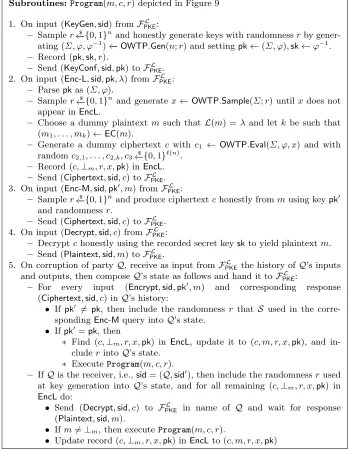
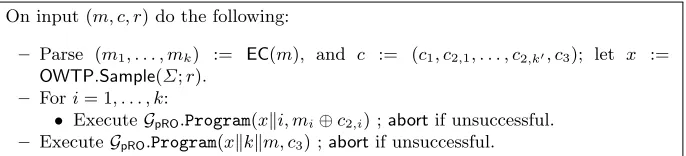
The simulator S is depicted in Figure 8. Basically, it generates an honest key pair for the receiver and responds to Enc-M and Decrypt inputs by using the honest encryption and decryption algorithms, respectively. OnEnc-Linputs, however, it creates a dummy ciphertext c composed of c1 =ϕ(x) for a freshly sampled x(but rejecting values ofxthat were used before) and randomly cho-sen c2,1, . . . , c2,k and c3 for the correct number of blocks k. Only when either the secret key or the randomness used for this ciphertext must be revealed to the adversary, i.e., only when either the receiver or the party Q who created the ciphertext is corrupted, does the simulator program the random oracle so that the dummy ciphertext decrypts to the correct message m. If the receiver is corrupted, the simulator obtains m by having it decrypted by FPKE; if the encrypting partyQis corrupted, thenmis included in the history of inputs and outputs that is handed toSupon corruption. The programming is done through the Program subroutine, but the simulation aborts in case programming fails, i.e., when a point needs to be programmed that is already assigned. We will prove in the reduction that any environment causing this to happen can be used to break the one-wayness of the trapdoor permutation.
We now have to show that S successfully simulates a real execution of the protocol πPKE to a real-world adversary A and environment Z. To see this,
consider the following sequence of games played with A and Z that gradually evolve from a real execution ofπPKE to the simulation by S.
Let Game 0 be a game that is generated by letting an ideal functionality
F0 and a simulator S0 collaborate, where F0 is identical to FPKEL , except that
it passes the full message m along with Enc-L inputs to S0. The simulator S0 simply performs all key generation, encryption, and decryption using the real algorithms, without any programming of the random oracle. The only difference between Game 0 and the real world is that the ideal functionality F0 aborts when the same ciphertext c is generated twice during an encryption query for the honest public key. BecauseS0 generates honest ciphertexts, the probability that the same ciphertext is generated twice can be bounded by the probability that two honest ciphertexts share the same first component c1. Given that c1 is computed as ϕ(x) for a freshly sampled x from Σ, and given that xis uni-formly distributed overΣwhich has size at least 2n, the probability of a collision occurring overqE encryption queries is at mostq2E/2
n.
LetGame1 toGameqE be games for a hybrid argument where gradually all ciphertexts by honest users are replaced with dummy ciphertexts. Let Game i
Parameters:leakage functionL, hash output length`(n) Variables:initially empty listEncL
Subroutines:Program(m, c, r) depicted in Figure 9
1. On input (KeyGen,sid) fromFPKEL :
– Sampler $ ←−{0,1}n
and honestly generate keys with randomnessrby gener-ating (Σ, ϕ, ϕ−1)←−OWTP.Gen(n;r) and settingpk←(Σ, ϕ),sk←ϕ−1. – Record (pk,sk, r).
– Send (KeyConf,sid,pk) toFL PKE.
2. On input (Enc-L,sid,pk, λ) fromFL PKE:
– Parsepkas (Σ, ϕ). – Sampler $
←−{0,1}n
and generatex←OWTP.Sample(Σ;r) untilxdoes not appear inEncL.
– Choose a dummy plaintextm such thatL(m) = λand letk be such that (m1, . . . , mk)←EC(m).
– Generate a dummy ciphertext c withc1 ← OWTP.Eval(Σ, ϕ, x) and with randomc2,1, . . . , c2,k, c3←−{$ 0,1}`(n).
– Record (c,⊥m, r, x,pk) inEncL.
– Send (Ciphertext,sid, c) toFPKEL .
3. On input (Enc-M,sid,pk0, m) fromFL PKE:
– Sampler $
←−{0,1}nand produce ciphertextchonestly frommusing keypk0
and randomnessr.
– Send (Ciphertext,sid, c) toFPKEL .
4. On input (Decrypt,sid, c) fromFL PKE:
– Decryptchonestly using the recorded secret keyskto yield plaintextm. – Send (Plaintext,sid, m) toFL
PKE.
5. On corruption of party Q, receive as input fromFL
PKE the history ofQ’s inputs
and outputs, then composeQ’s state as follows and hand it toFPKEL :
– For every input (Encrypt,sid,pk0, m) and corresponding response (Ciphertext,sid, c) inQ’s history:
• If pk0 6=pk, then include the randomness r that S used in the corre-spondingEnc-Mquery intoQ’s state.
• Ifpk0=pk, then
∗ Find (c,⊥m, r, x,pk) in EncL, update it to (c, m, r, x,pk), and
in-cluderintoQ’s state.
∗ ExecuteProgram(m, c, r).
– IfQis the receiver, i.e.,sid= (Q,sid0), then include the randomnessr used at key generation into Q’s state, and for all remaining (c,⊥m, r, x,pk) in
EncLdo:
• Send (Decrypt,sid, c) to FL
PKE in name of Q and wait for response
(Plaintext,sid, m).
• Ifm6=⊥m, then executeProgram(m, c, r).
• Update record (c,⊥m, r, x,pk) inEncLto (c, m, r, x,pk)
On input (m, c, r) do the following:
– Parse (m1, . . . , mk) := EC(m), and c := (c1, c2,1, . . . , c2,k0, c3); let x :=
OWTP.Sample(Σ;r). – Fori= 1, . . . , k:
• ExecuteGpRO.Program(xki, mi⊕c2,i) ;abortif unsuccessful.
– ExecuteGpRO.Program(xkkkm, c3) ;abortif unsuccessful.
Fig. 9: The oracle programming routine Program.
receiver as done by S in Figure 8, aborting in case programming fails. For the remainingEnc-Linputs,Si generates honest encryptions of the real message.
One can see thatGameqEis identical to the ideal world withFPKEL andS. To
have a non-negligible advantage distinghuishing the real from the ideal world, there must exist ani∈ {1, . . . , qE} such thatZ and Acan distinguish between Game(i−1) and Gamei. These games are actually identical,exceptin the case thataborthappens during the programming of the random oracleGpROfor thei -th ciphertext, which is a real ciphertext inGame(i−1) and a dummy ciphertext in Gamei. We call this the ROABORT event. We show that if there exists an environmentZ and real-world adversaryAthat makeROABORThappen with non-negligible probabilityν, then we can construct an efficient algorithmB(the “reduction”) with black-box access toZ and Athat is able to invertOWTP.
Our reductionB must only simulate honest parties, and in particular must provide toAa consistent view of their secrets (randomness used for encryption, secret keys, and decrypted plaintexts, just like S does) when they become cor-rupted. Moreover, since we are not in the idealized scenario, there is no external global random oracle functionality GpRO: instead, B simulates GpRO for all the parties involved, and answers all their oracle calls.
Upon input theOWTPchallenge (Σ, ϕ, y),B runs the code ofGame(i−1), but sets the public key of the receiver to pk= (Σ, ϕ). AlgorithmB answers the firsti−1 encryption requests with dummy ciphertexts and the (i+ 1)-st toqE -th queries wi-th honestly generated ciphertexts. For -thei-th encryption request, however, it returns a special dummy ciphertext withc1=y.
To simulateGpRO, B maintains an initially empty listListH to which pairs
(m, h) are either added by lazy sampling forHashQueryqueries, or by program-ming forProgramRO queries. (Remember that the environmentZ can program entries inGpROas well.) For requests fromZ,Bactually performs some additional steps that we describe further below.
It answers Decrypt requests for a ciphertext c = (c1, c2,1, . . . , c2,k, c3) by searching for a pair of the form (xkkkm, c3) ∈ ListH such that ϕ(x) = c1 and
m=DC(c2,1⊕h1, . . . , c2,k⊕hk), wherehj=H(xkj), meaning thathjis assigned the value of a simulated request (HashQuery, xkj) toGpRO. Note that at most one
such pair exists for a given ciphertextc, because if a second (x0kkkm0, c3)∈ListH
can be registered, this means thatm0 =DC(c2,1⊕h1, . . . , c2,k⊕hk) =mbecause DC is deterministic. If such a pair (xkkkm, c3) exists, it returnsm, otherwise it rejects by returning ⊥m.
One problem with the decryption simulation above is that it does not neces-sarily create the same entries intoListHas an honest decryption would have, and Zcould detect this by checking whether programming for these entries succeeds. In particular,Zcould first ask to decrypt a ciphertextc= (ϕ(x), c2,1, . . . , c2,k, c3) for randomx, c2,1, . . . , c2,k, c3and then try to program the random oracle on any of the pointsxkjforj= 1, . . . , kor onxkkkm. InGame(i−1) andGamei, such programming would fail because the entries were created during the decryption ofc. In the simulation byB, however, programming would succeed, because no valid pair (xkkkm, c3)∈ListH was found to perform decryption.
To preempt the above problem, B checks all incoming requests HashQuery andProgramRO byZ for points of the form xkj orxkkkm against all previous decryption queries c = (c1, c2,1, . . . , c2,k, c3). If ϕ(x) = c1, then B immediately triggers (by mean of appropriate HashQuery calls) the creation of all random-oracle entries that would have been generated by a decryption ofcby computing
m0 =DC(c2,1⊕ H(xk1), . . . , c2,k⊕ H(xkk)) andc03=H(xkkkm0). Only then does
Bhandle Z’s originalHashQueryor ProgramROrequest.
The only remaining problem is if during this procedure c03 = c3, meaning that c was previously rejected during by B, but it becomes a valid ciphertext by the new assignment of H(xkkkm) = c03 = c3. This happens with negligible probability, though: a random value c03 will only hit a fixed c3 with probability 1/|Σ| ≤ 1/2n. Since up to q
D ciphertexts may have been submitted with the same first componentc1=ϕ(x) and with different values forc3, the probability that it hits any of them is at most qD/2n. The probability that this happens for at least one ofZ’sqH HashQueryqueries or one of itsqPProgramRO queries during the entire execution is at most (qH+qP)qD/2n.
When A corrupts a party, B provides the encryption randomness that it used for all ciphertexts that such party generated. If A corrupts the receiver or the party that generated the i-th ciphertext, then B cannot provide that randomness. Remember, however, thatBis runningZandAin the hope for the ROABORTevent to occur, meaning that the programming of values for thei-th ciphertext fails because the relevant points inGpRO have been assigned already. Event ROABORT can only occur at the corruption of either the receiver or of the party that generated thei-th ciphertext, whichever comes first. AlgorithmB
therefore checksListHfor points of the formxkjorxkkkmsuch thatϕ(x) =y. If
ROABORToccurred, thenBwill find such a point and outputxas its preimage for y. If it did not occur, then B gives up. Overall, B will succeed whenever ROABORToccurs. Given thatGame(i−1) andGameiare different only when ROABORT occurs, and given that Z and A have non-negligible probability of distinguishing between Game(i−1) andGame i, we conclude thatB succeeds
5
Restricted Programmable Global Random Oracles
The strict and the programmable global random oracles,GsROandGpRO, respec-tively, do not give the simulator any extra power compared to the real world adversary/environment. Canetti and Fischlin [13] proved that it is impossible to realize UC commitments without a setup assumption that gives the simulator an advantage over the environment. This means that, whileGsROandGpRO allowed for security proofs of many practical schemes, we cannot hope to realize even the seemingly simple task of UC commitments with this setup. In this section, we turn our attention to programmable global random oracles that do grant an advantage to the simulator.
5.1 Restricting Programmability to the Simulator
Canetti et al. [15] defined a global random oracle that restricts observability only adversarial queries, (hence, we call it the restricted observable global random oracle GroRO), and show that this is sufficient to construct UC commitments. More precisely, if sidis the identifier of the challenge session, a list of so-called illegitimate queries forsidcan be obtained by the adversary, which are queries made on inputs of the form (sid, . . .) by machines that are not part of session sid. If honest parties only make legitimate queries, then clearly this restricted observability will not give the adversary any new information, as it contains only queries made by the adversary. In the ideal world, however, the simulatorScan observe all queries made through corrupt machines within the challenge session sidas it is the ideal-world attacker, which means it will see all legitimate queries insid. With the observability of illegitimate queries, that meansScan observeall hash queries of the form (sid, . . .), regardless of whether they are made by honest or corrupt parties, whereas the real-world attacker does not learn anything form the observe interface.
We recall the restricted observable global random oracleGroROdue to Canetti et al. [15] in a slightly modified form in Fig. 10. In their definition, it allowsideal functionalities to obtain the illegitimate queries corresponding to their own ses-sion. These functionalities then allow the adversary to obtain the illegitimate queries by forwarding the request to the global random oracle. Since the adver-sary can spawn any new machine, and in particular an ideal functionality, the adversary can create such an ideal functionality and use it to obtain the illegit-imate queries. We chose to explicitly model this adversarial power by allowing the adversary to query for the illegitimate queries directly.
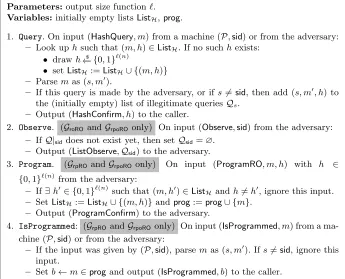
Also in Fig. 10, we define a restricted programmable global random oracle
GroRO,GrpRO, andGrpoRO – functionalities of the global random oracle with restricted
programming and/or restricted observability.
Parameters:output size function`. Variables:initially empty listsListH,prog.
1. Query. On input (HashQuery, m) from a machine (P,sid) or from the adversary: – Look uphsuch that (m, h)∈ListH. If no suchhexists:
• drawh $
←− {0,1}`(n)
• setListH:=ListH∪ {(m, h)}
– Parsemas (s, m0).
– If this query is made by the adversary, or ifs6=sid, then add (s, m0, h) to the (initially empty) list of illegitimate queriesQs.
– Output (HashConfirm, h) to the caller.
2. Observe. (GroRO andGrpoRO only) On input (Observe,sid) from the adversary:
– IfQ|siddoes not exist yet, then setQsid=∅.
– Output (ListObserve,Qsid) to the adversary.
3. Program. (GrpRO andGrpoROonly) On input (ProgramRO, m, h) with h ∈ {0,1}`(n)
from the adversary: – If∃h0∈ {0,1}`(n)
such that (m, h0)∈ListH andh6=h0, ignore this input.
– SetListH:=ListH∪ {(m, h)}andprog:=prog∪ {m}.
– Output (ProgramConfirm) to the adversary.
4. IsProgrammed: (GrpROandGrpoRO only) On input (IsProgrammed, m) from a
ma-chine (P,sid) or from the adversary:
– If the input was given by (P,sid), parsemas (s, m0). Ifs6=sid, ignore this input.
– Setb←m∈progand output (IsProgrammed, b) to the caller.
Fig. 10: The global random-oracle functionalities GroRO, GrpRO, and GrpoRO with restricted observability, restricted programming, and combined restricted ob-servability and programming, respectively. FunctionalityGroROcontains only the Query and Observe interfaces, GrpRO contains only the Query, Program, and IsProgrammedinterfaces, andGrpoROcontains all interfaces.
points are programmed. Note that while it typically internally simulates the real-world adversary that may want to check whether points of the form (sid, . . .) are programmed, the simulator can simply “lie” and pretend that no points are programmed. Therefore, the extra power that the simulator has over the real-world adversary is programming points without being detected.
5.2 UC-Commitments from GrpRO
We now show that we can create a UC-secure commitment protocol fromGrpRO. A UC-secure commitment scheme must allow the simulator to extract the message from adversarially created commitments, and to equivocate dummy commit-ments created for honest committers, i.e., first create a commitment that it can open to any message after committing. Intuitively, achieving the equivocability with a programmable random oracle is simple: we can define a commitment that uses the random-oracle output, and the adversary can later change the com-mitted message by programming the random oracle. Achieving extractability, however, seems difficult, as we cannot extract by observing the random-oracle queries. We overcome this issue with the following approach. The receiver of a commitment chooses a nonce on which we query random oracle, interpreting the random oracle output as a public keypk. Next, the committer encrypts the message to pk and sends the ciphertext to the receiver, which forms the com-mitment. To open, the committer reveals the message and the randomness used to encrypt it.
This solution is extractable as the simulator that plays the role of receiver can program the random oracle such that it knows the secret key corresponding to pk, and simply decrypt the commitment to find the message. However, we must take care to still achieve equivocability. If we use standard encryption, the simulator cannot open a ciphertext to any value it learns later. The solution is to use non-committing encryption, which, as shown in Section 4, can be achieved using a programmable random oracle. We use a slightly different encryption scheme, as the security requirements here are slightly less stringent than full non-committing encryption, and care must be taken that we can interpret the result of the random oracle as a public key, which is difficult for constructions based on trapdoor one-way permutations such as RSA. This approach results in a very efficient commitment scheme: with two exponentiations per party (as opposed to five) and two rounds of communication (as opposed to five), it is considerably more efficient than the one of [15].
LetCOMGrpRObe the following commitment protocol, parametrized by a group
G=hgiof prime order q. We require an algorithm Embedthat maps elements of {0,1}`(n) into G, such that forh←− {$ 0,1}`(n), Embed(h) is statistically close to uniform inG. Furthermore, we require an efficiently computable probabilistic algorithm Embed−1, such that for all x ∈ G, Embed(Embed−1(x)) = x and for x $
←−G, Embed−1(x) is statistically close to uniform in {0,1}`(n). COMGrpRO
assumes authenticated channelsFauthas defined by Canetti [9].
1. On input (Commit,sid, x), partyCproceeds as follows.
– Check that sid = (C,R,sid0) for some C, sid0. Send Commit to R over
Fauthby givingFauth input (Send,(C,R,sid,0),“Commit”).
– R, upon receiving (Sent,(C,R,sid,0),“Commit”) fromFauth, takes a nonce
n $
←− {0,1}n and sends the nonce back toC by giving Fauthinput (Send,
FCOM – functionality for interactive commitments.
1. Commit: on input (Commit,sid, x) from a partyCproceed as follows. – Check thatsid= (C,R,sid0).
– Storexand generate public delayed output (Receipt,sid) toR. Ignore subse-quentCommitinputs.
2. Open: on input (Open,sid) fromC proceed as follows. – Check that a committed valuexis stored.
– Generate public delayed output (Open,sid, x) toR.
Fig. 11: The commitment functionalityFCOM by Canetti [9].
– C, upon receiving (Sent,(R,C,sid,0), n), queriesGrpRO on (sid, n) to ob-tainhn. It checks whether this point was programmed by givingGroRO in-put (IsProgrammed,(sid, n)) and aborts ifGroROreturns (IsProgrammed,1).
– Setpk←Embed(hn).
– Pick a randomr $
←−Gandρ∈Zq. Setc1←gr, queryGrpRO on (sid,pkr)
to obtainhr and letc2←hr⊕x.
– Store (r, x) and send the commitment toRby givingFauthinput (Send,
(C,R,sid,1),(c1, c2)).
– R, upon receiving (Sent,(C,R,sid,1),(c1, c2)) fromFauthoutputs (Receipt,sid). 2. On input (Open,sid),C proceeds as follows.
– It sends (r, x) to Rby givingFauth input (Send,(C,R,sid,2),(r, x)).
– R, upon receiving (Sent,(C,R,sid,1),(r, x)):
• Query GrpROon (sid, n) to obtainhn and letpk←Embed(hn).
• Check that c1=gr.
• Query GrpROon (sid,pkr) to obtainhr and check thatc2=hr⊕x.
• Check that none of the points was programmed by giving GroRO in-puts (IsProgrammed,(sid, n)) and (IsProgrammed,pkr) and asserting that it returns (IsProgrammed,0) for both queries.
• Output (Open,sid, x).
COMGrpRO is a secure commitment scheme under the computational
Diffie-Hellman assumption, which given a group Ggenerated by g of prime order q, challenges the adversary to computegαβ on input (gα, gβ), with (α, β) $
←−Z2q.
Theorem 5. COMGrpRO GUC-realizes FCOM (as defined in Figure 11) in the GroRO andFauth hybrid model under the CDH assumption inG.
Proof. By the fact that COMGrpRO is GrpRO-subroutine respecting and by
Theo-rem 1, it is sufficient to show thatCOMGrpRO GrpRO-EUC-realizesFCOM.
We describe a simulatorS by defining its behavior in the different corruption scenarios. In all scenarios, whenever the simulated real-world adversary makes anIsProgrammedquery or instructs a corrupt party to make such a query on a point that S has programmed, the simulator intercepts this query and simply replies (IsProgrammed,0), lying that the point was not programmed.
1. WhenFCOM asksS for permission to output (Receipt,sid):
– Parse sid as (C,R,sid0) and let “C” create a dummy commitment by choosingr $
←−Zq, lettingc1=gr, choosingc2←− {$ 0,1}`(n).
– When “R” outputs (Receipt,sid), allowFCOM to proceed. 2. WhenFCOM asksS for permission to output (Open,sid, x):
– ProgramGrpROby givingGroROinput (ProgramRO,(sid,pkr), c2⊕x), such that the commitment (c1, c2) commits tox.
– Give “C” input (Open,sid) instructing it to open its commitment tox.
– When “R” outputs (Open,sid, x), allowFCOM to proceed.
If the committer is corrupt but the receiver is honest,S works as follows.
1. When the simulated receiver “R” notices the commitment protocol starting (i.e., receives (Sent,(C,R,sid,0),“Commit”) from “Fauth”):
– Choose noncenas in the protocol.
– Before sendingn, choosesk $
←−Zq and set pk←gsk.
– ProgramGrpROby givingGrpROinput (ProgramRO,(sid, n),Embed−1(pk)). Note that this simulation will succeed with overwhelming probability as
nis freshly chosen, and note that aspkis uniform inG, by definition of Embed−1the programmed valueEmbed−1(pk) is uniform in{0,1}`(n).
– S now lets “R” execute the remainder the protocol honestly.
– When “R” outputs (Receipt,sid), S extracts the committed value from (c1, c2). QueryGrpRO on (sid, csk1) to obtainhrand set x←c2⊕hr.
– Make a query with FCOM on C’s behalf by sending (Commit,sid, x) on
C’s behalf toFCOM.
– WhenFCOM asks permission to output (Receipt,sid), allow. 2. When “R” outputs (Open,sid, x):
– Send (Open,sid) onC’s behalf toFCOM.
– WhenFCOM asks permission to output (Open,sid, x), allow.
If the receiver is corrupt but the committer is honest,S works as follows.
1. WhenFCOM asks permission to output (Receipt,sid): – Parsesidas (C,R,sid0).
– AllowFCOM to proceed.
– WhenFCOM receives (Receipt,sid) fromFCOM as R is corrupt, it simu-lates “C” by choosingr $
←−Zq, computingc1=gr, and choosingc2←− {$ 0,1}`(n). 2. WhenFCOM asks permission to output (Open,sid, x):
– AllowFCOM to proceed.
– WhenS receives (Open,sid, x) fromFCOM asRis corrupt, S programs GrpROby givingGrpROinput (ProgramRO,(sid,pkr), c2⊕x), such that the commitment (c1, c2) commits tox.
What remains to show is that S is a satisfying simulator, i.e., no GrpRO
-externally constrained environment can distinguishFCOM andS fromCOMGrpRO
andA. When simulating an honest receiver,S extracts the committed message correctly: Givenpkandc1=grfor somer, there is a unique value pkr, and the message xis uniquely determined byc2 andpkr. SimulatorS also simulates an honest committer correctly. When committing, it does not know the message, but can still produce a commitment that is identically distributed as long as the environment does not query the random oracle on (sid,pkr). WhenS later learns the messagex, it must equivocate the commitment to open tox, by programming
GrpROon (sid,pkr), which again succeeds unless the environment makes a random oracle query on (sid,pkr). If there is an environment that triggers such aGrpRO
with non-negligible probability, we can construct an attackerB that breaks the CDH problem inG.
Our attacker B plays the role of FCOM, S, and GrpRO, and has black-box access to the environment. B receives CDH problem gα, gβ and is challenged to compute gαβ. It simulates G
rpRO to return hn ← Embed−1(gα) on random query (sid, n). When simulating an honest committer committing with respect to this pk, set c1 ← gβ and c2←− {$ 0,1}
`(n)
. Note that S cannot successfully open this commitment, but remember that we consider an environment that with non-negligible probability makes a GrpRO query on pkr(= gαβ) before the commitment is being opened. Next, B will choose a random GrpRO query on (sid, m). With nonnegligible probability, we have m = gαβ, and B found the
solution to the CDH challenge. ut
5.3 Adding Observability for Efficient Commitments
While the commitment scheme COMGrpRO from the restricted programmable
global random oracle is efficient for a composable commitment scheme, there is still a large efficiency gap between composable commitments from global ran-dom oracles and standalone commitments or commitments from local ranran-dom oracles. Indeed,COMGrpRO still requires multiple exponentiations and rounds of
interaction, whereas the folklore commitment schemec=H(mkr) for messagem
and random opening informationrconsists of computing a single hash function. We extendGrpRO to, on top of programmability, offer the restricted
observ-ability interface of the global random oracle due to Canetti et al. [15]. With this restricted programmableand observable global random oracleGrpoRO(as shown in Figure 10), we can close this efficiency gap and prove that the folklore com-mitment scheme above is a secure composable comcom-mitment scheme with a global random oracle.
LetCOMGrpoRO be the commitment scheme that simply hashes the message
and opening, phrased as a GUC protocol usingGrpoRO and using authenticated channels, which is formally defined as follows.
1. On input (Commit,sid, x), partyCproceeds as follows.
– Check thatsid= (C, R,sid0) for someC,sid0.
– Pickr $
![Fig. 4: The signature functionality FSIG due to Canetti [11].](https://thumb-us.123doks.com/thumbv2/123dok_us/7985964.1325045/11.612.139.487.127.352/fig-signature-functionality-fsig-canetti.webp)
![Fig. 5: The PKE functionality FLPKE with leakage function L [9, 8].](https://thumb-us.123doks.com/thumbv2/123dok_us/7985964.1325045/14.612.141.483.111.416/fig-pke-functionality-flpke-leakage-function-l.webp)
![Fig. 7: Public-key encryption scheme secure against adaptive attacks [8] basedon one-way permutation OWTP and encoding function (EC, DC).](https://thumb-us.123doks.com/thumbv2/123dok_us/7985964.1325045/17.612.137.485.285.550/public-encryption-adaptive-attacks-basedon-permutation-encoding-function.webp)
![Fig. 11: The commitment functionality FCOM by Canetti [9].](https://thumb-us.123doks.com/thumbv2/123dok_us/7985964.1325045/25.612.147.482.128.216/fig-commitment-functionality-fcom-canetti.webp)