© 2015, IJCSMC All Rights Reserved
507
Available Online atwww.ijcsmc.com
International Journal of Computer Science and Mobile Computing
A Monthly Journal of Computer Science and Information Technology
ISSN 2320–088X
IJCSMC, Vol. 4, Issue. 6, June 2015, pg.507 – 512
RESEARCH ARTICLE
A Constraint Analysis based Communication
Model to Optimize VANET Architecture
Preeti Kundu
Student, M.Tech (ECE), South Point Institute of Technology & Management
Amit Kumar
Asstt Prof, ECE Dept, South Point Institute of Technology & Management
Abstract: Security is always the critical challenge for any open area network. VANET is also such type of network in which the criticalities includes because of sensor specific restriction and communication limitations. In this work, the optimized communication is provided by combining the V2V and V2I communication. The proposed model has with inclusive authentication based and preventive approach. The work has provided the generation of safe path under probabilistic analysis. The analysis is here performed on communication adaptive parameters. The simulation result shows that the work has improved the network communication and network throughput.
Keywords: Throughput, VANET, Probabilistic, Authentication
I. INTRODUCTION
© 2015, IJCSMC All Rights Reserved
508
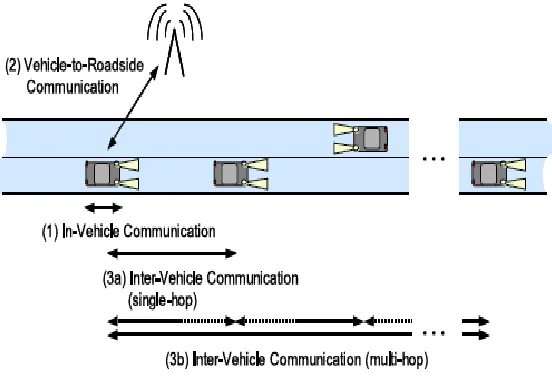
Figure 1 : Communication Models
A) V2V Communication
V2V is the most common communication type adapted without the inclusion of any infrastructure device as controller. The vehicle nodes performs the cooperative communication and identify the nearest neighbor based information exchange mechanism so that the inter-vehicle communication will be performed. This network form also includes the communication synchronization, peer-cooperation to provide information transmission, sensing range etc. This communication is effective where the infrastructure installation is difficult and cost is high as well as the number of vehicle nodes are less. As the decentralized mechanism is applied for the communication, there is also the requirement of position estimation to track the vehicle nodes. In such case, the vehicles are required to be installed with specialized tracking devices such as GPSR devices. Based on the vehicle adaptive tracking information, the inter-vehicle communication is established.
B) V2I Communication
This network form is also called centralized communication architecture. To provide the centralized control over the network, the specialized devices are installed over the network called infrastructure devices. These RSU (Road Side Units) are installed at different adaptive locations in the network with specific sensing range. The RSU used as the controller node that tracks all the incoming and outgoing nodes in the region. It provides the analysis on the communicating entities and identifies the critical situation such as overtraffic situation, accident situation, traffic light adjustment etc. If a node has to identify the communication route, it can send the route request to nearest RSU. The RSU can suggest the possibilities based on the requirement analysis. The V2I communication is effective as it provides the controlled communication for dense network. It reduces the network communication and provide the reliable communication over the network.
II. EXISTING WORK
© 2015, IJCSMC All Rights Reserved
509
Ghassan Samara[3] has presented a work on attention analysis to provide the secure communication in the network. Author provided the analysis on various attack models and provided the driver directed safe communication to improve the communication robustness. Author provided the solution to the security problems so that the various challenges associated with vehicular network will get resolved. Author provided the dependent analysis on security and privacy features so that more reliable communication will be drawn. Vimmi a gajbhiye[4] has provided a work on various routing protocols to control the network communication and to design the communication phenomenon under link formation model. Author described the protocol under swarm approach so that the QoS optimization will be achieved. Author defined the traffic driven clustered routing under ACO approach so that the safe communication route will be established and the delay over the communication route will be reduced. Author provided the route establishment to provide the safe and secure communication in vehicle network. Author also handled the handoff phenomenon to provide safe and secure communication in the network. Kamini and rakesh kumar[5] has provided a work on QoS improvement under application setup. Author presented a study on various routing protocol so that the requirement specific protocol selection can be done. Author also analyze the parameters associated with the network such as bandwidth adjustment, PDR, communication ratio analysis etc. Author provided the mobility model driven communication so that the safe and density driven communication will be performed in the network. Author provided the security driven optimized model to provide relevant communication. Tomoyo kitani[6] has provided a work on vehicular network to propagate the network model under the effective traffic analysis and propagate the associated communication deficiencies so that the reliable communication will be performed over the network.
Hyun Yu[7] provided a work on real time routing in city scenario. Author provided the route formation under road vehicle density analysis model to provide the reliable communication with dynamic nature of network. Author defined the density driven communication under reliability constraints. Xiaoqing Li[8] has provided a work on target region adaptive communication in vehicle network. Author provided the geocast communication route formation in vehicular network and provided the road topology formation under vehicular network. Author provided the topological map so that the greedy adaptive solution will be obtained formt he work. Sangheethaa Sukumaran[9] has provided the traffic light based communication route generation model that will analyze the network density and based on it the route formation is done. Komathy Karuppanan[10] provided the optimization on network route using fuzzy approach. Author defined the fuzzy adaptive routing model to improve the network reliability and packet delivery probability so that the reliable and secure communication will be performed over the network.
III. RESEARCH METHODOLOGY
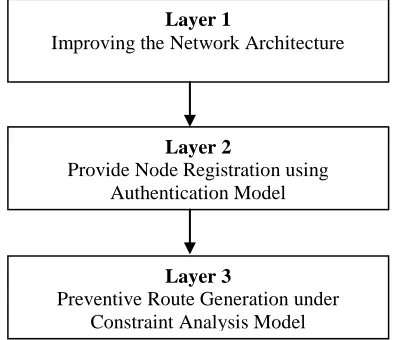
In this present work, an inclusive vehicular network architecture is presented that has improved the network formation, construction and communication under reliability and security criteria. The presented work model is divided in three main stages shown in figure 2.
Figure 2 : Proposed Model Layer 1
Improving the Network Architecture
Layer 2
Provide Node Registration using Authentication Model
Layer 3
© 2015, IJCSMC All Rights Reserved
510
The figure shows that the work has improved the network model under all three aspects. The model has improved the architectural specification of network by providing the infrastructure based network along with independent cooperative communication. The work also used the security integrity using the preventive modeling so that the safe node can participate to the network. In final stage, the attack inclusive situation is handled by providing the generation of preventive routing. Author has provided the route preventive routing under communication characterstics and node level feature analysis. In this section, the detailed description of proposed architecture is given
A) Layer I
The first stage of this proposed model is to generate the network architecture. The architectural specification is here done under the real time scenario specification. In this work, the city scenario is considered under the dense network specification. The network is defined with the specification of hybrid communication mechanism that can provide V2V and V2I communication. The V2V is the cooperative communication mechanism applied while generating the region adaptive route and the information broadcasting regarding the information failure or bad node occurrence. The V2I communication is performed to generate the route request and to perform the route generation over the network. The I2I communication is performed to generate the route for distance locations.
B) Layer II
The second stage of this model is the adaption to the particular RSU. This adaptation is here defined as the registration of the node to the relative RSU. The registration is here applied to provide the secure communication in the network. The node acceptance is here defined to provide the safe and secure communication. In this work, RSA based public key authentication model is applied for key adaptive registration. Only the authenticated nodes can participate in the communication. The work defined the key distribution and the cryptographic key sharing to prove the authentication. This authentication approach will reduce the changes of inclusion of external node in attack.
C) Layer III
The final stage of this work models it to provide the preventive communication in the network. The model begin as the node send the request to the nearest RSU to generate the adaptive communication. As the request is accepted, the request is processed by the routing algorithm to generate the adaptive route. The route selection is here based on the network region adaptation, node characteristics and communication capabilities. The analysis is here done under communication study. The first level analysis will be here performed under sensing range and the response time vectors. Based on these vectors, the neighbor list will be formed. These neighbors will be filtered under session adaptive delay analysis and loss analysis. The reliable node will be identified under these vectors and the lesser effective node will be blocks. The process will be continued till the destination node not occurs. Once the route will be obtained, the next work is to perform the communication over the generated route.
The experimentation is here done in real time simulation environment. The results shows that the work has provided the secure and reliable communication. The experimentation results are discussed in next section.
IV. RESULTS
© 2015, IJCSMC All Rights Reserved
511
Figure 3 : Packet Loss Analysis
Here figure 3 is showing the packet loss analysis applied with the network. The figure shows that the proposed work has reduced the packet loss over the network and overall network reliability is improved.
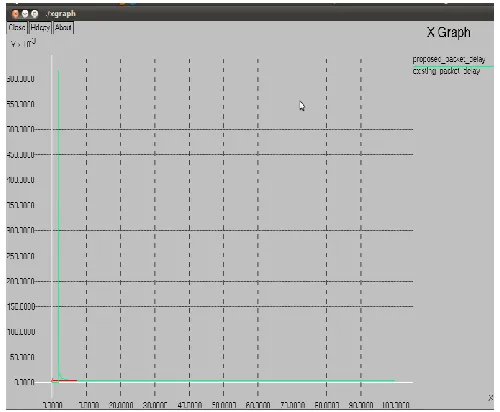
Figure 4 : Packet Delay Analysis
© 2015, IJCSMC All Rights Reserved
512
V. CONCLUSION
In this work, an improved communication model is presented under attacked vehicle network. The proposed model is the improvement against the network architecture along with authentication adaptive and preventive communication strengths. The results show that the work model has improved the network reliability and reduced the communication loss.
REFERENCES
[1]
Maria elsa Mathew and arun raj kumar p., “threat analysis and defence mechanisms in VANET”, international journal of advanced research in computer science and software engineering,volume 3, issue1, January 2013.[2] Nikhil D. Karande and Kushal K. Kulkarni “Efficient Routing Protocols For Vehicular Ad Hoc Network” International Journal of Engineering Research And Technology Vol. 2, Issue 1, January 2013.
[3] Ghassan Samara , Wafaa A.H. Al-Salihy , R. Sures” study of security analysis of vehicular ad hoc networks (VANET)” National Advanced IPv6 Center, Universiti Sains Malaysia, 2010
[4] Vimmi a gajbhiye, ratnaprabha w.jasutkar”study of efficient routing protocols for VANET” international journal of scientific & engineering research volume 4,issue3,march-2013
[5]
Kamini and rakesh kumar “VANET parameters and applications: a review” global journal of computer science and technology vol.10 issue 7 ver.1.0 september 2010.[6] Tomoyo kitani, takashi shinkawa, naoki shibata, keiichi yasumoto, minoru ito and teruo higashino “efficient VANET-based traffic information sharing using buses on regular routes” IEEE , 2008.
[7] Hyun Yu," A VANET Routing based on the Real-time Road Vehicle Density in the City Environment", ICUFN 2013, 978-1-4673-5990-0/13©2013 IEEE
[8] Xiaoqing Li," GRTR: A Geocasting Routing Based Target Region for VANET", 2013 5th International Conference on Intelligent Networking and Collaborative Systems 978-0-7695-4988-0/13 © 2013 IEEE
[9] Sangheethaa Sukumaran," Intersection Based Traffic Aware Routing In VANET", 978-1-4673-6217-7/13@ 2013 IEEE