Duplexing the sponge: single-pass authenticated encryption and
other applications
Guido Bertoni1, Joan Daemen1, Michaël Peeters2, and Gilles Van Assche1
1 STMicroelectronics 2 NXP Semiconductors
Abstract. This paper proposes a novel construction, called duplex, closely related to the sponge construction, that accepts message blocks to be hashed and—at no extra cost—provides digests on the input blocks received so far. It can be proven equivalent to a cascade of sponge func-tions and hence inherits its security against single-stage generic a acks. The main application proposed here is an authenticated encryption mode based on the duplex construction. This mode is efficient, namely, enciphering and authenticating together require only a single call to the underlying permutation per block, and is readily usable in, e.g., key wrapping. Further-more, it is the first mode of this kind to be directly based on a permutation instead of a block cipher and to natively support intermediate tags. The duplex construction can be used to effi-ciently realize other modes, such as a reseedable pseudo-random bit sequence generators and a sponge variant that overwrites part of the state with the input block rather than to XOR it in.
Keywords:sponge functions, duplex construction, authenticated encryption, key wrap-ping, provable security, pseudo-random bit sequence generator, Keccak
1 Introduction
While most symmetric-key modes of operations are based on a block cipher or a stream cipher, there exist modes using a fixed permutation as underlying primitive. Designing a cryptographically strong permutation suitable for such purposes is similar to designing a block cipher without a key schedule and this design approach was followed for several recent hash functions, see, e.g., [19].
The sponge construction is an example of such a mode. With its arbitrarily long input and output sizes, it allows building various primitives such as a stream cipher or a hash function [7]. In the former, the input is short (typically the key and a nonce) while the output is as long as the message to encrypt. In contrast, the la er takes a message of any length at input and produces a digest of small length.
Some applications can take advantage of both a long input and a long output size. For instance, authenticated encryption combines the encryption of a message and the gener-ation of a message authenticgener-ation code (MAC) on it. It could be implemented with one sponge function call to generate a key stream (long output) for the encryption and another call to generate the MAC (long input). However, in this case, encryption and authentica-tion are separate processes without any synergy.
The duplex construction is a novel way to use a fixed permutation (or transformation) to allow the alternation of input and output blocks at the same rate as the sponge con-struction, like a full-duplex communication. In fact, the duplex construction can be seen as a particular way to use the sponge construction, hence it inherits its security proper-ties. By using the duplex construction, authenticated encryption requires only one call to the underlying permutation (or transformation) per message block. In a nutshell, the input blocks of the duplex are used to input the key and the message blocks, while the intermediate output blocks are used as key stream and the last one as a MAC.
security proof against generic a acks, e.g., [3,21,28,45,38,5,30,43,32,24,46,39,25,27,26,31]. Interestingly, there have also been a empts at designing dedicated hybrid primitives of-fering efficient simultaneous stream encryption and MAC computation, e.g., Helix and Phelix [20,48]. However, these primitives were shown to be weak [36,40,49]. Another ex-ample of hybrid primitive is the Grain-128 stream cipher to which optional built-in au-thentication was recently added [50].
Our proposed mode shares with these hybrid primitives that it offers efficient simul-taneous stream encryption and MAC computation. It shares with the block cipher modes that it has provable security against generic a acks. However, it is the first such construc-tion that (directly) relies on a permutaconstruc-tion rather than a block cipher and that proves its security based on this type of primitive. An important efficiency parameter of an AE mode is the number of calls to the block cipher or to the permutation per block. While encryp-tion or authenticaencryp-tion alone requires one call per block, some AE modes only require one call per block for both functions. The duplex construction naturally provides a good basis for building such an efficient AE mode. Also, the AE mode we propose natively supports intermediate tags and the authenticated encryption of a sequence of messages.
Authenticated encryption can also be used to transport secret keys in a confidential way and to ensure their integrity. This task, called key wrapping, is very important in key management and can be implemented with our construction if each key has a unique identifier.
Finally, the duplex construction can be used for other modes as well, such as a reseed-able pseudo-random bit sequence generator (PRG) or to prove the security of an “over-write” mode where the input block overwrites part of the state instead of XORing it in.
These modes can readily be used by the concrete sponge function K [11] and the members of a recent wave of lightweight hash functions that are in fact sponge functions: Quark [2], Photon [23] and Spongent [14]. For these, and for the small-width instances of K , our security bound against generic a acks beyond the birthday bound pub-lished in [10] allows constructing solutions that are at the same time compact, efficient and potentially secure.
The remainder of this paper is organized as follows. First, we propose a model for au-thenticated encryption in Section 2. Then in Section 3, we review the sponge construction. The core concept of this paper, namely the duplex construction, is defined in Section 4. Its use for authenticated encryption is given in Section 5 and for other applications in Section 6. Finally, Section 7 discusses the use of a flexible and compact padding.
2 Modeling authenticated encryption
We consider authenticated encryption as a process that takes as input a keyK, a data headerAand a data bodyBand that returns a cryptogramCand a tagT. We denote this operation by the termwrappingand the operation of taking a data headerA, a cryptogram Cand a tagTand returning the data bodyBif the tagTis correct by the termunwrapping. The cryptogram is the data body enciphered under the key Kand the tag is a MAC computed under the same keyKover both header Aand bodyB. So here the headerA can play the role of associated data as described in [42]. We assume the wrapping and unwrapping operations as such to be deterministic. Hence two equal inputs (A,B) = (A′,B′)will give rise to the same output(C,T)under the same keyK. If this is a problem, it can be tackled by expandingAwith a nonce.
Formally, for a given key lengthkand tag lengtht, we consider a pair of algorithms W andU, with
The algorithms are such that if(C,T) = W(K,A,B)thenU(K,A,C,T) = B. As we con-sider only the case of non-expanding encryption, we assume from now on that|C|=|B|.
2.1 Intermediate tags and authenticated encryption of a sequence
So far, we have only considered the case of the authentication and encryption of a single message, i.e., a header and body pair(A,B). It can also be interesting to authenticate and encrypt a sequence of messages in such a way that the authenticity is guaranteed not only on each(A,B)pair but also on the sequence received so far. Intermediate tags can also be useful in practice to be able to catch fraudulent transactions early.
Let(A,B) = (A(1),B(1),A(2), . . . ,A(n),B(n))be a sequence of header-body pairs. We extend the function of wrapping and unwrapping as providing encryption over the last body B(n) and authentication over the whole sequence (A,B). Formally, W andU are defined as:
W :Zk2×(Z∗2)2+ →Z∗2×Zt2:(K,A,B)→(C(last),T(last)) =W(K,A,B), and U:Zk2×(Z∗2)2+×Z2t →Z∗2∪ {error}:(K,A,C,T(last))→B(last)or error.
Here,(Z∗2)2+means any sequence of binary strings, with an even number of such strings and at least two. To wrap a sequence of header-body pairs, the sender callsW(K,A(1),B(1))
with the first header-body pair to get(C(1),T(1)), thenW(K,A(1),B(1),A(2),B(2))with the second one to get(C(2),T(2)), and so on. To unwrap, the receiver first callsU(K,A(1),C(1),T(1)) to retrieve the first bodyB(1), then U(K,A(1),C(1),A(2),C(2),T(2))to retrieve the second body, and so on. As we consider only the case of non-expanding encryption, we assume that|C(i)|=|B(i)|for alli.
2.2 Security requirements
We consider two security notions from [45] and works cited therein, calledprivacy and authenticity. Together, these notions are central to the security of authenticated encryption [3].
Privacy is defined in Eq. (1) below. Informally, it means that the output of the wrapping function looks like uniformly chosen random bits to an observer who does not know the key.
Advpriv(A) =Pr[K←−$ Zk2 : A[W(K,·,·)] =1]−Pr[A[R(·,·)] =1], (1)
withR(A,B) =⌊RO(A,B)⌋|B(n)|+twhereB(n)is the last body inA,B,|x| is the bitlength
of stringx,⌊·⌋ℓindicates truncation toℓbits andK $ ←−Zk
2means thatKis chosen randomly and uniformly among the setZk2. In this definition, we use a random oracleROas defined in [4], but allowing sequences of one or more binary strings as input (instead of a single binary string). Here, a random oracle is a map from(Z∗2)+ to Z∞2, chosen by selecting each bit ofRO(x)uniformly and independently, for every input. The original definition can still be used by defining an injective mapping from(Z∗2)+toZ∗
2.
For privacy, we consider only adversaries who respect the nonce requirement. For a single header-body pair, it means that, for any two queries(A,B)and(A′,B′), we have A = A′ ⇒ B = B′. In general, the nonce requirement specifies that for any two queries
(A,B)and(A′,B′)of equal lengthn, we have
pre(A,B) =pre(A′,B′)⇒ B(n) =B′(n),
Authenticity is defined in Eq. (2) below. Informally, it quantifies the probability of the adversary successfully generating a forged ciphertext-tag pair.
Advauth(A) =Pr[K←−$ Z2k : A[W(K,·,·)]outputs a forgery]. (2)
Here a forgery is a sequence(A,C,T)such thatU(K,A,C,T)̸=error and that the adver-sary made no query toWwith input(A,B)returning(C(n),T), withC(n)the last cipher-text body ofA,C. Note that authenticity does not need the nonce requirement.
2.3 An ideal system
We can define an ideal system using a pair of independent random oracles(ROC,ROT). For a single header-body pair, encryption and tag computation are implemented as fol-lows. The ciphertextCis produced by XORingBwith a key stream. This key stream is the output ofROC(K,A). If(K,A)is a nonce, key streams for different data inputs are the result of calls toROC with different inputs and hence one key stream gives no informa-tion on another. The tagTis the output of ROT(K,A,B). Tags computed over different header-body pairs will be the result of calls toROT with different inputs. Key stream sequences give no information on tags and vice versa as they are obtained by calls to different random oracles.
Let us define the ideal system in the general case, which we call RO . Wrapping is defined asW(K,A,B) = (C(n),T(n)), if A,Bcontainsnheader-body pairs, with
C(n) =⌊ROC(K, pre(A,B))⌋|B(n)|⊕B(n),
T(n) =⌊ROT(K,A,B)⌋t.
The unwrapping algorithmUfirst checks thatT(n) =⌊ROT(K,A,B)⌋tand if so decrypts each bodyB(i) = ⌊RO
C(K,A(1),B(1),A(2), . . . ,A(i))⌋|C(i)|⊕C(i) from the first one to the last one and finally returns the last oneB(n) =⌊RO
C(K, pre(A,B))⌋|C(n)|⊕C(n). The security of RO is captured by Lemmas 1 and 2.
Lemma 1. LetA[ROC,ROT]be an adversary having access toROCandROTand respecting the nonce requirement. Then,AdvprivRO (A) ≤ q2−k if the adversary makes no more than q queries toROC orROT.
Proof. For any fixed last bodyB(n), the output of RO is indistinguishable from that ofROused in Eq. (1), unlessAmakes a query toROCorROTwith the correct keyKas first argument. This last event has probabilityq2−k amongqqueries and the advantage
can be bounded following [34, Theorem 1]. The conclusion is still valid for a variableB(n), as a differentB(n)implies a differentpre(A,B).
Lemma 2. LetA[ROC,ROT]be an adversary having access toROCandROT. Then, RO satisfiesAdvauthRO (A)≤ q2−k+2−tif the adversary makes no more thanqqueries toROC or ROT.
Proof. A similar argument as in Lemma 1 can be applied here. In addition, the adversary can just be lucky and output the correct tagTwith probability2−t.
3 The sponge construction
For the padding rule we use the following notation: the padding of a messageM to a sequence ofx-bit blocks is denoted by M||pad[x](|M|), where |M|is the length of M. This notation highlights that we only consider padding rules that append a bitstring that is fully determined by the length of Mand the block length x. We may omit[x],|M|or both if their value is clear from the context.
Definition 1. A padding rule issponge-compliantif it never results in the empty string and if it satisfies following criterion:
∀n≥0,∀M,M′ ∈Z2∗ :M ̸= M′ ⇒ M||pad[r](|M|)̸= M′||pad[r](|M′|)||0nr (3)
For the sponge construction to be secure (see Section 3.2), the padding rulepadmust be sponge-compliant. As a sufficient condition, a padding rule that is reversible, non-empty and such that the last block must be non-zero, is sponge-compliant [7].
3.1 Definition
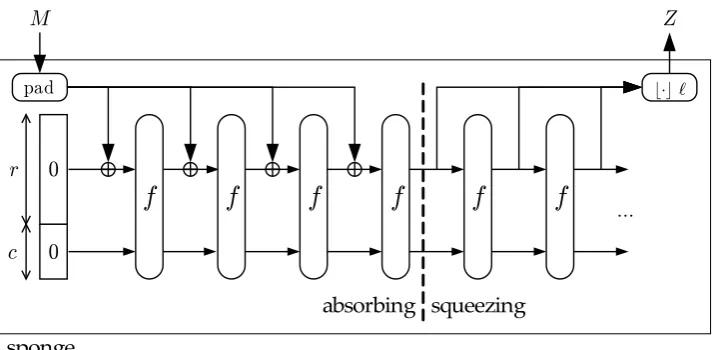
The permutationfoperates on a fixed number of bits, thewidthb. The sponge construction has a state ofbbits. First, all the bits of the state are initialized to zero. The input message is padded with the function pad[r] and cut into r-bits blocks. Then it proceeds in two phases: theabsorbing phasefollowed by thesqueezing phase:
Absorbing phase The r-bit input message blocks are XORed into the first r bits of the state, interleaved with applications of the function f. When all message blocks are processed, the sponge construction switches to the squeezing phase.
Squeezing phase The firstr bits of the state are returned as output blocks, interleaved with applications of the function f. The number of iterations is determined by the requested number of bits.
Finally the output is truncated to the requested length. The sponge construction is illus-trated in Figure 1, and Algorithm 1 provides a formal definition.
Fig. 1.The sponge construction
Algorithm 1The sponge construction [f, pad,r] Require: r<b
Interface:Z=sponge(M,ℓ)withM∈Z∗2, integerℓ >0andZ∈Zℓ
2
P=M||pad[r](|M|)
LetP=P0||P1||. . .||Pwwith|Pi|=r s=0b
fori=0towdo
s=s⊕(Pi||0b−r) s= f(s)
end for
Z=⌊s⌋r
while|Z|< ℓdo
s= f(s)
Z=Z||⌊s⌋r
end while return ⌊Z⌋ℓ
3.2 Security
Cryptographic functions are o en designed in two steps. In the first step, one chooses a construction that uses a cryptographic primitive with fixed input and output size (e.g., a compression function or a permutation) and builds a function that can take inputs and or generate outputs of arbitrary size. If the security of this construction can be proven, for instance as in this case using the indifferentiability framework, it reduces the scope of cryptanalysis to that of the underlying primitive and guarantees the absence of single-stage generic a acks (e.g., preimage, second preimage and collision a acks) [35]. How-ever, generic security in the multi-stage se ing using the indifferentiability framework is currently an open problem [41].
It is shown in [8] that the success probability of any single-stage generic a ack for differentiating the sponge construction calling a random permutation or transformation from a random oracle is upper bounded by 2−(c+1)N2. Here N is the number of calls to the underlying permutation or its inverse. This implies that any single-stage generic a ack on a sponge function has success probability of at most2−(c+1)N2plus the success probability of this a ack on a random oracle.
In [10], we address the security of the sponge construction when the message is pre-fixed with a key, as it will be done in the mode of Section 5. In this specific case, the security proof goes beyond the2c/2 complexity if the number of input or output blocks for which the key is used (data complexity) is upper bounded by M < 2c/2−1. In that case, distinguishing the keyed sponge from a random oracle has time complexity of at least2c−1/M>2c/2. Hence, for keyed modes, one can reduce the capacitycfor the same targeted security level.
3.3 Implementing authenticated encryption
The simplest way to build an actual system that behaves as RO would be to replace the random oraclesROC andROT by a sponge function with domain separation. The indifferentiability proof in [8] guarantees the result is secure if the permutation f of the sponge function has no structural distinguishers.
4 The duplex construction
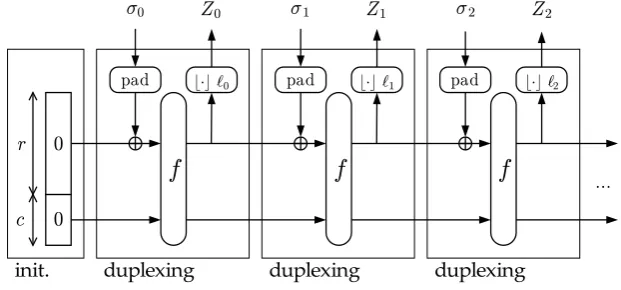
Like the sponge construction, theduplex construction [f, pad,r]uses a fixed-length transformation (or permutation)f, a padding rule “pad” and a parameter bitrater. Unlike a sponge function that is stateless in between calls, the duplex construction accepts calls that take an input string and return an output string depending on all inputs received so far. We call an instance of the duplex construction aduplex object, which we denoteDin our descriptions. We prefix the calls made to a specific duplex objectDby its nameDand a dot.
Fig. 2.The duplex construction
The duplex construction works as follows. A duplex object D has a state of bbits. Upon initialization all the bits of the state are set to zero. From then on one can send to it D.duplexing(σ,ℓ)calls, withσan input string andℓthe requested number of bits.
Algorithm 2The duplex construction [f, pad,r] Require: r<b
Require: ρmax(pad,r)>0 Require: s∈Zb
2(maintained across calls) Interface:D.initialize()
s=0b
Interface:Z=D.duplexing(σ,ℓ)withℓ≤r,σ∈∪ρmax(pad,r)
n=0 Zn2, andZ∈Zℓ2
P=σ||pad[r](|σ|)
s=s⊕(P||0b−r)
s= f(s) return ⌊s⌋ℓ
The maximum number of bitsℓ one can request isr and the input stringσ shall be short enough such that a er padding it results in a singler-bit block. We call the maximum length ofσthemaximum duplex rateand denote it byρmax(pad,r). Formally:
ρmax(pad,r) =min{x:x+|pad[r](x)|>r} −1. (4)
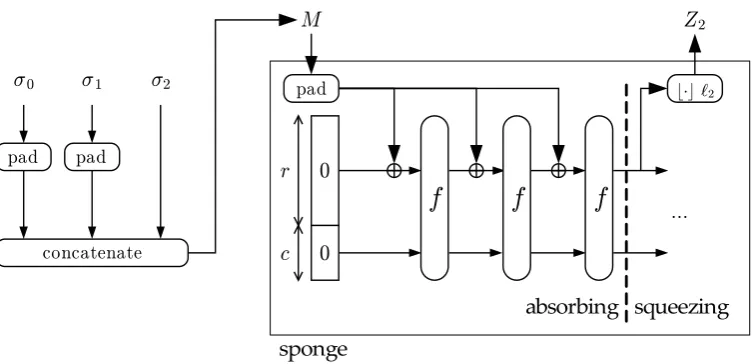
Fig. 3.Generating the output of a duplexing call with a sponge
ℓbits of the state at the output. We call ablank calla call withσ the empty string, and a mute calla call without output,ℓ = 0. The duplex construction is illustrated in Figure 2, and Algorithm 2 provides a formal definition.
The following lemma links the security of the duplex construction [f, pad,r]to that of the sponge construction [f, pad,r]. Generating the output of aD.duplexing()
call using a sponge function is illustrated in Figure 3.
Lemma 3. [Duplexing-sponge lemma]If we denote the input to thei-th call to a duplex object by(σi,ℓi)and the corresponding output byZi we have:
Zi = D.duplexing(σi,ℓi) =sponge(σ0||pad0||σ1||pad1||. . .||σi,ℓi)
withpadia shortcut notation forpad[r](|σi|).
Proof. The proof is by induction on the number of input stringsσi.
First consider the casei = 0. We must prove D.duplexing(σ0,ℓ0) = sponge(σ0,ℓ0). The state of the duplex object before the call has value0b, the same as the initial state of the sponge function. Both in the case of the sponge function and the duplex object the input string is padded withpadresulting in a singler-bit blockP. Then, in both casesPis XORed to the firstrbits of the state and f is applied to the state. At this point the sponge function and the duplex object have the same state and both return the firstℓ ≤r bits of the state as output string. Since the sponge function does not do any additional iterations of f on the state, the state of the duplex object a er the callD.duplexing(σ0,ℓ0)is equal to the state of the sponge construction a er absorbing a single blockσ0||pad0.
Now assume that a er the callD.duplexing(σi−1,ℓi−1)the duplex object has the same state as the sponge function a er absorbingσ0||pad0||σ1||pad1||. . .||σi−1||padi−1. During
the callD.duplexing(σi,ℓi), the blockσi||padiis XORed into the firstrbits of the state and
subsequently f is applied to the state. It follows that the state of the duplex objectDa er the call D.duplexing(σi,ℓi) is equal to the state of the sponge function a er absorbing
σ0||pad0||σ1||pad1||. . .σi||padi. As the output just consists of the firstℓi bits of the state,
this proves Lemma 3. ⊓⊔
The output of a duplexing call is thus the output of a sponge function with an input
σ0||pad0||σ1||pad1||. . .||σiand from this input the exact sequenceσ0,σ1, . . . ,σi can be
the sponge construction with the same parameters. In particular, it inherits its resistance against (single-stage) generic a acks. The reference point in this case is a random oracle whose input is the sequence of inputs to the duplexing calls since the initialization.
Lemma 4. Letpadandrbe fixed. Then, the mapping from a sequence(σ0,σ1, . . . ,σn)of binary
strings with|σi| ≤ρmax(pad,r)∀ito the binary strings= σ0||pad0||σ1||pad1||. . .||padn−1||σn
is injective.
Proof. The length ofσn can be determined as|σn| = |s|modr; this allows recoveringσn
froms. Then, ifn>0,padn−1can be removed and the process continues recursively with
s′ =σ0||pad0||σ1||pad1||. . .||σn−1. ⊓⊔
In the following sections we will show that the duplex construction is a powerful tool for building modes of use.
5 The authenticated encryption mode S W
We propose an authenticated encryption mode S W that realizes the authenti-cated encryption process defined in Section 2. Similarly to the duplex construction, we call an instance of the authenticated encryption mode a S W object.
Upon initialization of a S W object, it loads the keyK. From then on one can send requests to it for wrapping and/or unwrapping data. The key stream blocks used for encryption and the tags depend on the keyKand the data sent in all previous requests. The authenticated encryption of a sequence of header-body pairs, as described in Sec-tion 2.1, can be performed with a sequence of wrap or unwrap requests to a S W object.
5.1 Definition
A S W object W internally uses a duplex object D with parameters f, padand r. Upon initialization of a S W object, it initializesDand forwards the (padded) key blocksKtoDusing muteD.duplexing()calls.
When receiving a W.wrap(A,B,ℓ) request, it forwards the blocks of the (padded) header Aand the (padded) bodyBto D. It generates the cryptogramC block by block Ci = Bi⊕Zi with Zi the response ofDto the previousD.duplexing()call. Theℓ-bit tag
Tis the response ofDto the last body block (possibly extended with the response to ad-ditional blankD.duplexing()calls in caseℓ > ρ). Finally it returns the cryptogramCand the tagT.
When receiving aW.unwrap(A,C,T)request, it forwards the blocks of the (padded) headerAtoD. It decrypts the data bodyBblock by blockBi =Ci⊕ZiwithZithe response
ofDto the previousD.duplexing()call. The response ofDto the last body block (possi-bly extended) is compared with the tagT received as input. If the tag is valid, it returns the data bodyB; otherwise, it returns an error. Note that in implementations one may impose additional constraints, such as S W objects dedicated to either wrapping or unwrapping. Additionally, the S W object should impose a minimum length tfor the tag received before unwrapping and could break the entire session as soon as an incorrect tag is received.
Before being forwarded toD, every key, header, data or cryptogram block is extended with a so-calledframe bit. The rateρof the S W mode determines the size of the blocks and hence the maximum number of bits processed per call to f. Its upper bound isρmax(pad,r)−1due to the inclusion of one frame bit per block. A formal definition of
Algorithm 3The authenticated encryption mode S W [f, pad,r,ρ].
Require: ρ≤ρmax(pad,r)−1 Require: D= [f, pad,r]
1: Interface:W.initialize(K)withK∈Z∗2
2: LetK=K0||K1||. . .||Kuwith|Ki|=ρfori<u,|Ku| ≤ρand|Ku|>0ifu>0
3: D.initialize() 4: fori=0tou−1do 5: D.duplexing(Ki||1, 0)
6: end for
7: D.duplexing(Ku||0, 0)
8: Interface:(C,T) =W.wrap(A,B,ℓ)withA,B∈Z∗2,ℓ≥0,C∈Z|B|2 andT∈Zℓ
2 9: LetA=A0||A1||. . .||Avwith|Ai|=ρfori<v,|Av| ≤ρand|Av|>0ifv>0
10: LetB=B0||B1||. . .||Bwwith|Bi|=ρfori<w,|Bw| ≤ρand|Bw|>0ifw>0
11: fori=0tov−1do 12: D.duplexing(Ai||0, 0)
13: end for
14: Z=D.duplexing(Av||1,|B0|) 15: C=B0⊕Z
16: fori=0tow−1do
17: Z=D.duplexing(Bi||1,|Bi+1|) 18: C=C||(Bi+1⊕Z)
19: end for
20: Z=D.duplexing(Bw||0,ρ)
21: while|Z|< ℓdo
22: Z=Z||D.duplexing(0,ρ) 23: end while
24: T=⌊Z⌋ℓ
25: return (C,T)
26: Interface:B=W.unwrap(A,C,T)withA,C,T∈Z∗2,B∈Z|C|2 ∪ {error}
27: LetA=A0||A1||. . .||Avwith|Ai|=ρfori<v,|Av| ≤ρand|Av|>0ifv>0
28: LetC=C0||C1||. . .||Cwwith|Ci|=ρfori<w,|Cw| ≤ρand|Cw|>0ifw>0
29: LetT=T0||T1||. . .||Txwith|Ti|=ρfori<x,|Cx| ≤ρand|Cx|>0ifx>0
30: fori=0tov−1do 31: D.duplexing(Ai||0, 0)
32: end for
33: Z=D.duplexing(Av||1,|C0|) 34: B0=C0⊕Z
35: fori=0tow−1do
36: Z=D.duplexing(Bi||1,|Ci+1|) 37: Bi+1=Ci+1⊕Z
38: end for
39: Z=D.duplexing(Bw||0,ρ) 40: while|Z|< ℓdo
41: Z=Z||D.duplexing(0,ρ) 42: end while
43: ifT=⌊Z⌋ℓthen
44: return B0||B1||. . .Bw
45: else
5.2 Security
In this section, we show the security of S W against generic a acks. To do so, we proceed in two steps. First, we define a variant of RO for which the key stream depends not only onAbut also on previous blocks ofB. Then, we quantify the increase in the adversary advantage when trading the random oraclesROCandROTwith a random sponge function and appropriate input mappings.
For a fixed block lengthρ, letprei(A,B) = (A(1),B(1),A(2), . . . ,B(n−1),A(n),⌊B(n)⌋iρ),
i.e., the last bodyB(n)is truncated to its firstiblocks ofρbits. We define RO [ρ] iden-tically to RO , except that in the wrapping algorithm, we have
C(n)=⌊ROC(K, pre0(A,B))⌋|
B(0n)|⊕B
(n) 0
||⌊ROC(K, pre1(A,B))⌋|B(1n)|⊕B
(n) 1
. . .
||⌊ROC(K, prew(A,B))⌋|B(n)
w |⊕B
(n)
w
forB(n) = B0(n)||B1(n)||. . .||Bw(n) with |B
(n)
i | = ρ fori < w, |B
(n)
w | ≤ ρ and|B
(n)
w | > 0if
w>0. The unwrap algorithmUis defined accordingly.
The scheme RO [ρ] is as secure as RO , as expressed in the following two lemmas. We omit the proofs, as they are very similar to those of Lemma 1 and 2.
Lemma 5. LetA[ROC,ROT]be an adversary having access toROCandROTand respecting the nonce requirement. Then,AdvprivRO [ρ](A) ≤ q2−k if the adversary makes no more thanq queries toROC orROT.
Lemma 6. LetA[ROC,ROT]be an adversary having access toROCandROT. Then, RO satisfiesAdvauthRO [ρ](A)≤q2−k+2−tif the adversary makes no more thanqqueries toROC orROT.
Clearly, RO and RO [ρ]are equally secure if we implementROC andROT using a single random oracle with domain separation:ROC(x) =RO(x||1)andROT(x) = RO(x||0). Notice that S W uses the same domain separation technique: the last bit of the input of the last duplexing call is always a1(resp.0) to produce key stream bits (resp. to produce the tag). With this change, S W now works like RO [ρ], ex-cept that the input is forma ed differently and that a sponge function replacesRO. The next lemma focuses on the former aspect.
Lemma 7. Let(K,A,B)be a sequence of strings composed by a key followed by header-body pairs. Then, the mapping from(K,A,B)to the corresponding sequence of inputs(σ0,σ1, . . . ,σn)to the
duplexing calls in Algorithm 3 is injective.
Proof. We show that from(σ0,σ1, . . . ,σn)we can always recover(K,A,B). The convention
is that, when cu ing input strings into blocks ofρbits, there is always at least one block (see, e.g., line 2 of Algorithm 3). Consequently, any (possibly empty) input string causes at least one duplexing call (e.g., see lines 7, 14 and 20) or equivalently at least one element
σi.
The keyK can be found by looking for the first blockσi that ends with frame bit 0;
the keyK is concatenation of the blocks σj, j ≤ i, with their last bit removed. Then we
look for the first blockσi′,i′ > i, that ends with a frame bit1; blocks fromσi+1 toσi′ are
ends with a bit0. This operation is repeated to find the next headerA(2)and the next body B(2). And so on.
Note that the blocksσproduced by line 22 of Algorithm 3 do not contribute to neither a header nor a body as they contain only one bit, which is removed in the above procedure. ⊓ ⊔
We now have all the ingredients to prove the following theorem.
Theorem 1. The authenticated encryption mode S W [f, pad,r,ρ]defined in Algorithm 3 satisfies
AdvprivS W [f,pad,r,ρ](A)<q2−k+ N(N+1)
2c+1 and
AdvauthS W [f,pad,r,ρ](A)<q2−k+2−t+ N(N+1)
2c+1 ,
against any single adversaryAifK ←−$ Zk
2, tags ofℓ ≥ tbits are used, f is a randomly chosen permutation,qis the number of queries andNis the number of times f is called.
Proof. The scheme S W [f, pad,r,ρ] uses a [f, pad,r] object. Combining Lemmas 3, 4 and 7, we see that S W [f, pad,r,ρ]works like RO [ρ]with a random oracle replaced by the sponge function [f, pad,r]and an injective input function from(Z∗2)+toZ∗
2. Compared to the expressions in Lemmas 5 and 6, the extra term in the advantages above accounts for the adversary being able to differentiate a ran-dom sponge from a ranran-dom oracle. This follows from [35], formalized in [1, Theorem 2], and from the value of the RO-differentiating advantage of a random sponge [8]. ⊓⊔
Note that all the outputs of S W are equivalent to calls to a sponge func-tion with the secret key blocks as a prefix. So the results of [10] can also be applied to S W as explained in Section 3.2.
5.3 Advantages and limitations
The authenticated encryption mode S W has the following unique combination of advantages:
– While most other authenticated encryption modes are described in terms of a block cipher, S W only requires on a fixed-length permutation.
– It supports the alternation of strings that require authenticated encryption and strings that only require authentication.
– It can provide intermediate tags a er eachW.wrap(A,B,ℓ)request.
– It has a strong security bound against generic a acks with a very simple proof.
– It is single-pass and requires only a single call to the permutation f perρ-bit block.
– It is flexible as the bitrate can be freely chosen as long as the capacity is larger than some lower bound.
– The encryption is not expanding.
As compared to some block cipher based authenticated encryption modes, it has some limitations. First, the mode as such is serial and cannot be parallelized at algorithmic level. Some block cipher based modes do actually allow parallelization, for instance, the offset codebook (OCB) mode [44]. Yet, S W variants could be defined to support par-allel streams in a fashion similar to tree hashing, but with some overhead.
of B andB′, say Bi and B′i, will be enciphered with the same key stream, making their
bitwise XOR available to the a acker. Some block cipher based modes aremisuse resistant, i.e., they are designed in such a way that in case the nonce requirement is not fulfilled, the only information an a acker can find out is whetherBandB′ are equal or not [46]. Yet, many applications already provide a nonce, such as a packet number or a key ID, and can put it inA.
5.4 An application: key wrapping
Key wrapping is the process of ensuring the secrecy and integrity of cryptographic keys in transport or storage, e.g., [37,18]. Apayload keyis wrapped with a key-encrypting key (KEK). We can use the S W mode withKequal to the KEK and let the data body be the payload key value. In a sound key management system every key has a unique identifier. It is sufficient to include the identifier of the payload key in the headerAand two different payload keys will never be enciphered with the same key stream. When wrapping a private key, the corresponding public key or a digest computed from it can serve as identifier.
6 Other applications of the duplex construction
Authenticated encryption is just one application of the duplex construction. In this section we illustrate it by providing two more examples: a pseudo-random bit sequence generator and a sponge-like construction that overwrites part of the state with the input block rather than to XOR it in.
6.1 A reseedable pseudo-random bit sequence generator
In various cryptographic applications and protocols, random bits are used to generate keys or unpredictable challenges. While randomness can be extracted from a physical source, it is o en necessary to provide many more bits than the entropy of the physical source. A pseudo-random bit sequence generator (PRG) is initialized with a seed, gener-ated in a secret or truly random way, and it then expands the seed into a sequence of bits. For cryptographic purposes, it is required that the generated bits cannot be predicted, even if subsets of the sequence are revealed. In this context, a PRG is similar to a stream cipher. A PRG is also similar to a cryptographic hash function when gathering entropy coming from different sources. Finally, some applications require a pseudo-random bit sequence generator to support forward security: The compromise of the current state does not enable the a acker to determine the previously generated pseudo-random bits [6,17]. Conveniently, a pseudo-random bit sequence generator can be reseedable, i.e., one can bring an additional source of entropy a er pseudo-random bits have been generated. Instead of throwing away the current state of the PRG, reseeding combines the current state of the generator with the new seed material. In [9] a reseedable PRG was defined based on the sponge construction that implements the required functionality. The ideas behind that PRG are very similar to the duplex construction. We however show that such a PRG can be defined on top of the duplex construction.
As a next step, we propose a reseedable pseudo-random bit sequence generator mode called S PRG. This mode is similar to the one proposed in [9] in that it minimizes the number of calls to f, although explicitly based on the duplex construction. Internally it makes use of a duplex objectDand it has two buffers: an input bufferBinand an output bufferBout. During feed requests it accumulates seed material inBinand, if it has received at leastρbits, it forwards them toDin a D.duplexing()call. Any surplus seed string is kept in the input buffer. Upon a fetch request, if the input buffer is not empty, it emp-ties it by forwarding any remaining seed toDand returns the requested number of bits, performing more duplexing calls if necessary, each requestingρbits. The surplus of pro-duced bits are kept inBout, which will be returned first upon the next fetch request. Note that at any moment, one ofBin andBoutis empty.
As such, the operation of a S PRG object is based on a permutation and revealing the state allows the a acker to backtrack the generation back to the most recent unknown seed fed into it. Nevertheless, reseeding regularly with sufficient entropy already pre-vents the a acker from going backwards. Also, an embedded security device such as a smartcard in which such a PRG would be used is designed to protect the secrecy of keys and therefore reading out the state is expected to be difficult.
Still, forward security can be explicitly enforced by means of aP.forget()request. The effect of this request is the rese ing to zero of the firstρbits of the state, an application of the padding and a subsequent application of f. Under the condition thatρ≥c, guessing the state before this operation given the state a erwards requires guessing at leastcbits and hence is infeasible for reasonable values ofc. On a PC, which might be more vulner-able to a memory recovery a ack, this condition thatρ ≥ ccan easily be satisfied by a suitable sponge function; e.g., this is the case for K []with its default parameters.
The S PRG mode is defined in Algorithm 4. Note that the buffers do not require separate storage but can be implemented merely as pointers to the state: The input buffer requires a pointer to the state indicating from where on new bits must be XORed into the state, while the output buffer pointer points in the state where the next output bit must be taken. The storage is thus limited to theb-bit state and two integers.
It is clear that every bit returned byP.fetch()is part of the output of the sponge pre-sented with a string that contains all seed material prepre-sented so far. The S PRG mode does not allow reconstructing the individual blocksσibut does allow reconstructing their
concatenation.
6.2 The mode O
In [22] sponge-like constructions were proposed and cryptanalyzed. In some of these con-structions, absorbing is done by overwriting part of the state by the message block rather than XORing it in, e.g., as in the hash function Grindahl [29]. These overwrite functions have the advantage over sponge functions that between calls to f, only cbits must be kept instead ofb. This may not be useful when hashing in a continuous fashion, asbbits must be processed by f anyway. However, when hashing a partial message, then pu ing it aside to continue later on, storing onlycbits may be useful on some platforms.
The mode O differs from the sponge construction in that it overwrites part of the state with an input block instead of XORing it in. Such a mode can be analyzed by building it on top of the duplex construction. If the firstρbits of the state are known to be Z, overwriting them with a message block Pi is equivalent to XORing in Z⊕Pi.
Algorithm 4Pseudo-random bit sequence generator mode S PRG[f, pad,r,ρ] Require: ρ≤ρmax(pad,r)
Require: D= [f, pad,r]
Interface:P.initialize()
D.initialize()
Bin=empty string
Bout =empty string
Interface:P.feed(σ)withσ∈Z∗2
M=Bin||σ
LetM=M0||M1||. . .||Mwwith|Mi|=ρfori<wand0≤ |Mw|<ρ
fori=0tow−1do
D.duplexing(Mi, 0)
end for
Bin=Mw
Bout =empty string
Interface:Z=P.fetch(ℓ)with integerℓ≥0andZ∈Zℓ2
while|Bout|< ℓdo
Bout =Bout||D.duplexing(Bin,ρ)
Bin=empty string end while
Z=⌊Bout⌋ℓ
Bout =last(|Bout| −ℓ)bits ofBout return Z
Interface:Z=P.forget()requiringρ≥c Z=D.duplexing(Bin,ρ)
Bin=empty string
D.duplexing(Z,ρ)
Bout =empty string
We define the mode O on top of the duplex construction. An O
func-tion internally uses a duplex objectD. It pads the messageMand splits it inρ-bit blocks. Then it makes a sequence ofD.duplexing()calls, each time with a message block XORed with the response of the previousD.duplexing()call and with a frame bit appended to it. This frame bit is equal to 1 for the last block and 0 for all other blocks. If the requested number of output bitsℓis larger thanρ, additional D.duplexing()calls are done where each time the response of the previousD.duplexing()call is fed back toD.
Theorem 2. The construction O [f, pad,r,ρ]is as secure as [f, pad,r].
Proof. The construction O [f, pad,r,ρ]is defined in terms of calls to [f, pad,r]. From the sponge-duplexing lemma, the output of such a call is the output to [f, pad,r]
for a specific input. Hence, the theorem comes down to showing that the input M to O can be recovered from the inputs to the duplexing calls.
The coding using the frame bits in Algorithm 5 allows, for any input sequence ofD, finding the last block (Pw⊕Z) and the length of the original input M. To recover the
message Mfrom the input sequence, one can start with the first block. Since Z = 0ρ in the first block, the first block in theD.duplexing()call allows recovering the first block of M. Then, this block allows determining the outputZthat was XORed into the next block,
and so on. ⊓⊔
Algorithm 5The construction O [f, pad,r,ρ] Require: ρ≤ρmax(pad,r)−1
Require: D= [f, pad,r]
Interface:Z=O (M,ℓ)withM∈Z∗2, integerℓ >0andZ∈Zℓ
2
P=M||pad[ρ](|M|)
LetP=P0||P1||. . .||Pwwith|Pi|=ρfori≤w D.initialize()
Z=0ρ
fori=0tow−1do
Z=D.duplexing((Pi⊕Z)||0,ρ)
end for
Z=D.duplexing((Pw⊕Z)||1,ρ)
Bout =Z
while|Bout|< ℓdo
Z=D.duplexing(Z||1,ρ)
Bout =Bout||Z end while return ⌊Bout⌋ℓ
7 A flexible and compact padding rule
Sponge functions and duplex objects feature the nice property of allowing a range of security-performance trade-offs, via capacity-rate pairs, using the same fixed permuta-tion f. To be able to fully exploit this property in the scope of the duplex construction, and for performance reasons, the padding rule should be compact and should be suit-able for a family of sponge functions with different rates. In this section, we introduce the multi-rate padding and prove that it is suitable for such a family.
For a given capacity and width, the padding reduces the maximum bitrate of the du-plex construction, as in Eq. (4). To minimize this effect, especially when the width of the permutation is relatively small, one should look for the most compact padding rule. The sponge-compliant padding scheme (see Section 3) with the smallest overhead is the well-knownsimple reversible padding, which appends a single 1 and the smallest number of zeroes such that the length of the result is a multiple of the required block length. We denote it bypad10∗[r](M). It satisfiesρmax(pad10∗,r) =r−1and hence has only one bit of overhead.
When considering the security of a set of sponge functions that make use of the same permutation f but with different bitrates, simple reversible padding is not sufficient. The indifferentiability proof of [8] actually only covers the indifferentiability of a sin-gle sponge function instance from a random oracle. As a solution, we propose the multi-rate padding, denotedpad10∗1[r](|M|), which returns a bitstring10q1withq = (−|M| − 2)modr. This padding is sponge-compliant and hasρmax(pad10∗1,r) =r−2. Hence, this padding scheme is compact as the duplex-level maximum rate differs from the sponge-level rate by only two bits. Furthermore, in Theorem 3 we will show it is sufficient for the indifferentiability of a set of sponge functions. The intuitive idea behind this is that, with thepad10∗1padding scheme, the last block absorbed has a bit with value 1 at position r−1, while any other function of the family withr′ <rthis bit has value 0.
bitrater; hence, the sponge-level bitrate may no longer be a multiple of 8 or of a higher power of two. Therefore it is meaningful to consider the security of a set of sponge func-tions with common f and different bitrates, including bitrates that are not multiples of 8 or of a higher power of two. For instance, the mode S W could be based on K [r=1027,c=573]so as to process application-level blocks ofρmax(pad10∗1, 1027)− 1=1024bits [11].
Regarding the indifferentiability of a set of sponge functions, it is clear that the best one can achieve is bounded by the strength of the sponge construction with the lowest capacity (or, equivalently, the highest bitrate), as an adversary can always just try to dif-ferentiate the weakest construction from a random oracle. The next theorem states that we achieve this bound by using the multi-rate padding.
Theorem 3. Given a random permutation (or transformation) f, differentiating the array of sponge functions [f, pad10∗1,r]with0<r≤rmaxfrom an array of independent random oracles
(ROr)has the same advantage as differentiating [f, pad10∗,rmax]from a random oracle.
Proof. We can implement the array of sponge functions [f, pad10∗1,r]using a sin-gle sponge function spongemax= [f, pad10∗,rmax], a bitrate-dependent input pre-processing function I[r,rmax] and a bitrate-dependent output post-processing function O[r,rmax]. So we have:
[f, pad10∗1,r] =O[r,rmax]◦ [f, pad10∗,rmax]◦I[r,rmax]. (5)
The input pre-processing functionM′ = I[r,rmax](M)consists of the following steps:
1. ConstructQby paddingMwith multi-rate padding:Q= M||pad10∗1[r](|M|). 2. ConstructQ′ by spli ingQinr-bit blocks, extending each block with0rmax−rand
con-catenating the blocks again.
3. ConstructM′ by unpaddingQ′ according to the padding rulepad10∗.
Note that the third step removes the trailingrmax−rbits with value 0 and the bit with value 1 just before that. It follows that the length ofM′ modulormaxisr−1, hence this pre-processing implements domain separation between the differentrvalues for a given value ofrmax. Moreover, it is straightforward to extractM from I[r,rmax](M)and hence the pre-processing function is injective:
∀(M1,r1)̸= (M2,r2)⇒ I[r1,rmax](M1)̸= I[r2,rmax](M2).
The output post-processing functionZ=O[r,rmax](Z′)consists of spli ingZ′in rmax-bit blocksZi′, truncating each block to its first r bits Zi = ⌊Z′i⌋r and concatenating the
blocks again:Z= Z0||Z1||. . .
It is easy to verify that with these pre- and post-processing functions Eq. (5) holds. Any a ack that can differentiate the set of sponge functions [f, pad10∗1,r]from a set of random oracles with an advantageϵcan be converted into an a ack on spongemax with the same advantage. Namely, the responseZ(i)to a query M(i)to [f, pad
1,r] can be obtained from spongemaxby querying it withI[r,rmax](M(i))and applyingO[r,rmax] to its responseZ(i).
Hence, differentiating the array [f, pad10∗1,r] from the array (ROr) comes down to differentiatingspongemaxfromRO, wherespongemaxhas capacity cmin = b−
8 Duplexing iterated functions in general
The duplex construction can be seen as a way to use a sponge function in a cascaded way. The central idea is that a duplex object keeps a state equal to that of a sponge function that has absorbed the combination of all inputs to the duplex object so far. Clearly, the same principle can be applied to most other sequential hash function constructions that consist of the iterated application of a compression function or permutation f.
In general, a duplex-like object corresponding to such a hash function would work as follows. Its state is the chaining value resulting from hashing all previous inputs and possibly a counter (e.g., if the hash function requires the message length for the padding or as input in the compression function). Upon presentation of an inputσ, it performs two tasks. First, it generates an output: It padsσwith the padding rule of the hash function, applies the final compression function f or an output transformation g, and returns the result. Second, it updates its state by paddingσwith reversible padding, applying f and updating the counter.
The disadvantage of this method is that, in general, a single duplexing call to the object requires two calls to f, or in case of an output transformationg, one call to f and one to g. In contrast, for a sponge function, the generation of the output and the update of the state can be done in a single call to f.
Three main obstacles may hinder the efficiency of duplexing.
– First, as already mentioned, the special processing done a er the last block prevents to update the state and produce output at the same time. For instance, some construc-tions have an output transformation, which must be applied before producing output, while the main compression function is applied to update the state. The same prob-lem occurs in the HAIFA framework [12], which enforces domain separation between the final call to f and the previous ones. In some constructions, blank iterations are applied at the end, which must be performed every time output is requested.
– Second, the overhead due to the padding reduces the number of bits that can be input in a duplexing call. If the input block size is fixed to a power of two (or a small mul-tiple of it), the place taken by the padding can break the alignment of input blocks. Flexibility on the input block size is thus an advantage in this respect, as it can restore their alignment.
– Third, the output length of the hash function may be smaller than the input block size. This can be another slowdown factor, as in the case of the S W mode, since as many output bits are needed as input bits. The last compression function, output transformation or blank iterations have then to be performed several times to produce output bits like in a mask generating function. Another possible solution is just to use shorter input blocks.
The chop-MD construction [16,15] is a good candidate for duplexing. Producing out-put and updating the state can be made in the same operation. However, for the duplexing to be as fast as hashing, the output length should be as large as the message block and the padding should be as compact as possible.
9 Conclusions
the flexibility of the sponge construction in terms of security-speed trade-offs. Finally, we have argued that duplexing with other hash function constructions is in most cases not as efficient as with the sponge construction.
References
1. E. Andreeva, B. Mennink, and B. Preneel,Security reductions of the second round SHA-3 candidates, Cryp-tology ePrint Archive, Report 2010/381, 2010,http://eprint.iacr.org/.
2. J.-P. Aumasson, L. Henzen, W. Meier, and M. Naya-Plasencia,Quark: A lightweight hash, in Mangard and Standaert [33], pp. 1–15.
3. M. Bellare and C. Namprempre, Authenticated encryption: Relations among notions and analysis of the generic composition paradigm, Asiacrypt (T. Okamoto, ed.), Lecture Notes in Computer Science, vol. 1976, Springer, 2000, pp. 531–545.
4. M. Bellare and P. Rogaway,Random oracles are practical: A paradigm for designing efficient protocols, ACM Conference on Computer and Communications Security 1993 (ACM, ed.), 1993, pp. 62–73.
5. M. Bellare, P. Rogaway, and D. Wagner,The EAX mode of operation, in Roy and Meier [47], pp. 389–407. 6. M. Bellare and B. Yee,Forward-security in private-key cryptography, Cryptology ePrint Archive, Report
2001/035, 2001,http://eprint.iacr.org/.
7. G. Bertoni, J. Daemen, M. Peeters, and G. Van Assche,Sponge functions, Ecrypt Hash Workshop 2007, May 2007, also available as public comment to NIST fromhttp://www.csrc.nist.gov/pki/HashWorkshop/ Public_Comments/2007_May.html.
8. ,On the indifferentiability of the sponge construction, Advances in Cryptology – Eurocrypt 2008 (N. P. Smart, ed.), Lecture Notes in Computer Science, vol. 4965, Springer, 2008,http://sponge.noekeon.org/, pp. 181–197.
9. ,Sponge-based pseudo-random number generators, in Mangard and Standaert [33], pp. 33–47. 10. ,On the security of the keyed sponge construction, Symmetric Key Encryption Workshop (SKEW),
February 2011.
11. ,TheK reference, January 2011,http://keccak.noekeon.org/.
12. E. Biham and O. Dunkelman,A framework for iterative hash functions—HAIFA, Second Cryptographic Hash Workshop, Santa Barbara, August 2006.
13. A. Biryukov (ed.),Fast so ware encryption, 14th international workshop, FSE 2007, Luxembourg, Luxembourg, march 26-28, 2007, revised selected papers, Lecture Notes in Computer Science, vol. 4593, Springer, 2007. 14. A. Bogdanov, M. Knezevic, G. Leander, D. Toz, K. Varici, and I. Verbauwhede,SPONGENT: A lightweight
hash function, CHES (U. Parampalli and P. Hawkes, eds.), Lecture Notes in Computer Science, Springer, 2011, to appear.
15. D. Chang and M. Nandi,Improved indifferentiability security analysis of chopMD hash function, Fast So ware Encryption (K. Nyberg, ed.), Lecture Notes in Computer Science, vol. 5086, Springer, 2008, pp. 429–443. 16. J. Coron, Y. Dodis, C. Malinaud, and P. Puniya,Merkle-Damgård revisited: How to construct a hash func-tion, Advances in Cryptology – Crypto 2005 (V. Shoup, ed.), LNCS, no. 3621, Springer-Verlag, 2005, pp. 430–448.
17. A. Desai, A. Hevia, and Y. L. Yin,A practice-oriented treatment of pseudorandom number generators, Advances in Cryptology – Eurocrypt 2002 (L. R. Knudsen, ed.), Lecture Notes in Computer Science, vol. 2332, Springer, 2002, pp. 368–383.
18. M. Dworkin,Request for review of key wrap algorithms, Cryptology ePrint Archive, Report 2004/340, 2004, http://eprint.iacr.org/.
19. ECRYPT Network of excellence,The SHA-3 Zoo, 2011,http://ehash.iaik.tugraz.at/index.php/The_ SHA-3_Zoo.
20. N. Ferguson, D. Whiting, B. Schneier, J. Kelsey, S. Lucks, and T. Kohno,Helix: Fast encryption and authen-tication in a single cryptographic primitive, Fast So ware Encryption (T. Johansson, ed.), Lecture Notes in Computer Science, vol. 2887, Springer, 2003, pp. 330–346.
21. V. D. Gligor and P. Donescu,Fast encryption and authentication: XCBC encryption and XECB authentication modes, Fast So ware Encryption 2001 (M. Matsui, ed.), Lecture Notes in Computer Science, vol. 2355, Springer, 2001, pp. 92–108.
22. M. Gorski, S. Lucks, and T. Peyrin,Slide a acks on a class of hash functions, Asiacrypt ( J. Pieprzyk, ed.), Lecture Notes in Computer Science, vol. 5350, Springer, 2008, pp. 143–160.
23. J. Guo, T. Peyrin, and A. Poschman,The PHOTON family of lightweight hash functions, Advances in Cryptol-ogy – Crypto 2011 (P. Rogaway and R. Safavi-Naini, eds.), Lecture Notes in Computer Science, Springer, 2011, to appear.
24. T. Iwata,New blockcipher modes of operation with beyond the birthday bound security, Fast So ware Encryption 2006 (M. J. B. Robshaw, ed.), Lecture Notes in Computer Science, vol. 4047, Springer, 2006, pp. 310–327. 25. ,Authenticated encryption mode for beyond the birthday bound security, Africacrypt (S. Vaudenay, ed.),
26. T. Iwata and K. Yasuda,BTM: A single-key, inverse-cipher-free mode for deterministic authenticated encryption, Selected Areas in Cryptography (M. J. Jacobson Jr., V. Rijmen, and R. Safavi-Naini, eds.), Lecture Notes in Computer Science, vol. 5867, Springer, 2009, pp. 313–330.
27. ,HBS: A single-key mode of operation for deterministic authenticated encryption, Fast So ware Encryp-tion 2009 (O. Dunkelman, ed.), Lecture Notes in Computer Science, vol. 5665, Springer, 2009, pp. 394–415. 28. C. S. Jutla,Encryption modes with almost free message integrity, Advances in Cryptology – Eurocrypt 2001
(B. Pfitzmann, ed.), Lecture Notes in Computer Science, vol. 2045, Springer, 2001, pp. 529–544. 29. L. Knudsen, C. Rechberger, and S. Thomsen,The Grindahl hash functions, in Biryukov [13], pp. 39–57. 30. T. Kohno, J. Viega, and D. Whiting,CWC: A high-performance conventional authenticated encryption mode, in
Roy and Meier [47], pp. 408–426.
31. T. Krovetz and P. Rogaway,The so ware performance of authenticated-encryption modes, Fast So ware En-cryption 2011, 2011.
32. S. Lucks, Two-pass authenticated encryption faster than generic composition, Fast So ware Encryption (H. Gilbert and H. Handschuh, eds.), Lecture Notes in Computer Science, vol. 3557, Springer, 2005, pp. 284–298.
33. S. Mangard and F.-X. Standaert (eds.),Cryptographic hardware and embedded systems, CHES 2010, 12th in-ternational workshop, Santa Barbara, CA, USA, August 17-20, 2010, Lecture Notes in Computer Science, vol. 6225, Springer, 2010.
34. U. Maurer,Indistinguishability of random systems, Advances in Cryptology – Eurocrypt 2002 (L. Knudsen, ed.), Lecture Notes in Computer Science, vol. 2332, Springer-Verlag, May 2002, pp. 110–132.
35. U. Maurer, R. Renner, and C. Holenstein,Indifferentiability, impossibility results on reductions, and applica-tions to the random oracle methodology, Theory of Cryptography - TCC 2004 (M. Naor, ed.), Lecture Notes in Computer Science, no. 2951, Springer-Verlag, 2004, pp. 21–39.
36. F. Muller,Differential a acks against the Helix stream cipher, in Roy and Meier [47], pp. 94–108. 37. NIST,AES key wrap specification, November 2001.
38. ,NIST special publication 800-38C, recommendation for block cipher modes of operation: The CCM mode for authentication and confidentiality, July 2007.
39. ,NIST special publication 800-38D, recommendation for block cipher modes of operation: Galois/counter mode (GCM) and GMAC, November 2007.
40. S. Paul and B. Preneel, Solving systems of differential equations of addition, ACISP (C. Boyd and J. M. González Nieto, eds.), Lecture Notes in Computer Science, vol. 3574, Springer, 2005, pp. 75–88. 41. T. Ristenpart, H. Shacham, and T. Shrimpton,Careful with composition: Limitations of the indifferentiability
framework, Eurocrypt 2011 (K. G. Paterson, ed.), Lecture Notes in Computer Science, vol. 6632, Springer, 2011, pp. 487–506.
42. P. Rogaway,Authenticated-encryption with associated-data, ACM Conference on Computer and Communi-cations Security 2002 (CCS’02), ACM Press, 2002, pp. 98–107.
43. ,Efficient instantiations of tweakable blockciphers and refinements to modes OCB and PMAC, Asiacrypt (Pil Joong Lee, ed.), Lecture Notes in Computer Science, vol. 3329, Springer, 2004, pp. 16–31.
44. P. Rogaway, M. Bellare, and J. Black,OCB: A block-cipher mode of operation for efficient authenticated encryp-tion, ACM Trans. Inf. Syst. Secur.6(2003), no. 3, 365–403.
45. P. Rogaway, M. Bellare, J. Black, and T. Krovetz,OCB: A block-cipher mode of operation for efficient authen-ticated encryption, CCS ’01: Proceedings of the 8th ACM conference on Computer and Communications Security (New York, NY, USA), ACM, 2001, pp. 196–205.
46. P. Rogaway and T. Shrimpton,A provable-security treatment of the key-wrap problem, Eurocrypt (S. Vaude-nay, ed.), Lecture Notes in Computer Science, vol. 4004, Springer, 2006, pp. 373–390.
47. B. K. Roy and W. Meier (eds.),Fast so ware encryption, 11th international workshop, FSE 2004, Delhi, India, February 5-7, 2004, revised papers, Lecture Notes in Computer Science, vol. 3017, Springer, 2004.
48. D. Whiting, B. Schneier, S. Lucks, and F. Muller,Fast encryption and authentication in a single cryptographic primitive, ECRYPT Stream Cipher Project Report 2005/027, 2005,http://www.ecrypt.eu.org/stream/ phelixp2.html.
49. H. Wu and B. Preneel,Differential-linear a acks against the stream cipher Phelix, in Biryukov [13], pp. 87–100. 50. M. Ågren, M. Hell, T. Johansson, and W. Meier,A new version of Grain-128 with authentication, Symmetric