Available Online atwww.ijcsmc.com
International Journal of Computer Science and Mobile Computing
A Monthly Journal of Computer Science and Information Technology
ISSN 2320–088X
IMPACT FACTOR: 6.017
IJCSMC, Vol. 7, Issue. 11, November 2018, pg.112 – 120
A Survey on the Tracking of
Object in Sequence Image
Ali Fadhil Yaseen
Control and System Engineering Department, University of Technology, Baghdad, Iraq Email: [email protected]
Abstract— The field of tracking has seen a significant development in computer vision. Recognizing for object is essential part of a computer vision. The first step is detection toward tracking for moving object in video. The represent for object is the next step important in the tracking. The tracking for an object must be using monitoring this object temporal and spatial transforming in a sequence the video, with presence, shape, size, location and location etc. This paper provides a brief overview of the various detection, classification and tracking algorithms presented in the literature, containing comparative and analysis study of different techniques used for different stages.
Keywords— Object Tracking, Object Detection, Background subtraction, Object Classification, video processing.
I. INTRODUCTION
Video is a set of sequential images, each of it is which called a frame, and is displayed at a fast frequency so that the human eye can perceive its asynchronous content [1]. It is difficult to define an absolute standard as to what must be defined as the foreground and what should be developed as the background of that definition to some extent a specific application [2]. Typically, objects must be detect against noisy, clutter background and other object under different contrast and illumination environments. Video auditing is a more difficult task in today's environment. Mainly classifies video analysis into three basic stages, move entity detect, finding object path from one frame to another frame and checking entity paths to determine their performance [3]. The tracking object is process of determining the object to link the target in a successful video frame over time and it finds widespread applications in surveillance, security, augmented reality, video communication, traffic control and medical imaging etc . Obviously all the image processing technique that can applied to individual frames. Moreover, the contents of two consecutive frames are usually relevant [1]. The presence of high-speed network infrastructure, the development of computing power, and the high availability of high-capacity storage devices this leads to an inexpensive way of video surveillance multi-sensor system. The basic steps for object tracking
it’s the following detection, classification, and tracking see figure (1). The first step it is object detection, object
the problem of estimated the trajectory of an object in the image plane as it move around a scene. kernel tracking ,Point tracking, and silhouette tracking are the approaches to track the object.
Fig. 1 The main stages involved in tracking [10].
II. LITERATURE SURVEY
The previous studies related is discussed as follows:
Nagendran et al. (2014) Suggest a method the effective track moving objects in the video. Using the affine transformation to stabilize the video. Then extract these feature using the frame chosen [11]. Chakravarthy et al. (2015). Suggested technique is estimated to flow of video sequences. Furthermore, they demonstrate different types of cases based on arable and relational [12] . Zhang et al. (2016). Proposed an approach by combining the frame difference and the non-parameterized method of video trace analysis. The simulation results demonstrated that the approach performance was better than the traditional difference in the frame and GMM. Moreover, it can able to remove the noise from background which gives us the ability to detect the most precise moving object [13]. Najva and Bijoy (2016) proposed a model for detecting objects and classify in the video by combining Tensor features with a SIFT approach towards a classification of objects detected using Deep Neural Network (DNN) [14] .
III.STUDIES RELATED TO THE DETECTION OF OBJECT
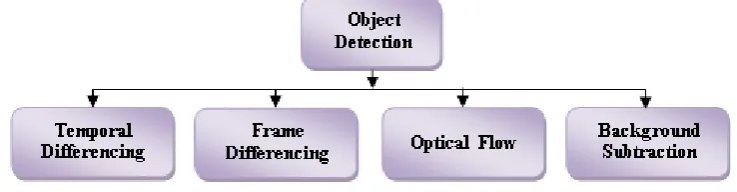
Object detection is meant to identify the moving object in a set of frames that are specific in the video sequence. Object detection in the video field of applications is very important and specifically in video
surveillance applications[15]. A detailed explanation of the different methods is provided in the following. see
figure (2).
Fig. 2 Detection techniques.
1- Temporal Differencing
The frame difference scheme is also known as the double difference, in which each current frame pixel is subtracted from its prior frame pixel and immediate next frame pixel. If the renovation is more than a defined threshold value then that pixel is reproduced as the foreground pixel, else, the pixel is replicated as the background pixel.
Cn (a,b) = Dn(a,b) – Dn+1(a,b) ……….(1) Cn+1(a,b) = Dn+1(a,b) – Dn+2(a,b) ……….(2) TD(a,b) = Cn(a,b) – Cn+1(a,b) ……….(3)
In equation (1), Cn(a, b) is the resulting foreground pixel. Dn denotes the current frame of the video sequence. Dn+1 indicates the next frame. Similarly, in equation (2), Dn+1 is the current frame, and Dn+2 is the next frame. Finally, in equation (3), TD(a,b) specifies the resulting Temporal difference frame pixel value. The pixel representation in binary form is given by R, as shown in equation (4).
……….(4)
2- Frame Differencing
The frame difference scheme is also known as the temporal difference, in which each present frame pixel is to be subtracted from its prior frame pixel. In case the transformation is superior to the manually set threshold value for that pixel, it is reflected as a foreground pixel, else the pixel is reflected as a background pixel. Equation (5) presents the way for finding frame difference.
……….(5)
Where; (In) is the prior frame pixel value and (In+1) is the pixel value of the current frame. (Th) will be the threshold value which is manually defined by the user. Calculation of this process is modest and easy [17].
3- Optical Flow
Optical flow is a standard form of object detection in which the optical flow arena of the image is calculated and grouping of those arenas is done rendering to appearances of the image. The motion among dual video frames occupied at time (t) and (t+ δt) at every single location is estimated in the optical flow process. This technique gives the broad information regarding the movement of the object, and it also detects the object accurately compared to that of background technique. This method is not widely used because of its huge calculation and it is very sensitive to noise. It is not good for the real-time occlusion condition [1].
4- The process of background subtraction
“Background subtraction” is a technique normally used to segment motion in scenes of static nature [18]. The way it adopts to detect regions with motion is by doing pixel-by-pixel subtraction for the present image from a background referenced image. The background is to be created through an overtime averaging arrangement for the images in the initial time period. In case of a subtraction difference larger than a pre specified value of threshold, then they are considered as foreground. Next to the creation of the pixel map of the foreground, a need comes to some pre-processing morphological processes. Among such processes or operations are the erosion operation, the dilation operation, and the closing operation. The operations are done to decrease the noise effects and for enhancing the regions being detected. Over time, new images are used to get the background, which is taken as a reference and adapted to keep tracking the dynamic changes in the scene.
For this basic and simple scheme named “background subtraction”, many approaches do exist. The approaches differ depending on the way the background is maintained and the kind of post done processing, and considering the detection of the foreground region. A simple version of this scheme is also used [18]. In this version, a pixel at location (a,b) in the current image is marked as foreground if the condition given in equation (6) is satisfied.
| IT (a,b) − BT (a,b) | > Th ……….(6)
Where; (Th) is a predefined threshold, (BT) is the background image and (IT) is the current image. The foreground pixel map creation is followed by morphological closing and the elimination of small sized regions.
Although background subtraction techniques perform well at extracting most of the relevant pixels of moving regions even if they stop, they are usually sensitive to dynamic changes when, for instance, stationary objects uncover the background (e.g. a parked car moves out of the parking lot) or when sudden illumination changes occur.
TABLE I
Comparative Study of Object Detection technique
Object Detection
Method Basic Principle Accuracy
Computation
al Time Comments
Temporal Differencing
Pixel-wise Subtraction of Current & Background frame
High Low
Needs background frame with still objects [19]
Easy to implement [20] [19] Sensitive to dynamic changes
[21]
Frame Differencing
Current frame is subtracted from background frame
Moderate to High
Low to Moderate
Cannot be used for real-time applications [21]
Simplest background Subtraction
[21][17]
Ba
c
k
g
r
ound Sub
tra
c
ti
o
n Approxima te Median
Simple subtraction between median frame &
test frame
Moderate Low to moderate
Requires a buffer with recent pixel values [17]
Running Gaussian Average
Based on Gaussian probability density function of pixels
Moderate
Moderate to high
Statistical calculations consumes more time
Much suitable for real-time applications [17] Mixture of
Gaussian
Based on multimodal distribution
Moderate to high
Moderate to high
Cannot cope up with objects as well as noise [22]
Low memory requirement [23]
Optical Flow
Uses optical flow distribution characteristics of pixels
of object
High
Moderate to high
This approach offers entire moving data [24] however require more calculations
IV.STUDIES RELATED TO THE CLASSIFICATION OF OBJECT
After the first phase of tracking, i.e. object detection, is completed, the following step represents objects identification followed by classifying them in the light of the intended aims or targets. Depending on the parameter selected for classification, the classification methods are indicated in figure (3) and are defined as follows.
Fig. 3 Classification methods.
1- Classification using shape
Classification using shape, as it sounds clearly, is done depending on analysis of the shape. The analysis of the shape is to be done through automatically analysing the geometrical shape with the help of a computer to discover objects of similar shapes by matching with the contents of a related database. Dissimilar imageries shape data of motion regions such as depictions of blob, points and boxes which are accessible for categorizing objects in motion [25]. Each blob at every frame is considered for classification.
2- Classification using motion
Classification using motion depends on motion periodicity. A system can be designed in such a way that it can be learned the way of movement of the object so that it can later classify it in a better way. Optical flow process is the suitable method for object grouping [26]. Classification using motion needs to consider solid objects as well as non-solid ones. Dealing with solid objects is easier regarding tracking them as their motion periodicity is evident. On the other hand, the amount of periodicity is limited when considering the non-solid objects.
3- Colour based classification
If the image is coloured, then the colour based classification can be applied to classify the objects by using the classification feature as colour.
Unlike other several features of an image, the colour feature is a relatively constant feature or information which does not change when the viewpoint to the object changes, and it is easy to attain [27]. Information of color is mostly represented by the RGB color space. The classification of descriptors of color in the last decade lays into descriptors adopting histogram and the descriptor adopting scale invariant feature transform (SIFT) [28].
4- Classification using texture
TABLE II
Comparative Study of Object Classification Methods
Classification
Method Accuracy Computational Time Comments
Texture Based High High
They described the color distribution using Gaussian Mixture Model in image sequence as well as segment background and objects of the image [29] .
Motion Based Moderate High struggles towards recognizing on-moving humanoid [29].
Shape Based Moderate to high Low
Pattern matching algorithm was applied. However, it's not worked at dynamic situation as well as unable towards control internal movements [29] .
Color based High High Delivers expenditure of added computation time with improved quality [29].
V. STUDIES RELATED TO THE TRACKING OF OBJECT
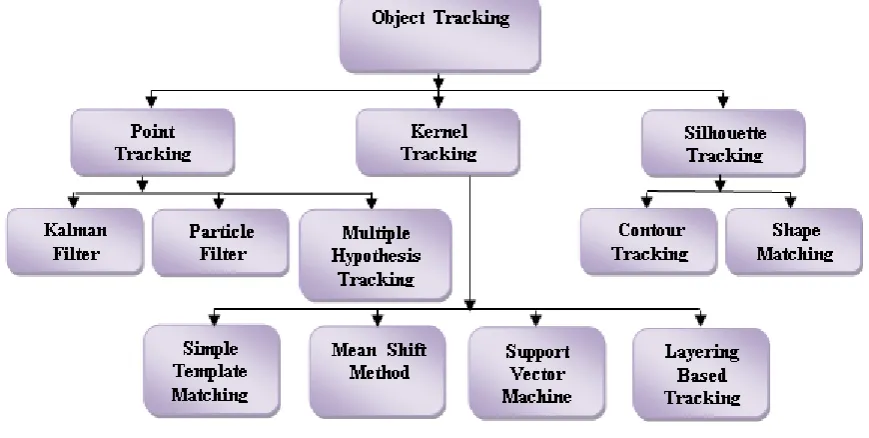
Object tracking is the process of finding or producing the route of the moving objects in a sequence of images [27]. Generally, the various types of object tracking techniques are grouped into three categories [25]. These categories with their details are depicted in figure (4) and are described in what follows.
Fig. 4 Object tracking methods.
1- Point dependent Tracking
Here, the objects are described by points. Tracking of objects with this method over the different frames is mostly achieved by evolving the state of these objects regarding position and regarding motion. Some of the points tracking algorithms are described below.
1) Particle Filter: This filter generates all the models for one variable before moving to the next variable. The particle filter based algorithm has an advantage when variables are generated dynamically and there can be unboundedly numerous variables. It also allows for new operation of resampling. Particle filters could be seen as a group of on-line subsequent estimator algorithms for density. The algorithms directly implemen the Bayesian recursion equations to deduce the subsequent density of the state-space [25].
2) Multiple Hypothesis dependent Tracking (MHT): This method is preferred in general when it is needed to solve the problem of data association encountered in modern systems used to track multiple targets (MTT) [30]. In this method, an estimation is made for the position of objects in the subsequent frames for each hypothesis.
applied to the nonlinear problem of trajectory estimation for the Apollo program leading to its incorporation in the Apollo navigation computer. [31]. The Kalman filter has many uses, including applications in control, navigation, and computer vision. One important field of computer vision is the object tracking [32] .An estimation Kalman filter process is done using a form of feedback control. It estimates a candidate for the state of the process at some time and then gets feedback in the form of noisy measurements. Equations of Kalman filters fall into two groups: time update equations and measurement update equations. The time update equations are responsible for projecting forward (in time) the current state and error covariance estimates for a prior estimate of step next time. The measurement update equations are responsible for the feedback. It is used to integrate the new measure with the priori estimate for the subsequent improvement of estimation. The time update equations can also be thought of as predictor equations, while the measurement update equations can be thought of as corrector equations.
2- Kernel depending tracking
A kernel dependent tracking is typically achieved by calculating the moving object considered. When moving from a frame to another one next to it, such an object is described by an embryonic area [33]. This approach or method encounters a drawback. This drawback occurs when an object part is not enclosed by the kernel, and instead, a not needed background part, is enclosed by the kernel. The object motion may take the form of either translation, parametric transformation, rotation, or affine. Some of the Kernel dependant tracking algorithms are covered in what comes.
1) Matching of Simple Template: Such a technique is adopted in treating digital images to obtain parts of small size for a video or for an image with the condition that this smaller image is a match for a pattern image. Next to this, all likely scenarios can be calculated to see the degree of fitness of the model for the image position in the frames. The method suits well for a single moving object tracking and handles partial occlusion.
2) Mean Shift dependant Method:
An algorithm depending this method is considered as a technique of analysis and it is described as being a nonparametric feature space. It is a technique for tracing the density function maxima. The algorithm is an iterative one and it depends on expecting the upcoming values depending on the previous ones. If a simple form is wished, then the new image confidence map is to be calculated depending on color histogram of the previous images [33]. Mean shift guesses the places of the area in the present frame from the preceding frame.
3) Support Vector Matching: For a linear system, the available data can be clustered into two classes or groups by finding the maximum marginal hyper plane that separates one class from the other with the help of Support Vector Machines [34]. The distance of the hyper plane and the closest data points help in defining the margin of the maximized hyper plane. The data points that lie on the hyper plane margin boundary are called the support vectors. For object detection purpose, the objects can be included in two classes, object class (positive samples) and the non-object class (negative samples).
4) Layering Based Tracking: This is another method of kernel based tracking where multiple objects are tracked. Each layer consists of shape representation (ellipse), motion such as translation and rotation, and layer appearance, based on intensity. Layering is achieved by first compensating the background motion such that the object’s motion can be estimated from the rewarded image by means of 2D parametric motion. Every pixel’s probability is calculated based on the object’s foregoing motion [25].
3- Silhouette dependant tracking
Tracking is accomplished this way if complex shapes are to be tracked and there is no possibility of modelling these shapes with basic geometric ones. Shapes may be complex, as in shoulders, fingers, and hand that cannot be described properly by simple geometric shapes. The aim of a silhouette-based object tracking is to find the object region in every frame by means of an object model generated by the previous frames [33]. Some of the Silhouette tracking algorithms are as described below.
1) Matching of Contour: In this method the object contour for the upcoming frame is calculated from iterative calculations of older frames contours. Two distinct approaches are adopted for tracking. The first approach uses state space models to model the contour shape and motion. The second approach minimizes the contour energy using direct minimization techniques like gradient descent.
silhouettes detected in two successive frames [25]. Tracking of a sole object can be done and handling of occlusions is done depending Hough transform [35] .
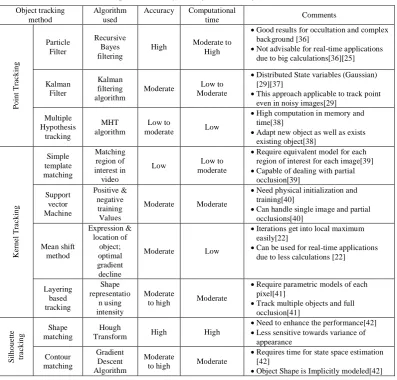
TABLE III
Comparative Study of Object Tracking Methods
VI.CONCLUSIONS
In this paper, object tracking techniques are dissected in detail by using the stage of the object tracking techniques such as the detection of an object, the classification of an object and the tracking of an object. This approach used to increase the detection of an object with new ideas. Some of the border and interest are also considered for tracking moving object in the image sequences. We have observed some methods that have high computational complexity but give precision to results. In the detection of an object, the statistical methods, temporal differencing, background subtraction, with the optical flow was discussed. Nevertheless, these technique needs to focus on darker shadows, handling sudden illumination changes and object occlusions.
R
EFERENCES
[1] A. K. Chauhan and P. Krishan, “Moving Object Tracking using Gaussian Mixture Model and Optical
Flow,” Int. J. Adv. Res. Comput. Sci. Softw. Eng., vol. 3, no. 4, pp. 243–246, 2013.
[2] S. S. Cheung and C. Kamath, “Robust techniques for background subtraction in urban traffic video,” p.
881, 2004.
[3] A. S. Jalal and V. Singh, “The State-of-the-Art in Visual Object Tracking,” Informatica, vol. 36, pp.
227–248, 2012.
[4] R. K. Rout, “A Survey on Object Detection and Tracking Algorithms,” p. 75, 2013.
[5] R. S. Rakibe and B. D. Patil, “Background Subtraction Algorithm Based Human Motion Detection,” Int.
Object tracking method
Algorithm used
Accuracy Computational
time Comments
P o in t T ra c k in g Particle Filter Recursive Bayes filtering
High Moderate to High
Good results for occultation and complex background [36]
Not advisable for real-time applications due to big calculations[36][25]
Kalman Filter
Kalman filtering algorithm
Moderate Low to Moderate
Distributed State variables (Gaussian) [29][37]
This approach applicable to track point even in noisy images[29]
Multiple Hypothesis tracking MHT algorithm Low to
moderate Low
High computation in memory and time[38]
Adapt new object as well as exists existing object[38] K e rn e l T ra c k in g Simple template matching Matching region of interest in video
Low Low to moderate
Require equivalent model for each region of interest for each image[39]
Capable of dealing with partial occlusion[39] Support vector Machine Positive & negative training Values
Moderate Moderate
Need physical initialization and training[40]
Can handle single image and partial occlusions[40] Mean shift method Expression & location of object; optimal gradient decline
Moderate Low
Iterations get into local maximum easily[22]
Can be used for real-time applications due to less calculations [22]
Layering based tracking Shape representatio n using intensity Moderate
to high Moderate
Require parametric models of each pixel[41]
Track multiple objects and full occlusion[41] S il h o u e tt e tra c k in g Shape matching Hough
Transform High High
Need to enhance the performance[42]
Less sensitive towards variance of appearance Contour matching Gradient Descent Algorithm Moderate
to high Moderate
Requires time for state space estimation [42]
J. Sci. Res. Publ., vol. 3, no. 5, pp. 3–6, 2013.
[6] M. Sankari and C. Meena, “Estimation of Dynamic Background and Object Detection in Noisy Visual
Surveillance,” Int. J. Adv. Comput. Sci. Appl., vol. 2, no. 6, pp. 77–83, 2011.
[7] R. Zhang and J. Ding, “Object tracking and detecting based on adaptive background subtraction,”
Procedia Eng., vol. 29, pp. 1351–1355, 2012.
[8] P. A. Dhulekar, V. D. Hire, and M. S. Agnihotri, “Moving Object Tracking Using Kalman Filter .,” vol.
2, no. 1, pp. 52–56, 2015.
[9] J. Y. Lee and W. Yu, “Visual tracking by partition-based histogram backprojection and maximum
support criteria,” 2011 IEEE Int. Conf. Robot. Biomimetics, ROBIO 2011, pp. 2860–2865, 2011.
[10] Y. Hou, S. Chiou, and M. Lin, “Real-time Detection and Tracking for Moving Objects Based on
Computer Vision Method,” 2017 2nd Int. Conf. Control Robot. Eng., pp. 213–217, 2017.
[11] A. Nagendran, N. Dheivasenathipathy, and R. V Nair, “RECOGNITION AND TRACKING MOVING
OBJECTS USING MOVING CAMERA IN COMPLEX SCENES,” vol. 4, no. 2, pp. 31–36, 2014.
[12] S. Chakravarthy, A. Aved, S. Shirvani, M. Annappa, and E. Blasch, “Adapting stream processing
framework for video analysis,” Procedia Comput. Sci., vol. 51, no. 1, pp. 2648–2657, 2015.
[13] T. Zhang, B. Ghanem, S. Liu, and N. Ahuja, “Robust visual tracking via structured multi-task sparse
learning,” Int. J. Comput. Vis., vol. 101, no. 2, pp. 367–383, 2013.
[14] N. Najva and K. E. Bijoy, “SIFT and Tensor Based Object Detection and Classification in Videos Using
Deep Neural Networks,” Procedia Comput. Sci., vol. 93, no. September, pp. 351–358, 2016.
[15] Amandeep and M. Goyal, “Review: Moving Object Detection Techniques,” Int. J. Comput. Sci. Mob.
Comput., vol. 4, no. 9, pp. 345 – 349, 2015.
[16] K. a Joshi and D.G. Thakore, “A Survey on Moving Object Detection and Tracking in Video
Surveillance System,” Int. J. Soft Comput. Eng., 2012.
[17] A. R. Aldhaheri and E. A. Edirisinghe, “Detection and Classification of a Moving Object in a Video
Stream,” Proc. Intl. Conf. Adv. Comput. Inf. Technol., pp. 978–981, 2014.
[18] Y. Dedeoglu, “Moving Object Detection, Tracking and Classification for Smart Video Surveillance,”
Master thesis, the Institute of Engineering and Science of Bilkent University, 2004.
[19] A. S. Mohan, “Video Image Processing for Moving Object Detection and Segmentation using
Background Subtraction,” no. December, pp. 288–292, 2014.
[20] M. Chate, S. Amudha, and V. Gohokar, “Object Detection and tracking in Video Sequences,” vol. 03,
no. 01, 2012.
[21] I. Haritaoglu, D. Harwood, and L. S. Davis, “W4: Real-time surveillance of people and their activities,”
IEEE Trans. Pattern Anal. Mach. Intell., vol. 22, no. 8, pp. 809–830, 2000.
[22] T. Zhang, Z. Liu, X. Lian, and X. Wang, “Study on moving-objects detection technique in video
surveillance system,” 2010 Chinese Control Decis. Conf. CCDC 2010, no. 2008176, pp. 2375–2380,
2010.
[23] G. Li, Y. Wang, and W. Shu, “Real-Time Moving Object Detection for Video Monitoring Systems,”
2008 Second Int. Symp. Intell. Inf. Technol. Appl., vol. 17, no. 4, pp. 163–166, 2008.
[24] M. T. G. Krishna, M. Ravishankar, and D. R. R. Babu, “Automatic detection and tracking of moving
objects in complex environments for video surveillance applications,” 2011 3rd Int. Conf. Electron.
Comput. Technol., vol. 1, pp. 234–238, 2011.
[25] J. J. Athanesious and P. Suresh, “Systematic Survey on Object Tracking Methods in Video,” Int. J. Adv.
Res. Comput. Eng. Technol. Oct., vol. 1, no. 8, pp. 242–247, 2012.
[26] S. Aslani and H. Mahdavi-nasab, “OpticalFlowBasedMovingObjectDetection
AndTrackingForTrafficSurveillance,” vol. 7, no. 9, pp. 1252–1256, 2013.
[27] G. Sindhuja and R. D. S. M, “A Survey on Detection and Tracking of Objects in Video Sequence,” Int.
J. Eng. Res. Gen. Sci., vol. 3, no. 2, pp. 418–426, 2015.
[28] S. Guo, W. Huang, and Y. Qiao, “Local Color Contrastive Descriptor for Image Classification,” no.
Lccd, pp. 1–10, 2015.
[29] O. Javed and M. Shah, “Tracking and Object Classification for Automated Surveillance,” pp. 343–357,
2002.
[30] C. Kim, F. Li, A. Ciptadi, and J. M. Rehg, “Multiple hypothesis tracking revisited,” Proc. IEEE Int.
Conf. Comput. Vis., vol. 2015 Inter, pp. 4696–4704, 2015.
[31] M. S. Grewal and A. P. Andrews, “Applications of Kalman Filtering in Aerospace 1960 to the Present,”
IEEE Control Syst., vol. 30, no. 3, pp. 69–78, 2010.
[32] H. Ait Abdelali, F. Essannouni, L. Essannouni, and D. Aboutajdine, “An Adaptive Object Tracking
Using Kalman Filter and Probability Product Kernel,” Model. Simul. Eng., vol. 2016, 2016.
[33] J. A. J and P. Suresh, “ImplementationAndComparisonOfKernelAndSilhouetteBased ObjectTracking,”
Int. J. Adv. Res. Comput. Eng. Technol., vol. 2, no. 3, pp. 1298–1303, 2013.
Conf. Comput. Vis. (IEEE Cat. No.98CH36271), vol. 0, no. January, pp. 555–562, 1998.
[35] H. S. Parekh, D. G. Thakore, and U. K. Jaliya, “A survey on object detection and tracking methods,” Int.
J. Innov. Res. Comput. Commun. Eng., vol. 2, no. 2, pp. 2970–2978, 2014.
[36] W. Hu, T. Tan, L. Wang, and S. Maybank, “A survey on visual surveillance of object motion and
behaviors,” IEEE Trans. Syst. Man Cybern. Part C Appl. Rev., vol. 34, no. 3, pp. 334–352, 2004.
[37] S. S. Ali and M. F. Zafar, “A robust adaptive method for detection and tracking of moving objects,” Int.
Conf. Emerg. Technol., pp. 262–266, 2009.
[38] S. S. Blackman, “Multiple hypothesis tracking for multiple target tracking,” IEEE Aerosp. Electron. Syst.
Mag., vol. 19, no. 1, pp. 5–18, 2004.
[39] R. Cucchiara, C. Grana, M. Piccardi, and A. Prati, “Detecting moving objects, ghosts, and shadows in
video streams,” IEEE Trans. Pattern Anal. Mach. Intell., vol. 25, no. 10, pp. 1337–1342, 2003.
[40] S. Avidan, “Support Vector Tracking,” IEEE Trans. Pattern Anal. Mach. Intell., vol. 26, no. 8, pp.
1064–1072, 2004.
[41] W. Jianhua and L. Qin, “Study on Moving Object Tracking Algorithm in Video Images 2 Tracker
Design Based on Mean Shift and Particle Filter 3 Experiment Result and,” vol. 1, pp. 810–813, 2007.
[42] B. Karasulu, “Review and evaluation of well-known methods for moving object detection and tracking