Review Paper on Hyperspectral Image Segmentation
Vijaya K. Shandilya
Sipna’s College of Engineering, Amravati, M.S(India)
Abstract:
Hyperspectral image segmentation has several applications which are becoming critical related to unmanned aerial interpretation leading to serious decision based algorithms. This paper reviews reported research by eminent authors in the past and a collective and conclusive view of state of art till date. This review will throw light on wide span of segmentation in spectral domain. Spectral-spatial domain based image segmentation using several algorithms is summarized. Paper concludes with need of specific direction oriented approach for the particular class related to spectral aspect while doing image segmentation. It will help authors to have pros and cons of past and recent research work in this area.
Keywords
Fractional-order Darwinian particle swarm optimization (FODPSO), mean shift segmentation (MSS), support vector machine (SVM), geodesicactive contours (GAC).
1.
Introduction
Material identification using spectroscopy involves digital images in the domain of hyperspectral specifications. Image segmentation of hyperspectral images is a challenging task. Its applications are vegetation, crop, soil condition, water condition etc. Apart from this military and intelligence applications, identification of manmade materials, camouflage. This technology of hyperspectral image interpretation using segmentation has tremendous potential; its utility is limited because of complexity of data. Unsupervised algorithms are devised which partition the image by cluster based analysis of pixels. K-means algorithm is one such area where lots of researchers have reported fairly good results. It has an advantage of being fast it has a drawback of initial information of cluster centers. Classical methods such as principal component analysis, manifold embeddings also suffers few drawbacks and reported non capturing pf complex non linear structures in HIS data. Several researches are going on with focused efforts for proper and useful segmentation so as to deal with better interpretation.
Given the wide range of real-life applications, great deal of research is invested in the field of hyperspectral image segmentation. The segmentation of these images is a key step intheir analysis. Unfortunately, hyperspectral image processing is still a difficult endeavor due to the huge amount of data involved. Consequently, most of the standard segmentation methods fail.
In the literature [1]-[8], different segmentation algorithms based on various aspects of hyperspectral image and image segmentation have worked and reported a lot. In these methods morphological profiles, end member extraction, Markov random fields, Bayesian segmentation and hierarchical segmentation have been proposed. The goal of segmentation (in particular for all the algorithms mentioned before) is to compute a partition from a pixel-based representation of the image. Following methods are summarized as follows.
2.
Methods
2.1. Community Detection Algorithms
It has recently been demonstrated [9]-[10] that topological tools, along with ideas from the theory of networks, are well suited to successfully identify complex nonlinear structures in HSI data sets and perform image segmentation. The new thought offered by these ideas points to significant progress and enhanced utility of hyperspectral imaging technology. The main idea is relatively simple, that the high dimensionality and nonlinearity of a spectral data set can be better handled by imposing a network structure on it. The problem of image segmentation then simplifies to the problem of detecting community structure on networks. To convert the image into a network, each pixel acts as a node. Since every pixel has N numbers associated, one for each frequency band, it can act as a point in N-dimensional space. Two nodes are connected by an edge if the distance between them is small. After the network is constructed, a community detection algorithm can be used to partition it.
2.2. Gradient Flow Method
distance is less than some threshold. The density of data in the neighborhood of each node is determined and a differential equation is constructed on the edges of the graph pointing to increasing density. The high density regions in the data are sinks for this differential equation and the basins of attraction for the clusters [11]. The gradient flow algorithm produces classes that outperform the corresponding results from the standard K-means algorithm.
2.3. K-Means Algorithm
The goal of image segmentation for a hyperspectral image is to devise an unsupervised algorithm that partitions the image by placing each pixel into one of several clusters, or spectral classes. Popular data clustering reported in literature is the K-means algorithm [12], which categorizes a pixel to a cluster by minimizing the variance between the pixel and the cluster center. Although this method is fast, it suffers two major drawbacks when applied to hyperspectral images. The number of clusters, K, must be specified in advance and the quality of the solution relies on the initial set of cluster centers. Other methods in the past for processing data sets, such as principal components analysis and manifold embeddings also has drawbacks and are not successful to capture many of the structures having complex non linearity, in HSI data.
3. Chronology of Literary Work
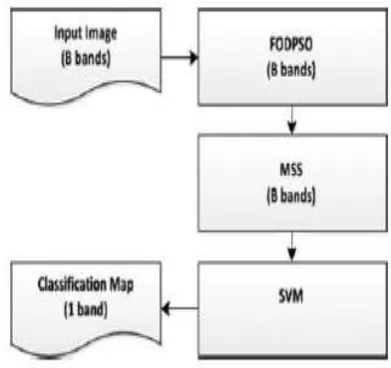
Recent work is reported by P. Ghamisi et al [13]-[16], they proposed new spectral-spatial method for hyperspectral image classification. An integrated approach of fractional order Darwinian particle swarm optimization, mean shift segmentation and support vector machine proves much better and recent one as well. They proved it to be more accurate and these methods overcome the drawbacks of each other. Schematic is shown in Figure1. Fractional-order Darwinian particle swarm optimization (FODPSO) segmentation has drawbacks such as 1) Poor handling related to in homogeneity 2) Failure when intensity of object is not observed as a peak in histogram and 3) Variance related problems.
Mean shift segmentation (MSS) is powerful for remote sensing images due to high redundancy. It is a clustering based method but non parametric. It possess drawback of kernel size to be tuned by user, which proves to be difficult task. Mean shift was firstly introduced in [17]. This approach has been more recently developed for different purposes of low-level vision problems, including adaptive smoothing and segmentation [18]. The most important limitation of the standard MSS is that the
value of the kernel size is unspecified. More information regarding the MSS can be found in [18].
Figure 1. Flowchart of the proposed methodology by P. Ghamisi et al.
The successive processing of image by mentioned methods improves the scenario of segmentation and yields highly accurate segmentation. The paper concludes that combination of FODPSO and MSS is a very powerful approach as compared to past work reported by researchers.
Image analysis needs effective image segmentation. The process of discrimination of based on features essentially partitions the image into segments. This leads to useful information extraction which is used in various fields of engineering. Practical applications of segmentation are biomedical engineering, face recognition, computer vision, digital libraries etc. Segmentation is categorized in following schemes.
1.Automatic, Semi-Automatic and manual.
2.Local Methods and Global Methods of thresholding.
3.Manual delineation, low-level segmentation (thresholding, region-growing, etc) and model-based segmentation (multispectral or feature map techniques, dynamic programming etc.).
4.Classical (thresholding, edge-based and region-based techniques), statistical, fuzzy and neural networks techniques.
3.1. Segmentation for Gray Scale Images
Following are different techniques used by authors for GRAY scale Image Segmentation.
1.Inversion Technique 2.Active Contour Models 3.Threshold Methods 4.Edge Flow Method 5.Cluster Based Method
6.Graph Cur Method and N-D Image Segmentation 7.K-Way Technique
8.Hybrid Watershed and Fast Region Merging Method
3.2. Medical Image Segmentation
Medical image segmentation algorithms have two components i.e. supervised and unsupervised. Unsupervised algorithms are completely automatic and region splitting with high density. It consists of different algorithms as feature-space based technique, clustering based (K-means, C-means, E-means), histogram thresholding, Region-based property techniques (Split-merge techniques, Region growing, Neural-network techniques, Edge detection), Fuzzy techniques, Wavelet based techniques etc.
3.3. Hperspectral Image Segmentation
The hyperspectral imaging sensors are used to capture the scenes in narrow spectral bands over visible and near infrared wavelength range of electromagnetic spectrum. Their range was tens to hundreds of spectral features of the captured material. The images are visualized as a 3D cube or a stack of multiple 2D images where the cube face is represented in spatial co-ordinates x, y and depth as a wavelength d(λ).
The segmentation techniques represented by the integration of information from several images called as Multispectral or Multimodal. In multispectral images where each pixel is characterized by a set of features and the segmentation can be performed in multidimensional feature space using clustering algorithms. The hyperspectral image plot is the formation of three-dimensional feature space. There are many segmentation techniques proposed as k-nearest neighbors, k-means, fuzzy c-means artificial networks algorithm, binary partition tree,level set segmentation, Spatial-Spectral graph, baysian approach etc.
3.3.1 Using Binary Partition Tree
The hyperspectral images have led to the growing number of applications such as remote sensing, food
safety, healthcare or medical research. In pixel-spectrum based presentation using Binary Partition Tree (BPT) [19][20][21], it stored the hierarchical region based representation in a tree structure. The representation of many applications of tree is such as segmentation, classification, indexing, compression, filtering or object recognition. BPT branches which consist of analyzing its own BPT branches based on the construction of the affinity matrices. It represents the distance based measure according to the canonical correlations. The minimal cut proposed as BPT pruning by using the recursive spectral graph partitioning algorithm. There are three types of nodes such as leaf node, root node and merging the neighboring nodes. The BPT method involves region based information stored in a tree structure. It starts from coarse segmentation map, and an iterative merging algorithm is applied. The root of tree is the whole image while leaves correspond to initial segments. It involves Region Model and Merging Criterion. There are several ways for modeling region i.e. parametric and non parametric models. Non parametric models are preferred over parametric model as reported by several researchers. Histogram based models find frequent use in such methods along with statistical aspects. The TREE structure is computationally very intensive. Hence as per reported research by Guillaume Tochon et al [25], principal component analysis is effective in reduction of spectral dimension. While watershed segmented regions can be used at initial stages instead of finest partition scale having individual pixels. This helps in reduction of spatial dimension.
Next step is iterative merging of initial partition. Merging is followed by the process of Pruning which aims at cutting off branches in the tree structure so as to keep most relevant segmentation map. Pruning is completely application dependent and may vary according to defined goal. Pruning strategy is based on the premise that all the nodes defining a real tree crown are similar to each other and can be merged in the early process While alike leaves in neighborhood are merged, the region is farther apart to its neighbors and therefore merged at a later stage. Hence there is a clear discontinuity from leaf to the root at the step where the region is no longer agglomerating leaves around it, but merges with other grown up region in neighborhood.
3.3.2. A Region Based Level Set Segmentation
For colour information and localizing the road structures of small width given by Zafiroprulos and Schenk(1998). The limitation in Snakes is to automatically change their topology during propagation given by Osher and Paragios (2003). This problem solved by Caselles (1997) by introducing geodesicactive contours (GAC). It further expanded and formulated byOsher and Sethian (1998). Level set technique for photo grammetric and remote sensing applications. In GAC,the initial curve was given before the curve proceeded to evolution. Its energy depend on the edges (gradients) inheriting. In 2005, Cao et.al. employed an energy functional based on Mumford – Shah segmentation model which wasused to detect the automatic man-made object in aerial images. The strategy used was the Coarse-to- fine and a fractal error metric. It finds application in extracting the buildings, urban and sub-urban regions.
3.3.3. Adaptive Markov Method
Hyperspectral images are represented by a very highresolution remote sensing images that required a hundred ofspectral bands but there is a problem of spectral unmixing.The unmixing algorithm is represented by the combination ofseveral pure material spectra or end members with relativefractions as abundances. The endmember extractionalgorithm (EEA) used to recover the spectral signature thatincludes the minimum volume simplex analysis (MVSA) andN-FINDR algorithm. The Baysian approach where spatialCorrelation between pixels was taken by using MarkovrandomFields (MRF) to model pixel dependencies resulted ina joint segmentation and unmixing algorithm [22]. The MRFactively used for modeling spatial correlations in image. The drawback of this technique is the computationalcost proportional to the size of the image. This problemreduced by using the mathematical morphology based onlattice theory where similar regions are built by using filterstemming.
3.3.4. Road Extraction Using SVM
Road information is an important data layer in theGeographical information System (GIS). The automatic roadextraction save time and labor. There are several Methods forroad extractions asi)Ridge Finding- In this technique edge magnitude anddirection are devised by edge operators followed bythresholding and thinning process to get the ridge pixels givenby Nevatia and Babu in 1980 and Treash and Amaratunga in2000. These ridge pixels are linked to get the road segment.
ii) Heuristic reasoning is based on knowledge of a series of apre-set rules on road characteristics as shape index, thedistance between primitives, fragments trend and contextual information to detect and connect the primitives or anti parallel linear edges to road segments by McKeown in1985 and Zhu and Yen in 1986. In the dynamic programming methods used a model of the roads with a set of mathematical equation of roads like smooth curves, homogeneous surface narrow linear features and relatively constant width. The statistical interference method used to model the linear features as a Markov point process or a geometric-stochastic model on the road width, direction, intensity, background intensity and maximum a posteriori probability used to estimate the road network given by Barzohar and Cooper in1996 and Stoica et.al. in 2000. In map-matching method,existing road maps were used as the starting point and update the road network. Support vector Machine (SVM) involves two steps A roads group that include actual roads and features having some spectral reflectance.ii) A non- road groups that include all other features havingspectral values different from roads.The SVM is used for the bias- variance trade- off and overfitting problem by achieving the best generalization performance where balancing the relationship between the accuracy obtained on the training data and the capacity of the machine given by Vapnik at AT&T Bell Laboratories in 1995,Then applied in every fields of image processing as handwritten digit recognition, face detection in images and text categorization. It can be used to separate the classes so as to maximize the margin in a hyperplanes surface also implemented the structural risk minimization principle by Vapnik in 1982.
3.3.5. Cluster Based Band Selection
The drawback of the hyperspectral images are i)It has a large amount of information hence It is very difficult to the application of supervised techniques.ii) For the classification or representation task it is represented in a large number of bands that are highly correlated.To reduce the hyperspectral representation we used feature extraction and feature selection techniques. Feature extraction represented by the transformed initial information to obtain the new and reduced data set. Feature selections have a subset of relevant data from the original information. Hence the processing step in hyperspectral imaging on pixel classification tasks performed by the redundant information without losing accuracy and no supervised information.
The applications of hyperspectral images are very dedicatedtask as it is difficult to learn high dimensional densities by a very limited number of training samples. The discriminative approach deals with small class distances, high dimensionality and limited training sets. It holds the state-of art in supervised hyperspectral image [23].The Baysian segmentation approach for hyperspectral images where spatial dependencies enforced by a multi-level logistic(MLL) and Markov-Gibs prior in favor of neighboring labels of the same class. These class densities built on the discriminative Fast Sparse Multi-resolution Regression(FSMIR) which has a fast version of the sparse multinomial regression (SMLR). The SMLR includes Laplacian prior to control the complexity of the classifier and achieve good generalization capabilities.
4. Conclusion
Remote sensing and geographic information related research needs a collective paradigm of research with wise integration of various approaches of image segmentation leading to fairly accurate decision related to data interpretation. Binary Partition Tree approach is finding important role in such applications. It is observed that BPT pruning improves the accuracy of classification preserving most of the edges and shapes as compared to SVM classifiers.