3182
A REVIEW ON REQUIREMENTS VALIDATION FOR
SOFTWARE DEVELOPMENT
1NOR AIZA MOKETAR, 2MASSILA KAMALRUDIN, 1MOKHTAR MOHD. YUSOF, 2SAFIAH
SIDEK
1Innovative Software System and Services Group, Universiti Teknikal Malaysia Melaka, MALAYSIA
2Institute of Technology Management and Entrepreneurship, Universiti Teknikal Malaysia Melaka,
MALAYSIA
E-mail: 1[email protected], {massila, mokhtaryusof, safiahsidek}@utem.edu.my
ABSTRACT
Requirement validation is an important phase in software development project in order to certify that the captured requirements are the exact representations of the users’ needs and expectations. This phase helps to identify and avoid requirements errors from propagating to the later stage. In this paper, we performed a literature review that investigated the trend in software requirements validation approach studied in a decade from the year of 2007 until 2016. Here, we investigated the types of contributions, modes of approaches, requirements types and the techniques that were commonly used and proposed for requirements validation. In this study, we found that many studies contributed new methodology/approach for validating the functional requirements using semi-formalise method. The Unified Modelling Language (UML) models were the most favourite models for this purpose. Furthermore, we found that requirements prototyping was the most used technique for requirements validation. This study also reported the most important requirements quality criteria that need to be validated and fulfil in order to develop high quality software. From the results we found that quality of consistency, correctness and completeness were most frequently validated in requirements validation.
Keywords: Software Engineering, Requirements Engineering, Requirements Validation, Quality of Requirements
1. INTRODUCTION
Requirements errors such as inconsistency, incompleteness, and incorrectness can lead to extensive rework and unrecoverable failures [1]. In addition, fixing those errors at the later stage is more difficult, time consuming and costly to a software development project [2]–[5]. Fortunately, such unnecessary errors can be avoided with a proper requirements validation. The main objective of requirements validation is to certify that the elicited requirements are the exact representations of the users’ needs and expectations [6]–[15].This key activity can help to identify and prevent requirements defects and errors from disseminating to the later stage [4][16]. It also helps to improve requirements quality, reduce the development time, cost and risks in order to develop high quality software that meets the users’ expectations [17][18]. The research in the area of requirements engineering has been recognised since mid-1980s [7]. Since its inception, there have been many
literature or systematic mapping studies covering various aspects of requirements engineering such as requirements specification [19][20], requirements prioritisation [21], and agile requirements engineering [22][23]. However, we found out that there are very limited studies in requirements validation; the sub-area of requirements engineering. The same has been mentioned in previous studies where the evidence about requirements validation techniques are still yet to be done [24]. We found a few literature studies on requirements validation [25][26], but they are not comprehensive. Therefore, we conclude that the study in requirements validation area is still immature and inadequate, which needs further investigation.
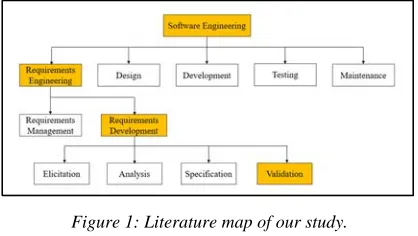
3183 proposed by previous studies. The literature map in Figure 1 show the scope of our study. We would also like to discover the most important requirements quality factors/criteria that were commonly validated by previous studies. Following this section we discuss our research method followed by the results and discussion and finally we conclude our work.
Figure 1: Literature map of our study.
2. RELATED WORKS
This paper is not the first one exploring the subject of requirements validation in software engineering. Our study complement the result presented by [14]. Previously, M. Kamalrudin and S. Sidek [14] have presented the various gaps existing within the process of validating requirements especially for consistency management. In this new study, we investigate the trend of requirements validation for checking the quality of requirements. We found an empirical study presented by U. Raja [25] highlighting the pros and cons of the general requirements validation techniques. Similarly, a survey have been conducted by [26] highlighting the issues of traditional requirements validation techniques in Global Software Development (GSD) environment. These two studies discussed on the general/traditional techniques in requirements validation, which is contrast to our study. We focus to seek the pattern and trend of requirements validation to present the approaches, techniques and tool proposed by various studies in a decade. 3. RESEARCH METHOD
The primary focus of our study was to identify the current trend in software requirements validation practice and the important qualities criteria of requirements that were validated in the selected studies. Next section discusses our research questions for this study.
2.1 The Research Questions
We have formulated the following research questions for this systematic analysis of software requirements validation.
RQ1: What was the current trend in the
requirements validation approach/technique/tool that was applied or proposed in the studies?
This research question aimed to understand and identify the trend in requirements validation practice. Here we identified their contributions in this area, the types of requirements they validated
(functional, non-functional or both), the
methods/techniques used or proposed, the modes of the approaches and the domain application of the studies.
RQ2: What were the quality criteria of requirements that were validated by the studies?
The objective of this research question was to identify the types of qualities criteria for requirements that were validated in the studies. 2.2 The Search Process
The primary search process in our study involved the use of standard online database such as Scopus, ACM Digital Library, IEEE Xplore, Science Direct and Springer Link. We searched all the relevant
papers published between 1st January 2007 and 31st
December 2016 from these online databases. We have developed the search phrases in order to find the answers to our research questions, which are as follow:
(“requirements” OR “specification”) AND
(“validation” OR “validate” OR “validity”) AND (“methodology” OR “technique” OR “method” OR “tool”) AND (“quality” OR “quality criteria” OR “quality factor”)
Our initial search using the above search phrase returned 146,327 papers. For example, the Science Direct database initially returned 139,777 papers, which included the publications in the areas such as social science, healthcare, pharmaceutical and applied energy. Therefore, we set some inclusion and exclusion criteria to gather relevant publications. We described our study selection in the following section.
2.3 The Study Selection
We set some inclusion and exclusion criteria for our study selection to include as many relevant publications as possible. The inclusion criteria were:
(a) The paper must be directly related to early
requirement validation topic in the area of
requirements engineering and software
engineering.
(b) The studies must be published between 2007
and 2016.
3184 area. Furthermore, the following exclusion criteria were also applied to:
(a) The papers that are not related to early
requirements validation in requirements engineering phase. We excluded the papers that discuss on the validation of requirements at the testing phase, which is validating the developed software system or implementation-under-test (IUT) against the requirements.
(b) Review papers that use the terms such as
“systematic literature review”, “literature review”, “literature survey”, “systematic analysis” or “meta-analysis”. We only included the papers that propose a new methodology, technique and tool for requirements validation.
(c) Papers that are not written in English.
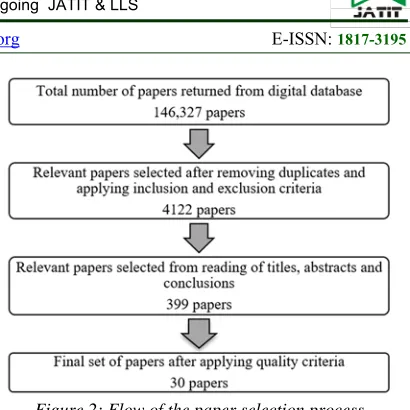
[image:3.612.318.523.59.264.2]Figure 2 describes the paper selection process. A total of 146,327 papers were found in our primary search in the specified databases. After removing duplicates and applying the inclusion and exclusion criteria only 4122 papers were selected. 399 relevant papers were selected after reading the titles, abstracts and conclusions. Finally, only 30 papers were selected after applying the quality assessment.
Figure 2: Flow of the paper selection process
2.4 Quality Assessment
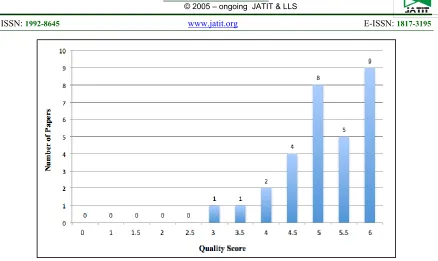
[image:3.612.91.522.409.615.2]We applied the quality criteria to assess the quality of the selected papers. We evaluated each paper using the quality assessment criteria listed in Table 1. The list of criteria was adapted from [23][27].We calculated the quality score of each selected paper based on the six criteria as listed. The quality scores of the result of the selected study are shown in Figure 3.
Table 1: Quality Assessment Criteria
Sections Criteria Response grading
Introduction 1. Does the introduction provide an overview of requirements validation? Is the context of the research well addressed?
Yes = 1 point, Partially = 0.5 point,
No = 0 point
2. Is the research aim/objective clearly defined? Yes = 1 point, Partially = 0.5 point,
No = 0 point
Method 3. Is the research methodology clearly defined? Yes = 1 point, Partially = 0.5 point,
No = 0 point Results 4. Are the findings clearly stated? Do the results help
to solve the requirements validation problems? Yes = 1 point, Partially = 0.5 point, No = 0 point
5. Based on the finding, how valuable is the research? >80% = 1 point, <20% = 0 point,
in between = 0.5 point Discussion / Conclusion 6. Are there any limits or restrictions imposed on the
3185
Figure 3: Quality scores of selected papers
4. DATA EXTRACTION RESULTS
We found 30 papers published between 1st
January 2007 and 31st December 2016 that discussed
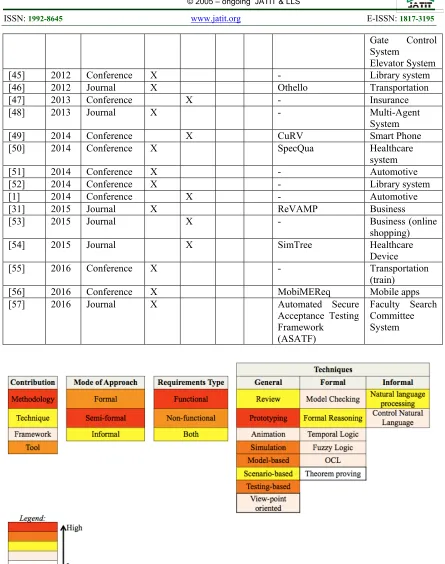
on the topic of requirements validation in the early stage of software development. For each of the paper, we identified the year of publication, type of publication, type of contribution, the proposed name of their approach/tool and the domain of application of their approach. The results are presented in Table 2.
3.1 (RQ1): What was the current trend in
requirements validation
approaches/technique/tool that was applied or proposed in the studies?
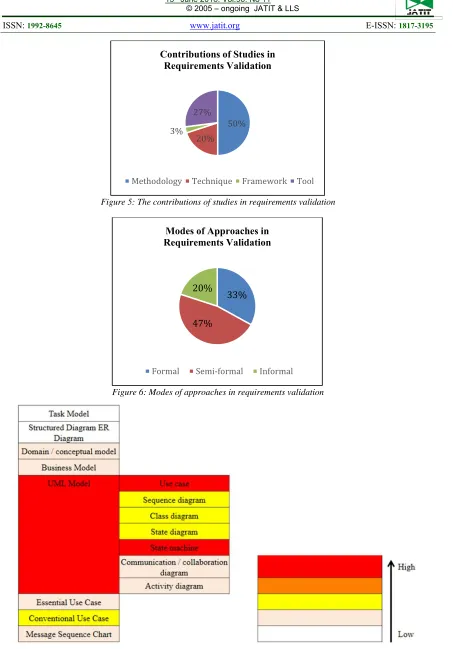
To answer this research question, we identified the contributions of the studies in the requirements validation area, the types of requirements they validated (functional, non-functional or both), the approaches, methods/techniques and tools used or proposed, the modes of the approaches and the domain applications of the studies. We represent the results of our analysis in both heat map (Figure 4) and pie charts (Figure 5 and Figure 6). There were four types of contributions on the software requirements validation studies; methodology, technique, framework and tool. From our analysis, methodology was the highest contribution from researchers to perform requirements validation, which was 50% from the relevant studies (See Figure 5). This was followed by the tool, technique and finally framework.
The studies’ approaches in software
requirements validation were divided into three
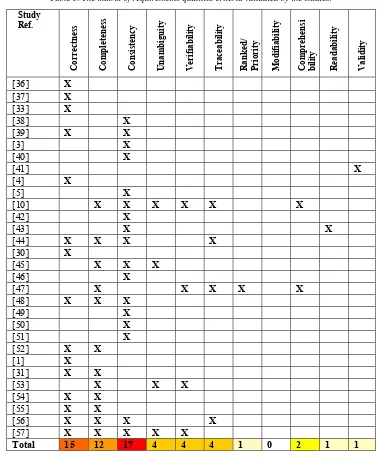
types of modes; formal, semi-formal and informal. Formal approach has a rigorous, mathematical basis [6]. In contrast with formal approach is informal approach that is more flexible and qualitative in nature such as natural language. In between this approach is semi-formal approach, which involves the usage of models/diagrams such as UML model. From our study, it was found that semi-formal approach was the most preferred approach followed by the formal method. Figure 6 shows the modes of approaches’ distribution in more detail. Many studies focused on validating the functional
requirements instead of non-functional
requirements. However, there were also studies that focused on validating both types of requirements.
In general, the most commonly used techniques in software requirements validation included; prototyping, animation, inspection, reviews, simulation, model-based, scenario-based, testing-based and view-point oriented [13][26][28][29]. These techniques were used in all the three modes of approaches for requirements validation. Studies such as [30][4][31] used a combination of these
techniques in their proposed approaches.
Prototyping seemed to be the most favourite technique used in the studies, followed by
simulation, model-based and testing-based
3186 engineer to understand the requested requirements from client-stakeholders [33][31][34][35]. Figure 4 shows that formal method techniques were applied more by the researchers. From this analysis, it was found that formal reasoning was the most used technique in formal requirements validation method. Theorem proving was the least used in this area of study. Natural language processing (NLP) was the most used technique in informal approach compared to control natural language.
As shown in Figure 6, almost half of the studies (47%) used semi-formal approach for requirements validation, which utilised the use of models/diagram. To further investigate the usage of these models we classified the models using a heat map representation
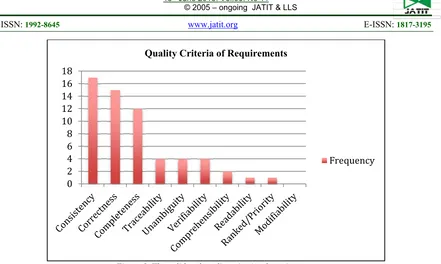
similar to the approach in Figure 4. From our analysis, as shown in Figure 7, UML model was the most used model in the semi-formal approach of requirements validation. From this result, state machine diagram and use case were the most favourite among researchers followed by the sequence, class and state diagram. The other models used for requirements validation were Essential Use Case (EUC) model, domain/conceptual model, business model, conventional use case and message
sequence chart. The task model and
structured/entity-relationship (ER) diagram were the least used models in requirements validation.
Table 2: Studies published between 1st January 2007 and 31st December 2016
Study
Ref. Year Paper Type Contribution Approach / tool Name Domain Application
M
ethod
ol
ogy
/
Ap
pr
oac
h
M
ethod
/
Technique Frame
w
ork
Tool
[36] 2007 Journal X CPN Tool Healthcare
System
[37] 2008 Conference X NRVA Web-based
system
[33] 2008 Journal X AutoPA3.0 Library system
[38] 2009 Conference X EuRailCheck Transportation
(train)
[39] 2009 Conference X ACE Framework Online
discussion /
forum
[3] 2009 Conference X Executable OCL
Checker (EOC) Business
[40] 2009 Conference X - Elevator system
Transportation
[41] 2009 Conference X WTM Simulator Invoice
Management System
[4] 2010 Conference X SQ2E Production line
[5] 2010 Conference X - -
[10] 2011 Conference X CoReVDO E-Commerce
[42] 2011 Conference X MaramaAI ATM System
[43] 2011 Conference X - Automotive
[44] 2011 Conference X VRP Embedded
software system
[30] 2012 Conference X AsmetaRE ATM System
Invoice Order
3187
Gate Control
System
Elevator System
[45] 2012 Conference X - Library system
[46] 2012 Journal X Othello Transportation
[47] 2013 Conference X - Insurance
[48] 2013 Journal X - Multi-Agent
System
[49] 2014 Conference X CuRV Smart Phone
[50] 2014 Conference X SpecQua Healthcare
system
[51] 2014 Conference X - Automotive
[52] 2014 Conference X - Library system
[1] 2014 Conference X - Automotive
[31] 2015 Journal X ReVAMP Business
[53] 2015 Journal X - Business (online
shopping)
[54] 2015 Journal X SimTree Healthcare
Device
[55] 2016 Conference X - Transportation
(train)
[56] 2016 Conference X MobiMEReq Mobile apps
[57] 2016 Journal X Automated Secure
Acceptance Testing Framework
(ASATF)
[image:6.612.87.532.60.624.2]Faculty Search Committee System
3188
Figure 5: The contributions of studies in requirements validation
Figure 6: Modes of approaches in requirements validation
Figure 7: Heat map representation: classification of the model used as a semi-formal requirements validation approach
50% 20% 3%
27%
Contributions of Studies in Requirements Validation
Methodology Technique Framework Tool
33%
47% 20%
Modes of Approaches in Requirements Validation
3189 3.2 (RQ2): What are the quality criteria of
requirements that were validated in the studies?
Next, we investigated the types of qualities criteria for requirements validated by the studies. There were multiple and diverse quality criteria in order to achieve good requirements document. Here we listed the common quality criteria as described in
[7][58][12], which included correctness,
completeness, consistency, unambiguity,
verifiability, traceability, comprehensibility,
readability, priority (ranked), validity and modifiability. Table 4 and Figure 8 show the common qualities criteria of requirements that were
considered in related studies. Table 4 shows that most of the studies had multiple quality criteria validated in their studies. The quality criteria with
the highest frequencies were consistency followed
by the correctness and completeness. Then,
traceability, unambiguity and verifiability resulted with the same frequencies, followed by comprehensibility, validity, readability, and priority (ranked). From our analysis, none of the studies
were discussing about modifiability. This analysis
[image:8.612.115.507.278.739.2]also showed that the most important quality factors for requirements were consistency, correctness and completeness. This important causal relationship is supported by various studies [59][60][61][62].
Table 3. The matrix of requirements qualities criteria validated by the studies.
Study Ref.
Correctn
es
s
Completeness Consiste
nc
y
Unambiguity Verifiabil
ity
Traceab
il
ity
Ranke
d/
Prio
rity
Modifiability Comp
reh
en
si
bility Readability Validity
[36] X
[37] X
[33] X
[38] X
[39] X X
[3] X
[40] X
[41] X
[4] X
[5] X
[10] X X X X X X
[42] X
[43] X X
[44] X X X X
[30] X
[45] X X X
[46] X
[47] X X X X X
[48] X X X
[49] X
[50] X
[51] X
[52] X X
[1] X
[31] X X
[53] X X X
[54] X X
[55] X X
[56] X X X X
[57] X X X X X
3190
Figure 8. The validated quality criteria of requirements
5. LIMITATION OF STUDY AND FUTURE WORKS
Our study has some limitation but they can be ameliorated in future work. Firstly, the results of our review only include the studies found from the year of 2007 until 2016. Any relevant studies published outside the time-frame was not included. Secondly, this study only provide the classification to show the trend in requirements validation practice. Therefore, in the future, we would like to conduct a comparative analysis of the approaches, techniques and tools for deeper insight in this topic.
6. CONCLUSION
This paper discusses the software requirements validation in the earliest stage of software development. Requirements validation is one of the most important phases in software development project to avoid requirements errors from propagate to the later stage. This phase is also crucial in order to achieve the best quality of requirements that reflects the user’s expectation and needs. From our analysis, many studies were validating the functional
requirements using the semi-formal
approach/method. For this, UML models were the most frequent used for requirements validation. In terms of the techniques, prototyping was the most favourite followed by simulation, model-based and testing-based requirements validation. Our analysis also found that the most important quality criteria of requirements were consistency, correctness and completeness.
ACKNOWLEDGEMENT
This research is funded by Ministry of Higher Education Malaysia (MOHE), Universiti Teknologi Mara (UiTM), Fulgent Corporation, FRGS grant: FRGS/1/2016/ICT01/FTMK/02/2/F00325.
REFRENCES:
[1] J. Zhou, “An Observer-Based Technique with Trace Links for Requirements Validation in
Embedded Real-Time Systems,” in
International Conference on Research in Engineering and Technology, 2014, no. 177, pp. 1–52.
[2] S. P. Miller, A. C. Tribble, M. W. Whalen, and M. P. E. Heimdahl, “Proving the shalls: Early validation of requirements through formal methods,” Int. J. Softw. Tools Technol. Transf., vol. 8, no. 4–5, pp. 303–319, 2006.
[3] L. Yin, J. Liu, and X. Li, “Validating requirements model of a B2B system,” in Proceedings of the 2009 8th IEEE/ACIS International Conference on Computer and Information Science, ICIS 2009, 2009, pp. 1020–1025.
[4] D. Aceituna, H. Do, and S.-W. Lee, “SQ^(2)E: An Approach to Requirements Validation with
Scenario Question,” in 2010 Asia Pacific
Software Engineering Conference, 2010, pp. 33–42.
[5] L. Kof, R. Gacitua, M. Rouncefield, and P. Sawyer, “Ontology and Model Alignment as a
Means for Requirements Validation,” in 2010
IEEE Fourth International Conference on
0 2 4 6 8 10 12 14 16 18
Quality Criteria of Requirements
3191 Semantic Computing, 2010, pp. 46–51.
[6] P. A. Laplante, Requirements Engineering for
Software and Systems. CRC Press, 2009. [7] A. van Lamsweerde, Requirements Engineering
From System Goals to UML Models to Software Specification, 2nd editio. Wiley, 2009.
[8] B. Nuseibeh and S. Easterbrook, “Requirements
Engineering: A Roadmap,” in Proceedings of
the Conference on The Future of Software Engineering, ICSE 00, 2000, pp. 35–46.
[9] P. Fenkam, H. Gall, and M. Jazayeri, “Visual Requirements Validation : Case Study in a Corba-supported environment,” 2002.
[10] M. D. Sourour and N. Zarour, “A Methodology of Collaborative Requirements Validation in a
Cooperative Environment,” in 10th
International Symposium Programming and Systems (ISPS), 2011, 2011, pp. 140–147. [11] S. Uchitel, R. Chatley, J. Kramer, and J. Magee,
“Fluent-based animation: exploiting the relation between goals and scenarios for requirements
validation,” Requir. Eng. Conf. 2004.
Proceedings. 12th IEEE Int., pp. 208–217, 2004.
[12] S. Heinonen and H. Tanner, “Early Validation of Requirements in Distributed Product Development – An Industrial Case Study,” in Lecture Notes in Computer Science (including subseries Lecture Notes in Artificial Intelligence and Lecture Notes in Bioinformatics), vol. 6428 LNCS, 2010, pp. 279–288.
[13] S. Maalem and N. Zarour, “Challenge of
validation in requirements engineering,” J.
Innov. Digit. Ecosyst., vol. 3, no. 1, pp. 15–21, Jun. 2016.
[14] M. Kamalrudin and S. Sidek, “A review on
software requirements validation and
consistency management,” Int. J. Softw. Eng. its Appl., vol. 9, no. 10, pp. 39–58, 2015.
[15] B. H. C. Cheng and J. M. Atlee, “Current and Future Research Directions in Requirements
Engineering,” in Design Requirements
Engineering: A Ten-Year Perspective. Lecture Notes in Business Information Processing, vol. 14, 2009, pp. 11–43.
[16] M. Kamalrudin, N. A. Moketar, J. Grundy, and J. Hosking, “Automatic Acceptance Test Case Generation From Essential Use Cases,” in 13th International Conference on Intelligent Software Methodologies, Tools and Techniques, 2014, pp. 246–255.
[17] R. R. Young, Effective Requirements Practice, 1st Editio. Addison-Wesley Information Technology Series, 2001.
[18] S. Tiwari and A. Gupta, “Statechart-based use case requirement validation of event-driven systems,” Proc. 27th Annu. ACM Symp. Appl. Comput. - SAC ’12, p. 1091, 2012.
[19] N. Condori-Fernandez, M. Daneva, K. Sikkel, R. Wieringa, O. Dieste, and O. Pastor, “A systematic mapping study on empirical
evaluation of software requirements
specifications techniques,” in 2009 3rd
International Symposium on Empirical Software Engineering and Measurement, 2009, pp. 502–505.
[20] A. Davis, O. Dieste, A. Hickey, N. Juristo, and A. M. Moreno, “Effectiveness of Requirements Elicitation Techniques: Empirical Results
Derived from a Systematic Review,” in 14th
IEEE International Requirements Engineering Conference (RE’06), 2006, pp. 179–188. [21] A. M. Pitangueira, R. S. P. Maciel, M. de
Oliveira Barros, and A. S. Andrade, “A Systematic Review of Software Requirements Selection and Prioritization Using SBSE
Approaches,” in Search Based Software
Engineering. SSBSE 2013. Lecture Notes in Computer Science, 2013, pp. 188–208.
[22] L. Cao and B. Ramesh, “Agile requirements engineering practices: An empirical study,” IEEE Softw., vol. 25, no. 1, pp. 60–67, 2008. [23] I. Inayat, S. S. Salim, S. Marczak, M. Daneva,
and S. Shamshirband, “A systematic literature review on agile requirements engineering
practices and challenges,” Comput. Human
Behav., vol. 51, no. 6, pp. 915–929, Oct. 2015. [24] M. Daneva, D. Damian, A. Marchetto, and O.
Pastor, “Empirical research methodologies and studies in Requirements Engineering: How far did we come?,” J. Syst. Softw., vol. 95, pp. 1–9, Sep. 2014.
[25] U. A. Raja, “Empirical Studies of Requirements
Validation Techniques,” in 2nd International
Conference on Computer, Control and Communication, IC4 2009, 2009, pp. 1–9. [26] F. Yousuf, Z. Zaman, and N. Ikram,
“Requirements validation techniques in GSD: A survey,” in 2008 IEEE International Multitopic Conference, 2008, pp. 553–557.
[27] R. Torkar, T. Gorschek, R. Feldt, ꞏ Uzair, A. Raja, K. KAMRAN, R. Torkar, T. Gorschek, R. Feldt, M. SVAHNBERG, U. A. RAJA, and K. KAMRAN, “Requirements Traceability: a Systematic Review and Industry Case Study,” Int. J. Softw. Eng. Knowl. Eng., vol. 22, no. 3, pp. 385–433, 2012.
[28] U. A. Raja, “Empirical studies of requirements
3192 International Conference on Computer, Control and Communication, 2009, pp. 1–9.
[29] A. Munir and N. Ikram, “Effective
communication and coordination: A
comparison of requirements validation
techniques in GSD,” in Proceedings of the
IASTED International Conference on Software Engineering, SE 2009, 2009, pp. 93–100. [30] P. Scandurra, A. Arnoldi, T. Yue, and M. Dolci,
“Functional requirements validation by
transforming use case models into Abstract
State Machines,” in Proceedings of the 27th
Annual ACM Symposium on Applied Computing - SAC ’12, 2012, p. 1063.
[31] S. Saito, J. Hagiwara, T. Yagasaki, and K.
Natsukawa, “ReVAMP: Requirements
Validation Approach using Models and Prototyping — Practical Cases of Requirements
Engineering in End-User Computing,” J. Inf.
Process., vol. 23, no. 4, pp. 411–419, 2015. [32] S. Hansen, N. Berente, and K. Lyytinen,
“Requirements in the 21st Century: Current
Practice and Emerging Trends,” in Design
Requirements Engineering: A Ten-Year Perspective. Lecture Notes in Business Information Processing, vol. 14, 2009, pp. 44– 87.
[33] D. Li, X. Li, J. Liu, and Z. Liu, “Validation of requirement models by automatic prototyping,” Innov. Syst. Softw. Eng., vol. 4, no. 3, pp. 241– 248, 2008.
[34] Y. Ling, L. Jing, and L. Xiaoshan, “Validating Requirements Model of a B2B System,” in 2009 Eighth IEEE/ACIS International Conference on Computer and Information Science, 2009, pp. 1020–1025.
[35] G. Gabrysiak, H. Giese, and A. Seibel, “Interactive Visualization for Elicitation and Validationn of Requirements with
Scenario-Based Prototyping,” in 2009 Fourth
International Workshop on Requirements Engineering Visualization, 2009, pp. 41–45. [36] R. J. Machado, K. B. Lassen, S. Oliveira, M.
Couto, and P. Pinto, “Requirements Validation: Execution of UML Models with CPN Tools,” Int. J. Softw. Tools Technol. Transf., vol. 9, no. 3–4, pp. 353–369, May 2007.
[37] J. Dargham and R. Semaan, “A navigational
web requirements validation through
animation,” in Proceedings - 3rd International Conference on Internet and Web Applications and Services, ICIW 2008, 2008, pp. 211–216. [38] R. Cavada, a. Cimatti, a. Mariotti, C. Mattarei,
a. Micheli, S. Mover, M. Pensallorto, M. Roveri, a. Susi, and S. Tonetta, “Supporting
requirements validation: The EuRailCheck
tool,” ASE2009 - 24th IEEE/ACM Int. Conf.
Autom. Softw. Eng., pp. 665–667, 2009. [39] I. Jureta, J. Mylopoulos, and S. Faulkner,
“Analysis of multi-party agreement in
requirements validation,” in 2009 17th IEEE
International Requirements Engineering Conference, 2009, pp. 57–66.
[40] A. Cimatti, M. Roveri, A. Susi, and S. Tonetta, “From Informal Requirements to Property-Driven Formal Validation,” in Lecture Notes in Computer Science (including subseries Lecture Notes in Artificial Intelligence and Lecture Notes in Bioinformatics), vol. 5596 LNCS, 2009, pp. 166–181.
[41] B. Bomsdorf and D. Sinnig, “Model-Based Specification and Validation of User Interface
Requirements,” in Proceedings of the 13th
International Conference on Human-Computer Interaction. Part I: New Trends, 2009, pp. 587– 596.
[42] M. Kamalrudin and J. Grundy, “Generating essential user interface prototypes to validate
requirements,” in 2011 26th IEEE/ACM
International Conference on Automated Software Engineering (ASE 2011), 2011, pp. 564–567.
[43] J. Holtmann, J. Meyer, and M. von Detten, “Automatic Validation and Correction of
Formalized, Textual Requirements,” in 2011
IEEE Fourth International Conference on Software Testing, Verification and Validation Workshops, 2011, pp. 486–495.
[44] D. Aceituna, H. Do, and S. W. Lee, “Interactive requirements validation for reactive systems through virtual requirements prototype,” in 2011 Model-Driven Requirements Engineering Workshop, MoDRE 2011, 2011, pp. 1–10. [45] R. Sharma and K. K. Biswas, “Using norm
analysis patterns for automated requirements validation,” in 2012 Second IEEE International Workshop on Requirements Patterns (RePa), 2012, pp. 23–28.
[46] A. Cimatti, M. Roveri, A. Susi, and S. Tonetta, “Validation of requirements for hybrid systems,” ACM Trans. Softw. Eng. Methodol., vol. 21, no. 4, pp. 1–34, Nov. 2012.
[47] M. Felderer and A. Beer, “Using defect taxonomies for requirements validation in
industrial projects,” in 2013 21st IEEE
International Requirements Engineering Conference, RE 2013 - Proceedings, 2013, pp. 296–301.
3193 J. Comput. Appl. Technol., vol. 47, no. 2/3, p. 172, 2013.
[49] Y. K. Lee, H. P. In, and R. Kazman, “Customer Requirements Validation Method Based on
Mental Models,” in 2014 21st Asia-Pacific
Software Engineering Conference, 2014, vol. 1, pp. 199–206.
[50] A. Rodrigues, “Quality of Requirements Specifications - A Framework for Automatic Validation of Requirements,” in Proceedings of the 16th International Conference on Enterprise Information Systems, 2014, pp. 96–107. [51] J. Zhou, Y. Lu, K. Lundqvist, H. Lonn, D.
Karlsson, and B. Liwang, “Towards feature-oriented requirements validation for automotive
systems,” in 2014 IEEE 22nd International
Requirements Engineering Conference (RE), 2014, pp. 428–436.
[52] M. Li and S. Liu, “Reviewing Formal Specification for Validation Using Animation
and Trace Links,” in 2014 21st Asia-Pacific
Software Engineering Conference, 2014, pp. 263–270.
[53] N. Ali and R. Lai, “A method of software requirements specification and validation for global software development,” Requir. Eng., pp. 1–24, Nov. 2015.
[54] S. Zafar, N. Farooq-Khan, and M. Ahmed, “Requirements simulation for early validation using Behavior Trees and Datalog,” Inf. Softw. Technol., vol. 61, pp. 52–70, May 2015. [55] W. Miao, G. Pu, Y. Yao, T. Su, D. Bao, Y. Liu,
S. Chen, and K. Xiong, “Automated Requirements Validation for ATP Software via Specification Review and Testing,” in Lecture Notes in Computer Science, vol 10009, 2016, pp. 26–40.
[56] N. Yusop, M. Kamalrudin, S. Sidek, and J. Grundy, “Automated Support to Capture and Validate Security Requirements for Mobile
Apps,” in Communications in Computer and
Information Science, vol 671, 2016, pp. 97–112. [57] M. El-Attar and H. A. Abdul-Ghani, “Using security robustness analysis for early-stage validation of functional security requirements,” Requir. Eng., vol. 21, no. 1, pp. 1–27, Mar. 2016.
[58] IEEE, IEEE Recommended Practice for
Software Requirements Specifications, vol. 1998. 1998.
[59] D. Zowghi and V. Gervasi, “The Three Cs of Requirements: Consistency, Completeness, and
Correctness,” in Proceedings of 8th
International Workshop on Requirements Engineering: Foundation for Software Quality,
2002, pp. 155–164.
[60] D. Zowghi and V. Gervasi, “On the interplay between consistency, completeness, and
correctness in requirements evolution,” Inf.
Softw. Technol., vol. 45, no. 14, pp. 993–1009, Nov. 2003.
[61] M. Kamalrudin, “Automated Software Tool Support for Checking the Inconsistency of
Requirements,” in 2009 IEEE/ACM
International Conference on Automated Software Engineering, 2009, pp. 693–697. [62] M. Kamalrudin, J. Grundy, and J. Hosking,
“MaramaAI: tool support for capturing and
managing consistency of multi-lingual