© 2017, IJCSMC All Rights Reserved
119
Available Online atwww.ijcsmc.comInternational Journal of Computer Science and Mobile Computing
A Monthly Journal of Computer Science and Information Technology
ISSN 2320–088X
IMPACT FACTOR: 6.017
IJCSMC, Vol. 6, Issue. 5, May 2017, pg.119 – 126
An Efficient Technique for Night Time Vehicle
Detection with Fusion Based Image Enhancement
Sabnam.K
1, Jebakumari.M
2¹PG student, Computer Science and Engineering, Nehru Institute of Technology, Coimbatore, India ²Associate Professor, Computer Science and Engineering, Nehru Institute of Technology, Coimbatore, India
1
[email protected]; 2 [email protected]
Abstract: Vehicle detection at night time is a challenging problem which deals with inadequately illuminated images of low contrast and reduced visibility. In this paper, an efficient region of interest (ROI) extraction approach which combines vehicle light detection and object proposals together with fusion-based level feature technique is proposed. The score-level multi-feature fusion method involves seven complementary features such as difference of Gaussian (DOG) , Scale Invariant Feature Transform (SIFT) ,local binary pattern (LBP), histogram of oriented gradients (HOG), four- direction features (FDF), HSV color histogram and edge HOG which represent different attributes of the vehicle and demonstrate different accuracy for vehicle recognition. In addition Elastic Edge Boxes is utilized on enhanced images to generate original object proposals. Eventually, the versatile AdaBoost classifiers are used to classify the corresponding features extracted from the ROIs for improving the accuracy of nighttime vehicle detection.
Keyword: Region of interest, Elastic edge boxes, Score Vector Machine, AdaBoost.
I.INTRODUCTION
The vehicle detection plays an important role for traffic control, surveillance applications and autonomous driving. Nighttime images have low luminosity and contrast. So night time vehicle detection is more difficult than daytime vehicle detection. Detecting vehicles during nighttime is a complex problem because it contains noisy images too. Hence it can be detected by considering vehicles as objects.
© 2017, IJCSMC All Rights Reserved
120
view systems on their cars. Object detection at night is a big challenge due to low illumination, distortion and noisy night images. The existing methods for car detection at night mainly use light blob features.
During night, vehicles are detected using their head and tail lights. Segmentation is the process by which an image is divided into smaller parts so that processing of the entire image can be more meaningful and easier (i.e. process of partitioning a digital image). The process of segmentation thus makes an image meaningful and easy for analysis. It assigns label for every pixel so that pixels having same characteristics shares the same label.
The edges of an image is used to indicate higher frequency region within that image. Edge Detection [4] is a process which identifies and locates changes in pixel intensity which indicates boundaries of an image. Detection of edges is used in image segmentation, data compression and image reconstruction.
Filtering [7] is used to modify and enhance an image by removing the noises from it. It is a neighborhood operation in which the output image pixel value is obtained by applying appropriate algorithms to the neighborhood pixel values of the input pixel. Image enhancement is the process by which the specific features of an image is brought out by histogram equalization, median filtering etc. Enhancement makes it easier to identify the key features of an image.
II. RELATED WORKS
Zitnick&Piotr [1] proposed a novel method for generating object bounding box proposals. This method is based on edges of an image. It introduces an objectness score that can be calculated by finding difference between number of edges that exist in the box and those that are members of contours that overlap the box’s boundary. With the help of data structure millions of candidate boxes can be evaluated quickly and it returned ranked set of a few thousand top scoring proposals. This method effectively finds object proposals in an image by using objectness score.
Hosang et al [2] analyzed various object proposal methods such as gPbUCM, objectness, CPMC, Endres2010, Selective Search, Rahtu2011, Randomized Prim’s, Bing, MCG, Rantalankila2014, Rigor, Edge Boxes and found better object proposal method based on good performance in ground truth recall, reasonable repeatability, and tolerable evaluation speed. It is concluded that Selective Search and Edge Boxes object proposal methods performed better than the other object proposal methods.
Ren& Deva [4] proposed a sparse representation for object detection. The sparse representation computes sparse codes with dictionaries learned from data using K-SVD, it is a dictionary learning algorithm for creating dictionary for sparse representation and form local histogram by aggregating per-pixel sparse codes. It only changes the underlying features. It applies dimension reduction by computing SVD on learned models, and adopt supervised training where latent positions of roots and parts are given externally.
Zhang et al [11] presented an integrated framework to predict the object boundaries and it is used for classification and detection of object boundaries. This framework showed multi scale and sliding window which is successfully implemented in Convolutional Networks. Bounding boxes are then accumulated rather than suppressed in order to increase detection confidence. From the single shared network simultaneously different task can be learned. This framework involves substantial modifications to networks designed for classification, but clearly demonstrates that Convolutional Networks are capable of these more challenging tasks.
Yu&Zhenwei [12] presented a new method to detect the vehicles in remote sensory images. A simple transformation is used to convert original panchromatic image into “fake” hyper spectral form and a hyper spectral algorithm is used to pre detect the vehicles. This algorithm captures the salient features of vehicle and it enhances the separation between vehicle and clutter. AdaBoost algorithm is used to validate the real vehicles from the pre detected vehicles based on hypotheses of vehicle.
Kuang et al [17] proposed a novel ROI extraction approach that fuses vehicle light detection and object proposals together and an image enhancement approach based on improved MSR to extract accurate ROIs is used to enhance images for accurate nighttime vehicle detection.
III. EXISTING SYSTEM
© 2017, IJCSMC All Rights Reserved
121
IV. PROPOSED SYSTEM
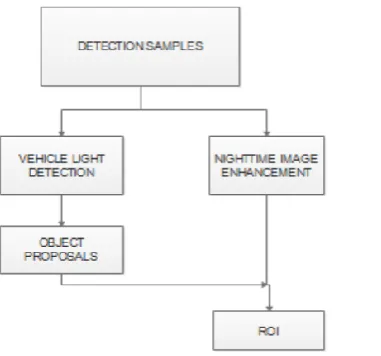
In the proposed work a fusion based enhancement method is used to enhance the night time images instead of MSR. First step is to apply a simple illumination estimation. It is based on morphological closing operation which decomposes an observed image into a reflectance image and an illumination image. Two inputs are derived that represent luminance-improved and contrast-enhanced version. Two weights are derived based on these inputs, an adjusted illumination is produced by fusing the derived inputs with the corresponding weights in a multi-scale fashion. The advantages of different techniques are blended to produce the adjusted illumination. The final enhanced image is obtained by compensating the adjusted illumination back to the reflectance.
For vehicle light detection, first the RGB image is converted in to color intensity image. The color intensity image is then converted in to Nakagami image to emphasize vehicle light regions. Then the Nakagami image is converted in to binary image by thresholding.
Fig. 1.System Architecture of vehicle light detection and nighttime image enhancement.
In the proposed work elastic edge boxes are used instead of edge boxes. In Score-level multi-feature fusion, SIFT and DOG are added with existing five features HOG, HSV, edge HOG, LBP and FDF to improve the accuracy of detection rate. In order to decrease false positives due to reflection, AdaBoost is used with SVM.
During the detection stage, detecting regions belonging to vehicle light in an image, is performed to extract all possible vehicle light regions. Subsequently, object proposals are extracted on enhanced images using Elastic Edges. SVM with AdaBoost is used for classification.
© 2017, IJCSMC All Rights Reserved
122
Next, extraction of accurate ROIs that are more likely to be vehicles by combining object proposals and vehicle light detection together is done.
A. Nighttime image enhancement
A fusion based enhancement method [17] is used to enhance the night time images. Several inputs and weights derived from a single estimated illumination are blended in proposed fusion based approach. For enhancing weakly illuminated images are three criteria are used. They are global luminance improvement, local contrast enhancement and preservation of naturalness. Hence inputs and weights are designed and processed based on these three criteria. Four main steps of proposed image enhancement algorithm are:
1) Illumination estimation
The simplified physical model of light reflection is used to estimate illumination.
Where S is the measured image, R is the reflectance, I is the illumination, c is the color channel of RGB (red, green, blue) space and (x, y) is the pixel location.
The image lightness is obtained from the maximum value of its three color channels to represent luminance variance (L).
Illumination estimation is done by using a morphologically closing operation.
Where P is the structuring element and ∙ is the closing operation.
2) Input derivation
In the proposed fusion-based approach, three inputs are derived from the estimated illumination. The first input, I1, is the original estimated illumination I. The second input I2 is designed to determine the global luminance.
The third input, I3, is designed to enhance local contrast by using “contrast local adaptive histogram equalization” (CLAHE).
3) Weight definition
The next step is designing weights for fusing the three input images. Pixel level weights for fusion are derived. A brightness weight assigns high values to well-exposed pixels. Next, the mean, the standard deviation and the histogram of the illumination values of images are calculated.
A second weight chromatic contrast weight is computed based on the chromatic filtering component.
Where H is the hue and S is the saturation in HSV color space of the original input color image. The parameter α is used to preserve the color opponency and ϕ represents the offset angle of the color wheel. The third weight is calculated using these two weights.
4) Multi-scale for input and weight fusion
© 2017, IJCSMC All Rights Reserved
123
B. Vehicle detection
1. ROI extraction: In the first step the RGB image is converted into color intensity image to enhance contrast. The color intensity image is filtered using the step function. A Nakagami image-based vehicle light detection approach is used. A Nakagami image is computed to emphasize vehicle light region. It helps in distinguishing between vehicle lights from non-vehicle lights. The characteristics of vehicle lights is modelled by Nakagami distribution. Then Nakagami image is converted in to binary image with thresholding.
2. Final ROI extraction: Instead of edge boxes, elastic edge boxes are used. Elastic edge boxes utilize both color and depth cues in RGBD images.
C. Score level multi feature fusion
Seven features are used here. They are local binary pattern (LBP), HSV color histogram, four direction feature (FDF), histogram of oriented gradients (HOG), edge HOG, scale invariant feature transform (SIFT) and difference of Gaussian. The seven features show different attributes and accuracy for vehicle recognition. These features are extracted by dividing images into blocks. These features are fused with weights. The score vectors are computed as
Here represents the probability of the ith sample. The classification contribution is taken as weight which is given by
Here N is the number of training samples and the first M samples are backgrounds. The final score vectors are computed by
Here is the weight of the jth feature.
D. SVM with Adaboost.
Support vector machines (SVMs) are supervised learning models. They analyze data and classify them. Here the SVM uses radial basis function kernel. The SVM classifier must be appropriately weakened to apply boosting. Resampling and reweighting can be used to train adaboost. Here reweighting is used without loss of generality.
Algorithm: AdaBoostSVM
Input: a set of training samples with labels {( )...). ( )}; the initial σ, σini; the minimal σ, σmin; the step of σ, σstep.
Initialize: the weight of samples: = 1/N, for all i =1,., N. Do While (σ>σmin)
a) Use RBFSVM algorithm to train the weak learner on the weighted training sample set.
b) Calculate training error of .
c) If > 0.5, decrease σvalue by σstep and goto (a).
d) Set weight of weak learner : = .
e) Update training samples' weights: where Ct is a normalization constant, and
.
© 2017, IJCSMC All Rights Reserved
124
V. RESULTS AND DISCUSSION
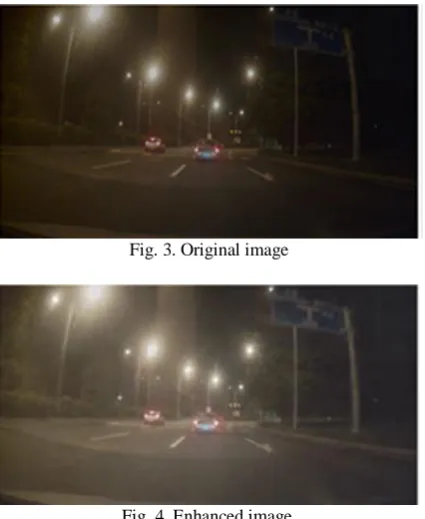
The original and enhanced images are shown in figure 3 and figure 4 respectively.
Fig. 3. Original image
Fig. 4. Enhanced image.
The enhanced image is obtained using fusion based method. For estimating illumination morphologically closing operation is used. For adjusting illumination a fusion based enhancement algorithm is used. Contrast limited adaptive histogram equalization (CLAHE) algorithm is used to enhance local contrast and can be accelerated using interpolation technique. The proposed algorithm subjectively appears as an improvement for processing weakly illuminated images. By blending features from the various derived inputs, results achieve a good luminance improvement, contrast enhancement (Fig. 5)and naturalness preservation.
Fig. 5. Contrast image.
© 2017, IJCSMC All Rights Reserved
125
Nakagami image (Fig. 6) is used to emphasize vehicle light regions and helps in differentiating between vehicle light and non-vehicle lights.
Fig. 7.Elastic edge boxes image.
Here edge boxes are utilized to generate candidate objects. The images are then represented with super pixels and bounding boxes are adjusted by grouping super pixels in elastic range which improves proposal accuracy while retaining high efficiency.
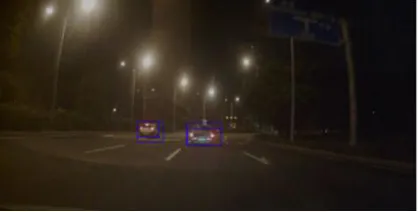
Fig. 8.Detected vehicles image
Here detected vehicles are enclosed within the edge boxes.
VI. CONCLUSION
In this work, a fusion based technique for nighttime vehicle image enhancement along with ROI extraction approach employing elastic edge boxes is presented. The error rate of vehicle detection is reduced by adding more features such as Scale Invariant Feature Transform and difference of Gaussian along with multiple complementary features. Scores of classifiers trained using each feature which are linearly combined with computed weights at score computing stage to improve recognition accuracy. Then SVM classifier with AdaBoost is used for classification. The experimental results prove that the proposed vehicle detection technique for nighttime is better than the existing techniques.
REFERENCES
[1] Zitnick, C. L., &Dollár, P. (2014, September). Edge boxes: Locating object proposals from edges. In European Conference on Computer
Vision (pp. 391-405). Springer International Publishing.
[2] Hosang, J., Benenson, R., &Schiele, B. (2014). How good are detection proposals, really? arXiv preprint arXiv:1406.6962.
[3] Lin, H., & Shi, Z. (2014). Multi-scale retinex improvement for nighttime image enhancement. Optik-International Journal for Light and
Electron Optics, 125(24), 7143-7148.
[4] Ren, X., &Ramanan, D. (2013). Histograms of sparse codes for object detection. In Proceedingsof the IEEE Conference onComputer Vision and Pattern Recognition (pp. 3246-3253).
[5] Girshick, R., Iandola, F., Darrell, T., & Malik, J. (2015). Deformable part models are convolutional neural networks. In Proceedings of the IEEE Conference on Computer Vision and Pattern Recognition (pp. 437-446).
[6] Chen, X., Xiang, S., Liu, C. L., & Pan, C. H. (2014). Vehicle detection in satellite images by hybrid deep convolutional neural networks. IEEE Geoscience and remote sensing letters, 11(10), 1797-1801.
[7] Tehrani, H., Kawano, T., &Mita, S. (2014, June). Car detection at night using latent filters. In 2014 IEEE Intelligent VehiclesSymposium Proceedings (pp. 839-844). IEEE.
© 2017, IJCSMC All Rights Reserved
126
[9] Dollár, P., &Zitnick, C. L. (2015). Fast edge detection using structured forests. IEEE transactions on pattern analysis and machine
intelligence, 37(8), 1558-1570.
[10]Sharif Razavian, A., Azizpour, H., Sullivan, J., &Carlsson, S. (2014). CNN features off-the-shelf: an astounding baseline for recognition. In Proceedings of the IEEE Conference on Computer Vision and Pattern Recognition Workshops (pp. 806-813).
[11]Sermanet, P., Eigen, D., Zhang, X., Mathieu, M., R., &LeCun, Y. (2013). Overfeat: Integrated recognition, localization and detection using convolutional networks. arXiv preprint arXiv:1312.6229.
[12]Yu, X., & Shi, Z. (2015). Vehicle detection in remote sensing imagery based on salient information and local shape feature. Optik
-International Journal for Light and Electron Optics, 126(20), 2485-2490.
[13]Mohamed, A., Issam, A., Mohamed, B., &Abdellatif, B. (2015). Real-time Detection of Vehicles Using the Haar-like Features and Artificial Neuron Networks. Procedia Computer Science, 73, 24-31.
[14]Arróspide, J., Salgado, L., &Camplani, M. (2013). Image-based on-road vehicle detection using cost-effective Histograms of Oriented Gradients.Journal of Visual Communication and Image Representation, 24(7), 1182-1190.
[15]Battiato, S., Farinella, G. M., Furnari, A., Puglisi, G., Snijders, A., &Spiekstra, J. (2015). An integrated system for vehicle tracking and classification. Expert Systems with Applications, 42(21), 7263-7275.
[16]XueyangFu, DeluZeng, YueHuang, YinghaoLiao, XinghaoDing, JohnPaisley (2016) A fusion-based enhancing method for weakly illuminated images.
[17]HulinKuang, Long Chen, Feng Gu, Jiajie Chen,Leanne L. H. Chan and Hong Yan (2016) Combining region of interest extraction and image enhancement for nighttime vehicle detection.
[18]N. Dalal and B. Triggs, “Histograms of oriented gradients for human detection, “in Proc. IEEE Conf. Computer Vision and Pattern Recognition,vol. 1, no. 12, 2005, pp. 886–893.
[19] Y. M. Chen and J.-H. Chiang, “Face recognition using combined multiple feature extraction based on fourier-ellin approach for single example image per person,” pattern Recognition Letters, vol. 31, no. 13 pp. 1833– 1841, 2010.
[20] J. Rubio et al., “Multiple-target tracking for intelligent headlight control,” IEEE.