A preliminary version of this paper appeared in the 32nd International Colloquium on Au-tomata, Languages and Programming, ICALP 2005, Lecture Notes in Computer Science Vol. ???, Giuseppe F. Italiano, Catuscia Palamidessi and Moti Yung eds, Springer Verlag, 2005. This is the full version.
Append-Only Signatures
Eike Kiltz∗ Anton Mityagin† Saurabh Panjwani‡ Barath Raghavan§
May 6, 2005
Abstract
We present a new primitive—Append-only Signatures (AOS)—with the property that any party given an AOS signature Sig[M1] on messageM1 can compute Sig[M1kM2] for any message M2, where M1kM2 is the concatenation ofM1 and M2. We define the security of AOS, present concrete AOS schemes, and prove their security under standard assumptions. In addition, we find that despite its simple definition, AOS is equivalent to Hierarchical Identity-based Signatures (HIBS) through efficient and security-preserving reductions. Fi-nally, we show direct applications of AOS to problems in network security. Our investigations indicate that AOS is both useful in practical applications and worthy of further study as a cryptographic primitive.
Keywords: Algebraic Signatures, Append-only Signatures, Hierarchical Identity-based Sig-natures
∗Department of Computer Science and Engineering, University of California, San Diego, San Diego, USA. Email: [email protected]. URL:http://www.kiltz.net/. Research supported by a DAAD postdoc fellow-ship.
†Department of Computer Science and Engineering, University of California, San Diego, San Diego, USA. Email: [email protected]. Research supported in part by NSF grants ANR-0129617 and CCR-0208842.
‡Department of Computer Science and Engineering, University of California, San Diego, San Diego, USA. Email: [email protected]. URL:http://www.cse.ucsd.edu/users/spanjwan/. Research supported in part by NSF grant 0313241. Any opinions, findings, and conclusions or recommendations expressed in this material are those of the author(s) and do not necessarily reflect the views of the National Science Foundation.
Contents
1 Introduction 1
2 Append-only Signatures 3
3 Efficient AOS Constructions 5
3.1 Certificate-Based Append-Only Signatures . . . 5
3.2 Shorter Signatures via Aggregation . . . 7
3.3 Compact Signatures via the Boneh-Goh-Boyen HIBE . . . 7
3.4 AOS via Hash Trees . . . 8
3.5 AOS via One-time Signatures . . . 10
4 Relations between HIBS and AOS 10 4.1 Definition of HIBS . . . 11
4.2 Constructing AOS from HIBS . . . 12
4.3 Constructing HIBS from AOS . . . 13
4.4 Discussion . . . 15
5 Applications 16 5.1 Wide-area Routing Protocol Security . . . 16
5.2 Secure Delegation of Resources . . . 17
6 Final Remarks and Open Problems 17 6.1 Finalization of AOS signature . . . 17
6.2 Restricted AOS . . . 17
6.3 Shorter AOS signatures . . . 18
A Public Key Signature Schemes 21
B Proof of Theorem 3.1 22
C Proof of Theorem 3.2 25
1
Introduction
In many real-world applications, users and programs alike require notions of delegation to model the flow of information. It is often required that delegation from one party to another enables the delegatee to “append” to the information it received but to do nothing more. For example, in wide-area Internet routing, each network passes a routing path advertisement to its neighbor-ing networks, which then append to it information about themselves and forward the updated advertisement to their neighbors. For security, the route advertisements must be authenticated; intermediate networks must be incapable of modifying routes except according to the protocol (that is, by appending their names to already-received advertisements). Likewise, in the context of secure resource delegation for distributed systems, users need to delegate their share of re-sources to other users, who may then re-delegate to other users by including their own rere-sources in the pool. In many of these applications, it is desirable that delegation is possible without parties having to share any cryptographic keys and that the authenticity of any information received through a series of delegations is verifiable based only on the identity of the first party in the chain.
To directly address the needs of these applications, we present a new cryptographic primitive called Append-Only Signatures (AOS). Informally, an AOS scheme enables the extension of signed messages and update of the corresponding signatures, without requiring possession of the signing key. That is, any party given an AOS signature Sig[M1] on message M1 can compute
Sig[M1kM2] for any message M2, where M1kM2 is the concatenation of M1 and M2. The verifier of the final signature needs the initial signer’s public key but does not need to know the public keys or any other information from intermediate signers except the message data appended. Clearly, such a scheme cannot be secure according to the standard notion of security for signatures. Instead, we define an AOS scheme to be secure if it is infeasible to forge signatures of messages that are not obtained by extending already-signed messages. We define the security of AOS more formally in Section 2.
We present several provably secure AOS schemes, offering different tradeoffs of flexibility and efficiency. Our first construction shows a generic approach to building AOS schemes from any standard digital signature scheme SIG using certificate chains. The construction works as follows: The secret and public keys for the AOS scheme are obtained by running the key generator for SIG. For any message M = M1kM2k · · · kMn, each Mi being a symbol in some
predetermined message space, the AOS signature ofM is defined as a sequence of npublic keys pk1, pk2,· · · , pkn (generated using the key generator for SIG) and a sequence of n certificates
binding the message symbols to these public keys. The ith certificate in the chain binds the message symbolMito the corresponding public keypki and is signed using the secret key,ski−1, corresponding to pki−1. The secret key,sk0, of the AOS scheme signs the first certificate in the chain while the secret key skn (corresponding to the last public key), is revealed as part of the
AOS signature and is used for appending new symbols toM. We observe that if the message space is small enough, we can make use of “weaker”, and more efficient, signature schemes without compromising the security of the resulting AOS scheme. Furthermore, using aggregation techniques[BGLS03, LMRS04], the size of the certificate chain can be made a constant, that is, independent of the number of message symbols appended, which leads to shorter AOS signatures than those in the basic scheme. (See Section 3 for more details on this scheme.)
a stronger assumption and makes use of pseudorandom generators and collision-resistant hash functions (CRHFs). We remark that both these schemes—one using CRHFs and one based on certificate chains—are in the standard model; neither of them makes use of random oracles.
Relation to Hierarchical Identity-Based Signatures. Identity-Based Signature (IBS)
schemes, due to Shamir [Sha85], are signature schemes in which the identity of the signer (for example, her email address) plays the role of his public key. Such schemes assume the existence of a trusted authority that holds a master public-private key pair that is used to assign secret keys to users based on their identities. Anyone can verify signatures on messages signed by a user knowing only the master public key and the identity of that user. Hierarchical IBS (HIBS) schemes, proposed by Gentry and Silverberg [GS02], are a natural generalization of this concept to a setting in which users are arranged in a hierarchy and a user at any level in this hierarchy can delegate secret keys to her descendants based on their identities and her own secret key. To verify the signature created by any user, one needs to know the identity of the user (and her position in the hierarchy) and the public key of the root user.
HIBS can be implemented using certificate chains (as suggested in [GS02]) and the resulting construction bears a strong resemblance to the certificate-based construction of AOS we give in this paper. Upon closer examination, we find that the similarity between the two construc-tions is not accidental: it is an artifact of the close relaconstruc-tionship between the two primitives themselves—AOS and HIBS are, in fact, tightly equivalent. This means that (a) there exist generic transformations from any HIBS scheme into a corresponding AOS scheme and, likewise, from any AOS scheme into a corresponding HIBS scheme; and (b) these transformations are extremely efficient (the derived scheme is as efficient as the scheme being derived from) and highly security-preserving (an adversary attacking the derived scheme can be transformed into an adversary attacking the original one, losing only a constant factor in efficiency and query complexity).
A benefit of this equivalence is that it considerably simplifies the notion of HIBS and makes security analysis for HIBS schemes less onerous: AOS is simpler than HIBS, and, for any HIBS scheme, it is typically easy to find an equivalent AOS scheme whose security properties carry over to the corresponding HIBS scheme. For example, our security proof for certificate-based AOS translates to a security proof for certificate-based HIBS (originally proposed in [GS02]). Although this construction of HIBS was known prior to our work, it was never analyzed in the literature, and, to the best of our knowledge, we give the first proof of security for it. Further-more, our construction of AOS based on pseudorandom generators and CRHFs yields a novel approach to designing HIBS and can be useful for some restricted scenarios (for example, in a constant-depth hierarchy wherein each user signs messages from a constant-size message space). We remark that both these constructions yield HIBS schemes in the standard model and neither involves the use of computationally intensive bilinear maps (this is in contrast with some recent results on HIBS [CHYC04]). Finally, we believe that AOS is a more intuitive primitive to study because it clearly reflects the requirements of our problem domains (such as secure routing) and is better suited for analyzing the problems that motivate our work.
Related Work. Append-only signatures belong to a general class of primitives called alge-braic signatures. Informally, an algebraic signature scheme allows the creation of signatures on a new message M using the signatures on some known messages, M1, M2, . . . , Mn, and the
public key, provided the new message can be obtained from the known messages using some prespecified set of (n-ary) operations, say O ={f1, f2,· · · , fm}. That is, given the signatures,
fi∈ O. In our setting, eachfi has arity 1 and appends some fixed message symbol Mi to an
in-put messageM. Security for algebraic signatures is defined in a manner similar to our approach to security of AOS (that is, it should be hard to forge signatures of messages that cannot be obtained by applying the operations in O to already-signed messages). Examples of algebraic signatures studied in the literature include transitive signatures by Micali and Rivest [MR02], homomorphic signatures by Johnson, Molnar, Song and Wagner [JMSW02], and graph-based algebraic signatures by Hevia and Micciancio [HM02].
Although no obvious relation exists between our primitive and any of the previously studied algebraic signature primitives, we do note that some of the techniques we use in our constructions parallel prior techniques. For example, our construction of AOS schemes using CRHFs can be viewed as a special instance of graph-based algebraic signature schemes studied in [HM02] (although the set of update operations considered there are different from theappend operation that we consider). Also, [JMSW02] introduces the notion of redactable signatures—signatures that allow “deletion” of message symbols without access to the secret key—and one of the constructions for this primitive given in their paper is also an example of graph-based algebraic signatures.
A concept closely related to AOS (and algebraic signatures, in general) is that ofincremental signatures, proposed by Bellare, Goldreich, and Goldwasser [BGG94, BGG95]. Given an incre-mental signature on a messageM, it is possible to compute the signature on a slightly updated version of M in time proportional to the “amount” of change made to M (rather than on the length of the entire message). The update operation, however, requires access to the initial signer’s secret key whereas, in the case of AOS, a message can be updated by any party. More-over, the update operations considered in [BGG94, BGG95] are replace, insert and delete
whereas we are interested in performingappend operations on messages.
Application to Secure Routing. In our discussion of applications of AOS, which we expand
upon in Section 5, our main focus is on the problem of wide-area Internet routing security. We argue that the existence of secure AOS schemes is a sufficient condition for guaranteeing an important security property of routing protocols, namely, authenticity of route announcements. Though routing is an important component of modern communication networks, its security has received little attention from the cryptography community (although a rich literature exists in the computer networks community [KLS00, SRS+04, HPS04, WKvO05]). Most cryptographic protocols assume that the network is an untrusted black box possibly under full control of the adversary; while this is useful when modeling the security of end-to-end protocols, it fails to capture the security of the underlying routing protocols. We are motivated by this apparent gap, as routing is not just an application in which cryptography is required, but a necessary component of the networks used by most cryptographic protocols.
2
Append-only Signatures
Informally, append-only signatures (AOS) are signatures that enable the public extension of existing signatures. That is, any party given an AOS signatureSigon a message (M1, . . . , Mn)
can compute an AOS signature on any message (M1, . . . , Mn, Mn+1). (As in the introduction, one could represent the message (M1, . . . , Mn) as the string M1||. . .||Mn which better captures
as ordinary signatures. That is, given only an AOS signature on the message (M1, . . . , Mn) it
should be infeasible to forge an AOS signature on any message not having (M1, . . . , Mn) as a
prefix. In terms of conventional signatures, AOS may seem strange, as it allows the “forgery” of signatures on messages not previously obtained. In particular, given a signature on the empty message ε, a signature on any message (M1, . . . , Mn) can be computed. In the context of AOS,
we view this as a feature, and, as we will show, this is useful in several applications.
We now formally define AOS and the corresponding notion of security. LetAOS.MSpace be any set of symbols (for example, {0,1} or {0,1}∗). For an integer n≥ 0, a message of length n is an n tuple of symbols written as M[1..n] = (M1, M2, . . . , Mn) with Mi ∈ AOS.MSpace.
The special case ofn= 0 is the empty message, denoted as ε, also written asM[1..0]. We use the symbol v to denote the prefix relation over the messages: for a given message M[1..n] = (M1, M2, . . . , Mn), any message from the set {M[1..i],0 ≤i ≤n} is a prefix. Note that εis a
prefix of any other message.
An append-only signature (AOS) scheme with respect to the message spaceAOS.MSpaceis a collection of three algorithms: a setup algorithm (AOS.Setup), an append algorithm (AOS.Append), and a verify algorithm (AOS.Vfy), defined as follows:
• AOS.Setup(the key generation algorithm) takes the security parameter as input and out-puts a pair of keys: the public keyAOS.pkand the secret keySig[ε], which is the signature on the empty messageε.
• AOS.Append(the append algorithm) takes the public keyAOS.pk, a signature on a message M[1..n−1] = (M1, . . . Mn−1), of length n−1, and a symbol Mn ∈ AOS.MSpace and
produces a signature on the messageM[1..n] = (M1, . . . , Mn).
• AOS.Vfy (the verification algorithm) takes the public keyAOS.pk, a message M[1..n], and a signaturesig, and returns either trueorfalse.
All algorithms can be randomized and all of them must be polynomial-time in the security parameter. Additionally, the scheme should have the property that for any pair (AOS.pk,Sig[ε]) generated byAOS.Setup(1k) and any message M[1..n] = (M
1, M2, . . . , Mn) (where nis
polyno-mially bounded in the security parameter), the signature onM[1..n] given by
sig=AOS.Append(AOS.pk, M[1..n−1],AOS.Append(AOS.pk, M[1..n−2], . . .
. . . ,AOS.Append(AOS.pk,Sig[ε], M1),· · ·, Mn−1), Mn) (1)
should be accepted by a verification algorithm. That is, AOS.Vfy(AOS.pk, M[1..n],sig) must
returntrue.
The way an AOS signature is defined in Eq. (1) implies that the only way of append-ing a sequence of symbols to a given AOS signature is to append the symbols one-by-one. This means that the distribution of an AOS signature created by appending a symbol Mn to
a message (M1,· · ·, Mn−1) is the same as the distribution of the signature on the message (M1,· · · , Mn−1, Mn) when generated from scratch (using the secret key Sig[ε]). This fact
in most applications (as already highlighted in previous work on algebraic signatures [JMSW02] and incremental signatures [BGG95]).
Definition 2.1 [AOS-UF-CMA] Let AOS = (AOS.Setup,AOS.Append,AOS.Vfy) be an AOS scheme, letk be the security parameter, and letAbe an adversary. We consider the experiment:
Experiment ExpaosAOS-uf,A-cma(k)
MSGSet← ∅; (AOS.pk,Sig[ε])←$ AOS.Setup(1k
) (M[1..n],sig)← A$ AOSSign(·)(AOS.pk)
if AOS.Vfy(AOS.pk, M[1..n],sig) =true and∀J[1..j]vM[1..n] :J[1..j]6∈MSGSet
then return1 else return0
OracleAOSSign(M[1..n])
MSGSet←MSGSet∪ {M[1..n]} returnExtract(M[1..n])
OracleExtract(M[1..i]) // defined recursively
if i= 0then returnSig[ε] else if Sig[M[1..i]] = defined
then returnSig[M[1..i]]
elseSig[M[1..i]]←$ AOS.Append(AOS.pk, M[1..i−1],Extract(M[1..i−1]), Mi)
returnSig[M[1..i]]
The aos-uf-cma-advantage of an adversary A in breaking the security of the scheme AOS is defined as
AdvaosAOS-uf,A-cma(k) = Pr[ExpaosAOS-uf,A-cma(k) = 1 ],
andAOS is said to be unforgeable under chosen message attacks (aos-uf-cma-secure) if the above advantage is a negligible function ink for all polynomial-time adversariesA.
Note that in our definition of security, adversaryAis given access to the oracleAOSSign(·), not
to the oracleExtract(·). (The latter is used internally by AOSSign(·) to create intermediate
signatures.) The history independence property of AOS ensures that the adversary can get no advantage when given the power to decide “how” the signature on any message is to be created byAOSSign(·) (for example, whether it asks for a message (M1, M2) to be signed from scratch
or by first signingM1 and then appending M2, it would get the same reply in return).
3
Efficient AOS Constructions
3.1 Certificate-Based Append-Only Signatures
We present an efficient construction of a provably-secure AOS scheme based on a public-key signature scheme. Let SGN = (SGN.G,SGN.S,SGN.V) be a signature scheme with a space of public keysSGN.PKSpace and message space SGN.MSpace=AOS.MSpace×SGN.PKSpace. (A formal definition of a public-key signature scheme including a security definition is given in Appendix A.) That is, messages to be signed by SGN are tuples of the form (M, pk), where M ∈ AOS.MSpace and pk ∈ SGN.PKSpace. Intuitively, an AOS signature Sig of a message
M[1..n] consists of the following elements:
(pk1,sig1, . . . , pkn,sign, skn),
where for 1 ≤i ≤n, (pki,ski) are random public/secret key pairs of the public-key signature
schemeSGN andsigiis a signature on the tuple (Mi,pki) under the secret keyski−1. Note that the secret keyski used to sign sigi is entangled withsigi+1 by signing its corresponding public key pki, thereby certifying its validity. For this reason, this construction is sometimes referred to as a certificate chain. The signature sig0 needs to be signed with the secret key sk0, which we define to be the master secret key.
More formally, we construct the AOS scheme AOS1 with the message space AOS.MSpace as specified below:
• AOS.Setup(1k) (the setup algorithm):
Run SGN.G(1k) to generate a pair (sk
0, pk0). Set AOS.pk ← pk0 and Sig[ε] ← (sk0). Return (AOS.pk,Sig[ε]).
• AOS.Append(AOS.pk,Sig[M[1..n]], Mn+1) (the append algorithm):
Parse Sig as (pk1,sig1, . . . , pkn,sign, skn). If n = 0, then Sig[ε] consists of a single
secret key sk0. Run SGN.G(1k) to generate a pair (skn+1, pkn+1). Compute sign+1 ← SGN.Sskn(Mn+1, pkn+1). Return (pk1,sig1, . . . , pkn,sign, pkn+1,sign+1, skn+1).
• AOS.Vfy(AOS.pk, M[1..n],Sig) (the verification algorithm):
ParseSig as (pk1,sig1, . . . , pkn,sign, skn). If n= 0, thenSig= (sk0). Setpk0 to be the master public keyAOS.pk. Fori= 1..n−1 verify thatSGN.V(pki−1,sigi,(Mi, pki)) =true.
If any of the verifications fail, return false. If all the verifications succeed, verify that (skn, pkn) is a valid secret key/public key pair: pick any message M ∈SGN.MSpace and
compute sig ←$ SGN.S(skn, M). Return true if SGN.V(pkn,sig, M) = true and false
otherwise.
The length of a signature of AOS1 grows linearly with the number of symbols in a message. The efficiency of AOS1 is summarized in Table 1. We prove aos-uf-cma security of AOS1 provided that the original public-key signature scheme SGN is sig-uf-cma secure (as defined in Appendix A).
Theorem 3.1 The AOS schemeAOS1 is aos-uf-cma secure assuming that the public-key sig-nature scheme SGN is sig-uf-cma secure.
The full proof of Theorem 3.1 is in Appendix B. Here we sketch the main ideas of why this construction works. Intuitively, in order to break the aos-uf-cma security ofAOS1, an adversary has two choices between which we must distinguish. First, she could try to forge a signature on a prefix of a message she already knows the signature of. Since a valid AOS1 signature of this prefix (say, of length n0) has to contain the secret key skn0 in cleartext, this would imply a full break of the security of the signature scheme. Second, the adversary could try to forge an AOS signature on a message that is different from all those with known signatures. To do so, the adversary could use existing public/secret key pairs, meaning she has to produce (for some i) a new signature on a tuple (Mi,pki) under an unknown secret key and a different messageMi.
Otherwise, the adversary breaks the certificate chain. That is, at some positioni, the adversary creates a fresh secret-public key pair (ski,pki) and usesski to createsigi. However,sigi−1 is a signature on the public keypki and the symbolMi−1 under the secret keyski−1. In order to use a new secret keyski to create sigi, the adversary has to forge a signature under the unknown
Metric Certificate-based AOS
Signature length n SGN signatures,n SGN public keys, 1SGN secret key Setup time 1×SGN.G(·)
Append time 1×SGN.G(·), 1×SGN.S(·) Verify time (n+ 1)×SGN.V(·), 1×SGN.S(·)
Table 1: Efficiency of certificate-based AOS. Data is given for messages of lengthn.
3.2 Shorter Signatures via Aggregation
An aggregate signature scheme, ASGN = (ASGN.G,ASGN.S,ASGN.AGG,ASGN.V), allows the aggregation ofnsignatures onndistinct messages from ndistinct users into a single signature. Its verification algorithm,ASGN.V(n,·), takes an aggregated signature,nmessages, andnpublic keys and verifies that the n users signed the n messages. A sequential signature aggregation algorithm assumes to receive the signatures sequentially: given an aggregated signature ofn− 1 messages and a signature on an nth message, it outputs an aggregated signature for all n messages.
When using the certificate-based construction of AOS from Section 3.1, we can use sequential signature aggregation to shrink the size of the signature (without significantly decreasing security or efficiency). To be more precise, the length of an AOS signature of a message of lengthncan be condensed to one signature ofASGN,npublic keys ofASGN, and one secret key ofASGN. We summarize the efficiency of this approach in Table 2. We note that there are two known signature aggregation techniques. The first scheme, given in [BGLS03], is based on bilinear maps. The second scheme (only supporting sequential aggregation) is from [MOR01] and can be based on homomorphic trapdoor permutations (such as RSA). We note that both aggregation schemes are in the random oracle model.
Metric Certificate-based AOS with aggregation
Signature length 1ASGN signature,n ASGN public keys, 1ASGN secret keys Setup time 1×ASGN.G(·)
Append time 1×ASGN.G(·), 1×ASGN.S(·), 1×ASGN.AGG(·) Verify time 1×ASGN.V(n,·), 1×ASGN.V(1,·), 1×ASGN.S(·)
Table 2: Efficiency of AOS with signature aggregation. Data is given for messages of length n.
3.3 Compact Signatures via the Boneh-Goh-Boyen HIBE
Metric HIBE-based AOS2
Signature length ≤2√d+ 1 elements ∈G1
Setup time 1×e(·,·), 1 exp, 2√d+ 1 rand number gen ∈G1
Append time ≤√d+ 3 exp/mult
Verify time (√d+ 1)×e(·,·),d+√dexp/mult
Table 3: Efficiency of AOS2. d represents the maximum message length. e(·,·) is a pairing operation on elements of the group G1 as used by the HIBE scheme.
ε
h0i h1i
h0,0i h0,1hi1,0i h1,1i [0,0] [0,1][1,0] [1,1]
[0] [1]
˜ ε
ε
h0,1i [0,0]
[1]
˜ ε
Figure 1: Structure of the hash-tree construction ford= 2. The diagram on the left depicts the hash tree. The diagram on the right highlights the nodeu=h0,1i(shown in black) and the set of its complements, Comp(u) (shown in gray).
3.4 AOS via Hash Trees
If the number of symbols in the alphabet AOS.MSpace is small, AOS can be efficiently imple-mented using hash trees [Mer88]. This approach suffers from dramatic complexity blowup as the size of the message space increases, but uses only secret-key primitives and provides good security guarantees. We believe that this construction is useful in computationally constrained applications.
Next we construct an AOS scheme AOS3 with fixed message space AOS.MSpace ={0,1}; the messages ofAOS3 are limited to length at mostd. The construction uses a pseudorandom generator and a collision-resistant hash function (for a formal definition of the two primitives we refer the reader to the textbook of Goldreich [Gol01]). Let G : {0,1}k → {0,1}2k be a
pseudorandom generator. DenoteGi :{0,1}k → {0,1}k to be thei-thk-bit component ofGfor
i∈ {0,1}. LetH :{0,1}2k → {0,1}k be a collision-resistant hash function.
Consider the left graph T depicted in Figure 1. T consists of the upper tree U T and lower tree LT. The top node ε is called the source and the bottom node ˜εis called the destination. Lethv1, . . . , vji denote the node at leveljbelowε(in the upper tree) such that each vi ∈ {0,1}
is an index of a node taken at thei-th level on the path fromεtohv1, . . . , vji. A mirror image
of this node in the lower tree is denoted as [v1, . . . , vj].
of u, denoted Comp(u), to be the minimal set of nodes in LT − {ε˜} such that every path from ε to ˜ε passes through exactly one node from {u} ∪Comp(u). An example of a complement set is given in Figure 1 (the right graph). Let ¬ denote the not operator. Then Comp(u) = {[v1, . . . , vi−1,¬vi]|i= 1, . . . , j}.
In AOS3, we associate every node of the graphT with a secret key. Keys are assigned in a top-down manner, starting with a random key for the rootε ofU T. Furthermore, for nodes in U T everybody can compute key(hv1, . . . , vj,0i) and key(hv1, . . . , vj,1i) from key(hv1, . . . , vj,0i)
(using the pseudo random generatorsG0(·), G1(·)) and for nodes inLT everybody can compute key([v1, . . . , vj]) from key([v1, . . . , vj,0]) and key([v1, . . . , vj,1]) (using the hash functionH(·,·)).
The nodes between LT and U T are “connected” through the pseudorandom generator G0(·). The secret key is key(ε), the public key is key(˜ε). The AOS of a nodehv1, . . . , vni (representing
the messageM[1..n] = (M1, . . . , Mn)∈ {0,1}n,n≤d) is given by the set of keys {key(x) |x∈
{hv1, . . . , vni}∪Comp(hv1, . . . , vni)}. Verification of a given AOS is done by computing top-down
the corresponding keys in LT and checking if the last key matches the public key key(˜ε). The algorithms constituting AOS3 are defined as follows:
• AOS.Setup(1k):
Pick key(ε)← {$ 0,1}k;
Sig[ε]←key(ε).
Compute key(u)∈ {0,1}k for all nodes u∈T as follows:
For every nodehv1, . . . , vji ∈U T recursively compute
key(hv1, . . . , vji) =Gvj(key(hv1, . . . , vj−1i)).
For every nodec= [v1, . . . , vd] at thed-th level ofLT key(c) =G0(hv1, . . . , vji).
For the remaining nodes in LT recursively compute
key([v1, . . . , vj]) =H(key([v1, . . . , vj,0]),key([v1, . . . , vj,1]));
The public key is key(˜ε) =H(key([0]),key([1])). Return (key(ε),key(˜ε)).
• AOS.Append(Sig[M[1..n]], Mn+1): //denotehM1, . . . , Mni asu
Parse Sigas a set{key(x) |x∈ {u} ∪Comp(u)}.
Compute key(hM1, . . . , Mn+1i) =GMn+1(key(hM1, . . . , Mni)).
Compute key([M1, . . . , Mn,¬Mn+1]) from key(hM1, . . . , Mni) by iterating G(·) andH(·,·)
// Note that Comp(hM1, . . . , Mn+1i) = [M1, . . . , Mn,¬Mn+1]∪Comp(u). Return {key(x) |x∈ {hM1, . . . , Mn+1i} ∪Comp(hM1, . . . , Mn+1i)}.
• AOS.Vfy(AOS.pk, M[1..n],Sig) :
Let u=hM1, . . . , Mni. ParseSig as a set{key(x) |x∈ {u} ∪Comp(u)}.
By iteratingG(·) and H(·,·) compute key(·) for all the descendants of{u} ∪Comp(u). If key(˜ε) =AOS.pkreturn 1, otherwise return 0.
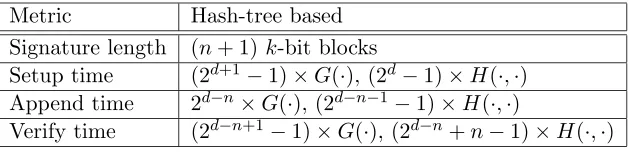
We give the efficiency of this scheme in Table 4. We prove aos-uf-cma security of the AOS3 scheme assuming the security of the underlying functions G(·) and H(·,·):
Theorem 3.2 If G(·) is a secure pseudorandom generator, G0(·), G1(·), are secure one-way functions and H(·,·), G0(·), and G1(·) are all collision-resistant hash functions, then AOS3 is aos-uf-cma secure.
Metric Hash-tree based Signature length (n+ 1)k-bit blocks
Setup time (2d+1−1)×G(·), (2d−1)×H(·,·)
Append time 2d−n×G(·), (2d−n−1−1)×H(·,·)
Verify time (2d−n+1−1)×G(·), (2d−n+n−1)×H(·,·)
Table 4: Efficiency of the hash-tree based scheme AOS3. d represents the maximum message length,n represents the length of a given message, andkis the security parameter.
3.5 AOS via One-time Signatures
We observe that we can combine the ideas of certificate-based AOS (Section 3.1) and hash-tree AOS (Section 3.4) to gain a more efficient append-only signature scheme when the message space is small. Assume the message space AOS.MSpace consists of m elements. Then we can use our certificate-based constructionAOS1 instantiated with am-time signature scheme. m -time signatures can be efficiently constructed using hash-trees (see [BM96], [HM02], [Mer88], and [RR02] for the definition and efficient constructions of m-time signatures). In addition, the security proof ofAOS1 guarantees unforgeability ifSGN is at least an |AOS.MSpace|-time signature scheme. Note that in contrast to AOS3, the length of the AOS messages in this construction is unbounded2.
4
Relations between HIBS and AOS
In this section, we show that the concepts of AOS and Hierarchical Identity-based Signatures (HIBS) are in fact equivalent. Before we present the poly-time reductions between the AOS and HIBS, we first review related concepts and relationships.
In Identity-based Signature (IBS) schemes, the identity of a sender (for example, an email address) is used as a public key for verification of the signature. This approach assumes the existence of a trusted party (the certificate authority), which assigns secret keys to all users. The certificate authority has a pair of keys: a master public key and a master secret key; the master secret key is used to delegate keys to the users and the master public key is used for signature verification. Anyone can verify signatures on messages signed by any user, knowing only the master public key and the identity of that user.
Hierarchical Identity-based Signature (HIBS) schemes are a natural generalization of IBS to the setting with a hierarchical organization of users. Assume that the users are structured in a tree with a root being the certificate authority. Descendants of a user are the usernames that contain this user’s name as a prefix; the canonical example involves domain names. In HIBS, each individual user can play the role of a certificate authority and can delegate secret keys to his descendants. As in IBS, a secret key allows a user to sign arbitrary messages such that anyone is able to verify the signature knowing only the identity of the sender and the master public key (announced by the certificate authority, who can be viewed as the root user). A formal description of HIBS follows.
encrypt data to any user in the hierarchy knowing only the user’s identity and the master public key; the ciphertext can only be decrypted using the user’s secret key.
As noted by Naor (see Section 6 of [BF03]), any IBE scheme can readily be converted into a public key signature scheme (by interpreting user identities of IBE as messages for a regular signature scheme and defining the signature of a message to be the secret key associated with the corresponding identity). Similarly, any HIBE scheme can be transformed into a HIBS scheme. This was sketched by Gentry and Silverberg [GS02], giving the construction for a HIBS scheme. We note that the converse (transforming HIBS into HIBE) is not known to be possible. Related to these are Forward-secure Signature (FSS) schemes, which modify a secret key over time (while the public key remains the same) such that exposure of the secret key at a certain time period does not allow forgery of signatures from previous time periods. (See [BM99] for an exact definition of FSS.) In [CHK03] it is proved that HIBE implies Forward-secure Encryption (FSE) (which is defined as FSS with signing replaced by encryption). Using the same construction it is easy to show that HIBS implies FSS (as explicitly noted in [CHYC04]). More precisely, a HIBS scheme of depthdcan be used to construct a forward-secure scheme providing security for 2d time steps (using a tree-based construction). The converse (transforming FSS into HIBS) is
not known to be possible. Thus, relating HIBE, HIBS, AOS, and FSS, we obtain the following hierarchy:
HIBE⇒HIBS⇔AOS⇒FSS
In particular, given a secure HIBE scheme, we can construct a secure AOS scheme and given a secure AOS scheme, it is easy to obtain a secure FSS scheme.
4.1 Definition of HIBS
We recall the syntax of Hierarchical Identity-based Signature (HIBS) schemes and the appropri-ate notions of unforgeability. LetHIBS.IDSpacebe any set of identities (typically{0,1}∗). For an integern≥0, a username at the levelnin the tree (called hierarchical identity of depth n) is an (ordered) n-tuple of identities written as I[1..n] = (I1, I2, . . . , In) with eachIi ∈HIBS.IDSpace.
The special case of n = 0 is the root identity, denoted as I[1..0] or ε. Further on, we will refer to strings fromHIBS.IDSpace as identities and to n-tuples of them as hierarchical identi-ties. We use the symbol v to denote the prefix relation over the set of hierarchical identities: for a given hierarchical identity I[1..n] = (I1, I2, . . . , In), any hierarchical identity from the set
{I[1..i],0≤i≤n}is its prefix. Note that the root identityεis a prefix of any other hierarchical identity.
A HIBS schemeHIBS with respect to the message spaceHIBS.MSpaceand the identity space HIBS.IDSpace is made up of four algorithms: a setup algorithm HIBS.Setup, a key delegation algorithmHIBS.KeyDel, a signature algorithmHIBS.Sign, and a verification algorithmHIBS.Vfy. • HIBS.Setup (the setup algorithm) takes as input a security parameter and generates the master public keyHIBS.pkof the scheme and the secret key of the root identityHIBS.SK[ε] (the master secret key).
• HIBS.KeyDel(the key delegation algorithm) takes as input a hierarchical identityI[1..n] = (I1, . . . , In), its associated secret keyHIBS.SK[I[1..n]], and an identityIn+1 ∈HIBS.IDSpace of its child. It returns a secret keyHIBS.SK[I[1..n+1]] associated with the new hierarchical identityI[1..n+ 1] = (I1, . . . , In, In+1).
message M with respect to this identity.
• HIBS.Vfy (the verification algorithm) takes the master public key HIBS.pk, a hierarchical identity I[1..n], a messageM, and a signature sig. It outputs true or falsedepending on whethersigis a valid signature ofM signed by hierarchical identity I[1..n].
All these algorithms can be randomized. All of them must be polynomial-time in the security parameter. Moreover, it is required that for all pairs (HIBS.pk,HIBS.SK[ε]) of master public and secret keys output byHIBS.Setup, and for all messagesM ∈HIBS.MSpace, hierarchical identities I[1..n] and associated secret keys HIBS.SK[I[1..n]] (recursively generated from the secret key HIBS.SK[ε] using the HIBS.KeyDelalgorithm),
HIBS.Vfy(HIBS.pk, I[1..n],HIBS.Sign(HIBS.SK[I[1..n]], I[1..n]),M), M) =true.
Unforgeability of the HIBS schemeHIBS under chosen-plaintext attacks is formally defined as follows:
Definition 4.1 [HIBS-UF-CMA] Let HIBS = (HIBS.Setup,HIBS.KeyDel,HIBS.Sign,HIBS.Vfy) be a hierarchical identity-based signature scheme, letk be the security parameter, and letAbe an adversary. We consider the experiment:
Experiment Exphibs-uf-cmaHIBS,A (k)
IDSet ← ∅; (HIBS.pk,HIBS.SK[ε])←HIBS.Setup(1k
) (I[1..n],M,sig)← ACorrupt(·),Sign(·,·)(HIBS.pk) if HIBS.Vfy(I[1..n],M,sig) =true
and∀J[1..j]vI[1..n] : J[1..j]6∈IDSet
and(I[1..n],M)6∈MSGSet
then return 1else return0
OracleCorrupt(I[1..n])
IDSet←IDSet∪ {I[1..n]} returnExtract(I[1..n])
OracleSign(I[1..n],M)
MSGSet←MSGSet∪ {(I[1..n],M)}
HIBS.SK[I[1..n]]←Extract(I[1..n])
returnHIBS.Sign(HIBS.SK[I[1..n]], I[1..n],M)
OracleExtract(I[1..i]) // defined recursively
if i= 0returnHIBS.SK[ε] else if HIBS.SK[I[1..i]] = defined
then returnHIBS.SK[I[1..i]]
elseHIBS.SK[I[1..i]]←HIBS.KeyDel(HIBS.pk, I[1..i−1],Extract(I[1..i−1]), Ii)
returnHIBS.SK[I[1..i]]
The hibs-uf-cma-advantage of an adversary A in breaking the security of the scheme HIBS is defined as
AdvhibsHIBS-uf,A-cma(k) = Pr[ExphibsHIBS-uf,A-cma(k) = 1 ],
and HIBS is said to be existentially unforgeable under chosen message attacks (hibs-uf-cma-secure) if the above advantage is a negligible function ink for all polynomial-time adversaries A. Note that the adversary is given access to the two oraclesCorrupt(·) andSign(·,·), not to
the oracleExtract(·). The latter one is only used internally by the experiment.
4.2 Constructing AOS from HIBS
The idea of the reduction is as follows. We set AOS.MSpace =HIBS.IDSpace and associate an AOS message (M1, . . . , Mn) of length nwith the hierarchical identity I[1..n] = (M1, . . . , Mn) of
Given the above analogy between signatures of messages and secret keys of hierarchical identities, we construct an AOS scheme given a HIBS scheme as follows. Appending to a given signature in AOS is done using key delegation in HIBS. The verification of an AOS signature HIBS.SK[I[1..n]] is done by signing a random message M ∈ HIBS.MSpaceunder the secret key HIBS.SK[I[1..n]] and verifying that the resulting signature is valid.
Construction 4.2 Given a HIBS schemeHIBS = (HIBS.Setup,HIBS.KeyDel,HIBS.Sign,HIBS.Vfy), we construct an AOS schemeAOS = (AOS.Setup,AOS.Append,AOS.Vfy) as follows:
• AOS.Setup: Run the HIBS.Setup algorithm to generate a pair (HIBS.pk,HIBS.SK[ε]) and output (HIBS.pk,HIBS.SK[ε]) as the key pair for AOS. HIBS.SK[ε] is the signature of an empty message ε.
• AOS.Append: Given the public keyAOS.pk, signatureSig[M[1..n]] of the messageM[1..n], and the message Mn to append, the AOS signature on Sig[M[1..n+ 1]] is returned as
Sig[M[1..n+ 1]]←HIBS.KeyDel(HIBS.pk,Sig[M[1..n]], Mn+1).
• AOS.Vfy: Given a public key AOS.pk, a messageM[1..n], and a signatureSig[I[1..n]], the verification algorithm first signs a random message M ∈HIBS.MSpace under hierarchical identityM[1..n] using Sig[I[1..n]] as a secret key of M[1..n] inHIBS:
sig←HIBS.Sign(I[1..n],Sig[I[1..n]],M).
Then it outputs the result of theHIBS verification HIBS.Vfy(HIBS.pk, I[1..n],M,sig). Theorem 4.3 If the HIBS scheme HIBS = (HIBS.Setup,HIBS.KeyDel,HIBS.Sign,HIBS.Vfy) is hibs-uf-cma secure, then the AOS scheme from Construction 4.2 is aos-uf-cma secure.
We omit the proof of Theorem 4.3.
4.3 Constructing HIBS from AOS
A naive approach to building a HIBS schemeHIBS from an AOS schemeAOS is to first append all the identities and then to append a message to be signed. That is, both the identity space HIBS.IDSpace and the message space HIBS.MSpace of HIBS are subsets of the message space AOS.MSpace of theAOS scheme. The secret key of a hierarchical identity I[1..n] in this HIBS scheme is exactly the AOS signature ofI[1..n] viewed as the AOS message. Delegation in HIBS is equivalent to appending in AOS. Signing a messageM with respect to a hierarchical identity I[1..n] is defined by appending M to the AOS signature of I[1..n].
This naive construction is secure only ifHIBS.IDSpaceandHIBS.MSpaceare disjoint subsets of AOS.MSpace. If there is some identity J which itself is a valid message, the security of the HIBS scheme can be broken even if its corresponding AOS is secure. An adversary could query the HIBS signing oracle with a message J and some hierarchical identityI[1..n]. The resulting signature equals the secret key for the hierarchical identity (I1, . . . , In, J), which violates the
security of the HIBS scheme.
Construction 4.4 HIBS = (HIBS.Setup,HIBS.KeyDel,HIBS.Sign,HIBS.Vfy):
• HIBS.Setup(1k): Run theAOS.Setup(1k) algorithm to generate a pair (AOS.pk,Sig[ε]) and
output it as the master public/private key pair for HIBS.
• HIBS.KeyDel(HIBS.pk,HIBS.SK[I[1..n]], In+1): Given the master public key, the secret key of hierarchical identityI[1..n], and a new identityIn+1, the delegation algorithm interprets HIBS.SK[I[1..n]] as an AOS signature of I[1..n]. It appends to the signature a message In+1 and outputs the resulting signature as the secret key ofI[1..n+ 1]:
HIBS.SK[I[1..n+ 1]]←AOS.Append(HIBS.pk,HIBS.SK[I[1..n]], In).
• HIBS.Sign(HIBS.pk,HIBS.SK[In],M): Given a master public key, a secret key of the
hi-erarchical identity I[1..n], and a message M, the sign algorithm for HIBS interprets HIBS.SK[I[1..n]] as anAOS signature ofI[1..n]. It appends a symbol ∆ toHIBS.SK[I[1..n]] and then appends a message M to the resulting AOS signature to get the final signature
sig:
sig←AOS.Append(HIBS.pk,AOS.Append(HIBS.pk,HIBS.SK[I[1..n]],∆),M). • HIBS.Vfy(HIBS.pk, I[1..n],M,sig): Given a master public key, a hierarchical identity
I[1..n], a signaturesig, and a messageM, the verification algorithm forHIBS returns the output of
AOS.Vfy(HIBS.pk,(I1, . . . , In,∆,M),sig).
Theorem 4.5 If the AOS scheme AOS = (AOS.Setup,AOS.Append,AOS.Vfy) is aos-uf-cma secure, then the HIBS schemeHIBS from Construction 4.4 is hibs-uf-cma secure.
Proof:Given an adversaryAattacking the hibs-uf-cma security of theHIBS scheme with suc-cess probabilityAdvhibs-uf-cmaHIBS,A (k), we can construct an adversaryBthat attacks the aos-uf-cma security ofAOS with success probability
AdvaosAOS-uf,B-cma(k)≥Advhibs-uf-cmaHIBS,A (k).
As in Definition 2.1, adversary B gets input a public key AOS.pk for the AOS scheme. B runs the HIBS-UF-CMA experiment againstHIBS as well as an instance of adversaryA. Bgives as input toAthe master public keyHIBS.pk=AOS.pk. AdversaryBanswers the oracle queries of adversaryA using the oracleAOSSign(·) forAOS as follows:
Corrupt(I[1..n]):
HIBS.SK[I[1..n]]←$ AOSSign(I[1..n]) return HIBS.SK[I[1..n]] toA.
Sign(I[1..n], M):
sig0←$ AOSSign(I[1..n])
sig1←$ AOS.Append(AOS.pk,sig0,∆)
Eventually, adversary A halts and outputs the triple (I∗[1..n],M∗,sig∗), which consists of a target hierarchical identity I∗[1..n], a message M∗, and a forged signature sig∗. Adversary B then outputssig∗ as the forgery of messageM∗[1..n+ 2] = (I1∗, . . . , In∗,∆,M∗). This completes the description of the simulation.
It is easy to see that B perfectly simulates the two oracles Corrupt(·) and Sign(·,·); that is, B’s responses on A’s queries are distributed exactly as in the true HIBS-UF-CMA experiment. Note that if sig∗ is a valid signature of M∗ with respect to the hierarchical identity I∗[1..n], thensig∗ is also a valid AOS signature on the messageM∗[1..n+ 2].
The fact that ∆6∈HIBS.IDSpaceensures that the message M∗[1..n+ 2] was never queried byB to the oracleAOSSign(·) when simulating the oracle Corrupt(·). Furthermore, ifA’s forgery
is valid, no prefix of the hierarchical identityI∗[1..n] can be queried to the oracleCorrupt(·)
by Aand hence no prefix of M∗[1..n+ 2] was queried to the oracleAOSSign(·) byB. Also, A
is not allowed to call oracle Sign(·) for the tuple (I∗[1..n],M∗). This ensures that no prefix of M∗[1..n+ 2] was ever queried to oracle AOSSign(·) when simulating oracle Sign(·,·). Thus,
whenever Aoutputs a valid forgery, B wins AOS-UF-CMA game againstAOS.
The above reduction uses the existence of a symbol ∆ such that ∆ ∈ AOS.MSpace but ∆6∈HIBS.IDSpace. For the case that HIBS.IDSpace=AOS.MSpace, there is an alternative way of constructing a HIBS from an AOS scheme. We sketch the construction for the interesting binary case—that is, forHIBS.IDSpace=AOS.MSpace=HIBS.MSpace={0,1}.
The HIBS secret key of the hierarchical identityI[1..n] is then defined to be the AOS signa-ture of (I1,0, I2,0, . . . , In,0). The HIBS signature ofM under the hierarchical identityI[1..n] is
defined as the AOS signature of (I1,0, . . . , In,0, M,1). The security proof of the resulting HIBS
scheme is a natural modification of the proof of Theorem 4.5.
4.4 Discussion
Given the equivalence between the AOS and HIBS schemes, one can easily transform all our constructions in Section 3 into provably secure HIBS schemes. Note that since the reductions are tight, an efficient AOS implies an efficient HIBS and vice-versa. The advantages of this indirect approach to designing HIBS are twofold. First, AOS is a much simpler primitive than HIBS; security proofs for AOS schemes are easier to carry out than those for HIBS. Second, some of the tricks used in efficient AOS schemes (for example, the hash-tree based construction) could yield more efficient HIBS constructions.
5
Applications
In this section, we describe two practical scenarios in which append-only signatures are directly applicable.
5.1 Wide-area Routing Protocol Security
An important application of AOS is in the construction of secure routing protocols for the Internet. The Border Gateway Protocol (BGP), which is the primary routing protocol used today in the Internet, has some well-known security weaknesses which require cryptographic solutions. While there have been many proposals for securing BGP in the past [KLS00, HPS04, SRS+04, WKvO05], each must develop its own cryptographic constructions due to the lack of any primitive designed specifically for this application. In the discussion below, we briefly describe Internet routing and explain how our primitive is useful for ensuring one of the most important security requirements in BGP, namely path authenticity. Indeed, providing a sufficient cryptographic primitive for this problem led us to design AOS.
We begin with BGP, the Internet’s primary routing protocol, which is tasked with advertising paths from one network to all other networks. Each network, named by an Autonomous System (AS) number, uses BGP to advertise the sets of IP addresses it is responsible for to its neighbor ASes. Each AS, upon receiving such advertisements, appends itself to the list of ASes on the forwarding path and repropagates the advertisement if it adheres to some local policies. When an AS receives two path advertisements for the same IP address space, it must make a decision as to which it wishes to use for its purposes and also to propagate to neighbors. Finally, once the set of routes have converged, these routes are used for packet forwarding; for each packet, the router looks up the destination IP address and forwards it to the neighbor AS as given by the BGP path advertisement.
Unfortunately, this path advertisement process also allows for any intermediate AS to hijack the process by changing advertisements arbitrarily. For example, if an AS truncates the AS path in an advertisement, then its neighbors will receive an advertisement shorter than the true path (typically causing them to prefer it). In the worst case, an AS can use this attack to convince its neighbors to forward all their traffic to it, which it could then modify or drop at will. (There are several other classes of attacks against BGP, but path modification and truncation are the most significant.)
advertisement process continues in this manner until all ASes in the network receive information about a path toR0. Each recipient can verify the validity of the announced path by verifying the corresponding AOS signature using the public key AOS.pk. If the AOS scheme is secure according to our definition (defn. 2.1), then all that a malicious AS can do is append the label of one of its neighbors into the AOS signature chain (since each neighborRi can check that the
AS it receives an advertisement from was the last to be appended beforeRi4).
In practice, the number of path advertisements received by any AS to a given source ASR0 is extremely small: as observed in real routing data [HPS04], the odds that an AS receives more than 15 path advertisements coming from the same source are about 1 in a 1000. This allows the use of efficient m-time signature schemes (as in Section 3.5), with m equal to 15, in order to implement the AOS scheme in the above protocol and obtain a reasonable level of security.
5.2 Secure Delegation of Resources
Fuet al. describe the SHARP system for distributed resource management, in which users wish to share their resources with each other in a fully decentralized system [FCC+03]. Central to this system is the notion of a claim—users are issued claims on resources which they present upon resource use. These claims are signed such that they can be verified to be valid by third parties. Furthermore, users can delegate their claims to others, restricting them in the process. In this setting, the resource owner wishes to place some restrictions on how her resources are delegated. Their setting allows for a direct application of AOS. Quite simply, each resource provider, when initially issuing a resource claim, appends to an AOS the amount of resources to be given. Upon delegation, subsequent parties simply append to the signature what fraction of the existing claim is to be delegated. Upon claiming resources, the holder of the sub-delegated claim cannot use more than the fraction of the original resources indicated by the AOS signature.
6
Final Remarks and Open Problems
6.1 Finalization of AOS signature
An interesting feature of append-only signature schemes which might be needed by some appli-cations is the ability to “finalize” the signature, that is, to modify the signature of a message in the way which prohibits any further appending. The general solution to this problem is to use a special symbol Θ (from the message space) to denote the end of the message. When one wants to finalize the signature of some message, he should append Θ to the signature. Messages that contain symbol Θ in the middle of the message (not as the last symbol) are therefore considered to be invalid.
6.2 Restricted AOS
In AOS, anyone can append and verify signatures. In certain scenarios, however, one may want to restrict the ability to append messages to a limited group of users. Still, anyone should be able to verify the signatures. We call this extension of AOSRestricted Append-Only Signatures (RAOS).
Let U be a group of users allowed to perform the append operation. We assume that all members of the group U are given some key K of an (symmetric) encryption scheme EN C = (ENC,DEC).
We modify a given AOS scheme to get a RAOS scheme as follows: Define the RAOS signature of a messageM[1..n] = (M1, . . . , Mn) as the tuple
Sig0 = (ENCK(Sig(M[1..n])),Sig(M1, . . . , Mn,Θ)),
where Θ is the finalization symbol from the last paragraph. In order to append the message Mn+1 to a given RAOS signature on M[1..n], a member of the group U decrypts the first part of the RAOS signature with her key K to obtain Sig(M[1..n]). She then appends Mn+1 using the originalAOS.Appendalgorithm. Finally, she outputs the new RAOS signature tuple by encryptingSig(M[1..n+1]) and appending Θ toSig(M[1..n+1]). Note that without knowledge of the key K, the AOS signatureSig(M[1..n]) remains secret and hence appending cannot be performed. Public verification is done by verifying if the second part of the RAOS signature is a valid AOS signature on the message (M1, . . . , Mn,Θ).
6.3 Shorter AOS signatures
Given that wide-area routing protocols propagate a large number of messages, compact signa-tures are desirable. Thus we raise an open problem of whether it is possible to build an AOS scheme with constant signature length (in both message length and maximal message length). This problem is equivalent to building a HIBS scheme where secret keys of the users have con-stant length (in the depth of the given user in the hierarchy and in the maximal depth of the hierarchy).
So far the best we can get is the construction from Section 3.3 which provides an AOS scheme that can sign messages of length up tonsymbols with signatures of lengthO(√n). This construction translates to a HIBS scheme with n-level deep hierarchy, where the secret key of each user has lengthO(√n).
Acknowledgments
We would like to thank Mihir Bellare (for suggesting an improvement to the proof of Theo-rem 3.1) and Daniele Micciancio (for some useful insight about the definition of AOS). Thanks also to the anonymous reviewers for pointing out errors and suggesting improvements.
References
[AR00] Michel Abdalla and Leonid Reyzin. A new forward-secure digital signature scheme. In Tatsuaki Okamoto, editor,Advances in Cryptology – ASIACRYPT 2000, volume 1976 of Lecture Notes in Computer Science, pages 116–129, Kyoto, Japan, Decem-ber 3–7, 2000. Springer-Verlag, Berlin, Germany.
[BBG05] D. Boneh, X. Boyen, and E.-J. Goh. Hierarchical identity based encryption with constant size ciphertext. In Ronald Cramer, editor, Advances in Cryptology – EU-ROCRYPT 2005, Lecture Notes in Computer Science, page ???? Springer-Verlag, Berlin, Germany, May 22–26, 2005.
[BF03] Dan Boneh and Matthew K. Franklin. Identity based encryption from the Weil pairing. SIAM Journal on Computing, 32(3):586–615, 2003.
[BGG94] Mihir Bellare, Oded Goldreich, and Shafi Goldwasser. Incremental cryptography -the case of hashing and signing. In Yvo Desmedt, editor, Advances in Cryptology – CRYPTO’94, pages 57–66. Springer-Verlag, Berlin, Germany, August 21–25, 1994. [BGG95] Mihir Bellare, Oded Goldreich, and Shafi Goldwasser. Incremental cryptography
and application to virus protection. In 27th Annual ACM Symposium on Theory of Computing, pages 57–66, Las Vegas, Nevada, USA, May 29 – June 1, 1995. ACM Press.
[BGLS03] Dan Boneh, Craig Gentry, Ben Lynn, and Hovav Shacham. Aggregate and verifiably encrypted signatures from bilinear maps. In Eli Biham, editor, Advances in Cryp-tology – EUROCRYPT 2003, volume 2656 of Lecture Notes in Computer Science, pages 416–432, Warsaw, Poland, May 4–8, 2003. Springer-Verlag, Berlin, Germany. [BM96] Daniel Bleichenbacher and Ueli M. Maurer. Optimal tree-based one-time digital signature schemes. In STACS ’96: Proceedings of the 13th Annual Symposium on Theoretical Aspects of Computer Science, pages 363–374. Springer-Verlag, 1996. [BM99] Mihir Bellare and Sara Miner. A forward-secure digital signature scheme. In
Michael J. Wiener, editor, Advances in Cryptology – CRYPTO’99, volume 1666 of Lecture Notes in Computer Science, pages 431–448, Santa Barbara, CA, USA, August 15–19, 1999. Springer-Verlag, Berlin, Germany.
[CHK03] Ran Canetti, Shai Halevi, and Jonathan Katz. A forward-secure public-key encryp-tion scheme. In Eli Biham, editor, Advances in Cryptology – EUROCRYPT 2003, volume 2656 ofLecture Notes in Computer Science, pages 255–271, Warsaw, Poland, May 4–8, 2003. Springer-Verlag, Berlin, Germany.
[CHYC04] S. S. M. Chow, L. C. K. Hui, S. M. Yiu, and K. P. Chow. Secure hierarchical identity based signature and its application. In Proceedings of ICICS 2004, pages 480–494, 2004.
[FCC+03] Yun Fu, Jeffrey Chase, Brent Chun, Stephen Schwab, and Amin Vahdat. SHARP: an architecture for secure resource peering. InProceedings of the 19th ACM Symposium on Operating System Principles (SOSP), Bolton Landing, NY, October 2003. [Gol01] Oded Goldreich. Foundations of Cryptography: Basic Tools, volume 1. Cambridge
University Press, Cambridge, UK, 2001.
[Gol04] Oded Goldreich. Foundations of Cryptography: Basic Applications, volume 2. Cam-bridge University Press, CamCam-bridge, UK, 2004.
in Computer Science, pages 548–566, Queenstown, New Zealand, December 1–5, 2002. Springer-Verlag, Berlin, Germany.
[HM02] A. Hevia and D. Micciancio. The provable security of graph-based one-time signa-tures and extensions to algebraic signature schemes. In Yuliang Zheng, editor, Ad-vances in Cryptology – ASIACRYPT 2002, volume 2501 of Lecture Notes in Com-puter Science, pages 379 – 396, Queenstown, New Zealand, December 1–5, 2002. Springer-Verlag, Berlin, Germany.
[HPS04] Yih-Chun Hu, Adrian Perrig, and Marvin Sirbu. SPV: secure path vector routing for securing BGP. In Proceedings of the ACM SIGCOMM Conference, pages 179–192, 2004.
[JMSW02] Robert Johnson, David Molnar, Dawn Xiaodong Song, and David Wagner. Homo-morphic signature schemes. In Bart Preneel, editor, Topics in Cryptology – CT-RSA 2002, volume 2271 of Lecture Notes in Computer Science, pages 244–262, San Jose, CA, USA, February 18–22, 2002. Springer-Verlag, Berlin, Germany.
[KLS00] Stephen Kent, Charles Lynn, and Karen Seo. Secure border gateway protocol (S-BGP). IEEE Journal on Selected Areas in Communications, 18(4):582–592, 2000. [LMRS04] Anna Lysyanskaya, Silvio Micali, Leonid Reyzin, and Hovav Shacham. Sequential
aggregate signatures from trapdoor permutations. In Christian Cachin and Jan Camenisch, editors, Advances in Cryptology – EUROCRYPT 2004, volume 3027 of Lecture Notes in Computer Science, pages 74–90, Interlaken, Switzerland, May 2–6, 2004. Springer-Verlag, Berlin, Germany.
[Mer88] Ralph C. Merkle. A digital signature based on a conventional encryption function. In Carl Pomerance, editor, Advances in Cryptology – CRYPTO’87, volume 293 of Lecture Notes in Computer Science, pages 369–378, Santa Barbara, CA, USA, Au-gust 16–20, 1988. Springer-Verlag, Berlin, Germany.
[MOR01] Silvio Micali, Kazuo Ohta, and Leonid Reyzin. Accountable-subgroup multisigna-tures. InACM CCS 01: 8th Conference on Computer and Communications Security, pages 245–254, Philadelphia, PA, USA, November 5–8, 2001. ACM Press.
[MR02] Silvio Micali and Ronald L. Rivest. Transitive signature schemes. In Bart Pre-neel, editor, Topics in Cryptology – CT-RSA 2002, volume 2271 of Lecture Notes in Computer Science, pages 236–243, San Jose, CA, USA, February 18–22, 2002. Springer-Verlag, Berlin, Germany.
[Rom90] John Rompel. One-way functions are necessary and sufficient for secure signatures. In 22nd Annual ACM Symposium on Theory of Computing, pages 387–394, Balti-more, Maryland, USA, May 14–16, 1990. ACM Press.
[RR02] Leonid Reyzin and Natan Reyzin. Better than biba: Short one-time signatures with fast signing and verifying. In Proceedings of 7th Australasian Conference ACSIP, 2002.
[SRS+04] Lakshminarayanan Subramanian, Volker Roth, Ion Stoica, Scott Shenker, and Randy Katz. Listen and whisper: Security mechanisms for bgp. In Proceedings of USENIX/ACM NSDI, 2004.
[WKvO05] Tao Wan, Evangelos Kranakis, and P.C. van Oorschot. Pretty secure BGP (psBGP). In Proceedings of ISOC NDSS, 2005.
A
Public Key Signature Schemes
A public key signature schemeSGN = (SGN.G,SGN.S,SGN.V) is a collection of three algorithms: a key generation algorithm SGN.G, a signing algorithm SGN.S, and a verification algorithm SGN.V. These algorithms must be polynomial time in the security parameter and should have the following input/output specification:
• SGN.Gtakes as input the security parameter 1k and outputs a secret key/public key pair
(sk,pk). The public key also includes some system parameters like the description of the message spaceSGN.MSpace.
• SGN.S takes as input a message M ∈ SGN.MSpace and produces a string sig which is called a signature of a messageM.
• SGN.Vtakes as input a public keypk, a messageM and a signaturesig and returns either
trueor false.
The verification algorithm must accept all signatures produced by the signing algorithm, namely the following should hold for every (sk,pk) produced bySGN.G(k), every messageM ∈SGN.MSpace and every choice of random coins:
SGN.Vpk(M,SGN.Ssk(M)) =true.
Next we define unforgeability under chosen message attacks (sig-uf-cma) for a signature scheme.
Definition A.1 [SIG-UF-CMA] LetSGN be a signature scheme, letk be a security parameter, and letA be an adversary. We consider the following experiment:
Experiment Expsig-uf-cmaSGN
,A (1
k
)
MSGSet← ∅; (sk,pk)←$ SGN.G(1k
) (M,sig)← A$ Sign(·)(pk) if SGN.V(M,sig) =true
andM not inMSGSet,return1 else return0
OracleSign(M)
sig←$ SGN.Ssk(M)
MSGSet←MSGSet∪ {M}
returnsig
The sig-uf-cma advantage of an adversaryA in breaking security of the schemeSGN is defined as
Advsig-uf-cmaSGN,A (k) = Pr[Expsig-uf-cmaSGN,A (k) = 1 ].
B
Proof of Theorem 3.1
We show that for any adversary A against AOS1, there exists an adversary B against SGN running in about the same time asA such that
Advaos-uf-cmaAOS1,A (k)≤s·Advsig-uf-cmaSGN,B (k).
The reduction factor sis the upper bound on the number of messages M for which Sig[M] is defined by the Extract(·) oracle in the experiment Expforge-cma
AOS1,A(k). This bound should be known by B before she runs the simulation of A and the bound should hold for any choice of the public key, for any random coins ofAand for any oracle responses. The number scould be also upper bounded byqe·d, whereqe is the maximal number ofAOSSign(·) queries made by
Aand dis the maximal length of the queries.
Now we proceed to the construction of adversary B who attacks the unforgeability of the public key signature scheme SGN. In the sig-uf-cma experiment the challenger runs a key generation algorithmSGN.G(1k) to get a pair of keys (sk,pk) and gives pk as input toBas well
as an access to theSGN.Ssk(·) oracle.
During its execution B will construct a set T that at each moment of time will contain all the messages M for which Sig[M] is already defined by Extract(·). This set plays the
same role as in the original aos-uf-cma experiment. The only difference is that now, for each messageM[1..n]∈T, we will keep not only a signatureSig[M[1..n]] but also a pair of elements (skM[1..n],pkM[1..n]). The latter will correspond to the secret key/public key pair for SGN
generated by Extract(·) oracle when computing the signature for M[1..n]. The pseudocode
for the adversaryB is given below: AdversaryB(1k,pk):
Pickguess←$ [1, . . . , s]; ctr←1;T ← ∅ if guess= 1 thenpk²←pk; sk² ←false
else(sk²,pk²)
$
←SGN.G(1k)
SetAOS.pk←pk² and defineSig[²]← {sk²}
Add²toT
RunA(1k,AOS.pk) and answer its AOSSign(·) queries as follows:
AOSSign(M[1..n]) :
Sig←$ Extract(M[1..n]); parse Sigas{pk
M[1],sig1, . . . ,pkM[1..n],sign,skM[1..n]}
if skM[1..n]6=false then returnSigtoAelse haltB; return Failure. Extract(M[1..n]) : // defined recursively
if M[1..n]∈T then returnSig[M[1..n]]
elseSig←$ Extract(M[1..n−1]); parse Sigas{pk
M[1],sig1, . . . ,pkM[n−1],sign−1,skM[n−1]} ctr←ctr+ 1
if guess=ctr thenM+[1..n+]←M[1..n]; set (sk
M+[1..n+],pkM+[1..n+])←(false,pk) else (skM[1..n],pkM[1..n])
$
←SGN.G(1k)
if skM[1..n−1]=6 false thensign←$ SGN.SskM[1..n−1](mn,pkM[1..n]) else getsign by querying (mn,pk) to the SGN.Ssk(·) oracle.
DefineSig[M[1..n]] ={pkM[1],sig1, . . . ,pkM[1..n],sign,skM[1..n]}