On security of XTR public key cryptosystems
against Side Channel Attacks
?Dong-Guk Han1??, Jongin Lim1? ? ?, and Kouichi Sakurai2
1 Center for Information and Security Technologies(CIST), Korea University, Seoul, KOREA
{christa,jilim}@korea.ac.kr
2 Department of Computer Science and Communication Engineering 6-10-1, Hakozaki, Higashi-ku, Fukuoka, 812-8581, Japan,
Abstract. The XTR public key system was introduced at Crypto 2000. Application of XTR in cryptographic protocols leads to substantial sav-ings both in communication and computational overhead without com-promising security. It is regarded that XTR is suitable for a variety of environments, including low-end smart cards, and XTR is the excellent alternative to either RSA or ECC. In [LV00a,SL01], authors remarked that XTR single exponentiation (XTR-SE) is less susceptible than usual exponentiation routines to environmental attacks such as timing attacks and Differential Power Analysis (DPA). In this paper, however, we in-vestigate the security of side channel attack (SCA) on XTR. This paper shows that XTR-SE is immune against simple power analysis (SPA) un-der assumption that the orun-der of the computation of XTR-SE is carefully considered. However we show that XTR-SE is vulnerable to Data-bit DPA (DDPA)[Cor99], Address-bit DPA (ADPA)[IIT02], and doubling attack [FV03]. Moreover, we propose two countermeasures that prevent from DDPA and a countermeasure against ADPA. One of the counter-measures using randomization of the base element proposed to defeat DDPA, i.e., randomization of the base element using field isomorphism, could be used to break doubling attack. Thus if we only deal with SPA, DDPA, ADPA, and doubling attack as the attack algorithm for XTR-SE, XTR-SE should be added following countermeasures: randomization of the base element using field isomorphism (DDPA and doubling attack) + randomized addressing (ADPA). But the proposed countermeasure against doubling attack is very inefficient. So to maintain the advantage of efficiency of XTR a good countermeasure against doubling attack is actually necessary.
Keywords:XTR Public Key Cryptosystem, Side Channel Attacks, SPA, Data-bit DPA, Address-bit DPA, doubling attack
?This is a “full” version of a paper that will been published in ACISP04.
?? This work was done while the first author visits in Kyushu Univ. and was supported
by the Korea Science and Engineering Foundation (KOSEF). (M07-2003-000-20123-0)
? ? ? This work was supported by the Ministry of Information & Communications, Korea,
1
Introduction
In Crypto 2000 Lenstra and Verheul proposed XTR public key system [LV00a]. It is a novel method that makes use of traces to represent and calculate powers of elements of a subgroup of a finite field. XTR uses the trace overGF(p2) to represent elements of the orderp2−p+1 subgroup ofGF(p6)∗, thereby achieving
a factor 3 size reduction compared to the traditional representation. The security of XTR relies on the difficulty of solving discrete logarithm related problems in the multiplicative group of a finite field.
In general, it is well known that ECC is suitable for a variety of environments, including low-end smart cards and over-burdened web servers communicating with powerful PC clients. But XTR has some advantages such as its very faster parameter and key selection (much faster than RSA, orders of magnitude faster than ECC), small key sizes (much smaller than RSA, comparable with ECC for current security settings), and speed (overall comparable with ECC for current security settings). Combined with its very easy programmability, this makes XTR an excellent public key system for a very wide variety of environments, ranging from smart cards to web serves.
XTR single exponentiation (XTR-SE) [LV00a,SL01] has a rather unusual property that the two computations involved (i.e., if mj = 0 and mj = 1) are very similar and take the same number of instructions. Thus, the instructions carried out in XTR-SE for the two different cases are very much alike. So, authors remarked that XTR-SE is less susceptible than usual exponentiation routines to environmental attacks such as timing attacks and Differential Power Analysis (DPA).
In this paper, we investigate the security of side channel attack (SCA) on XTR. Especially, we consider following four SCA : simple power analysis (SPA), data-bit differential power analysis (DDPA) proposed by Coron [Cor99], address-bit differential power analysis (ADPA) proposed by Itoh et al. [IIT02], and dou-bling attack proposed by Fouque et al. [FV03].
This paper shows that XTR-SE is immune against simple power analysis (SPA) under assumption that the order of the computation of XTR-SE is care-fully considered. As the instructions performed during XTR-SE does not depend on the secret value being processed the order of computation is flexible. For ex-ample, if XTR-SE is implemented as following orderXT RDBL,XT RDBL, and thenXT R C2n−1ifmj= 0, andXT R C2n+1,XT RDBL, and thenXT RDBL ifmj = 1, then the order of the computation can be easily known to an attacker by SPA. Thus if the order of computation of XTR-SE is not considered XTR-SE could not be any more secure against SPA.
XTR-SE is secure against SPA without any countermeasure if the order of the computation is carefully considered, but we will show that XTR-SE is vulnerable to DDPA, ADPA, and doubling attack.
number. In the case of doubling attack randomization of the base element using field isomorphism which is proposed to defeat DDPA could be used to break doubling attack. Note that the randomization of the private exponent method is not secure against doubling attack [FV03].
Thus if we only deal with SPA, DDPA, ADPA, and doubling attack as the attack algorithm for XTR-SE, XTR-SE should be added following countermea-sures: randomization of the base element using field isomorphism (DDPA and doubling attack) + randomized addressing (ADPA).
However, as the proposed countermeasure against doubling attack that is randomization of the base element using field isomorphism is very inefficient, for instance, the cost of XTR-SE with this countermeasure is about 129 times slower than that of XTR-SE without it, the efficiency of XTR-SE with SCA countermeasures could not be comparable with that of ECC or RSA with SCA countermeasures. To maintain the advantage of efficiency of XTR a good coun-termeasure against doubling attack is actually necessary. Construction of efficient countermeasures against doubling attack is an open question.
Note that we hope this first step towards side channel attack on XTR public key cryptosystems will be a motivating starting point for further research.
2
XTR public key system
2.1 Preliminaries
In this section we review some of the results from [LV00a,SL01].
For constructing XTR, primespandq must satisfy following conditions :
– pis prime such thatp(mod3) is a primitive element inZ3. – Φ6(p) has a prime factorq of which the size is more than 160 bits.
Note thatΦ6(X) is 6−thcyclotomic polynomial. The first above condition guaranteesGF(p2) has an optimal normal basis of type I [[M93], Theorem 5.2]. And the subgroup with orderqcannot be embedded in the multiplicative group of any true subfield ofGF(p6) by the second condition [[L97], Lemma 2.4].
Letg be a generator of the orderqsubgroup ofGF(p6)∗.
Definition 1. The trace T r(h) over GF(p2) of h ∈GF(p6) is the sum of the conjugates over GF(p2)of h, i.e.,
T r(h) =h+hp2
+hp4 .
In XTR elements of< g >are represented by their trace overGF(p2). It was shown that actual representation of the elements of< g >and other elements of
GF(p6) can be avoided. Thus, there is no need to represent elements ofGF(p6), however, representation ofGF(p2) is needed. That is to say XTR usesGF(p2) arithmetic to achieveGF(p6) security, without requiring explicit construction of
XTR has two main advantages compared to ordinary representation of ele-ments of< g >:
– It is shorter, since T r(h) ∈ GF(p2), whereas representing an element of
< g >requires in general an element ofGF(p6), i.e., three times more bits. – It allows faster arithmetic, because givenT r(g) andnthe valueT r(gn) can be computed substantially faster thangn can be computed giveng andn.
Throughout this paper,cn denotesT r(gn)∈GF(p2), for some fixedpandg of orderq, whereqdividesΦ6(p). Note that in [LV00a,LV00b,LV01] it is shown howp, q, andc1 can be found quickly.
Lemma 1 ([SL01]). Letx, y, z∈GF(p2) withp≡2 mod 3.
i. Computingxp is free.
ii. Computing x2 takes two multiplications inGF(p).
iii. Computingxy costs the same as two a half multiplications inGF(p). iv. Computing xz−yzp costs the same as three multiplications inGF(p).
Efficient computation ofcn givenp, qandc1is based on the following facts.
Corollary 1 ([LV00a,SL01]). Letc, cn−1, cn andcn+1 be given.
i. c=c1.
ii. c−n =cnp=cpn forn∈Z. iii. cn∈GF(p2)forn∈Z.
iv. c2n=c2n−2cpn takes two multiplications in GF(p).
v. cn+2=c∗cn+1−cp∗cn+cn−1 takes three multiplications in GF(p). vi. c2n−1=cn−1∗cn−cp∗cpn+c
p
n+1 takes three multiplications inGF(p). vii. c2n+1=cn∗cn+1−c∗cpn+c
p
n−1 takes three multiplications inGF(p). LetSn = (cn−1, cn, cn+1)∈GF(p2)3; thusS1 = (3, c1, c21−2c
p
1). The triple
S2n−1= (c2(n−1), c2n−1, c2n) can be computed fromSnandc1by applying Corol-lary 1iv twice to computec2(n−1)andc2n based onc(n−1)andcn, respectively, and by applying Corollary 1vito computec2n−1based onSn= (cn−1, cn, cn+1) andc1. This takes seven multiplications inGF(p). The tripleS2n+1can be com-puted in a similar manner from Sn and c1 at the cost of seven multiplications in GF(p) using Corollary 1 vii.
2.2 XTR Single Exponentiation
In XTR, the algorithm to computeT r(gn) givenT r(g) andn∈Zis needed like the algorithm to compute gn in public key system based on discrete logarithm problem. We call this algorithm as XTR single exponentiation (SE). XTR-SE is as follows.
Output :Sn= (cn−1, cn, cn+1)
- If n < 0, apply this algorithm to −n and c, and apply Corollary 1ii to the resulting value.
- Ifn= 0, then S0= (cp,3, c) (cf. Corollary 1ii). - Ifn= 1, then S1= (3, c, c2−2cp) (cf. Corollary 1iv).
- Ifn= 2, use Corollary 1v andS1 to computec3 and therebyS2.
- Otherwise, to compute Sn forn >2 defineSi =S2i+1 and letm=n. Ifm is even, then replace mbym−1. Letm= 2m+ 1,k= 1, and compute Sk =S3 using Corollary 1iv andS2.
Letm=Plj=0mj2j withm
j ∈ {0,1}andml= 1. Forj=l−1, l−2, . . . ,0 in succession do the following:
– Ifmj= 0 then use
Sk= (c2k, c2k+1, c2k+2) to computeS2k = (c4k, c4k+1, c4k+2). (using Corollary 1iv forc4k andc4k+2and Corollary 1viforc4k+1) – Ifmj= 1 then use
Sk= (c2k, c2k+1, c2k+2) to computeS2k+1= (c4k+2, c4k+3, c4k+4). – Replacek by 2k+mj.
After this iterationk=mandSm=Sm. Ifnis even use
Sm= (cm−1, cm, cm+1) to computeSm+1= (cm, cm+1, cm+2)
(using Corollary 1v) and replace mbym+ 1. As a resultSn=Sm.
Theorem 1 ([SL01], cf. Section 2.4). Given the representation T r(g) ∈ GF(p2), the representation T r(gn)∈GF(p2)can be computed in7 log
2n multi-plications inGF(p), for any integer n.
In above algorithm, the tracec1 ofg in S1 = (c0, c1, c2) can be replaced by the tracectof thet−th powergtofg: withec1=ct,Se1= (ec0,ec1,ec2) = (3, ct, c2t), and by the above theorem, the tripleSev= (ecv−1,ecv,cev+1) = (c(v−1)t, cvt, c(v+1)t) can be computed in 7 log2vmultiplications in GF(p), for any integer v < q.
The only difference between the two different cases in XTR-SE is the appli-cation of Corollary 1 vi ifmj = 0 and of Corollary 1 vii if mj = 1. But, the two computations involved are very similar and take the same number of in-structions. Thus in [[LV00a], Remark 2.3.9] they claimed that XTR-SE is much less susceptible than exponentiation routines to environmental attacks such as timing attacks and Differential Power Analysis.
Notation :Define following three functions:
XT RDBL(cn) :=c2n,
XT R Cn+2(cn−1, cn, cn+1, c) :=cn+2,
XT R C2n−1(cn−1, cn, cn+1, c) :=c2n−1,
Note that XT RDBL, XT R Cn+2, XT R C2n−1, and XT R C2n+1 are de-fined by Corollary 1iv,v,vi, andvii, respectively.
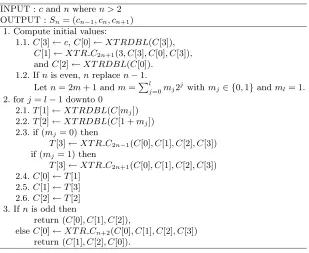
Whenn >2, above XTR-SE could be simplified as following Table 1.
Table 1.XTR Single Exponentiation Algorithm (XTR-SE).
INPUT :candnwheren >2 OUTPUT :Sn= (cn−1, cn, cn+1)
1. Compute initial values:
1.1.C[3]←c,C[0]←XT RDBL(C[3]), C[1]←XT R C2n+1(3, C[3], C[0], C[3]), andC[2]←XT RDBL(C[0]).
1.2. Ifnis even,nreplacen−1.
Letn= 2m+ 1 andm=Plj=0mj2jwithmj∈ {0,1}andml= 1.
2. forj=l−1 downto 0
2.1.T[1]←XT RDBL(C[mj])
2.2.T[2]←XT RDBL(C[1 +mj])
2.3. if (mj= 0) then
T[3]←XT R C2n−1(C[0], C[1], C[2], C[3]) if (mj= 1) then
T[3]←XT R C2n+1(C[0], C[1], C[2], C[3]) 2.4.C[0]←T[1]
2.5.C[1]←T[3] 2.6.C[2]←T[2] 3. Ifnis odd then
return (C[0], C[1], C[2]),
elseC[0]←XT R Cn+2(C[0], C[1], C[2], C[3]) return (C[1], C[2], C[0]).
2.3 Toy example
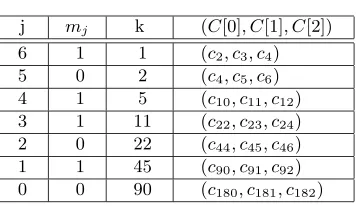
Letn= 181. Thenm= 90 = 26+24+23+2, i.e, (m
6, m5, m4, m3, m2, m1, m0) = (1,0,1,1,0,1,0). Givenc andn,S181 could be computed as following Table 2.
3
Side Channel Attacks on XTR-SE
Table 2.ComputeS181given c. j mj k (C[0], C[1], C[2])
6 1 1 (c2, c3, c4) 5 0 2 (c4, c5, c6) 4 1 5 (c10, c11, c12) 3 1 11 (c22, c23, c24) 2 0 22 (c44, c45, c46) 1 1 45 (c90, c91, c92) 0 0 90 (c180, c181, c182)
In 1999, Messerges et al. proposed a new powerful attack against the secret key cryptosystems, the address-bit DPA (ADPA), which analyzes a correlation between the secret information and addresses of registers [MDS99]. To distin-guish from ADPA, we call general DPA as Data-bit DPA (DDPA).
In 2003, Fouque et al. proposed doubling attack against a classical imple-mentation of the modular exponentiation or scalar multiplication in the ECC that only requires two queries to the device [FV03].
In this section, we investigate the security of side channel attack on XTR, especially SPA, DDPA, ADPA, and doubling attack are considered.
3.1 XTR-SE is secure against SPA
The computation of the XTR-SE requires the computations repeatedly that (XT RDBL, XT RDBL, XT R C2n−1) or (XT RDBL, XT RDBL,
XT R C2n+1) from (C[0],C[1],C[2],C[3]) depending on the value of each bitmj. As XT R C2n−1 and XT R C2n+1 require same multiplications inGF(p), these two operations are indistinguishable from the observation of the power con-sumption. This means that the instructions performed during XTR-SE does not depend on the secret value being processed. Thus XTR-SE is resistant against SPA.
Caution : Since XT RDBLs and XT R C2n−1 (or XT R C2n+1) are indepen-dent, the order of computation is flexible. But the order of the computation is very important. For instance, assume that XTR-SE is implemented as following orderXT RDBL,XT RDBL, and thenXT R C2n−1ifmj= 0, andXT R C2n+1,
XT RDBL, and thenXT RDBLifmj= 1. Then, the order of the computation can be easily known to an attacker by SPA.
Thus, if the order of the computation of XTR-SE is not considered XTR-SE could not be any more secure against SPA.
Remark 1. Similar results could be found in the computation of the scalar mul-tiplication on the Montgomery-form elliptic curves [OS00].
Remark 2. In step 3 in XTR-SE, a dummyXT R Cn+2operation is needed when
3.2 Data-bit DPA against XTR-SE
In this section we describe a DDPA [Cor99] against an implementation of XTR-SE. DDPA on XTR-SE can be performed by noticing that at stepjthe processed
T[1] depends only on the first bits (ml, . . . , mj) ofm. Now assume that we know how field elements are represented in memoryT[i] (orC[i]) during computation and select a particular bit of this representation. When C[i] is processed to updateT[1], power consumption will be correlated to this specific bit ofC[i]. No correlation will be observed with an elementC[i] not computed inside the card . To update T[1] in XTR-SEC[0] is used when mj = 0 and C[1] is used when
mj = 1
Thus it is possible to successively recover the bits of the exponent by guessing whichC[i] are computed by the card.
For example, the second most significant bit ml−1 of m can be recovered by computing the correlation between power consumption and any specific bit of the binary representation ofc4. If ml−1 = 0, c4 is computed in XTR-SE to update T[1], and power consumption is thus correlated with any specific bit of c4. Otherwise if ml−1 = 1, c4 is never computed to update T[1], and no correlation will be observed with c4. This givesml−1. The following bits of m can be recursively recovered in the same way.
3.3 Address-bit DPA against XTR-SE
The address-bit DPA was originally investigated by Messerges, Dabbish and Sloan [MDS99] and Itoh et al. extended the analysis to elliptic curve based cryptosystems [IIT02].
This paper extends the analysis to XTR-SE. Since XTR-SE has similar struc-ture to the Montgomery form elliptic curves, the analysis technic proposed by Itoh et al. could be applicable to XTR-SE.
ADPA [IIT02] is successful if there is a close dependence between a secret value and addresses of accessed registers. Thus if we could find correlations between address value and secret value then XTR-SE is also vulnerable to ADPA.
Following property shows that there are correlations between address value and secret valuemj in XTR-SE.
Property 1. In substep 2.1 and 2.2 in XTR-SE,
– Whenmj = 0
• To updateT[1] read addressC[0].
• To updateT[2] read addressC[1]. – Whenmj = 1
• To updateT[1] read addressC[1].
• To updateT[2] read addressC[2].
3.4 Doubling Attack against XTR-SE
In CHES 2003, Fouque et al. proposed the new attack against a classical imple-mentation of the modular exponentiation or scalar multiplication in the ECC that only requires two queries to the device [FV03]. Their attack only works for theLeft-to-Rightimplementation.
The main idea of the doubling attack is based on the fact that, even if an attacker could not know which computation is done by the device, he/she could at least detect when the device does twice the same operation. Namely, if the device computes 2·X and 2·Y, the attacker could not guess the value ofX or
Y but he/she could check ifX =Y.
First, consider an example. This example is the same as example described in section 2.3. Then we compare the sequence of operations when XTR-SE is used to compute S180 = (c180, c181, c182) given c1 and Se180 = (c180·2, c181·2, c182·2) givenec1=c2. Note that these notations are described in section 2.2.
Table 3.ComputeS181 andSe180 givenc1 andec1=c2, respectively.
ComputeS181 givenc1 ComputeSe181 givenec1=c2 j mj k (C[0], C[1], C[2]) (C[0], C[1], C[2])
6 1 1 (c2, c3, c4) (ec2,ec3,ec4) = (c2·2 , c3·2, c4·2) 5 0 2 (c4, c5, c6) (ec4,ec5,ec6) = (c4·2, c5·2, c6·2) 4 1 5 (c10, c11, c12) (ec10,ec11,ec12) = (c10·2, c11·2, c12·2) 3 1 11 (c22, c23, c24) (ec22,ec23,ec24) = (c22·2, c23·2, c24·2) 2 0 22 (c44, c45, c46) (ec44,ec45,ec46) = (c44·2, c45·2, c46·2) 1 1 45 (c90, c91, c92) (ec90,ec91,ec92) = (c90·2, c91·2, c92·2) 0 0 90 (c180, c181, c182) (ec180,ec181,ec182) = (c180·2, c181·2, c182·2)
From the table 3, we can see thatXT RDBLoperation atj= 5,2,and 0 to updateC[0] in the computationS181is the same as theXT RDBLoperation at 6,3,and 1 to updateC[0] in the computation Se181, respectively.
In XTR-SE, we can easily derive the following property.
Property 2. C[0] is updated as c2k·1 (or c2k·v) in Sn (or Sen when ec1 =cv). If
mi = 0 thenki = 2·ki−1, where ki denotes the value of k when index j =i. Thus ifv= 2 andmi= 0 thenc2ki·1=c2ki−1·2. Ifmi= 1 thenki= 2·ki−1+ 1.
Thus ifv= 2 andmi= 1 thenc2ki·16=c2ki−1·2.
From the above property,XT RDBLoperation at rank j to updateC[0] in the computation Sn is the same as the XT RDBL operation at rankj+ 1 to updateC[0] in the computationSen (whence1=c2) if and only ifmj= 0.
Remark 3. The doubling attack defeats two of the three countermeasures pro-posed by Coron [Cor99], which are randomization of the private exponent and randomization of the base element.
4
Countermeasures against the Proposed Attacks
4.1 Countermeasures against Data-bit DPA
Many countermeasures against side channel attacks have been proposed. Okeya et al. classified them into several types such as fixed procedure type, random-ized addition chains type, indistinguishable operations type, data randomization type, and so on [OT03]. Especially, to resist against DDPA randomized exponent methods contained in randomized addition chains type and the data randomiza-tion type are used.
Randomization of the Base Element Using Field Isomorphism To ran-domize computing objects, we use field isomorphism. Asp≡2mod3, the zeros
αand αp of the polynomial (X3−1)/(X−1) =X2+X+ 1 form an optimal normal basis for GF(p2) overGF(p). An elementx∈GF(p2) is represented as
x1α+x2α2withx1, x2∈GF(p). Namely,x∈GF(p)[X]/(X2+X+1)∼=GF(p2). As we know, there is one and only one finite fieldGF(p2) up to isomorphism. So, if we find another quadratic monic irreducible polynomial X2+a
1X +a0 over GF(p) then we can construct GF(p)[X]/(X2+a
1X+a0) isomorphic to
GF(p2). Thus we obtain another representation for the elementxusing the roots ofX2+a
1X+a0.
The field isomorphism method is described as follows:
– Goal : ComputeSn from givenc andn.
Note thatcis represented as the element ofGF(p)[X]/(X2+X+ 1). – Step 1 : Choose randomly a quadratic monic irreducible polynomial X2+
a1X+a0 overGF(p).
Let φ denote an isomorphism from GF(p)[X]/(X2 + X + 1) to
GF(p)[X]/(X2+a
1X+a0).
– Step 2 : Representcas an elementφ(c)∈GF(p)[X]/(X2+a
1X+a0). Let
c0:=φ(c). Note that in this case basis conversion is needed.
– Step 3 : ComputeS0
n:=XTR-SE(c0, n) = (c0n−1, c0n, c0n+1).
– Step 4 : Go back to the original representation by representing S0
n as an element
Sn = (φ−1(c0n−1), φ
−1(c0
n), φ
−1(c0
n+1))∈(GF(p)[X]/(X2+X+ 1))3.
Efficiency of the countermeasure :The efficiency of the countermeasure depends on the choice of the irreducible polynomial X2+a
efficiency of basic operations in XTR andSnfor XTR [SL01] using optimal nor-mal basis type I and XTR using random quadratic monic irreducible polynomial with polynomial basis. Note that the numbers in Table 4 denote the required number of multiplications in GF(p).
Table 4.The costs of the basic operations in XTR.
xp x2 x·y xz−yzp Basis Cost ofSn
XTR [SL01] free 2 2.5 3 Optimal normal 7 log2n basis type I
XTR 1.3 log2p 4.6 6 12+1.3log2p Polynomial basis (21.2 + 5.2 log2p)·log2n
Remark 4. In step 2 and 4, basis conversions are needed. In general, the cost of basis conversion is not negligible because square root calculation is required in the case of XTR. For instance, in step 2, to representc∈GF(p)[X]/(X2+X+1) with normal basis as an element ofGF(p)[X]/(X2+a
1X+a0) with polynomial basis a root ofX2+X+ 1 should be represented with respect to normal basis of
GF(p)[X]/(X2+a
1X+a0). At that case, square root calculation is required. If two field bases which are changed between themselves are fixed and a root ofX2+
X+ 1 is represented with respect to basis ofGF(p)[X]/(X2+a
1X+a0) then we could use the novel basis conversion method proposed by Kaliski and Yin [KY98]. But their method can not be directly applicable to the countermeasure using field isomorphism because in step 1 a quadratic irreducible polynomialX2+a
1X+a0 is randomly chosen. So, whenever a quadratic irreducible polynomial is randomly chosen we should do square root calculation to represent a root of X2+X+ 1 with respect to basis of the randomly chosen fieldGF(p)[X]/(X2+a
1X+a0).
Remark 5. In Table 4 we assume that squaring takes 80% of the complexity taken for multiplication in GF(p). The result of the second low in the above table could be changed depending on the choice of basis and multiplication (squaring) method. However, if the basic operations such asx2, xy, xp, xz−yzp are overlooked in the construction of GF(p2) there is not any more advantage of speed on XTR. For example, when pis 170-bit prime the cost Sn of second low is 129 times slower than that of the first low in the above table.
Remark 6. The field isomorphism method is originally proposed by Joye and Tymen to protect against DDPA for elliptic curve cryptography [JT01].
Randomization of the Private Exponent The randomized exponent meth-ods [Cor99] is well known countermeasure against DDPA.
The computation ofSn =XTR-SE(c, n) is done by the following algorithm: 1. Select a random numberr.
3. ComputeSn = XTR-SE(c, n0). Note that XTR-SE(c, n0) = (c
n0−1, cn0, cn0+1) = (T r(gn 0−1
), T r(gn0
), T r(gn0+1
)) (=∗) (T r(gn−1), T r(gn), T r(gn+1)) = XTR-SE(c, n), where c = T r(g). (∗) : as order ofgis prime q.
Efficiency of the countermeasure :The effective key length may increase depending on the bit length ofr·q. In general, the recommended bit length of
ris over 20 bits. Thus required computing time become at least 1.2 times than that of without countermeasure.
4.2 Countermeasure against Address-bit DPA
Address-bit DPA is based on the relation between a secret value and addresses of the accessed registers. In order to resist ADPA, this relation should be hidden. We use random numberrl−12l−1+· · ·+r12 +r0 where ri ∈ {0,1}. Define [a]3 denote remainder ofamodulo 3 for anya∈Z. For example, [5]3= 2.
Goal :Remove the relations described in Property 1.
If we could obtain following relations in XTR-SE, ADPA is infeasible to XTR-SE.
– Whenmj = 0 andrj= 0,
• To updateT[1] read addressC[0].
• To updateT[2] read addressC[1]. – Whenmj = 0 andrj= 1,
• To updateT[1] read addressC[1].
• To updateT[2] read addressC[2]. – Whenmj = 1 andrj= 0,
• To updateT[1] read addressC[1].
• To updateT[2] read addressC[2]. – Whenmj = 1 andrj= 1,
• To updateT[1] read addressC[0].
• To updateT[2] read addressC[1].
We propose following XTR-SE with countermeasure against ADPA.
Efficiency of the countermeasure : The proposed countermeasure has almost no overhead for the protection, i.e., the processing speed is no slower than that without the countermeasure.
4.3 Countermeasure against Doubling Attack
Since no attack as efficient as the doubling attack is known on the upward double-and-add (square-and-multiply) algorithm from the least to the most significant bit in ECC (RSA), this routine is recommended to the countermeasure against doubling attack.
XTR-SE with countermeasure against ADPA INPUT :candnwheren >2
OUTPUT :Sn
1. Compute initial values: 1.1.C[3]←c,
C[[rl−1(1 +ml−1)]3]←XT RDBL(C[3]),
C[[1 +rl−1(1 +ml−1)]3]←XT R C2n+1(3, C[3], C[[1 +rl−1(1 +ml−1)]3], C[3]), andC[[2 +rl−1(1 +ml−1)]3]←XT RDBL(C[[rl−1(1 +ml−1)]3]).
1.2. Ifnis even,nreplacen−1.
Letn= 2m+ 1 andm=Plj=0mj2j withmj∈ {0,1}andml= 1.
2. forj=l−1 downto 0
2.1.T[1]←XT RDBL(C[[mj+rj(1 +mj)]3]) 2.2.T[2]←XT RDBL(C[[1 +mj+rj(1 +mj)]3]) 2.3. if (mj= 0) then
T[3]←XT R C2n−1(C[[rj(1 +mj)]3], C[[1 +rj(1 +mj)]3], C[[2 +rj(1 +mj)]3], C[3]) if (mj= 1) then
T[3]←XT R C2n+1(C[[rj(1 +mj)]3], C[[1 +rj(1 +mj)]3], C[[2 +rj(1 +mj)]3], C[3]) If (j= 0) go to step 3.
2.4.C[[rj−1(1 +mj−1)]3]←T[1] 2.5.C[[1 +rj−1(1 +mj−1)]3]←T[3] 2.6.C[[2 +rj−1(1 +mj−1)]3]←T[2]
3. ComputeC[0]←XT R Cn+2(T[1], T[2], T[3], C[3]). Ifnis odd then return (T[1], T[3], T[2]),
else return (T[3], T[2], C[0]).
Remark 7. As previously remarked the countermeasure using field isomorphism is not efficient. Construction of an efficient countermeasure against doubling attack is an open question.
4.4 Combining Countermeasures
In this section, we only deal with SPA, DDPA, ADPA, and doubling attack de-scribed in the Section 3 as the attack algorithm for XTR-SE. As we saw in the previous section, some all countermeasures only resist specific attacks, for ex-ample the randomized exponent method is good countermeasure against DDPA but it could be broken by the doubling attack [FV03]. Thus we should combine them to resist the referred SCA, namely XTR-SE should be added following countermeasures: randomization of the base element using field isomorphism (DDPA+doubling attack) + randomized addressing (ADPA). Note that XTR-SE does not need a countermeasure against SPA.
5
Comparison among XTR, ECC, and RSA
In the case of ECC : Itoh et al. [IIT03] recommended the best combina-tion countermeasures against SPA, DDPA, and ADPA from the security level and processing speed: binary method (from MSB or LSB)+ double-and-add-always method (SPA) + randomized projective coordinate (or randomized curve) (DDPA) + randomized addressing (ADPA). To defeat doubling attack upward binary method could be used. Thus in ECC, upward binary method (i.e., from LSB) (doubling attack) + double-and-add-always method (SPA) + randomized projective coordinate (or randomized curve) (DDPA) + randomized addressing (ADPA) are needed to resist against SCA.
Note that above recommended combination of countermeasures is not secure against Goubin’s attack [Gou03]. Thus if Goubin’s attack [Gou03] is considered ECC needs extra countermeasure such as point blinding or randomization of the private exponent. Goubin’s attack [Gou03], however, could not be applicable to XTR and RSA.
In the case of RSA : upward binary method (doubling attack) + square-and-multiply-always method (SPA) + randomization of the private exponent (DDPA) + randomized addressing (ADPA) are needed to resist against SCA.
In the case of XTR :XTR-SE + randomization of the base element using field isomorphism (DDPA and doubling attack) + randomized addressing (ADPA) are needed to resist against SCA. Note that XTR-SE does not need a countermeasure against SPA.
Efficiency : If the side channel attack is not considered, XTR is faster than 170-bit ECC and 1020-bit RSA in the signing (decrypting) step [LV00a]. We roughly compare the efficiency among ECC (170-bit), RSA (1020-bit), and XTR (170-bit) with the countermeasures against SCA. Note that in the case of ECC we also consider Goubin’s attack. We ignore the cost for randomization or transformations required in the countermeasures such as randomized pro-jective coordinate and randomized addressing because they are relatively small compared to basic operations, for instance, point addition or 1020-bit multipli-cation.
– ECC : 87 point additions and 2 point doublings are additionally required in the combination of countermeasures.
• 85 (= 170/2) point additions are additionally required in double-and-add-always method.
• 2 point additions and 2 point doublings are additionally required in point blinding (countermeasure against Goubin’s attack).
Thus required computing time become at least 1.39 times than that of scalar multiplication without SCA countermeasures.
– RSA : 530 1020-bit multiplications and 20 squarings are additionally re-quired in the combination of countermeasures.
• 20 1020-bit multiplications and 20 squarings are additionally required in randomization of the private exponent if the bit length of random numberris 20 bits.
Thus required computing time become at least 1.41 times than that of single exponentiation without SCA countermeasures.
– XTR :The efficiency of XTR-SE with SCA countermeasures is at least 129 times slower (without considering the cost of basis conversion) than that of XTR-SE without that.
Thus the comparison of efficiency among XTR, ECC, and RSA with SCA countermeasures may be meaningless if there is no efficient countermeasure against doubling attack.
6
Conclusion and Remark
In this paper, we investigate the security of side channel attack on XTR. In [LV00a,SL01] authors remarked that XTR-SE is less susceptible than usual ex-ponentiation routines to environmental attacks such as timing attacks and Dif-ferential Power Analysis (DPA).
However we showed that XTR-SE is vulnerable to DDPA [Cor99], ADPA [IIT02], and doubling attack [FV03]. XTR-SE is, however, secure against SPA if the order of computation is carefully considered.
Moreover, We proposed two countermeasures that prevent from DDPA and a countermeasure against ADPA. One of the countermeasures using randomization of the base element proposed to defeat DDPA, i.e., randomization of the base element using field isomorphism, could be used to break doubling attack. If we only deal with SPA, DDPA, ADPA, and doubling attack as the attack algorithm for XTR-SE, XTR-SE should be added following countermeasures: randomiza-tion of the base element using field isomorphism (DDPA and doubling attack) + randomized addressing (ADPA).
As the countermeasure against doubling attack is very inefficient, the effi-ciency of XTR-SE with SCA countermeasures could not be comparable with that of ECC or RSA with SCA countermeasures. To maintain the advantage of efficiency of XTR a good countermeasure against doubling attack is actually necessary. Note that construction of an efficient countermeasure against doubling attack is an open question.
As a final conclusion, we hope that this first step towards side channel attack on XTR will be a motivating starting point for further research.
References
[CMO98] Cohen, H., Miyaji, A., Ono, T.,Efficient elliptic curve exponentiatiion using mixed coordinates, Proceedings of Asiacrypt 1998, LNCS1514, (1998), 51-65.
http://www.ecstr.com
[FV03] Fouque, P.-A., Valette, F.,The Doubling Attack Why Upwards is better than Downwards, Workshop on Cryptographic Hardware and Embedded Systems 2003 (CHES 2003), LNCS 2779, (2003), 269-280.
[Gou03] Goubin, L.,A Refined Power-Analysis Attack on Elliptic Curve Cryptosys-tems, Public Key Cryptography, (PKC 2003), LNCS 2567, (2003), 199-211. [IIT02] Itoh, K., Izu, T., Takenaka, M.,Address-bit Differential Power Analysis of Cryptographic Schemes OK-ECDH and OK-ECDSA, Workshop on Crypto-graphic Hardware and Embedded Systems 2002 (CHES 2002), LNCS 2523, (2002), 129-143.
[IIT03] Itoh, K., Izu, T., Takenaka, M., A Practical Countermeasure against Address-bit Differential Power Analysis, Workshop on Cryptographic Hard-ware and Embedded Systems 2003 (CHES 2003), LNCS 2779, (2003), 382-396.
[JT01] Joye, M., Tymen, C., Protections against differential analysis for elliptic curve cryptography: An algebraic approach, Cryptographic Hardware and Embedded Systems (CHES’01), LNCS2162, (2001), 377-390.
[Koc96] Kocher, C., Timing Attacks on Implementations of Diffie-Hellman, RSA, DSS, and Other Systems, Advances in Cryptology - CRYPTO ’96, LNCS 1109, (1996), 104-113.
[KJJ98] Kocher, P., Jaffe, J., Jun, B., Introduction to Differential Power Analysis and Related Attacks, 1998.
http://www.cryptography.com/dpa/technical.
[KJJ99] Kocher, C., Jaffe, J., Jun, B., Differential Power Analysis, Advances in Cryptology - CRYPTO ’99, LNCS1666, (1999), 388-397.
[KY98] Kaliski, B.S., Yin, Y.L., Storage-Efficient Finite Field Basis Conversion, Proceedings of SAC 98, LNCS1556 , (1998), 81-93.
[L97] Lenstra, A.K., Using Cyclotomic Polynomials to Construct Efficient Dis-crete Logarithm Cryptosystems over Finite Fields, The 2th Australasian Conference in Information Security and Privacy, (ACISP 1997), LNCS1270, (1997), 127-138.
[LV00a] Lenstra, A.K., Verheul, E.R., The XTR public key system, Advances in Cryptology - CRYPTO ’00, LNCS1880, (2000), 1-19.
http://www.ecstr.com
[LV00b] Lenstra, A.K., Verheul, E.R.,Key improvements to XTR, Proceedings of Asiacrypt 2000, LNCS1976, (2000), 220-233.
http://www.ecstr.com
[LV01] Lenstra, A.K., Verheul, E.R.,Fast irreducibility and subgroup membership testing in XTR, Public Key Cryptography, (PKC 2001), LNCS 1992, (2001), 73-86.
http://www.ecstr.com
[M93] Menezes, A.J.,Applications of Finite Fields, Waterloo, 1993.
[MDS99] Messerges, T., Dabbish, E., Sloan, R.,Investigations of Power Analysis At-tacks on Smartcards, preprint, USENIX Workshop on Smartcard Technol-ogy, 1999.
[OT03] Okeya, K., Takagi, T.,The Width-wNAF Method Provides Small Memory and Fast Elliptic Scalar Multiplications Secure against Side Channel At-tacks, Topics in Cryptology, The Cryptographers’ Track at the RSA Con-ference 2003 (CT-RSA 2003), LNCS2612, (2003), 328-342.
[SL01] Stam, M., Lenstra, A.K.,Speeding Up XTR, Proceedings of Asiacrypt 2001, LNCS2248, (2001), 125-143.