CONTENTS
Characteristics of Offensive Operations.... 3-1Historical Example... 3-1 Types of Offensive Operations ... 3-3 Movement to Contact ... 3-3 Attack ... 3-3 Exploitation ... 3-4 Pursuit... 3-4 Common Offensive Control Measures ... 3-4 Assault Position... 3-4 Assault Time... 3-4 Attack-by-Fire Position... 3-5 Attack Position... 3-5 Axis of Advance ... 3-5 Direction of Attack ... 3-6 Final Coordination Line... 3-6 Limit of Advance ... 3-7 Line of Departure ... 3-8 Objective... 3-9 Point of Departure ... 3-9 Probable Line of Deployment ... 3-9
Rally Point... 3-10 Support-by-Fire Position... 3-10 Time of Attack ... 3-11 Forms of Maneuver... 3-11 Envelopment ... 3-12 Turning Movement... 3-15 Infiltration ... 3-19 Penetration ... 3-25 Frontal Attack ... 3-30 Common Offensive Planning
Considerations... 3-33 Intelligence ... 3-33 Maneuver ... 3-35 Fire Support... 3-41 Air Defense ... 3-43 Mobility/Countermobility/Survivability . 3-43 Combat Service Support ... 3-46 Command and Control ... 3-48 Transition... 3-50
Offensive Operations
Chapter 3
The Basics of the Offense
To move swiftly, strike vigorously, and secure all the fruits of victory, is the secret of successful war.
Thomas J. “Stonewall” Jackson, 1863
3-1. The commander seizes, retains, and exploits the initiative when conduct-ing offensive operations. Even in the defense, wrestconduct-ing the initiative from the enemy requires offensive operations.
3-2. Offensive operations are either force- or terrain-oriented. Force-oriented operations focus on the enemy. Terrain-oriented operations focus on seizing and retaining control of terrain and facilities.
CHARACTERISTICS OF OFFENSIVE OPERATIONS
3-3. Surprise, concentration, tempo, and au-dacity characterize the offense. Effective of-fensive operations capitalize on accurate intelligence and other relevant information regarding enemy forces, weather, and terrain. The commander maneuvers his forces to ad-vantageous positions before contact. Security operations and defensive informationopera-tions keep or inhibit the enemy from acquiring accurate information about friendly forces. Contact with enemy forces before the decisive operation is deliberate, designed to shape the optimum situation for the decisive opera-tion. The decisive operation is a sudden, shattering action that capitalizes on subordinate initiative and a common operational picture (COP) to expand throughout the area of operations (AO). The commander executes violently without hesitation to break the enemy’s will or destroy him. FM 3-0 discusses the four characteristics of offensive operations.
HISTORICAL EXAMPLE
3-4. The following vignette discusses the offensive operations of the 101st Airborne Division (Air Assault) during OPERATION DESERT STORM. The actions of the 101st Airborne Division between 24 and 28 February 1991 were a shaping operation for the XVIII Airborne Corps.
The 101st Airborne Division (Air Assault), 24–28 February 1991
The 101st attacked on 24 February 1991 to interdict, block, and defeat enemy forces operating in or moving through AO Eagle. On order, they were to attack to the east to assist in defeating the Iraqi Republican Guard Forces Command (RGFC). As part of that attack, the 101st conducted an air assault to establish forward operating base (FOB) Cobra. The FOB was approximately halfway between tactical assembly area (TAA) Campbell and the Euphrates River and Highway 8 (the main road between Basrah and Baghdad). In the FOB, the 101st would build up supplies and forces by both land and air. That FOB would support a further air assault by the division’s remaining uncommitted brigade into AO Eagle. This second air assault would cut both Iraqi lines of communication (LOC) and retreat routes of Iraqi forces in Kuwait. From FOB Cobra, the 101st, with two brigades, could launch air assault operations to support other operations.
The operation was scheduled to begin at 0400 on 24 February. The 1st Brigade’s ground column departed the TAA at 0700. However, weather delayed the air assault into FOB Cobra, approximately 150 kilometers north of the TAA, until
Characteristics of
Offensive Operations
· Surprise
· Concentration
· Tempo
0730. The assault elements of the brigade cleared the area within the FOB of Iraqi soldiers by 1030, making it secure enough for AH-64 operations. Attack helicopter operations from FOB Cobra into AO Eagle began by 1330 with patrols along Highway 8. The CG, MG J.H. Binford Peay III, decided to bring in 2nd Brigade to FOB Cobra that day while the weather permitted. However, he delayed 3rd Brigade’s assault into AO Eagle until 25 February.
That night, recon-naissance assets found an alterna-tive route for the vehicles to use from LZ Sand, in AO Eagle, to High-way 8. The first air assault on 25 Feb-ruary landed three antiarmor compa-nies, two infantry companies, and an artillery battalion into the LZ, but these units were unable to link up with their parent battalions until the next day. The 3rd Brigade’s main
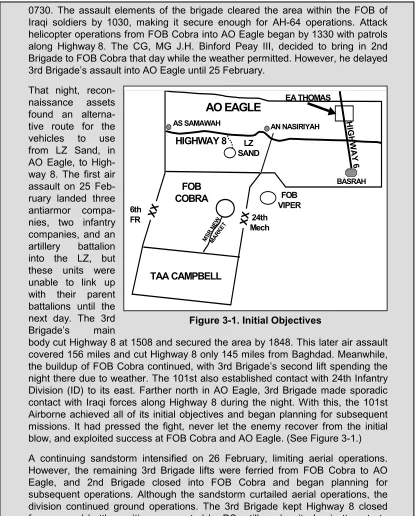
body cut Highway 8 at 1508 and secured the area by 1848. This later air assault covered 156 miles and cut Highway 8 only 145 miles from Baghdad. Meanwhile, the buildup of FOB Cobra continued, with 3rd Brigade’s second lift spending the night there due to weather. The 101st also established contact with 24th Infantry Division (ID) to its east. Farther north in AO Eagle, 3rd Brigade made sporadic contact with Iraqi forces along Highway 8 during the night. With this, the 101st Airborne achieved all of its initial objectives and began planning for subsequent missions. It had pressed the fight, never let the enemy recover from the initial blow, and exploited success at FOB Cobra and AO Eagle. (See Figure 3-1.)
A continuing sandstorm intensified on 26 February, limiting aerial operations. However, the remaining 3rd Brigade lifts were ferried from FOB Cobra to AO Eagle, and 2nd Brigade closed into FOB Cobra and began planning for subsequent operations. Although the sandstorm curtailed aerial operations, the division continued ground operations. The 3rd Brigade kept Highway 8 closed from ground battle positions supported by DS artillery despite Iraqi attempts to bypass. The 1st Brigade continued the buildup of FOB Cobra by ground transport and established contact with the 82nd Airborne Division. The 24th ID reached the Euphrates that night and cut Highway 8 farther to the east with heavy forces. The tempo was such that planned contingencies were overtaken by events; XVIII Corps had accomplished its initial objectives and issued new orders orienting the corps’ main effort eastward. As part of this reorientation, MG Peay decided to establish FOB Viper, 150 kilometers to the east of Cobra, for aerial operations
Figure 3-1. Initial Objectives
6th FR
TAA CAMPBELL
AO EAGLE
EA THOMASHIGHWAY 8
AS SAMAWAH AN NASIRIYAH
BASRAH FOB
COBRA FOB
VIPER
HI G HW AY
6
LZ SAND
MSR NEW
MA RKET
XX
against EA Thomas, 200 kilometers northeast of Viper, to destroy Iraqi forces fleeing north from Basrah. Corps assets, including the 12th Aviation Brigade and the 5th Battalion, 8th Artillery (155, T), reinforced the 101st Division.
The 101st launched its third major air assault at 0830, 27 February. The 2nd Brigade assaulted into FOB Viper with an infantry battalion and a reinforced artillery battalion augmented by engineers and air defense forces. By 1400, four attack helicopter battalions began operations against EA Thomas. The 2nd Brigade continued to close into FOB Viper. The division’s attack helicopters cut the last escape route north out of Kuwait and destroyed 14 APCs, eight BM-21 MRLs, four MI-6 helicopters, and two SA-6 units. The Iraqi forces, unable to escape north, lay in the paths of VII Corps and 24th ID. The 1st Brigade had orders to air assault into EA Thomas on 28 February, but the cease-fire precluded this operation. Although the actions of the 101st during these 100 hours were a shaping operation, they illustrate the tactical application of all of the characteristics of offensive operations.
TYPES OF OFFENSIVE OPERATIONS
3-5. The four types of offensive operations are movement to contact, attack, exploitation, and pursuit. Entry operations, while offensive in na-ture, are one of the six subordinate forms of force-projection operations. Force-projection op-erations are operational level tasks and fall out-side the scope of this manual. Joint doctrine ad-dresses force-projection operations. Appendix C
addresses tactical airborne and air assault operations as vertical envelop-ments.
MOVEMENT TO CONTACT
3-6. Movement to contact is a type of offensive operation designed to develop the situation and establish or regain contact (FM 3-0). The commander con-ducts a movement to contact (MTC) when the enemy situation is vague or not specific enough to conduct an attack. A search and attack is a specialized technique of conducting a movement to contact in an environment of noncon-tiguous AOs. Chapter 4 discusses MTC.
ATTACK
3-7. An attack is an offensive operation that destroys or defeats enemy forces, seizes and secures terrain, or both (FM 3-0). Movement, supported by fires, characterizes the conduct of an attack. However, based on his analysis of the factors of METT-TC, the commander may decide to conduct an attack using only fires. An attack differs from a MTC because enemy main body dispositions are at least partially known,
Types of Offensive
Operations
· Movement to contact
· Attack
· Exploitation
· Pursuit
Forms of the Attack
· Ambush
· Spoiling attack
· Counterattack
· Raid
· Feint
which allows the commander to achieve greater synchronization. This enables him to mass the effects of the attacking force’s combat power more effectively in an attack than in a MTC.
3-8. Special purpose attacks are ambush, spoiling attack, counterattack, raid, feint, and demonstration. The commander’s intent and the factors of METT-TC determine which of these forms of attack are employed. He can conduct each of these forms of attack, except for a raid, as either a hasty or a deliberate operation. Chapter 6 discusses the attack and its subordinate forms.
EXPLOITATION
3-9. Exploitation is a type of offensive operation that rapidly follows a suc-cessful attack and is designed to disorganize the enemy in depth (FM 3-0). The objective of an exploitation is to complete the enemy’s disintegration. Chapter 6 discusses exploitation.
PURSUIT
3-10. A pursuit is an offensive operation designed to catch or cut off a hostile force attempting to escape, with the aim of destroying it (JP 1-02). A pursuit normally follows a successful exploitation. However, if it is apparent that en-emy resistance has broken down entirely and the enen-emy is fleeing the battle-field, any other type or subordinate form of offensive operation can transition into a pursuit. Chapter 7 discusses the pursuit.
COMMON OFFENSIVE CONTROL MEASURES
3-11. This section defines in alphabetical order those common offensive con-trol measures that a commander uses to synchronize the effects of his combat power. The commander uses the minimum control measures required to successfully complete the mission while providing the flexibility needed to re-spond to changes in the situation.
ASSAULT POSITION
3-12. An assault position is a covered and concealed position short of the objective from which final preparations are made to assault the objective. Ideally, it offers both cover and concealment. These final prepara-tions can involve tactical consideraprepara-tions, such as a short halt to coordinate the final assault, reorganize to adjust to combat losses, or make necessary ad-justments in the attacking force’s dispositions. These preparations can also involve technical items, such as engineers conducting their final prepare-to-fire checks on obstacle clearing systems and the crews of plow- and roller-equipped tanks removing their locking pins. It may be located near to either a final coordination line (FCL) or a probable line of deployment (PLD). (Para-graphs 3-18 and 3-23 define a FCL and a PLD respectively.)
ASSAULT TIME
results by several different units. It synchronizes the moment the enemy feels the effects of friendly combat power. It is similar to the time-on-target control method for fire mission processing used by the field artillery. A commander uses it instead of a time of attack (defined in paragraph 3-26)because of the different distances that elements of his force must traverse, known obstacles, and differences in each unit’s tactical mobility.
ATTACK-BY-FIRE POSITION
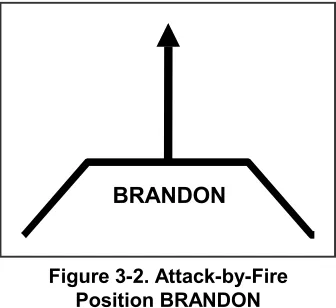
3-14. An attack-by-fire position des -ignates the general position from which a unit conducts the tactical task of attack by fire. (Appendix B defines the tactical mission task of at-tack by fire.) The purpose of these posi-tions is to mass the effects of direct fire systems for one or multiple locations toward the enemy. An attack-by-fire position does not indicate the specific site. Attack-by-fire positions are rarely applicable to units larger than com-pany size. Figure 3-2 depicts attack-by-fire position BRANDON.
ATTACK POSITION
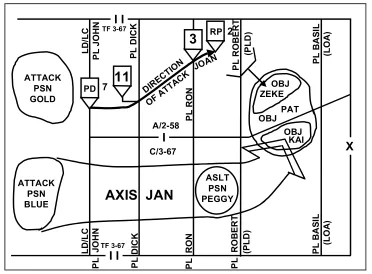
3-15. The attack position is the last position an attacking force occu -pies or passes through before crossing the line of departure. An at-tack position facilitates the deployment and last-minute coordination of the attacking force before it crosses the LD. It is located on the friendly side of the LD and offers cover and concealment for the attacking force. It is used primarily at battalion level and below. Whenever possible, units move through the attack position without stopping. An attacking unit occupies an attack position for a variety of reasons; for example, when the unit is waiting for specific results from preparatory fires or when it is necessary to conduct additional coordination, such as a forward passage of lines. If the attacking unit occupies the attack position, it stays there for the shortest amount of time possible to avoid offering the enemy a lucrative target. (Figure 3-3 on page 3-6 shows attack positions BLUE and GOLD used in conjunction with other common offensive control measures.)
AXIS OF ADVANCE
3-16. An axis of advance designates the general area through which the bulk of a unit’s combat power must move. There are three primary reasons why a commander uses an axis of advance. First, to direct the bypass of locations that could delay the progress of the advancing force, such as known contaminated areas. Second, to indicate that he does not require the force to clear the AO as it advances. His force will be required to clear the axis in accordance with specified bypass criteria. The third primary reason is to indicate to a unit involved in offensive encirclement, exploitation, or
BRANDON
AXIS DEBRA
Figure 3-4. Axis of Advance pursuit operations the need to move rapidly toward an objective. Figure 3-4 depicts axis of advance DEBRA.
DIRECTION OF ATTACK
3-17. The direction of attack is a specific direction or assigned route a force uses and does not deviate from when attacking. It is a restrictive con-trol measure. The commander’s use of a direction of attack maximizes his control over the movement of his unit, and he of-ten uses it during night attacks,
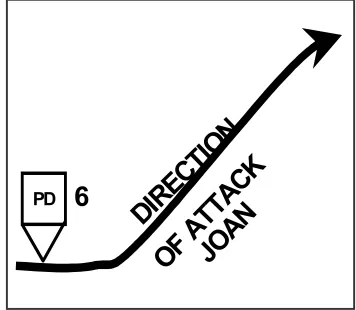
infil-trations, and when attacking through smoke. The commander establishes a direction of attack through a variety of means, such as target reference points, checkpoints, global positioning system (GPS) way points, using ground surveillance radar to track the attack force, and the impact of artillery shells. Target reference points placed on recognizable terrain provide the com-mander with the capability to rapidly shift fires and reorient his maneuver forces. When using a direction of attack, the commander designates a point of departure (PD). (Figure 3-5 depicts direction of attack JOAN and PD 6.)
FINAL COORDINATION LINE
3-18. The final coordination line (FCL) is a phase line (PL) close to the enemy position used to coordinate the lifting or shifting of sup -porting fires with the final deployment of maneuver elements. Final Figure 3-3. Attack Positions Used with Other Common Offensive Control Measures
AXIS JAN
ATTACK PSN GOLD ATTACK PSN BLUE PAT ASLT PSN PEGGY A/2-58 C/3-67 OBJ OBJ ZEKE KAI OBJ
7 DIRECT
ION
OF A TTAC K JO AN
I I
I I
PD3
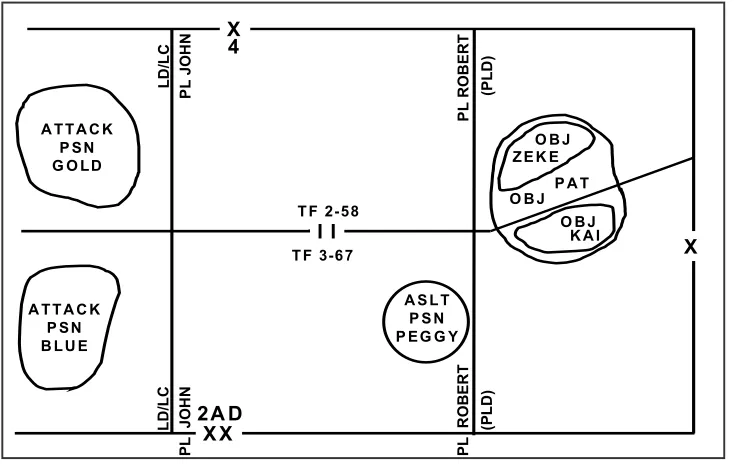
RP 2adjustments to supporting fires neces-sary to reflect the actual versus the planned tactical situation take place prior to crossing this line. It should be easily recognizable on the ground. The FCL is not a fire support coordinating measure. (Figure 3-6 shows PL ROBERT as the FCL for the 4th Bri-gade.)
LIMIT OF ADVANCE
3-19. The limit of advance (LOA) is a phase line used to control for-ward progress of the attack. The attacking unit does not advance
any of its elements or assets beyond the LOA, but the attacking unit can push its security forces to that limit. A commander usually selects a linear terrain feature, perpendicular to the direction of attack, on the far side of the objective as the LOA because such a terrain feature is easily identifi-able. The commander employs a LOA to prevent overextending the attacking force and reduce the possibility of fratricide by fires supporting the attack. The commander positions a LOA far enough beyond the objective to allow the unit to defend the objective. An LOA prevents units from exploiting success and launching a pursuit; therefore, a commander should only use it if he does not want the unit to conduct an exploitation or pursuit. A forward boundary is always a LOA, but a LOA is not necessarily a forward boundary. In fact, a
DI
RE
CT
IO
N
OF
A
TT
AC
K
JO
AN
PD
6
Figure 3-5. Direction of Attack JOAN
Figure 3-6. Final Coordination Line (FCL) ROBERT Used in Conjunction with Other Offensive Control Measures
AXIS JAN
ATTACK PSN GOLD ATTACK PSN BLUE PAT ASLT PSN PEGGY TF 2-58 TF 3-67 OBJ OBJ ZEKE KAI OBJ
7 DIRECT ION
OF A TTAC K JO AN
X
XX
PD3
RP 2I I
11
4
LD/ L C PL JOH N L D /L C PL JO H N PL RO BERT (F CL) PL ROBERT (F
C
L
)
2AD
LOA and the unit’s forward boundary should rarely coincide because of the resulting limitations that a forward boundary places on supporting fires be-yond the forward boundary. Figure 3-7 shows PL BASIL used as 4th Bri-gade’s LOA.
LINE OF DEPARTURE
3-20. The line of departure is a phase line crossed at a prescribed time by troops initiating an offen -sive operation. The purpose of the LD is to coordinate the advance of the attacking force so that its elements strike the enemy in the order and at the time desired. The LD also marks where the unit transitions from move-ment to maneuver. The commander can also use it to facilitate the coordi-nation of fires. Generally, it should be
perpendicular to the direction the attacking force will take on its way to the objective. Friendly forces should control the LD. The commander analyzes the terrain before designating his LD. Different units have different movement rates on leaving their assembly areas (AAs) based on their inherent mobility characteristics and the terrain being crossed. The commander considers these different characteristics when establishing the LD to prevent these dif-ferences from affecting the synchronization of the operation. When possible, the commander selects the LD so that the terrain the attack unit traverses before crossing the LD provides sufficient cover for the attacking unit’s final Figure 3-7. Limit of Advance Used with Other Common Control Measures
ATTACK PSN GOLD ATTACK PSN BLUE PAT ASLT PSN PEGGY TF 3-67 OBJ OBJ ZEKE KAI OBJ
X
XX
I I
4
LD/L C PL J O H N L D /LCPL J
O HN PL R O BERT (F C L ) P L RO BE R T (FCL )
2AD
X
TF 2-58PL B
A
SIL
(LOA
)
PL B
A SIL (LO A )
PL DON
(LD)
PL DON
(LD)
X
X
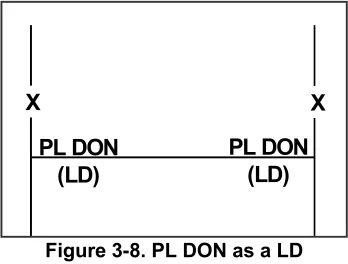
deployment into a combat formation before crossing the LD. In many cases the LD is also the line of contact because the unit in contact is conducting the attack from its current positions. Figure 3-8 depicts PL DON as the LD. (Chapter 2 contains a definition for a line of contact.)
OBJECTIVE
3-21. An objective is a location on the ground used to orient operations, phase operations, facilitate changes of direc -tion, and provide for unity of effort. An objective can be either terrain- or force-oriented. Terrain objectives should be easily identifiable on the ground to facilitate their recognition. The commander determines his force-oriented objectives based on known ene-my positions. The commander normally as-signs his subordinate commanders only their final objectives, but can assign intermediate objectives as necessary. Figure 3-9 depicts
ob-jective STEVE. Obob-jective STEVE is further broken down into two subordinate objectives, objective JOHN and objective HARRY.
POINT OF DEPARTURE
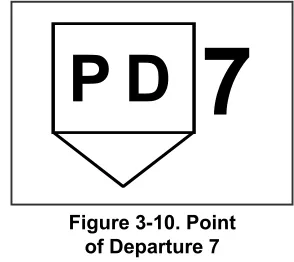
3-22. The point of departure is the point where the unit crosses the LD and begins moving along a direction of attack. Units conducting reconnaissance and security patrols and other operations in a low-visibility environment commonly use a PD as a control measure. Like a LD, it marks the point where the unit transitions from movement to maneuver under conditions of limited visibility. Figure 3-10 depicts PD 7.
PROBABLE LINE OF DEPLOYMENT
3-23. A probable line of deployment is a phase line that a commander designates as the location where he intends to completely deploy his unit into assault formation before beginning the assault. The PLD is used primarily at battalion level and below when the unit does not cross the LD in its assault formation. It is usually a linear terrain feature perpendi-cular to the direction of attack and recognizable under conditions of limited visibility. The PLD should be located outside the range where the enemy can place the attacking force under effective direct fire. It has no use except as it relates to the enemy. In Figure 3-11, page 3-10, PL ROBERT is also the PLD.
P D
7
Figure 3-10. Point of Departure 7
OBJECTIVE
STEVE
OBJ HARRY OBJ
JOHN
RALLY POINT
3-24. A rally point is an easily identifiable point on the ground at which units can reassemble and reorganize if they become dispersed. Alternatively it is an easily identi -fiable point on the ground at which aircrews and passengers can assemble and reorganize following an incident requiring a forced landing. Forces conducting a patrol or an infiltra-tion commonly use this control measure. The
objective rally point (ORP) is a rally point
established on an easily identifiable point on the ground where all elements of the infil
-trating unit assemble and prepare to attack the objective. It is typi-cally near the infiltrating unit’s objective; however, there is no standard dis-tance from the objective to the ORP. It should be far enough away from the objective so that the enemy will not detect the infiltrating unit’s attack prepa-rations. Figure 3-12 depicts Rally Point 14.
SUPPORT-BY-FIRE POSITION
3-25. A support-by-fire position designates the general position from which a unit conducts the tactical mission task of support by fire. (Appendix B defines the tactical mission task of support by fire.) The purpose of these positions is to increase the supported force’s freedom of maneuver by placing direct fires on an objective that is going to be assaulted by a friendly force. Support-by-fire positions are located within the maximum friendly direct-fire range of the enemy positions. The commander selects them so that the moving assault force does not mask its supporting fires. For this reason,
Figure 3-12. Rally Point 14
14
RLY
Figure 3-11. Probable Line of Deployment ROBERT Used with Other Control MeasuresA T T A C K P SN G O LD
A T T A C K P SN B L U E
P A T
A S L T P S N P E G G Y T F 3-67
O B J
O B J Z E K E
support-by-fire positions are normally located on the flank of the assault force, elevated above the objective if possible. Support-by-fire positions are rarely applicable to units larger than company size. The support-by-fire posi-tion graphic depicted in Figure 3-13 indicates the general location and direction from which the unit provides fires; it does not indicate a specific site.
TIME OF ATTACK
3-26. The time of attack is the moment the
leading elements of the main body cross the LD, or in a night attack, the PD. A commander uses it when conducting simultaneous operation where a shaping operation must accomplish its mission to set the conditions for the success of the decisive operation. When determining the time of attack, the commander considers the time required for his subordinate to—
· Conduct necessary reconnaissance, prepare plans, and issue orders.
· Synchronize plans between all subordinate units.
· Complete attack preparations, such as precombat inspections.
· Move to the LD or PD.
3-27. Orders normally designate the time of attack as H-hour. This is nor-mally when the main body crosses the LD. However, H-hour can also desig-nate the time to implement a phase of an operation, such as an airborne or air assault. The headquarters planning the offensive operation specifies the term’s exact meaning. This is usually a part of the unit’s standing operating procedures (SOP).
FORMS OF MANEUVER
3-28. The forms of maneuver are envelopment, turning movement, frontal attack, penetration, and infiltration. Combined arms organizations seeking to accomplish their assigned mission synchronize the contributions of all battlefield operating systems (BOS) to execute these forms of maneuver. The commander generally chooses one form on which he builds a course of action
(COA). The higher commander rarely specifies the specific form of offensive maneuver. However, his guidance and intent, along with the mission that in-cludes implied tasks, may impose constraints such as time, security, and di-rection of attack that narrow the forms of offensive maneuver to one alterna-tive. Additionally, the AO’s characteristics and the enemy’s dispositions also help determine the form of offensive maneuver selected. A single operation may contain several forms of offensive maneuver, such as a frontal attack to clear a security area followed by a penetration to create a gap in enemy defenses. An envelopment would follow to destroy the enemy’s first line of defense.
Forms of Maneuver
· Envelopment
· Turning movement
· Frontal attack
· Penetration
· Infiltration
SCOTT
ENVELOPMENT
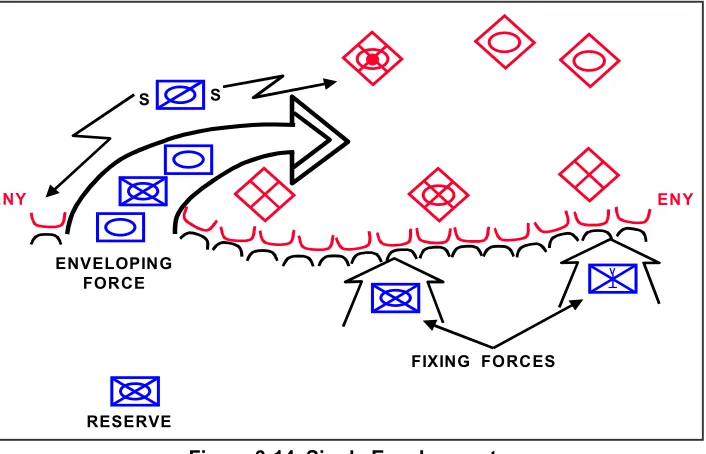
3-29. An envelopment is a form of maneuver in which an attacking force seeks to avoid the principal enemy defenses by seizing objectives to the en-emy rear to destroy the enen-emy in his current positions. At the tactical level, envelopments focus on seizing terrain, destroying specific enemy forces, and interdicting enemy withdrawal routes (FM 3-0). Also, at the tactical level, air-borne and air assault operations are vertical envelopments. (See Appendix C.) The commander’s decisive operation focuses on attacking an assailable flank. It avoids the enemy’s strength—his front—where the effects of his fires and obstacles are the greatest. Generally, a commander prefers to conduct an en-velopment instead of a penetration or a frontal attack because the attacking force tends to suffer fewer casualties while having the most opportunities to destroy the enemy. An envelopment also produces great psychological shock on the enemy. If no assailable flank is available, the attacking force creates one. The four varieties of envelopment are single envelopment, double envelopment, encirclement, and vertical envelopment. (See Figures 3-14 and 3-15.) For a discussion of the use of vertical envelopments, see Appen-dix C. For a discussion of encirclement operations, see Appendix D.
3-30. Single and double envelopments force the enemy to fight in two or more directions simultaneously to meet the converging efforts of the attack. A double envelopment generally requires a preponderance of force and can be difficult to control. A force seeking to execute a double envelopment must also have a substantial mobility advantage over the defender. A unit performs a double envelopment by conducting a frontal attack as a shaping operation in the center to fix the enemy in place while enveloping both hostile flanks. Be-cause of the forces required, normally only divisions and larger organizations have the resources to execute a double envelopment.
Figure 3-14. Single Envelopment
ENVELOPING FORCE
RESERVE
FIXING FORCES S S
V
Organization of Forces
3-31. The commander envisioning a single envelopment organizes his forces into the enveloping force and the fixing force. He also allocates forces to con-duct reconnaissance, security, reserve, and sustaining operations. The envelo-ping force, conducting the decisive operation, attacks an assailable enemy flank and avoids his main strength en route to the objective. The fixing force conducts a frontal attack as a shaping operation to fix the enemy in his cur-rent positions to prevent his escape and reduce his capability to react against the enveloping force. A commander executing a double envelopment organ-izes his forces into two enveloping forces and a fixing force in addition to re-connaissance, security, reserve, and sustaining forces. The commander typi-cally designates the more important of the two enveloping forces as the main effort for resources. That enveloping force will also be the commander’s deci-sive operation if its action accomplishes the mission.
Control Measures
3-32. The commander, at a minimum, designates AOs for each unit partici-pating in the envelopment by using boundaries. He also designates PLs, support-by-fire and attack-by-fire positions, contact points, and appropriate fire coordination measures, such as a restricted fire line or boundary between converging forces, and any other control measures he feels are necessary to control the envelopment. Figure 3-16 on page 3-14 is an example of control measures used when conducting a single envelopment.
Planning an Envelopment
3-33. Successful planning for an envelopment depends on knowing and un-derstanding the enemy and his capabilities. The commander wants to maneu-ver his enveloping force around or omaneu-ver the enemy’s main defenses to secure objectives on the enemy’s flank or rear. From those objectives the enveloping force can use its positional advantage to employ superior combat power
Figure 3-15. Double Envelopment
ENVELOPING FO RCE
RESERVE
FIXING FORCE S S
V
OBJ GINA OBJ KRISTA
ENVELOPING FORCE
against a defending enemy oriented in the wrong direction. The commander uses his intelligence assets and personnel to determine the disposition and capabilities of enemy forces to detect and react to their operations.
3-34. The commander plans for the force conducting the envelopment to re-main within supporting distance of the fixing force. (If the enveloping force is going outside of supporting distance, it is probably conducting a turning movement, not an envelopment.)
3-35. Sustaining the enveloping force requires deliberate planning because only intermittent ground lines of communication (LOCs) between the rear area and the enveloping force may exist. A line of communication is a route, either land, water, and/or air that connects an operating military force with a base of operations and along which supplies and military forces move (JP 1-02).
3-36. The commander plans how he will exploit the success of his envelop-ment as he encircles the enemy or transitions to a pursuit to complete the de-struction of the enemy force. These plans are developed as branches and se-quels to the envelopment operation.
Executing an Envelopment
3-37. A successful envelopment depends largely on the degree of surprise the commander achieves against his opponent or the presence of overwhelming combat power. The envelopment’s probability of success also increases when the commander’s forces have superior tactical mobility, possess air and
AA RESERVE
PL LYNN (LD/LC) PL LYNN
(LD/LC)
OBJ JOHN
PL
F
E
L
IX
(LOA
)
PL
F
E
L
IX
(LOA
)
XX
XXX
XXX
XX
X
XX
X
XX
XX
XX
17
22
PL B
IL LY
PL B
IL LY
AX IS
EDW ARDS
OBJ PHIL
information superiority, and his shaping operations fix the bulk of the enemy’s forces in their current positions. The commander uses his intelli-gence, surveillance, and reconnaissance (ISR) systems to provide continuous intelligence and combat information to identify changes in enemy COAs throughout the execution of the envelopment.
3-38. Normally, a unit orients the majority of its combat power toward where it expects to engage enemy forces, while placing less combat power on its own flanks. Thus the flanks of most units are more vulnerable to attack. The com-mander creates an assailable flank using whatever means necessary. The en-veloping force then moves rapidly to exploit the situation before the enemy strengthens an assailable flank by preparing positions in depth and by holding mobile forces in reserve. When faced with the threat of envelopment, the enemy commander might move his reserves to meet the enveloping force. Thus, rapid movement around the enemy’s flank is essential to prevent him from occupying previously prepared positions. Vigorous shaping operations conducted by ground and air assets aim to prevent him from reconstituting reserves from other portions of his front.
3-39. The enemy may attempt to cut off the enveloping force and extend his flank beyond the area that the enveloping force is attempting to attack through. If the encircling force attempts to outflank such hostile extension, it may become overextended by moving outside of supporting distance from the fixing force. Therefore, it is usually better for the encircling force to take ad-vantage of the enemy’s extension and subsequent weakness by penetrating a thinly held area of the enemy’s front rather than overextending itself in an attempt to completely outflank the enemy’s position.
3-40. The enemy may attempt a frontal counterattack in response to an at-tempted envelopment. In this case, the fixing force defends itself or conducts a delay while the enveloping force continues the envelopment.
3-41. After the initial envelopment of one flank—which places the enemy at a disadvantage—the commander has many options. He may choose to establish favorable conditions for passing to a double envelopment by using reserves or exploit success by generating additional combat power along the same axis. Alternatively, he can destroy or defeat the enveloped enemy force in place, or transition to another type of operation, such as exploitation or pursuit.
TURNING MOVEMENT
movement seeks to make the enemy displace from his current locations, whereas an enveloping force seeks to engage the enemy in his current loca-tion from an unexpected direcloca-tion.
Organization of Forces
3-43. The commander directing a turning movement task organizes his re-sources into a turning force, a main body, and a reserve. Each of these forces conducts security and reconnaissance operations. Either the turning force or the main body can conduct the echelon’s decisive operation given the appro-priate factors of METT-TC. A turning movement is particularly suited for division-size or larger forces possessing a high degree of tactical mobility. It is not until a commander has access to the resources of these echelons that he has the combat power to resource a turning force that can operate outside supporting range of his main body to allow the turning force to force enemy units out of their current positions. He bases the exact task organization of these forces on the factors of METT-TCand his concept of operations for the turning movement.
3-44. The maneuver of the turning force is what causes the enemy to leave his position. A turning force normally conducts the majority of its operations outside of the supporting range of the main body and possibly outside its sup-porting distance. Thus, the turning force must contain sufficient combat, com-bat support (CS), and comcom-bat service support (CSS) capabilities to operate in-dependently of the main body for a specific period of time. This normally re-quires at least a division-size element.
SHAPING OPERATION
RESERVE
OBJ DAVOUT
OBJ KARL
V
TURNING FORCE
MAIN BODY
ENY ENY
EN
Y EN
Y
3-45. The commander task organizes his main body to ensure the success of the turning force. The main body conducts operations, such as attacks designed to divert the enemy’s attention away from the area where the turning force conducts its operations. The operations of the main body can be either the echelon’s decisive or shaping operations. The commander organizes his reserve to exploit success by either the turning force or the main body. The reserve also provides the commander insurance against unexpected enemy actions.
Control Measures
3-46. The commander designates the AOs for each unit participating in the turning movement by establishing boundaries. He also designates additional control measures as necessary to synchronize the operations of his subordi-nates. These additional control measures include: phase lines (PLs), contact points, objectives, LOA, and appropriate fire coordination measures. Fig-ure 3-18 depicts these control measFig-ures used to synchronize a turning move-ment that employs an airborne division as the turning force. (Appendix C dis-cusses control measures associated with airborne and air assault operations.)
Planning a Turning Movement
3-47. Selecting the geographic objective of the turning movement is of major importance to the success of the operation. The commander’s scheme of ma-neuver in a turning movement may vary, depending on the specific situation and the factors of METT-TC. In addition to common offensive planning con-siderations addressed on pages 3-33 through 3-50, the commander conducting
PL JOELLE (I CORPS CFL)
PL JOELLE ( I CORPS CFL)
PL MONICA
PL ROBBIN (LOA)
PL GAVIN (AIRHEAD LINE)
OBJ GOOD
OBJ LUC
K
XX
XX
PL MONICAX
X
a turning movement pays special attention to planning branches and sequels to the turning movement, including—
· Defensive operations by the turning force.
· Link-up operations between the turning force and the main body.
· Retrograde operations for the turning force.
Essential to the planning of the branches and sequels is the linkage between the branch or sequel and specific decision points supported by situation devel-opment.
3-48. After developing his tactical plan, the commander plans how the turning force maneuvers to its objective. The commander develops his move-ment, loading, and staging plans if outside transportation assets are required. He can plan to occupy key terrain that will threaten the enemy’s survival or remain mobile and seek ways to exploit the turning force’s success. Before ini-tiating the operation, the commander plans how the turning force can exploit success.
3-49. In a turning movement that envisions an early linkup with the main body, the turning force normally plans to defend only that terrain required to protect itself. Once reinforcement or linkup with the main body occurs, the commander plans how to use the turning force to continue the attack or re-lieve it so it can prepare for subsequent missions.
3-50. The distances between forces and the existence of intermittent LOCs magnify the problems inherent in providing CSS to a combat force during a turning movement. Therefore, in the planning of a turning movement, the commander emphasizes resupply, equipment maintenance, casualty evacua-tion, graves registraevacua-tion, and prisoner of war handling to deal with these likely problems. Prepackaging company- and battalion-size resupply sets can ease the execution of sustaining operations during periods when CSS units must push supplies to the combat units.
3-51. Planners must consider the provision of all supplies and equipment re-quired for mission accomplishment as an integral part of tactical planning. The commander plans and organizes his CSS operations to support a rapid tempo of highly mobile and widely dispersed operations. Traditional doctrinal supporting distances and responsibilities do not always apply to turning movements. CSS planners recognize this and adjust their plans using avail-able resources. Only supplies required to meet the force’s immediate needs are carried into the operation. Excess supplies and equipment can burden the force. Staffs establish and maintain required supply levels in the objective area by phasing supplies into the objective area on an accompanying, follow-up (automatic and on-call), and routine basis. Medical evacuation, resfollow-upply, and reinforcement airlifts may be necessary to sustain the force’s combat op-erations. Ammunition and petroleum, oils, and lubricants (POL) normally constitute the major tonnage items. Lift restrictions affect what can be supplied using helicopters and fixed-wing aircraft.
Executing a Turning Movement
sustainment. A commander can reduce his losses by operating under condi-tions of friendly air and information superiority, suppressing enemy fires, and having a mobility advantage over the enemy.
3-53. Major sources of firepower to suppress enemy fires are fixed-wing air-craft, attack helicopters, jammers, and Multiple Launch Rocket Systems that cover the entire route taken by the turning force. Other sources include naval surface fire support and artillery units accompanying the turning force. 3-54. When threatened with a turning movement, the enemy commander is in a dilemma. His original defense is misplaced. He must move forces from their original position in meeting the new threat. Often he must commit his available reserves against the new threat. He exposes those forces to friendly fires as he weakens his defense and moves his forces. He must now engage friendly forces on ground he has not chosen or prepared. Whenever possible, the commander tries to reach the decisive location without encountering the enemy. Techniques to accomplish this include outflanking the enemy or using airborne, air assault, and amphibious means to avoid his prepared positions. Once friendly forces find a way deep into the enemy’s rear area, the turning force moves rapidly to exploit the situation. It seeks to achieve its mission be-fore the enemy can reposition his committed or uncommitted forces to react. Rapid movement is essential to prevent the enemy from occupying previously prepared positions in his rear. Vigorous shaping operations prevent the ene-my from reconstituting reserves from other portions of the eneene-my front. 3-55. The enemy may counterattack in an attempt to cut off and destroy the turning force and prevent the successful completion of the turning movement. In this case, the turning force’s security elements conduct an area or mobile defense or engage in delaying actions while the rest of the turning force con-tinues its mission. Alternatively, the enemy may try to withdraw his forces to a position where his LOCs are not threatened.
INFILTRATION
3-56. An infiltration is a form of maneuver in which an attacking force con-ducts undetected movement through or into an area occupied by enemy forces to occupy a position of advantage in the enemy rear while exposing only small elements to enemy defensive fires (FM 3-0). Infiltration is also a march technique used within friendly territory to move forces in small groups at ex-tended or irregular intervals. (See Chapter 14 for a discussion of infiltration as a movement technique.)
3-57. Infiltration occurs by land, water, air, or a combination of means. Mov-ing and assemblMov-ing forces covertly through enemy positions takes a consider-able amount of time. To successfully infiltrate, the force must avoid detection and engagement. Since this requirement limits the size and strength of the infiltrating force—and infiltrated forces alone can rarely defeat an enemy force—infiltration is normally used in conjunction with and in support of the other forms of offensive maneuver. Historically, the scope of the mission for the infiltrating force has been limited.
· Reconnoiter known or templated enemy positions and conduct surveil-lance of named areas of interest and targeted areas of interest.
· Attack enemy-held positions from an unexpected direction.
· Occupy a support-by-fire position to support the decisive operation.
· Secure key terrain.
· Conduct ambushes and raids to destroy vital facilities and disrupt the enemy’s defensive structure by attacking his reserves, fire support and air defense systems, communication nodes, and logistic support.
· Conduct a covert breach of an obstacle or obstacle complex.
3-59. Special operations forces and light infantry units up to brigade size are best suited to conduct an infiltration. In some circumstances, heavy forces op-erating in small units can conduct an infiltration. However, as the prolifera-tion of technology leads to increased situaprolifera-tional understanding, this should increase the ability of heavy forces to avoid enemy contact and move undetec-ted through enemy positions. In the future a commander may conduct an in-filtration with heavy forces in coordination with precision fires as a prelude to an attack.
Organization of Forces
3-60. Normally, to be successful, the infiltrating force must avoid detection at least until it reaches its ORP. Thus, the infiltrating force’s size, strength, and composition is usually limited. The infiltrating unit commander organizes his main body into one or more infiltrating elements. The largest size element possible, compatible with the requirement for stealth and ease of movement, conducts the infiltration. This increases the commander’s control, speeds the execution of the infiltration, and provides responsive combat power. The exact size and number of infiltrating elements are situationally dependent. 3-61. The commander considers the following factors when determining how to organize his forces. Smaller infiltrating elements are not as easy to detect and can get through smaller defensive gaps. Even the detection of one or two small elements by the enemy will not prevent the unit from accomplishing its mission in most cases. Larger infiltrating elements are easier to detect and their discovery is more apt to endanger the success of the mission. Also, they require larger gaps to move through. A unit with many smaller infiltrating elements requires more time to complete the infiltration and needs more link-up points than a similar size unit with only a few infiltrating elements. Many infiltrating elements are also harder to control than fewer, larger elements. 3-62. The commander resources a security force that moves ahead of, to the flanks of, and to the rear of each infiltrating element’s main body. These se-curity forces can be given either a screen or a guard mission. (Chapter 12 dis-cusses screen and guard missions.) The sizes and orientations of security ele-ments are also situationally dependent. Each infiltrating element is respon-sible for its own reconnaissance effort.
Control Measures
3-64. Control measures for an infiltration include, as a minimum—
· An AO for the infiltrating unit.
· One or more infiltration lanes.
· A LD or point of departure.
· Movement routes with their associated start and release points, or a di-rection or axis of attack.
· Linkup or rally points, including ORPs.
· Assault positions.
· One or more objectives.
· A LOA.
The commander can impose other measures to control the infiltration includ-ing checkpoints, PLs, and assault positions on the flank or rear of enemy posi-tions. If it is not necessary for the entire infiltrating unit to reassemble to ac-complish its mission, the objective may be broken into smaller objectives. Each infiltrating element would then move directly to its objective to conduct operations. (Most of these control measures have been previously described.) The following paragraphs describe using an infiltration lane and a linkup point.
3-65. An infiltration lane is a control measure that coordinates forward and lateral movement of infiltrating units and fixes fire planning responsi -bilities. The commander selects infiltration lanes that avoid the enemy, provide cover and concealment, and fa-cilitate navigation. Figure 3-19 depicts the graphic for an infiltration lane. Each unit assigned an infiltration lane picks its own routes within the lane and switches routes as necessary. The left and right limits of the infiltration lane act as lateral boundaries for the unit conducting the infiltration. Attacks by rotary- or fixed-wing aircraft,
indirect fires, or munitions effects that impact the lane must be coordinated with the infiltrating unit. Units leaving their assigned lane run the risk of being hit by friendly fires. Company-size units are normally assigned a single infiltration lane, although they can use more than one lane. Larger organiza-tions, battalion and above, are always assigned more than one infiltration lane.
3-66. A linkup point is where two infiltrating ele -ments in the same or different infiltration lanes are scheduled to meet to consolidate before pro -ceeding on with their missions. Figure 3-20 depicts Linkup Point 8. A linkup point is normally positioned in the enemy’s rear or along one of his flanks. It should be large enough for all infiltrating elements to assemble and should offer cover and concealment for these elements. It should be an easily identifiable point on the ground. The commander should position his linkup points on defensible terrain located away from normal enemy troop movement routes.
Figure 3-19. Infiltration Lane
LU
8
Planning an Infiltration
3-67. The activities and functions associated with the process of planning an infiltration are the same as with any other combat operation. That planning takes advantage of that unit’s stealth capabilities to surprise the enemy. The planning process synchronizes the BOS that support the infiltrating unit, es-pecially precise, high-resolution intelligence. Without precise, detailed intelli-gence, infiltration maneuvers become high-risk probing operations, that can be costly and time-consuming. Careful planning, full ISR integration, detailed analysis, and aggressive operations security can permit an infiltrating force to avoid an enemy force, minimize direct contact, and maximize surprise ac-cording to the commander’s intent.
3-68. After identifying gaps or weaknesses in the enemy’s defensive positions, the commander assigns infiltration lanes, contact points, and objectives to subordinate units. These objectives afford the infiltrating force positions of greatest advantage over the enemy and are not required to be to the geo-graphic rear of the targeted enemy force. Each subordinate unit commander picks one or more routes within his assigned lane and establishes additional contact points, rally points, assault points, and other control measures as re-quired. The commander wants each of the routes within an infiltration lane to be far enough apart to prevent an infiltrating element on one route from seeing other infiltrating elements, but close enough so that an infiltrating ele-ment could switch quickly to another route if required by the situation. The commander wants each route to provide his infiltrating elements cover and concealment while avoiding known enemy and civilian locations and move-ment routes to the maximum extent possible. If possible, the subordinate unit commander selects his exact routes during the preparation phase after recon-noitering each infiltration lane. He decides whether his unit will infiltrate as a unit, in smaller elements, or even as two-man buddy teams, depending on the density and strength of the enemy.
3-69. The commander may use single or multiple infiltration lanes depending on the infiltrating force’s size, the amount of detailed information on enemy dispositions and terrain accessible, time allowed, and number of lanes avail-able. A single infiltration lane—
· Facilitates navigation, control, and reassembly.
· Requires the existence or creation of only one gap in the enemy’s posi-tion.
· Reduces the area for which detailed intelligence is required. 3-70. Multiple infiltration lanes—
· Require the existence or creation of more gaps in the enemy’s security area.
· Reduce the possibility of compromising the entire force.
· Increase difficulty with maintaining control.
· A lead element, possibly the advance guard, makes contact, but the trail elements have not started infiltrating.
· A lead element infiltrates successfully, but compromises one or more trailing elements.
· A compromised linkup point.
3-72. The commander uses available technology to assist in planning the in-filtration and avoiding unintended enemy and civilian contact during the infiltration. This can be as simple as all units using the same infiltrating lane being on the same frequency to facilitate the avoidance of enemy contact. An accurate depiction of enemy systems and locations, tied to rapid terrain anal-ysis, can graphically depict dead spots in the enemy’s battlefield surveillance. The commander can then plan how to expand those existing dead spots into infiltration lanes through a precision attack of selected enemy elements and systems.
3-73. The plan also addresses the following considerations:
· Availability of supporting fires, including rotary- and fixed-wing air-craft and offensive information operations—especially electronic attack, throughout the operation, during infiltration and the attack on the ob-jective.
· Linkup or extraction of the infiltrating unit after mission completion.
· Sustainment of the infiltrating force during the operation, to include casualty evacuation.
· Deception operations, such as actions by other units designed to divert enemy attention from the area selected for the infiltration.
· Linkup of the various infiltrating elements.
· Command and control (C2), to include recognition signals.
· Positioning of combat vehicles to support the infiltrating elements.
· Using limited visibility and rough terrain to mask movement and re-duce the chance of detection.
· Infiltration of the largest elements possible to maintain control.
· Rehearsals.
· Specially required preparations, such as modifying the unit’s SOP re-garding the soldier’s combat load for the mission. When infiltrating on foot, units carry only required equipment. For example, in close terrain and in the absence of an armor threat, heavy antiarmor missile sys-tems may be a liability.
· Abort criteria.
· Critical friendly zones.
Preparing an Infiltration
3-75. Once the commander selects the objective, infiltration lanes, and linkup or rally points, he directs ISR operations to update and confirm the details on which he bases his plan. He identifies enemy sensors and surveillance systems. He then revises the plan to reflect current conditions within the AO.
Executing an Infiltration
3-76. Moving undetected during an infiltration requires a considerable amount of time. The infiltrating unit moves from its AA or current position through the start point and then continues moving along the infiltration route to a release point. If buddy teams or small elements are conducting the infiltration, the unit uses a series of linkup points to reassemble into a coher-ent unit. Units can use a variety of navigation aids, such as GPS, to remain within the planned infiltration lane, which minimizes their chances of detec-tion by the enemy. At the same time, they report their progress and status using communication systems that provide this information automatically to all command nodes which require this information.
3-77. If the complete unit is conducting the infiltration, the forward security force begins its movement first, followed by the main body. The distance be-tween the forward security force and the main body depends on the factors of METT-TC. The advance guard must be far enough ahead of the main body so that it can either deploy or move to another route if the forward security force discovers the enemy. The forward security force in an infiltration must have enough time to move in a stealthy and secure manner. Enemy units should not be able to move undetected in the gap between the forward security force and the main body.
3-78. As the infiltrating unit moves, the advance guard reports to the com-mander regarding the cover and concealment of each route, enemy activity, location of danger areas and linkup points, enemy activity on the objective, and other combat information. The unit attempts to avoid enemy and civilian contact; however, contact does not always mean the mission is compromised. The infiltrating unit engages targets first with indirect fires to avoid reveal-ing its presence and exact location. These fires include the conduct of offen-sive information operations designed to blind enemy ISR assets and prevent the enemy from coordinating an effective response to the infiltration.
3-79. If necessary, the forward security force conducts actions on contact while the main body moves to another route, reconstitutes a forward security force, and continues the mission. If the main body makes contact unexpec-tedly, it either overruns the enemy force, if the enemy has little combat power, or bypasses him and continues the mission. During the infiltration, the unit ignores ineffective enemy fire and continues to move. The command-er may use suppressive fires against the enemy to covcommand-er the sounds of the in-filtration or to divert the enemy’s attention to areas other than where the infiltration lanes are located.
accomplish its assigned mission, which could be an attack, raid, ambush, seiz-ing key terrain, capturseiz-ing prisoners, or collectseiz-ing specific combat information. 3-81. A commander may need to abort an infiltration operation if the factors of METT-TC change so drastically during the infiltration that the infiltrating force is no longer capable of accomplishing its mission. Examples of changes that might trigger such an action include—
· Significant portions of the infiltrating force’s combat power are lost through navigation errors, enemy action, accidents, or maintenance failures.
· Movement or significant reinforcement of a force-oriented objective.
· Detection of the infiltration by the enemy.
· Changes in the tactical situation that make the mission no longer ap-propriate, such as the initiation of an enemy attack.
The criteria for aborting the operation are developed in the planning process. The decision to abort the infiltration is transmitted to all appropriate head-quarters for their action and information.
PENETRATION
3-82. A penetration a form of maneuver in which an attacking force seeks to rupture enemy defenses on a narrow front to disrupt the defensive system (FM 3-0). Destroying the continuity of that defense allows the enemy’s subsequent isolation and defeat in detail by exploiting friendly forces. The penetration extends from the enemy’s security area through his main defen-sive positions into his rear area. A commander employs a penetration when there is no assailable flank, enemy defenses are overextended and weak spots are detected in the enemy’s positions, or time pressures do not permit an envelopment.
Organization of Forces
3-83. Penetrating a well-organized position requires overwhelming combat power in the area of penetration and combat superiority to continue the mo-mentum of the attack. (See Figure 3-21, page 3-26.) The commander desig-nates a breach, support, and assault force. He can designate these elements for each defensive position that he is required to penetrate. He should not withhold combat power from the initial penetration to conduct additional penetration unless he has so much combat power that the success of the ini-tial penetration is assured.
Control Measures
3-85. A commander assigns, as a minimum, an AO to every maneuver unit, a LD or LC; time of the attack or time of assault; phase lines; objective; and a LOA to control and synchronize the attack. (A commander can use a battle handover line instead of a LOA if he knows where he would like to commit a follow-and-assume force.) The lateral boundaries of the unit making the deci-sive operation are narrowly drawn to help establish the overwhelming com-bat power necessary at the area of penetration. The commander locates the LOA beyond the enemy’s main defensive position to ensure completing the breach. If the operation results in opportunities to exploit success and pursue a beaten enemy, the commander adjusts existing boundaries to accommodate the new situation. (See Figure 3-22.)
3-86. A commander uses the graphics associated with a breach site, such as gaps and lanes, on the small-scale maps used to control the maneuver of his forces at each point where he penetrates the enemy’s defenses. FM 3-34.2 de-fines the graphics.
3-87. Other control measures available to the commander include check-points, support-by-fire and attack-by-fire positions, probable line of deploy-ment, fire support coordinating measures, attack position, assault position, and time of assault. Within the unit’s AO, a commander can use either an axis of advance or a direction of attack to further control maneuver.
Planning a Penetration
3-88. The success of the penetration depends primarily on a coordinated and synchronized plan—violently executed at a high tempo to achieve surprise—
Figure 3-21. Penetration: Relative Combat Power
XXX
XXX
XX X DIVISION
SHAPING OPERATIONS 3:1
CORPS SHAPING OPERATIONS DIVISION DECISIVE
OPERATIONS 9:1
against comparatively weak enemy defenses. However, the terrain behind the area selected to penetrate must allow the penetration to proceed from the breach to a decisive objective.
3-89. The depth of the enemy position and the relative strength of attacking echelons determine the width of the penetration. The availability of artillery, air support, and other combat multipliers for the attacking force helps the commander determine relative combat power. A wider gap allows friendly forces to drive deeper, making it more difficult for the enemy to close the gap. The deeper the penetration, the easier it is for a unit to seize its objective and roll up the enemy’s flanks exposed by the breach and the less likely it is that the enemy will be in a position to restore his front by falling back.
3-90. Plans for penetrating a defensive position include isolating, suppress-ing, and destroying by fire—to include offensive information operations— enemy forces in the area selected for the penetration. These plans should also address how to isolate the area of penetration from support or reinforcement by enemy forces located outside the area. This consideration includes how to fix enemy reserves and long-range weapons in their current locations. Posi-tioning friendly assets so that the commander can mass the effects of their combat power to accomplish these results without giving away the location of the penetration is also a critical part of the plan.
3-91. The commander plans to place the majority of his forces and assets in positions where the effects of their combat power can be felt in the area
RESERVE AA OBJ OBJ OBJ SUSAN TREY SLICK STRIFE OBJ PL SEAN (LD/LC) PL SEAN (LD/LC) XX XX XX XX XXX XXX XXX XXX XX XX
PL IAN PL IAN
XX XX (O/O ) (O/O ) PL CONNEL (LOA) PL CONNEL (LOA) XX XX X C o rp s X Corps X C o rp s 23 A D 23AD 52 MD 52 MD 52MD 10 3A A 103AA X Corps X Corps X Corps X Corps X Corps X Corps X Corps 23AD 52MD 103AA
selected for penetration. The commander’s plan for the penetration normally has three phases:
· Breaching the enemy’s main defensive positions.
· Widening the gap created to secure the flanks by enveloping one or both of the newly exposed flanks.
· Seizing the objective with its associated subsequent exploitation. 3-92. Planning the sequence of these phases depends on the specific situa-tion. In some situations, if there are weaknesses or gaps in the enemy’s front, it is possible for heavy forces to breach the enemy’s defenses and proceed straight to the objective. Simultaneously, light units could conduct local en-velopment and exploitation operations. In other situations, the commander uses his light forces to create the breach, holding his heavy forces initially in reserve to exploit gaps in the enemy’s defenses created by light forces.
3-93. The commander plans shaping operations outside the area of penetra-tion to contain the enemy on the flanks of the penetrapenetra-tion and fix his reserves in their current locations. Synchronizing the effects of rotary- and fixed-wing aircraft, artillery fires, and obscuration smoke to delay or disrupt reposi-tioning forces is an example of such shaping operations. These shaping opera-tions will involve the maintenance of operaopera-tions security and the conduct of deception operations. The commander usually attempts to penetrate the ene-my’s defensive positions along unit boundaries because defenses tend to be less effective along a boundary.
3-94. The commander plans for the penetration to break through the enemy’s defenses so he is unable to reestablish his defense on more rearward posi-tions. Until this event takes place, the commander does not want to divert the strength of his attacking units to widening the gap to secure the flanks of the penetration. However, he must develop plans that address contingencies, such as hostile counterattacks against the flanks of the penetration. The plan should provide assistance to attacking elements as they close with the enemy and support the attack until the enemy’s power of resistance is broken.
Executing a Penetration
3-95. After the initial breach of the enemy’s main line of resistance, the sequence of the remaining two phases is determined by the factors of METT-TC. If the enemy is in a weak defensive position, it may be possible for the lead attacking force to seize the penetration’s final objective while simul-taneously widening the initial breach. In other situations, the commander must wait to seize the final objective until the breach is wide enough for other forces, such as reserves and follow-and-assume forces, to be committed. Com-manders at all levels must take advantage of success within the commander’s intent throughout the penetration.