LOHMEYER, EDWIN LLOYD. Unstable Aesthetics: The Game Engine and Art Modifications (Under the direction of Dr. Andrew Johnston).
This dissertation examines episodes in the history of video game modding between 1995
and 2010, situated around the introduction of the game engine as a software framework for
developing three-dimensional gamespaces. These modifications made to existing software and
hardware were an aesthetic practice used by programmers and artists to explore the relationship
between abstraction, the materiality of game systems, and our phenomenal engagement with
digital media. The contemporary artists that I highlight—JODI, Cory Arcangel, Orhan Kipcak,
Julian Oliver, and Tom Betts—gravitated toward modding because it allowed them to unveil the
technical processes of the engine underneath layers of the game’s familiar interface, in turn,
recalibrating conventional play into sensual experiences of difference, uncertainty, and the new.
From an engagement with abstract forms, they employed modding techniques to articulate new
modes of aesthetic participation through an affective encounter with altered game systems.
Furthermore, they used abstraction, the very strangeness of the mod’s formal elements, to reveal our habitual interactions with video games by destabilizing conventional gamespaces through
sensory modalities of apperception and proprioception. In considering the imbrication of technics
and aesthetics in game engines, this work aims to resituate modding practices within a dynamic
© Copyright 2018 by Edwin Lohmeyer
by
Edwin Lloyd Lohmeyer
A dissertation submitted to the Graduate Faculty of North Carolina State University
in partial fulfillment of the requirements for the degree of
Doctor of Philosophy
Communication, Rhetoric, and Digital Media
Raleigh, North Carolina
2018
APPROVED BY:
_______________________________ _______________________________ Andrew Johnston Stephen Wiley
Committee Chair
_______________________________ _______________________________
DEDICATION
I dedicate this dissertation to my dog Bandit for his unwavering loyalty and support
BIOGRAPHY
Eddie Lohmeyer is a Ph.D. student and media artist in the Communication, Rhetoric, and
Digital Media program at North Carolina State University. His research explores aesthetic and
technical developments within histories of digital media, with an emphasis on video games and
their relationship to theories of the avant-garde. Additionally, his art considers embodied
experience through processes of play and defamiliarization. Using deconstructive approaches
such as glitch, physical modifications to hardware, and assemblage, his installations stage bizarre
encounters with nostalgic media objects to unveil our normal attitudes and perceptions toward
ACKNOWLEDGEMENTS
I want to thank the members of my committee including Andrew Johnston, Steve Wiley,
Nick Taylor, and Chris Ingraham for their support and encouragement throughout the
dissertation process. I especially want to thank my chair Andrew Johnston for his exceptional
TABLE OF CONTENTS
LIST OF FIGURES ... vi
Introduction: An Anatomy of Art Modding ... 1
Technicities of Modding ... 6
Aimlessness and the Formation of Sensory Experience ... 10
Theoretical Approaches to Video Game Art and the Avant-Garde ... 13
Methodologies... 16
Chapter One: A (Scroll) Down Memory Lane: Non-Play, Commodity Aesthetics, and the Vitality of 8-bit Engines in Cory Arcangel’s Super Mario Bros. Mods ... 31
The Technics of the NES and Arcangel’s ROM Hacking ... 35
Speculative Ontologies of an 8-bit World ... 46
The Vitality of Glitch ... 51
The Démodé Object, Pop Art, and the Repetition of Smiling Clouds ... 60
Proprioceptive Non-Play and Engines of Difference ... 70
Chapter Two: Slaying Machines: Embodied Mimesis in ArsDoom ... 80
Developments in Game Engine Technology ... 82
Doom and Epistemologies of Modding ... 88
The Archive of the Engine ... 99
ArsDoom and Mimetic Vectors of Play ... 104
The Strangeness of Institutional Critique ... 115
Chapter Three: “Perspective Engines” and the Strangeness of 3D Space in JODI’s Untitled Game... ... 122
The Work of Anamorphosis... 124
A Grammatology of the Quake Engine ... 133
The Formal Materiality of Untitled Game ... 148
Flicker Mods and the Modulation of Bodily Space ... 156
Chapter Four: Generative Mods and the Violence of Sensation ... 172
The Quake III: Arena Engine ... 176
Volatile Machines and Physical Systems ... 185
The Meat of the Glitch ... 193
Conclusion: Intractable Spaces ... 205
LIST OF FIGURES
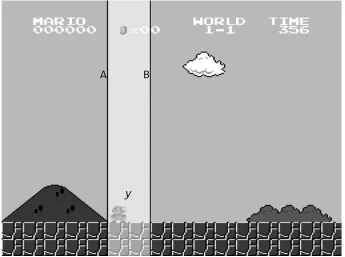
Figure 1.1 Horizontal scrolling thresholds in the SMB engine from Nathan Altice, I am error: the Nintendo family computer/entertainment system platform (Cambridge, MA: The MIT Press, 2017), 153 ... 39
Figure 1.2 Hacked Super Mario Bros. cartridge with exposed PRG-ROM chip (Cory Arcangel, 2002). Photo courtesy of the artist at
http://www.coryarcangel.com ... 42
Figure 1.3 Continually-scrolling clouds in Super Mario Clouds (Cory Arcangel, 2002) ... 44 Figure 1.4 Strobing patterns of glitch in the deteriorating gameworld of Super Mario Movie
(Cory Arcangel and Paper Rad, 2005) ... 55
Figure 1.5 Puppet and dolls animated using stop-motion techniques in Street of Crocodiles
(Quay Brothers, 1987) ... 57
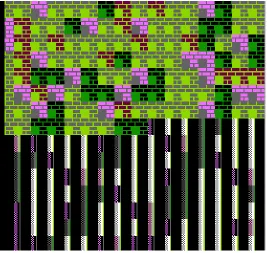
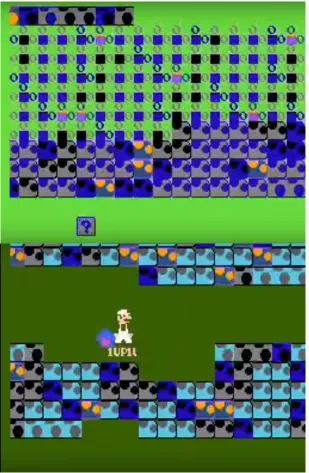
Figure 1.6 A sequence of glitched tile patterns resulting in Mario’s flight through the
gameworld of Super Mario Movie (Cory Arcangel and Paper Rad, 2005) ... 59 Figure 1.7 Cutout demode commodities animated through stop-motion techniques from
Pony Glass (Lewis Klahr,1998) ... 61 Figure 1.8 The traumatic image of Marilyn Monroe in Marilyn Diptych
(Andy Warhol, 1962) ... 64
Figure 1.9 The scrolling repetition of game icons in Super Mario Movie (Cory Arcangel and Paper Rad, 2005) ... 67
Figure 1.10 Mario transforming into the energy of the system in Super Mario Movie (Cory Arcangel and Paper Rad, 2005) ... 68
Figure 1.11 Super Mario Clouds exhibited at the Whitney Museum of American Art in
2002. Photo courtesy of the artist and Team Gallery, New York ... 69
Figure 1.12 Super Mario Movie exhibited at Deitch Projects in 2005. Photo courtesy of
Deitch Projects ... 71
Figure 1.13 Super Mario Clouds exhibited at Arcangel’s Masters show at the Carnegie
Museum of Art in 2012. Photo courtesy of Tom Little ... 74
Figure 2.3 Fast-paced navigation through rendered hallways in Wolfenstein 3D
(id Software, 1992) ... 86
Figure 2.4 Run and gun tactics within the 3D gamespace of Doom (id Software, 1993) ... 90 Figure 2.5 Divided subsectors and their individual segs within the E1M1: Hangar map of
Doom from “Doom rendering engine,” Doom Wiki,
http://doom.wikia.com/wiki/Doom_rendering_engine ... 92
Figure 2.6 Subdivided planes via BSP ordering in the E1M1: Hangar map of Doom from Fabien Sanglard, “Doom Code Review,” Fabien Sanglard’s Website, January 13th 2010, http://fabiensanglard.net/doomIphone/doomClassicRenderer.php ... 94 Figure 2.7 Thousands of monsters in the joke WAD Nuts (B.P.R.D., 2001) ... 98 Figure 2.8 Gameplay from Museum Meltdown II: The Vilnius Vengeance (Palle Torsson
and Tobias Bernstrup, 1997). ... 105
Figure 2.9 Architectural rendering of the Brucknerhaus exterior from ArsDoom
(Orhan Kipcak and Reini Urban, 1995) ... 110
Figure 2.10 Firing at an enemy artist using a crucifix gun in ArsDoom (Orhan Kipcak and Reini Urban, 1995). ... 110
Figure 2.11 Shooting projectiles from a TV remote-launcher, a citation to the work of
Nam June Paik from ArsDoom (Orhan Kipcak and Reini Urban, 1995). ... 113 Figure 2.12 Destroying an artwork by firing a crucifix gun and painting over its contents in
the style of Arnulf Rainer from ArsDoom (Orhan Kipcak and
Reini Urban, 1995) ... 115
Figure 2.13 Hans Haacke’s Manet-PROJEKT’74 (1974) including ten panels of provenance documents under glass and color photo reproduction of Manet’s Une
botte d’asperges (Bunch of Asparagus) at Paul Maenz Gallery, Cologne, 1974. Photo courtesy of Rolf Lillig ... 118
Figure 2.14 Splatters of blood-paint across an artwork in the simulated Brucknerhaus of
ArsDoom (Orhan Kipcak and Reini Urban, 1995) ... 120 Figure 3.1 Swirling, psychedelic patterns in Ctrl-Space (JODI, 1996-2001) ... 125 Figure 3.2 An anamorphic rendering of a skull in The Ambassadors (Hans Holbein the
Younger, 1533) ... 127
Figure 3.3 The distorted, anamorphic space in the installation skulls
Figure 3.4 JODI’s Untitled Game mods projected onto large scrims in the 2012
Street Digital exhibition at the Museum of the Moving Image, New York.
Photo courtesy of Daniel Love ... 132
Figure 3.5 Fighting monsters within the 3D environments of Quake (id Software, 1996) ... 134 Figure 3.6 BSP ordering in which polygons within the map are stored as leaves from
Michael Abrash, “Inside Quake: Visible Surface Determination,” Ramblings in Realtime, Blue’s News, https://www.bluesnews.com/abrash/ ... 138 Figure 3.7 Visible Surface Determination in which only visible sections of polygons are
drawn within the frustum and all others are culled, from Michael Abrash, “Inside Quake: Visible Surface Determination,” Ramblings in Realtime, Blue’s
News, https://www.bluesnews.com/abrash/ ... 139 Figure 3.8 A PVS of visible polygons arranged within the player’s frustum from Quake
(id Software, 1996) ... 141
Figure 3.9 A pre-calculated lightmap for map E2M7 from Quake (id Software, 1996). ... 144 Figure 3.10 A surface rendered by illuminating texels in the pre-calculated lightmap from
Michael Abrash, “Quake's Lighting Model: Surface Caching,” Ramblings in
Realtime, Blue’s News, https://www.bluesnews.com/abrash/ ... 145 Figure 3.11 Communication between the client and server in the Quake engine from
Michael Abrash, “Quake’s 3-D Engine: The Big Picture,” Ramblings in
Realtime, Blue’s News, https://www.bluesnews.com/abrash/ ... 147 Figure 3.12 JODI’s use of aliasing effects in Ctrl-9 (JODI, 1996-2001). ... 152 Figure 3.13 The rotating white line and flicker effect in I-N (JODI, 1996-2001). ... 154 Figure 3.14 The camera accelerating and summersaulting through walls in Q-L
(JODI, 1996-2001) ... 155
Figure 3.15 Arranged rhythms of black and white frames in The Flicker
(Tony Conrad, 1966) ... .159
Figure 3.16 Stroboscopic patterns generated from the rotating screen in I-N
(JODI, 1996-2000) ... 162
Figure 3.17 Spinning and accelerating through the polygonal architecture of the map in Q-L
(JODI, 1996-2001) ... 163
Figure 3.18 Abstract sensations of accelerating through space in Koyaanisqatsi
Figure 3.19 Pulsating moiré effects caused when the player moves toward edges and
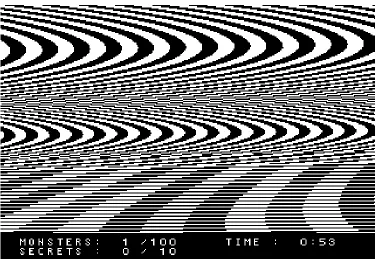
corners of the map in Crtl-9 (JODI, 1996-2001) ... 167 Figure 3.20 Optical, illusory patterns in Fall (Bridget Riley, 1963) ... 168 Figure 3.21 The player’s wildly spinning viewpoint and an exploded piece of an
enemy’s body (far right) in Q-L (JODI, 1996-2001) ... 169
Figure 4.1 Fighting Bots in Quake III Arena (id Software, 1999) ... 177 Figure 4.2 Top: Q3A level textures. Middle: Lightmap applied to arena.
Bottom: multi-texturing combining both textures and lighting, from
Fabien Sanglard, “Quake 3 Source Code Review: Architecture (Part 2 of 5),”
Fabien Sanglard’s Website, June 30th 2012, http://fabiensanglard.net/quake3/ .... 181 Figure 4.3 The Q3A engine architecture from Fabien Sanglard, “Quake 3 Source
Code Review: Architecture (Part 2 of 5),” Fabien Sanglard’s Website,
June 30th 2012, http://fabiensanglard.net/quake3/ ... 185
Figure 4.4 Méta-Matic No. 10(Jean Tinguely, 1959). ... 186 Figure 4.5 Homage to New York (Jean Tinguely, 1960). Photo courtesy of The Museum of
Modern Art Archives and David Gahr ... 189
Figure 4.6 Condensation Cube (Hans Haacke, 1965). A version of the cube at
Museu d'Art Contemporani de Barcelona from 2006. Photo courtesy of the
artist ... 191
Figure 4.7 Grass Grows (Hans Haacke, 1967-69). Photo courtesy of the artist ... 193 Figure 4.8 Superflat aesthetics in In the Land of the Dead, Stepping on the Tail of a
Rainbow (2014) at Gagosian Gallery (Takashi Murakami, 2014).
Photo courtesy of Ben Davis ... 194
Figure 4.9 Figure with Meat (Francis Bacon, 1954) ... 196 Figure 4.10 Abstractions of glitch in QQQ (Tom Betts, 2002). ... 198 Figure 4.11 A user interacting with QQQ at the 2012 Evolution Festival. Photo courtesy
of the artist at http://www.nullpointer.co.uk/qqq/qqq5.htm ... 200
INTRODUCTION
An Anatomy of Art Modding
At the 1995 Ars Electronica Festival in Linz, Austrian artists Orhan Kipack and Reini
Urban exhibited their work ArsDoom: an art modification (or mod) made to the game engine of
Doom, the popular first-person shooter developed by id Software in 1993. Forgoing the use of
Doom’s hell-like environments, the artists designed a custom map that painstakingly replicated
the festival’s Brucknerhaus exhibition hall using Autodesk AutoCAD and rendered the 3D space
using the Doom II game engine. Within this reconstruction of the Brucknerhaus that employed video game technology contemporaneous with the festival, Kipack asked artists to submit work
to be showcased within the gamespace. He then invited visitors, both remotely and at the festival,
to log on to Doom’s online network to play as famous artists—Joseph Beuys, Jeff Koons, Nam June Paik among others—and destroy the artworks on display using custom weapons such as a
paint brush gun and a bullet-firing cross.
Instead of advancing through hordes of demons or skirmishing in multiplayer
deathmatches, participants within this Doom level-cum-museum took on the role of critic: they kept works intact that they liked, while desecrating the ones they didn’t. This bizarre
reconfiguration of a widely-known and commercially successful first-person shooter, marked not
only an initial foray into the discipline of video game art, but introduced the public to a new
mode of aesthetic participation with video games through art modding techniques. Players
interacted with a popular medium in ways that were perceptually unfamiliar, prompting new
sensory and affective engagements with video game technologies of the time.
This dissertation examines four unique episodes in the history of video game art modding
development, rendering, and display of two and three-dimensional gamespaces. In particular, I
look at art modding—the modification of an existing video game system’s software code or
hardware components—as a unique, aesthetic practice that was used by gamers and artists
between 1995 and 2010. Although the canon of video game art spans techniques beyond
modding to include performance, in-game interventions, sculpture, and the appropriation of
video game objects, I look at modifications made to game software and hardware in these four
historical moments as ways in which artists explored the relationship between an aesthetic of
abstraction, the technics of game systems, as well as our phenomenal engagement with the
medium.
The contemporary artists that I highlight—Cory Arcangel, JODI, Julian Oliver, Orphan
Kipack and Reini Urban, and Tom Betts—initially approached game modifications from other
artistic fields—net art, experimental music, sculpture—and were experienced coders and
programmers. In many ways, their attraction to modding arose out of previous artistic
experimentation with digital media technologies situated within the hacker, DIY technoculture of
the 1980s and 90s, and aesthetic strategies of appropriation more broadly within histories of the
avant-garde. They were invested in concerns of both the video game’s materiality and the
player’s sensory perceptual experience of a computational system as a cultural and aesthetic
object.
Naturally, these artists gravitated toward game modding because, as I suggest, it allowed
them to disclose the material operations of the game engine through which illusions of action and
movement within space are produced. Modding allowed them to expose technical processes of
the engine underneath layers of the game’s familiar interface, in turn, recalibrating conventional
drawn to modding practices because they provided a technical platform to generate novel
sensory experiences with abstract forms, notably through aesthetics of world-building and glitch.
Appropriating the mechanics of existing game systems created avenues for artists to engage the
body in perceptual registers and intensities through the player’s haptic input, in turn, generating
an abstract, graphical output. They not only used modding to articulate new forms of aesthetic
participation through bodily encounters with the altered game system, but used abstraction, the
very strangeness of the mod’s formal elements, to reveal our habitual perceptions of and interactions with video games.
This relationship among the technical conditions of art modding that allowed for artists to
experiment with modes of abstraction, and the body’s phenomenal engagement with its forms,
has been largely overlooked in art history and game studies. My aim in this dissertation is to
address this historical gap in which the introduction of game engine technologies beginning in
the 1990s afforded artists the possibilities to modify, abstract, and play with the materiality of video game systems. In examining this period in the history of the avant-garde, my main
outcome is not only to provide a theoretical understanding for art modding as an aesthetic
practice, but to consider the player’s sensual investment in abstract forms generated from game
engines. To this end, I look at the unique work of aesthetics that unfolds among participant and the mod.
Here, I consider the ways in which novel sensory experiences are produced through our
encounter with the mod that is fundamentally embodied and mimetic. I consider mimesis not as a
product of verisimilitude as it is understood in the tradition of Western visual culture, but rather
as an affective modality in which the movement of non-figurative forms are reciprocated
elucidate our phenomenal experience of the art mod and video games in general. I am interested
in the medium’s capacity to modulate the player’s affective resonance of their own body and
world.
Within the last two decades, scholars have begun to address the cultural significance of
video games as an art form and particularly aesthetic strategies used in game modding. Yet, this
scholarship largely focuses on the discursive construction of the video game medium as an
artistic genre and its connections to previous art historical movements. Discussions of game art
often assign modding aesthetics a representationalist label, with critics situating its formal
abstraction in relationship to radical, subversive, or otherwise counterhegemonic interventions
within the avant-garde. These considerations for the ways modding reworks or deconstructs
modernist narratives are not without significance as this scholarship not only provides a means to
properly contextualize game art and concepts of play within histories of the avant-garde, but also
legitimizes video games as an artistic medium.
Yet, recent intellectual work in historicizing game art has largely overlooked what I see
as two aspects critical to our understanding of art modding as an aesthetic practice: the complex
materialities of game engine technologies that artists used to generate the illusory movement of
abstract forms, and the vibrant possibilities for our embodied engagement with these forms.
Scholars have approached recent histories of art modding only through a cursory examination of
game technologies and the forms they produce, without reflecting upon how the technical
affordances of modding and the interactivity inherent to the medium, both interrogate and modify
our phenomenal immanence in the world. Thus, how do abstract forms generated from modding
techniques engage the body in novel modes of affective and phenomenal experience? Why were
standard perceptions and operations of play with video games? In what ways did they alter the
technics of game engines to produce new forms of aesthetic participation within the dominant
framework of technoculture during the time?
In my aim to flesh out the vital relationship between technology, abstraction, and bodily
experience in these historical episodes, I focus largely on the technical and often experimental
methods artists used in the production of abstract gaming scenarios. These experimentations
throughout arose during a unique period of video game history in which hegemonic forms of
technicity—our cultural perceptions and attitudes toward the medium—developed through the
introduction of the game engine and its ability to render 3D gameplay. As I will discuss, the
game engine, notably id Software’s Doom and Quake engines (also known as id tech 1 and 2)
created by John Carmack and John Romero, organized a gaming subject that was phenomenally
situated within a new perceptual regime of the first-person shooter genre, one in which the
engine generated a seemingly palpable illusion: an aesthetic vector of movement through
actionable space and highly-detailed 3D environments.
The pioneering game artists that I observe appropriated mainstream engine technologies
and manipulated game mechanics using a range of techniques: altering commands and values
within the game’s source code; radically transforming the appearances of maps, characters, and
weapons; breaking open game cartridges and rewriting the read-only memory (ROM); and
writing generative algorithms that progressively abstract the gameworld through the use of its
AI. I argue that they employed experimental uses of game engines from within a hegemonic field
of popular gaming technologies as well as modding subcultures with a particular aesthetic
outcome: to defamiliarize conventional attitudes toward play and produce new forms of
aesthetic of apperception is the body’s affectivity as it relates to the act of perceiving the very
strangeness of the mod’s forms outside of standard gameplay, while proprioception is the body’s
interior sense of movement, balance, posture, and coordination within the gamespace. It is my
argument that these two interrelated phenomenal modalities catalyze the player’s bodily capacity
to experience the video game medium and engage the possibilities for new forms of aesthetic
participation. I consider the emergence of bodily sensation in relation to modding aesthetics as
the ways in which video game technologies affirm a multiplicity of new modes of thought,
sensation, and experience. In the remainder of this introduction, I will lay out in more detail the
theoretical approaches I use to situate art modding within this historical period of video game
development. Next, I include a review of literature on modding as an aesthetic practice inserted
within theories and histories of the avant-garde. Lastly, I look at the methodologies I use and
give a brief overview of each chapter included in the dissertation.
Technicities of Modding
The group of artists, hackers, and programmers that I engage throughout each chapter
began experimenting with modding during a period that gave rise to new formations of both
player and developer through technicities of video game development. By technicity, I refer to
Jon Dovey and Helen Kennedy’s use of the term as the imbrication of technologies, identity, and
habitual uses of and attitudes toward game technologies. Technicities of cyberculture in the l980s
and 90s gave dominant meaning to computer game culture through the authority of game
developers and consumer markets that circulated hegemonic truth about what constituted the
social identity of a “gamer.” The prevailing technicities of video games during the 1990s
assumed that developer and player were technically proficient, white, heterosexual males and
within capitalist regimes of the industry. Therefore, technicities are not inherent to game
technologies themselves but are always the result of specific cultural processes brought into
relationship with games, and our experience and knowledge of them are always in flux,
contingent upon historical and social contexts and changing impositions of power. Dovey and
Kennedy argue that when flows of power produce dominant technicities, they also invite
subversive, counter identities and cultures to develop from within the hegemonic field. As an
example, they look toward the ethos of the hacker and cyborg, two marginal forms of identity
conceived during the 1980s that presented critical and often utopic means through which
computer technologies might be re-appropriated.1
These identities were embodied for instance, in “cracker” communities or rather, groups
of coders who disabled the copy protection on games for early systems like the ZX Spectrum,
Commodore 64, and Amiga to produce unique intro animation sequences that demonstrated the
hacker’s technical prowess. In a similar way, John Carmack and John Romero, the creators and
programmers of the popular first-person shooters Doom (1993) and Quake (1996) were often described as “social misfits” with cyborgian and automated work habits. They would stay up all
night developing software with a machine-like efficiency. 2 Yet, by the early 1990s, these
hacker/cyborg identities shifted from marginalized subcultures to central formations of technicity
through the work of cultural capital that the video game industry produced. The game developer
or expert player-coder who were once considered social outcasts, had by the early 1990s taken a
central role in mainstream gaming culture.
1 Jon Dovey and Helen W. Kennedy, Game cultures: computer games as new media (Maidenheard: Open Univ.
Press, 2011), 63-66.
2 See Dovey and Kennedy’s description of Romero and Carmack and “cyborgs” in Dovey and Kennedy, Game
It was also Romero and Carmack who anticipated the emergence of various modding
subcultures through the open-source architecture of the engine. With the introduction of the
Doom engine in 1993, players were given access to the game’s source code, allowing them to record in-game speed runs—completing a certain map in the fastest time possible—and their
skills in deathmatch competitions with other players. These early machinima demos, or short
films generated in real-time using a game engine, were shared widely as .LMP files across the
burgeoning Internet with networked communities of other skilled players in what was referred to
as the demoscene. The open-source nature of the engine also afforded players the ability to
design their own game maps and modify skins (the appearance of an avatar), weapons, and other
tools for Doom. Romero and Carmack further solidified the demoscene and modding subculture with the release of Quake in 1996. With access to sections of the Quake source code, players produced a rich variety of user-generated mods within the complex, real-time 3D environments
of the game. Like its predecessor Doom, these mods were distributed within a cultural economy of online Quake communities as downloadable .pak files for other players to use. Both the Doom
and Quake engines facilitated the organization of new technicities we see in the game modder. The Quake modder was not only an expert player, but also a proficient coder who was integral to the emerging demoscene. Groups of Quake players or clans, used their knowledge of the engine’s source code to film and edit machinima footage of their gaming expertise—called
.dem (demo) files—in multiplayer deathmatches as well as speed runs, such as with Anthony
Bailey’s famed Quake Done Quick series. Each .dem file recorded not only player input but the
movement of all objects in the gameworld. In turn, this allowed Quake clans to experiment with producing narrative machinima recorded with a virtual camera, scripted dialogue, and
animated film Diary of a Camper (1996), a short narrative about a player who is ambushed after strategically holding his position in an advantageous area of the map. Likewise, the ILL Clan
created longer machinima films such as Apartment Huntin’ (1998) which chronicled two blundering lumberjacks in search of a new place to rent. Other modifications included David
“Zoid” Kirch’s popular Capture the Flaggame mode developed in late 1996 which included the
Grappling Hook: a unique item allowing players to fast travel throughout a map by launching the
hook and using its rope to swing and propel to various platforms. At roughly the same time,
Robin Walker, John Cook and Ian Caughley created the influential Team Fortress which pitted
specialized player classes (demolition, sniper, medic, heavy weapons expert, spy, etc.) against
each other in team deathmatches or capture the flag.
The game modder and the range of innovations they produced using the Doom and Quake
engines points to the fluid nature of technicity. Cultural attitudes developed toward modding and
the early demoscence indicate the unique historical fabric from which artists experimented with
manipulating game systems as an aesthetic technique. Here, I don’t claim that game artists
engaged strictly in counter-hegemonic practices to resist the commanding ideologies and
capitalist regimes that undergirded the gaming industry. Rather, I believe they were drawn to
repurposing the material affordances of engines within this dynamic era of game development to
work through ways in which the medium could potentially reconfigure our phenomenological
relationship to video game forms and bodily space within and of the world. As I argue
throughout this project, artists experimented with engines to create new modes of bodily
Aimlessness and the Formation of Sensory Experience
In using the term “aimlessness,” I refer not only to a disruption of a game’s flow through
a type of sensual play lacking competitive reward or purpose, but also consider its double
meaning as an intervention in the ability to aim a weapon within the simulated perspective of the
first-person shooter genre which emerged from game engine technologies. Brian Schrank
discusses this break in flow through what he calls “radical formal” strategies of the avant-garde
in game art. He draws a relation between Renaissance painting, conventional gameplay, and our
movement through a gamespace. Formal elements within Renaissance painting—anatomical
precision, linear perspective, the reduction of scale as objects diminish toward a vanishing
point—function to lead the eye throughout an illusory representation of depth within the picture
plane. To Schrank, video games operate similarly in that they introduce a perceptual regime that
guides ours actions and optimizes the potential for reward, or the flow of the player’s experience.3
Dominant technicities within the gaming industry dictate that flow is an expectation for a
game to appeal to consumer desires and result in a fun and pleasurable experience. Game
developers mobilize flow by designing a game system to assess a player’s skills and adjust
difficulty accordingly in response to their progress or establish given rules and mechanics to
motivate them to keep playing. Therefore, a game is rewarding when flow falls between a
player’s skill set and appropriate challenges that they can potentially overcome without getting
too frustrated or conversely, too bored. Developers situate normative expectations of play in
mainstream games around certain perceptual formulae through which flow becomes operational.
In first-person shooters such as Doom and Quake, Cartesian perspective generated through the 3D space of the engine function as the coordinates through which the player’s experience is
optimized. Flow is realized in instances of movement within rendered 3D space—engaging in
firefight, jumping, running, and solving puzzles to proceed to the next level or map—guided by
the player’s point-of-view perspective. And in instances of optimal play, this 3D space
technically and socially conditions the competitive player into what Emma Witkowski calls the
“balanced body”: a body that adapts and responds to game scenarios through both its physical
exteriority—pressing buttons to engage an in-game mechanic—and bodily composure when
interacting with the affective forces of the game.4
Throughout these historical episodes, I argue that the type of sensory experiences
revealed in the player’s strange interaction with the mod results from a disruption of flow. Artists
intentionally practiced what Josephine Bosma refers to as “cargo cult coding” in her discussion
of JODI’s game mods and works of net art. The “cargo cult” was a ritualistic belief system
adopted by the people of the Melanesian islands in which they mimicked characteristics of
Western colonists in hopes of bringing good fortune and wealth to their communities. In
programming circles, the term indicates a type of “ritual” coding that does not have any
functional outcome. In the case of JODI’s work, cargo cult coding is a way to appropriate
specific computational effects without abiding by the standard logic and protocols of a game
system.5 These formal interventions undertaken at the level of the engine’s code, worked to shift the player’s experience away from reward, pleasure, and mastery within a
perspectivally-coherent gamespace toward a type of aimless play: an aesthetic interaction with the system that
forgoes optimal flow (and the ability to aim), re-channeling goal-driven play into sensory
engagements with abstract forms.
4 Emma Witkowski, “On the Digital Playing Field: How we “do sport” with Networked Computer Games,” in
Games and Culture 7, no.5 (2012): 359-360.
5 Josephine Bosma, “Jodi and the Cargo Cult,” in INSTALL.EXE-JODI, ed. Tilman Baumgaertel (Basel: Christoph
The forms of bodily experience I articulate in these chapters that emerge from the
aimlessness of play are aesthetically and politically constituted through what Jacque Ranciere
calls the distribution of the sensible. It refers to the system of societal order, rules, and laws of
sensory perception understood as self-evident that shape the conditions of possibility for what
can be seen or said, or what one can do or make. It describes the circumstances for what can be
sensed, divided into perceptual regimes that delineate who is included and excluded in forms of
aesthetic experience within society. Ranciere argues that the distribution of the sensible produces
the possibility for common experience, yet at the same time partitions experience through the
circulation of temporalities, spaces, and movements, that arbitrate the ways in which groups or
individuals participate in the aesthetic reception of a work. Within this political distribution,
Ranciere relates aesthetics to a particular sensory regime for experiencing art, or rather the
relationship among artistic production and the modes of visuality they generate as well as the
possibilities for thinking through connections among making, doing, and seeing.6 Here, the
articulation between politics and aesthetics does not describe a type of radical projection of
politics by way of a given aesthetic practice, but instead it examines the participatory roles taken
up within a work of art. I use Ranciere’s relationship between politics and aesthetics to describe
the type of sensory experience that is revealed through forms of aesthetic engagement within
modding techniques of this period.
I want to suggest that the technical and material conditions that unfolded during this
historical era produced what Ranciere refers to as the aesthetic regime of art. In Ranciere’s
understanding, the aesthetic regime does not operate through the canonization of art historical
movements and theories, but rather indicates a particular mode of sensing for whatever objects in
6 Jacques Rancière, The politics of aesthetics: The distribution of the sensible, ed. and trans. Gabriel
the world can be constituted within the realm of art. This mode of the sensible frees the art object
from its relationship to canon, genre, and subject matter, its reliance on previous forms of
cultural production and representation. As Ranciere tells us, art within the aesthetic regime is
produced by a “heterogeneous power” as a singularity removed from previous designations of
doing and making. It at once affirms the autonomy of aesthetic experience that is produced
through the distribution of the sensible, yet simultaneously undoes any means of classifying its
singular nature within art historical discourses.7 Here, I believe that Ranciere’s aesthetics allow us to think about techniques of modding as the product of a sensory regime through which new
art forms, technicities, communities of practice, and modes of phenomenal engagement
originate. The distribution of the sensible accounts for a multiplicity of subjectivities, identities,
and sensual experiences in relation to art modding that extend from novice to technologically
literate bodies. And, similar to the vibrant activity of both players and onlookers within an
arcade, the public reception of art modding within the gallery implicates not only players but also
spectators that view experiences of play. That is, the exhibition of mods I discuss within these
chapters includes the phenomenal work of bodies that watch players interact with the strange
spaces generated by the altered engine.
Theoretical Approaches to Video Game Art and the Avant-Garde
In this dissertation, I draw a relationship among video games and histories of the
avant-garde because consumer technologies and experimental practices have held a close connection
throughout art movements of the 20th and 21st centuries. Artists have often employed
technologies contemporaneous with the era to critique mass commodification and conformity
existing within capitalist structures. In this historical affiliation among technology and the
avant-garde, I define “art modding” as a technical and phenomenal operation through what Matteo
Bittani suggests is the augmentation of existing software used to deconstruct the entertainment
value of games and affirm non-normative modes of play. Thus, modding is often predicated on a
type of unplayability—what I call aimlessness—that foregrounds abstract forms produced by
disrupting the internal operations of the game system.8 To borrow Anne-Marie Schleiner’s term, mods are parasitic in nature: they re-contextualize popular game technologies to produce an aesthetic confrontation with participants.9
As I’ve mentioned, scholarship that addresses video games from the perspective of art
history, defines modding largely through categories of representation and its relation to other
movements of the avant-garde. John Sharp looks at modding practices through the ways artists
conceptualize and produce works of game art based on their material affordances. Sharp situates
modding as an aesthetic process of appropriation unfolding at the intersection of games and
histories of art within the 20th century through the ways artists use video games “as tool sets and cultural tropes rather than as a medium or craft unto itself.”10 In Sharp’s view, a mod like Cory
Arcangel’s Super Mario Clouds (2002) is a playful rearticulation of Duchamp’s Fountain (1917)
or Robert Rauschenberg’s combines. Modding is a way of questioning the cultural value of the
medium and what can ultimately be included as an aesthetic object. Although she doesn’t focus
specifically on modding, Mary Flannigan’s work also positions video games within 20th century histories of the avant-garde yet largely through theories and concepts of play. In Critical Play: Radical Game Design, Flannigan introduces what she calls avant-garde game design, or when artists reuse mainstream gaming practices as a form of political and social subversion through
8 Matteo Bittani, “Game Art: (This) is not a Manifesto, (this) is a Disclaimer,” in Gamescenes: Art in the Age of
Videogames, ed. Matteo Bittanti and Domenico Quaranta (Milano: Johan & Levi, 2006), 9.
playful engagements with the medium.11 Flannigan considers radical appropriations of popular
gaming technologies as a form of activism in relation to other counter-hegemonic approaches
within the 20th century avant-garde.
Similarly, Brian Schrank looks at the ways in which video games shape the contemporary
avant-garde and reciprocally how the avant-garde influences the production of games as artifacts
within our current technoculture. He situates practices of modding within a multiplicity of
aesthetic strategies that the technical conditions of video games make opportune. Games
naturally reveal ways we interact with both technology and culture and their interactivity affords
artists the possibilities to diverge from prior artistic mediums privileged in the historical and
neo-avant-garde. Movements within the avant-garde have always found interest in using technologies
contemporaneous with the times. Thus, instead of thinking about what defines the contemporary
avant-garde and how games might fit into this definition, Schrank instead asks how do video
games emerge from the avant-garde and allow for artists to deploy a range of formal and political
strategies. Following Hal Foster and his historicizing of the neo-avant-garde, Schrank points out
that there is no all-encompassing theory of the “avant-garde” but rather a dispersion of multiple
avant-garde techniques and communities from which gaming practices emerge.12
Alexander Galloway proposes one such avenue for games within the contemporary
avant-garde through what he calls counter-gaming: a strategy of subverting normal operations of
play through modifications to existing software. He suggests that modding both disrupts the
game’s flow while also foregrounding the materiality of the system and its unit operations.13
Although this scholarship does engage with issues of aesthetics that surround modding as a
11 Mary Flanagan, Critical play: radical game design (Cambridge, MA: MIT Press, 2013), 1-2, 10.
12 Brian Schrank, Avant-garde videogames: playing with technoculture (Cambridge, MA: The MIT Press, 2014), 3, 13 Alexander Galloway, “Countergaming,” Gaming: Essays on Algorithmic Culture. Minneapolis: University of
specific trajectory of the avant-garde, it sidesteps what is at stake politically for the player’s
phenomenal relation to material forms generated by the game engine. In other words, current
literature ignores the emergence of art modding as a singular type of aesthetic composed of
linkages and connections within a heterogeneous terrain of popular gaming technologies,
avant-garde communities, and contemporary attitudes toward technoculture. I expand upon this recent
scholarship in game art and consider the ways modding generates sensory experience through
what Gilles Deleuze calls “difference-in-itself,” an affirmation of the unique singularities that
compose a thing.14 Here, I want to validate modding beyond its taxonomical framing within the
avant-garde, or rather what art modding is, to consider the possibilities for what it does; or, the intensities and perceptions produced in the body through our phenomenal relation to the game
engine. Therefore, I define modding not in its categorical sameness to a specific strategy, tactic,
or movement within iterations of the avant-garde, but rather through the ways in which its
technical operations affirm a specific regime of sensible experience and new modes of aesthetic
engagement with video games.
Methodologies
Throughout these episodes, I employ a range of methodologies to map the relationship
between the materiality and technics of modding, the illusory, abstract forms they create, and the
body’s aesthetic encounter with those forms. Thus, my purpose here is to triangulate materiality,
form, and phenomenology for each of the artists and works outlined in this dissertation. In order
to examine the game engine as a software framework for modding practices, I draw upon recent
methodological approaches grounded in media archaeology, what Jussi Parikka aptly describes
as an “…analysis of the historical layers of media in their singularity—a conceptual and practical
14 Gilles Deleuze, Difference and Repetition, trans. Paul Patton (New York: Columbia University Press, 1994),
exercise in carving out the aesthetic, cultural, and political singularities of media.”15 I consider
the emergence of art modding during the 1990s as a singular aesthetic practice and thus trace the
technical operations of the game engine as a media technology that afforded artists unique
possibilities to experiment with games.
To this end, I also look to histories and theories of animation within film and media
studies. I believe that the inclusion of modding within processes of animation allows us to
consider how mechanisms inherent to the game engine provide the technical generation of
abstract forms in their vital movements. Therefore, I situate modding within recent conversations
in animation studies to suggest that animation is the technical production of the mod’s strange
formal articulations that are placed into movement by the artist’s manipulation and participant’s
input. This approach also highlights the vitality of these moving forms and the minute
ontologies that govern their computational processes. I believe these methods in media
archeology and animation studies allow for a more inclusive definition of a “game engine.” I
define an engine within these historical instantiations of modding as a technical framework of hardware and software that generates video game forms through a range of computational mechanisms. Therefore, each chapter focuses on specific historical game engine technologies with this definition in mind: the Nintendo Entertainment System, id Tech 1 (Doom engine),
Quake engine, and id Tech 3 (Quake III Arena engine).
The work of Matthew Kirschenbaum provides a cornerstone to this media archeological
method, specifically his concepts of forensic and formal materiality. Kirschenbaum states that
forensics is the examination of the unique individuality of a media artifact and its interior
processes at the level of code, digital inscription, and “where individual bit representations
deposit discrete legible trails,” requiring technologies such as magnetic force microscopy for
their analysis. It also includes the material surfaces, components, design, and labor that make up
digital media. Forensic materiality is correlated to a media object’s formal materiality, or the way
in which interrelated layers of computer hardware and software act upon a user’s experience.
Kirchenbaum tells us that these computational layers, although individually self-supporting and
complete in themselves, indicate “something of the procedural friction or perceived difference,
the torque, as a user shifts from one set of software logics to another.” It describes the push and
pull of formal processes applied to an underlying structure of code, producing certain
affordances and constraints for what software can do and through which user experiences
become naturalized.16
By examining the fold between forensic and formal materialities, I trace the procedural
behavior of game engine architectures to the formal parameters of their modifications. This close
reading of the forensic and formal properties of engines is undertaken through archival work,
which plays a significant role in my examination of art modding histories. Archival research of
artists and programmers affords not only the study of technical innovations during the
development of game engines, but also the techniques artists used to modify these engines. This
thick description is guided by my own play of game engines as well as the mods produced from
them. These play episodes have been attentive to the ways engine technologies construct
dominant perspectival regimes. Through play, I also consider how these hegemonic modes of
visuality are abstracted and as a result, question the body’s phenomenal engagement with video
games.
The next component of my methodology is an examination of the abstract forms
produced by the game engine. Thus, I move from a thick technical description of these
16 Matthew Kirschenbaum, Mechanisms: New Media and the Forensic Imagination (Cambridge, MA: MIT Press,
technologies to a formal analysis of the art mod informed by Kirchenbaum’s tracing of a media
artifact’s forensic and formal materialities. This formal analysis is largely guided by aesthetic
strategies of defamiliarization. Kirchenbaum suggests that the forensic investigation of a
computational device resembles a process of defamiliarization through an unveiling of the
mechanism’s deep stratum of inscriptive operations. These computational processes are
perceived as fundamentally alien in that they are removed from our experience of computers at
the level of interfaces, software, and operating systems.17
In conjunction with the ways forensics construe media as strange, I draw upon aesthetics
of defamiliarization from Russian formalist thought, especially the work of Viktor Shklovsky. In
his essay “Art as Technique” from 1917, Shklovsky contends that defamiliarization is the
underlying value of aesthetic practice. The purpose of art lies in its capacities to disrupt the
habitual perception and conventions of a work, particularly in the way images produce an
automated perception of an object that clouds the very means by which we come to know it.
Shklovsky sees defamiliarization as an aesthetic strategy through which such perception is
countered by imbuing the familiar conventions of an artwork with a sense of strangeness, or
ostranenie. This strangeness Shklovsky describes as an act of “baring the device,” is the way artistic techniques are self-reflexively foregrounded and made unfamiliar by an artist, calling out
their artificial construction. Shklovsky tells us that defamiliarization expels “the automatism of
perception” and instead produces “the vision which results from that deautomatised perception.”
Through defamiliarization, meaning and satisfaction elicited from a work are perceived through
their lingering or slowness, or rather the particular continuity in space and time through which
the unfamiliar becomes evident.18 I draw upon this formalist aesthetic to describe the means by
which our attention is drawn to the mechanisms of the engine through a lingering contemplation
of its minute operations.
Specific to the art mod, I believe that defamiliarization is ultimately expressed by the
artists and programmers I highlight through aesthetic strategies of world-building and glitch. By
“world-building,” I refer to the often surreal ways in which artists construct entities and
environments that are seemingly unrelated to the diegetic space of the game, and employ the
engine to render their appearances and movements within the gameworld. I think of
world-building within these modifications through what Deleuze and Felix Guattari refer to as
“disjunctive synthesis”: an affirmative relation between divergent parts, that although are
separate in their qualities and modes of being, still interact through a vital force of difference.19 Here, the game engine acts as a force of difference through which the artist integrates custom
weapons, characters, and maps into an existing game, and programs them to interact within the
modified gameworld. Through this difference the game engine produces, world-building
defamiliarizes the player’s experience by transmogrifying familiar in-game environments and
objects into strange correlates. Kipcak and Urban’s use of the Doom engine to transform a gun into a cross, or Cory Arcangel’s technique of ROM hacking to include caricatures of rapper
Flava Flav and The Pope in the NES game Hogan’s Alley for his work I Shot Andy Warhol
(2002), take on an aesthetic of things becoming something other than their familiar in-game status.
18 Viktor Shklovsky, “Art as Technique,” in Russian Formalist Criticism: Four Essays, ed. Lee T. Lemon and
Marion J. Reiss. (Lincoln, NE: University of Nebraska Press, 1965), 18, 22.
19 See Deleuze and Guattari’s concept of “disjunctive synthesis” in Gilles Deleuze and Félix Guattari, Anti-Oedipus:
Along with concepts of world-building, I look to recent scholarship in glitch studies to
consider computational glitch as a formal strategy used by artists to defamiliarize the player’s
standard perception of a game engine. I define glitch in relation to art modding through what
artist Rosa Menkman calls the glitch’s inherent moment(um), or the possibilities for glitch to
generate difference through the disruption or entropy of dominant technical frameworks, yet
within the phenomenological moment through which such possibilities are initially experienced.
She considers glitch as a rupture or unknown breach within the standard transmission of
information in a system. It is a moment in which the computer or media device experiences a
break in functionality, whether technical or social, that eludes codification within the norms of
technoculture.20 Menkman’s assertion of glitch is particularly helpful in thinking about a formal analysis of art modding as it foregrounds the forensic materiality of the game engine. It unveils
to us the alien processes of the system through an aesthetic of error that makes bizarre our
standard experience of the video game.
Lastly, my methodology explores phenomenal experience of the art mod through an
aesthetic of mimesis. I believe the forensic operations of code that generate abstract form,
modulate the mimetic capacities of the player to feel the distortion of gamespaces—both two and three dimensional—as an intensive, bodily process. Thus, I define and situate aesthetics within
theories of media phenomenology that explore the player’s sensual encounter with the art mod. I
believe that this consideration of art modding aesthetics through phenomenological traditions of
mimesis allows us to rethink representation, figuration, and the illustrative through
non-representational and embodied modes of experience. In using the term, I frame mimesis as an
abstraction away from representational concepts of verisimilitude, naturalism, and imitation
toward a non-representational theory grounded in our sensual engagement with form.
Throughout these episodes, I look at aesthetics as a mimetic operation through which the player
encounters the technical image of the mod and experiences its vital rhythms and movements as
varying levels intensity in the body.
Here, I want to emphasize that modding aesthetics reflect a process of affective
reciprocation between body and altered game engine. The unique work of aesthetics I discuss in relation to the specific mods throughout these chapters points to the valence among player and
engine through which human (and non-human) phenomenologies emerge. I consider aesthetics
through a neutral ontology: an exchange between the body’s affectivity and the vital energies of
form generated within the computational environment of the mod. Therefore, aesthetics becomes
the technical capacity of the game engine to modulate and attune the senses through new and
unexpected avenues of embodied experience. As I’ve mentioned, I believe that artists were
invested in modding experimentations as a way to interrogate bodily experience through an
aesthetic of mimesis that destabilizes the player’s apperceptive and proprioceptive senses. In its
processes of making strange familiar gamespaces, the mod engages the player in what I call
gamic apperception, a bodily sensation of uncanniness or unfamiliarity in which our awareness is drawn to the very strangeness of the engine’s formal disruptions. It is the body’s affective
response to the game system laying bare the material constructs and perceptual mechanisms
through which we habitually play. It operates as a mode of intuiting the act of perception in
itself. The other affective modality I situate in this aesthetic of mimesis is what I call gamic proprioception, or the player’s affective attunement toward movement through and spatial
grounding within actionable gamespaces. This describes the body’s autonomic, intensive
and vestibular functions. By disordering the player’s spatial grounding within the video game,
modding aesthetics prompt an unraveling of the body’s proprioceptive equilibrium.
Throughout this dissertation, I consider gamic apperception as closely related to
proprioception in that both are constitutive of the body’s affectivity to be aware of its own
orientation within the gamespace, and I focus on the interrelatedness of these two terms as a
means to articulate our mimetic engagement with the art mod. The player’s experience of these
disrupted gamespaces point to a politically-organized body that is apperceptively aware of the
game engine’s materiality and proprioceptively destabilized by its formal abstraction. I approach
this aesthetic of mimesis through a methodological interweaving of several materialist and
phenomenological traditions: theories of affect through the work of Henri Bergson and the
aesthetics of Gilles Deleuze; Walter Benjamin’s Marxist, materialist theories of media; the
existential phenomenology of Maurice Merleau-Ponty; and the metaphysics of Alfred North
Whitehead, among others.
Within these schools of thought, I look at mimesis as an affective resonance generated
from an encounter with the art mod and the sensation of the familiar video game form
transformed into something-other: an entity that exceeds the representational properties of what environments and objects appear to be to a player. I believe that these materialist traditions
provide insight into our affective relation to art modding through interactivity with the medium
and consider how expressions of game art modulate our bodily affectivity and immanence in the
world as well as the embodied meaning we give to games as aesthetic objects. My understanding
of mimesis within these phenomenological traditions is guided by the materialist thought of
Henri Bergson in Mark Hansen’s philosophy of digital media. Drawing from Bergson and his
Hansen argues for the body’s capacity to frame the perception of digital media through a process
of diminution or reducing down the material images of a media work from other images in the
universe.
Our perceptual selectivity of the qualities inherent to media in turn generate bodily
affectivity, or to borrow from Bergson, affection as the body’s “actual effort upon itself,” a “zone
of indetermination” or affective propensity to hesitate before a motor action is taken.21 Hansen
proposes that this region of indeterminacy resulting from perception engages the body’s creative
capacities to “experience itself more than itself”; rather, its ability to produce embodied sensation
as a process of instability, experimentation, or difference outside of rational cognition and
representational frameworks. To Hansen, when the body perceptually frames digital information,
it negotiates its own affectivity and “gives body” to the digital work by transforming
disembodied information into something that possesses human meaning.22
I believe that Hansen’s reading of our affective embodiment in the presence of new
media art, allows us to consider the ways in which art modding catalyzes bodily affectivity.
Here, I refer to the virtuality of the body and the possibilities for it to feel itself in a surplus of
experience—to intensively produce the new or unexpected—in our interactions with the game
engine and its computational logic. Bergson informs us that perception is merely a process of the
body translating other durations in the world so as to make them comprehensible within our
reality, or our own embodied process of becoming. Our selective framing of material things and
the rhythms, vibrations, and movements of matter that constitute their being, reflect the body’s
capacity to slow down and attune our perception to different durations within the world.23 The
21 Henri Bergson, Matter and Memory. Trans. by Nancy Margaret Paul and William Scott Palmer. London: G. Allen
&, 1912, 58-60, 21, 23, 40.
body’s phenomenal relation to the art mod involves a perceptual and sensory concretization of
the material rhythms and temporalities of the game system. Therefore, I see the work of modding
aesthetics as the body’s engagement with the strange ontologies that compose the modified
engine. To this end, my methods are informed by recent materialist thought in object-oriented
ontology and speculative realism through the work of Ian Bogost and Jane Bennet among others,
that inquire into the vital being of things and objects outside an anthropocentric framework. In
considering the possibilities for how the player’s affectivity is modulated by the game engine, we
can also look to the unique agency of the art mod as a thing that has a neutral onotological status
in its phenomenal encounter with the body. In Bergson’s terms, an ontology of the art mod
indicates its own alien perception of the body and computational abilities to reduce down and
interpret human input into abstract forms. Thus, my methodology of aesthetics has a particular
investment in the ways video game systems perceive us in a phenomenal relation among player,
game engine, and world.
Chapter one “A (Scroll) Down Memory Lane: Non-Play, Commodity Aesthetics, and the
Vitality of 8-Bit Engines in Cory Arcangel’s Super Mario Bros. Mods,” focuses on two works by artist Cory Arcangel: Super Mario Clouds (2002) and Super Mario Movie (2005). Arcangel’s modding techniques consist of hacks to Nintendo Entertainment System game cartridges and
their read-only memory (ROM). By rewriting the game’s ROM chip, Arcangel alters the game
code so when interpreted by the NES console, the game exhibits abstract, time-based animations.
Here, I provide a recent archaeology of the game engine as a technical object through a
close-reading of the NES system’s split architecture and particularly the capacities for its 6502
processor and Picture Processing Unit to generate 8-bit gameworlds from the ROM chips
the engine as a technical platform for the generation of animated images beyond our discursive
understanding of its development with games such as Doom and Quake. Through Arcangel’s
work, I demonstrate that an engine is fundamentally the code of a game system that coordinates
complex operations among software and hardware such as graphics rendering and physics.
I argue that Arcangel’s mods introduce an aesthetic of defamiliarization through ROM
hacking techniques and glitch by disclosing the unique speculative phenomenologies of the
Nintendo’s 8-bit microprocessor and its units of operation. Arcangel uses the NES to generate
abstract forms that engage the body’s affective resonance with the system by making strange our
perception of lateral movement through a scrolling of two-dimensional space. By taking away
our ability to control Super Mario Brothers (1985), Arcangel recontexualizes the scrolling operations of the NES engine used for player navigation so that they engage the body in dynamic
patterns of glitch. In disclosing the interobjectivity of the NES architecture through a glitch
aesthetic, Arcangel’s mods catalyze gamic apperceptivity while destabilizing our proprioceptive
engagement with the two-dimensionality of the 8-bit platformer genre: what I call embodied non-play. In using this term, I refer to the player’s inability to control the game through a disruption
of our serial interfacing with the system. In this aesthetic of non-play, Arcangel’s creative reuse
of the NES as a démodé commodity, especially his integration of fragmented game icons into
Super Mario Clouds and Super Mario Movie, modulates the body’s proprioceptive sensitivity to
the scrolling gameworld. As I argue, these animated sequences of the deconstructed pop icons,
result in an affirmative sense of difference through the body’s kinesthetic response to the
scrolling and flickering 8-bit tiles that Arcangel programs into movement.
In chapter two “Slaying Machines: Embodied Mimesis in ArsDoom,”I look at Orhan
engine and modding techniques came into being beginning in the early 1990s. In performing an
archaeological examination of John Romero and John Carmack’s Doom, I consider the ways in
which the engine proffered a new epistemology of modding practices for constructing and
animating gameworlds. Romeo and Carmack solidified our knowledge of an engine as a reusable
platform for 3D content creation that is also separated from the content it renders.
As a modification derived from the Doom engine, ArsDoom operates through strategies of institutional critique in histories of the avant-garde, while evoking a mimetic response
articulated as vectors of embodied vision within the 3D environments of the game. Here, I argue
that modifying Doom’s familiar interface into uncanny sequences of play in ArsDoom, produces sensations of the mod’s strange spaces mirrored intensively within the body. Through our
encounter with ArsDoom’s surreal objects, spaces, and mechanics—blood-paint, crucifix-gun, gallery-deathmatch—mimesis is articulated as the sensation of things transforming into
something-other than their gamic representation.
In ArsDoom, the player’s experience of running and shooting across vectors of line
within the simulated Brucknerhaus gallery, at once questions the body’s proprioceptive
receptivity through abstractions of the gamespace, while apperceptively engaging the senses in
playful, mimetic associations among objects and environments. In the act of appropriating the
Doom engine and reconfiguring the game into a bloody deathmatch of the Ars Electronica festival, Kipcak and Urban’s mod reveals the engine’s modularity while exposing institutional
power through mimetic affinities among art world politics and first-person shooter tropes.
Chapter three, ““Perspective Engines” and the Strangeness of 3D Space in JODI’s Untitled Game,” examines the Quake engine as it was repurposed by the art duo JODI to create