Towards Security Limits in Side-Channel Attacks
(With an Application to Block Ciphers)
F.-X. Standaert⋆, E. Peeters, C. Archambeau, J.-J. Quisquater
UCL Crypto Group, Place du Levant 3, B-1348 Louvain-la-Neuve, Belgium
Abstract. This paper considers a recently introduced framework for the analysis of physically observable cryptographic devices. It exploits a model of computation that allows quantifying the effect of practically relevant leakage functions with a combination of security and informa-tion theoretic metrics. As a result of these metrics, a unified evaluainforma-tion methodology for side-channel attacks was derived that we illustrate by applying it to an exemplary block cipher implementation. We first con-sider a Hamming weight leakage function and evaluate the efficiency of two commonly investigated countermeasures, namely noise addition and masking. Then, we show that the proposed methodology allows capturing certain non-trivial intuitions about the respective effectiveness of these countermeasures Finally, we justify the need of combined metrics for the evaluation, comparison and understanding of side-channel attacks.
1
Introduction
In [14], a unified framework for the analysis of cryptographic primitives against side-channel attacks was introduced as a specialization of Micali and Reyzin’s “physically observable cryptography” paradigm [8]. It exploits a model of com-putation in which the effect of practically relevant leakage functions is evaluated with a combination of security and information theoretic measurements. A cen-tral objective of this framework was to provide a fair evaluation methodology for side-channel attacks. This objective is motivated by the fact that side-channel
attacks may take advantage of different statistical tools (e.g.difference of means
[5], correlation [2], Bayesian classification [1], stochastic models [13]) and are therefore not straightforward to compare. Additionally to the comparisons of side-channel attacks, a more theoretical goal was the understanding of the un-derlying mechanisms in physically observable cryptography.
Specifically, [14] suggests to combine the success rate of a well specified
phys-ical adversary1with an information theoretic metric in order to capture the
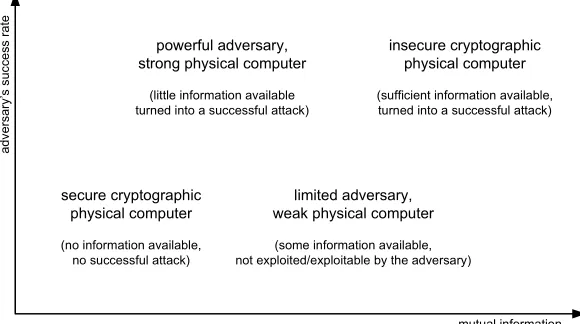
intu-ition summarized in Figure 1. That is, an information theoretic metric (namely the mutual information) should measure the average amount of information that is available in some physical observations while a security metric measures how efficiently an actual adversary can turn this information into a successful attack,
e.g. a key recovery that is the goal of most present research on side-channels.
⋆Postdoctoral researcher funded by the Belgian Fund for Scientific Research (FNRS). 1 More precisely, [14] suggests either the success rate or the guessing entropy as possible
a
d
v
e
rs
a
ry
’s
s
u
c
c
e
s
s
r
a
te
mutual information
insecure cryptographic physical computer
(sufficient information available, turned into a successful attack)
powerful adversary, strong physical computer
(little information available turned into a successful attack)
secure cryptographic physical computer
(no information available, no successful attack)
limited adversary, weak physical computer
(some information available, not exploited/exploitable by the adversary)
Fig. 1: Summary of side-channel evaluation criteria.
In this paper, we consequently study the relevance of the suggested method-ology, by the analysis of a practical case. For this purpose, we investigate an exemplary block cipher and consider a Hamming weight leakage function in dif-ferent attack scenarios. First, we consider an unprotected implementation and evaluate the information leakages resulting from various number of Hamming weight queries. We discuss how actual block cipher components compare to ran-dom oracles with respect to side-channel leakages. Then, we evaluate the secu-rity of two commonly admitted countermeasures against side-channel attacks,
i.e. noise addition and masking. Through these experiments, we show that the
proposed evaluation criteria allows capturing certain non-trivial intuitions about the respective effectiveness of these countermeasures. Finally, we provide some experimental validations of our analysis and discuss the advantages of our com-bination of metrics with respect to other evaluation techniques.
2
Model specifications
In general, the model of computation we consider in this paper is the one ini-tially presented in [8] with the specializations introduced in [14]. In this section, we first describe our target block cipher implementation. Then, we specify the leakage function, adversarial context and decision strategy that we consider in this work. Finally, we provide the definitions of our security and information theoretic metrics for the evaluation of the attacks in the next sections. For a more complete description of the model, we refer to the original paper [14].
2.1 Target implementation
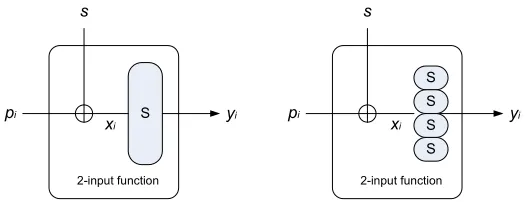
Our target block cipher implementation is represented in Figure 2. For conve-nience, we only represent the combination of a bitwise key addition and a layer
of substitution boxes. We make a distinction between asingle block and a
mul-tiple block implementation. This difference refers to the way the key guess is
performed by the adversary. In a single block implementation (e.g.typically, an
8-bit processor), the adversary is able to guess (and therefore exploit) all the
bits in the implementation. In a multiple block implementation (e.g.typically, a
hardware implementation with data processed in parallel), the adversary is only able to guess the bits at the output of one block of the target design. That is, the other blocks are producing what is frequently referred to as algorithmic noise.
S
s
pi
xi y
i
2-input function
s
pi
xi y
i
2-input function S
S
S
S
Fig. 2: Single block and multiple block cipher implementation.
2.2 Leakage function
Our results consider the example of a Hamming weight leakage function. Specif-ically, we assume a side-channel adversary that is provided with the
(possi-bly noisy) Hamming weight leakages of the S-boxes outputs in Figure 2, i.e.
WH(yi) +n, where n is a random noise value. As a matter of fact, it involves
that our following analysis is theoretical in the sense that we consider simulated leakages. However, since the Hamming weight model as been effectively exploited
in a number of works,e.g.[2], the obtained conclusions are expected to hold in
2.3 Black box adversarial context and decision strategy
We consider a non-adaptive known plaintext adversary that can perform an arbitrary number of side-channel queries to the target implementation of Figure 2 but cannot choose its queries in function of the previously observed leakages. In addition, we consider a side-channel key recovery adversary with the following
(hard) strategy: “given some physical observations and a resulting classification
of key candidates, select the best classified key only”.
2.4 Security metric: success rate of the key recovery adversary
The success rate of a side-channel key recovery attack can be written as follows.
Let S be a discrete variable denoting the target key class in a side-channel
attack and s be a realization of this variable. Typically, s corresponds to one
or two bytes of the master key. Let Lq be a random vector denoting the
side-channel observations generated withqqueries to the target implementation and
lq = [l1, l2, . . . , lq] be a realization of this random vector,i.e.one actual output of
the leakage functionL, as defined by Micali and Reyzin in [8]. Following [14], we
finally consider a side-channel adversary of which the aim is to guess a key classs
with non negligible probability. For this purpose and for each key candidates∗, it
compares the actual observation of a leaking devicelq with some key dependent
model for these leakagesM(s∗, .). Let T(lq,M(s∗, .)) be the statistical test used
in the comparison. We assume that the highest value of the statistic corresponds
to the most likely key candidate. For each observationlq, we first define the set
of keys selected by the adversary with a vector:
dq={ˆs|T(lq,M(ˆs, .)) =max
s∗ T(lq,M(s ∗, .))}.
dqgenerally has only one element but several key candidates may have the same
test score. Then, we define the result of the attack with the index matrix:
Iqs,s∗ =
1
|dq| if s∗∈dq, else0.
Thirdly, we define the success rate of the adversary afterqqueries:
SR=E
s lEq|s I q
s,s (1)
In the following, we willonlyconsider a Bayesian classifier,i.e.an adversary that
selects the keys such that Pr[S =s∗|Lq =lq] is maximum, since it corresponds
to the most efficient way to perform a side-channel key recovery.
It is also interesting to remark that one can use the complete index matrix to
build a confusion matrixCqs,s∗ =Elq|sI
q
s,s∗. The previously defined success rate
simply corresponds to the averaged diagonal of this matrix. Note finally that the previous definition of success rate corresponds to the success rate against a key
2.5 Information theoretic metric: conditional entropy
In addition to the success rate, [14] suggests the use of an information theoretic metric to evaluate the information contained in side-channel observations. Let
Pr[s|lq] be the probability of a key candidates given an observation lq with q
queries to the target device. We first define an entropy matrix:
Hqs,s∗ =−
X
lq
Pr[lq|s]·log2Pr[s∗|lq],
from which we derive Shannon’s conditional entropy2:
H[S|Lq] =−
X
s
Pr[s]X
lq
Pr[lq|s]·log2Pr[s|lq] =E s H
q
s,s (2)
We note that this definition is equivalent to the classical one since:
H[S|Lq] =−
X
lq Pr[lq]
X
s
Pr[s|lq]·log2Pr[s|lq]
=−X
s
Pr[s]X
lq
Pr[lq|s]·log2Pr[s|lq]
Then, we define an entropy reduction matrix:Heqs,s∗ = H[S]−H
q
s,s∗, where H[S]
is the entropy of the key class variableSbefore any side-channel attack has been
performed: H[S] =Es−log2Pr[s]. It directly yields the mutual information:
I(S;Lq) = H[S]−H[S|Lq] =E
s He q
s,s∗ (3)
Let us finally mention that in the context of simulated attacks where an analyt-ical model for the leakage probability distribution is known, the previous sums
can be turned into integrals,e.g. we have for the conditional entropy:
H[S|Lq] =−
X
s
Pr[s]
Z +∞
−∞
Pr[lq|s]·log2Pr[s|lq]dlq
It is important to observe that the success rate measures the effectiveness of an adversary. In general, it has to be computed for different number of queries in order to evaluate how much observations are required to perform a successful attack. By contrast, the information theoretic metric says nothing about the ac-tual strength of an adversary but characterizes an implementation. It is generally
computed once, for an arbitrarily chosen number of queries (typically,q= 1).
3
Investigation of single leakages
In this section, we analyze a situation where an adversary is provided with the observation of one single Hamming weight leakage. First, we evaluate single block implementations. Then, we discuss multiple block implementations and key guesses. Finally, we evaluate the effect of noise addition in this context.
2 With Pr[s|l
3.1 Single block implementations
Let us assume the following situation: we have an n-bit secret key s and an
adversary is provided with the leakage corresponding to a computation Y1 =
f(s, P1) = S(P1 ⊕s). As previously, capital letters represent variables while
small letters represent particular values of the variables. That is, the adversary
obtains observations of the form l1 = WH(y1) and we assume a single block
implementation as the one in the left part of Figure 2. Therefore, the adversary
can potentially observe then+ 1 Hamming weights of the variableY1. Since the
Hamming weights of a random value are distributed as binomials, one can easily evaluate the success rate of the adversary as:
SR=E
s El1 I
1
s,s= n X
h=0
n h
2n ·
1
n h
= n+ 1
2n (4)
This equation means that on average, obtaining the Hamming weight of a secret
n-bit value increases the success rate of a key-recovery adversary from 1
2n to
n+1 2n .
Similar evaluations will be performed for the conditional entropy in Section 3.3.
3.2 Multiple blocks and key guesses
Let us now assume a situation similar to the previous one, but the adversary tries to target a multiple block implementation. Therefore, it is provided with
the Hamming weight of an n-bit secret value of which it can only guess b bits,
typically corresponding to one block of the implementation. Such a key guess situation can be analyzed by considering the un-exploited bits as a source of algorithmic noise approximated with a Gaussian distribution. This will be done in the next section. The quality of this estimation will then be demonstrated in Section 5, by relaxing the Gaussian estimation.
3.3 Noise addition
Noise is a central issue in side-channel attacks and more generally in any signal processing application. In our specific context, various types of noise are usually
considered, including physical noise (i.e. produced by the environment),
mea-surement noise (i.e.caused by the sampling process and tools), model matching
noise (i.e. meaning that the leakage model used to attack does possibly not
perfectly fit to real observations) or algorithmic noise (i.e. produced by the
un-targeted values in an implementation). All these disturbances similarly affect the efficiency of a side-channel attack and their consequence is that the information delivered by a single leakage point is reduced. For this reason, a usually accepted
method to evaluate the effect of noise is to assume that there is an additive
In our experiments, we will consequently assume that the adversary is
pro-vided with observations:l1sg =WH(y1)+n, wherenis a realization of a Gaussian
distributed random noise variable N with mean 0 and variance σ2. Then, we
evaluate the success rate of the adversary and the conditional entropy as:
SR=E
s El1 I
1
s,s= n X
h=0
n h
2n ·
Z +∞
−∞
Pr[l1|h]·I1s,s dl, (5)
H[S|L1] =E
s H
1
s,s= n X
h=0
n h
2n ·
Z +∞
−∞
Pr[l1|h]· −log2(Pr[s|l1])dl, (6)
where Pr[L1 =l1|WH(Y1) =h] = 1
σ√2π exp
−(l1−h)2
2σ2 and the a posteriori
proba-bility Pr[s|l1] can be computed thanks to Bayes’s formula: Pr[s|l1] = Pr[
l1|s]·Pr[s] Pr[l1] ,
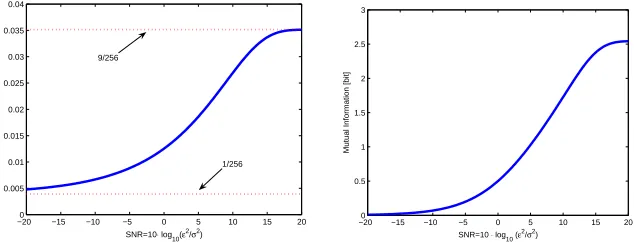
with Pr[l1] =Ps∗Pr[l1|s∗]·Pr[s∗]. As an illustration, the success rate and the
mutual information are represented in Figure 3 for an 8-bit value, in function
of the observation signal-to-noise ratio (SNR=10·log10(ε
2
σ2), where ε =
p
n/4
denotes the standard deviation of the Hamming weight signal andσis the
pre-viously introduced Gaussian noise standard deviation).
−200 −15 −10 −5 0 5 10 15 20
0.005 0.01 0.015 0.02 0.025 0.03 0.035 0.04
SNR=10⋅ log10(ε2/σ2)
Success Rate
9/256
1/256
−200 −15 −10 −5 0 5 10 15 20
0.5 1 1.5 2 2.5 3
Mutual Information [bit]
SNR=10 ⋅ log10 (ε 2
/σ2
)
Fig. 3: Success rate and mutual information in function of the SNR.
Note that the success rate starts at 9/256,i.e.the noise-free value computed
with Equation (4) and tends to 1/256 which basically means that very little
information can be retrieved from the leakage. Also, since for each key class s,
the same 9 Hamming weights can be observed with the same frequency, we are typically in the context of a weak template attack as described in [14]. That is, each line of the entropy matrix is identical up to a permutation of its elements.
4
Investigation of multiple leakages
For this purpose, let us consider the following situation: we have an n-bit
secret key class sand an adversary is provided with the leakages corresponding
to two computationsY1=f(s, P1) andY2=f(s, P2). That is, it obtainsWH(Y1)
andWH(Y2) and we would like to evaluate the average predictability ofs. The
y sg
y1
y2
f -1(p1,y1)
f -1(p2,y2)
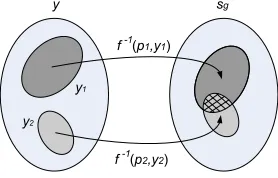
Fig. 4: Multiple point leakages.
consequence of such an experiment (illustrated in Figure 4) is that the key will be contained in the intersection of two sets of candidates obtained by inverting
the 2-input functions y1 =f(s, p1) and y2 = f(s, p2). The aim of our analysis
is therefore to determine how the keys within this intersection are distributed. Importantly, and contrary to the single query context, this analysis requires to characterize the cryptographic functions used in the target implementation, since they will determine how the intersection between the sets of candidates behaves. Therefore, we will consider two possible models for these functions.
4.1 Assuming random S-boxes
A first (approximated) solution is to consider the functions f−1(Pi, Yi) to
be-have randomly. As a consequence, each observed Hamming weight leakagehi=
WH(yi) will give rise to a uniform list of candidates for the keysof sizeni= hin,
without any particular dependencies between these sets but the key. Let us
de-note the size of the set containings after the observation ofq leakages
respec-tively giving rise to these uniform lists of ni candidates by a random variable
Tq(n1, n2, . . . , nq). From the probability density function ofTq(given in appendix
A), it is straightforward to extend the single leakage analysis of Section 3.1 to multiple leakages. The success rate can be expressed as:
SR=
n X
h1=0
n X
h2=0 . . .
n X
hq=0 n h1
2n ·
n h2
2n . . .
n hq
2n ·
X
i
Pr[Tq =i]·
1
i (7)
4.2 Using real block cipher components
In order to validate the previous theoretical predictions of the success rate, we performed the experiments illustrated in Figure 5. In the first (upper) experi-ment, we generated a number of plaintexts, observed the outputs of the function
f = S(Pi⊕s) through its Hamming weights WH(Yi), derived lists of ni
inverted function f−1(P
i, Yi) to obtain lists of key candidates. In the second
(lower) experiment, a similar procedure is applied but the ni key candidates
were selected from random lists (including the correct key). As a matter of fact, the first experiment corresponds to a side-channel attack against a real block cipher (we used the AES Rijndael S-box) while the second experiment emulates the previous random S-box estimation.
f sg
p y WH (y ) [yi ,yi ,…,yi ] f-1 [si ,si ,…,si ]
p
R y ni
[sg| sr1,sr2,sr3,…,srn]
[sg| si ,si , … si ]
WH (y ) i
i i
i i
i
1 2 ni 1 2 ni
r1 r2 rni-1
Fig. 5: Multiple leakages experiments: real S-boxes and random S-boxes simulation.
We generated a large number (namely 100 000) of observations and, for these generated observations, derived the experimental success rate in the two previous contexts. Additionally, we compared these experiments with the theoretical pre-dictions of the previous section. The results of our analysis are pictured in Figure
6, where we can observe that the real S-box gives rise to lower success rates (i.e.
to less information) than a random function. The reason of this phenomenon is that actual S-boxes give rise to (slightly) correlated lists of key candidates and therefore to less independence between consecutive observations, as already sug-gested in [2, 11]. These experiments suggest that even if not perfectly correct, the assumption that block cipher components are reasonably approximated by ran-dom functions with respect to side-channel attacks is acceptable. We note that this assumption is better verified for large bit sizes since large S-boxes better approximate the behavior of a random function than small ones.
0 1 2 3 4 5 6 7 8 9
0 0.1 0.2 0.3 0.4 0.5 0.6 0.7 0.8 0.9 1
Number of Leakages Obtained
Success Rate
zoom
4 0.835
0.84 0.845 0.85 0.855 0.86 0.865 0.87 0.875
Number of Leakages Obtained
Success Rate
real S−boxes random S−boxes
theoretical predictions
5
Investigation of masked implementations
The previous sections illustrated the evaluation of simple side-channel attacks based on a Hamming weight leakage function thanks to the success rate and mutual information. However, due to the simplicity of the investigated contexts, these notions appeared to be closely correlated. Therefore it was not clear how one could need both criteria for our evaluation purposes. In this section, we consequently study a more complex case, namely masked implementations and higher-order side-channel attacks. This example is of particular interest since it allows us to emphasize the importance of a combination of security and infor-mation theoretic metrics for the physical security evaluation process of an im-plementation. As a result of our analysis, we provide (non-trivial) observations about the respective effectiveness of masking and algorithmic noise addition that can be easily turned into design criteria for actual countermeasures.
S
S’
s
p
r q
y = S(p s) q
i
i
i i i
i
Fig. 7: 1storder boolean masking.
The masking technique (e.g.[4]) is one of the most popular ways to prevent
block cipher implementations from Differential Power Analysis. However, recent results suggested that it is not as secure as initially thought. Originally pro-posed by Messerges [7], second and higher-order power analysis attacks can be successfully implemented against various kinds of designs and may not require more hypotheses than a standard DPA [9]. In [12], an analysis of higher-order masking schemes is performed with respect to the correlation coefficient. In the following, we intend to extend this analysis to the (more powerful but less flexi-ble) case of a Bayesian adversary, as introduced in [10].
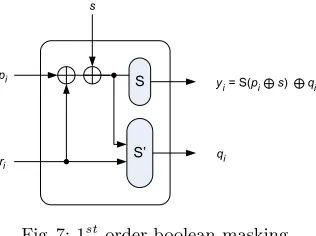
For the purposes of our analysis, we will use the masked implementation
il-lustrated in Figure 7 in which the plaintextpi is initially XORed with a random
maskri. We use two S-boxes S and S’ such that: S(pi⊕ri⊕s)=S(pi⊕s)⊕qi,
with qi = S′(pi⊕ri ⊕s, ri). According to the notations introduced in [10], it
is particularly convenient to introduce the secret state of the implementation
as Σi = S(pi⊕s) and assume an adversary that obtains (possibly noisy)
ob-servations: lq = WH[Σi⊕qi] +WH[qi] +n, with the same noise as in Section
3.3. Similarly to a first-order side-channel attack, the objective of an adversary
is then to determine the secret state Σi (it directly yields the secret key class
s). Because of the masking,Σi is not directly observable through side-channel
the Hamming weight of the secret stateWH(Σi). As an illustration, we provide
the different discrete PDFs (computed over the random mask values) for a 4-bit
masked design in Figure 8, in function of the secret stateΣi. We also depict the
shapes of the discrete PDFs corresponding to an unmasked secret state affected
by four bits of algorithmic noise (i.e. we add 4 random bits to the 4-bit target
and the PDF is computed over these random bits). Similar distributions can be obtained for any bit size. In general, knowing the probability distributions of the secret state, the success rate and conditional entropy can be straightforwardly derived. For example, after one query it yields:
1/16 4/16 6/16 4/16 1/16 2/16 6/16 6/16 2/16 4/16 8/16 4/16 8/16 8/16 16/16
0 2 4 6 8 1 3 5 7 2 4 6 3 5 4
WH(S(Pi Sg))= 0 1 2 3 4
(a) 4-bit masked value
1/16 4/16
6/16 4/16
1/16
0 1 2 3 4
1/16 4/16
6/16 4/16
1/16
1 2 3 4 5
1/16 4/16
6/16 4/16
1/16
2 3 4 5 6
1/16 4/16
6/16 4/16
1/16
3 4 5 6 7
1/16 4/16
6/16 4/16
1/16
4 5 6 7 8
WH(S(Pi Sg))= 0 1 2 3 4
(b) 4-bit value and 4 noisy bits
Fig. 8: Exemplary discrete leakage PDFs.
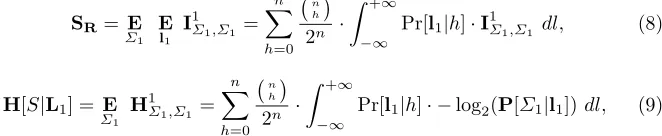
SR= E
Σ1
E
l1 I
1
Σ1,Σ1 =
n X h=0 n h
2n ·
Z +∞
−∞
Pr[l1|h]·I1Σ1,Σ1 dl, (8)
H[S|L1] = E
Σ1
H1Σ1,Σ1=
n X h=0 n h
2n ·
Z +∞
−∞
Pr[l1|h]· −log2(P[Σ1|l1])dl, (9)
where Pr[L1=l1|WH(Σ1) =h] can be computed as in Section 3.3, assuming that
thel1’s are distributed as a mixture of Gaussians. In the following, we illustrate
these metrics in different contexts. First, we consider 1stand 2ndorder masking
schemes for 8-bit S-boxes. Then, we consider unmasked implementations where 8 (resp. 16) random bits of algorithmic noise are added to the secret signalS,
corresponding to the 1st (resp.2nd) order mask bits.
The first (and somewhat surprising) conclusion of our experiments appears in Figure 9. Namely, looking at the mutual information for high SNRs, the use
of an-bit mask is less resistant (i.e.leads to lower leakages) than the addition of
nrandom bits to the implementation. Fortunately, beyond a certain amount of
−200 −15 −10 −5 0 5 10 15 20 0.5
1 1.5 2 2.5 3
Mutual Information [bit]
SNR=10 ⋅ log10 (ε 2
/σ2
) 8−bit value
8 masked bits and one 8−bit mask
8−bit value and 8 noisy bits
(a) 1st order masking
−200 −15 −10 −5 0 5 10 15 20
0.5 1 1.5 2 2.5 3
Mutual Information [bit]
SNR=10 ⋅ log10 (ε 2
/σ2
) 8−bit value
8−bit value and 16 noisy bits
8 masked bits and two 8−bit masks
(b) 2ndorder masking
Fig. 9: Mutual information of 1st, 2ndorder masking and equivalent algorithmic noise.
different with small noise values (e.g.in Figure 13.a, the probability that an
ob-servation belong to both PDFs is very small) but becomes almost identical when
the noise increases, since they are all identically centered (e.g. in Figure 13.b).
Conversely, the means of each PDF in the unmasked implementations stay
dif-ferent whatever the noise level (e.g. in Figure 14.b). Therefore the Bayesian
classification is easier than in the masked case when noise increases. These ob-servations confirm the usually accepted fact that efficient protections against side-channel attacks require to combine different countermeasures. A practically important consequence of our results is the possibility to derive the exact design
criteria (e.g.the required amount of noise) to obtain an efficient masking.
It is also interesting to observe that Figure 9 confirms that algorithmic noise
is nicely modeled by Gaussians. Indeed,e.g. for the 1st order case, the mutual
information of an 8-bit value with 8 noisy bits for high SNRs exactly corresponds to the one of an unprotected 8-bit value with SRN=0.
−200 −15 −10 −5 0 5 10 15 20
0.005 0.01 0.015 0.02 0.025 0.03 0.035 0.04
SNR=10 ⋅ log10(ε 2
/σ2
)
Success Rate
8−bit value
8−bit value and 8 noisy bits 8 masked bits and one 8−bit mask
(a) 1st order masking
−200 −15 −10 −5 0 5 10 15 20
0.005 0.01 0.015 0.02 0.025 0.03 0.035 0.04
SNR=10 ⋅ log10(ε 2
/σ2
)
Success Rate
8−bit value
8−bit value and 16 noisy bits 8 masked bits and two 8−bit masks
(b) 2nd order masking
Fig. 10: Success rate of 1st, 2ndorder masking and equivalent algorithmic noise.
The second interesting conclusion is that the success rate after one query
(pictured in Figure 10) doesnot follow an identical trend. Namely, the masked
implementations and their equivalent noisy counterparts do not cross over at
of limited adversary against a weak implementation in Figure 1. That is, some information is available but the number of queries is too low to turn it into a successful attack. If our information theoretic measurement is meaningful, higher number of queries should therefore confirm the intuition of Figure 9.
Success rates with higher number of queries for a 2ndorder masking scheme
(and noisy equivalent) were simulated in Figures 11, 12. In Figure 11, a very high SNR=20 is considered. As a consequence, we observe that the masks bring much less protection than their equivalent in random bits, although the initial value (for one single query) suggests the opposite. Figure 12 performs similar ex-periments for two SNRs that are just next to the crossing point. It illustrates the same intuition that the efficiency of the key recovery when increasing the number of queries is actually dependent on the information content in the observations.
Importantly, these experiments illustrate a typical context where the com-bination of security and information theoretic metrics is meaningful. While the success rate is the only possible metric for the comparison of different side-channel attacks (since it could be evaluated for different statistical tools), the information theoretic metric allows to infer the behavior of an attack when in-creasing the number of queries. As an illustration, the correlation-based analysis performed in [12] only relates to one particular (sub-optimal) statistical tool and was not able to lead to the observations illustrated in Figure 9.
10 20 30 40 50 60 70 80
0 0.1 0.2 0.3 0.4 0.5 0.6 0.7 0.8 0.9 1
Number of Leakages Obtained
Success Rate
8 masked bits and two 8−bit masks
8−bit value and 16 noisy bits
Zoom
(a) Comparison
1 2 3 4 5
0 0.005 0.01 0.015 0.02 0.025 0.03 0.035 0.04 0.045 0.05
Number of Leakages Obtained
Success Rate
8 masked bits and two 8−bit masks
8−bit value and 16 noisy bits
(b) Zoom
Fig. 11: Success rate of an 8-bit 2ndorder masking scheme with noisy counterpart.
6
Concluding remarks
0 20 40 60 80 100 120 0
0.1 0.2 0.3 0.4 0.5 0.6 0.7 0.8 0.9 1
Number of Leakages Obtained
Success Rate
8−bit value and 16 noisy bits
8 masked bits and two 8−bit masks
(a) SNR=10
0 20 40 60 80 100
0 0.1 0.2 0.3 0.4 0.5 0.6 0.7 0.8 0.9 1
Number of Leakages Obtained
Success Rate
8 masked bits and two 8−bit masks
8−bit value and 16 noisy bits
(b) SNR=11
Fig. 12: Success rate of an 8-bit 2ndorder masking scheme with noisy counterpart.
design criteria. As a scope for further research, we suggest the analysis of more complex (statistically sampled, multivariate, . . . ) leakage functions possibly
giv-ing rise to strong template attacks (as defined in [14]),i.e. attacks in which each
key class gives rise to a different security level.
References
1. S. Chari, J.R. Rao, P. Rohatgi, Template Attacks, CHES 2002, Lecture Notes in Computer Science, vol. 1965, pp. 13–28.
2. E. Brier, C. Clavier, F. Olivier,Correlation Power Analysis with a Leakage Model, CHES 2004, Lecture Notes in Computer Science, vol 3156, pp 16-29.
3. J.-S. Coron, P. Kocher, D. Naccache,Statistics and Secret Leakage, Financial Crypto 2000, Lecture Notes in Computer Science, vol. 1972, pp. 157–173.
4. L. Goubin, J. Patarin,DES and Differential Power Analysis, CHES 1999, Lecture Notes in Computer Science, vol. 1717, pp. 158-172.
5. P. Kocher, J. Jaffe, B. Jun, Differential Power Analysis, CRYPTO 1999, Lecture Notes in Computer Science, vol. 1666, pp. 15–19.
6. S. Mangard, Hardware Countermeasures against DPA - a Statistical Analysis of their Effectiveness, CT-RSA 2004, LNCS, vol. 2964, pp. 222-235.
7. T.S. Messerges,Using Second-Order Power Analysis to Attack DPA Resistant Soft-ware., CHES 2000, LNCS, vol. 2523, pp. 238–251.
8. S. Micali, L. Reyzin,Physically Observable Cryptography (extended abstract)., TCC 2004, Lecture Notes in Computer Science, vol. 2951, pp. 278–296.
9. E. Oswald, S. Mangard, C. Herbst, S. Tillich,Practical Second-Order DPA Attacks for Masked Smart Card Implementations of Block Ciphers, CT-RSA 2006, Lecture Notes in Computer Science, vol. 3860, pp. 192–207.
10. E. Peeters, F.-X. Standaert, N. Donckers, J.-J. Quisquater,Improved Higher-Order Side-Channel Attacks with FPGA Experiments, CHES 2005, Lecture Notes in Com-puter Science, vol. 3659, pp. 309–323.
11. E. Prouff,DPA Attacks and S-Boxes, FSE 2005, LNCS, vol. 3557, pp. 424-441. 12. K. Schramm, C. Paar,Higher Order Masking of the AES, CT-RSA 2006, Lecture
Notes in Computer Science, vol. 3860, 208-225.
13. W. Schindler, K. Lemke, C. Paar,A Stochastic Model for Differential Side-Channel Cryptanalysis, CHES 2005, LNCS, vol 3659, pp 30-46.
A
Probability density function of the variable
T
qWe take an iterative approach and first consider the intersection after two
leak-ages. Assuming that the leakages respectively give rise to uniform lists of n1
and n2 candidates and the the key space has size N = 2n, it yields Pr[T2 =
i|n1, n2] =
n
1−1
i−1
·N−n1 n2−i
N
−1 n2−1
,where the binomials are taken among sets ofN−1
possible elements since there is one fixed key that is not chosen uniformly. Then,
assuming the knowledge of the distribution ofTq(n1, n2, ..., nq) and an additional
leakage that gives rise to a uniform list of nnew candidates, we can derive the
distribution of Tq+1 as follows: Pr[Tq+1 =j|Tq, nnew] =Pi Pr[Tq+1 =j|Tq =
i, nnew]·Pr[Tq=i],with: Pr[Tq+1 =j|Tq =i, nnew] =
i −1 j−1
· N−i nnew−j
N
−1 nnew−1
.
B
Additional figures
−1 0 1 2 3 4 5 6 7 8 9
0 0.2 0.4 0.6 0.8 1 1.2 1.4 1.6 1.8 2
WH(Σ)=1
WH(Σ)=0
(a) SNR=10
−10 −5 0 5 10 15 20
0 0.01 0.02 0.03 0.04 0.05 0.06 0.07 0.08 0.09 0.1
WH(Σ)=1
WH(Σ)=0
(b) SNR=−6
Fig. 13: Leakages PDFs in function of the noise: masked implementation.
−1 0 1 2 3 4 5 6
0 0.2 0.4 0.6 0.8 1 1.2 1.4 1.6 1.8 2
WH(Σ)=0 WH(Σ)=1
(a) SNR=10
−150 −10 −5 0 5 10 15 20
0.01 0.02 0.03 0.04 0.05 0.06 0.07 0.08 0.09 0.1
WH(Σ)=0
WH(Σ)=1
(b) SNR=−6