
A Meet-in-the-Middle Collision Attack
Against the New FORK-256
Markku-Juhani O. Saarinen
Information Security Group Royal Holloway, University of London
Egham, Surrey TW20 0EX, UK. [email protected]
Abstract. We show that a2112.9collision attack exists against the FORK-256 Hash Function. The attack is surprisingly simple compared to existing published FORK-256 cryptanalysis work, yet is the best known result against the new, tweaked version of the hash. The attack is based on “splitting” the message schedule and compression function into two halves in a meet-in-the-middle attack. This in turn reduces the space of possible hash function results, which leads to significantly faster collision search. The attack strategy is also applicable to the original version of FORK-256 published in FSE 2006.
Keywords: FORK-256, Hash Function Cryptanalysis, Meet-in-the-middle Attack.
1 Introduction
FORK-256 is a dedicated hash function that produces a 256-bit hash from a message of arbitrary size. The original version of FORK-256 was presented in the first NIST hash workshop and at FSE 2006 [1]. Several attacks have been outlined against this original version, namely:
– Matusiewicz, Contini, and Pieprzyk attacked FORK-256 by using the fact that the functionsf andg in the step function were not bijective in the original version. They used microcollisions to find collisions of 2-branch FORK-256 and collisions of full FORK-256 with complexity of2126.6in [3].
– Independently, Mendel, Lano, and Preneel published the collision-finding attack on 2-branch FORK-256 using microcollisions and raised possibility of its expansion [5].
– At FSE 2007 [4], Matusiewicz et al. published the result of [3] and another attack which finds a collision with complexity of2108and memory of264.
2 Description of New FORK-256
New FORK-256 (hereafter FORK-256) is a Merkle-Damgård hash with a 256-bit (8-word) internal state and a 512-bit (16-(8-word) message block. Padding and chaining de-tails are similar to those of the SHA and the MD families of hash functions.
FORK-256 is entirely built on shift, exlusive-or, and addition operations on 32-bit words. In this paper we use the following notation for these operations:
x⊕y Bitwise exclusive-or betweenxandy.
x¢y Equal to(x+y) mod 232.
x¯y Equal to(x−y) mod 232.
x≪y Circular left shift of 32-bit wordxbyybits.
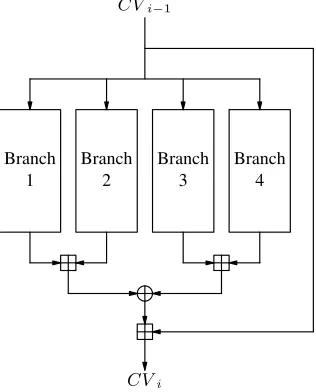
The compression function of FORK-256 consists of four independent “branches”. Each one these branches takes in the 256-bit (8-word) chaining value and a 512-bit (16-word) message block to produce a 256-bit result. These four branch results are combined with the chaining value to produce the final compression function result. Figure 1 illustrates the branch structure.
CVi−1
CVi Branch
1
Branch 2
Branch 3
Branch 4
Fig. 1.Overall structure of four branches of FORK-256. Note that the lines are 256 bits wide; the addition symbols represent eight 32-bit modular additions in parallel.
The four branches are structurally equivalent, but differ in scheduling of the message words and round constants. Each branch is computed in eight steps,0≤s ≤7. Each step utilizes two message words and two round constants.
word”),b(“right word”),α(“left constant”), andβ(“right constant”) in this description as follows:
a(js)=M[σj(2s)]
b(js)=M[σj(2s+ 1)]
α(js)=δ[ρj(2s)]
βj(s)=δ[ρj(2s+ 1)]
FORK-256 uses two 32-bit Boolean functionsf andg, which were redefined for the New FORK-256 to avoid microcollisions.
f(x) =x⊕(x≪15)⊕(x≪27)
g(x) =x⊕((x≪7)¢(x≪25)).
Following the convention of the FORK-256 specification, letCVi[0..7]be the result
of the compression function iterationiandCV0[0..7]the Initialization Vector, given in
Table 4.
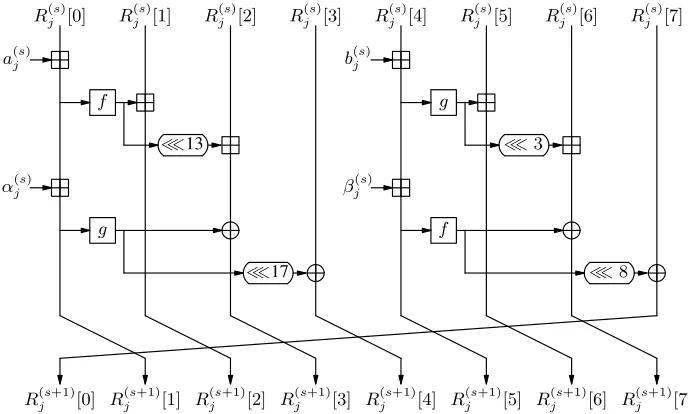
Each branchjprocesses eight input wordsR(0)j [t] =CVi[t]to eight output words
Rj(8)[t],0≤t≤7. Figure 2 illustrates the step function. For0≤s≤7:
t1=f(R(js)[0]¢a
(s)
j )
t2=g(R(js)[0]¢a
(s)
j ¢α
(s)
j )
t3=g(R(js)[4]¢b
(s)
j )
t4=f(R(js)[4]¢b
(s)
j ¢β
(s)
j )
Rj(s+1)[0] =Rj(s)[7]⊕(t4≪8)
R(js+1)[1] =R(js)[0]¢a(js)¢α(js)
R(js+1)[2] =R(js)[1]¢t1
R(js+1)[3] = (Rj(s)[2]¢(t1≪13))⊕t2
Rj(s+1)[4] =Rj(s)[3]⊕(t2≪17)
R(js+1)[5] =R(js)[4]¢b(js)¢β(js)
R(js+1)[6] =R(js)[5]¢t3
R(js+1)[7] = (Rj(s)[6]¢(t3≪3))⊕t4
The final result of the compression function for each word0≤t≤7is
CVi+1[t] =CVi[t]¢((R1(8)t¢R2(8)[t])⊕(R(8)3 [t]¢R(8)4 [t])).
3 Observations
Each branch of the compression function uses each message wordM[0. . .15]exactly once. Due to diffusion properties of the step function, message words that are scheduled for the last steps do not affect all output words.
Consider the sixth output word of each branch,R(8)j [5]. The last step is defined as:
Rj(8)[5] =R(7)j [4]¢b(7)j ¢βj(7).
Furthermore we “open up”R(7)j [4]in the previous step:
R(7)j [4] =R(6)j [3]⊕(g(Rj(6)[0]¢a(6)j ¢βj(6))≪17).
Ignoring the round constantsα(js)andβj(s), we can observe that the only message words in steps 6 and 7 affecting R(8)j [5] are a(6)j andb(7)j , the latter having a linear effect. Constantsb(6)j anda(7)j have no effect in the computation of this word.
By thus inspecting the step function and the message word schedule in Table 1, it is easy to verify thatRj[5]satisfies the following properties:
Branch 1:R(8)1 [5]is independent ofM[14] =a(7)1 . Branch 2:R(8)2 [5]is linearly dependent onM[1] =b(7)2 .
Branch 3:R(8)3 [5]is independent ofM[1] =a(7)3 .
Branch 4:R(8)4 [5]is independent ofM[14] =b(6)4 .
R(s)j [0]
R(s+1)j [1] R(s)j [1]
R(s+1)j [2] R(s)j [2]
R(s+1)j [3] R(s)j [3]
R(s+1)j [4] R(s)j [4]
R(s+1)j [5] R(s)j [5]
R(s+1)j [6] R(s)j [6]
R(s+1)j [7] R(s)j [7]
R(s+1)j [0] a(s)j
f
≪13
α(s)j
g
≪17
b(s)j
g
≪3
β(s)j
f
≪8
We shall use these simple observations to construct an attack against FORK-256. We note that due to the fact the message word schedule is shared between the old and new versions of FORK-256, the same four observations – and the same general attack – apply to both versions, although there are important technical differences between the old and the new version. The complexity of the attack is the same for both.
4 A Collision Attack
The main strategy of the attack is to use a fast method for finding messages that hash into a significantly smaller subset of possible hash values. We do this by forcing the sixth word of the compression function to remain constant over the hash function itera-tion,CV1[5] =CV0[5], thereby generating hashes in a subset of size2224. Assuming
uniform distribution, a full collision can be expected afterpπ2 ×22242 ≈2112.3hashes in the small subset have been found.
The value ofCV1[5]is combined from the four branches and the initialization
vec-tor as follows:
CV1[5] =CV0[5]¢((R1(8)[5]¢R(8)2 [5])⊕(R(8)3 [5]¢R(8)4 [5])).
By substitutingCV1[5] =CV0[5]and regrouping branches 2 and 3 on the left side
and branches 1 and 4 on the right side, we obtain the following necessary and sufficient condition forCV1[5] =CV0[5]:
R(8)2 [5]¯R(8)3 [5] =R(8)1 [5]¯R(8)4 [5].
Our attack is based on choosing two message wordsM[1]andM[14]in a specific way to satisfyCV1[5] = CV0[5], which is possible due to the observations given in
the previous section. The values of the fourteen other message words are arbitrary and can be chosen at random (as long as they remain constant through the two phases of the attack). The two phases can be repeated any number of times to produce sufficient amount of hashes in the subset.
4.1 First Phase
SetM[1] = 0and loop overM[14] = 0,1,2,· · ·,232−1. Compute branches 2 and 3
for eachM[14]to obtainx=R(8)2 [5]¯R(8)3 [5]. PlacexandM[14]into a look-up table so that the value ofM[14]can be immediately retrieved based on the correspondingx
value (i.e.M[14]is indexed byx).
Note that since the mapping fromM[14]toxis not surjective, about1/e≈36.8%
4.2 Second Phase
Loop over the232values ofM[1]. Compute branches 1 and 4 for eachM[1]to obtain
y=R(8)1 [5]¯R4(8)[5]¢M[1]. TheM[1]term is included due to the linear dependence ofR(8)2 [5]on it (this is also whyM[1]is set to zero in the first phase).
In each step, perform a look-up. If a match or matchesx= yare found, the nec-essary and sufficient condition is satisfied and we have found a message (or rather, a pair of M[1] and M[14] values) that produces one or more hashes that satisfy
CV1[5] =CV0[5].
4.3 Runtime Analysis
Each loop step in the second phase produces one match in the lookup table on average. This is due to the fact that even though the mapping is not surjective, there is a total of
232M[14]entries in the table. Hence approximately232hashes with the property are
produced in the second phase.
Since computation of only two branches out of four are needed, the computational effort in the first and second phases is roughly equivalent to231full hash computations
each, or232total. If the full 8 words in phase 1 are not stored, branches 2 and 3 need
to be computed again to reproduce a full hash, bringing the total number to3∗231.
The average cost of producing a hash in the2224subset therefore is 3
2 hash function
invocations.
Unfortunately we have been unable to come up with a method of utilizing “mem-oryless” random-walk collision search methods such as those discussed in [6]. This is due to the fact that the algorithm outlined above only works in “batches” of 232
to obtain a favorable average cost for each hash with the desired propertyCV1[5] =
CV0[5]. The memory requirement is therefore equivalent to running time requirement, 3
2
pπ
2 ×2
224
2 = 2112.9.
5 Further Work
The same observations about the effects ofM[1]andM[14]on the final hash can be easily be adopted into a pre-image attack that recovers the values of these two message words with232effort, rather than264as expected in a brute-force search.
It may be possible to “fix” more than 32 bits by using additional words of keying material besides M[1]andM[14]in the attack. This would naturally lead to a more effective overall collision attack. TermsM[0]andM[5]appear to be good candidates as they are only used in steps 5 and 6 of branches 2 and 3, respectively, and are therefore not fully diffused at the end of step 7.
6 Conclusion
We have presented a 2112.9 collision attack against the new, improved version of the
hash function FORK-256. This represents a speed improvement of factor215.4 over a
7 Acknowledgements
The author would thank Keith Martin and the INDOCRYPT Program Committee mem-bers for essential quality control and helpful comments. Financial support for this work was provided by Nixu Ltd. and Academy of Finland.
References
1. D. HONG, D. CHANG, J. SUNG, S. LEE, S. HONG, J. LEE, D. MOON,ANDS. CHEE.
“A New Dedicated 256-Bit Hash Function: FORK-256.” FSE 2006, LNCS 4047, Springer-Verlag, pp. 195 – 209, 2006.
2. D. HONG, D. CHANG, J. SUNG, S. LEE, S. HONG, J. LEE, D. MOON,ANDS. CHEE. “New FORK-256.” Cryptology ePrint Archive 2007/185, Jul., 2007.
3. K. MATUSIEWICZ, S. CONTINI,ANDJ. PIEPRZYK. “Weaknesses of the FORK-256 Com-pression Function.” Cryptology ePrint Archive 2006/317 (Second version), Nov., 2006. 4. K. MATUSIEWICZ, T. PEYRIN, O. BILLET, S. CONTINI,ANDJ. PIEPRZYK.
“Cryptanaly-sis of FORK-256.” Preproceeding of FSE 2007, 2007.
5. F. MENDEL, J. LANO, AND B. PRENEEL. “Cryptanalysis of Reduced Variants of the
FORK-256 Hash Function.” CT-RSA, LNCS 4377, Springer-Verlag, pp. 85 – 100, 2007. 6. P.VANOORSCHOT ANDM. WIENER. “Parallel collision search with cryptanalytic
Step Branch 1 Branch 2 Branch 3 Branch 4
s a(s)1 b (s) 1 a (s) 2 b (s) 2 a (s) 3 b (s) 3 a (s) 4 b (s) 4 0 M[0] M[1] M[14]M[15] M[7] M[6] M[5] M[12] 1 M[2] M[3] M[11] M[9] M[10]M[14] M[1] M[8] 2 M[4] M[5] M[8] M[10]M[13] M[2] M[15] M[0] 3 M[6] M[7] M[3] M[4] M[9] M[12]M[13]M[11] 4 M[8] M[9] M[2] M[13]M[11] M[4] M[3] M[10] 5 M[10]M[11] M[0] M[5] M[15] M[8] M[9] M[2] 6 M[12]M[13] M[6] M[7] M[5] M[0] M[7] M[14] 7 M[14]M[15]M[12] M[1] M[1] M[3] M[4] M[6]
Table 1.Message word schedule for FORK-256. It is easy to observe that in branch 2 and branch 3,M[1]only affects the result in the last step.M[14]is used in the last and next-to-last steps in branches 1 and 4, correspondingly. These observations are used in the attack.
δ[0]=0x428a2f98 δ[1]=0x71374491 δ[2]=0xb5c0fbcf δ[3]=0xe9b5dba5 δ[4]=0x3956c25b δ[5]=0x59f111f1 δ[6]=0x923f82a4 δ[7]=0xab1c5ed5 δ[8]=0xd807aa98 δ[9]=0x12835b01 δ[10]=0x243185be δ[11]=0x550c7dc3 δ[12]=0x72be5d74 δ[13]=0x80deb1fe δ[14]=0x9bdc06a7 δ[15]=0xc19bf174
Table 2.Round constants.
Step Branch 1 Branch 2 Branch 3 Branch 4
s α(s)1 β (s) 1 α (s) 2 β (s) 2 α (s) 3 β (s) 3 α (s) 4 β (s) 4 0 δ[0] δ[1] δ[15] δ[14] δ[1] δ[0] δ[14] δ[15] 1 δ[2] δ[3] δ[13] δ[12] δ[3] δ[2] δ[12] δ[13] 2 δ[4] δ[5] δ[11] δ[10] δ[5] δ[4] δ[10] δ[11]
3 δ[6] δ[7] δ[9] δ[8] δ[7] δ[6] δ[8] δ[9]
4 δ[8] δ[9] δ[7] δ[6] δ[9] δ[8] δ[6] δ[7]
5 δ[10] δ[11] δ[5] δ[4] δ[11] δ[10] δ[4] δ[5] 6 δ[12] δ[13] δ[3] δ[2] δ[13] δ[12] δ[2] δ[3] 7 δ[14] δ[15] δ[1] δ[0] δ[15] δ[14] δ[0] δ[1]
Table 3.Round constant schedule.
CV0[0]=0x6a09e667 CV0[1]=0xbb67ae85 CV0[2]=0x3c6ef372 CV0[3]=0xa54ff53a CV0[4]=0x510e527f CV0[5]=0x9b05688c CV0[6]=0x1f83d9ab CV0[7]=0x5be0cd19
![Table 1. Message word schedule for FORK-256. It is easy to observe that in branch 2 and branch3, M[ 1 ] only affects the result in the last step](https://thumb-us.123doks.com/thumbv2/123dok_us/1854660.1240799/8.595.187.432.119.234/table-message-schedule-observe-branch-branch-affects-result.webp)
