2636 | P a g e
Reliability and Availability Analysis of a Dissimilar Unit
Cold Standby System withMaximum Redundancy Time
Limit
R.K. Bhardwaj, Komaldeep Kaur
Department of Statistics, Punjabi University Patiala-147002, India
ABSTRACT
A probabilistic model of a cold standby system is developed. There are two dissimilar units in the system.
Initially the system starts operating taking original unit in active and duplicate in passive mode. The passive unit
fails after crossing a pre-specified time limit and become degraded after repair. The theory of renewal processes
is explored to derive expressions for reliability and availability of the model. An assumed data set is considered
for numerical analysis of the results. For a special case all the random variables are assumed to follow Weibull
distribution.
Keywords
-
Availability, Reliability, Redundancy Time, Standby System, Stochastic Processes.1.
INTRODUCTION
The reliability and availability are the vital characteristics of a working system.There are various ways to
improve theseessentials attributes. To serve this cause some redundancy techniques are discussed in the related
studies. The cold standby redundancy is one such techniqueused commonly in the literature [1-6]. Most of the
studies considered identical units for the standby [7-14]. This consideration seems costlier as the standard unit
always has budgets higher than a duplicate unit.
Therefore, keeping this fact in view in this paper a dissimilar unit cold standby system models is
considered.To save cost a duplicate unit is taken as standby instead of a standard one. As the original unit fails it
goes under repair and becomes as new after each repair. The duplicate standby unit can fails after exceeding a
pre-specified maximum time limit, termed as maximum redundancy time limit.There is a single repair facility in
the system,accountable for all remedial actions. The duplicate unit becomes degraded after the first repair and
gets replaced by new one at further failure. The replacement takes some random amount of time andthe original
unit is given the first choice for operation as well as repair upon the duplicate unit.All the random variables are
statistically independent and follow general probability distribution with distinct distribution functions. The
inter-switching of original and duplicate unit is perfect and prompt. The paper utilized the concepts of
semi-Markov regenerative processes of renewal theory [15-17]. The expressions are derived for reliability and
availability of the system.An assumed rough data set is taken for the numerical exploration of results.For the
2637 | P a g e
2.
NOTATIONS
E
E/ : The set of regenerative/ Non-regenerative states
2 2 1
No
Do
No
: Original unit/ Duplicate unit/ Degraded unit in operation. 22
DCs
Cs
: Duplicate unit/ Degraded unit in cold-standby mode.i
i UR
ur F
F : Failed unit i= 1, 2 under repair /under repair continuously from previous state.
2
2 WR
wr F
F : Duplicate failed unit waiting for repair / waiting for repair continuously from previous
state.
2
2 URp
urp DF
DF : Degraded failed unit under replacement / under replacement continuously from previous
state.
2
2 WRp
wrp DF
DF : Failed unit waiting for replacement / waiting for replacement continuously from
previous state.
) ( / ) (t Z t
zi i : pdf / cdf of failure time of i= 1, 2 unit.
) ( / )
( 2
2 t Z t
zd d : pdf / cdf of failure time of degraded unit.
) ( / )
( 2
2 t S t
s : pdf / cdf of maximum redundancy time of duplicate unit.
) ( / )
( 2
2 t S t
sd d : pdf / cdf of maximum redundancy time of degraded unit.
) ( / ) (t G t g
i
i : pdf / cdf of repair time of i=1, 2 unit.
) ( / ) (
2
2 t F t
f
d
d : pdf / cdf of replacement time of degraded unit.
) ( ) (t Q t
qij ij : pdf/cdf of first passage time from regenerative state i
S to regenerative State Sj or
failed state Sj without visiting any other regenerative state in
0,t
.) ( ) (
.
. t Q t
q
kr ij kr
ij : pdf/cdf of first passage time from regenerative state Si to regenerative state Sj or failed
state Sj visiting state k
S ,
S
r once in
0,t
.)
(
t
i
: Probability that the system up initially in state SiEis up at time t without visiting toany regenerative state
) (t
Wi : Probability that server busy in the state i
S up to time t without making any transition
to any other regenerative state or returning to the same state via one or more
non-regenerative states
] /[ ]
[s c : Symbol for Laplace-Stietjes convolution/Laplace convolution
/*
~ : Symbol for Laplace- stietjes Transform (LST)/Laplace transform (LT)
) (
2638 | P a g e
3.
THE MODEL DEVELOPMENT
The following are possible transition states of the system model
The regenerative states:
,
,2 1 0 No Cs
S
21
F
1,
No
S
ur ,
2,
1 2No
F
urS
,
,
,2 1 3 No DCs
S 4 , 2
1
Do F
S ur ,
2,
1 5No
DF
urpS
The non-regenerative states:
,
,
2 1
6
F
URF
wrS
2 1
,
7 Fur Fwr
S ,
2 1,
8F
URDF
wrpS
, 2 1 ,
9 Fur DFwrp
S
3.1 Transition Probabilities and Mean Sojourn Times
Simple probabilistic considerations yield the following expressions for the non-zero
elements:-
0 dt t q Qp ij ij
ij (1)
0 2 1
16
0 1 2
10
0 1 2 02 0 2 1
01 z (t)S (t)dt, p s (t)Z (t)dt, p g (t)Z (t)dt, p z (t)G (t)dt,
p , ) ( ) ( , ) ( ) ( , ) ( ) ( , p
0 1 2
34
0 2 1 27 0 1 2
23 62
16
12.6
p p p g t Z t dt p z t G t dt p z t S t dt
d , ) ( ) ( , ) ( ) ( , ) ( ) ( ,
0 1 2 48 0 2 1
43
0 2 1
35 85
48 8 .
45
p p p s t Z t dt p g t Z t dt p z t G t dt
p d d d , ) ( , ) ( , ) ( ) ( , ) ( ) (
0 1 72 0 1
62
0 1 2
59
0 2 1
50
f t Z t dt p z t F t dt p g t dt p g t dt
p d d
0 1 95 0 185 g (t)dt, p g (t)dt,
p
For these Transition Probabilities, it can be verified that
59 50 8 . 45 43 48 43 35 34 27 23 6 . 12 10 16 10 02
01 p p p p p p p p p p p p p p p
p
1
95 85 72
62p p p
p
The Mean sojourn time µiin state Si are given by:
0 ) ( )(t PT t dt E
i i
2639 | P a g e
,
)
(
,
)
(
),
(
)
(
,
)
(
)
(
0 2 1
3
0 2 1
2
0 1 2
1
0 1 2
0
Z
t
S
t
dt
G
t
Z
t
G
t
Z
dt
S
dt
Z
dt
0 1 2
5
0 1 2
4 G(t)Zd dt,
Z (t)Fd (t)dt
4.
RELIABILITY AND MEAN TIME TO SYSTEM FAILURE (MTSF)
Let (t) i
be the cdf of first passage time from regenerative state iS to a failed state. Regarding the failed state as
absorbing state, we have the following recursive relations for (t) i
: ) ( ] )[ ( ) ( ] )[ ( )( 01 1 02 2
0 t Q t s
t Q t s
t
) ( ) ( ] )[ ( ) ( 16 0 101 t Q t s
t Q t
) ( ) ( ] )[ ( )( 23 3 27
2 t Q t s
t Q t
) ( ] )[ ( ) ( ] )[ ( ) ( 5 35 4 343 t Q t s
t Q t s
t
) ( ) ( ] )[ ( )( 43 3 48
4 t Q t s
t Q t
) ( ) ( ] )[ ( ) ( 59 0 505 t Q t s
t Q t
(3)Taking Laplace transform of above equations and solving for~( ) 0 s
we get
50 02 23 35 10 01 43 34 27 02 16 01 43 34 59 35 48 34 02 23
0 ~ ~ ~ ~
] ~ ~ 1 ][ ~ ~ 1 [ ] ~ ~ ~ ~ ][ ~ ~ 1 [ ] ~ ~ ~ ~ [ ~ ~ ) ( ~ Q Q Q Q Q Q Q Q Q Q Q Q Q Q Q Q Q Q Q Q s
Here the argument s is omitted for brevity.Further, we can have
s s s
R ( )
~ 1 ) ( 0 * (4)
The reliability of the system model can be obtained by taking Laplace inverse transform of (4). The mean time
to system failure (MTSF) is given by
1 1 0 0 ) ( ~ 1 lim D N s s MTSF s (5) Where ] [ ] ][ 1 [ 5 35 4 34 3 23 02 2 02 1 01 0 43 34
1 p p
p
p
p p
p
p
N
50 02 23 35 10 01 43 34
1 [1 p p ][1 p p ] p p p p
2640 | P a g e
5.
STEADY STATE AVAILABILITY
Let A(t)
i be the probability that the system is in up-state at instant t given that the system entered regenerative
state i
S at t=0. Let M (t)
i be the probability that system is up initially in state SiE is up at time t without visiting any other regenerative state, then we have
) ( ) ( )
( 1 2
0 t Z t S t
M , () () ()
2 1 1t G t Z t
M ,
), ( ) ( ) ( 2 1 2 t Z t G t
M M3(t)Z1(t)Sd2(t),
),
(
)
(
)
(
1 24
t
G
t
Z
t
M
d M5(t)Z1(t)Fd2(t) The recursive relations for A(t)i are as obtained as follows:
) ( ] )[ ( ) ( ] )[ ( ) ( ) ( 2 02 1 01 0
0 t M t q t c A t q t c A t
A
) ( ] )[ ( ) ( ] )[ ( ) ( ) ( 2 6 . 12 0 10 1
1 t M t q t c A t q t c A t
A
) ( ] )[ ( ) ( ] )[ ( ) ( )
( 2 23 3 27 7
2 t M t q t c A t q t c A t
A
) ( ] )[ ( ) ( ] )[ ( ) ( )
( 3 34 4 35 5
3 t M t q t c A t q t c A t
A
) ( ] )[ ( ) ( ] )[ ( ) ( ) ( 5 8 . 45 3 43 4
4 t M t q t c A t q t c A t
A
) ( ] )[ ( ) ( ] )[ ( ) ( ) ( 9 59 0 50 5
5 t M t q t c A t q t cA t
A
) ( ] )[ ( )
( 72 2
7 t q t c A t
A ) ( ] )[ ( )
( 95 5
9 t q t c A t
A (6)
Taking LST of above relation (6) and solving for *( ) 0 s
A , we get
] 1 ][ 1 ][ 1 ][ 1 [ ] ][ [ ] ][ [ }] { } 1 ][{ 1 ][ [ ] ][ 1 ][ 1 ][ 1 [ ) ( * 10 * 01 * 95 * 59 * 43 * 34 * 72 * 27 * 02 * 6 . 12 * 01 * 35 * 8 . 45 * 34 * 50 * 23 * 5 * 35 * 8 . 45 * 34 * 02 * 6 . 12 * 01 * 23 * 4 * 34 * 3 * 23 * 2 * 43 * 34 * 95 * 59 * 02 * 6 . 12 * 01 * 1 * 01 * 0 * 95 * 59 * 43 * 34 * 72 * 27 * 0 q q q q q q q q q q q q q q q q M q q q q q q q M q M q M q q q q q q q M q M q q q q q q s A
Then the steady state availability of the system is given by
2 2 *
0 0
0( ) lim ( )
D N s sA A s (7) Where } ]{ 1 [ ] ][ 1 ][ 1 [ ] ][ 1 [ 4 34 3 10 01 50 23 5 23 2 50 43 34 10 01 1 01 0 43 34 50 23 2 p p p p p p p p p p p p p p p p
2641 | P a g e
}]{ 1
[
}] {
} {
][ 1
][ 1
[ ] ][
1 [
,
4 34 3 10 01
50 23 9 59 5 23 7 27 2 50 43 34 10
01 ,
1 01 0 43 34 50 23 2
p p
p
p p p
p p
p p p p
p p
p p p p D
6.
SPECIAL CASE (WEIBULL DISTRIBUTION)
Let us assume that all the random variables follows Weibull distribution as follows: z1(t)1t1exp(1t),
) exp( )
( 2 1 2
2
t t
t
z , zd2(t)2dt1exp(d2t), s2(t)2ct1exp(c2t),
) exp( )
( 2 1 2
2
t t
t
sd d d , g1(t)1t1exp(1t), g2(t)2t1exp(2t),
) exp( )
( 2 1 2
2
t t
t
fd d d where t0and,1,2,d2,2c,2d,1,2,2d 0 respectively.Further, let us assume the following values for different parameters: Failure rate of original unit (
1
) = 0.01 to 0.09 per unittime, Failure rate of duplicate unit (
2) = 0.15 per unit time,Failure rate of degraded unit (d2) = 0.21 per unittime,Maximum redundancy time of duplicate unit ( c
2
) = 0.8 per unit time,Maximum redundancy time ofdegraded unit (
2d ) = 1.0 per unit time,Repair rate of original unit (1
) = 2.1 per unit time, Repair rate ofduplicate unit (
2
) = 2.6 per unit time, Replacement rate of degraded unit (2d) = 2.0 per unit time,Now we consider the following cases:
Case-1: When shape parameter η=0.5
In this case the probability densities of Weibull distribution becomeasfollows:
) exp( 2 )
( 1 1
1 t
t t
z , exp( )
2 )
( 2 2
2 t
t t
z , exp( )
2 )
( 2 2
2 t
t t
z d
d
d
, exp( )
2 )
( 2 2
2 t
t t
s c
c
,
) exp( 2 )
( 2 2
2 t
t t
s d
d
d
, exp( )
2 )
( 1 1
1 t
t t
g , exp( )
2 )
( 2 2
2 t
t t
g exp( )
2 )
( 2 2
2 t
t t
f d
d
d
ly. respective
0 , , , , , , , , and 0
t 1 2 2d 2c 2d 1 2 2d
2642 | P a g e
Table 1: Effect of various parameters on MTSF, Availability and Profit with respect to λ1
1
Parameters
2
d2
c
2
d2
1
2d
2
MT
SF
0.01
0.02
0.03
0.04
561.75
279.42
185.34
138.32
524.83
260.92
172.98
129.03
525.28
261.26
173.28
129.31
389.40
193.98
128.86
96.31
470.04
234.04
155.39
116.08
578.89
287.83
190.84
142.37
599.65
298.21
197.77
147.56
609.25
302.85
200.76
149.73
Av
ailab
ilit
y
0.01
0.02
0.03
0.04
0.99919
0.99837
0.99753
0.99668
0.99913
0.99825
0.99735
0.99644
0.99913
0.99825
0.99735
0.99644
0.99883
0.99765
0.99646
0.99525
0.99903
0.99805
0.99705
0.99603
0.99949
0.99896
0.99843
0.99789
0.99924
0.99847
0.99768
0.99688
0.99925
0.99849
0.99772
0.99693
Case-2:When shape parameter η=1
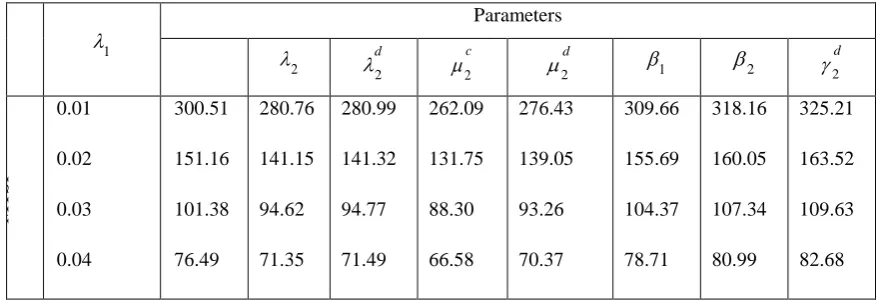
In this case the Weibull distribution reduces to Exponential distribution and we get the following:
) exp( )
( 1 1
1 t t
z , z2(t)2exp(2t), zd2(t)2dexp(2dt),s2(t)2cexp(2ct),
) exp( )
( 2 2
2 t t
sd d d , g1(t)1exp(1t), g2(t)2exp(2t),fd2(t)2dexp(2dt)
ly. respective
0 , , , , , , , , and 0
t 1 2 d2 2c 2d 1 2 2d
where
Table 2: Effect of various parameters on MTSF, Availability and Profit with respect to λ1
1
Parameters
2
d2
c
2
2d
1
2d
2
MT
SF
0.01
0.02
0.03
0.04
300.51
151.16
101.38
76.49
280.76
141.15
94.62
71.35
280.99
141.32
94.77
71.49
262.09
131.75
88.30
66.58
276.43
139.05
93.26
70.37
309.66
155.69
104.37
78.71
318.16
160.05
107.34
80.99
325.21
163.52
109.63
2643 | P a g e
Av
ailab
ilit
y
0.01
0.02
0.03
0.04
0.99841
0.99684
0.99528
0.99373
0.99830
0.99662
0.99495
0.99329
0.99830
0.99662
0.99495
0.99329
0.99818
0.99638
0.99459
0.99282
0.99827
0.99656
0.99487
0.99319
0.99876
0.99752
0.99629
0.99507
0.99850
0.99701
0.99554
0.99408
0.99853
0.99708
0.99564
0.99421
Case-3: When shape parameter η=2
In this case the Weibull distribution reduces to Rayleigh distribution and we get the following:
) exp( 2 )
( 1 1 2
1 t t t
z , z2(t)22texp(2t2), zd2(t)2
2dtexp(
d2t2), s2(t)22ctexp(2ct2),) exp( 2
)
( 2 2 2
2 t t t
sd
d
d , g1(t)21texp(1t2), () 2 exp( )
2
2 2
2 t t t
g , fd2(t)2
2dtexp(
2dt2) ,ly. respective
0 , , , , , , , , and 0
t 1 2 2d 2c 2d 1 2 2d
where
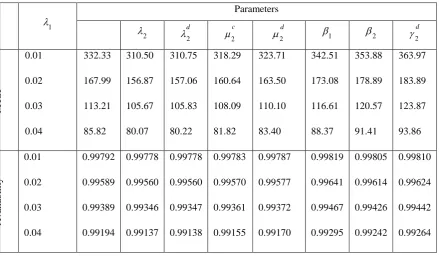
Table 3:Effect of various parameters on MTSF, Availability and Profit with respect to λ1
1
Parameters
2
d2
c
2
2d
1
2d
2
MT
SF
0.01
0.02
0.03
0.04
332.33
167.99
113.21
85.82
310.50
156.87
105.67
80.07
310.75
157.06
105.83
80.22
318.29
160.64
108.09
81.82
323.71
163.50
110.10
83.40
342.51
173.08
116.61
88.37
353.88
178.89
120.57
91.41
363.97
183.89
123.87
93.86
Av
ailab
ilit
y
0.01
0.02
0.03
0.04
0.99792
0.99589
0.99389
0.99194
0.99778
0.99560
0.99346
0.99137
0.99778
0.99560
0.99347
0.99138
0.99783
0.99570
0.99361
0.99155
0.99787
0.99577
0.99372
0.99170
0.99819
0.99641
0.99467
0.99295
0.99805
0.99614
0.99426
0.99242
0.99810
0.99624
0.99442
0.99264
7.
DISCUSSION AND CONCLUSION
The numerical effect of change in values of different parameters on the reliability and availability is shown in
Tables 1-3. Table 1 gives thevalues of MTSF and availability when the shape parameter of Weibull distribution
η=0.5. Whereas Table 2 and Table 3 gives the values of MTSF and availability,w.r.t. the failure rate of the
2644 | P a g e
exhibit similar results. Both the performance measures declines with increasing values of1
,2
, d2
, c
2
and d2
but the trend declines with increasing values of
1,
2and2d.Therefore the numerical results reveal thatunder the stated framework a cold standby system can be made more reliable and available for use by keeping:a. the failure rate of both units under control b. maximum redundancy times lower
c. repair times of both the units higher and d. faster replacement rate of failed unit.
Acknowledgement:
The authors are very thankful to the reviewers for valuable comments and suggesitions.REFERENCES
[1] S. K. SrinivasanandM. N. Gopalan, Probabilistic analysis of a 2-unit cold-standby system with a single
repair facility, IEEE Transactions on Reliability, 22(5),1973, 250-254.
[2] K.Murari andV. Goyal, Comparison of two unit cold standby reliability models with three types of
repair facilities, Microelectronics Reliability, 24(1),1984, 35-49.
[3] S. K. Singh andB. Srinivasu, Stochastic analysis of a two unit cold standby system with preparation
time for repair, Microelectronics Reliability, 27(1), 1987, 55-60.
[4] J. Cao andY. Wu, Reliability analysis of a two-unit cold standby system with a replaceable repair
facility, Microelectronics Reliability, 29(2),1989, 145-150.
[5] R. Subramanian and V. Anantharaman, Probabilistic analysis of a three unit cold standby redundant
system with repair, Microelectronics Reliability, 35(6),1995, 1001-1008.
[6] K. M. El-Said andM. S. El-Sherbeny, Stochastic analysis of a unit cold standby system with
two-stage repair and waiting time, Sankhya B, 72(1),2010, 1-10.
[7] R. K. Bhardwaj and S, C. Malik , Asymptotic performance analysis of 2oo3 cold standby system with
constrained repair and arbitrary distributed inspection time, International Journal of Applied
Engineering Research, 6(08), 2011, 1493-1502.
[8] X. Bao and L. Cui, A study on reliability for a two-item cold standby Markov repairable system with
neglected failures, Communications in Statistics-Theory and Methods, 41(21), 2012, 3988-3999.
[9] R. K. Bhardwaj and K. Kaur,Reliability and Profit Analysis of a Redundant System with Possible
Renewal of Standby Subject to Inspection, Int. J. of Stat. &Reliab. Eng, 1(1), 2014, 36–46.
[10] R. K. Bhardwaj and R. Singh, Semi Markov approach for asymptotic performance analysis of a
standby system with server failure, Int. J Comput. Appl, 98(3),2014, 9-14.
[11] R. K. Bhardwaj and R. Singh, Steady state behavior of a cold standby system with server failure and
arbitrary repair, replacement & treatment, International Journal of Applied Engineering Research,
9(24),2014, 26563-26578.
[12] R. K. Bhardwaj, K. Kaur and S. C. Malik, Stochastic Modeling of a System with Maintenance and
Replacement of Standby Subject to Inspection, American J. of Theoretical & Applied Statistics,
2645 | P a g e
[13] R. K. Bhardwaj and R. Singh, An inspection-repair-replacement model of a stochastic standby systemwith server failure, Mathematics in Engineering, Science & Aerospace (MESA), 6(2), 2015, 191-203.
[14] R. K. Bhardwaj, K. Kaur and S. C. Malik, Reliability indices of a redundant system with standby
failure and arbitrary distribution for repair and replacement times, International Journal of System
Assurance Engineering and Management, 8(2), 2017, 423-431.
[15] W. L. Smith, Regenerative stochastic processes, Proceedings of the Royal Society of London, Series A.
Mathematical and Physical Sciences, 232(1188), 1955, 6-31.
[16] D. R. Cox, Renewal theory, Methuen and co. Ltd., London, 1962.