Scholarship@Western
Scholarship@Western
Electronic Thesis and Dissertation Repository
1-10-2014 12:00 AM
Effects of Surface Topographies on Heat and Fluid Flows
Effects of Surface Topographies on Heat and Fluid Flows
Hadi Vafadar Moradi
The University of Western Ontario
Supervisor
Dr. Jerzy Maciej Floryan
The University of Western Ontario
Graduate Program in Mechanical and Materials Engineering
A thesis submitted in partial fulfillment of the requirements for the degree in Doctor of Philosophy
© Hadi Vafadar Moradi 2014
Follow this and additional works at: https://ir.lib.uwo.ca/etd
Part of the Mechanical Engineering Commons
Recommended Citation Recommended Citation
Vafadar Moradi, Hadi, "Effects of Surface Topographies on Heat and Fluid Flows" (2014). Electronic Thesis and Dissertation Repository. 1878.
https://ir.lib.uwo.ca/etd/1878
This Dissertation/Thesis is brought to you for free and open access by Scholarship@Western. It has been accepted for inclusion in Electronic Thesis and Dissertation Repository by an authorized administrator of
(Thesis format: Monograph)
by
Hadi Vafadar Moradi
Graduate Program in Engineering Science Department of Mechanical and Materials Engineering
A thesis submitted in partial fulfillment of the requirements for the degree of
Doctor of Philosophy
The School of Graduate and Postdoctoral Studies The University of Western Ontario
London, Ontario, Canada
ii
Abstract
Responses of annular and planar flows to the introduction of grooves on the bounding surfaces have been analyzed. The required spectral algorithms based on Fourier and Chebyshev expansions have been developed. The difficulties associated with the irregularities of the physical domain have been overcome using either the immersed boundary conditions (IBC) concept or the domain transformation method (DT).
Steady flows in annuli bounded by walls with longitudinal grooves have been studied. Analysis of pressure losses showed that the groove-induced changes can be represented as a superposition of a pressure drop due to a change in the average position of the bounding cylinders and a pressure drop due to the flow modulations induced by the shape of the grooves. The former effect can be evaluated analytically while the latter requires explicit computations. It has been shown that the reduced-order model is an effective tool for extraction of features of the groove geometry that lead to flow modulations relevant to drag generation. It has been shown that the presence of the longitudinal grooves may lead to a reduction of the pressure loss in spite of an increase of the wetted surface area. The form of the optimal grooves from the point of view of the maximization of the drag reduction has been determined.
When mixing augmentation is not available, heat can be transported across micro-channels by conduction only. A method to increase this heat flow has been proposed. The method relies on the use of grooves parallel to the flow direction. It has been shown that it is possible to find grooves that can increase the heat flow and, at the same time, can decrease the pressure losses. The optimal groove shape that maximizes the overall system performance has been determined. Since it has been assumed that the flow must be laminar, it is of interest to determine the maximum Reynolds number for which this assumption remains valid.
iii
numbers < ≈ 4.22 and flow destabilization for larger . The stabilizing/destabilizing effects increase with the groove amplitude. Variations of the critical Reynolds number over the whole range of groove wave numbers and groove amplitudes of interest have been determined. Special attention has been paid to the effects of long wavelength, drag reducing grooves. It has been shown that such grooves lead to a small increase of the critical Reynolds number compared with the smooth channel.
Keywords
iv
Co-Authorship Statement
v
To my wife and my parents
vi
Acknowledgments
It is a pleasure to thank the many people who made this thesis possible. It is difficult to overstate my gratitude to my Ph.D. supervisor, Dr. Jerzy Maciej Floryan. I will remain indebted to Prof. Floryan for his precious time, patience, enthusiasm, inspiration, and his great efforts to explain things clearly and simply. The completion of this dissertation would not have been possible without his incomparable assistance and invaluable guidance.
I would like to extend my sincerest thanks to the member of my advisory committee, Dr. A. G. Straatman, for his valuable suggestions and encouragement.
I would also like to thank all of my colleagues (past and present), Dr. Syed Zahid Husain, Dr. Mohammad Zakir Hossain, Dr. Alireza Mohammadi, Mohammad Fazel Bakhsheshi, David César Del Rey Fernandez, Ali Asgarian for their friendship, cooperation and helping attitude. I am particularly grateful to Alireza not only for the insightful scientific discussions I had with him that have been tremendously helpful for me in achieving my research objectives but also because of friendship, courage, motivation, and support I have received from him.
Words are not enough to express my gratitude towards my wife, Shima Ahmadi. Without her unconditional love, encouragement, tremendous patience and understanding, I would not have been able to accomplish my goals.
vii
Table of Contents
Abstract ... ii
Keywords ... iii
Co-Authorship Statement ... iv
Acknowledgments ... vi
Table of Contents ... vii
List of Figures ... xi
List of Appendices ... xxvii
List of Abbreviations, Symbols, Nomenclature ... xxviii
Chapter 1 ... 1
1 Introduction ... 1
1.1 Objective ... 1
1.2 Motivations ... 1
1.3 Literature review ... 2
1.3.1 Grooved surfaces ... 2
1.3.2 Drag generation / reduction ... 4
1.3.3 Laminar-turbulent transition ... 5
1.3.4 Heat transfer enhancement ... 6
1.3.5 Roughness modeling ... 10
1.4 Overview of the present work ... 13
1.5 Outline of the dissertation ... 14
Chapter 2 ... 16
2 Algorithm for Analysis of Flows in Ribbed Annuli... 16
2.1 Introduction ... 16
viii
2.2.1 Problem formulation ... 17
2.2.2 Reference flow ... 20
2.2.3 Discretization ... 20
2.2.4 Post-processing of Results ... 27
2.2.5 Solution strategy ... 28
2.2.6 Efficient linear solver ... 30
2.2.7 Testing of the algorithm ... 32
2.3 Annulus with longitudinal grooves ... 43
2.3.1 Formulation of the problem ... 43
2.3.2 Discretization ... 45
2.3.3 Testing of the algorithm ... 53
2.4 Summary ... 60
Chapter 3 ... 62
3 Flows in Annuli with Longitudinal Grooves ... 62
3.1 Introduction ... 62
3.2 Problem formulation ... 63
3.3 Curvature effects ... 64
3.4 Numerical solution ... 69
3.4.1 Discretization of the field equation ... 69
3.4.2 Flow constraint ... 72
3.4.3 Evaluation of surface stress ... 73
3.5 Groove-induced flow modifications ... 74
3.5.1 Effect of the average position of the bounding cylinders ... 74
3.5.2 Reduced order representation of groove shape ... 79
3.5.3 Effect of the dominant geometric parameters ... 80
ix
3.6 Groove optimization for drag reduction ... 88
3.6.1 The equal-depth grooves ... 90
3.6.2 The unequal-depth grooves ... 95
3.7 Summary ... 101
Chapter 4 ... 103
4 Maximization of Heat Transfer Across Micro-Channels ... 103
4.1 Introduction ... 103
4.2 Problem formulation ... 104
4.3 Cost function evaluation ... 106
4.3.1 Arbitrary grooves ... 109
4.3.2 Long wavelength grooves ... 111
4.4 Transport mechanisms ... 113
4.5 Optimization ... 119
4.6 Results ... 123
4.6.1 The equal-depth grooves ... 124
4.6.2 The unequal-depth grooves ... 129
4.7 Summary ... 134
Chapter 5 ... 135
5 Stability of Flow in a Channel with Longitudinal Grooves ... 135
5.1 Introduction ... 135
5.2 Flow in a channel with longitudinal grooves ... 136
5.2.1 Problem formulation ... 136
5.2.2 Numerical solution ... 138
5.2.3 Small wave number approximation ... 139
5.2.4 Description of the flow ... 141
x
5.3.1 Problem formulation ... 144
5.3.2 Numerical solution ... 147
5.4 Results ... 150
5.4.1 Sinusoidal grooves ... 151
5.4.2 Grooves with arbitrary shapes ... 161
5.4.3 Optimal grooves ... 164
5.5 Summary ... 166
6 Conclusions and Recommendations ... 168
6.1 Conclusions ... 168
6.2 Recommendations for future work ... Error! Bookmark not defined. References ... 176
Appendices ... 190
Appendix A ... 190
Appendix B ... 194
Appendix C ... 196
Appendix D ... 197
Appendix E ... 198
Appendix F... 199
Appendix G ... 200
Appendix H ... 201
Appendix I ... 204
Appendix J ... 208
xi
List of Figures
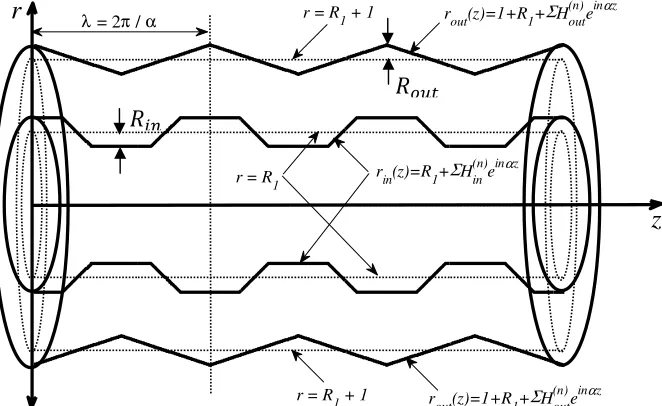
Figure 2-1: Sketch of the flow geometry - axisymmetric annulus with transverse ribs of arbitrary cross-section. ...17
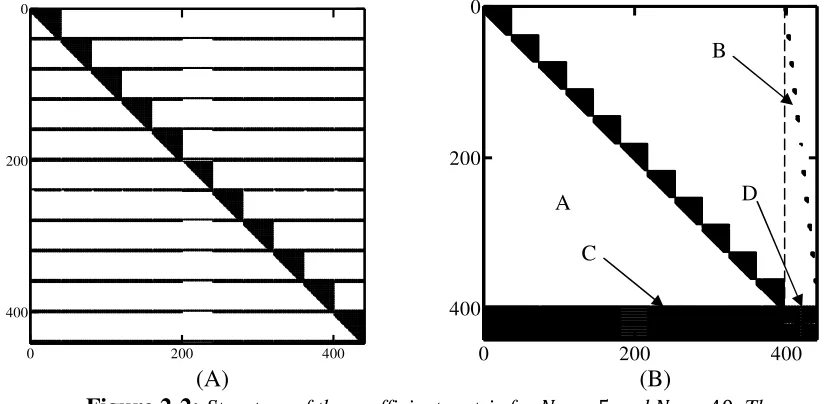
Figure 2-2: Structure of the coefficient matrix for = 5 and = 40. The nonzero
elements are marked in black. The total number of elements, the number of nonzero elements and the sparsity (ratio of the number of the zero elements to the total number of the elements) for this matrix are 440= 193600, 27780 and 0.86, respectively. Figure 2-2A - the structure of the coefficient matrix before the re-arrangement, Figure 2-2B - the structure of the coefficient matrix after the re-arrangement (see Section 2.2.5 for a discussion). ...31
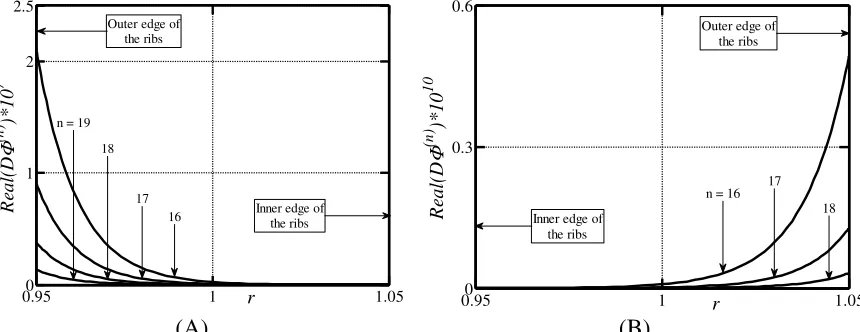
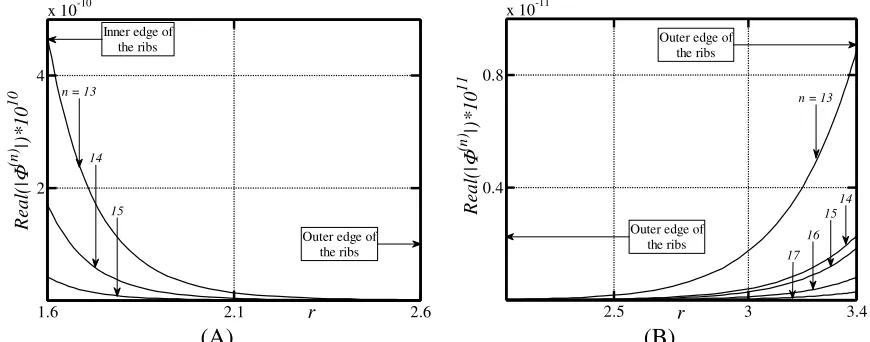
Figure 2-3: Distribution of the real part of as a function of r for higher Fourier modes
> 15 for ribs placed either at the inner cylinder (Figure 2-3A) or at the outer cylinder (Figure 2-3B). The geometry of the ribs' is given by Eq. (2.2.52) with the ribs' wave number
= 5, the ribs' amplitude S = 0.05 and the average radius on the inner cylinder = 1. Computations have been carried out for the flow Reynolds number Re = 50 using = 20
Fourier modes and = 70 Chebyshev polynomials. ...33
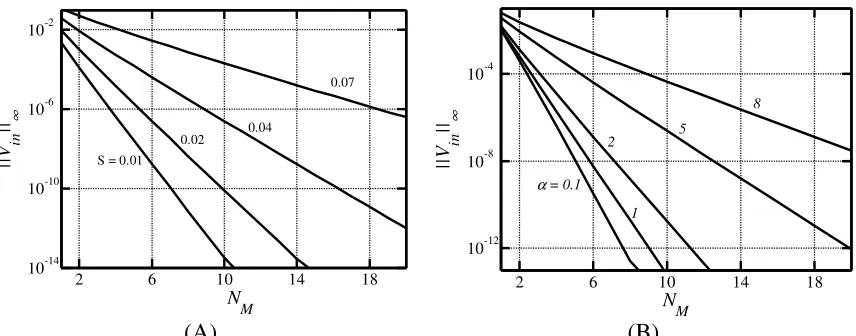
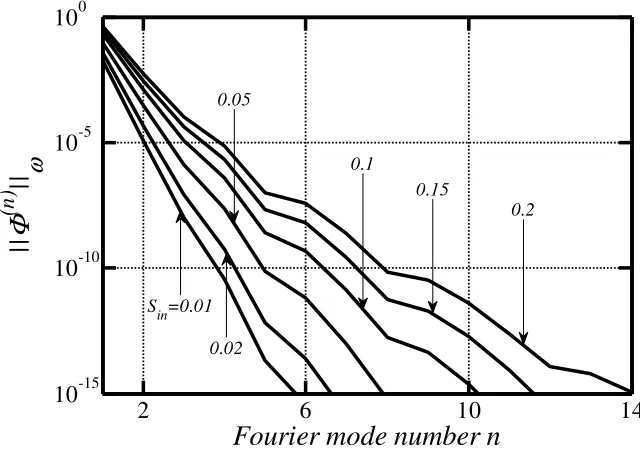
Figure 2-4: Variations of the Chebyshev norm defined by Eq. (2.2.53) as a function of the Fourier mode number n for the model geometry described by Eq. (2.2.52) with the ribs' wave number = 2 for selected values of the ribs' amplitude S (Figure 2-4A) and with the ribs' amplitude S = 0.04 for selected values of the ribs' wave numbers (Figure
2-4B). Calculations have been carried out for the flow Reynolds number Re = 50 and the
average radius of the inner cylinder = 1.5 using = 20 Fourier modes and = 70 Chebyshev polynomials. ...34
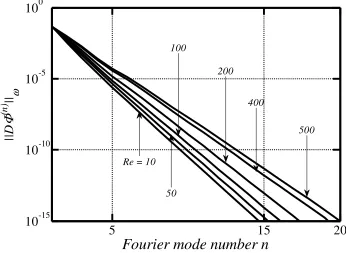
Figure 2-5: Variations of the Chebyshev norm defined by Eq. (2.2.53) as a function of the Fourier mode number n for the model geometry described by Eq. (2.2.52) with the ribs' amplitude = 0.04, the ribs' wave number = 2 and the average radius of the inner cylinder = 1.5 for selected values of the flow Reynolds number Re. Calculations
xii
Figure 2-6: Variations of the norm ‖"#‖$ defined by Eq. (2.2.54) as a function of the number of Fourier modes used in the computations for the model problem described by Eq. (2.2.52) with the ribs' wave number = 5 for selected values of the ribs' amplitude S
(Figure 2-6A) and with the ribs' amplitude S = 0.04 for selected values of the ribs' wave
number (Figure 2-6B). Calculations have been carried out for the flow Reynolds number
Re = 50 and the average radius of the inner cylinder = 1 using = 70 Chebyshev
polynomials. ...36
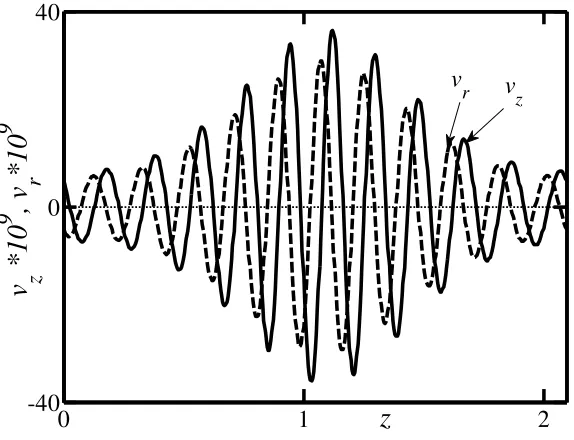
Figure 2-7: Distributions of the velocity components %& and % evaluated along the inner cylinder for the model geometry described by Eq. (2.2.52) with the ribs' wave number = 3, the ribs' amplitude S = 0.05 and the average radius of the inner cylinder = 1. Calculations
have been carried out for the flow Reynolds number Re = 50 using = 10 Fourier modes
and = 40 Chebyshev polynomials. ...37
Figure 2-8: Fourier spectra of the velocity components %& and % (Figure 2-8A) and of the
stream function derivatives () (*⁄ and () (,⁄ (Figure 2-8B) evaluated at the surface of the inner cylinder. Other conditions as in Figure 2-7. ...38
Figure 2-9: Fourier spectra of the axial velocity component %& evaluated at the surface of the inner cylinder for ribs with the wavelength - = 2. 3⁄ . Other conditions as in Figure 2-7. Solution have been obtained with = 3 and = 10 in case A, = 1.5 and = 20 in case B, and = 1 and = 30 in case C. ...39
Figure 2-10: Variations of the norms ‖"#‖$ and ‖"/0‖$ defined by Eq. (2.2.54) as a
function of the radius of the inner cylinder . The former one corresponds to an annulus with geometry described by Eq. (2.2.52) with the ribs' wave number = 4 and the ribs' amplitude S = 0.06. The latter one corresponds to the same ribs but placed at the outer
cylinder. Computations were carried out for the flow Reynolds number Re = 10 using = 20 Fourier modes and = 70 Chebyshev polynomials. ...39
Figure 2-11: Variation of the norm ‖"#‖$ defined by Eq. (2.2.54) as a function of the flow Reynolds number Re for an annulus with geometry defined by Eq. (2.2.52) with the ribs'
xiii
= 1 determined using different number of Fourier modes and = 70 Chebyshev
polynomials. ...40
Figure 2-12: Variations of the norm ‖"#‖$ defined by Eq. (2.2.54) as a function of the ribs'
amplitude S for selected values of the ribs' wave numbers (Figure 2-12A) and as a function
of the ribs' wave number for selected values of the ribs' amplitude S (Figure 2-12B) for the model configuration described by Eq. (2.2.52). Calculations have been carried out for the flow Reynolds number Re = 50 and the average radius of the inner cylinder = 1 using = 20 (solid lines) and = 15 (dashed line) Fourier modes, and = 70 Chebyshev polynomials. ...41
Figure 2-13: Variations of the additional pressure loss generated by the ribs with geometry defined by Eq. (2.2.52) as a function of the rib’s amplitude S and the ribs' wave number for the flow Reynolds number Re = 10 and the average radius of the inner cylinder = 1. 42
Figure 2-14: Variations of the additional pressure loss generated by the ribs with geometry given by Eq. (2.2.52) as a function of the flow Reynolds number Re and the average radius
of the inner cylinder for ribs with the wave number = 2 and the amplitude S = 0.04. ...42
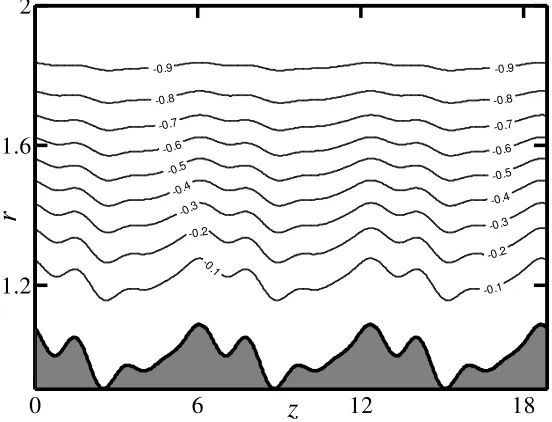
Figure 2-15: Streamlines of a flow in an annulus with geometry defined by Eq. (2.2.55) for the flow Reynolds number Re = 10. ...43
Figure 2-16: Sketch of the flow geometry - annulus with axial ribs of arbitrary form. Shaded area represents computational domain. ...44
Figure 2-17: Distribution of the real part of as a function of r for higher Fourier
modes > 13 in the region close to the surfaces of the inner (Figure 2-17A) and outer (Figure 2-17B) cylinders. The ribs' geometry is given by Eq. (2.3.37) with the inner and outer amplitudes # = 0.4 and /0 = 0.4, respectively, and the average radius on the inner cylinder = 2. Computations have been carried out using = 20 Fourier modes and
= 70 Chebyshev polynomials. ...54
xiv
ribs' amplitude #. Calculations have been carried out for the smooth outer cylinder
/0 = 0 and the average radius of the inner cylinder = 2 using = 20 Fourier modes
and = 70 Chebyshev polynomials. ...55
Figure 2-19: Variations of the norm ‖"#‖$ defined by Eq. (2.3.38) as a function of the number of Fourier modes used in the computations for the model problem described by Eq. (2.3.37) for selected values of the inner ribs' amplitude #. Calculations have been carried out for the smooth outer cylinder /0 = 0 and the average radius of the inner cylinder = 1 using = 70 Chebyshev polynomials. ...56
Figure 2-20: Variations of the norm ‖"#‖$ defined by Eq. (2.3.38) as a function of the ribs' inner amplitude # for the model configuration described by Eq. (2.3.37). Calculations have been carried out for the smooth outer cylinder /0 = 0 and the average radius of the inner cylinder = 1 using = 70 Chebyshev polynomials and selected number of the Fourier modes . ...56
Figure 2-21: Distributions of the axial velocity component %& evaluated along the inner and
outer cylinders for the model geometry described by Eq. (2.3.37) with the ribs' inner and outer amplitudes /0 = 0.05 and /0 = 0.1, respectively, and 1 replaced by 31. Calculations have been carried out for the average radius of the inner cylinder = 1 using
= 20 Fourier modes and = 70 Chebyshev polynomials. ...57
Figure 2-22: Fourier spectra of the axial velocity component %& evaluated along the inner and outer cylinders for the model geometry described by Eq. (2.3.37). Other conditions as in Figure 2-21. ...58
Figure 2-23: Variations of the norms ‖"#‖$ and ‖"/0‖$ defined by Eq. (2.3.38) as a
xv
Figure 2-24: Variations of the additional pressure loss 2 (3⁄(, associated with the presence of the ribs at the inner cylinder while the outer cylinder is kept smooth /0 = 0 as a function of the ribs' amplitude # and the average radius of the inner cylinder . The ribs' geometry is defined by Eq. (2.3.37). Computations were carried out using = 20 Fourier modes and = 70 Chebyshev polynomials. ...59
Figure 2-25: Velocity contours for the model problem defined by Eq. (2.3.39). ...60
Figure 3-1: Sketch of the flow geometry - annulus with longitudinal grooves with an arbitrary geometry. ...63
Figure 3-2: Variations of the error of the asymptotic approximation for → ∞. Solid lines
correspond to grooves placed at the inner cylinder (Eq. 3-6) with M = 8 and # = 0.15 and dashed lines correspond to the same grooves placed at the outer cylinder (see Eq. B-1). ...68
Figure 3-3: Variations of the geometric correction factors #,7 and /0,7 as functions of for the groove geometry described by Eq. (3.4.3) with 89,# = 89,/0 = : = 0 with the same grooves placed either at the inner cylinder (solid lines, # = 0.1, /0 = 0) or at the outer cylinder (dashed lines, # = 0, /0 = 0.1). ...76
Figure 3-4: Sketch of the test configuration used to demonstrate the effect of the average position 89,# of the grooves. Four grooves (M = 4) with the shape defined by Eq. (3.4.3)
with # = 0.3, /0 = 0, 89,/0 = 0 are placed at three different average locations: Case A – 89,#= 0.3; Case B – 89,#= 0; Case C – 89,#= −0.3. See text for details. ...78
Figure 3-5: Variations of the normalized modification friction factor ;⁄;< as a function of the groove amplitude # for = 1. Four grooves (M = 4) are placed at the inner cylinder with their geometry described by Eq. (3.4.3) with 89,/0 = /0 = 0 and 89,# = 0.05, 0, −0.05 in Cases A, B, C, respectively. ...78
Figure 3-6: Shapes of the grooves used in this study: A- rectangular groove, B- trapezoidal
xvi
Figure 3-7: Variations of the normalized modification friction factor ;⁄;< as a function of the number of Fourier modes A used to describe the groove geometry. Four grooves (M = 4)
with shapes described in Figure 3-6 and the same amplitude #= 0.1 are placed at the inner cylinder with the average radius = 1 in such a way that mode zero of their Fourier expansion is zero. For grooves A: B = C = . @⁄ ; for grooves B: B = C = . 3@⁄ , D =
2. 3@⁄ . ...81
Figure 3-8: Variation of the normalized modification friction factor ;⁄;< as a function of
for the geometry described by (3.4.3) with 89,/0 = /0 = 0 and @ = 2, 5 and 10. Solid (dashed) lines correspond to the same grooves placed only on the inner (outer) cylinder with
# = 0.3, /0 = 0 ( /0 = 0.3, # = 0 ). ...82
Figure 3-9: Variations of the normalized modification friction factor ;⁄;< as a function of the groove amplitudes # and /0 and the radius of the inner cylinder for the geometry described by Eq. (3.4.3) with 89,/0 = 89,# = 0. Results for M = 2, 4, 10, 15 grooves are displayed in Figure 3-9A, B, C, D, respectively. Solid (dashed) lines correspond to grooves placed only at the inner (outer) cylinder. ...83
Figure 3-10: Variations of the normalized modification friction factor ;⁄;< induced by the
grooves placed at the inner cylinder with the shape defined by Eq. (3.4.3) with 89,/0 =
89,# = /0 = 0 and M = 4, as a function of the amplitude # (solid lines) and as a
function of the wave number = @/ (dashed lines). ...84
Figure 3-11: Variations of the critical groove wave number 7 as a function of the number of grooves M for an annulus with geometry described by Eq. (3.4.3) with 89,/0 = 89,# =
0. Solid (dashed) line corresponds to the grooves placed only at the inner (outer) cylinder with # = 0.1 and 0.8, /0 = 0 ( # = 0, /0 = 0.1 and 0.8). ...85
Figure 3-12: Variations of the normalized modification friction factor ;⁄;< as a function of the groove phase difference : and the radius of the inner cylinder for the grooves described by Eq. (3.4.3) with #= /0 = 0.3 and 89,/0 = 89,# = 0. Results for M = 5,
xvii
Figure 3-13: Distribution of the axial component of shear stress acting on the fluid at the
inner (Figure 3-13A) and outer (Figure 3-13B) cylinders for grooves with the geometry defined by Eq. (3.4.3) with # = 0.3, /0 = 0, = 5, and 89,/0 = 89,#= 0. Dashed lines provide reference values for the smooth cylinders. ...87
Figure 3-14: Distribution of the axial velocity component in an annulus with the geometry defined by Eq. (3.4.3) with # = 0.3, = 5, 89,/0 = 89,#= /0 = 0 and M = 5
(Figure 3-14A) and M = 15 (Figure 3-14B). ...87
Figure 3-15: Distribution of the axial velocity component in an annulus with the geometry defined by Eq. (3.4.3) with # = /0 = 0.3, = 5, 89,/0 = 89,#= 0, M = 5, and :
= 0 (Figure 3-15A) and : = . (Figure 3-15B). ...88
Figure 3-16: Variations of the normalized modification friction factor ;⁄;< as a function of the number of Fourier modes used for description of the optimal shape of the equal-depth grooves placed at the inner cylinder. ...91
Figure 3-17: Evolution of the optimal shape of M = 2, 10 equal-depth grooves placed at the
inner cylinder as a function of the wall curvature . Solid, dashed and dotted lines correspond to the depth of the grooves #,# = #,/= S = 0.2, 0.5, 0.8, respectively. All these
lines overlap for = ∞. The other values of shown correspond to values close to those that cause a change from drag reduction to a drag increase (see Figure 3-11). Thick lines describe the universal shape, i.e. trapezoid with B = C = -/6 and D = G = -/3 (see text for details). ...92
Figure 3-18: Variations of the normalized modification friction factor ;⁄;< for M = 2 equal-depth optimal grooves (Figure 3-18A) and M = 10 similar grooves (Figure 3-18B) placed at
the inner cylinder (solid lines). Modification friction factors for the same grooves approximated using the universal trapezoid are marked using dashed lines. See text for details. ...93
Figure 3-19: Variations of the normalized modification friction factor ;⁄;< as a function of
the wall curvature and the groove amplitude #,# = #,/= S for M = 2 universal
xviii
at the inner cylinder (see text for discussion). Dashed lines are for the sinusoidal grooves defined by Eq. (3.4.3) with 89,/0= 89,#= 0. ...94
Figure 3-20: Optimal shapes of the equal-depth grooves placed at both cylinders. H1 is defined as IJ/01 − 1 − L ⁄ /0,#, IJ#1 − L ⁄ #,#. Figure 3-20A displays results for
M = 2 grooves; the solid lines are for = 3, #,/ = #,# = /0,/ = /0,# = 0.2, the
dotted lines are for = 5, #,/ = #,# = /0,/ = /0,# = 0.4, and the dash lines are for
= 10, #,/ = #,# = /0,/ = /0,# = 0.4. Figure 3-20B displays results for M = 10
grooves; the solid lines are for = 8, #,/ = #,# = /0,/= /0,#= 0.2, and the dashed lines are for = 10 and #,/ = #,# = /0,/ = /0,# = 0.4. ...95
Figure 3-21: Variations of the normalized modification friction factor ;⁄;< as a function of
the wall curvature and the groove amplitude #,# = #,/ = /0,# = /0,/= S for M = 2 universal equal-depth trapezoidal grooves (Figure 3-21A) and M = 10 similar grooves
(Figure 3-21B) placed at both cylinders (see text for discussion). Dashed lines are for the sinusoidal grooves defined by Eq. (3.4.3) with 89,/0 = 89,# = 0. The reader should note that the universal trapezoid does not offer a good approximation for the optimal grooves under conditions close to transition between the drag increasing and the drag decreasing geometries. ...96
Figure 3-22: Variations of the normalized modification friction factor ;⁄;< as a function of the depth of the grooves, i.e. /0,/, for the unequal-depth grooves. The grooves are placed at the outer cylinder and have the same maximum height set at /0,# = 0.5. Solid and dashed lines correspond to the use of @ = 2 and @ = 10 grooves, respectively. The dotted (@ = 2) and dashed-dotted (@ = 10) lines identify the depth of the grooves that leads to the maximum drag reduction. ...97
Figure 3-23: Evolution of the optimal shape of the unequal-depth grooves placed at the outer
cylinder as a function of the depth of the groove /0,/. The height of the groove is set at
/0,# = 0.5. The results presented in Figure 3-23A are for M = 2, = 1, and in Figure 3-23B for M = 10, = 20. Dashed lines illustrate shapes corresponding to the optimal
xix
Figure 3-24: Shapes of the unequal-depth optimal grooves corresponding to the optimal
depth, i.e. the optimal geometry, for grooves placed at the outer cylinder for selected values of the wall curvature . H1 is defined as IJ/01 − J/0N#L IJ⁄ /0NO− J/0N#L. The height of the groove is set at /0,# = 0.5. Figure 3-24A-B present results for M = 2 and
M = 10, respectively. The same shapes, but normalized with the width at half height PQRS
are presented in Figure 3-24C-D. The universal shape has the form of a Gaussian function defined by T = 2UV.OW and is illustrated using solid lines.. ...98
Figure 3-25: Variations of the normalized modification friction factor (Figure 3-25A), the optimal depth (Figure 3-25B) and the half width of the optimal groove (Figure 3-25C) as a function of the wall curvature for an annulus with the smooth inner cylinder and the optimal geometry of the outer cylinder. The maximum heights of the grooves are set as
/0,# = 0.8 (dashed-dotted lines), /0,# = 0.5 (solid lines) and /0,# = 0.2 (dashed lines).
Dotted lines correspond to the asymptotic solution, i.e. → ∞.. ...100
Figure 3-26: Variations of the normalized modification friction factor (Figure 3-26A), the
optimal depth (Figure 3-26B) and the half width of the optimal groove (Figure 3-26C) as a
function of the wall curvature for an annulus with the optimal geometries of the inner and outer cylinders. The maximum heights of the grooves at the inner and outer cylinders are the same and set at the level of /0,# = 0.4 (dashed lines) and /0,# = 0.2 (solid lines). Dotted lines correspond to the asymptotic solution, i.e. → ∞. ...101
Figure 4-1: Sketch of the heat transfer system. ...104
Figure 4-2: Variation of X X⁄ < as a function of the groove amplitude Y and the wave
number for the geometry described by Eq. (4.4.1). Dashed lines identify asymptotic values for → 0.. ...113
Figure 4-3: Temperature distribution inside the channel for the grooves described by Eq.
(4.4.1) with the amplitude Y = 2 and the wave number = 0.5 (Figure 4-3A) and = 30
(Figure 4-3B). ...114
Figure 4-4: Temperature profiles at Z = -O⁄2 for the grooves described by Eq. ( 4.4.1) with
xx
Figure 4-5: Distributions of the local heat flux at the lower (Figure 4-5A) and upper (Figure 4-5B) walls for grooves described by Eq. (4.4.1) with the amplitude Y = 1. ...115
Figure 4-6: Variations of the wetted surface area [ [⁄ < (see Eq. (4.3.13)) as a function of the
groove amplitude Y and the wave number for the groove geometry described by Eq. (4.4.1). ...116
Figure 4-7: Variation of ; ;⁄ < as a function of the groove amplitude Y and the wave number for the geometry described by Eq. (4.4.1). Dashed lines identify asymptotic values for
→
0. ...117Figure 4-8: Distribution of the w - velocity component for grooves described by Eq. (4.4.1)
with amplitude Y = 2 and the wave numbers = 0.5 (Figure 4-8A) and = 5 (Figure 4-8B). ...117
Figure 4-9: Distribution of the z-component of shear acting at the lower (Figure 4-9A) and upper (Figure 4-9B) walls for grooves described by Eq. (4.4.1) with amplitude Y = 1. ...118
Figure 4-10: Variations of the ; ;⁄ < and X X⁄ < for a channel with geometry described by Eq.
(4.4.1) as a function of the groove wave number .. ...119
Figure 4-11: Variations of the thermal enhancement factor Ω for a channel with geometry described by Eq. (4.4.1) as a function of the groove wave number . ...121
Figure 4-12: Variations of the normalized friction factor ; ;⁄ < and the thermal enhancement
factor Ω for the equal-depth grooves with amplitude Y = 1 as a function of the number of Fourier modes A used in the description of the groove geometry. ...123
Figure 4-13: The optimal shapes of the equal-depth grooves. Solid line identifies a groove with Y = 0.4 and = 0.1, whilst dotted line is for Y = 1.6 and = 1. The y-coordinate is
scaled using the groove depth. Thick line illustrates the best-fitted trapezoid characterized by
B = C = - 11⁄ and D = G = 4.5- 11⁄ . ...124
Figure 4-14: Velocity isolines for the equal-depth optimal grooves (thick lines) and for the
xxi
Distributions of the shear stress acting on the fluid at the lower wall for the same grooves are shown in Figure 4-14B. Solid, dashed and dotted lines in Figure 4-14
Figure 4-14B correspond to the optimal groove, the sinusoidal groove and the reference
smooth wall. The corresponding total shear forces are -1.8173, -1.8878 and −2. ...125
Figure 4-15: Variations of the normalized heat transfer per unit length X X⁄ < (Figure 4-15A),
the normalized friction factor ; ;⁄ < (Figure 4-15B) and the thermal enhancement factor Ω
(Figure 4-15C) as a function of the groove wave number and the groove depth Y for a channel with the lower wall fitted with the equal-depth grooves approximated by a trapezoid with B = C = - 11⁄ , D = G = 4.5- 11⁄ and a smooth upper wall. Dashed lines identify results for the simple sinusoidal grooves. ...126
Figure 4-16: Variations of the wetted surface area [ [⁄ < (see Eq.(4.3.13)) as a function of
the groove wave number for the same grooves as used in Figure 4-15. Dashed lines identify results for the simple sinusoidal grooves...127
Figure 4-17: Variations of the thermal enhancement factor as a function of the groove wave
number for the equal-depth grooves located on the lower wall. Solid and dashed lines correspond to grooves with the optimal and trapezoidal shapes, respectively. ...127
Figure 4-18: The optimal shapes for the equal depth grooves placed on both walls. Solid line
identifies Y = ] = 0.2 and = 0.1, whilst dotted line is for Y = ] = 0.5 and = 1 . Thick lines illustrate the best-fitted trapezoids with B = C = 1.25- 11⁄ and D = G =
4.25- 11⁄ . ...128
Figure 4-19: Variations of the thermal enhancement factor Ω as a function of the groove
wave number and the groove depth L for a channel with the lower and upper walls fitted with the equal-depth grooves approximated by a trapezoid with B = C = 1.25- 11⁄ and
xxii
Figure 4-20: Variations of the thermal enhancement factor Ω for a channel with the smooth upper wall and the optimal grooves with height Y,NO = 1 placed at the lower wall as a function of the depth of the grooves Y,N#. ...130
Figure 4-21: Evolution of the shape of the optimal, unequal-depth grooves with height Y,NO = 1 placed on the lower wall as a function of the groove depth Y,N#. Results for = 0.1, 0.5, 1 are displayed in Figure 4-21A, B and C, respectively. Dashed lines identify
shapes corresponding to the optimal depth. ...131
Figure 4-22: Shapes of the unequal-depth grooves with height Y,NO corresponding to the
optimal depth placed at the lower wall. The y-coordinate is scaled using the groove
peak-to-bottom distance T^YZ = _TYZ − Y,N#` a c Y,NO− Y,N#b− 1. Solid, dashed, dash-dotted, and dotted lines correspond to = 0.1, 0.5, 0.8, 1.0, respectively. ...132
Figure 4-23: Shapes of the grooves displayed in Figure 4-22 scaled in the x-direction with the groove width at half height PQRS (Figure 4-23A). Solid, dashed, dash-dotted, and dotted
lines correspond to = 0.1, 0.5, 0.8, 1.0, respectively. Thick dashed line identifies the universal shape T^Z̅ = −2Z3−3.5Z̅. Variations of the optimal depth /e and the corresponding width at half height PQRS as a function of the groove wave number
α
are displayed in Figure 4-23B. ...132Figure 4-24: Variations of the thermal enhancement factor Ω for the optimal geometry with grooves placed on only one wall. ...133
Figure 4-25: Variations of the thermal enhancement factor Ω (Figure 4-25A) and the
corresponding optimal depth /e and the width at half height PQRS (Figure 4-25B) as a
function of the groove wave number for the optimal geometry with grooves placed on both walls and moved by half wavelength with respect to each other. ...133
Figure 5-1: Sketch of the flow system problem. ...137
Figure 5-2: Variations of the error G3 GZ⁄ 9 of the small wave number approximation of
the stationary state (see Eq. (5.2.23)) and variations of the pressure gradient correction
xxiii
show the pressure-gradient asymptote for → 0 and the lower bound for the pressure gradient for → ∞. ...142
Figure 5-3: Variations of the pressure gradient correction 2 G3⁄GZ as a function of the groove wave number and the groove height Y for groove geometry described by Eq. (5.2.21). ...142
Figure 5-4: Distributions of the streamwise velocity fg in the middle of the groove with
geometry described by Eq. (5.2.21) with Y = 0.05. ...143
Figure 5-5: Variations of the Chebyshev norm ΦT (see Eq. (5.3.14)) as a function of the Fourier mode number for the groove geometry described by Eq. (5.2.21) with
Y = 0.05, for flow Reynolds number 2 = 6500 and disturbance wave numbers i = 1.02, j = 0. ...149
Figure 5-6: Variations of the growth rate k#× 10V of disturbances with the wave numbers
i = 1.02 and j = 0 as a function of the number of Fourier modes used in the numerical solution of the stability problem for flow with the Reynolds number Re = 6500 in the
grooved channel with the groove geometry described by Eq. ( 5.2.21) with Y = 0.05.. ...150
Figure 5-7: Variation of the growth rate k# × 10V of disturbances with the wave numbers
i = 1.02 and j = 0 as a function of the groove amplitude Yfor the groove geometry described by Eq. ( 5.2.21) for flow with the Reynolds number 2 = 6500.. ...152
Figure 5-8: Variations of the critical Reynolds number of disturbances with the wave vector
m = i, j of constant magnitude as a function of its inclination angle
θ
for the groove geometry described by Eq. ( 5.2.21) with the amplitude Y = 0.05. Solid lines correspond to|m| = 1.02 and dotted lines to|m| =1.0.. ...153
xxiv
Figure 5-10: Eigenfunctions n0T, = 0, 1, 2, describing two-dimensional travelling
wave disturbances with the wave number i =1.02 in a channel with grooves whose geometry is described by Eq. ( 5.2.21) with Y = 0.05. Results displayed in Figs. 5-10A, B, C, and D correspond to the onset conditions for the groove wave numbers =10, 4.22, 1.0, and 0.2, i.e. 27 = 5028.5, 5773.5, 5886, and 6227.5, respectively. The normalization condition
oBZp∈I<,Lrn0<Tr = 1 has been used for the presentation purposes. Solid and dash lines
identify the real and imaginary parts. Thin dashed-dotted and dotted lines identify the real and imaginary parts of the eigenfunction for the smooth channel with the same Reynolds number.. ...155
Figure 5-11: Pathlines in the y-z plane for the disturbance flow field corresponding to
“two-dimensional” disturbances with the wave number i = 1.02 at the onset for flow in a channel with grooves described by Eq. ( 5.2.21) with Y = 0.05. Figures 5-11A, B, C and D display results for , 27 = (10, 5028.5), (4.22, 5773.5), (1.0, 5886), (0.2, 6227.5), respectively. ...157
Figure 5-12: Pathlines in the x-z plane at y = 0 for the disturbance flow field corresponding
to “two-dimensional” disturbances with the wave number i = 1.02 at the onset for flow in a channel with grooves described by Eq. ( 5.2.21) with Y = 0.05. Figures 5-12A, B, C, D, E and F display results for , 27 = (10, 5028.5), (5, 5652.4), (4.35, 5755), (4.22, 5773.5), (1.0, 5886), (0.5, 6073.1), respectively. ...158
Figure 5-13: Neutral curves in the 2, i-plane for the “two-disturbances” with the wave
numbers i = 1.02 in a channel with grooves whose geometry is described by Eq. ( 5.2.21). Figures 5-13A, B and C display results for the groove wave numbers = 0.2, 4.22, 10, respectively.. ...159
Figure 5-14: Neutral curves in the , i-plane for the “two-dimensional” disturbances in a
xxv
Figure 5-15: Variations of the critical Reynolds number 27 as a function of the groove wave number i and the groove amplitude Y for channel with geometry described by Eq. ( 5.2.21). Dotted-line corresponds to 2 G3⁄ = 0GZ .. ...161
Figure 5-16: Groove shapes used in this study: A- triangular groove, B- trapezoidal groove,
C- rectangular groove.
λ
denotes the groove wavelength.. ...162Figure 5-17: The neutral curves in the 2, i-plane for flow in channels with triangular grooves (solid lines), trapezoidal grooves (dashed lines; B = C = - 6⁄ , D = G = - 3⁄ , see Figure 5-16B for notation), and rectangular grooves (dashed-dotted lines: B = C = - 2⁄ , see
Figure 5-16C for notation). All grooves have the same amplitude Y = 0.05 and the same wave number = 1. Their shapes are described using 1, 3, 5, 7 leading Fourier modes from the complete Fourier expansion describing geometry. ...163
Figure 5-18: The optimal shapes for = 0.2, 0.5 for the equal-depth (Figure 5-18A) and the
unequal-depth grooves (Figure 5-18B) with Y= 0.01, 0.03, 0.05 in the former case and Y,]= 0.01, 0.03, 0.05 in the latter case. The best-fitted trapezoid (B = C = - 8⁄ , D = G = 3- 8⁄ ) overlaps within resolution of this figure with all grooves in Figure 5-18A after shapes had
been rescaled with the groove amplitude. The universal Gaussian function T^ = −2Ut&̅W overlaps within resolution of this figure with all grooves in Figure 5-18B; shapes have been
rescaled with the peak-to-bottom distance as the vertical length scale, i.e.
T^Y= aTY+ 1 − Y,0b ac /e+ Y,0b, and width at half height PQRS as the horizontal length
scale, i.e.,̅ = , − ,< P⁄ QRS. ...164
Figure 5-19: Neutral curves in the 2, i-plane for channel fitted with optimal,
equal-depths grooves at the lower wall. Groove geometry is represented by the universal trapezoid with B = C = - 8⁄ and D = G = 3- 8⁄ (see Figure 5-18A for notation). Results for sinusoidal
grooves are given for reference (dashed lines). Figure 5-19A, Figure 5-19B and Figure 5-19C provide results for the groove wave numbers = 0.2, 0.5, and 0.8, respectively. ...165
Figure 5-20: Neutral curves in the 2, i-plane for channel fitted with the optimal
xxvi
xxvii
List of Appendices
Appendix A: Final discretized form of the field equation for flow in an annulus with transverse grooves ... 190
Appendix B: Evaluation of Fourier coefficients of the Chebyshev polynomials evaluated at the inner and outer cylinders ... 194
Appendix C: Explicit form of geometric coefficients of asymptotic solution ( → ∞). .... 196
Appendix D: Asymptotic solution ( → ∞) for an annulus with sinusoidal grooves placed at the outer cylinder ... 197
Appendix E: Evaluation of the axial force and stress tensor components at the inner and outer cylinders of an annulus fitted with longitudinal grooves ... 198
Appendix F: The small wave number limit solution for a stationary flow in a channel with longitudinal grooves... 199
Appendix G: Definitions of operators T, S, C, v8, vw, x8, xw appearing in the linear
disturbance equations for flow in a channel with longitudinal grooves ... 200
Appendix H: Discretization of the disturbance equations for flow in a channel with longitudinal grooves... 201
Appendix I: Description of boundary relations required to complete formulation of the linear stability problem. ... 204
xxviii
List of Abbreviations, Symbols, Nomenclature
Abbreviations
APF Annular Poiseuille flow
DT Domain transformation
FFT Fast Fourier transform
HPF Hagen-Poiseuille flow
HTE Heat transfer enhancement
IB Immersed boundary
IBC Immersed boundary conditions
LES Large eddy simulation
NSERC Natural sciences and engineering research council
NURBS Non-uniform rational B-spline
OS Orr-Sommerfeld
PPF Planar Poiseuille flow
TS Tollmien-Schlichting
Nomenclature used in Chapter 1
k Average height of roughness
2y Roughness Reynolds number
zy Undisturbed velocity at height k
{ Kinematic viscosity
Nomenclature shared in Chapters 2–5
D Derivative with respect to the transverse direction
x#, x/0 Fourier coefficients of the groove geometries at the inner and outer cylinders
xY, x] Fourier coefficients of the groove geometries at the lower and upper
walls
A Number of Fourier modes used in description of geometry of the
xxix
Number of Fourier modes used for discretization in the direction
associated with periodicity of the grooves
Number of Chebyshev polynomials used for discretization of the
modal functions in the transverse direction
Pr Prandtl number
Average radius of the inner annulus
Re Reynolds number
|y Chebyshev polynomials of the kth order
zNO Maximum of the streamwise velocity component of the reference flow
De Specific heat
i Imaginary unit
k Thermal conductivity
p Pressure
} Density
j Dynamic viscosity
{ Kinematic viscosity
〈;, n〉 Inner product of two functions
in,out Inner and outer cylinders (as subscript)
U, L Upper and lower walls (as subscript)
* Complex conjugate (as superscript)
Nomenclature used in Chapter 2
[#, [/0 Groove locations at the inner and outer cylinders in the transformed
domain
C Pressure normalization constant
v# Coefficients of the governing equation for the field equation
#, /0 Coefficients of Fourier expansions representing velocity of the reference flow at the inner and outer cylinders
y Coefficients of the Chebyshev expansions representing modal
xxx
,y, &,y, &&,y Coefficients of the Chebyshev expansions of the modal functions in the Fourier expansions representing velocity products
L Average annulus opening
Number of Fourier modes used to represent the function JU evaluated
at the inner and outer cylinders
Number of Fourier modes used to describe the Chebyshev polynomials
and their derivatives evaluated at the inner and outer cylinders
Modal functions in the Fourier expansion of the pressure field
Q Volume flow rate
X/R, X9S, XN/ Volume flow rates of the total, reference, and modification flows
RF Relaxation factor
#, /0 Locations of the groove extremities at the inner and outer cylinders
S Groove amplitude
#, /0 Fourier coefficients of the Fourier expansion of the function JU evaluated at the inner and outer cylinders
c Constant of transformation for the IBC method
G#,y, G/0,y Coefficients of the Fourier expansions of the first derivative of the
Chebyshev polynomials evaluated at the inner and outer cylinders
J#, J/0 Locations of the inner and outer cylinders
%&, % Axial and radial components of velocity vector %&%&, %&%, %% Velocity products in physical space
%, %&, %&& Modal functions in the Fourier expansions of the velocity products #,y, /0,y Coefficients of the Fourier expansions representing the Chebyshev
polynomials evaluated at the inner and outer cylinders
z, r, 1 Axial, radial, and circumferential directions
L, x, R Coefficients matrix, vector of unknowns and the right-hand-side vector
Current solution
A, B, C, D Different sections of the re-arranged coefficients matrix L
Vector of unknowns containing y for ∈ I− , L and ∈
xxxi
Vector of unknowns containing y for ∈ I− , L and ∈ I0,3L
Γ Factor in the coordinate transformation for the IBC method
Groove wave number in the axial direction
- Groove wavelength in the axial direction
* Transformed radial coordinate
*#, */0 Geometries of the inner and outer cylinders expressed in the
transformed radial coordinate
Modal function in the Fourier expansion representing the stream
function
) Stokesstream function
Weight function
‖"#‖$ $ norm of error in the velocity vector in the whole computational
domain
Chebyshev norm for
0, 1 Reference flow and flow modifications (as subscript)
Nomenclature used in Chapter 3
[,#, … , [,# Fourier coefficients in the Fourier expansion representing the groove
geometry at the inner cylinder expressed in terms of real variables
[,/0, … , [,/0 Fourier coefficients in the Fourier expansion representing the groove
geometry at the outer cylinder expressed in terms of real variables
[//89 , [N//Q Cross-sectional area of the grooved and smooth annuli
A, B Geometric functions
Er Error in the evaluation of the pressure gradient
A,, A,, A,V, A,t Geometric coefficients in boundary oriented coordinates system /R,& Total axial component of the shear stress acting on the wall
y Unknown coefficients of the Chebyshev expansion of the modal
function of the axial velocity component
R,, R,, R,V Coefficients of the Chebyshev expansions representing the geometrical coefficients
xxxii
M Number of identical grooves along the circumference
Q Flow rate
#,7, /0,7 Correction in the location of the grooved inner and outer cylinders that
must be applied in order to have the same cross-sectional area as the smooth cylinder
89,#, 89,/0 Shifts in the average locations of the grooves at the inner and outer
cylinders
# Groove amplitude at the inner cylinder
#,#, #,/ Maximum permissible depth and height of the grooves at the inner
cylinder
/0 Groove amplitude at the outer cylinder
/0,#, /0,/ Maximum permissible depth and height of the grooves at the outer
cylinder
P, P, PV, Pt Geometrical coefficients in the polar coordinates system G/R,& Axial component of the shear stress acting on the wall
f Friction factor
, Normal unit vector pointing outward in the J and 1 directions
3̂<, 3̂,X<, X, %<, % Terms inthe asymptotic expansions for the pressure field, the volume
flow rate, and the axial velocity component
J#, J/0 Locations of the inner and outer cylinders in radial direction
t Distance measured along the inner cylinder
v Axial velocity component
, , V, t Coefficients of Fourier expansions expressing the geometrical coefficients
y Distance measured outward from the inner cylinder
T#, T/0 Locations of the inner and outer cylinders in boundary oriented
coordinates
z, r, 1 Axial, radial, and circumferential directions
Groove wave number
xxxiii
:,#, … , :,# Phase shifts between modes in the Fourier expansion describing
geometry of the grooves at the inner cylinder expressed in terms of real variables
:,/0, … , :,/0 Phase shifts between modes in the Fourier expansion describing
geometry of the grooves at the outer cylinder expressed in terms of real variables
Modal function in the Fourier expansions expressing the axial velocity
&, & Component of the stress tensor
0, 1 Reference flow and flow modifications (as subscript)
Nomenclature used in Chapter 4
[,Y, … , [,Y Coefficients of Fourier expansion describing groove geometry at the
lower wall expressed in terms of real variables
[,], … , [,] Coefficients of Fourier expansion describing groove geometry at the
upper wall expressed in terms of real variables
, , V, t Geometric coefficients
M Volume flow rate
Q Heat transfer per unit length
Y Groove amplitude at the lower wall
Y,N#, Y,NO Maximum permissible depth and height of the grooves at the lower
wall
],N#, ],NO Maximum permissible depth and height of the grooves at the upper
wall
|, | Temperatures of the cold and hot plates
c Pressure normalization constant
G& Component of the shear stress acting on the wall in the z-direction
f Friction factor
O, p Normal unit vector pointing outward in the x- and y- directions
q Local heat flux
TY, T] Locations of the lower and upper walls
Ω Thermal enhancement factor
xxxiv
Weight factor
¡ Adjustment factor
1 Dimensionless temperature
1<, 1, 1, 1V Terms in the asymptotic expansions for temperature
- Groove wavelength
, * Transverse and spanwise directions in the computational domain
O, OO, p Geometric derivatives
O&, p& Components of stress tensors
:,Y, … , :,Y Phase shifts between modes in the Fourier expansion describing
geometry of the grooves at the lower wall expressed in terms of real variables
:,], … , :,] Phase shifts between modes in the Fourier expansion describing
geometry of the grooves at the lower wall expressed in terms of real variables
0 Reference smooth channel (as subscript)
Nomenclature used in Chapter 5
[Y, [] Groove locations at the lower and upper walls in the transformed y
-direction
E Eigenvector
y,8N, y,wN Coefficients of the Chebyshev expansions of the vertical components of the disturbance velocity and vorticity
X< Volume flow rate of the reference flow
<, , , V Terms inthe asymptotic expansions for the pressure
z<, z, z, zV Terms in the asymptotic expansions for the streamwise velocity
component
GY,y, GY,y Coefficients of the Fourier expansions for the derivatives of the
Chebyshev polynomials evaluated at the lower and upper walls
n0N, n8N, nN Modal functions in the Fourier expansions for the disturbance velocity
xxxv
n¢N, nwN, n£N Modal functions in the Fourier expansions for the disturbance vorticity components in the x-, y-, and z-directions
u, v, w Components of the velocity vector in the x-, y-, and z-directions
f Modal function in the Fourier expansion for the flow modification
Y,y, Y,y Coefficients of the Fourier expansions for the first derivative of the
Chebyshev polynomials evaluated at the lower and upper walls
TY, T] Locations of the lower and upper walls
T, T¤ Locations of the rib extremities at the upper and lower walls
T Transformed y-direction
Γ Constant in the coordinate transformation for the IBC method
Groove wave number in the z-direction
i Disturbance wave number in the x-direction
j Disturbance wave number in the z-direction
k Eigenvalue
k# Rate of growth of disturbances
k Frequency of disturbances
)< Stream function of the reference flow
) Stream function of the modification flow
¥, ¦ Transverse and spanwise directions in the computational domain
¥O, ¥&, ¥&& Geometric derivatives
*, , : Components of the vorticity vector in the x-, y-, and z-directions
Vorticity vector
ΦT
Chebyshev norm for Φ
0, 1 Reference flow and flow modifications (as subscript)
B, D Mean and disturbance quantities (as subscript)
T Transpose (as superscript)
Chapter 1
1
Introduction
1.1
Objective
The main objective of this dissertation is to study the effects of different forms of surface topographies on fluid flow and heat transfer in conduits. It includes analysis of the effects of axisymmetric and longitudinal grooves in annular Poiseuille flow (APF), and effects of longitudinal grooves in planar Poiseuille flow (PPF). The first reference flow, i.e. APF, is defined as the flow driven by a constant axial pressure gradient in an annulus formed by two co-axial circular cylinders. The second reference flow, i.e. PPF, is defined as the flow between two parallel plates driven by a constant streamwise pressure gradient. We are interested in the determination of the effects of the surface topography on the friction factor, the laminar-turbulent transition, and the heat transfer.
1.2
Motivations
Boundary irregularities are found in many biological systems and are encountered in many practical engineering problems. It is known that such irregularities affect the flow characteristics as well as the heat transfer. In particular, it is well known that grooved surfaces have effects on the skin friction drag (McLean 1983; Croce & D’Agaro 2005), heat transfer rate (Ligrani et al. 2003; Croce & D’Agaro 2005), the form of turbulence
(Jimenez 2004), and the laminar-turbulent transition (Floryan 2003; Floryan 2007).
Different types of surface topographies have been widely used in many heat transfer augmentation techniques (Ligrani et al. 2003) and in the development of flow control strategies (Gad-el-Hak et al. 1997). Performance improvements can be achieved through the use of properly selected surface structures, assuming that one can attain a complete understanding of how these structures affect the flow.
the bounding surfaces with changes in the flow and heat transfer characteristics. Therefore, achieving the complete understanding of the possible system responses to the presence of grooves represents a significant challenge. This challenge forms the main motivation for the present work. The aim of this dissertation is to explore effects of surface topographies on APF, PPF and the heat transfer. Since proper selection of surface topography may lead to an overall improvement in the performance of the heat and flow systems, the optimal shapes of the grooved surfaces subject to suitable constraints are also sought.
1.3
Literature review
The existing literature on the effects of surface structures on the heat and fluid flows is very diverse. Thus, this review is limited a few examples of many possible application areas with focus on the effects of surface topography on the drag generation, the laminar-turbulent transition and the heat transfer.
1.3.1
Grooved surfaces
Variations in the structure of surface topography offers potential for improving the performance of flow systems, following examples found in biology (Jung & Bhushan 2010). The leaves of the lotus plant provide an example of a super-hydrophobic and low drag surface. The special properties of this surface are associated with wax tubules that create a certain surface topography. Shark skin represents another good example of a low drag surface. The skin is covered with very small tooth-like scales ribbed with longitudinal grooves which reduce the formation of vortices present on a smooth surface.
introduced the concept friction factor to quantify the drag and carried out extensive measurements. Their results demonstrate that roughness does not affect the laminar drag or, at least, the effect is too small to be measured using the techniques available at that time, and it always increases turbulent flow drag, with the increases being a function of the form of the roughness.
Surface roughness can affect fluid flow indirectly by changing the flow regime from laminar to turbulent. This subject was first studied experimentally with a focus on Hagen-Poiseuille flow (HPF), i.e., flow in a pipe with constant cross-sectional area driven by a constant streamwise pressure gradient, by Hagen, Poiseuille, and Reynolds (Eckhardt et al. 2007). Reynolds showed that for a range of flow velocities, pipe diameters, and viscosities, the transition from the laminar to the turbulent regime happened at almost the same value of the dimensionless parameter that today bears his name, Reynolds number. He mentioned that the critical value of the Reynolds number was not unique and strongly depends on the level of background disturbances (Jackson & Launder 2007). Theoretical work on the laminar-turbulent transition was started based on the linear hydrodynamic stability at the same time being pioneered by Rayleigh, Kelvin, and Helmholtz (Bayly et al. 1988). General linear stability theory for inviscid plane-parallel shear flows was
developed by Lord Rayleigh (1880). His theory successfully described the instability associated with inflectional shear flow, but failed in the case of wall-bounded flows such as PPF.
Most of the recent work dealing with surface corrugations has been conducted in the context of PPF. Kleinstreuer & Koo (2004) determined pressure losses in laminar flow by modeling corrugations as layers of porous material. Kandlikar et al. (2005) introduced a
Hydrophobic surfaces represent a fairly new area where surface grooves play an important role. Maynes et al. 2007 studied laminar flow with micro-ribs oriented in the
flow direction. Cheng et al. 2009 carried out detailed studies of slip performance and
correlated them with groove patterns. Davis & Lauga (2009) studied friction associated with mesh-like surfaces. Ng & Wang (2009) focused their attention on the Stokes flow over gratings.
The recent use of the reduced-order method (Floryan 1997) offers the potential for extraction of geometric features that are relevant for flow dynamics and elimination of the irrelevant details that clutter the analysis and mask the relevant mechanisms. Use of such techniques may lead to general conclusions regarding the effects of roughness shape. The global shape properties can be extracted using a projection of the surface geometry onto a convenient functional space, e.g. Fourier space, with the expectation that only a few leading Fourier modes matter. Such spectral models of surface geometry (Floryan 1997) have proved very successful as it has been demonstrated that, in many instances, it is sufficient to use only the leading Fourier mode to capture the main physical processes with accuracy sufficient for most applications (Floryan 2007).
1.3.2
Drag generation / reduction
The mechanisms of drag generation associated with surface corrugations have been clearly delineated only recently (Mohammadi & Floryan 2012). The shear drag is associated with surface-corrugation-induced changes in the wall shear, as well as an increase of the wetted area. The pressure form drag is associated with the mean pressure gradient driving the flow and the pressure interaction drag is generated by projection of the corrugation-modulated part of the pressure field on the surface geometry. The importance of pressure effects increases rapidly with the corrugation amplitude. Information about the types of drag and their dependence on the corrugation shape offers potential for identification of surface topographies that may result in a lower drag.
and an interest in the reduction of environmental impact. Most of the fundamental work has been devoted to classical canonical flows, e.g. pressure driven flow either through a plane channel or through a circular pipe, kinematically driven flows (Couette flow) and various forms of boundary layers (the Blasius and the Falkner-Skan boundary layers).
One particular form of surface topography, i.e. longitudinal grooves, commonly referred to as riblets, have attracted attention due to their drag reducing capabilities in turbulent flow regimes (Walsh 1980, 1983; Seong-Ryong & Wallace, 1994). Such grooves have a wavelength of the order of the viscous scale and lead to reduced shear drag through an interference with the turbulence production (Tullis & Pollard, 1993). The viscous regime of vanishing riblet spacing is well understood (Bechert & Bartenwerfer 1989; Lucini et al. 1991) and detailed measurements of the drag reduction for various shapes have been
carried out by Bechert et al. (1997) and Frohnapfel et al. (2007). For larger riblets, the
minimum drag is related to the breakdown of the viscous regime and this process is less well understood (Garcia-Mayoral & Jimenez 2011).
Laminar riblets have attracted less attention. Mohammadi & Floryan (2013) considered pressure-driven laminar flows and demonstrated that the drag reducing abilities of long wavelength grooves was associated with a redistribution of the bulk flow. They showed that the presence of the grooves may lead to a reduction of pressure loss in spite of an increase of the wetted surface area. The drag-decreasing grooves are characterized by the groove wave number.