Scholarship@Western
Scholarship@Western
Electronic Thesis and Dissertation Repository
8-18-2015 12:00 AM
Hand-Eye
Hand-Eye
Michael S. Pszczonak
The University of Western Ontario
Supervisor
Prof. Sky Glabush
The University of Western Ontario Graduate Program in Visual Arts
A thesis submitted in partial fulfillment of the requirements for the degree in Master of Fine Arts © Michael S. Pszczonak 2015
Follow this and additional works at: https://ir.lib.uwo.ca/etd
Part of the Ancient, Medieval, Renaissance and Baroque Art and Architecture Commons, Art Practice Commons, Contemporary Art Commons, Fine Arts Commons, Modern Art and Architecture Commons, Photography Commons, Theory and Criticism Commons, and the Visual Studies Commons
Recommended Citation Recommended Citation
Pszczonak, Michael S., "Hand-Eye" (2015). Electronic Thesis and Dissertation Repository. 3117. https://ir.lib.uwo.ca/etd/3117
This Dissertation/Thesis is brought to you for free and open access by Scholarship@Western. It has been accepted for inclusion in Electronic Thesis and Dissertation Repository by an authorized administrator of
(Thesis format: Integrated Article)
by
Michael Pszczonak
Graduate Program in the Department of Visual Arts
A thesis submitted in partial fulfillment of the requirements for the degree of
Masters of Fine Art
The School of Graduate and Postdoctoral Studies The University of Western Ontario
London, Ontario, Canada
ii
Abstract
This integrated article thesis has two distinct chapters: The first chapter is a case study on a selection of works by German artist Sigmar Polke using Hal Fosters writing on the historical and neo-avant-gardes. The study traces the way Polke revisits the first avant-garde project and comprehends its attempted traumatic rift from dominant ideologies for the first time. The second chapter is a comprehensive artist statement which simultaneously outlines the
theoretical underpinnings of my work as well as the process leading to the body of work on display at McIntosh Gallery. The research sets out to answer the following question: If, throughout nineteenth century modernity photography provided an index allowing for the observation of individual subjects and populations, what is the role of the indexical sign now and what are the implications if the index has been effectively erased in favor of
mathematical notation?
Keywords
iii
Acknowledgments
First, I would like to thank my advisor, Professor Sky Glabush, who gave me the freedom to explore while also providing extremely valuable insight into my studio practice. His
generosity with his time and willingness to challenge me as an artist is something that has benefited me immensely. Sky pushed me to constantly experiment and try new and different things in the studio. This is the best thing anyone could take away from an MFA experience and something that I will continue to do throughout the rest of my life as an artist.
Secondly, I would like to thank Professor David Merritt who, in addition to being on my examination committee, was my mentor during the first year of my MFA candidacy. The first question he asked me was “Why are you doing your MFA?” This allowed me to really think about what I wanted to take away from the program, which was to push my work as far as it could go. David’s generosity and thought provoking discussions really paved the way and allowed me to dive deep into my practice.
I would like to thank my examination committee: Martin Pearce and Kim Moodie. I would also like to thank James Patten of McIntosh Gallery for his support in hosting my thesis exhibition. I am also indebted to other faculty members within the Visual Arts Department, Kelly Jazvac, Patrick Mahon, Christof Migone, and Kelly Wood for their support, generosity, and important feedback during studio visits, critiques, and seminar courses.
Finally, I would like to thank all of my friends and colleagues for their continued support and important discussions around kitchen tables and at pubs. Special thanks to my mum,
iv
v
Table of Contents
Abstract ... ii
Acknowledgments... iii
Table of Contents ... v
List of Figures ... vii
Preface... ix
Chapter 1 ... 1
1 Indexicality in the Neo-Avant-Garde Art Practices of Sigmar Polke ... 1
1.1 Twentieth Century Schizoid Man ... 2
1.2 A Return from the Future ... 5
1.3 Difference, Desire, and Polke Dots... 6
1.4 Humour and Art History ... 9
1.5 The Past through the Lens of the Present... 12
1.6 The Index in Pre-Linguistic Art ... 15
1.7 Conclusion ... 17
Chapter 2 ... 18
2 Artist Statement: Hand-Eye ... 18
2.1 On Vision ... 19
2.2 Photography, Painting, and Indexicality ... 21
2.3 The Indexical Sign Now ... 23
2.4 Vision and Touch: Theoretical Underpinnings ... 25
2.5 Vision and Touch: A Practical Approach ... 28
2.6 Towards an Architectural Space ... 31
vi
Bibliography ... 43
vii
List of Figures
Figure 1: Untitled (Studio Lights from Observation), oil on canvas, 72.5” x 72”, 2013 ... 34
Figure 2: (Left) Untitled (Studio Lights from Observation), oil on canvas, 36” x 30”, 2013. (Right) Untitled, acrylic on canvas, 28” x 30”, 2013... 34
Figure 3:(Left) Untitled (Studio Lights from Observation), oil on canvas, 72.5” x 72”, 2013. (Right) Untitled, oil on canvas, 72” x 40”, 2014. ... 35
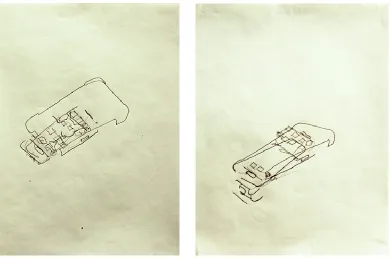
Figure 4: Untitled (Blind Contour of Light Sources), ballpoint pen on paper, 12” x 10”, 2014 ... 35
Figure 5: Untitled (Blind Contour of Light Sources), ballpoint pen on paper, 12” x 10”, 2014 ... 36
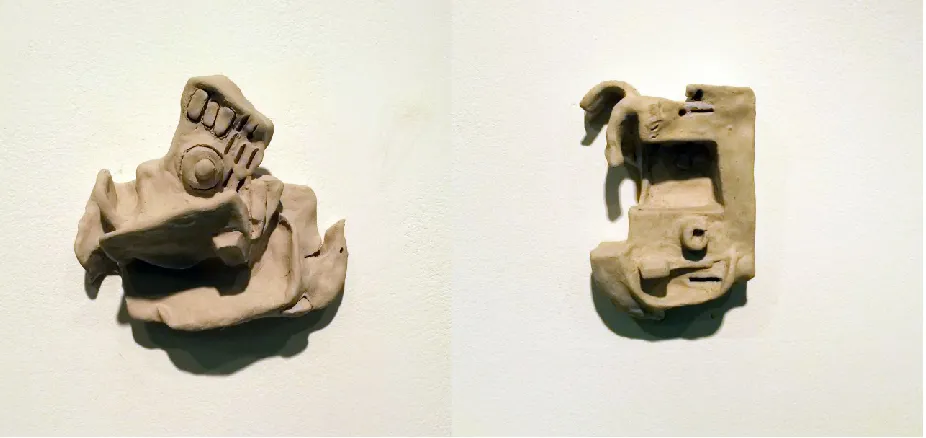
Figure 6: (Left) Untitled, clay, 7” x 7” x 3.5”, 2014. (Right) Untitled, clay, 6” x 4” x 2.5”, 2014... 36
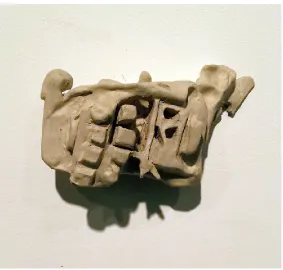
Figure 7: Untitled, clay, 4.5” x 6” x 3”, 2014. ... 37
Figure 8: Untitled, clay, 5” x 7” x 3”, 2014. ... 37
Figure 9: Untitled (Frottage), charcoal on canvas, 10” x 8”, 2014 ... 38
Figure 10: Untitled (Frottage), charcoal on canvas, 10” x 8”, 2014 ... 38
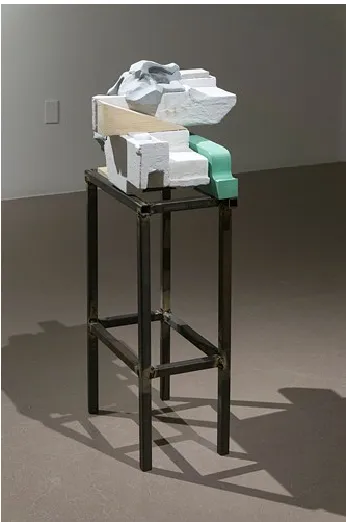
Figure 11: Untitled (Composition VI), clay, foam packaging, high density foam, plaster, wood, paint, dimensions variable, 2015... 39
Figure 12: Untitled (Composition VI), clay, foam packaging, high density foam, plaster, wood, paint, dimensions variable, 2015... 39
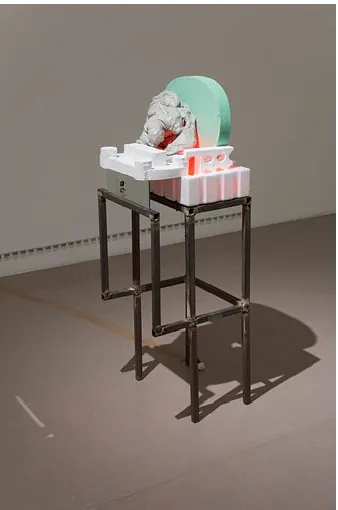
Figure 13: Untitled (Composition VIII), epoxy putty, foam packaging, high density foam, wood, plaster, LED light tape, mirror, and steel,dimensions variable, 2015. ... 40
viii
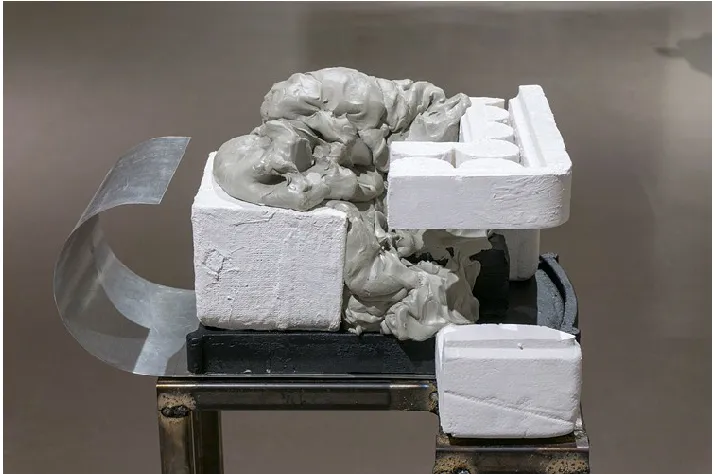
Figure 15: Untitled (Composition V), epoxy putty, foam packaging, aluminum, plaster, paint, dimensions variable, 2015. ... 41
Figure 16: Untitled (Composition V), epoxy putty, foam packaging, aluminum, plaster, paint, dimensions variable, 2015. ... 41
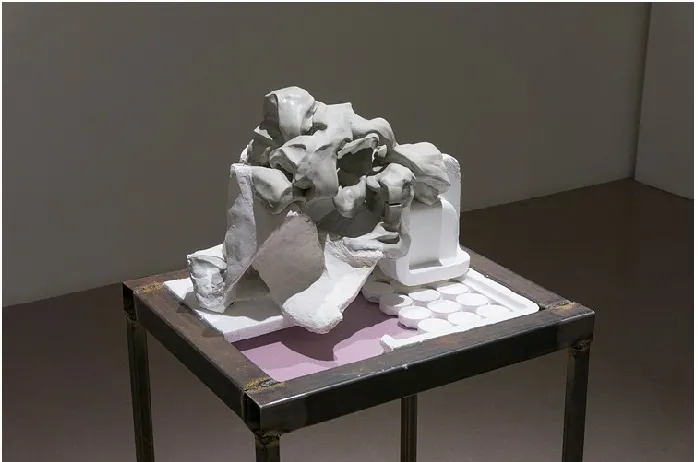
Figure 17: Untitled (Composition III), clay, foam packaging, plaster, paint, dimensions variable, 2015.. ... 42
ix
Preface
SigmarPolke’s historical revisionist sensibility and strategies could be seen as problematic in that it implies a one-way power dynamic in its critique of past ideals in art. However, the case study in the first chapter of this integrated article thesis takes into account Hal Foster’s discussion of the historical avant-garde’s attempted rift with bourgeois image making practices in the early twentieth century and, through an analogy to traumatic events and deferred action, the advancing of their project by neo-avant-garde artists a half century later. In short, because Dadaists artists were completely embedded within the field and conventions in which they operated, their interventions could not have been immediately effective.
Sigmar Polke fused contemporary mediated imagery and image production techniques with a Dadaist sensibility of experimentation to address the dominant ideals of high-modernism and the contemporary issues of his time.
I am reluctant to say that my work follows a direct lineage with Dada and neo-avant-garde artists – that is, the explicit use of readymade materials, appropriation, and playful chance operations. I would, however, say that I share an interest in a critique of dominant modes of image-making practices through an acknowledgement of material exploration and historical conventions. Because post-modern aesthetics no longer allows for dominant historical trajectories and narratives, the possibility of traumatic rifts and the subsequent recoding of events seem increasingly less likely. Nevertheless, while it may not be fashionable to say, I do believe that there are still dominant ideologies that inform image making practices which aim to form specific experiences in subjects - a perceptual apparatus that is still bound up with modernist notions of progress and aims to be increasingly imperceptible. While Sigmar Polke aimed to subvert dominant image making practices by means of a sometimes
performative and ironic adoption of those dominant practices, my work ultimately aims not to adopt but to distance from the dominant modes of image production. Therefore, a question remains: How does one effectively critique and intervene on culture if one is deeply
embedded within the current perceptual field?
x
begin by describing Jonathan Crary and Martin Jay’s writings on perception. They describe the acquisition of knowledge about vision in early-modernity as originating from sources outside of the body which is followed by a shift that occurs in the late eighteenth century to an interest in the interior workings of the eye. Not coincidentally, this coincided with the invention of photography and was precluded by a dominant ideology in which the aim was to guarantee the observation and documentation of social life. This allowed for new methods of control over people in order to create productive workers and consumers within the emerging industrial society. If photography was the result of a new model of perception, certainly contemporary digital imaging devices must be the descendants of that past ideological model. In chemical photography, through the inscription of light onto film, the photograph exists in that it points to a real object or event that was physically present at a moment in time. However, in digital imagery and its translation into mathematical notation, the result is to erase the physical referent while making the process perceptually indiscernible.
Power is always most effective when it is rendered invisible and appears natural. In an era where culture moves too fast to properly assess meaning and power becomes increasingly decentralized, and therefore the subject de-centered and disoriented, my role as an artist is to engage the dominant forces that govern perception in an effort to disrupt our passive
reception of images. The comprehensive artist statement attempts to outline some of the theoretical implications of digital media and its relationship to the ideology that initially produced photography in modernity. While outlining these theoretical models I
simultaneously trace the trajectory of my artistic practice and material choices which has constituted painting, sculpture, and drawing while maintaining a close relationship to photographic practices.
Above I posed the question: How does one effectively intervene on culture if one is deeply embedded within the current perceptual field? The question for me has expanded and
Chapter 1
1
Indexicality in the Neo-Avant-Garde Practices of Sigmar
Polke.
It is difficult to think of Sigmar Polke without thinking about Capitalist Realism, a movement co-founded by the German artist along with Gerhard Richter, and Konrad Lueg in the early-1960’s. It was conceived as a reaction against high-modernist aesthetic art practices as well as Socialist Realism, the official doctrine established by the Soviet Union in the 1930’s that had spread among other socialist countries in Eastern Europe. Socialist Realism severely limited artistic production that was seen as decadent or
unintelligible by the proletariat while favoring traditional representation over abstraction. Polke, Richter, and Lueg lived and trained in socialist East Germany, but following their move to West Germany were exposed to a new way of life in accordance with American consumer capitalist values.1 Thus, the Capitalist Realism movement aimed to redefine German identity through a move away from traditional national characteristics of
Socialist Realism and German Expressionism from the early 20th Century and establish a new set of artistic practices and performative gestures. Furthermore, using the
conventions of representation set up by Socialist Realism, the artists aimed to
differentiate themselves from the subjectivity of the American Abstract Expressionists that dominated art discourse in the 1940’s. Thus, in the post-war art of the 1960s, "a whole generation was now directed away from the overpowering presence of Jackson Pollock toward Dadaism in general and the work of Duchamp in particular, and was guided in this by the pervasive influences of Cage's models of chance operations, an aesthetic of the everyday, and a new type of (artistic) subjectivity."2 Not only did Polke, Richter, and other neo-avant-garde artists continue the Dadaist interrogation of the bourgeois notion of the autonomous art object, but they also expanded the attack to transform the function of the artist away from the modernist ideal of the creative genius. Thus, these artists focused their attack on individual style through the adoption of
1
Yve-Alain Bois, et al, Art Since 1900. (London: Thames & Hudson Ltd., 2004), 475.
2
dandyish personas of irony and indifference while concurrently producing works rooted in banal everyday mediated imagery. In short, the Capitalist Realist’s aim was to situate themselves within a broader set of aesthetic practices that would break away from
German nationalist traditions and expand on the historical avant-garde (Dada), while also aiming to differentiate themselves from the American neo-avant-garde, in particular Pop artists, and refuting high-modernist ideals. Whether it be through the pictorial
organization of department store motifs, mimicking the technological processes of raster dots in media imagery, or his later experiments in alchemy using radioactive materials, upon a quick glance of Sigmar Polke’s work it is clear that his interest lies in his own present-day iconography. However, I would like to explore how the indexical sign functions in relation to a seemingly paradoxical temporal relationship between the perpetual present-tense of post-modern schizophrenia and the “deferred-action” of neo-avant-garde art practices. To do so I will begin with a brief description of how post-modernism has been characterized as temporally schizophrenic in contrast to past modern and pre-modern periods. Immediately following I will describe Hal Foster’s argument of avant-garde art practices as being traumatic in nature and advancing in “deferred action” while attempting to draw a relationship to post-modern schizophrenia. I will then
describe a sample of Sigmar Polke’s artistic practice and how it relates to modern and post-modern practices. A discussion of Rosalind Krauss’s description of the indexical sign will follow as a tool for analysis to explore the notion that Polke’s work functions as a kind of snapshot: always mediating the past through the lens of the present.
1.1 Twentieth Century Schizoid Man.
Post-Modernism has been characterized as an end to the temporal evolution of
whatsoever that is enfranchised as art, raising the question “Why am I a work of art?”3 While both are ontological questions, and it seems as though Danto focuses on a very specific notion of American formalism while ignoring the European version, it highlights the transition from modern to post-modern aesthetics that involved a rejection of the local specificity and essentialism of individual materials in favor of a more global enquiry into the nature of art itself. Therefore, following the second world-war, the ideology of material specificity linked to modernist notions of progress is increasingly seen as suspect, resulting in a theoretical stoppage in the linear progression of history. Post-modern aesthetics is thus seen as being stuck in a perpetual present-tense.
Similarly, in Lacan’s reading of Freud, the schizophrenic is described as living in a perpetual presence “[through] the failure of the infant to enter fully into the realm of speech and language."4 It is here, in the temporal function of language, that the analogy between post-modernism and schizophrenia can be made:
Personal identity is itself the effect of a certain temporal unification of past and future with one’s present; and second, that such active temporal
unification is itself a function of language, or better still of the sentence, as it moves along its hermeneutic circle through time. If we are unable to unify the past, present, and future of the sentence, then we are similarly unable to unify the past, present, and future of our own biographical experience or psychic life. With the breakdown of the signifying chain, therefore, the schizophrenic is reduced to an experience of pure material signifiers, or, in other words, a series of pure and unrelated presents in time.5
This is to say, the schizophrenic lacks an ability to generate a self-identity shifting between “I” and “You” in the symbolic order. If one is to believe in the idea of language as constituting the individual by the temporal moving through the chain of signifiers, then the notion of schizophrenia has implications on the authority of individuality in high-modernist art. Consequently “to claim that I am having a wholly private experience is
3
Arthur Danto, After the End of Art. (New Jersey: Princeton University Press, 1995), 14.
4
Madan Sarup, An Introductory Guide to Post-Structuralism and Postmodernism. (Athens: The University of Georgia Press, 1989), 134.
5
meaningless: I would not be able to have an experience in the first place unless it took place in the terms of some language within which I could identify it […] and to imagine language is to imagine a whole form of social life.”6 Following this logic, the
schizophrenic is no one and has no individual personal identity because s/he doesn’t grasp the temporal function of language. The subject, thus, continually lives in a pre-linguistic state.
This is significant for understanding the practices of Capitalist Realist artists and their adoption of distanced and cool irony. It is Richter’s writing on painting and photography that point to these attitudes of a post-modern attack on subjective style: “I like everything that has no style: dictionaries, photographs, nature, myself, and my paintings.”7 His placement of the words “nature” and “myself” side-by-side as a reference to Jackson Pollock’s famous quip “I am nature” is notable, but more importantly, because style is intrinsically linked to identity and subjectivity, the deadpan irony of his statement is indicative of his generations outright condemnation of modernist myths of artistic genius and the emphasis placed on the modern individual. Unlike Richter, whose stylessness became a pervasive style, by glancing at the multitude of approaches in Polke’s artistic output, one can see how elusive he is in his iconography. This alludes to the
schizophrenic who "produces himself as a free man, irresponsible, solitary, and joyous, finally able to say and do something in his own name, without asking permission; a desire lacking nothing, a flux that overcomes barriers and codes, a name that no longer
designates any ego whatever.”8 Paradoxically, for the schizophrenic, living in the present signals a lack of presence. Therefore, what describes this generation of artists is the adoption of a schizophrenic temperament in order to reject the modernist myths of individuality, subjective style, and the modernist notions of progress. However, it is important to note that this schizophrenic temperament is only an adoption of a persona
6
Terry Eagleton. Literary Theory: An Introduction. (Minneapolis: The University of Minnesota Press, 1983), 60.
7 Gerhard Richter, The Daily Practice of Painting: Writings 1962-1993.(Cambridge, Massachusetts: The MIT Press, 1995), 35.
8
and one could argue that, because of Hal Foster’s description of the traumatic nature of neo-avant-garde art practices, Sigmar Polke’s work is hardly schizophrenic at all.
1.2
A Return from the Future.
In Hal Foster’s account of the avant-garde he outlines Peter Bürger’s linear history of avant-garde practices in three stages. The first stage occurs in the Enlightenment
aesthetics of the eighteenth century where the autonomy of art is proclaimed as the ideal. The second stage occurs in the nineteenth century where this autonomy is made into the subject of art, thus withdrawing from the world. Finally, at the beginning of the 20th century, the withdrawal of art from the world comes under attack by the historical avant-garde demanding that art either regain a use-value or acknowledge its uselessness.9 Foster argues against Bürger’s linear history of the avant-garde by way of an anaylsis of Freud’s concept of deferred-action in relation to traumatic experience. In this analysis
“subjectivity is not set once and for all; it is structured as a relay of anticipations and reconstructions of traumatic events[…] One event is only registered through another that recodes it; we come to be who we are only in deferred action.”10 Furthermore, if Dadaists sought the destruction of traditional forms of experience (a traumatic break from
convention), it follows that the “[historical] avant-garde work is never historically
effective or fully significant in its initial moments. It cannot be because it is traumatic – a hole in the symbolic order of its time that is not prepared for it, that cannot receive it, at least not immediately, at least not without structural change.”11 This described hole in the symbolic chain of signifiers recalls the schizophrenic’s inability to fully apprehend language. This throws into question the idea of immediacy, absolute origins, and cause and effect linear history that is at the centre of modernist aesthetics: Could Picasso have possibly known the influence of Les Demoiselles d’Avignon upon its conception? “Did Duchamp appear as “Duchamp”?”12 Foster argues that the neo-avant-garde doesn’t
9
Hal Foster. The Return of the Real.(Cambridge, Massachusetts: The MIT Press, 1996), 9.
10
Ibid, 29.
11
Ibid, 29.
12
complete the historical avant-garde but returns from the future and comprehends it for the first time. It is this inability to fully grasp its own identity that characterizes the historical avant-garde’s schizophrenia. It is through this deferred action of comprehending the past for the first time that constitutes the post-modern practices of Sigmar Polke. Thus, while modernism defines itself by looking to the future, post-modernism defines itself through modernism by looking at the past. Polke’s work is thus paradoxical in its break from modernism with his schizophrenic-like concern with present-tense immediacy, but
always advances in relation to it through hindsight. As a side note, that I will elaborate on later, there is a similar temporal distance in Rosalind Krauss’s discussion of indexicality noting “a striking aspect of the photographic message, [that points] to this paradox of a presence seen as past.”13
1.3
Difference, Desire, and Polke Dots.
Continuing the historical avant-garde’s attack on bourgeois principles of autonomous art, pop artists where drawn to familiar everyday iconography found in mass-media
representations. While modern artists had been incorporating newspapers, bottle labels, and posters into their work for a while (synthetic cubism, Duchamp’s readymades, and Picabia’s assemblages for instance), the appropriation of mass cultural signifiers in the first avant-garde was to “reinvigorate staid high forms with feisty low contents; with Pop, on the other hand, the low appeared to overrun the high."14 While familiar images of Campbell’s soup cans, Mickey Mouse, and the Brillo Box pervaded Pop art in America, Sigmar Polke employed a more subtle strategy of overthrowing the high-modernist ideals of authenticity through the inclusion of readymade patterns, newspaper imagery, and department store iconography without the use of specific brands. A drawing like Soap (Seife) (1963) is indicative of this shift from the enlightened expressive to this low-culture serial form. The simple line drawing depicts a shallow rounded-rectangular form set against three diagonal lines, two of which are vertical and run parallel to each while another cuts across the two horizontally. The placement of the word “seife” in the middle
13 Rosalind Krauss, “Notes on the Index: Seventies Art in America, Part 2,” October 4 (Autumn 1977): 66, accessed 28 October, 2013, http://www.jstor.org.proxy1.lib.uwo.ca/stable/pdfplus/778437.pdf.
14
of the form, a seemingly generic no-name-brand of soap that signifies serial-production, contaminates the potential for any reading of the work as being a purely formal modernist abstraction. It is this open composition featuring a hybrid of high art and low art with the inclusion of serially produced iconography that signifies liberation from expression, feelings, or emotions. The generic word Seife, as opposed to a specific brand, replaces any sense of individual identity of the soap signaling a “liberation from every other kind of feeling as well, since there is no longer a self-present to do the feeling.”15Plastic Tubs
(1964), with its frontal organization of squares and use of primary colours, evokes Mondrian’s use of solid blocks of primary colours delineated by sharp vertical and horizontal lines in his characteristic neo-plasticist style. Polke’s inclusion of
commonplace quotidian items also evokes De Stijl’s aim at the fusion of life and art through the design and construction of furniture and architecture. However, Polke’s painting corrupts these referents through the depiction of the rounded edges of the tubs, the pastel tints of white, and the inclusion of low-culture iconography. Chocolate Painting (1964) is a flat graphic image of a chocolate bar set against a background
comprised of black and white lines. The stripes juxtaposed with the chocolate bar suggest the serial production of the everyday; of things as basic as nourishment. In Socks (1963), a painting of three socks slightly different in colour and pattern, are displayed in
department store fashion. Here the idea of difference in the serial production of commodities is illustrated, “for in serial production a degree of difference between commodity-signs becomes necessary; this distinguishes it from mass production. Indeed, in our political economy of commodity-signs it is difference that we consume."16
Therefore, our desire for objects in constructed through difference.
In his paintings derived from newspaper and magazine imagery, Polke insists that he create the dot patterns by hand. In Raster drawing (portrait of Lee Harvey Oswald)
(1963), the dots function on multiple levels: individually as singular dots, abstract blobs when multiple dots overlap, as a mimicry of the technical means of production, and
15
Fredric Jameson, Postmodernism, or, the Cultural Logic of Late Capitalism. (Durham, North Carolina: Duke University Press, 1991), 15.
16
finally as the image of Lee Harvey Oswald when seen in its entirety. Furthermore, the overlapping raster dots create abstract imagery which allowed Polke to explore his interest in Dada artists such as Max Ernst, who “liked to find surreal images in rubbings from floorboards or marks made by smoke."17 In the process of painting the dots by hand Polke eliminates any formal considerations and decisions, distancing himself from the imagery, and subsequently anticipating his interest in chance operations that would later define some of his practice. This interest in chance is echoed in Polke’s statement that "paintings must be produced according to recipes. Creation is not an act of art."18 His manual painting of halftone imagery is indicative of the reaction against the subjectivity typified by high-modernist aesthetics, allowing him to “exclude subjective feelings as far as possible, and above all contradict the cult of inspired creative artist."19 While Portrait of Lee Harvey Oswald is a relatively straight-ahead reproduction of newspaper imagery, when approaching Girlfriends (1965/66) the image, with its inclusion of colour, becomes perplexing in trying to resolve the procedure of its creation. Polke’s process has involved blowing-up the images to emphasize the artificiality, distancing, and mediation of mass produced imagery. However, with the inclusion of colour it becomes increasingly difficult to resolve the process: What came first, the black, red, blue, or yellow? While it is difficult to trace the artists hand in any of his halftone paintings, Girlfriends furthers his repertoire of image production methods since the abstract blotches, irregularities, and deformations in the original image are mimicked and painted, adding more confusion to the artists’ subjectivity. This pseudo-robotic sensibility in the creation of an impenetrable surface of small raster dots functions as a philosophical critique against the grand
gestures of high-modernism, he states that it is “a way of showing that even tiny specks and particles are worth counting and noticing,"20 In addition to these hand-made
reproductions, Polke, adopts a persona fetishizing dots with Dadaist irony: "Believe it or
17
Sigmar Polke, Interview with Martin Gayford, “A Weird Intelligence,” Modern Painters 16, no. 4 (Winter 2003): 82.
18
Gerhard Graulich, et al, “The Roguish Joys of Dots” In Sigmar Polke: Transit. (Ostfildern: Cantz, 1996), 14.
19
Ibid, 14.
20
not, I really see my surroundings as dots. I love all dots, I am married to many of them. I want all dots to be happy. Dots are my brothers. I am a dot myself. We always used to play together, but nowadays everyone goes his own way. We meet only on family occasions and ask each other 'How are things?'"21 Thus, Polke formulates his identity through the readymade material of the dot. That is to say, he does not exist as an autonomous authentic presence, but is a construction of the commodified images that surround him. Therefore, not only do we consume difference as was stated around the description of the painting Socks, but subjective identity is contingent on the idea of differentiating oneself. Polke’s raster dot paintings suggest that our identity is constructed by the desire created by images, and that we ourselves are products of the images we consume.
1.4
Humour and Art History.
The notion of artist as a construct and commodity to be consumed is another theme that has pervaded Polke’s work. He has continually appropriated and drawn from art
historical iconography as a way to comment on the marketability of the creative genius. Dürer Hare (1970), for instance, is an image created using nails and elastic bands overtop of blue fabric to form an image from an Albrecht Dürer drawing. This juxtaposition of readymade image with industrial materials “drew attention to the department store aesthetical marketability of the Dürer motif in his works as early as 1968.”22 The use of the artist motif as a readymade was fundamental to Sigmar Polke’s criticism of modernist ideals. Constructivist (1968) again references Mondrian’s Neo-Plasticist period as well as Russian Constructivism. In the open composition, Polke has manipulated the black lines to imply the form of a swastika, repeating the form in white in the background and rendering the red and grey areas using raster dots. The readymade dots in Constructivist
function much in the same way as the elastic bands in Dürer Hare by expressing the reproduction and distribution of the artists’ style. Additionally, Yve-Alain Bois states that
21
Gerhard Richter, The Daily Practice of Painting: Writings 1962-1993.(Cambridge, Massachusetts: The MIT Press, 1995), 42.
22
the use of the iconic swastika itself, an appropriation of an appropriation, “recognized that the spiritual and utopian aspirations of the Bauhaus and De Stijl, of Suprematism and Constructivism lay in historical ruins, he also realized that all attempts to resuscitate them would inevitably turn out to be travesties."23 Thus, Polke does not intend to resuscitate or complete the historical avant-garde, but comprehend it.
Despite the pseudo- robotic impulse in his raster dot paintings and the use of serious loaded imagery such as the Swastika, Polke’s work also has a humorous sensibility. In
Modern Art (1968) Polke uses a variety of mark-making strategies, such as architectural angular marks, spiral like gestures and a pink splatter, laying them over top of a black geometric background with the top-right corner painted red and the bottom-left corner painted grey. Rosalind Krauss characterizes painting as “a field of articulations or divisions. It is only by disrupting its physical surface and creating discontinuous units that it can produce a system of signs, and through those signs, meaning."24 Here, the juxtaposition of these discontinuous units, divisions, and gestures signifies the ironic meaninglessness of internal formal logic and, like the indexical sign, the iconic gestures all point to a referent located elsewhere. For example, the mark on the middle-bottom-left evokes the delineating lines in Mondrian’s early work while also literally illustrating the number 4 (Mondrian would title many of his compositions numerically). The pink splatter of paint suggests a Jackson Pollock drip contaminated by the palette of pop. This experimental approach allows Polke to draw attention to the arbitrariness of the gesture and quote from a multitude of approaches where the composition is reduced to a series of unrelated material signifiers or, similar to Fredric Jameson’s description of the
schizophrenic, “a series of pure and unrelated presents in time.”25Higher Beings
Commanded: Paint the Upper-Right Corner Black (1969) is a black and white painting in which the top right corner is painted black and the title of the work is painted to resemble typed font along the bottom of the painting. The humour in the work lies in the “critique
23
Yve-Alain Bois, et al, Art Since 1900. (London: Thames & Hudson Ltd., 2004), 557.
24
Rosalind Krauss, “Notes on the Index: Seventies Art in America, Part 2,” October 4 (Autumn 1977): 64, accessed 28 October, 2013, http://www.jstor.org.proxy1.lib.uwo.ca/stable/pdfplus/778437.pdf.
25
of the aesthetic values that has propped painting up for so long,"26 namely those of myth. Here the artist as spiritually enlightened mystic is ridiculed and the incorporation of text suggests the contamination of a pure mediated experience. Terry Eagleton summarizes this impossibility of a pure enlightened experience through text:
since language is something I am made out of, rather, than merely a convenient tool I use, the whole idea that I am a stable, unified entity must also be a fiction [...] It is not that I can have a pure unblemished meaning, intention or experience which then gets distorted and refracted by the flawed medium of language: because language is the very air I breathe, I can never have a pure unblemished meaning or experience at all.27
Consequently, the painting itself requires the descriptive text within the frame to have meaning. This descriptive text indexically points to the black painted corner.
The use of humour in Polke’s work is an effective strategy for debunking some of the myths of previous aesthetic practices. While language involves a shared symbolic code, humour requires the shared social convention to be subverted. In a joke an expectation is set up by the communicator and, subsequently, when that expectation is subverted the receiver of communication laughs (hopefully). Humour is an effective tool in subverting structures of power, and if Abstract Expressionism was the dominant form of art making in the 1950s, “by laughing at power, we expose its contingency, we realize that what appeared to be fixed and oppressive is in fact the emperor’s new clothes, and just the sort of thing that should be mocked and ridiculed.”28 This strategy is apparent in the drawings entitled Sculpture (c.1968) and Malevic Looks Down on Pollock (1968). In the former, drawn on small notebook paper, there is a small outline of a man standing next to a plinth on which a large abstract form stands. The abstract form suggests high modernist abstract sculpture, perhaps something derivative of Brancusi, but is, of course, also an illustration of a sideways turned pretzel - a German baked good. Malevic Looks Down on Pollock
suggests Malevich’s objective supremacy looking down on the subjectivity of Jackson
26
Thomas McEvilley, The Exile’s Return: Toward a Redefinition of Painting for the Post-Modern Era. (Cambridge, Massachusetts: Cambridge University Press, 1993), 160.
27
Terry Eagleton. Literary Theory: An Introduction. (Minneapolis: The University of Minnesota Press, 1983), 130.
28
Pollock’s paintings. The illustration of the orientation of their respective painting
processes also serves to subvert the authority of both artists through the use of humour – Malevich has the higher ground by painting on the wall, while Pollock is the lower figure on the floor, but the joke brings them both down to the same level. This attack on the authority of high modernist art exploits the Fluxus idea that “routine, banal, and everyday actions should be regarded as artistic events, declaring that "everything is art and
everyone can do it."29 The small drawings on notebook paper suggest that art does not need to be a precious art object comprised of grand gestures.
1.5
The Past through the Lens of the Present.
The shared understanding of convention as mentioned above relates to the indexical sign and how it functions in the aforementioned works. Along the entire chain of signifiers the indexical sign points to another sign and, in art, exists in that it maintains a direct
physical relationship to its referent. “They are the marks or traces of a particular cause, and that cause is the thing to which they refer, the object they signify.”30 For example, the index in photography works where light refracts off of an object, through the lens, and results in an inverted image physically imprinted onto the film by light. It is a trace of the physical presence of that object, but that presence is rooted in the past as a document of that phenomenon. In communication, indexicality functions in a manner that to “identify an object, we generally state its place at a stated time; and in every case must show how an experience of it can be connected with the previous experience of the hearer. To state a time, we must reckon from a known epoch, […] when we say the epoch must be known, we mean it must be connected with the hearer’s experience.”31 Not only do Polke’s paintings and drawings mentioned above rely on a shared common conventional wisdom to elicit a humorous response, but by referencing a specific epoch the artworks are both rooted in the present and activated in their indexical function pointing to the
29
Yve-Alain Bois, et al, Art Since 1900. (London: Thames & Hudson Ltd., 2004), 456.
30
Rosalind Krauss, “Notes on the Index: Seventies Art in America, Part 1,” October 3 (Spring 1977): 70, accessed 28 October, 2013, http://www.jstor.org.proxy1.lib.uwo.ca/stable/pdfplus/778437.pdf.
31 Charles Sanders Peirce, What is a Sign? (1894)
past. The three types of signs are not mutually exclusive, but can at once share a likeness (icon), be an indication, or contain a symbol.32Polke as Astronaut (1968) is an image that contains index, symbol, and icon. In this work, Polke paints a cartoonish version of himself on top of a readymade fabric depicting astronauts, globes and lunar modules. The black shape with white paint functions symbolically as the construction of his identity as a distorted black dot. The paint is iconic in that Polke mocks the essentialism of his own likeness by depicting his glasses and shape of his head (the sloped chin seems to be the giveaway). The patterned fabric is both iconic but also indexical of the time; that is, the race to space during the cold war. But it is the indexical function in the readymade fabric that should briefly be explored. Not only does the readymade pattern point to a specific epoch that the viewer must recognize to “get” the joke, but the “readymade's parallel with the photograph is established by its process of production. It is about the physical
transposition of an object from the continuum of reality into the fixed condition of the art-image by a moment of isolation, or selection."33 This action of appropriation is the physical manifestation of a cause much in the same way that a photograph or a mark of paint carries a trace or imprint of a physical phenomenon or gesture. The sculpture
Apparatus Whereby One Potato Can Orbit around Another (1969) suggests Duchamp’s readymade sculpture Bicycle Wheel (1913), but literally inverts the direction of potential rotation along both vertical and horizontal axis. This orbiting action indexically points to the epoch of the works creation while the potatoes themselves function, not only as symbols of socialist culture, but also as readymade objects pointing to Polke’s use of avant-garde tropes of the everyday banal. Here the indexical sign functions as the selection and transposition of a ready-made object from one continuum into another similar to the way a photograph captures the image of an object thereby changing its context.
32
Charles Sanders Peirce, What is a Sign? (1894)
http://www.iupui.edu/%7Epeirce/web/ep/ep2/ep2book/ch02/ep2ch2.htm. (accessed January 16, 2014)
33
As stated before, the indexical sign also implies the trace of a physical presence. In mark-making it suggests a trace of the presence of the artist, in photography the past presence of a phenomenon, and in the readymade it is the physical shifting of presence from one context to another. Shifters are “indexical words connected with a referent only within a temporary context of a given act of pointing, so the personal pronouns “you” and “I” are similarly indexical.”34 In Telepathic session II (William Blake-Sigmar Polke) (1968) Polke links two canvases by pieces of string connected to the words “ja” and/or “nein”. The connections of string reference the plug-in connectors on circuit boards of personal computers newly available at the time, and the text references binary code that directs a computer’s operations. Here “the index's aspect as a shifter has implications for the status of the subject, of the one who says "I”.”35 Because Polke in this instance is the receiver of communication, he is the “you” in relation to William Blake’s speaking “I”. Of course, this implies a traditional left-to-right reading of the work as text. The irony lies in the presence of both artists. The “I” spoken by Blake in the telepathic session is impossible because he is a dead 18th Century romantic painter. Polke’s presence is contingent on the acknowledgement of the “you” spoken by Blake, and thus relies on the ability to shift from the receiving end of the “you” to the speaking end of the “I”. Polke’s being is therefore contingent on another subjects being. But because the communicator is absent, Polke cannot fulfill the shift to the self-differentiating presence of the “I”, and is thus forever doomed to live a life of eternal ahistorical purgatory. He will be the nonexistent schizophrenic. Therefore, the pointing function of the “I” and the “you” are “empty signs that are filled with meaning only when physically juxtaposed with an external referent or object.”36 Here Polke cannot be the traditional sender of communication with Blake because that would cause the end-game result of a one-way power conversation with history. But instead Polke speaks through his use of avant-garde tropes suggesting he is more interested in the history offered by the avant-garde than that offered by the
Enlightenment. Post-modernism, as Polke would have it, involves not the adoption of one
34
Yve-Alain Bois, et al, Art Since 1900. (London: Thames & Hudson Ltd., 2004), 158.
35
Ibid, 158..
36
dominant history, but a selection of multiple histories. Therefore, in the aforementioned works, Polke advances his practice in hindsight through a reception of ideas from a very specific past furthering his use of appropriation, the readymade object, and the adoption of a Dadaist impulse.
1.6
The Index in Pre-Linguistic Art.
Polke’s later work contains an interest in Alchemy which was brought on by his early studies with Joseph Beuys. Polke’s investigations into materials extend his interest in the contingency of subjective experience. Golden Mirror (1992), a combination of Iron mica, pigment, and synthetic resin on canvas, is a highly reflective surface that changes as the viewer moves around it from various intensities of violet in the background layers and gold in the central blob figure. The painting requires the viewer to move around it and thus functions more as a pre-linguistic experience of the object itself as opposed to the earlier works where the intentional creation of relationships between multiple signifiers forms an intelligible sign. In this work, as well as Untitled (Colour Experiments) (1982-86) in which he used synthetic resins, pigment, acrylic, fluorescent paint, lead, silver, lacquer, and enamel, Polke is interested in using elements which tend to shift, fade, and change over time. These paintings reference the Dadaist impulse towards chance operations as depicted in Francis Picabia’s The Blessed Virgin (1920) or Hans Arp’s
Untitled (Collage with Squares Organized According to the Laws of Chance) (1917). In Arp’s appropriation of cubist collage, by tearing rough squares of commercial paper letting them fall and gluing them where they landed on the support, "it became a medium less of semiotic analysis than of chance composition."37 This chance operation works against “the authority of the expressive artist. Arp regarded his collages as “a denial of human egotism.”38 Chance occurrences work towards cancelling subjective choices and decision making processes traditionally associated with the artists’ responsibility of composing a work of art. However, returning to the indexical sign, subjectivity still exists in that “indexes establish their meaning along the axis of a physical relationship to their
37
Yve-Alain Bois, et al, Art Since 1900. (London: Thames & Hudson Ltd., 2004), 137.
38
referents. They are the marks or traces of a particular cause, and that cause is the thing to which they refer, the object they signify.”39 Here the index is a trace of a past chance occurrence and the painting is “a sign connected to a referent along a purely physical axis. And this indexical quality is precisely the one of photography."40 Therefore, the index doesn’t point to the artists’ various choices and decision making processes, it ultimately suggests the presence of the artist through his physical encounter with the material. Polke’s Uranium (Pink) (1992) expands on his pre-linguistic material
experiments by placing uranium on photographic plates and capturing the effects of the radioactive elements. A similar indexical operation happens in Duchamp’s Tu m’ (1918), a work where his readymade objects were projected onto the canvas and depicted as cast shadows. Not only are these images a document of past occurrences, but Polke maintains his interest in contemporary issues by relating the radioactive works to “what's been happening in Iraq. [He goes on to state that] radioactivity is always a problem in our lives, and what to do about it. Also, as a metaphor it's connected with the distortions and printing mistakes that I repeat in my paintings. Radioactivity is the biggest distortion of all; it distorts everything."41 Therefore, Polke’s later process driven works are by no means simply indicative of materialist explorations. Polke’s interest in alchemy and material explorations are as rooted in time as his earlier pop paintings, parody’s of high-modernist abstraction, or the (undiscussed) Bowery photographs and works influenced by his Pakistan travels. The material experiments are indexical records of a process
occurring in the past, but also carry the function of observing the present: With an impulse to recreate pre-Modern and ahistorical culture that is virtually part of nature, the technique of blowing powders onto a prepared adhesive surface also alludes to the paintings in Paleolithic caverns [...] The early works solve the Adornean problem by the tactic of using culture to critique itself rather than uncritically affirm itself. The more recent work
39
Rosalind Krauss, “Notes on the Index: Seventies Art in America, Part 1,” October 3 (Spring 1977): 70, accessed 28 October, 2013, http://www.jstor.org.proxy1.lib.uwo.ca/stable/pdfplus/778437.pdf.
40
Rosalind Krauss, “Notes on the Index: Seventies Art in America, Part 2,” October 4 (Autumn 1977): 63, accessed 28 October, 2013, http://www.jstor.org.proxy1.lib.uwo.ca/stable/pdfplus/778437.pdf.
41
[...] finds it by turning to nature; instead of doing culture as culture the artist-alchemist now does nature as culture.42
Consequently, if avant-garde artist like Arp and Picabia attempted to critique culture with culture by borrowing cubist collage materials and other conventions, Polke revisits and expands on their methods, not through transposition, but through transmutation in his alchemy experiments.
1.7
Conclusion.
Because of its inability to comprehend its own significance during the time of its initial conception, it could be said that post-modern schizophrenia is what characterizes the actions of the historical avant-gardes artistic output. It is only through Hal Fosters analogy to traumatic events and deferred action that Polke and other neo-avant-garde artists are able to fully comprehend the first avant-garde. He does so in the same way the indexical sign functions: the selection, isolation, and transposition of past and disparate image making strategies, sources and styles and thereby recoding it into a present context. Sigmar Polke, through the transposition and transmutation of one object into another, has the ability to critique the past through the lens of the present and vice versa. This draws our attention to the contingency of subjective experience on context and convention.
42
Chapter 2
2
Artist Statement: Hand-Eye.
Process is an increasingly important aspect of my work and allows for generating
different iterations and material investigations on a single theme. Rather than outlining a singular or specific purpose and perhaps limiting potential readings of my work, I will describe the different stages, thought processes, and theoretical models that have
informed my process. The description will explore my ideas surrounding material choices and how I imagine their function both within the work and also within a broader artistic discourse.
I began my research with an interest in perception and with the process of painting artificial light from direct observation, and so I will use Jonathan Crary’s writings on vision in the nineteenth century as a model of how the work was initially conceptualized. My initial discussion of vision will be complemented by a description of how indexicality functions in relation to both chemical and digital photography and its implications on my observational painting practice. The discussion of indexicality will be based on Rosalind Krauss and David Rodowick’s writings on the index, and complemented by W.J.T. Mitchell’s writings on biocybernetic ideals in digital imagery.
Whereas the first stage in the process was concerned mainly with vision, the second stage began with an interest in the sense of touch. Here I will build off of Crary’s model of perception and use Martin Jay’s writing on synthetic perspective in baroque painting to draw an analogy between touch and vision. Following these theoretical underpinnings I will describe my exploration of pictorial problems within sculptural space and how it acts, metaphorically, as an exploration of how contemporary digital media devices operate with a haptic functionality within our current perceptual field.
of pictorial, sculptural, and architectural space. In short, this statement is an attempt to illustrate my working through some of the questions surrounding perception posed in modernity and their implications now through material investigations. Ultimately I ask: With the abundance of dematerialized digital imagery being proliferated through the world, how do I create an object now?
2.1 On Vision.
In his writing on perception, Jonathan Crary describes the camera obscura as providing a fundamental model of vision between the sixteenth and late eighteenth century. Through experimentations with the lens, knowledge about vision was primarily based on the study of lenses, the mechanics of light, and the representation of the world outside of the
interiority of the body. That is to say, information was autonomous and present outside of the body as opposed to it being produced and interpreted by a physiological subject. Following the French Revolutions at the end of the eighteenth century, an ideological structure had emerged resulting in an increased need for empirical truth in the
observation of life and the development of the natural sciences. Following this shift was an increased mastery and specialization in various fields of knowledge in order to not only observe and understand, but also to control and manipulate social and biological behaviour.
A common understanding suggests that the invention of photography in the early nineteenth century fundamentally altered the way in which the world was perceived, particularly in its relationship to painting and art. However, this model of photography’s impact on perception in modernity is problematic in that it sets up two contradictory modes of representation. On one hand, painting was suddenly and immediately freed from previous conventions of representation, while on the other photography was still operating within those conventions set up by painting. Consequently, these two models of perception somehow occurred simultaneously during the same historical moment. Crary explains that “one of the crucial consequences of the bourgeois political revolutions at the end of the 1700’s was the ideological force that animated the myths of the rights of man, the right to equality and to happiness. In the nineteenth century, for the first time,
in fact been attained.”43 Thus, the invention of photography did not alter perception; rather, following the political revolutions in Europe at the end of the 1700’s, an ideological structure had shifted making possible the imagining of this technological innovation.
Certainly the search for empirical knowledge extended beyond the observation of social life through technology, this search expanded into the natural sciences as well. It is important to note that, in the field of perception, the differentiation of the social sciences and the natural sciences in early-modernity is not to be overstated, for the two are
intertwined. According to Crary the perceptual field in early-modernity, thus, shifts from the stable “timeless order of the camera obscura and becomes lodged in another
apparatus, within the unstable physiology and temporality of the human body.”44 The interest in observing the interior physiology of the body is demonstrated in Goethe’s description of afterimages in the eye, where colored circles “seem to float, undulate, and undergo a sequence of chromatic transformations [that] have no correlative either within or without the dark room; as Goethe explains at length, they are “physiological” colors belonging entirely to the body of the observer and are “the necessary conditions of
vision.”45 Goethe’s observations and descriptions of afterimages in the late-eighteenth and early-nineteenth century led to what Crary has described as the separation of the senses in which the physiological components could be isolated and made observable. Therefore it was no longer the technology of the lens and the physics of light, but the human body that becomes the active producer of optical experience.
Demonstrated is an ideological shift where perception was constituted by representations of the world from outside of the body, to the acquired knowledge of the interior
architecture of the body and its production of images. This process of observation was not strictly altruistic in intent, but rather was centered on the manipulation of bodies
43
Jonathan Crary, Techniques of the Observer: On Vision and Modernity in the Nineteenth Century (Cambridge, Mass: MIT Press, 1992), 11.
44
Ibid, 70.
45
within the emerging industrial society of modernity. As previously stated, this need for quantifying the physiology of vision through the natural sciences was inherently bound up with the development of industrial society and, according to Crary, “such studies were clearly related to the demand for knowledge about the adaptation of a human subject to productive tasks in which optimum attention was indispensable for the rationalization and making efficient of human labor. The economic need for rapid coordination of eye and hand in performing repetitive actions required precise knowledge of human optical and
sensory capacities.”46
The divisionist approach used by post-impressionists painters in the late nineteenth century serves as an apt metaphor for the aforementioned specialization and control over physiology through the separation of the senses. Pointilism is an approach in painting where multiple colours are set beside one another, as opposed to blended or mixed, allowing for optical mixing of colour to create pictorial form on a two-dimensional surface. This optical experience with the artwork allowed the viewer to be an active producer in the work and, not coincidentally, this corresponded with emerging democratic ideals following the revolutions of the eighteenth century. While these painters were interested in the way light refracted off of a subject creating an impression on the eye and subsequently translated into paint, my project began with an interest in observing light itself as a still-life object. While light itself is invisible and is only knowable through its relation to pigment and/or the reflection off objects, the experience of directly looking into a light creates increased possibilities for observing and describing subjective vision and the flickering and floating orbs of colour described previously by Goethe(Figure 1). When creating the observational paintings of light, I imagined my body acting as a camera; observing light directly and refracting it onto a surface with the use of paint. In these paintings, individual brushmarks can be isolated as indexes of the ephemerality of light and vision while maintaining a relationship to the materiality of paint. Before continuing to the next stage of developments in my work I will briefly discuss the relationship between light, photography, and the index.
46
2.2
Photography, Painting, and Indexicality.
As stated above, the photograph could not have altered the perceptual field of observation and representation in modernity because photography continued to operate within the very conventions set up by painting. Some of the ontological questions posed in the natural and social sciences in modernity were: What is Vision? What is democracy? What is an observer? Therefore, some of the ontological questions posed in art were: What is painting? What is photography? These questions presuppose the object of
enquiry as being autonomous, however, it would be difficult to look at Manet’s Dejeuner sur L’Herbe(1863) or Olympia(1863) and not see the influence of photography. Whether by his recognition of the flattening of space that occurs with the flash of the camera, or his depictions of space that would reinforce the flat picture plane of painting while simultaneously refuting the single-point perspectival depth of photography, within these parameters painting and photography would continue to develop parallel and in relation to each other well into late modernism. In Rosalind Krauss’s two-part essay Notes on the Index she states “if we could say of several generations of painters in the late 19th and early 20th centuries that the conscious aspiration for their work was that it attain the condition of music, we now have to deal with an utterly different claim. As paradoxical as it might seem, photography has increasingly become the operative model for
abstraction.”47 Krauss’s analogy stems from a description of how the index functions within both photography and painting. In the chemical photography process, the index is a physical transposition of light onto film, “the type of sign which arises as the physical
manifestation of a cause, of which traces, imprints, and clues are examples.”48 The photograph, thus, is a physical imprint of light depicting an action and/or object that has physically occurred. While the indexical sign in painting has no physical relationship to the subject being depicted, it points to its making by the artist; it points to the direction of the mark, the pressure applied to the canvas, the choice of brush, the amount of paint used, the energy and immediacy of an expressive mark, and so on, and so forth.
47
Rosalind Krauss, “Notes on the Index: Seventies Art in America, Part 2,” October 4 (Autumn 1977): 58, accessed 28 October, 2013, http://www.jstor.org.proxy1.lib.uwo.ca/stable/pdfplus/778437.pdf.
48
Furthermore, because painting does not exist as an autonomous object and is bound up in a history of representational conventions, the indexical sign can also point to that history and exist as a symbol and/or icon.
In the process of creating observational paintings of light, I would create a separate index of the painting’s production which would then act as a device for generating different pictorial systems and codes of painting (Figure 2). In the process of depicting my studio lights, each colour being used would be applied as a quick swatch on a separate surface before being worked into the observational painting. This surface of swatches would then act as a generator of a new abstract painting where each colour would be used in the initial order of its use. Therefore, my work sought to explore Krauss’s entanglement of photography and abstraction through indexicality by using light, vision, and paint as a subject.
2.3
The Indexical Sign Now.
Recently, there has been a crisis of the index in the production of digital images. In what W.J.T. Mitchell has termed The Age of Biocybernetic Reproduction, digital technology and biological science have come together to project fantasies and anxieties back onto the spectator. Films such as Jurassic Park, The Matrix, and Terminator 2 all revolve around Mitchell`s description of biocybernetics as being the representation of the amalgamation of the organic and machine. Mitchell states that “the specter of the ‘living machine,’ the reanimation of dead matter and extinct organisms, the destabilizing of species identity and difference, the proliferation of prosthetic organs and perceptual apparatuses, and the infinite malleability of the human mind and body have become commonplace of popular
culture.”49 If there was an index of the presence of the film actors body in cinema using analogue cameras, the aforementioned films began the implementation of digital
processes to effectively rewrite and erase the body of the film actor altogether. Whereas analogue or chemical representations are indexical in that they are a document of a
49
physical presence in time, virtual and/or digital representations are derived from numerical manipulation. According to David Rodowick, digital imagery renders “all expressions as identical since they are all ultimately reducible to the same computational notation[,] mathematical abstractions that render all signs as equivalent regardless of their
output medium.”50 In digital imaging, the physical relationship to a referent has been erased, the physical material of representation has been eliminated, and the mode of production in mass produced images has effectively become hidden.
It is important not to romanticize or overstate chemical photography while devaluing digital photography in art practices. David Rodowick draws attention to a paradoxical relationship between both analogue and digital representations and the way they are coded in culture:
In terms of market differentiation, computer-generated imagery codes itself as contemporary, spectacular, and future-oriented; a sign of the new to bolster sagging audience numbers. At the same time, the photographic basis of cinema is coded as “real”, the locus of a truthful representation and the authentic aesthetic experience of cinema. Photography becomes the sign of the vanishing referent, which is a way of camouflaging its own imaginary status.51
Within this description, on one hand, digital imagery codes itself within modernist notions of progress – bigger, better, and towards some utopic future of visual experience. On the other, analogue/chemical photography represents authentic truth, coded in
nostalgia and a longing for better days. Nonetheless, within the digital arts, the referent becomes increasingly imperceptible and hidden. With the increased use of photoshop in advertising and special effects in movies, most visual images no longer have any (real) reference to the position of an observer in an optically perceived world. Rodowick continues to ask: “If the digital is such a revolutionary process of image making, why is its technological and aesthetic goal to become perceptually indiscernible from an earlier
50
David Rodowick, The Virtual Life of Film (Cambridge, Mass: Harvard University Press, 2007), 10.
51
mode of image production?”52 It would seem that the materiality of film and its physical reference to a past occurrence is crucial to draw attention to and question a contemporary ideology governing perception within an increasingly de-materialized digital world.
I will now return to the relationship between light, vision, and indexicality in my painting process. On one level, the process of generating abstract paintings by isolating indexes of colour, or what could more appropriately be called “pixels”, from my observational paintings functioned as an analogy to the separation of the senses in modernity; specifically, the isolation of data open to control and manipulation in a system of
commodity production (Figure 3). On another level this process was analogous to digital imagery in its translation into different notation and back again into a language of painting.
2.4
Vision and Touch: Theoretical Underpinnings.
The second stage of my work moved from a strictly observational approach in painting to an increased interest in how the indexical sign functions in relation to the sense of touch. In Jonathan Crary’s writing on the relationship between vision and touch he discusses the writings of George Berkeley, an eighteenth century philosopher, who published various accounts of vision in which he contested that there is no such thing as visual perception of depth, and that mastery of space could only be done through the use of movement and touch. This position demonstrates that, before nineteenth century modernity, the sense of touch once served an important role in the observation and acquisition of knowledge. Crary describes how, in modernity, representations of the world through tactility and movement through space became incompatible with “a field organized around exchange and flux, [one] in which a knowledge bound up in touch would have been irreconcilable with the centrality of mobile signs and commodities whose identity is exclusively
optical.”53 Furthermore, Guy Debord’s writing on vision and touch echoes Crary’s
52
David Rodowick, The Virtual Life of Film (Cambridge, Mass: Harvard University Press, 2007), 11.
53
description of the prevalence of visuality and its implications of control, production, and consumption in the spectacle of modernity:
Since the spectacle’s job is to cause a world that is no longer directly perceptible, to be seen via different specialized mediations, it is inevitable that it should elevate the human sense of sight to the special place once occupied by touch; the most abstract of the senses, and the most easily deceived, sight is naturally the most readily adaptable to present-day society’s generalized abstraction.54
Debord’s writing on the domination of vision in modernity responds directly to David Rodowick’s question stated above about the so-called revolutionary process of digital media and the indiscernibility of its mode of production. Moreover, Debord’s response can be traced back to 1967, long before the prevalence of digital imagery.
At the end of my introduction I asked “with the abundance of digital imagery being proliferated, how do I create an object now?” If the primacy of vision in the spectacle of modernity is ideologically inscribed in digital media, then, naturally, creating objects through the sense of touch would seem the most appropriate method to escape the
described field as being organized around exchange, flux, and the mobility of commodity signs. Moreover, if pictures are becoming increasingly de-materialized through digital media, what is the function of their touch screen counterparts as objects of display in the current perceptual field?
To answer this question I will examine if there is any area of similarity between the domination of vision in modernity and the navigation of space through the sense of touch. I will do this by building off of the camera obscura model of perception described above through Martin Jay’s differentiation between artificial Cartesian perspective in
renaissance painting and synthetic perspective in baroque painting.
Martin Jay expands on Crary`s camera obscura model of perception by arguing that the camera obscura model contains two competing modes of the representation of vision in
54