1896 | P a g e
SMART IRRIGATION SYSTEM USING INTERNET
OF THINGS
R. J. Muley
1, V. N. Bhonge
21,2
Department of Electronics and Telecommunication, SSGMCE,Shegaon, Maharashtra, India
ABSTRACT
Developing countries like India have large area under cultivation and agriculture. But due to the constant draughts and mismanagement of the agricultural produce, it is the need of the hour to upgrade our agriculture systems from being automatic to become smart. This paper proposes an irrigation system for proper management of inadequate agriculture resources of a system with Internet of Things (IoT). The system contains three parts: wireless sensor nodes, an IoT gateway and a management server. Each sensor node will be connected with sensors like temperature, humidity and soil moisture. Each sensor node is given WiFi connectivity for sending sensor data and receiving control signals to/from management server through IoT gateway. The management server receives, stores analyses and processes the sensor data; it will generate control signals based on the predefined parameters. Using these technologies, the control of the irrigation will be ensured at low cost and high accuracy. Our proposed system will facilitate the irrigation tasks and optimize the cost in term of minimizing the water consumption and reducing the cost of the working force.
Keywords: Arduino IDE, IoT, Smart irrigation.
I. INTRODUCTION:
With technological advances in the system of identification of devices, there emerged a new technology: The Internet of Things. This technology facilitated the identification and connection of each and every possible thing to exchange information and made decisions by themselves [1]. With advances in the single board computers [2], the release of the economical board Arduino Uno, even the people from the non-technical background made DIY devices [3]. This single board computer is applied to the system of irrigation in agriculture. The irrigation system is mainly a group of wireless sensors provided a common internet access via a gateway. The data will be stored over the cloud and it will be accessed by a management server for monitoring, processing and feedback controlling action.
1897 | P a g e 1.1 Literature Review:
S.No. References Conclusion
1.
Ji-chun Zhao, Jun-feng
Zhang,Yu Feng,Jian-xin Guo,
Beijing, China,2010 [4]
Remote monitoring system with internet and
wireless communications combined is proposed
2.
Nilesh R. Patel, Swarup S.
Mathurkar, Rahul B. Lanjewar,
Ashwin A. Bhandekar,
India,2013 [6]
Developed system is Simple and cost effective. It
measures different environmental conditions. Key
feature is the size which facilitates relocation. Drip
irrigation minimizes water wastage.
3.
B. Balaji Bhanu,Mohammed
Ali Hussain, PrasadAnde, AP,
India,2014 [7]
Focusing on soil moisture monitoring results in a
reduction of freshwater consumption and lowered
irrigation costs.
4.
Nattapol Kaewmard, Saiyan
Saiyod, Thailand,2013 [8]
Automated irrigation control and handle by smart
phone is great.
5.
Benahmed Khelifa,Douli
Amel,Douzekri Amel, Chabane
Mohamed, Benahmed Tarek
Tahri Mohamed University,
Bechar, Algeria., 2015 [5]
The intelligent technologies play a very important
role for an effective management of irrigation,
system is based on ICT and IoT technologies.
Value and the importance of the adoption of WSN
and IoT technologies in precision farming.
II. PROPOSED SYSTEM:
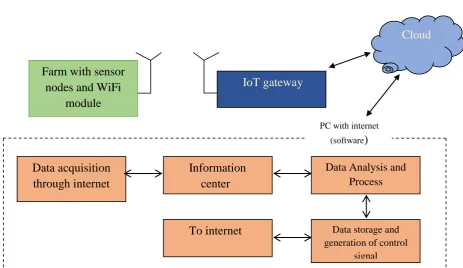
In the proposed system, the soil moisture as well as the surrounding temperature will be
measured using sensors at field. This data will be sent to the cloud via ESP 8266 module, as
shown in Fig. 1.
1898 | P a g e II. METHODOLOGY
Part 1:
1. Each sensor node contains sensors such as DHT 11(temperature and humidity sensor)
moisture sensor.
2. Arduino board will be used to collect sensor data.
3. Arduino board will send the collected data to the management server via wifi connectivity
through IoT gateway.
4. Wi-Fi connectivity will be provided to the sensor node using the esp 8266 WiFi module.
5. A battery power is provided for each sensor node.
Part 2:
1. The gateway will consist of the ESP 8266 Wi-Fi module. This module will receive the
data from the sensor node.
2. The whole data will be clubbed and sent by an arduino board and an Ethernet interface to
the internet.
Farm with sensor nodes and WiFi
module
IoT gateway
Information center
Data Analysis and Process
Data storage and generation of control
signal
To internet Data acquisition
through internet
Cloud
PC with internet (software)
1899 | P a g e 3. The internet will be accessed by a wireless modem.
Part 3:The management server
1. The internet connectivity will be provided to the management server via internet modem.
2. The server will be made up of a personal computer that will have internet connectivity.
This computer will receive the whole data over internet and will analyze it.
3. The server will also be responsible for controlling of any stray parameters that will be
detected due course.
III.Proposed Hardware:
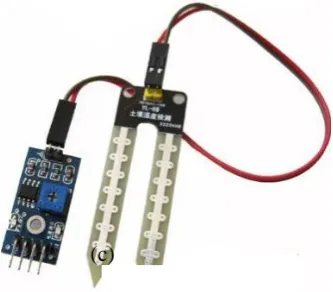
The Fig. 2 shows the hardware to be used to develop the proposed system. ESP 8266-12 E is
the Wi-Fi module used to connect sensors to the cloud. DHT11 is a temperature and humidity
sensor. Soil moisture sensors sense the water content in the soil. A 12V DC pump is used to
supply water whenever water content falls below set point.
1900 | P a g e IV.RESULTS
The project outcome will be a complete smart and automatic system for the irrigation.
It can be applied to remote environments like the green house. It will prove very useful in
all the places where frequent monitoring and quick controlling should be essential. Also
a proper GUI can be made for the user like layman.
REFERENCES:
[1.] S. Sawant, J. Adinarayana, S. Durbha, “Krishisense: a semantically aware web enabled wireless sensor network system for precision agriculture applications”, Centre of studies in resources engineering, IIT Bombay, Powai, 2014, p.p. 4090 – 4093.
[2.] Li Hu, X Chen, Ke Ketai, “The Applications Of WiFi-based Wireless Sensor Network In Internet Of Things And Smart Grid”, IEEE Conference on Industrial Electronics and Applications(ICIEA), 2011, p.p. 789 – 793.
[3.] D. Yane, “Design of Intelligent Agriculture Management Information System Based on IoT”, Fourth International Conference on Intelligent Computation Technology and Automation, vol. 1, p.p. 1045 – 1049. [4.] Ji-chun Zhao, Jun-feng Zhang; Yu Feng ; Jian-xin Guo, “The Study and Application of the lOT Technology
in Agriculture”, Third IEEE International Conference on Computer Science and Information Technology ICCSIT , vol. 2, July 2010, p.p. 462-465.
Fig. 2: a) DHT11, b) ESP 8266-12 E Development Board, c) Soil moisture sensor, d) Pump Courtesy: Google Images
DHT-11
Soil moisture detection module
1901 | P a g e
[5.] B. Khelifa, D. Amel, B. Amel, C. Mohamed, B. Tarek, “Smart Irrigation Using Internet of Things”, The Fourth International Conference on Future Generation Communication Technologies (FGCT 2015), 2015, p.p. 1-6.
[6.] N. Patel, R. Lanjeware, S. Mathurkar, A. Bhandekar, “Microcontroller based Drip Irrigation System using Smart Sensor”, IEEE India Conference (INDICON), 2013.
[7.] B. Bhanu, M. Hussain, P. Ande, “Monitoring of Soil Paramters for effective Irrigation using Wireless Sensor Networks”, International Conference on Advanced Computing (ICoAC), 2014, pp. 211-215.