Intelligent Safety Alert Realtime Automobile
Tracker
Sherin Thomas
1, Eldho N Joy
2, Febin George
3, Melbin C Emmanual
4, Diya Jose
5Assistant Professor, Dept. of ECE, Mar Baselios Institute of Technology and Science, Nellimattom, Kerala, India1
UG Student, Dept. of ECE, Mar Baselios Institute of Technology and Science, Nellimattom, Kerala, India2
UG Student, Dept. of ECE, Mar Baselios Institute of Technology and Science, Nellimattom, Kerala, India3
UG Student, Dept. of ECE, Mar Baselios Institute of Technology and Science, Nellimattom, Kerala, India4
UG Student, Dept. of ECE, Mar Baselios Institute of Technology and Science, Nellimattom, Kerala, India5
ABSTRACT: The upcoming technology where machine to machine communication is possible by deploying the intelligent sensors on machine for smart interaction. The automobile sector is one of the application domain where vehicle can be made intelligent. The aim of embedded intelligence in a machine through an application specific embedded microcontroller, sensor shields integrated with signal conditioning and signal processing circuitry, communication modules, smart power management system, is to interact with other machines equipped with similar facilities, in the form of machine2machine (M2M) communication. This project presents the interface of Arduino Uno R3 development board, sensor shield and smartphone. The proposed schematic is for car security which gives the access of car through internet and GPS, to the owner of car, in case car is stolen or damaged. The system also provides a live video streaming inside the car with remote ignition system. It provides a compact and user friendly system.
KEYWORDS: Internet of Things; Arduino Uno R3;1SHEELD; Android App
I. INTRODUCTION
With the expansion of the internet in smart gadgets with the latest internet technologies like IPv6, LTE, and 5G, the intelligence is embedded into the many devices used in various application domains like: health, agriculture, transport, defense, and energy sectors [1], [2]. The aim of embedded intelligence in a machine through an application n specific embedded microcontroller, sensor shields integrated with signal conditioning and signal processing circuitry, communication modules, smart power management system, is to interact with other machines equipped with similar facilities, in the form of machine2machine (M2M) communication. IoT gives the flexibility to access the devices over internet using D2D, D2S, S2D, and S2Scommunication protocols [3], [4], [5], [6], [7].
This paper aims to use a genuine open source platform to design a car security system, where the possible threatscan be sensed through the interfaced IoT board with sensor shielding. The open source development is a reliable means of designing and developing projects in this modern era. In this paper, we use an Arduino Uno R3 development board, a common sensor shield that fits on the Arduino board and a smartphone to implement the idea [8]. The idea focuses on the need to design a security system, which is quite obvious.
For instance, when a family goes out of town, or anywhere, leaving their house and car behind, there has to be something that keeps a smart check on the house and a car [9], [10].Similarly, when someone' s car is being stolen, there has to be some device that can get you the access of the car remotely, like-locking the car, starting a GPS tracker, enable skype call to see what' s inside a car etc. The best possible utility of this work is, to access a security system through a smart IP enabled device at any distance using IoT protocols [11], [12].
II. INTERNET OF THINGS
The Internet of things (IoT) is the network of physical devices, vehicles, and other items embedded with electronics, software, sensors, actuators, and network connectivity which enable these objects to collect and exchange data.
The IoT allows objects to be sensed or controlled remotely across existing network infrastructure, creating opportunities for more direct integration of the physical world into computer-based systems, and resulting in improved efficiency, accuracy and economic benefit in addition to reduced human intervention. When IoT is augmented with sensors and actuators, the technology becomes an instance of the more general class of cyber-physical systems, which also encompasses technologies such as smart grids, virtual power plants, smart homes, intelligent transportation and smart cities. Each thing is uniquely identifiable through its embedded computing system but is able to interoperate within the existing Internet infrastructure. Experts estimate that the IoT will consist of about 30 billion objects by 2020.
Typically, IoT is expected to offer advanced connectivity of devices, systems, and services that goes beyond machine-to-machine (M2M) communications and covers a variety of protocols, domains, and applications. The interconnection of these embedded devices (including smart objects), is expected to usher in automation in nearly all fields, while also enabling advanced applications like a smart grid, and expanding to areas such as smart cities.
"Things", in the IoT sense, can refer to a wide variety of devices such as heart monitoring implants, biochip transponders on farm animals, cameras streaming live feeds of wild animals in coastal waters, automobiles with built-in sensors, DNA analysis devices for environmental/food/pathogen monitoring, or field operation devices that assist firefighters in search and rescue operations. Legal scholars suggest regarding "things" as an "inextricable mixture of hardware, software, data and service".
III. KEY FEATURES OF THE SYSTEM
The main key features of proposed security system are, automatically notifies the user via a text message that the car is moving when the speed of the car reaches a certain threshold level. Alternatively, it can be used to infer that car is being stolen. Allows the Arduino to skype call the user, whenever asked for by the user, via a suitable text message like: "skype", from user's phone to the Smartphone hidden inside the car.
Allows the user to turn ON the GPS tracker, by sending suitable message like "gps" to the Smartphone. The GPS location can be easily viewed on Google Map and Google earth. Allows the user to stop and restart the car at any desired instant by sending the messages: "stop" and "start". If the car's windows and doors are configured by hydraulic mechanism, user can shut down the doors and locks at its own end by sending a message to the Smartphone.
IV. SYSTEM SETUP
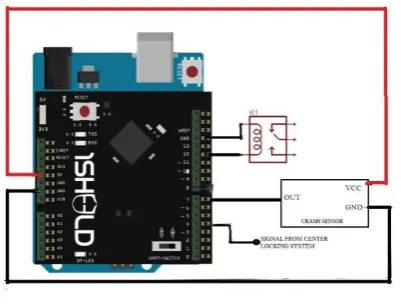
The setup requires an Arduino Uno R3 development board, an open source sensor shield named 1SHEELD that fit right on the top of the Arduino board, a Smartphone with 1 SHEELD android application installed, a 9V battery, 40 Ampere or above Relay, IC ULN2003A. Using these components, the circuit is connected as shown in figure, with the Smartphone kept as a separate unit. The sensor shields 1 SHEELD is put up on the top of Arduino board. 1SHEELD is connected to the Smartphone via Bluetooth. The Sensor shield runs on an Atmel ATMega 162 and use a standard inbuilt Bluetooth HC-06 adapter.
A. BLOCK DIAGRAM
Fig 1 Block Diagram
The block diagram consists of Arduino and 1sheeld, relay, power supply, Smartphone and its inbuilt sensors. Arduino and 1sheeld is the basic microcontroller of the system. The Arduino is connected to a Smartphone in order to access and manipulate its sensors. 1sheeld is used to connect Arduino and Smartphone via Bluetooth. The various sensors such as gps, camera, accelerometer, etc are used for various functionalities. Gps used for gps tracking, accelerometer for alerts, camera used for taking burglar picture inside car. The relay is used to cut the engine connection remotely using the owners mobile phone. Power supply is used for powering the whole system. Depending upon the status of the crash sensor, the accident alert is working. The signal from the centre locking system is used to monitor the status of vehicle along with the accelerometer. Here we are using external power bank for it. Instead of that in future we can implement solar panel charging for this powering.
B. CIRCUIT DIAGRAM
Fig 2 Circuit Diagram
V. MODULES WITH WORKING PRINCIPLES
A.TEXT MESSAGE ALERT
This feature notifies the user by a text message, when the speed of car crosses the threshold value (taken as 20Kmph). This not only ensures car's safety but also informs the user that car has been stolen. When car is taken other than the owner, a text message alert is sent to owner’s mobile via text message.
The system work under principle that, when the threshold value or the y co-ordinate of the accelerometer sensor rises beyond the threshold limit, the signal generates and the text message will have sent to already allocated mobile number. The message alert “The car is moving” will sent to the particular mobile number. At this condition the owner notified that the car is stolen.
B. SKYPE CALL
The Skype Call features allows the user to get live video streaming of inside of the car, at any instant of time. As soon as the user requests for Skype call through a text message: -"Skype", to the Smartphone hidden inside the car, the Arduino checks for the message Android application and activates the Skype feature, thereby calling the user's Skype id, automatically. This features acts as a spy camera that enables the user to see the identity of driver. The user can record the video for future references and post it on social networking sites for immediate actions.
C. GPS TRACKER
This features allows the Arduino to use GPS sensors and Internet feature to start logging the latitude and longitude of location of the car, and send it to car’s owner, and connects it to Google Maps, to allow the user to give real time location of the car. The User can use these locations to analyses the nearby police stations and contact them to carry out some legal actions. This whole idea works on the Internet of Things protocol, which uses internet connection, to get remote access to information and data.
When a particular message “gps” is sent to the mobile inside the car the current position the car will be obtained. By the action of sending the message, the current position of the car assisted by Google map will be received by the owner.
D. TURN OFF THE CAR
The user can control the car's engine by turning it off at any instant. The user can request the Arduino to turn on the relay and connect it to ground instead, by sending an appropriate message, like: - "start" as shown.
1) Setting up the JC ULN2003: -
The setup is implemented by using a 40A-12V relay device. The relay is connected in a manner so as to control the inflow and outflow of current from fuse circuit to the engine. The pin 85 and pin 86 of relay, joins together to form two ends of an internally connected coil, that creates a magnetic field on passage of a current through it. The pin 85 of the relay is connected to the pin 16 of IC ULN2003. ULN 2003 consists of seven NPN Darlington pairs that features high-voltage outputs with common-cathode clamp diode for switching inductive loads. The collector-current rating of a single Darlington pair is 500mA. The Darlington pairs may be paralleled for higher current capability. Pin 7 of the Arduino is connected to Pin 1 of the IC ULN2003, as a result the output current of the Arduino gets amplified sufficient enough to magnetize the coil.
2) Setting up the Relay
1 of IC ULN2003, which turns on the relay and connects the pole to normally open pin (pin 87). Hence the fuse is shorted to the ground and car' s engine stops.
E. EMAIL AND CAMERA
If the skype feature is not working properly due to slow network connections in some areas then the user has an alternative option to check the inside of the car, particularly the accused, by just sending a text message "mail" to the smartphone hidden in the car and this feature will click the selfie or photograph of the person driving the car and directly sent it to predefined e-mail id and the user can save this proof of the photograph for legal actions. This email feature also includes camera feature for clicking the photograph and internet feature for sending the mail, all being processed by mobile application, hidden inside the car at the expense of mobile data.
F. REAL-TIME ACCIDENT ALERT
If the car’s owner is taking the car for a drive, suppose the car may undergo an accident, an alert will be produced to the third party. This facility is created by manipulating the accelerometer sensor of the smartphone inside the car. A normal accelerometer has basically 3 co-ordinates(x,y,z). In normal movement of the car, only x and y co ordinates value may get vary. But during the condition of an accident both the 3 x,y,z co-ordinates may vary simultaneously. This combined variation accelerometer is detected as an accident and corresponding alert will create.
Here also a threshold value is set for the combined co-ordinates variation. Beyond that threshold value, it is detected as accident. The equation used setting the threshold value is
Sum =√((x*x)+(y*y)+(z*z) )
If the value exceeds the sum alert generates. Here we set the threshold as 15. That means if the value of sum exceeds by 15, it is detected as accident and corresponding function take place. In the case of accident, a text message alert with accident zone gps co-ordinates assisted by Google map will be sent. In addition to that a mail attached with the same information in text message will be sent to the third party.
VI. RESULT AND CONCLUSION
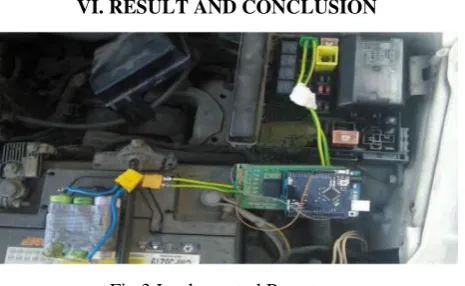
Fig 3 Implemented Prototype
The proposed IoT prototype is tested and implemented on a car successfully. This work can also have connected to the other application domains. Arduino power supply derived from a 9V battery will not last much long with so much going in with the Arduino and may drain after few hours. Similarly, battery of the android smartphone hidden inside car will also drain continuously with so much sensors kept busy by the Arduino. This limitation can be solved by connecting the system with car battery with a power control circuit. This whole project can be further modified to help us safe our home from external threats when we our away from our home and when we our sleeping at night. It can also be useful at times when some guests arrive and the owners are away.
is good connectivity. After pressing the doorbell, you can send a text message to the smartphone inside house to directly see who is outside your house and then open the door for them by simply messaging "open". If some has entered house, then you can have their video with the other camera facing inside of the house for the live streaming of what they are doing. If someone tries to unlock your door with something then the IR and pressure sensors sensor will sense it and then it will send you a text message "THIEF", and then you can contact the nearby police stations and even your neighbors for immediate help. In this case the owner can remotely allow the person to enter the house after securely identifying the person via live streaming of what they are doing.
REFERENCES
[1] Y. Li, J. Wang, and B. Dong, "Reseach on the application of the Internet of Things in intelligent transport". Mobile Communication vol. 15, pp.30-34, Sep 20 I O.
[2] K. Ashton, "That 'Internet of Things' Thing", RFID Journal, 22June 2009.
[3] P. Magrassi, A. Panarella, N. Deighton and G. Johnson ,"Computers to Acquire Control of the Physical World", Gartner research report T - 14-030 I, 28 September 200 I[5)
[4] Zhihua Cheng, Jianfei Sun, Weixian Zhu, Qian Zhao. Embeddedvehicle anti-theft system based on GPS and GPRS[J]. Computer Systems & Applications, 20 I 3, vo1.22, no.5,pp.38-4 I.
[5] Chengpeng Ru . Vehicle monitoring system design based on the ARM Beidou navigationl GPRS/GIS[J]. Railway Transport and Economy, 20 I 3,no.3 , pp.80-84.
[6] V. K. Sehgal, M. Singhal, B. Mangla, S. Singh and S. Kulshrestha ,"An Embedded Interface for GSM Based Car Security System, "Computational Intelligence, Communication Systems and Networks (CICSyN), 20 I 2 Fourth International Conference on, Phuket, 2012, pp. 9-13 .
[7] Zeming Li , Jinming Li, Yanjiao Yang. Remote target position ingsystem based on GPS/GPRS[J]. Computer Measurement &Control, 2013,voI.21 ,no.6, pp.1644-1647.
[8] Abuzalata M, Momani M, Fayyad S,et aLA practical design of anti theft car protection system based on micro-controller[J].American Journal of Applied Sciences, 2012, vol.9, no.5, pp.709-716.
[9] Changlong Cao,Yong Ji, Xuchu Dai. Wireless mobile videomonitoring terminal design and implementation based on Beidousatellite navigation[J]. Journal of Telemetry,Tracking and Command, 20 I 3, pp.33-38.
[10] V. K. Sehgal, A. Patrick and L. Rajpoot, "A comparative study of cyber physical cloud, cloud of sensors and internet of things: Their ideology, similarities and differences," Advance Computing Conference (IACC), 2014 IEEE International, Gurgaon, 2014,pp. 708-716.
[11] Lei Zhang, Yingjie Chen, Mengqian Sun, Zicong Xiao. Tilting accident vehicle alarm system design based on GPS and GSM[J].Computer Measurement and Control, 201 I , vol.I9, noS,pp.1 127-1 129.