PAPR Reduction and Sidelobe Suppression
Using DWT and Hadamard Transform in
NC-OFDM Based Cognitive Radio Systems
Anu Mathew 1, Jinto Mathew2, Robin George3, Sherin Mary Kuriakose4
Assistant Professor, Dept. of ECE, MBITS Engineering Collage, Nellimattom, Kerala, India1 2 3
PG Student [ACIS], Dept. of ECE, MBITS Engineering Collage, Nellimattom, Kerala, India4
ABSTRACT: OFDM is a bandwidth efficient multicarrier modulation where the available spectrum is divided into subcarriers, with each subcarrier containing a low rate data stream.NC-OFDM is variant of OFDMwhich achieves high data rates and avoid interference. The main two drawbacks of NC-OFDM (Non Contiguous Orthogonal Frequency Division Multiplexing) based CR systems are high peak to average power ratio (PAPR) and side lobe suppression. In this paper, we compare signal cancelation (SC) method for joint PAPR reduction and sidelobe suppression in NC-OFDM based CR systems by using DWT and Hadamard Transform. Moreover, we also propose a suboptimal SC (sub-SC) method too efficiently with low computational complexity. The proposed SC method and the sub-SC method can provide both significant PAPR reduction and sidelobe suppression performances. Compared to DFT, in DWT signal is localized in frequency and time domain and bandwidth wastages are highly reduced. Also compared to DFT, Hadamard Transform reduce bandwidth storage requirement and it is faster to calculate.
KEYWORDS: Cognitive radio (CR), non-contiguous orthogonal frequency-division multiplexing (NC-OFDM), peak-to-average power ratio (PAPR), side lobe suppression
I. INTRODUCTION
In this paper, it proposes a method called Signal Cancellation that jointly reduce PAPR and spectrum sidelobe.In SC method the outer constellation points on SU subcarriers is dynamically extended and SC signals are added to PU subcarriers to generate appropriate cancelation signal for PAPR reduction and sidelobe suppression.
II. PROBLEM DESCRIPTION
A. PAPR
Peak to Average Power Ratio is defined as the ratio of maximum power to the average instantaneous power. It is purely caused by the presence of high power amplifier. Let x (n) be the transmitted signal. Then, the mathematical representation of PAPR be
The complementary cumulative distribution function (CCDF) is widely employed to measure the PAPR reduction performance, which is defined as the probability that the PAPR exceeds a given threshold PAPR0, i.e.
CCDF = Pr {PAPR > PAPR0}
B. SIDELOBE FORMATION
During the transmission of OFDM signal sidelobe is formed. Large formation of this sidelobe may introduce possibility of interference to the signal. Also side lobe utilizes more amount of power.
The efficient transmission of a signal requires a method that reduces the PAPR and also suppresses the sidelobe. Signal Cancellation is a method that reduces the PAPR and suppress the sidelobe.
III. SYSTEM MODEL
A. SIGNAL CANCELLATION METHOD
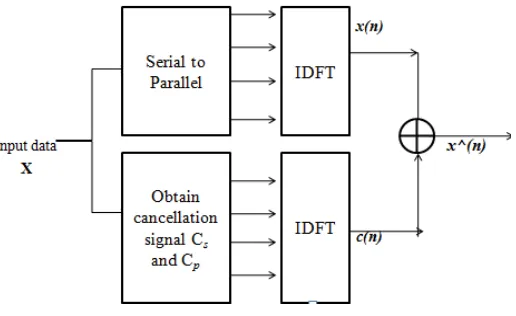
Here, we propose a Signal Cancellation (SC) method that jointly reduce PAPR and suppress the sidelobe. In SC method, part of the outer constellation points is dynamically extended on SU subcarriers, whereas several SC symbols are added on PU subcarriers.
Fig.1 Block diagram of SC method
arrowed lines, and corner points can be extended to the shaded regions. The minimum Euclidean distance of the modified constellation points can be maintained the same as that of the original constellation points; thus, the BER performance of the SC method can be maintained.
Fig. 2 Constellation region on SU subcarriers with 4-QAM and 16-QAM, respectively.
Then, the SC method formulates the problem of the joint PAPR reduction and sidelobe suppression as a quadratic ally constrained quadratic program (QCQP) and the optimal cancelation signal can be obtained by convex optimization. We also propose a suboptimal SC (sub-SC) method to efficiently solve the QCQP optimization problem with low complexity.
B. SUB SIGNAL CANCELLATION METHOD
Fig. 3 Algorithm of Sub SC method
Fig.4 shows algorithm of sub –SC method. From the figure, the CS can be obtained by projection on to convex set algorithms as shown in fig 4.
Fig .4. Calculation of Cs
Then for calculating CP, the constellation adjustment symbol Csis seen as a constant, and the SC symbol Cpon PU subcarriers is utilized as a variable to suppress the sidelobe in NC-OFDM-based CR systems.
Cp=TCˆP (1)
Denote Cpˆas an L × 1 vector, which squeezes out zero from the N × 1 vector Cpand only leaves the weights on the position Rc. Moreover, T is a matrix that transfers Cpˆ to Cp.
CˆP= - (BHB)-1BHPd(X+CS) (2) Where B=Pd T , and BH denotes the complex conjugate transpose matrix of B.
Substituting 1 and 2, we have
Cp = -T (BHB)-1BHPd(X+Cs)
= Q(X+CS) (3)
Where Q=-T (BHB)-1BHPd
Thus we obtain the total added symbol C as
C=CP+CS (4)
IV. DISCRETE WAVELET TRANSFORMS
The time windowed exponentials are replaced by wavelet carriers at different scales and position on time axis.In numerical analysis and functional analysis, a Discrete Wavelet Transform (DWT) is any wavelet transform for which wavelets are discretely sampled. As with the other wavelet transform, a key advantage is has over the Fourier transform is temporal resolution, i.e. it captures both frequency and location information
V. WALSH HADAMARD TRANSFORMS
The Walsh Hadamard Transform (WHT) is a non-sinusoidal, orthogonal linear transform. WHT decomposes a signal into set of basic functions. These functions are Walsh functions, which are square waves with values of +1 or -1. The proposed Hadamard Transform scheme may reduce the occurrence of the high peaks comparing the original OFDM system. The idea to use the WHT is to reduce the autocorrelation of the input sequence to reduce the peak to average power problem and it requires no side information to be transmitted to the receiver.
X1=IDFT(X+Cp) X2=X1
Clip the signal whose amplitude is greater than A X1(X1>A) =A
Clipping noise
W=X2-X1
VI. RESULT
Fig.5. shows the performance of PAPR with SC and Sub SC method. The black line in the graph represents PAPR reduction by using SC method and blue line in the graph represents PAPR reduction by using Sub SC method with low computational complexity. Fig.6. shows the power spectrum density of NC-OFDM signals.Fig.7. Shows PAPR reduction when DWT is employed .Fig. 8. Shows PAPR reduction when Hadamard Transform is employed.
Fig.5. PAPR reduction with SC and Sub SC method Fig.6. Power Spectrum Density
Fig.7. PAPR reduction using DWT Fig.8. PAPR reduction using Hadamard Transform
VII. CONCLUSION
Moreover we also proposed a Sub SC method to efficiently reduce PAPR and suppress the sidelobe with low computational complexity.
REFERENCES
[1] S. Haykin, “Cognitive radio: Brain-empowered wireless communications,”IEEE J. Sel. Areas Commun., vol. 23, no. 2, pp. 201–220, Feb. 2005.
[2] A. Ghassemi, L. Lampe, A. Attar, and T. A. Gulliver, “Joint sidelobe and peak power reduction in OFDM-based cognitive radio,” in Proc. IEEE72nd Veh. Technol. Conf. Fall, Sep. 2010, pp. 1–5.
[3] D. Li, X. Dai, and H. Zhang, “Sidelobe suppression in NC-OFDM systems using constellation adjustment,” IEEE Commun. Lett., vol. 13, no. 5,pp. 327–329, May 2009
[4] L. J. Cimini and N. R. Sollenberger, “Peak-to-average power ratio reduction of an OFDM signal using partial transmit sequences,” IEEE Commun. Lett., vol. 4, no. 3, pp. 86–88, March. 2000.
[5] H. Yamaguchi, “Active interference cancellation technique for MBOFDM cognitive radio,” in Proc. 34th IEEE Eur. Microw. Conf., Oct. 2004, vol. 2, pp. 1105–1108.
[6] S. Brandes, I. Cosovic, and M. Schnell, “Sidelobe suppression in OFDM systems by insertion of cancellation carriers,” in Proc. IEEE Veh. Technol.Conf., Sep. 2005, vol. 1, pp. 152–156.
[7] Van Nee, R. , and Wild, A., "Reducing the Peak to Average Power Ratio of OFDM," in IEEE Vehicular Technology Conference, May 1998, Vol.3.
[8] T. jiang and y. wu,”an over view peak to average power ratio reduction techniques for ofdm signals, IEEE transactions on broad casting, vol.54, no.2, June 2008, pp.257-268.
[9] C. V. Bouwel, et. al, Wavelet Packet Based Multicarrier Modulation, IEEE Communications and Vehicular Technology, SCVT 200, pp. 131-138, 2000.