DOI: 10.1051/epjconf/20158401002 C
Owned by the authors, published by EDP Sciences, 2015
State selective study of H
+3recombination in Cryo-FALP and
SA-CRDS experiments at 77 K
Juraj Glosíka, Michal Hejduk, Petr Dohnal, Peter Ruboviˇc, Ábel Kálosi and Radek Plašil
Charles University in Prague, Faculty of Mathematics and Physics, Department of Surface and Plasma Science, V Holešoviˇckách 2, 18000 Prague, Czech Republic
Abstract.Rate coefficients for nuclear spin state-specific recombination of H+3 ions with thermal electrons were measured using FALP and SA techniques at temperatures 77–300 K. For this purpose H2 gas with both thermal and enriched population of the para nuclear
spin configuration was used. Measurements have shown that at 77 K para-H+3 exhibits five
times higher binary recombination rate coefficient than ortho-H+3: (1.5±0.4)×10−7 vs.
(3±2)×10−8cm3s−1.
1. Introduction
H+3 ion is the most abundantly produced molecular ion in interstellar space [1] and as such stands at the beginnings of astrochemical chains leading to formation of other astrophysically important molecules. One of its major destruction mechanisms, recombination with electrons
H3++e−bin−→−TDE(T)H2+H, H+H+H, (1a)
wherebin−TDE(T) is recombination rate coefficients of H+3 ions with population of states according to
thermal equilibrium at temperatureT, has been studied for more than 60 years [2–4]. Recently, attention has been focused on the dependence of the recombination rate coefficient of H+3 ions on nuclear spin states of these ions (para and ortho):
pH+ 3 +e−
p bin
−→H2+H, H+H+H (1b)
oH+ 3 +e−
o bin
−→H2+H, H+H+H, (1c)
where “p” and “o” superscripts indicate para and ortho nuclear spin configurations of H+3, respectively. The corresponding binary state-specific rate coefficients for pure para-H+3 and pure ortho-H+3 arepbin
ando
bin, respectively. In the text below we will usepf3 andof3for relative populations (fractions) of
para-H+3 and ortho-H+3 in H+3. The overall recombination rate coefficient is then given by a sum: bin
p
f3
=pf
3pbin+of3obin (2)
aCorresponding author:[email protected]
EPJ Web of Conferences
for more details see Ref. [5]. The state-specific binary recombination has been studied by monitoring decay of the low temperature H+3 dominated afterglow plasma (in He/Ar/H2gas mixture) [5–7] and also
by several storage ring experiments, see Refs. [8–11]. The advantage of the afterglow experiments is that H+3 ions are rotationally thermalized by multiple collisions with ambient neutral gas molecules/atoms at properly chosen conditions [5,12]. In the recent afterglow type experiments the evolution of densities of H+3 ions in the particular spin state and the thermalisation (rotational temperature within para and ortho nuclear spin manifolds and kinetic temperature) are monitored by a laser absorption spectroscopy (SA-CRDS – Stationary Afterglow with Cavity Ring-Down absorption Spectrometer [6,7,13]). One of the advantages of plasmatic environment is possibility to study ternary recombination processes assisted by neutrals, by electrons, or eventually by both of them, see Refs. [14–17] and references therein. In studies of binary recombination of H+3 ions in He/Ar/H2gas mixture it was observed that the decay of afterglow
plasma is dependent on He number density [5,6,18–20]. This indicates that a ternary He-assisted recombination process contributes to the overall recombination in afterglow plasma in He/Ar/H2 gas
mixture:
H3++e−+HeKHe−→-TDE(T)neutral products+He (3a) where KHe-TDE(T) is the ternary recombination rate coefficients of H+3 ions with population of states
according to thermal equilibrium at temperature T. In this ternary process a dependence of ternary recombination rate coefficient on nuclear spin state of the recombining H+3 ions was also observed [5]:
pH+
3 +e−+He
pKHe
−→neutral products+He (3b)
oH+
3 +e−+He
oKHe
−→neutral products+He (3c)
where pKHe and oKHe are corresponding ternary recombination rate coefficients for pure para-H+3
and pure ortho-H+3, respectively. At low pressure of He we observed a linear dependence of overall (effective) binary recombination rate coefficienteffon [He]:
eff=bin+KHe·[He]. (4)
The state selective experiments by Dohnal et al. [5,6] and Varju et al. [7] have been performed at temperatures 77–200 K using SA-CRDS apparatus. The measurements with SA-CRDS at 77 K have shown that the binary recombination rate coefficientp
bin for pH+3 is at 77 K approximately 10 times
higher than correspondingo
bin foroH+3 [5]. This difference decreases with increasing temperature up
to 200 K, where both binary rate coefficients are comparable. After taking into the account Jahn-Teller effect [21–23], the theoretical calculations were successful in description of the binary recombination processes (1a, 1b, 1c). Measured ternary recombination rate coefficients also showed pronounced nuclear spin specificity at temperatures 100–200 K. Theory of the aforementioned ternary processes is based on a calculation of the life time of rotationaly excited neutral p/oH
3 Rydberg molecule.
This molecule is formed in collision ofp/oH+
3 with electron [18–20] and theory predicts the order of
magnitude of the ternary rate coefficient correctly. However, the theory is not detailed enough for closer comparison with the experimental values of state selected ternary rate coefficients and their temperature dependencies.
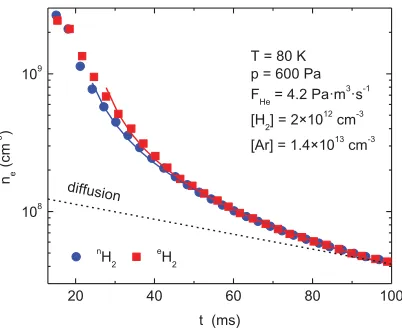
Figure 1. The electron density decay curves measured by Langmuir probe [28] along the flow tube in Cryo-FALP II experiment [16] at 77 K withnH
2 (circles) and witheH2 (squares). Hydrogen gas is added to the flow
tube at position corresponding to 15 ms. The full lines indicate the fits of the measured data. The dashed line indicates the decay due to losses by ambipolar diffusion. Obtained effective recombination rate coefficients are
eff(nH
2)=1.7×10⁻⁷cm3s−1andeff(eH2)=2.1×10⁻⁷cm3s−1.
2. Experiments
Cryo-FALP II [16] is a modification of the standard FALP technique [24]. The technical details were described elsewhere [14, 20,25], only very short description will be given here. A source of para-state-enriched hydrogen gas (para-hydrogen generator) was also described in our previous publication [12]. The combination of the para-hydrogen generator and Cryo-FALP II allows us to measure the recombination rate coefficients of para- and ortho-H+3 ions with electrons at temperatures down to 40 K [15,16]. To obtain information on para/ortho H+3 composition in the afterglow plasma, which is important for evaluation of state specific recombination rate coefficients we measured this composition in parallel SA-CRDS experiment at temperatures 77–300 K [5–7, 12]. In the Cryo-FALP II setup the movable Langmuir probe [26] measures the electron number density along the flow tube and the time evolution of electron density in afterglow plasma (see example in Fig. 1) can be obtained [27–29]. A microwave discharge is ignited in helium buffer gas (with a number density [He] ~1016– 1017cm−3) in the first section of the flow tube kept at room temperature and plasma consisting of helium
metastable atoms Hem, He+, and He+
2 ions and electrons is formed. Downstream at temperature 100 K
argon is introduced ([Ar]∼1013cm−3) and Ar+ dominated plasma is formed. The plasma then flows
into the section where either normal H2 (nH2) or para-states-enriched H2 (eH2) is introduced (typical
[H2]∼5×10¹¹–2×1013cm−3) and H+3 dominated plasma is formed. In this article the H2with
para-H2fractionpf2=0.25 is denoted as normal H2and it is represented by symbolnH2. The symboleH2is
used for para enhanced H2 gas. The kinetics of formation of H+3 dominated afterglow plasma was
described in details in Refs. [27,29]. Formed H+3 ions are thermalized in subsequent multiple collisions with He and H2. The thermalisation of plasma during the afterglow was studied at similar conditions
using SA-CRDS (kinetic energy and rotational temperature [5,7,12]).
The para-state-enriched hydrogen gas is produced using “para-hydrogen generator” that works on principle of conversion ofoH2 topH2 on thermally dehydrated HFeO2 surface cooled in cryostat
to temperatures 10–18 K [30]. In this experiment normal hydrogen (nH2) is liquefied in the catalyst
container and the saturated vapor of converted gas (eH2) is collected through an outlet tube. The
actual value of pf2 in eH2 was obtained by measurement of N++ H2 reaction rate coefficient in a
EPJ Web of Conferences
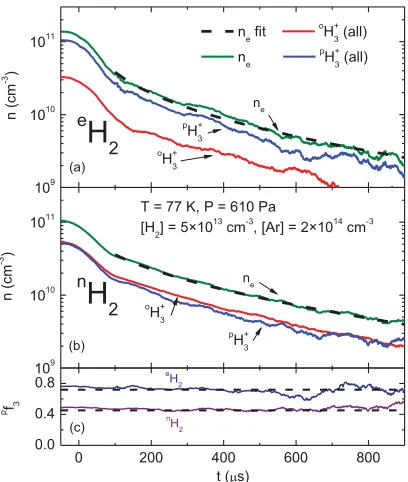
Figure 2. TheoH+ 3 and
pH+
3 number density decay curves measured in SA-CRDS experiment at 77 K with eH
2and
withnH
2, panels (a) and (b), respectively. Electron number densityneis calculated as sum of [oH+3] and [ pH+
3]. The
dashed lines indicate the fit of the measured data. Time evolutions of populationpf
3ofpH+3 for both nH
2andeH2
are shown in panel (c).
entry port of the Cryo-FALP II apparatus which provide a well-defined and constant flow of para-H2
with relative population (para fraction of H2)pf2 =(0.995±0.005).
In both experiments the decrease of electron/ion densities during the afterglow was measured. The examples of the decay curves measured in Cryo-FALP II and SA-CRDS experiments are shown in Figs. 1 and2, respectively. Note large difference in time scale and in electron densities in both experiments. The measured decay curves were fitted to obtain recombination rate coefficients. Using Eq. (4) we can obtainbin−TDE(T) and KHe−TDE(T) from the measured dependences of an apparent
(effective) recombination rate coefficienteffon [He] andT. Ifeffis measured using hydrogen gas with
two different relative populations ofpH2, e.g. by usingnH2andeH2, we obtain afterglow plasmas with
different relative populations ofpH+
3 (pf3). From corresponding decay curves (see Fig. 2) we can obtain
dependence ofeff onpf3 and consequently we can calculatep/obin(T) ando/pKHe(T), details of data
analysis are given in Refs. [5,6].
3. Population of para-H
+3and ortho-H
+3in afterglow plasma
To obtain recombination rate coefficients for H+3 ions in thermodynamic equilibrium and for pure para-and ortho-H+3 from afterglow experiment one need to know relative population of para-H+3 to ortho-H+3, i.e.pf
3 value. In present study we decided to use dependencepf3=pf3(T,pf2, [He], [H2]) measured
in SA-CRDS experiment. We used both experiments to monitor decay of the afterglow plasma in a He/Ar/H2mixture at different temperatures and over a broad range of He and H2number densities. In
SA-CRDS experiments we monitored also para/ortho composition of H+3 ions in afterglow with nH2
andeH2. The fractionpf3 at 77 K was measured very carefully over broad range ofnH2,eH2 and He
densities. The dependence ofpf
Figure 3. The dependence of the fractionpf
3of para-H+3 on He number density in afterglow plasma measured at
different number densities ofnH
2(empty circles) andeH2(full circles). Hydrogen number densities were varied in
the range 2×10¹³–5×1014cm−3.
Figure 4. The dependence of the fraction pf
3 of para-H+3 on hydrogen number density in afterglow plasma
measured in experiments withnH
2(empty circles) andeH2(full circles). The helium number density was varied in
the range 2×10¹⁷–2×1018cm−3.
pf
3 on [H2] measured at 77 K is shown in Fig.4. The constant value ofpf3(77 K) at broad range of nH
2,eH2and He densities made it possible to use the results from SA-CRDS for analysis of data from
Cryo-FALP II. The parameter which was kept the same in both experiments is the number of collisions of formed H+3 with H2prior to its recombination.
The kinetic temperature of H+3 ionsTKinis determined from Doppler broadening of the measured
absorption lines in SA-CRDS experiment. From the measured relative populations of H+3 ions in ortho (1,0), (3,3), and para (1,1) states we obtained relative population (fraction pf
3) of para H+3 in the
afterglow plasma and also rotational temperature of H+3 in ortho manifold (TRot−ortho) at particular
kinetic temperature of the ions. On the basis of our present and previous measurements ofTKin and
TRot−orthowe concluded that in both afterglow experiments we can useTRot−ortho=TKin=THein rather
good approximation (THe is temperature of helium buffer gas). From the measured diffusion losses
EPJ Web of Conferences
Figure 5. The dependence ofeffon [H2] measured at several He pressures at 77 K in experiments witheH2(panel
(a)) and withnH
2(panel (b)) Dotted lines represent linear fits of the data.
temperature in good approximation again [14]. If we consider also measurements ofpf3we can conclude
that in plasmas containingnH2ions under study are kinetically and internally thermalized. In plasmas
containingeH
2we found thatTRot−ortho=TKin=THebut in this case the relative abundances of para-H+3
and ortho-H+3 (pf
3andof3) are not according to thermal equilibrium at givenT.
4. Measurements of state selected recombination rate coefficients in
Cryo-FALP II experiment
By utilizing dependence of pf
3=pf3(T,pf2, [He], [H2]) obtained in SA-CRDS experiment, state
selected recombination rate coefficients can be measured using Cryo-FALP II apparatus. In our previous studies we observed that recombination of H+3 ions in He/Ar/H2 gas mixture is governed by binary
and by ternary He assisted processes. When measuringeff in experiments witheH2 we observed also
dependence ofeffon [eH2]. The effective rate coefficientseffmeasured at 77 K and several He pressures
in Cryo-FALP II experiments withnH
2andeH2are plotted in Fig.5. In the first approximation we fitted
the data with linear dependence eff∼effn−0+const.[H2]. In experiment with nH2 the dependence
on [H2] is very small (within accuracy of experiment). We deliberately did not write proportionality
constant asKH2because from available experimental data we cannot conclude that observed dependence
on [eH2] is given by a ternaryeH2 assisted recombination. We presume that the dependence can be
connected with enhanced formation of H+5 inpH2enriched hydrogen at low temperature [32]. We just
assume that at low hydrogen densities the dependence ofeff on [eH2] is in good approximation linear
Figure 6. The dependence ofeffon [He] measured at several H2densities at 77 K in experiments withnH2and
witheH
2(see Fig.5). The closed triangles and closed circles indicate data measured in experiments withnH2and
witheH
2, respectively. The open circles and the open triangles indicate data obtained from the linear fit in Fig.5for
[H2]=8×1012cm−3and for [H2]→0, respectively. The full straight lines indicate the fit of the data (indicated
by open and closed triangles) by functioneff=bin+KHe·[He].
Theeffmeasured in experiments withnH2 and witheH2are plotted in Fig.6as a function of [He]
(closed triangles and circles, respectively). Plotted are also values ofeffe−0 (open triangles) obtained
from the extrapolation of the measuredefftowards low [eH2],effe−0 =eff([He], [eH2]→0).
From the linear fit of the data plotted in Fig.6 we can see thateff is dependent onpf3 and the
dependence ofKHeonpf3is only very weak (nearly parallel lines). Statistical errors of measured data
are within 5% but systematic error of the measurement itself is about 30%, see detailed discussion in [14]. From the parameters of the fit we obtain the corresponding binarybin (nH2, 77 K)=(0.8±
0.3)×10−7cm3s−1, bin (eH2, 77 K)=(1.2±0.3)×10−7cm3s−1 and ternary rate coefficients are:
KHe(nH2, 77 K)=(1.6±0.5)×10−25cm6s−1,KHe(eH2, 77 K)=(1.5±0.4)×10−25cm6s−1. When
considering para/ortho composition of H+3 we obtained rate coefficients for pure para-H+3 and pure ortho-H+3:p
bin(77 K)=(1.5±0.4)×10−7cm3s−1,obin(77 K)=(0.3±0.2)×10−7cm3s−1,pKHe(77 K)=
(1.3±0.4)×10−25cm6s−1,oK
He(77 K)=(1.6±0.5)×10−25cm6s−1.
5. Results and discussion
We studied the state selective recombination of para-H+3 and ortho-H+3 at 77 K using two afterglow experiments: SA-CRDS and Cryo-FALP II. In both experiments we used normal hydrogen (nH
2) and
para-enriched hydrogen (eH
2) produced by para-hydrogen generator. CRDS spectrometer was used to
measure fractionpf
3ofpH+3 in recombination dominated afterglow plasma. Cryo-FALP II was used to
measure the time evolution of the electron number density during the afterglow. The obtained binary recombination rate coefficients are plotted together with our previous data in Fig. 7. Present value of the binary rate coefficientbin−TDE(77 K) for H+3 ions in thermal equilibrium at temperature 77 K and
also binary state-specific rate coefficients pbin for pure para-H+3 andobin for pure ortho- H+3 are in
agreement with previous data. In addition the new data have higher accuracy given by FALP technique and higher sensitivity of present arrangement of CRDS spectrometer. We fitted all the values ofp
bin
ando
binwith following function:
bin(T)=A
T
300 K B
exp
−C T
EPJ Web of Conferences
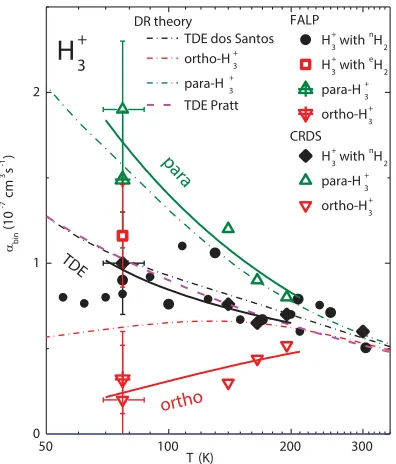
Figure 7. Temperature dependence of nuclear spin state-specific binary recombination rate coefficients measured by Cryo-FALP II and SA-CRDS apparatuses with para-hydrogen generator. Closed circles and closed rhomboids indicate values of neff measured with Cryo-FALP II [25] and SA-CRDS [5] using nH
2, respectively. These nbin correspond at 77–300 K tobin
−TDE. Open up triangles indicate measured values ofpbin and open down
triangles indicate valuesobin, both of them are taken from [5] and [7]. Open square indicate valueebinmeasured
by Cryo-FALP II with para-enriched H2. The crossed triangles indicate value measured by Cryo-FALP II at 77 K.
The full lines indicated as para, ortho and TDE are fits ofpbin,obinand corresponding calculated value ofbin
−TDE.
Dash-dotted lines represent theoretical calculations by Fonseca dos Santos [21] foroH+ 3,
pH+
3, and H+3 with states
populated according to TDE. Dashed line represents values ofbin−TDEbased on theory by Pratt and Jungen [33].
where A, B, C are free parameters. From the fit functions we calculated corresponding values bin−TDE(T) forpH+3 andoH+3 in thermal equilibrium (see Fig.7). These fits are plotted as full lines
in Fig.7. We included also the theoretical dependencies calculated by Fonseca dos Santos et al. [21] and by Pratt and Jungen [33] in Fig.7. Line indicated as theory of Pratt and Jungen in Fig. 7 was calculated from the dependence of the recombination rate on energy [33]. For rate coefficientsp
bin, and
bin−TDE is the agreement of the measured and calculated rate very good for temperatures 77–300 K.
The measuredobinis substantially lower in comparison with calculated values. For this conclusion the
present Cryo-FALP study with higher accuracy is substantial.
Further measurements extending temperature range are in progress. Presented values of state-selected recombination rate coefficients obtained in Cryo-FALP II experiment are in a very good agreement with previous SA-CRDS results. Nevertheless, as history of H+3 recombination has shown, agreement with independent storage ring experiment is desirable.
References
[1] T. Oka, Proc. Natl. Acad. Sci. USA 103, 12239 (2006)
[2] T. Oka, Dissociative Recombination of Molecular Ions with Electrons (Kluwer Academic/Plenum Publishers, New York, 2003)
[3] M. Larsson, A. Orel, Dissociative Recombination of Molecular Ions, (Cambridge University Press, Cambridge, 2008)
[4] R. Johnsen, S.L. Guberman, Adv. At. Mol. Opt. Phys. 59, 75 (2010)
[5] P. Dohnal, M. Hejduk, J. Varju, P. Rubovic, S. Roucka, T. Kotrik, R. Plasil, J. Glosik, R. Johnsen, J. Chem. Phys. 136, 244304 (2012)
[6] P. Dohnal, M. Hejduk, J. Varju, P. Rubovic, S. Roucka, T. Kotrik, R. Plasil, R. Johnsen, J. Glosik, Phil. T. Roy. Soc. A 370, 5101 (2012)
[7] J. Varju, M. Hejduk, P. Dohnal, M. Jilek, T. Kotrik, R. Plasil, D. Gerlich, J. Glosik, Phys. Rev. Lett. 106, 203201 (2011)
[8] H. Kreckel, M. Motsch, J. Mikosch, J. Glosik, R. Plasil, S. Altevogt, V. Andrianarijaona, H. Buhr, J. Hoffman, L. Lammich, M. Lestinsky, I. Nevo, S. Novotny, D.A. Orlov, H.B. Pedersen, F. Sprenger, A.S.Terekhov, J. Toker, R. Wester, D. Gerlich, D. Schwalm, A. Wolf, D. Zajfman, Phys. Rev. Lett. 95, 2633201 (2005)
[9] B.J. McCall, A.J. Honeycutt, R.J. Saykally, T.R. Geballe, N. Djuric, G.H. Dunn, J. Semaniak, O. Novotny, A. Al-Khalili, A. Ehlerding, F. Hellberg, S. Kalhori, A. Neau, R. Thomas, F. Osterdahl, M. Larsson, Nature 422, 500 (2003)
[10] B.A. Tom, V. Zhaunerchyk, M.B. Wiczer, A.A. Mills, K.N. Crabtree, M. Kaminska, W.D. Geppert, M. Hamberg, M. af Ugglas, E. Vigren, W.J. van der Zande, M. Larsson, R.D. Thomas, B.J. McCall, J. Chem. Phys 130, 031101 (2009)
[11] H. Kreckel, O. Novotny, K.N. Crabtree, H. Buhr, A. Petrignani, B.A. Tom, R.D. Thomas, M.H. Berg, D. Bing, M. Grieser, C. Krantz, M. Lestinsky, M.B. Mendes, C. Nordhorn, R. Repnow, J. Stutzel, A. Wolf, B.J. McCall, Phys. Rev. A 82, 042715 (2010)
[12] M. Hejduk, P. Dohnal, J. Varju, P. Rubovic, T. Kotrik, R. Plasil, J. Glosik, Plasma Sources Sci. Technol. 21, 024002 (2012)
[13] P. Macko, G. Bano, P. Hlavenka, R. Plasil, V. Poterya, A. Pysanenko, O. Votava, R. Johnsen, J. Glosik, Int. J. Mass Spectrom. 233, 299 (2004)
[14] P. Dohnal, P. Rubovic, T. Kotrik, M. Hejduk, R. Plasil, R. Johnsen, J. Glosik, Phys. Rev. A 87, 052716 (2013)
[15] T. Kotrik, P. Dohnal, S. Roucka, P. Jusko, R. Plasil, J. Glosik, R. Johnsen, Phys. Rev. A 83, 032720 (2011)
[16] T. Kotrik, P. Dohnal, P. Rubovic, R. Plasil, S. Roucka, S. Opanasiuk, J. Glosik, Eur. Phys. J. Appl. Phys. 56, 24011 (2011)
[17] R.J. Saykally, E.A. Michael, J. Wang, C.H. Greene, J. Chem. Phys. 133, 234302 (2010)
[18] J. Glosik, I. Korolov, R. Plasil, O. Novotny, T. Kotrik, P. Hlavenka, J. Varju, I.A. Mikhailov, V. Kokoouline, C.H. Greene, J. Phys. B-At. Mol. Opt. 41, 191001 (2008)
[19] J. Glosik, R. Plasil, I. Korolov, T. Kotrik, O. Novotny, P. Hlavenka, P. Dohnal, J. Varju, V. Kokoouline, C.H. Greene, Phys. Rev. A 79, 052707 (2009)
[20] R. Johnsen, P. Rubovic, P. Dohnal, M. Hejduk, R. Plasil, J. Glosk, J. Phys. Chem. A 117, 9477 (2013)
[21] S. Fonseca dos Santos, V. Kokoouline, C.H. Greene, J. Chem. Phys. 127, 124309 (2007) [22] C. Jungen, S.T. Pratt, Phys. Rev. Lett. 102, 023201 (2009)
[23] L. Pagani, C. Vastel, E. Hugo, V. Kokoouline, C.H. Greene, A. Bacmann, E. Bayet, C. Ceccarelli, R. Peng, S. Schlemmer, Astron. Astrophys. 494, 623 (2009)
EPJ Web of Conferences
[25] P. Rubovic, P. Dohnal, M. Hejduk. R. Plasil, J. Glosik, J. Phys. Chem. A 117, 9626 (2013) [26] J.D. Swift, M.J.R. Schwar, Electrical Probes for Plasma Diagnostics (Iliffe, London, 1970) [27] R. Plasil, J. Glosik, V. Poterya, P. Kudrna, J. Rusz, M. Tichy, A. Pysanenko, Int. J. Mass Spectrom.
218, 105 (2002)
[28] I. Korolov, T. Kotrik, R. Plasil, J. Varju, M. Hejduk, J. Glosik, Contrib. Plasma Phys. 48, 521 (2008)
[29] J. Glosik, R. Plasil, T. Kotrik, P. Dohnal, J. Varju, M. Hejduk, I. Korolov, S. Roucka, V. Kokoouline, Molec. Phys. 108, 2253 (2010)
[30] E. Ilisca, Prog. Surf. Sci. 41, 217 (1992)
[31] I. Zymak, M. Hejduk, D. Mulin, R. Plasil, J. Glosik, D. Gerlich, Astrophys. J. 768, 86 (2013) [32] E. Hugo, O. Asvany, S. Schlemmer, J. Chem. Phys. 130, 164302 (2009)

![Figure 5. The dependence of(a)) and with �eff on [H2] measured at several He pressures at 77 K in experiments with eH2 (panel nH2 (panel (b)) Dotted lines represent linear fits of the data.](https://thumb-us.123doks.com/thumbv2/123dok_us/8185374.1366983/6.482.142.338.56.311/figure-dependence-measured-pressures-experiments-dotted-represent-linear.webp)
![Figure 6. The dependence ofwithwith[H �eff on [He] measured at several H2 densities at 77 K in experiments with nH2 and eH2 (see Fig](https://thumb-us.123doks.com/thumbv2/123dok_us/8185374.1366983/7.482.142.338.59.221/figure-dependence-ofwithwith-eff-measured-densities-experiments-fig.webp)