RFID Based Intelligent Book
Finder Using Ultra High Frequency Sensor
Nithya.M1,Solaiyammal.K2
P.G Student, Dept. of Communication Systems (ECE), Idhaya Engineering College for Women, Chinnasalem, Taminadu, India.1
Assistant Professor, Dept. of Electronics and Communication Engineering, Idhaya Engineering College for Women, Chinnasalem, Taminadu, India2
ABSTRACT: Locating items rapidly and accurately has become a crucial part of our modern library. Accurate
locating not only saves time and money but also reduces waste, as products do not get lost along supply chains. One promising indoor tracking method is provided by radio-frequency identification (RFID) technology. The main benefit of RFID technology is the ability to inventory items simultaneously and rapidly without the requirement of line of sight to thetarget. Because RFID tags are attached to various objects and are used indifferent environments, RFID engineers are required to design RFID tags thatoperate reliably within varying environments and medium materials. In this approach, the booksare equipped withan ultrahigh frequency (UHF) RFID tag and can be located using a hand-heldRFID reader device. In addition to locating the books, the system keeps the bookinventory up to date.
KEYWORDS: RFID, Library Management System, Proteus Design Suite.
I. INTRODUCTION
RFID stands for Radio-Frequency Identification. The acronym refers to small electronic devices that consist of a small hip and an antenna. The chiptypically is capable of carrying 2,000 bytes of data or less. RFID is a general term that is used to describe a system that transmits the identity (in the form of a unique serial number) of an object wirelessly, using radio waves. This is sometimesreferred to as contact-less technology and a typical RFID system is made up of three components: tags, readers and the host computer system. An RFID tag is a tiny radio device that is also referred to as a transponder, smart tag, smart label or radio barcode. The tag comprises of a simple silicon microchip attached to a small flat aerial and mounted on a substrate. The whole device can then be encapsulated in different materials (such as plastic) dependent upon its intended usage. Thefinished tag can be attached to an object, typically an item, box or pallet and read remotely to ascertain its identity, position or state.
II. RELATED WORK
containing the desired book which was misplaced. The book list mode offers a corresponding list of the bookshelves and the misplaced books regularly for a librarian to localize all misplaced books in the wrong bookshelves. The simulation results show that the locating accuracies of the single book mode and the book list mode. The paper [5] presents a 3D RFID-based library search System. Measuring and determining RFID-tagged book location is an applicationdevelopment for the library search system namely 3D RFID-based library searchsystem. This paper presents the development of this application which includes theapplication execution flow and as well as the laboratory scale system structure.
A. EXISTING SYSTEM
RFID based systems are going to revolutionize the entire library automation systems. In this project we are going to develop library automation system, which will track the books, whether they are issued or they are in library, so that library user will get the instant information. RFID can be used library circulation operations and theft detection systems. RFID-based systems move beyond security to become tracking systems thatcombine security with more efficient tracking of materials throughout the library, including easier and faster charge and discharge, inventorying, and materials handling. This technology helps librarians reduce valuable staff time spent scanning barcodes while charging and discharging items. RFID is a combination of radio - frequency-based technology and microchip technology. The information contained on microchips in the tags affixed to library materials is read using radio frequency technology, regardless of item orientation or alignment (i.e., the technology does not require line-of-sight or a fixed plane to read tags as do traditional theft detection systems). This system only detects the missing books. It does not give any student information. It only provides the easy maintenance of the books in library. It will not give the due date information.
III. PROPOSED SYSTEM
RFID is an automatic identification technique used for the fast transaction of books, journals or DVDs using RFID tags and readers. The RFID technology helps in fast issuing, returning, and reissuing of books. The technology helps in direct transaction of information from the tags to the PC of the librarian and in automatic updation of transactions in the users account. The RFID tags can be programmed unique code. This code gets read when passing through the RFID reader. When a tag crosses the reader the reader recognizes the unique code and updates the account of the user. The RFID tags are embedded into the books and are not visible for detection. The readers since they have a wide read range unlike bar code readers have the capability to read the tags even when they are embedded within the books. Special care and attention should be given in programming the tags since they are mostly programmable only once. These tags can store stack number, accessionnumber, book number, author information etc., but the bar code technology is limited to only the identification number. The programming cost of RFID tags are much costlier than the barcodes but it should be noted that the same tag can be reprogrammed if necessary. Depending on the applications added the cost of tag increases.
A. SOFTWARE DESCRIPTION
To implement Library Management System (LMS) designs, a platform has been selected which includes the Software : Embedded C, PIC C Compiler, Proteus design suite.
B. PROTEUS DESIGN SUITE
toautomatically update the data of the different modules which are part of the mainproject. In addition, the 3D viewer has been improved and lets you see changesand modifications in real time.
C. PROCEDURE
1. Open the Proteus 8 Professional software
2. Click the new project in the Proteus 8 Professional window. 3. Enter the file name and select the folder.
4. Select – Create a Schematic from the selected template then the schematiccapture will be opened. 5. To select device click component mode, pick the needed devices andclick ok.
6. Click the device name one by one then place the device in the schematiccapture window and connect the devices.
7. Run the simulation.
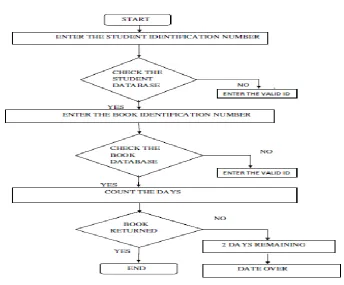
D. FLOWCHART
Figure 1: Flow chart
IV.RESULT & DISCUSSION
Figure 2: Library Management System (LMS)
STEP 1-STUDENT IDENTIFICATION
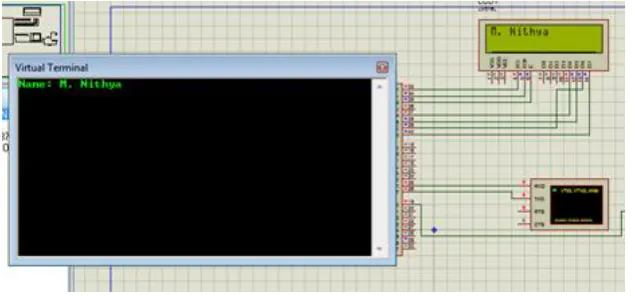
If enter the student identification number, the student details will be displayed one by one as follows. (i).Student name
Figure 3:Student name
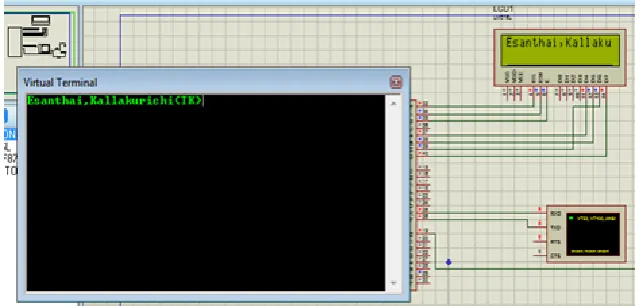
Figure 4:Student Register Number (iii) Student Mobile Number
Figure 5:Student Mobile Number (iv) Student Address
STEP 2- BOOK IDENTIFICATION
If enter the book identification number, the book details will be displayed one by one as follows. (i) Book Name
Figure 7: Book Name (ii) Book Author Name
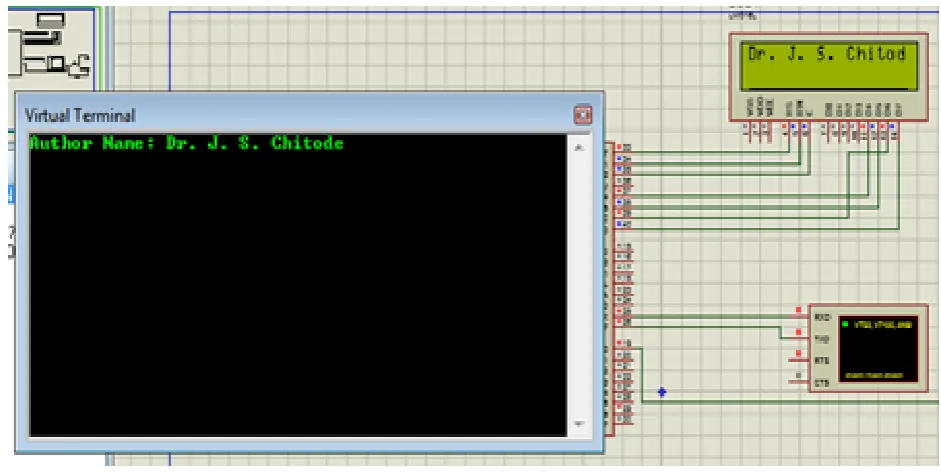
(iii) Book Publisher Name
Figure 9: Book Publisher Name The Book Name will be stored in the Student database.
After few days the student will return the book.
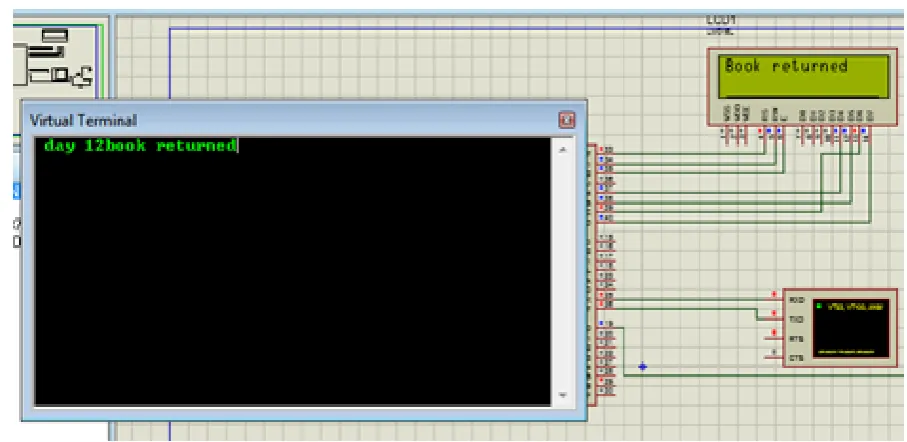
STEP 3 – RETURN PROCESS
If the student returnsthe book, the following window will be displayed. Book returned
STEP 4 – ALERT PROCESS
If the Student does not return the book within due date, the 2 days remaining message will be displayed. 2 days remaining message
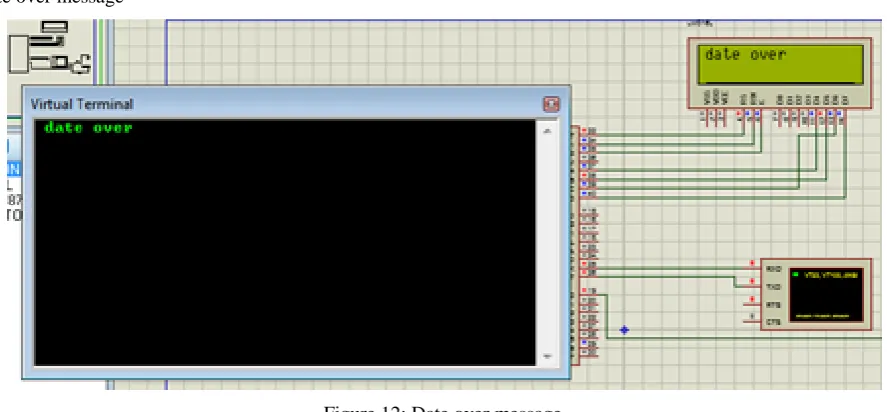
Figure 11: 2 days remaining message After 2 days the date over message will be displayed.
Date over message
Figure 12: Date over message
V. CONCLUTION AND FUTURE WORK
A. CONCLUSION
RFID in the library speeds up book borrowing, monitoring, books searchingprocesses and thus frees staff to do more user-service tasks. These applications canlead to significant savings in labour costs, enhance customer service, lower booktheft and provide a constant record update of new collections of books. The systemthat would allow fast Transaction flow and will make it easy to handle the issueand return of books from the library without much intervention of manual book
B. FUTURE WORK
In future the system will be implemented in hardware. This system wouldbe able to issue and return books via RFID tags. GSM technology is used in thesystem in order to alert the user with the books taken, due date for return. As theuser leaves the library after picking a book a SMS alert is given to the userregarding the book issued. Similarly a SMS is sent after the person returns thebook. GPS is used to find the location of the book.
REFERENCES
[1]. Wu Jieming, Ding Yu, 2009, "A Study on RFID Book Information Management System with an EDA/SOA", vol. 02, no.,pp. 451-455, 2009,doi:10.1109/ISECS.2009.157.
[2]. Wing W. Y. NG, Yi-Song Qiao, Li Lin, Hai-Lan Ding, Patrick P. K. Chan, Daniel S. Yeung, 2011, “Intelligent book positioning for library using RFID and book spine matching” 978-1-4577-0308-9/11/$26.00 ©2011 IEEE.
[3]. Zhu Chang-ping, Wang Zh , Deng Jing-xuan, Gu Hui ,Shan Ming-lei HanQing-bang,Yu Hong-zhen, Zhang Shen, 2010, “Design of an IntelligentBook Conveyor Based on RFID”, 978-1-4244- 7618-3 /10/$26.00 ©2010 IEEE.
[4]. Kuen-Liang Sue, Yi-Min Lo,2007, “BLOCS: A Smart Book-Locating System Based on RFID in Libraries”,1-4244-0885-7/07/$20.00 2007 IEEE.
[5]. Terence Jerome Daim, RazakMohd Ali Lee, 2010 “3D RFID-Based Library Search System Application Development” , 978-1-4244-8648-9/10/$26.00 ©2010 IEEE.
[6]. Suganthy. R, 2016, “ RFID Library Management System” , Vol.4 (Iss.5: SE): May, 2016.
[7]. S.Vimalraj, S. Sameera, S. Saranya, 2015 , “ RFID based Library Management System” , ISSN: 2349-2163 Issue 1, Volume 2 (January 2015). [8]. Sree Lakshmi Addepalli, SreeGowriAddepalli, 2014“ Library Management System Using RFID Technology”, Vol. 5 (6) , 2014, 6932-6935. [9]. S.Parameshwara, B. Anusha, M. R. Chandrika, J. Pavithra, RakshaMuralidharkodangal, 2016, “ RFID for Library Management”,Volume-2, Issue-1, January 2016, ISSN: 2395-3470.
[10]. Narayanan A., Sanjay Singh and Somasekharan. M, 2010, “ ImplementingRFID in Library: Methodologies, Advantages and Disadvantages”. [11]. Dr.Prabhat Pandey, Ms. K.D. Mahajan, 2010,“Application of RFIDTechnology in Libraries and Role of Librarian”.
[12]. Dhanalakshmi M, UppalaMamatha, 2009, “RFID Based Library ManagementSystem”.
[13]. PritiPawar, KavitaShegaonkar, ArchanaUdane, 2016, “Radio FrequencyIdentification Based LibraryManagement System”,March 2016,ISSN NO -2394-3696.
[14]. A. Ankit Kumar Jain, T. Rama Krishna, 2014 “Dynamic Book Search UsingRFID Technology”, Volume 2, Issue 6, October-November, 2014, ISSN 2091-2730.
[15]. Priyanka Grover and Anshul Ahuja, 2010“Radio Frequency IdentificationBasedLibrary Management System”,Vol. 1, _o. 1, July 2010. [16]. Embedded system tutorial,www.tutorialpoints.com.
[17]. Basics of RFID Technology,www.discountpdh.com.