Western University Western University
Scholarship@Western
Scholarship@Western
Electronic Thesis and Dissertation Repository
8-28-2014 12:00 AM
The antisaccade task: Visual distractors elicit a
The antisaccade task: Visual distractors elicit a
location-independent planning 'cost'
independent planning 'cost'
Jesse C. DeSimoneThe University of Western Ontario
Supervisor
Dr. Matthew Heath
The University of Western Ontario Graduate Program in Kinesiology
A thesis submitted in partial fulfillment of the requirements for the degree in Master of Science © Jesse C. DeSimone 2014
Follow this and additional works at: https://ir.lib.uwo.ca/etd
Part of the Cognitive Psychology Commons, Musculoskeletal, Neural, and Ocular Physiology Commons, Nervous System Commons, and the Neurosciences Commons
Recommended Citation Recommended Citation
DeSimone, Jesse C., "The antisaccade task: Visual distractors elicit a location-independent planning 'cost'" (2014). Electronic Thesis and Dissertation Repository. 2393.
https://ir.lib.uwo.ca/etd/2393
This Dissertation/Thesis is brought to you for free and open access by Scholarship@Western. It has been accepted for inclusion in Electronic Thesis and Dissertation Repository by an authorized administrator of
THE ANTISACCADE TASK: VISUAL DISTRACTORS ELICIT A LOCATION-INDEPENDENT PLANNING ‘COST’
(Thesis format: Monograph)
by
Jesse C. DeSimone
Graduate Program in Kinesiology
A thesis submitted in partial fulfillment of the requirements for the degree of
Master of Science
The School of Graduate and Postdoctoral Studies The University of Western Ontario
London, Ontario, Canada
© Jesse C. DeSimone 2014
ii
ABSTRACT
Prosaccades are rapid eye movements with direct stimulus and response relations and are
designed to bring the fovea onto a target or area of interest. In contrast, antisaccades require
the inhibition of a prosaccade and the evocation of a saccade to a target’s mirror-symmetrical
location. Previous work has shown that a remote (i.e., midline, contralateral) – but not
proximal (i.e., ipsilateral) – task-irrelevant distractor relative to a visual target delays
prosaccade reaction times (RT) (i.e., remote distractor effect: RDE). To my knowledge,
however, no work has examined whether antisaccade RTs are similarly influenced by a RDE.
Accordingly, I sought to determine whether planning costs for antisaccades are similarly
dependent on the location-specific presentation of a distractor. In Chapter Two, I demonstrate
increased antisaccade RTs independent of the spatial location of a distractor. Based on this
result, I concluded that distractor-related antisaccade costs reflect the top-down evocation of
explicit response-selection rules.
Keywords:
Antisaccade
Distractor
Oculomotor
Prosaccade
Reaction time
Remote distractor effect
Response-selection
iii
CO-AUTHORSHIP
The author (J. DeSimone), under the supervision and mentorship of Dr. Matthew
Heath, conducted the work in this master’s thesis. This encompasses experimental
conception, design, and implementation; data collection, analysis and interpretation; and
manuscript preparation. The author received support from one volunteer undergraduate
research assistant in the data collection phase of this experiment.
This master’s thesis contains material from a manuscript presently under peer-review
in which Jesse C. DeSimone is the first author and Drs. Matthew Heath and Stefan Everling
serve as co-authors.
iv
TABLE OF CONTENTS
Abstract ... ii
Co-Authorship Statement ... iii
Table of Contents ... iv
List of Figures ... v
List of Appendices ... vi
List of Abbreviations ... vii
CHAPTER ONE ... 1
General Introduction ... 1
Oculomotor Control of Pro- and Antisaccades ... 2
Distractor-related Influences in Oculomotor Control ... 4
Thesis Objectives ... 6
References ... 8
CHAPTER TWO ... 12
Introduction ... 13
Methods ... 18
Results ... 23
Discussion ... 26
Conclusions ... 33
References ... 34
CHAPTER THREE ... 40
General Disucssion ... 40
General Conclusions ... 45
References ... 47
Appendix ... 49
v
LIST OF FIGURES
Figure 1. Illustration of sensory- and motor-related distractor spatial properties ... 17
Figure 2. Illustration of stimulus array and experimental timeline ... 21
Figure 3. Reaction time as a function of task and trial-type (main experiment) ... 24
Figure 4. Saccade amplitude as a function of task and trial-type (main experiment) ... 26
Figure 5. Saccade amplitude as a function of trial type (supplemental experiment) ... 29
vi
LIST OF APPENDICES
vii
LIST OF ABBREVIATIONS
ANOVA analysis of variance
CDD contralateral distal distractor
CIM competitive integration model
CPD contralateral proximal distractor
ID ipsilateral distractor
MD midline distractor
RDE remote distractor effect
RT reaction time (ms)
SC superior colliculus
SR stimulus and response
1
CHAPTER ONE
2
Oculomotor Control of Pro- and Antisaccades
Eye movements (i.e., saccades) are supported via six extraocular muscles that
specify the rotation of the eye within horizontal, vertical, and torsional axes. In particular,
the medial and lateral rectus muscles enable horizontal gaze shifts toward (i.e.,
adduction) and away (i.e., abduction) from the nose, respectively; the superior and
inferior rectus muscles enable vertical eye movements in an upward (i.e., elevation) and
downward (i.e., depression) direction, respectively; and the superior and interior oblique
muscles enable torsional rotations toward (i.e., intorsion) and away (i.e., extorsion) from
the nose, respectively. Moreover, the extraocular musculature is innervated by three
groups of cranial nerves that originate in the brain stem. Cranial nerve III (i.e., the
oculomotor nerve) innervates the superior rectus, medial rectus, inferior rectus, and
inferior oblique muscles, whereas cranial nerves IV (i.e., the trochlear nerve) and VI (i.e.,
the abducens nerve) innervate the superior oblique and lateral rectus muscles,
respectively (Kandel et al., 2000).
The activation of the ocular musculature is mediated by cortical and subcortical
saccade structures that provide information related to the desired position and speed of
the upcoming response. In particular, the cortical structures associated with saccades
encompass – but are not limited to – the supplementary eye fields, frontal eye fields,
dorsolateral pre-frontal cortex, lateral intraparietal area, and the anterior cingulate cortex.
These cortical areas project directly or indirectly (via basal ganglia) to subcortical
saccade mechanisms in the superior colliculus (SC) and eventually to the pre-motor
circuit in the reticular formation. An important area of interest in the visual neurosciences
3
task-rules. In particular, a functional dissociation in task-rules is highlighted throughout
this master’s thesis via contrasting the movement planning and execution properties of
pro- and antisaccades. In particular, prosaccades entail a rapid eye movement that brings
a peripheral target or area of interest onto the region of the retina that has the highest
visual acuity (i.e., the fovea). Notably, the direct spatial overlap between stimulus and
response (SR) (so-called standard task) associated with prosaccades enables dedicated
retinotopic motor maps in the SC to specify a maximally efficient (i.e., rapid) and
effective (i.e., accurate) response (Wurtz and Albano, 1980) that is largely independent of
top-down cognitive control (Milea et al., 2005; Pierrot-Deseilligny et al., 1995). Notably,
however, a salient visual stimulus need not reflexively capture one’s gaze; rather the
oculomotor system can decouple the normally direct SR relations and saccade to a
volitional area of interest (so-called standard task). The most frequently studied
non-standard task involves the execution of a saccade mirror-symmetrical (i.e., 180° spatial
transformation) to the location of a single and exogenously presented target (i.e., the
antisaccade task). Extensive evidence has shown that antisaccades produce longer
reaction times (RT) (Hallett, 1978; Hallett and Adams, 1980), increased directional errors
(Fischer and Weber, 1992) and less accurate and more variable endpoints (Dafoe et al.,
2007; Heath et al., 2011) than prosaccades. As well, the aforementioned behavioral
‘costs’ have been related to a top-down and two-component process requiring the
inhibition of a stimulus-driven prosaccade (i.e., response suppression) and the visual
remapping of the target’s spatial properties to mirror-symmetrical space (i.e., vector
inversion) (Munoz and Everling, 2004). Moreover, extensive human and non-human
4
of the antisaccade task to increased activity within the frontal and supplementary eye
fields, dorsolateral pre-frontal cortex, lateral intraparietal area, and anterior cingulate
cortex (i.e., the classical saccade networks: Brown et al., 2007; Curtis and D’Esposito,
2003; DeSouza et al., 2003; Ford et al., 2005). As well, antisaccades are related to an
increase and decrease in the activity of fixation and buildup neurons in the SC,
respectively (Everling et al., 1999). In summary, the modulation of oculomotor networks
associated with the preparation of an antisaccade supports a neural pre-setting that
provides sufficient time to implement the constituent elements of the task (i.e., response
suppression and vector inversion).
Distractor-related Influences in Oculomotor Control
The daily environments in which humans interact rarely comprise a single
stimulus. Accordingly, the successful execution of common goal-directed movements
such as a prosaccade, walking, or reaching to grasp an object requires that we allocate
cognitive resources toward a particular sub-set of task-relevant visual information while
simultaneously placing less attentive emphasis on information that bears little or no
importance to the response (Pashler, 1998). For example, consider riding a bike along a
paved path through a park with hundreds of people. In order to reduce the risk of a
collision the rider will generally restrict gaze shifts to the people or objects that are
contained along the bike path in front of him/her and place less attentive emphasis on the
patrons who occupy the distant grass-covered regions of the park. Thus, extracting
task-relevant information from the visual properties contained along the bike path permit the
rider to steer his/her bike in a manner that appropriately adapts to the ever-changing
5
A central theme in the visual neurosciences is how the spatial properties of
task-irrelevant visual information (i.e., a distractor) influence the oculomotor system’s
efficiency and effectiveness. In particular, one methodology used to address the influence
of task-irrelevant visual information on the planning and control of saccades is the remote
distractor paradigm (e.g., Lévy-Schoen, 1969; Walker et al., 1997). For example, Walker
et al. (1997) reported that the onset of a remote distractor (i.e., a distractor contralateral to
a target or at the visual midline) concurrent with target presentation produced longer RTs
than when a target was presented alone or when presented with a proximal distractor (i.e.,
ipsilateral to a target) (i.e., the remote distractor effect: RDE). The RDE has been
attributed to the motor-related properties of neurons in the intermediate layers of the SC.
In particular, the competitive integration model (CIM: Godijn and Theeuwes, 2002)
contends that the visual information supporting a target and distractor are concurrently
transformed into motor programs on a common retinotopic motor map in the SC.
Consequently, if a distractor is presented distal (i.e., remote) to the location of the
intended saccade goal, the motor-related activity of the distractor delays the activation of
motor-related buildup neurons encoding the target via a long-range inhibitory pathway
(see Takahashi et al., 2005) – thereby resulting in longer RTs (i.e., the RDE). Moreover,
previous work has shown that homologous neural ensembles in the frontal eye fields are
influenced by the presentation of a distractor and support target selection in a visual
search task (Lee and Keller, 2008; McPeek and Keller, 2002). Although a number of
studies have examined the basis of the RDE for prosaccades (Benson, 2008; Casteau and
Vitu, 2012; Findlay and Walker, 1999; Honda, 2005; Lévy-Schoen, 1969; McSorley et
6
previous work has examined whether the motor-related properties of a target and
distractor similarly influence antisaccade RTs.
As an alternative to the RDE, my thesis proposes that distractor-related planning
costs for antisaccades may relate to a top-down evocation of response-selection rules
independent of the distractor’s spatial location. Such a proposal is drawn from previous
literature showing that increasing the number of SR alternatives (i.e., distractors)
associated with antisaccades – but not prosaccades – results in a log-linear increase in RT
as defined by Hick’s law (Hick, 1952; Kloft et al., 2012; Kveraga et al., 2002). In
particular, distractor-related antisaccade RT costs are considered an index of
response-selection uncertainty that relates to the top-down adoption of the task-rules necessary to
decouple SR relations. In turn, prosaccades do not conform to the law because of the
highly efficient retinotopic mapping of the SC that directly couples SR spatial relations
(i.e., SR compatibility: see Fitts and Seeger, 1953). In other words, localization of the
target stimulus in the prosaccade task serves as the imperative for an automatic
response-selection process (see also Wright et al., 2007).
Thesis Objectives
The principal objective of my master’s research program was to determine
whether – and to what degree – the spatial location of a distractor relative to a visual
target influences antisaccade RTs. Indeed, such a question represents an important issue
in the oculomotor control literature because the decoupling of SR relations provides a
basis for determining whether sensory (i.e., target)- and/or motor (i.e., goal)-related
features of a distractor influence response planning. To accomplish my objective, in
7
and had participants complete pro- and antisaccades in a condition that entailed a single
and briefly (i.e., 50 ms) presented target. In addition, pro- and antisaccades were
completed in conditions wherein a target was concurrently presented with a distractor at a
remote (i.e., midline, contralateral) or proximal (i.e., ipsilateral) spatial location.
Specifically, the target was 8° left and right of fixation, whereas distractors were located:
(1) ipsilateral to the target at an eccentricity of 4° from the fixation cross, (2) at the
location of the fixation cross (i.e., visual midline, 0°), and (3) contralateral to the target at
eccentricities of 4° and 8° from the fixation cross. If a RDE characterizes the planning of
antisaccades, then a proximal – but not remote – distractor is predicted to selectively
delay antisaccade RTs. The basis for this prediction stems from the fact that although a
proximal distractor in an antisaccade task is in the same visual field as the target stimulus,
the goal-location of the response is mirror-symmetrical to the target’s veridical (i.e.,
sensory) location (i.e., remote to the saccade generating neurons supporting the
goal-location). Thus, in accord with the CIM – a proximal distractor is predicted to induce a
long-range attenuation of motor-related buildup neurons in the SC that serve the
antisaccade response. Alternatively, if increasing the number of SR alternatives (i.e.,
target only versus target and distractor) results in increased response uncertainty, then the
decoupling of SR relations necessary for the antisaccade task should result in a
8
References
Benson, V. (2008). A comparison of bilateral versus unilateral target and distractor
presentation in the remote distractor paradigm. Experimental Psychology, 55(5),
334 – 341.
Brown, M. R. G., Vilis, T., and Everling, S. (2007). Frontoparietal activation with
preparation for antisaccades. Journal of Neurophysiology, 98, 1751 – 1762.
Casteau, S. and Vitu, F. (2012). On the effect of remote and proximal distractors on
saccadic behavior: A challenge to the neural-field models. Journal of Vision,
12(12):14, 1 – 33.
Curtis, C. E. and D’Esposito, M. (2003). Success and failure suppressing reflexive
behavior. Journal of Cognitive Neuroscience, 15, 409 – 418.
Dafoe, J. M., Armstrong, I. T., and Munoz, D. P. (2007). The influence of stimulus
direction and eccentricity on pro- and anti-saccades in humans. Experimental
Brain Research, 179, 563 – 570.
DeSouza, J. F. X., Menon, R. S., and Everling, S. (2003). Preparatory set associated with
pro-saccades and anti-saccades in humans investigated with event-related fMRI,
Journal of Neurophysiology, 89, 1016 – 1023.
Everling, S., Dorris, M. C., Klein, R. M., and Munoz, D. P. (1999). Role of primate
superior colliculus in preparation and execution of anti-saccades and
pro-saccades, TheJournal of Neuroscience, 19, 2740 – 2754.
Findlay, J. M. and Walker, R. (1999). A model of saccade generation based on parallel
processing and competitive integration. Behavioral and Brain Sciences, 22, 661 –
9
Fischer, B. and Weber, H. (1992). Characteristics of “anti” saccades in man.
Experimental Brain Research, 89, 415 – 424.
Fitts, P. M. and Seeger, C. M. (1953). S-R compatibility: Spatial characteristics of
stimulus and response codes. Journal of Experimental Psychology, 46(3), 199 –
210.
Ford, K. A., Goltz, H. C., Brown, M. R. G., and Everling, S. (2005). Neural processes
associated with antisaccade task performance investigated with event-related
fMRI. Journal of Neurophysiology, 94, 429 – 440.
Godijn, R. and Theeuwes, J. (2002). Programming of endogenous and exogenous
saccades: Evidence for a competitive integration model. Journal of Experimental
Psychology: Human Perception and Performance, 28(5), 1039 – 1054.
Hallett, P. E. (1978). Primary and secondary saccades to goals defined by instructions.
Vision Research, 18, 1279 – 1296.
Hallett, P. E. and Adams, B. D. (1980). The predictability of saccadic latency in a novel
voluntary oculomotor task. Vision Research, 20, 329 – 339.
Heath, M., Weiler, J., Marriott, K., and Welsh, T. (2011). Vector inversion diminishes the
online control of antisaccades. Experimental Brain Research, 209, 117 – 127.
Hick, W. E. (1952). On the rate of gain of information. Quarterly Journal of
Experimental Psychology, 4:1, 11 – 26.
Honda, H. (2005). The remote distractor effect of saccade latencies in fixation-offset and
overlap conditions. Vision Research, 45, 2773 – 2779.
Kandel, E. R., Schwartz, J. H., Jessell, T. M., Siegelbaum, S. A., and Hudspeth, A. J.
10
Kloft, L., Reuter, B., Viswanathan, J., Kathmann, N., and Barton, J. J. S. (2012).
Response selection in prosaccades, antisaccades, and other volitional saccades.
Experimental Brain Research, 222, 245 – 353.
Kveraga, K., Boucher, L., and Hughes, H. C. (2002). Saccades operate in violation of
Hick’s Law. Experimental Brain Research, 146, 307 – 314.
Lee, K. and Keller, E. L. (2008). Neural activity in the frontal eye fields modulated by the
number of alternatives in target choice. The Journal of Neuroscience, 28(9), 2242
– 2251.
Lévy-Schoen, A. (1969). Détermination et latence de la réponse oculomotrice à deux
stimulus simultanés ou successifs selon leur excentricité relative. L’Année
Psychologique, 69(2), 373 – 392.
McPeek, R. M. and Keller, E. L. (2002). Saccade target selection in the superior
colliculus during a visual search task. Journal of Neurophysiology, 88, 2019 –
2034.
McSorley, E., McCloy, R., and Lyne, C. (2012). The spatial impact of visual distractors
on saccade latency. Vision Research, 60, 61 – 72.
Milea, D., Lobel, E., Lehéricy, S., Pierrot-Deseilligny, C., and Berthoz, A. (2005).
Cortical mechanisms of saccade generation from execution to decision. Annals of
the New York Academy of Sciences, 1039, 232 – 238.
Munoz, D. P., and Everling, S. (2004). Look away: The anti-saccade task and the
voluntary control of eye movement. Nature Reviews Neuroscience, 5, 218 – 228.
11
Pierrot-Deselligny, C., Rivaud, S., Gaymard, B., Müri, R., and Vermersch, A. (1995).
Cortical control of saccades. Annals of Neurology, 37, 557-567.
Takahashi, M., Sugiuchi, Y., Izawa, Y., and Shinoda, Y. (2005). Commissural excitation
and inhibition by the superior colliculus in tectoreticular neurons projecting to
omnipause neuron and inhibitory burst neuron regions. Journal of
Neurophysiology, 94(3), 1707 – 1726.
Trappenberg, T. P., Dorris, M. C., Munoz, D. P., and Klein, R. M. (2001). A model of
saccade initiation based on the competitive integration of exogenous and
endogenous signals in the superior colliculus. Journal of Cognitive Neuroscience,
13(2), 256 – 271.
Walker, R., Deubel, H., Schneider, W. X., and Findlay, J. M. (1997). Effect of remote
distractors on saccade programming: Evidence for an extended fixation zone.
Journal of Neurophysiology, 78, 1108 – 1119.
Walker, R., Kentridge, R. W., and Findlay, J. M. (1995). Independent contributions of the
orienting of attention, fixation offset and bilateral stimulation on human saccade
latencies. Experimental Brain Research, 103, 294 – 310.
Weber, H. and Fischer, B. (1994). Differential effects of non-target stimuli on occurrence
of express saccades in man. Vision Research, 34(14), 1883 – 1891.
Wright, C. E., Marino, V. F., Belovsky, S. A., and Chubb, C. (2007). Visually guided,
aimed movements can be unaffected by stimulus-response uncertainty.
Experimental Brain Research, 179, 475 – 496.
Wurtz, R. H. and Albano, J. E. (1980). Visual-motor function of primate superior
12
CHAPTER TWO
13
Introduction
Prosaccades are rapid eye movements that bring a target of interest into central
vision. The majority of work involving prosaccades has employed an experimental
paradigm wherein a target is presented in an impoverished (i.e., empty) visual
environment. Results from this work have shown that prosaccades are characterized by
short latencies and accurate endpoints – a finding attributed to their mediation via
dedicated retinotopic motor maps in the superior colliculus (SC) (Wurtz and Albano,
1980). It is, however, important to recognize that the visual environments in which
humans interact are rarely comprised of a single stimulus; rather, successful prosaccades
require disentangling the location of a target from task-irrelevant visual cues. As an
experimental corollary, the visual distractor paradigm requires that participants ignore the
presentation of a task-irrelevant visual distractor and complete a saccade to a visual
target. A number of studies have shown that the location of a distractor relative to a
target differentially influences prosaccade reaction times (RT) and amplitudes. For
example, Walker et al. (1997) reported that the onset of a remotedistractor (i.e., a
distractor contralateral to a target or at the visual midline) concurrent with target
presentation produced longer RTs than when a target was presented alone or when
presented with a proximal distractor (i.e., ipsilateral to the target) (i.e., the remote
distractor effect: RDE) (see also Casteau and Vitu, 2012; Lévy-Schoen, 1969). In turn,
distractor location elicits a converse effect on prosaccade amplitudes such that proximal
distractors bias amplitudes toward the distractor (i.e., the global effect), whereas a remote
distractor does not influence amplitudes (Coren and Hoenig, 1972; Deubel et al., 1984;
14
A number of studies have attributed the RDE and global effect to the
motor-related properties of neurons in the SC. In particular, the competitive integration model
(CIM) (i.e., Trappenberg et al., 2001; Godijn and Theeuwes, 2002) contends that the
visual information supporting target and distractor are concurrently transformed into
motor programs within a common retinotopic motor map in the intermediate layers of the
SC. Given the common retinotopic mapping, target- and distractor-specific saccade
neurons compete for a common threshold and create conflicting saccade generation
commands that require additional time to resolve (see also Dorris et al. 2007). More
directly, the CIM asserts that the RDE results from a long-range intercollicular inhibitory
pathway in which saccade-related activity at one location inhibits the activation of distant
locations within the motor map (Takahashi et al., 2005). Thus, active saccade neurons
associated with a remote distractor delay the motor-related buildup properties serving a
saccade to the target location (Trappenberg et al., 2001). In turn, when a distractor is
presented proximal to a target the motor activity related to each stimulus merges into a
single movement vector that represents a spatially averaged response (see also Van
Gisbergen et al., 1987; Van Opstal and Van Gisbergen, 1989). Notably, although the
spatially averaged response of a proximal distractor does not engender a cost to saccade
latency it does result in a response that falls between the target and distractor (i.e., the
global effect).
To my knowledge, previous work has not examined location-specific distractor
effects for antisaccade planning times. In particular, antisaccades represent a
non-standard motor task requiring that participants saccade mirror-symmetrical (i.e., 180°
15
evidence has shown that antisaccades produce longer RTs (Hallett, 1978; Hallett and
Adams, 1980), increased directional errors (Fischer and Weber, 1992) and less accurate
and more variable endpoints (Dafoe et al., 2007; Heath et al., 2011; Krappmann et al.,
1998) than prosaccades. Moreover, human and non-human primate neuroimaging and
electrophysiology findings have attributed the antisaccade planning ‘cost’ to a
two-component process requiring the top-down inhibition of a stimulus-driven prosaccade
(i.e., response suppression) and the visual remapping of target parameters to a
mirror-symmetrical location in space (i.e., vector inversion) (for review see Munoz and Everling,
2004).
The present investigation sought to determine whether distractor location
influences antisaccade planning times in a manner similar to prosaccades. Notably, the
decoupled stimulus and response (SR) relations associated with the antisaccade task
provide a basis for determining whether the sensory (i.e., target)- and/or motor (i.e.,
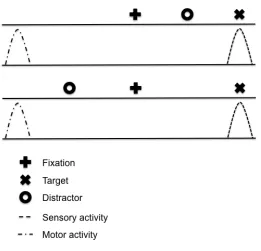
goal)-related features of a distractor influence response planning. In order to highlight
this issue, Figure 1 shows that in an antisaccade task the sensory properties (i.e., veridical
location) of a ‘proximal’ distractor are contained within the same visual field as the target
stimulus; however, the goal-location of the response is in the mirror-symmetrical visual
field (i.e., remote to the target’s veridical location). In other words, the sensory-related
property of the distractor is proximal to the target, whereas the motor-related property of
the distractor is remote to the target. In turn, Figure 1 shows the converse relationship
associated with a ‘remote’ distractor. As such, a corollary prediction drawn from the
CIM regarding antisaccades is that the saccade-related buildup properties serving a
location-16
specific increase in RT for a proximal distractor would support the contention that
distractor costs – in the antisaccade task – arise from a motor-related competition
between conflicting and directionally alternative saccade generation commands. More
directly, a proximal distractor would result in distractor- and saccade-related motor
activity that is encoded within remote areas of the retinotopic motor maps of the SC. As
such, a proximal – but not remote – distractor would induce a long-range attenuation of
motor-related buildup neurons serving antisaccade planning. As an alternative to
distractor-related antisaccade planning costs, it is possible that top-down
response-selection rule necessary for a response with decoupled SR relations influence planning
times independent of the distractor’s spatial location. The basis for this prediction stems
from a choice-RT study by Kveraga et al. (2002) showing that increasing the number of
SR alternatives (i.e., distractors) associated with an antisaccade – but not prosaccade –
task conforms to the log-linear increase in RT defined by Hick’s law (Hick, 1952).
According to Kveraga et al., antisaccades conform to Hick’s law because the top-down
nature of decoupling a SR requires: (1) an obligatory response-selection strategy that
entails the spatial transformation of the target vector, and (2) an increased
response-selection uncertainty related to the processing of each potential SR alternative. In turn,
Kveraga et al. proposed that prosaccades do not adhere to Hick’s law because localization
of the target among distractor(s) serves as the imperative to automatically map the
target’s spatially encoded visual activity into a motor response. As such, if
response-selection uncertainty underlies antisaccade distractor costs than RT delays should be
17
Figure 1. Sensory- and motor-related spatial properties of a distractor in the antisaccade
task. The top panel shows that although the sensory-related activity of a ‘proximal’
distractor in an antisaccade task is in the same visual field as the target stimulus, the
goal-related activity is ‘remote’ (i.e., the opposite visual field). The bottom panel shows that
the sensory-related activity of a ‘remote’ distractor in an antisaccade task is in the visual
field opposite to the target (i.e., it is remote); however, the goal-related activity is
proximal to the target (i.e., the same visual field).
The present study sought to determine whether – and to what degree – the spatial
location of a distractor relative to a visual target differentially influences pro- and
antisaccade planning times. To that end, I employed the same general methodology used
in Walker et al’s (1997) examination of the RDE for prosaccades. In particular, pro- and
18
contrasted with responses completed in conditions involving proximal (i.e., ipsilateral)
and remote (i.e., midline and contralateral) distractors. In terms of potential research
outcomes, if antisaccades are susceptible to the same long-range inhibition as
prosaccades than the motor- and not the sensory-related location of the distractor should
result in an increase in RT. More directly, the presentation of a proximal distractor
should selectively lengthen antisaccade RTs because the encoded motor activity of the
distractor and the required response are represented within distant retinotopic
coordinates. In turn, if an obligatory process of response-selection influences in
antisaccade planning then distractor-related RT costs should be location-independent.
Methods
Participants
Fifteen individuals (11 female and 4 male: age range 18 – 30 years) from the
University of Western Ontario community volunteered for this experiment. All
participants were self-declared right-hand dominant with normal or corrected-to-normal
vision. Participants signed consent forms approved by the Office of Research Ethics, the
University of Western Ontario, and all work was conducted in accord with the ethical
standards outlined in the Declaration of Helsinki.
Apparatus and procedure
Participants were seated at a table (775 mm in height) with their head placed in a
head-chin rest for the duration of the experiment. Visual stimuli were presented on a
30-inch LCD monitor (60 Hz, 8 ms response rate, 1280 × 960 pixels, Dell 3007WFP, Round
Rock, TX, USA) placed 550 mm from the participant and centered on their midline. Point
19
system (Eye-Trac 6: Applied Science Laboratories, Bedford, MA, USA) sampling at 360
Hz. Prior to data collection a nine-point calibration of the viewing space was performed
and confirmed via an immediate follow-up calibration. Two additional monitors that
were visible only to the experimenter provided: (1) real-time point of gaze information,
(2) visual depiction of trial-to-trial saccade kinematics (i.e., displacement, velocity), and
(3) information on the accuracy of the eye tracking system (i.e., to allow for drift
correction or re-calibration when necessary). All computer events were controlled via
MATLAB (Version 7.8.0, The MathWorks, Inc., Natick, MA, USA) and the
Psychophysics Toolbox extension (version 3.0; see Brainard, 1997). The lights in the
experimental suite were extinguished during data collection.
Visual stimuli included a white fixation cross (0.7°) centered horizontally on the
monitor and at the eye level of the participant. White diagonal crosses (0.7°) served as
target stimuli and were located 8° left and right of fixation. Additionally, unfilled white
circles (0.7°) served as task-irrelevant stimuli (i.e., distractors) and were presented along
the same horizontal axis as the fixation and target stimuli. Distractors were located (1)
ipsilateral to the target at an eccentricity of 4° from the fixation cross (i.e., ipsilateral
distractor: ID), (2) at the location of the fixation cross (i.e., 0° and henceforth referred to
as the midline distractor: MD), (3) contralateral to the target at an eccentricity of 4° from
the fixation cross (i.e., contralateral proximal distractor: CPD), and (4) contralateral to the
target and at an eccentricity of 8° from the fixation cross (i.e., contralateral distal
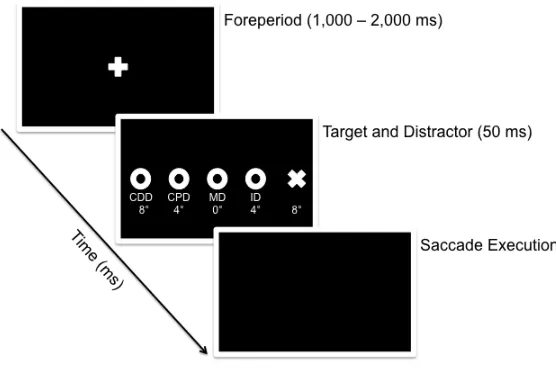
distractor: CDD) (see Figure 2). The different distractor locations were identical to those
employed in Walker et al’s (1997) initial examination of the RDE for prosaccades.
20
instructed to direct their gaze to its location. Once a stable gaze of the fixation cross was
achieved (±1.5° for 420 ms), a randomized foreperiod (1,000 – 2,000 ms) was initiated
during which time the fixation cross remained visible. Following the foreperiod, a target
stimulus (i.e., target-only condition: TO), or target stimulus with distractor (i.e., ID, MD,
CPD, CDD conditions) was presented for 50 ms (see Figure 2 for timeline of visual
events). The onset of the target stimulus served as the cue to pro- or antisaccade “as
quickly and accurately as possible” and to ignore the irrelevant distractor when present.
Notably, prosaccades entailed a response to the target’s veridical location, whereas
21
Figure 2. Timeline of visual events for a target presented in the right visual field. A white
fixation cross was presented for a randomized foreperiod (1,000 – 2,000 ms). Following
the foreperiod, the fixation cross was extinguished and a visual target was presented right
of fixation for 50 ms. For 80% of trials, a visual distractor was presented concurrent with
the target at a proximal (ID), or remote (MD, CPD, CDD) spatial location along the
horizontal target axis. For the remaining trials a target was presented without a distractor
(TO). The onset of the target (and distractor) served as the imperative to complete the
instructed pro- or antisaccade.
Participants completed pro- and antisaccades in separate and randomly ordered
blocks. As noted above, responses were completed in target-only (TO) and four distractor
conditions (ID, MD, CPD, and CDD) that were randomly interleaved within each block.
In addition, the visual field (left, right) associated with the target stimulus was
randomized within each block. For each block, participants completed 12 trials to each of
22
trials).
Data analysis and dependent variables
Displacement data were filtered offline using a dual-pass Butterworth filter
employing a low-pass cut-off frequency of 15 Hz. Filtered displacement data were used
to compute instantaneous velocities via a five-point central finite difference algorithm.
Acceleration data were similarly obtained from the velocity profiles. Saccade onset was
determined on the basis of velocity and acceleration values that exceeded 30°/s and
8,000°/s2, respectively. Saccade offset was marked when velocity fell below 30°/s for 15
consecutive frames (i.e., 42 ms). The dependent variables were reaction time (RT: time
from target onset to movement onset) and saccade amplitude in the horizontal movement
direction. Dependent variables were examined using 2 (task: prosaccade, antisaccade) by
5 (trial-type: TO, ID, MD, CPD, CDD) repeated measures ANOVAs. Post-hoc
decomposition for trial-type were completed by contrasting each distractor condition to
their respective TO condition counterpart via paired samples t-tests. Only directionally
correct pro- and antisaccade trials were analyzed. Accordingly, for each participant an
average of 3% and 10% of pro- and antisaccade trials were excluded, respectively.
Furthermore, for each participant an average of 2% of trials were removed due to: (1)
signal loss (i.e., blinking), (2) a RT greater than two standard deviations above the mean
group performance (i.e., RT > 700 ms), and (3) an anticipatory response (i.e., RT < 85
23
Results
Reaction time
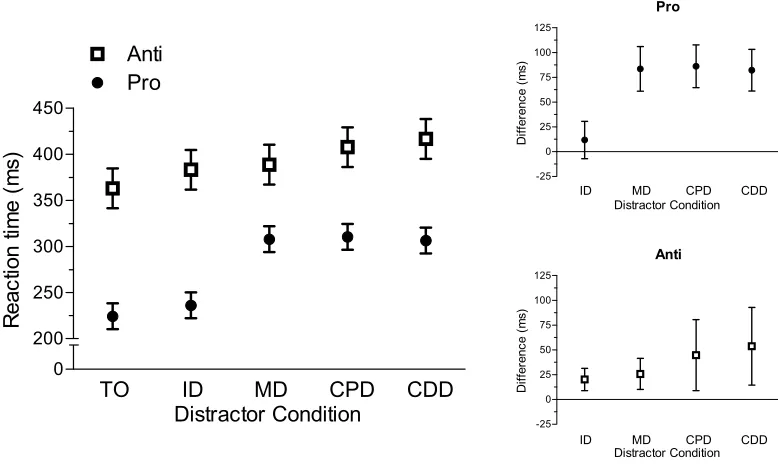
Results yielded main effects of task, F(1,14) = 70.80, p < 0.001, trial-type,
F(4,56) = 25.12, p < 0.001, and their interaction, F(4,56) = 5.64, p < 0.002. As expected,
Figure 3 shows that prosaccades (277 ms, SD = 37) produced shorter RTs than
antisaccades (391 ms, SD = 72). Moreover, Figure 3 shows that RTs for prosaccades in
the remote distractor conditions (i.e., MD, CPD, CDD) were longer than their TO
condition counterpart, ts(14) > 7.97, ps < 0.001, whereas the ID and TO conditions did
not reliably differ, t(14) = 1.35, p = 0.20. For antisaccades, ID, MD, CPD, and CDD
conditions produced longer RTs than the TO condition, ts(14) > 2.68, ps < 0.02. Thus,
prosaccade elicited a RDE, whereas antisaccade RTs were increased independent of the
distractor’s spatial location.
To determine if distractor location differentially influenced the magnitude of the
above-mentioned RT costs, I computed difference scores (i.e., distractor RT minus
target-only RT) for those conditions that reliably differed from the TO condition. As such, for
prosaccades I computed difference scores for MD, CPD, and CDD conditions, whereas
for antisaccades I computed difference scores for each distractor condition (i.e., ID, MD,
CPD, and CDD). Pro- and antisaccade difference scores were submitted to separate
one-way ANOVAs. Results for prosaccades indicated that the magnitude of the distractor cost
did not reliably differ across conditions (MD: 84 ms, SD = 40; CPD: 86 ms, SD = 39; and
CDD: 82 ms, SD = 38), F(2,28) = 0.25, p = 0.78. Similarly, the magnitude of the
24
MD: 25 ms; SD = 28; CPD: 45 ms; SD = 64; and CDD: 54 ms; SD = 70), F(3,42) = 2.22,
p = 0.10 (see Figure 3).
Figure 3. The main panel depicts mean reaction time (ms) for pro (i.e., closed circles)-
and antisaccades (i.e., open squares) in target-only (TO), proximal distractor (ID), and
remote distractor (MD, CPD, CDD) conditions. Error bars for this panel represent
within-participant 95% confidence intervals (Loftus and Masson, 1994). Confidence intervals
were computed based on the mean-squared error term for trial-type separately for pro-
and antisaccades. The top-right and bottom-right offset panels show mean distractor RT
difference scores for pro- and antisaccades, respectively. Error bars represent
between-participant 95% confidence intervals (Cumming, 2011; 2013). The absence of overlap
between error bars and zero (i.e., horizontal axis) provides a graphical depiction of a
25
Saccade Amplitude
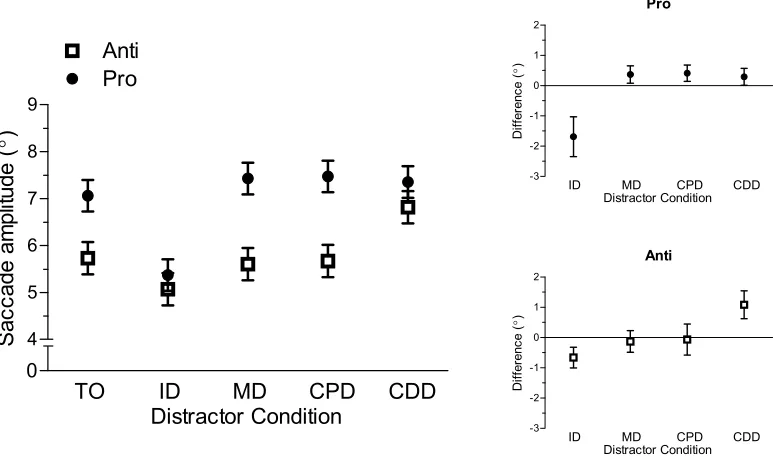
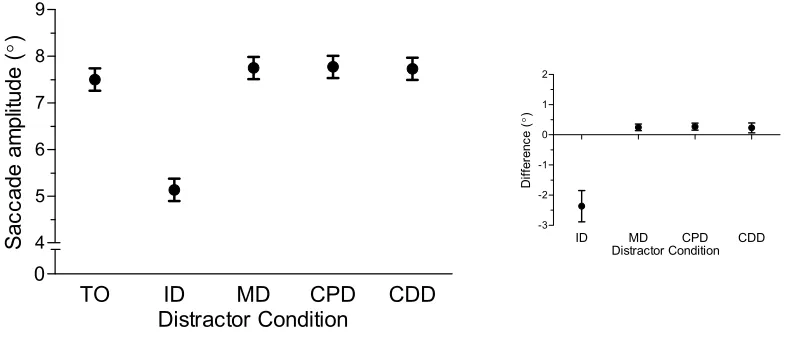
Saccade amplitude data yielded main effects of task, F(1,14) = 18.01, p < 0.002,
trial-type, F(4,56) = 38.32, p < 0.001, and their interaction, F(4,56) = 9.82, p < 0.001. As
shown in Figure 4, prosaccade amplitudes (6.9°, SD = 0.9) were longer than antisaccades
(5.8°, SD = 1.5) across each trial-type. As well, prosaccade amplitudes in the ID
condition were less than the TO condition, t(14) = 5.51, p < 0.001, whereas MD, CPD,
and CDD conditions were greater than the TO condition, ts(14) > 2.23, ps < 0.05. For
antisaccades, ID and CDD conditions produced amplitudes that were less than and
greater than the TO condition, respectively, ts(14) > 4.14, ps < 0.002. In turn, amplitudes
for MD and CPD conditions did not reliably differ from their TO counterpart, ts(14) =
26
Figure 4. The main panel depicts mean saccade amplitude (°) in the horizontal direction
for pro (i.e., closed circles)- and antisaccades (i.e., open squares) completed in target-only
(TO), proximal distractor (ID), and remote distractor (MD, CPD, CDD) conditions. Error
bars for this panel represent within-participant 95% confidence intervals (Loftus and
Masson, 1994). The top-right and bottom-right offset panels show mean distractor
amplitude difference scores for pro- and antisaccades, respectively. Error bars represent
between-participant 95% confidence intervals (Cumming, 2011; 2013).
Discussion
The present study sought to determine whether – and to what degree – the spatial
location of a distractor relative to a visual target differentially influences pro- and
antisaccade planning times. More specifically, I sought to determine whether putative
distractor related costs for antisaccades relate to: (1) a long-range inhibitory pathway in
27
response-selection rules that are independent of the distractor’s spatial location (e.g.,
Kveraga et al., 2002). To that end, participants completed pro- and antisaccades left and
right of a common fixation in a target-only condition (i.e., TO: distractor-free), and
conditions wherein a distractor was presented at a proximal (i.e., ID) or remote (i.e., MD,
CPD, CDD) spatial location.
Prosaccade RTs: A replication of Walker et al. (1997)
The target and distractor conditions employed here were the same as those used
by Walker et al. (1997). Figure 3 shows that remote distractor (i.e., MD, CPD, CDD)
conditions elicited longer prosaccade RTs than the TO condition, whereas the proximal
distractor (i.e., ID) and TO conditions did not reliably differ. Moreover, the average cost
of a remote distractor was 84 ms and the magnitude of this effect did not vary across the
different remote distractor locations. Thus, the results demonstrate a reliable RDE in line
with Walker et al. (1997) and I interpret this result to evince that remote distractors delay
prosaccade planning times via a long-range attenuation of target-related buildup neurons
in the SC (i.e., the CIM).
Prosaccade amplitudes are influenced by proximal and remote distractors
Prosaccades in the ID condition landed between the target and distractor. This
result reported previously by Walker et al. (1997) and others (Coren and Hoenig, 1972;
Deubel et al., 1984; 1988; Findlay, 1982; Ottes et al., 1985) has been interpreted to reflect
that the motor representation of target and distractor locations on a common short-range
motor map within the intermediate layers of the SC results in the spatial averaging of
motor-related saccade activity (i.e., the global effect). Notably, however, I also observed
28
counterpart. This finding counters Walker et al. who reported a null amplitude effect of
remote distractors. One possible explanation for the between-experiment discrepancy is
that the current study employed a brief (50 ms) target presentation, whereas the target
(and distractor) used in Walker et al’s study was available throughout response execution.
As such, the continuous target (and distractor) vision associated with Walker et al. may
have served to support on- or offline corrections to the primary saccade trajectory
(Gaveau et al., 2003; Heath et al., 2011; West et al., 2009). To address this issue, I
completed a supplemental experiment involving 10 participants (7 female and 3 male:
age range 18 – 30 years) and used the same procedures as the main experiment with the
only difference being that the target (and distractor) was available throughout response
execution. In other words, the supplemental experiment provided the same online target
(and distractor) vision as employed by Walker et al. The results for the supplemental
experiment are presented in Figure 5 and provide a direct replication of the main
experiment – amplitudes for the ID condition landed between the target and distractor
(t(9) = 10.32, p < 0.001), whereas amplitudes for the remote distractor conditions (MD,
CPD, and CDD) were longer than the TO condition (ts(9) > 3.17, ps < 0.002). Thus, the
presence of target and distractor vision throughout response execution does not account
for the discrepancy between the current results and Walker et al. As an alternative
account, I note that Walker et al. employed six participants, whereas the main and
supplemental experiments used here employed 15 and 10 participants, respectively. It is
therefore possible that the detection of remote distractor effects may relate to statistical
power. In addressing this issue I created 20 unique and pseudo-randomly sampled data
29
contrasted amplitudes for the TO and CDD condition amplitudes via paired-samples
t-tests. Results showed that the probability of statistically equivalent endpoints for CDD
and TO conditions were 100% (20/20) and 60% (12/20) for the main and supplemental
experiments, respectively. Given these findings, I propose that the null remote distractor
effect reported in previous work relates to an exiguous replication sample size.
Figure 5. Data for the supplemental experiment wherein target and distractor were
visible throughout response execution. The main panel depicts mean saccade amplitude
(horizontal °) for prosaccades completed in target-only (TO), proximal distractor (ID),
and remote distractor (MD, CPD, CDD) conditions. Error bars represent
within-participant 95% confidence intervals (Loftus and Masson, 1994). The right panel shows
the mean distractor amplitude difference scores. Error bars represent between-participant
95% confidence intervals (Cumming, 2011; 2013).
In explaining the longer amplitudes in the remote distractor conditions I note that
30
location of a distractor in pursuit of the response goal (Doyle and Walker, 2001; Tipper et
al., 2000; 2001; Walker and McSorley, 2008). In particular, Tipper and colleagues’
population coding model contends that the top-down inhibition of exogenous
distractor-related activity in the saccade map of the SC biases the mean vector of saccade-distractor-related
activity in a direction contralateral to the distractor. Thus, the results may relate to a
spatial bias wherein the programmed amplitude of a prosaccade moves further away from
the location of a remote distractor to avoid capture of task-irrelevant visual information.
Antisaccade RTs: Planning costs are independent of a distractor’s spatial location
Antisaccade RTs in each distractor condition were longer than the TO condition,
and the magnitude of the distractor cost (average of 36 ms) was independent of the
distractor’s spatial location. As such, antisaccades RTs do not elicit a RDE commensurate
with prosaccades. Moreover, results demonstrate that distractor-related saccade activity at
a remote area of the collicular motor map does not selectively inhibit saccade-related
motor activity. Instead, results suggest that distractors influence antisaccade RTs due to
the top-down demands of evoking the response-selection rule necessary for decoupling
SR spatial relations. In accord with this view, previous work has shown that antisaccades
– but not prosaccades – adhere to Hick’s law (Kloft et al., 2012; Kveraga et al., 2002; see
also Lawrence, 2010). According to Kveraga and colleagues, prosaccades violate Hick’s
law because an automatic response-selection process couples the location of a target
stimulus with a motor response. Indeed, the fact that humans complete upwards of
100,000 prosaccades in the course of their daily activities (Irwin and Thomas, 2007)
highlights the fact that the prosaccade response-selection process efficiently attenuates
31
In turn, Kveraga et al. contend that antisaccades adhere to Hick’s law because the
location of a target stimulus cannot be automatically mapped onto the direction of an
ensuing response. Instead, the decoupled SR relations engender a cost related to the
processing of each potential SR alternative. Moreover, electrophysiological evidence
from non-human primates has shown that distinct neural ensembles serve the visual
selection of a target stimulus and the selection of an appropriate antisaccade endpoint.
For example, Sato and Schall (2003) recorded single-cell activity from the frontal eye
fields (FEF) of macaques during the planning of pro- and antisaccades to a target
stimulus presented within an array of three distractors. Results showed that pro- and
antisaccade RT differences were not linked to stimulus identification within the FEF (i.e.,
disentangling target from distractor); rather, the increase in antisaccade RTs was linked to
the onset of FEF activity supporting the selection of the task-rule necessary for
decoupling SR relations. Notably, my work adds to previous literature insomuch as it
demonstrates that the spatial location of a distractor does not differentially influence the
planning time required to adopt an appropriate antisaccade task-rule.
Effects of proximal and remote distractors on antisaccade endpoints
Antisaccade amplitudes in the ID and CDD conditions were less than and greater
than the TO condition, respectively. In turn, antisaccade amplitudes in the MD and CPD
conditions did not reliably differ from the TO condition. In contrast to the present results,
Viswanathan and Barton (2013) reported that antisaccade endpoints in a remote – but not
proximal – distractor condition produced endpoints consistent with a global effect.
Viswanathan and Barton interpreted their results to evince a spatial averaging of
32
map in the intermediate SC. Notably, however, my results do not support a global effect
for remote distractors. Indeed, had the present results demonstrated a global effect then
the CPD condition would have produced shorter amplitudes than the TO condition
because the goal-location of the response is proximal to the distractor’s location (see
Figure 1). To my knowledge, the present work and Viswanathan and Barton’s represents
the only studies to have examined distractor-related influences on antisaccade
amplitudes. As well, I am unable to identify a between-experiment methodological
difference that might explain for the discrepant findings. Moreover, Viswanathan and
Barton did not systematically report distractor-related antisaccade RT costs; and thus, I
am unable to contrast planning and endpoint related differences between experiments.
Taken together then, I propose that a global effect does not represent a reliable property
of antisaccade amplitudes.
In accounting for the finding that ID and CDD conditions produced amplitudes
that were distinct from TO trials I note that antisaccade sensorimotor transformation are
mediated via a relative visual percept (Dafoe et al., 2007; Evodokimidis et al., 2006;
Heath et al., 2001; Krappmann et al., 1998). Moreover, the antisaccade visual percept
has been shown to be governed by a strategy of perceptual averaging such that the visual
properties of a target are encoded relative to the properties of other stimuli (i.e.,
distractors) within a stimulus-set (Gillen and Heath, 2014a; 2014b). Thus, I propose that
antisaccade amplitudes are based on a statistical summary of the visual location of the
target and distractor. Indeed, for the ID condition the proximity between target and
distractor would render a statistical summary and associated visual percept that leads to
33
condition are in opposite visual fields, but have equal eccentricities, a statistical summary
would render a more accurate target percept and therefore serve to reduce hypometria. Of
course, I emphasize that the perceptual averaging proposal is distinct from the global
effect as the former represents a statistical summary of the sensory-related properties
contained within a stimulus-set (Ariely, 2001; Corbett and Oriet, 2011; Gillen and Heath
2014a; 2014b), whereas the latter is attributed to the weighted average of motor-related
activity encoding target and distractor response goals (e.g., Godijn and Theeuwes, 2002).
Conclusions
Antisaccades showed a distractor-related increase in RT that was independent of
the distractor’s spatial location. Such a finding indicates that motor-related activity
associated with the distractor at a remote location from the intended saccade goal does
not selectively attenuate the motor-related properties of buildup neurons serving the
antisaccade response. Instead, I propose that distractor-related antisaccade RT costs
reflect uncertainty associated with the top-down evocation of the task-rule necessary to
34
References
Ariely, D. (2001). Seeing sets: representation by statistical properties. Psychological
Science, 12, 157 – 162.
Brainard, D. H. (1997). The Psychophysics Toolbox. Spatial Vision, 10, 433 – 436.
Casteau, S. and Vitu, F. (2012). On the effect of remote and proximal distractors on
saccadic behavior: A challenge to the neural-field models. Journal of Vision,
12(12):14, 1 – 33.
Corbett, J. E. and Oriet, C. (2011). The whole is indeed more than the sum of its parts:
perceptual averaging in the absence of individual item representation. Acta
Psychologica (Amst), 138, 289 – 301.
Coren, S. and Hoenig, P. (1972). Effect of non-target stimuli upon the length of voluntary
saccades. Perceptual Motor Skills, 34(2), 499 – 508.
Cumming, G. (2011). Understanding the new statistics: Effect sizes, confidence intervals,
and meta-analysis. New York: Routledge.
Cumming, G. (2013). The new statistics: Why and how. Psychological Science, 25(1), 7
– 29.
Dafoe, J. M., Armstrong, I. T., and Munoz, D. P. (2007). The influence of stimulus
direction and eccentricity on pro- and anti-saccades in humans. Experimental
Brain Research, 179, 563 – 570.
Deubel, H., Findlay, J., Jacobs, A., and Brogan, D. (1988). Saccadic eye movements to
targets defined by structure differences. In G. Lüer, U. Lass and J.
Shallo-Hoffmann (Eds.), Eye movement research: Physiological and psychological
35
Deubel, H., Wolf, W., and Hauske, G. (1984). The evaluation of the oculomotor error
signal. In Gale, A. G. and Johnson, F. (Eds.), Theoretical and applied aspects of
eye movement research (pp. 55 – 62). Amsterdam: North Holland.
Dorris, M. C., Oliver, E., and Munoz, D. P. (2007). Competitive integration of visual and
preparatory signals in the superior colliculus during saccadic programming. The
Journal of Neuroscience, 27(19), 5053 – 5062.
Doyle, M. and Walker, R. (2001). Curved saccade trajectories: Voluntary and reflexive
saccades curve away from irrelevant distractors. Experimental Brain Research,
139, 333 – 344.
Evdokimidis, I., Tsekou, H., and Smyrnis, N. (2006). The mirror antisaccade task:
direction-amplitude interaction and spatial accuracy characteristics. Experimental
Brain Research, 174, 304 – 311.
Findlay, J. M. (1982). Global visual processing for saccadic eye movements. Vision
Research, 22, 1033 – 1045.
Fischer, B. and Weber, H. (1992). Characteristics of “anti” saccades in man.
Experimental Brain Research, 89, 415 – 424.
Gaveau, V., Martin, O., Prablanc, C., Pelisson, D., Urquizar, C., and Desmurget, M.
(2003). On-line modification of saccadic eye movements by retinal signals.
Neuroreport, 14(6), 875 – 878.
Godijn, R. and Theeuwes, J. (2002). Programming of endogenous and exogenous
saccades: Evidence for a competitive integration model. Journal of Experimental
36
Gillen, C. and Heath, M. (2014a). Asymmetrical weighting of target eccentricities within
a trial block influences antisaccade endpoint bias. Poster presented at the meeting
of the Vision Sciences Society, St. Pete Beach, FL.
Gillen, C. and Heath, M. (2014b). Perceptual averaging governs antisaccade endpoint
bias. Experimental Brain Research, in press.
Hallett, P. E. (1978). Primary and secondary saccades to goals defined by instructions.
Vision Research, 18, 1279 – 1296.
Hallett, P. E. and Adams, B. D. (1980). The predictability of saccadic latency in a novel
voluntary oculomotor task. Vision Research, 20, 329 – 339.
Heath, M., Weiler, J., Marriott, K., and Welsh, T. (2011). Vector inversion diminishes the
online control of antisaccades. Experimental Brain Research, 209, 117 – 127.
Hick, W. E. (1952). On the rate of gain of information. Quarterly Journal of
Experimental Psychology, 4:1, 11 – 26.
Irwin, D. E. and Thomas, L. E. (2007). The effect of saccades on number processing.
Perception & Psychophysics, 69(3), 450 – 458.
Kloft, L., Reuter, B., Viswanathan, J., Kathmann, N., and Barton, J. J. S. (2012).
Response selection in prosaccades, antisaccades, and other volitional saccades.
Experimental Brain Research, 222, 245 – 353.
Krappmann, P., Everling, S., and Flohr, H. (1998). Accuracy of visually and
memory-guided antisaccades in man, Vision Research, 38(19) 2979 – 2985.
Kveraga, K., Boucher, L., and Hughes, H. C. (2002). Saccades operate in violation of
37
Lawrence, B. M. (2010). An anti-Hick’s effect for exogenous, but not endogenous,
saccadic eye movements. Experimental Brain Research, 204, 115 – 188.
Lévy-Schoen, A. (1969). Détermination et latence de la réponse oculomotrice à deux
stimulus simultanés ou successifs selon leur excentricité relative. L’Année
Psychologique, 69(2), 373 – 392.
Loftus, G. R. and Masson, M. E. (1994). Using confidence intervals in within-subjects
designs. Psychonomic Bulletin and Review, 1, 476 – 490.
Munoz, D. P. and Everling, S. (2004). Look away: The anti-saccade task and the
voluntary control of eye movement. Nature Reviews Neuroscience, 5, 218 – 228.
Ottes, F. P., Van Gisbergen, J. A. M., and Eggermont, J. J. (1985). Latency dependence
of colour-based target vs nontarget discrimination by the saccadic system. Vision
Research, 25(6), 849 – 862.
Pashler, H. E. (1998). The psychology of attention. Cambridge, MA: MIT Press.
Sato, T. S. and Schall, J. D. (2003). Effects of stimulus-response compatibility on neural
selection in frontal eye field. Neuron, 38, 637 – 648.
Takahashi, M., Sugiuchi, Y., Izawa, Y., and Shinoda, Y. (2005). Commissural excitation
and inhibition by the superior colliculus in tectoreticular neurons projecting to
omnipause neuron and inhibitory burst neuron regions. Journal of
Neurophysiology, 94(3), 1707 – 1726.
Teichner, W. H. and Krebs, M. J. (1974). Laws of visual choice reaction time.
38
Tipper, S. P., Howard, L. A., and Houghton, G. (2000). Action-based mechanisms of
attention. Philosophical Transactions of the Royal Society of London, 353, 1385 –
1393.
Tipper, S. P., Howard, L. A., and Paul, M. A. (2001). Reaching affects saccade
trajectories. Experimental Brain Research, 136, 241 – 249.
Trappenberg, T. P., Dorris, M. C., Munoz, D. P., and Klein, R. M. (2001). A model of
saccade initiation based on the competitive integration of exogenous and
endogenous signals in the superior colliculus. Journal of Cognitive Neuroscience,
13(2), 256 – 271.
Van der Stigchel, S. and Nijboer, T. C. W. (2011). The global effect: what determines
where the eyes land? Journal of Eye Movement Research, 4(2):3, 1 – 13.
Van Gisbergen, J. A. M., Van Opstal, A. J., and Tax, A. A. M. (1987). Collicular
ensemble coding of saccades based on vector summation. Neuroscience, 21(2)
541 – 555.
Van Opstal, A. J. and Van Gisbergen, J. A. (1989). A nonlinear model for collicular
spatial interactions underlying the metrical properties of electrically elicited
saccades. Biological Cybernetics, 60(3), 171 – 183.
Viswanathan, J. and Barton, J. J. S. (2013). The global effect for antisaccades.
Experimental Brain Research, 225, 247 – 259.
Walker, R., Deubel, H., Schneider, W. X., and Findlay, J. M. (1997). Effect of remote
distractors on saccade programming: Evidence for an extended fixation zone.
39
Walker, R. and McSorley, E. (2008). The influence of distractors on saccade-target
selection: Saccade trajectory effects. Journal of Eye Movement Research, 2(3):7,
1 – 13.
West, G. L., Welsh, T. N., and Pratt, J. (2009). Saccadic trajectories receive online
correction: Evidence for a feedback-based system of oculomotor control. Journal
of Motor Behavior, 41(2), 117 – 127.
Wurtz, R. H. and Albano, J. E. (1980). Visual-motor function of primate superior
40
CHAPTER THREE
41
The primary objective of my master’s research program was to determine whether
distractor-related antisaccade RT costs relate to: (1) a long-range inhibitory pathway in
the SC (i.e., the RDE; e.g., Godijn and Theeuwes, 2002; Trappenberg et al., 2001), or (2)
a top-down evocation of response-selection rules that is independent of the distractor’s
spatial location (e.g., Kveraga et al., 2002). To accomplish my objective, Chapter Two
employed the same general stimulus paradigm as Walker et al. (1997) wherein
participants completed pro- and antisaccades in a condition that entailed the presentation
of a single and briefly (i.e., 50 ms) presented target stimulus (i.e., TO), as well as
conditions wherein a target was concurrently presented with a distractor at a proximal
(i.e., ID) or remote (i.e., MD, CPD, CDD) spatial location along the horizontal target
axis. Importantly, in synthesizing the present results it is important to recall that the
sensory- and motor-related properties of a target in an antisaccade task are dissociable,
whereas the properties overlap in a prosaccade task. In particular, the top panel of Figure
1 provides an example of a proximal distractor condition. In this condition, the
sensory-related position of target and distractor are proximal (i.e., presented in the same visual);
however, for an antisaccade task the motor-related activity of the response is remote to
the distractor’s spatial location. In turn, the bottom panel of Figure 1 shows that for a
remote distractor the motor-related activity associated with the antisaccade task is
proximal to the distractor’s spatial location. Thus, antisaccades entail dissociable sensory-
and motor-related target activity.
Chapter Two showed that prosaccade RTs were increased for the remote (i.e.,
MD, CPD, CDD) but not proximal (i.e., ID) distractor conditions (Figure 3). Thus,
42
competitive integration model’s (CIM) assertion of an attenuation of motor-related
buildup neurons in the SC via long-range inhibitory connections. In turn, antisaccade RTs
in each distractor condition (i.e., ID, MD, CPD, CDD) were increased relative the TO
condition and the magnitude of this effect was independent of the distractor’s spatial
location (average RT cost 36 ms; see Figure 3). As such, I propose that the results for
Chapter Two support the position that distractor-related antisaccade RT costs relate to
implementing top-down task-rules associated with selecting a response with decoupled
SR relations.
In light of the findings of Chapter Two, it is important to highlight the extensive
body of work demonstrating that planning efficiency is influenced by the adoption of an
appropriate task-set related to a set of N possible SR alternatives. In particular, Merkel’s
(1885; cited in Keele, 1973; Woodworth, 1938) classic work was the first to show that
choice-RT increases linearly as a function of doubling the number of SR alternatives.
Specifically, Merkel asked subjects to perform a key-press task where the number of SR
alternatives was varied between one and 10 within different sets of trials. Participants
were presented with a set of Arabic (i.e., 1 to 5) and Roman (i.e., I to V) numerals and
were required to press a key with a corresponding finger on the left (i.e., Roman) and
right (i.e., Arabic) hands. For example: the Roman numeral III corresponded to a key
press using the left middle finger, whereas the Arabic numeral 2 corresponded to a key
press using the right ring finger. Moreover, the seminal papers of Hick (1952) and